DEVELOPING CHILDREN’S L2 SKILLS THROUGH READING-ALOUD TO THEM IN L2
A Thesis Presented to
The Faculty of the Department of English Mie University
In Partial Fulfillment
of the Requirements for the Degree Master of Education
by Yuki Ozuka February 22, 2016
Approved by ______Prof._Mitsuaki Hayase_________
Thesis Advisor
Table of Contents
Acknowledgement iii
Introduction 1
Chapter 1. Reading aloud to children in L1 and L2 3
1.1 Reading benefits through reading aloud to children in an L1 3
1.2 Effective points of reading aloud to children in L1 help children with their L2 learning 5
Chapter 2. Reading aloud to children in an L2 can help children with their L2 development 7
2.1 Reading aloud to kindergarteners (The practice in the attached kindergarten) 7 2.2 The experiments (Experiment 1 and Experiment 2) 10
2.2.1 Methods 12
2.2.2 Experiments 13
2.2.3 Results 14
2.2.4 Analysis and Discussions 18
2.3 Reading aloud to older children in an L2 (the second-year students of I. G. Senior High School) 20
2.4 The questionnaire research on Freshman of Faculty of Medicine at M University 21
2.5 Reading Aloud Hypothesis of my own 24
Chapter 3. Some effects of reading aloud picture books to children in an L2 30
3.1 Enhancing children’s abilities to imagine by visual help from the picture books 30
3.2 Emotional Intelligence 31
3.3 Developing comprehension skills through literatures 33
3.4 Motivating children to learn an L2 and read books in an L2 33
3.5 Phonological awareness 34
3.6 The importance of the passive (receptive) area in an L2 for children 35
Conclusion 37
References 41
Appendix 1-A 45
Appendix 1-B 46
Appendix 2 48
Appendix 3 49
Acknowledgements
I would like to express my deepest gratitude toward Prof. Mitsuaki Hayase who has given me precious advice constantly since I started my study at Graduate School of Mie University. His advice has been always useful for my study and the basis of the motivation to learn more about recent academic researches.
I would also like to express my deepest appreciation to Prof. Nobuhiro Miyachi, Prof.
Hideo Nishimura, and Prof. Hiroko Arao of Graduate School of Education, and also Prof. J.
Roberts of Faculty of Education of Mie University, for their great support and advices.
Especially, Prof. Miyachi and Prof. Roberts have kindly guided me to the deepest interest of English and American literatures. I have had opportunities to enhance my reading skills during my two-year studying period in Mie University, thanks to the best professors of literatures.
I would like to thank deeply to Prof. Taryn McLachlan, Dr. A. Oo, Faculty of Medicine, Mie University, and Mr. K. Blay, the attached elementary school of Faculty of Education, Mie University, for their wonderful advices upon research designs for my study.
I would also like to thank Ms. K. Ogihara, the principal of Tatsumizu Elementary School in Tsu City, and teachers of Tatsumizu Elementary School for their warmest support for my study.
Lastly, I would like to thank my husband and daughters for the warmest support all through my studying period in Mie University.
Introduction
Reading is one of the keys to successful learning and literacy development (Krashen, 1993). Therefore, to facilitate this development, parents in Japan and around the world read to their children at a young age. Reading aloud to children also fosters skills that lead to voluntary independent reading, which further literacy skills
Voluntary independent reading is important to succeed in the educational
environment. Parents use reading educational models of their native languages (L1) and second languages (L2) to create an atmosphere conducive to children’s educational success.
This exposure primarily helps the children to acquire the language but it also assists in emotional development and imagination enhancement. In Chapter 1, I will consider some of the reading benefits in an L1 atmosphere, and how reading to children can work in
developing children’s learning process.
Chapter 2 will examine the L2 development through reading to children in the L2. If there are some benefits in reading aloud to children in an L1, there must be similar benefits in the reading aloud to children in an L2. Based on this idea, I consider L2 learning through reading aloud to children in an L2. When children start learning their L2, they naturally use their listening skills as the first stage of learning. As parts of listening practices, listening to stories should have a significant effect on learning, and visual helps of the picture books can make children imagine the story or meanings of the vocabulary, comprehend the contexts, and remember some words. Also, if children have opportunities to listen to authentic literature written in an L2, they surely learn the natural expressions of the L2.
To show these effects, I will introduce the experiments that show some results of benefits through reading-aloud to children in an L2 for their L2 learning, which was
conducted in a public school in Tsu, Japan. Also, in the same chapter, I will introduce some surveys based on the questionnaires towards high school students and university students
about their reading aloud experiences given by their parents or teachers in their childhood.
In Chapter 3, I will show some concrete merits of using picture books in children’s L2 learning. Based on the results of the two experiments, using picture books, reading aloud in an L2 has been proven to have some effective merits on children’s development of learning the L2. There are ability to imagine by visual helps (3.1), emotional intelligence (3.2), development on comprehension skills (3.3), motivations to learn and read in an L2 (3.4), phonological awareness (3.5), and expansion of the receptive area of L2 learning (3.6).
I will conclude that reading-aloud to children in L2 can expand children’s receptive skills for learning L2 which can be acquired through listening to stories and that reading- aloud books to children must be the best way for elementary school students who start learning L2 in Japan.
The translation from the Japanese sources is mine.
Chapter 1 Reading aloud to children in an L1 and in an L2
1.1 Reading benefits through reading aloud to children in an L1
“Reading-aloud” consists of three types of reading; 1) adults read aloud stories to children; 2) children read aloud books themselves in a loud voice; and 3) children read books themselves silently. These three types of reading can be given in an L1 or L2 or other
languages. In this paper, I focus on 1) adults read aloud stories to children in an L1 or an L2, and the term “reading aloud” is used in the 1) concept.
When I think of reading aloud to children, I always have the idea based on my experience parenting my daughters. The main thing that I did to them as a parent was only reading aloud a huge number of picture books. Reading aloud to children made my daughters enjoy the book world and influence them with various fields of interests, which led especially the older daughter to the voluntary reading at a quite early stage of her childhood. She started her voluntary reading at the age of three, and since then she has kept reading in her daily life even in five-minute free time. She became a bookworm. She reads books in a vast range of the fields, including fiction, poetry, and science.
By reading books, children can obtain the input of abundant vocabulary and expressions and learn to use them in their own ways. My older daughter showed it.
According to Nakajima (2013), by the power of words children “understand things properly, think about them, and express them in their own words” (p. 14). Of course, vocabulary acquisition is not the only benefit of reading, and there are other benefits of reading such as building up spelling skills, listening skills, and thinking skills. For anybody, things they can obtain through reading are great treasures in their life.
Then, what is the most prioritizing thing for parents to do for their children? I think it is reading aloud books to children. At home, at school, and in the library, we should promote
the reading aloud activities, and guide children to become ‘children who read books’. In this way, we can expand children’s width of the range of vocabulary and their expressions. Saito (2002) says, “To know as many words as possible, reading is the best way. To the question why it is good to read books, the answer ‘because we can acquire a number of words’ seems too simple, but is a proper answer.”(p.67)
Murakami (1999) shows the following important points of reading effects (pp. 176- 180);
1. Children can obtain abundant vocabulary, and use it in a proper way.
2. Children can enhance their listening skills.
3. Children can concentrate during working on the activities.
4. Children can acquire the thinking skills.
Elley’s studies (1989) also support vocabulary acquisition from listening to stories.
Elley performed two experiments related to young students’ vocabulary acquisition from listening to stories, and obtained the results that showed “oral story reading constitutes a significant source of vocabulary acquisition, whether or not the reading is accompanied by teacher explanation of word meanings” (p.175). Also Elley showed that children can acquire much more than they do if there are any teacher’s explanations during the reading. Vivas (1996) mentions, “If story reading stimulates more verbal interaction between parent and child and, in turn, the amount of speech addressed to the child is a variable that predicts the child’s language development, story reading should be an ideal vehicle for language
enhancement.” (p. 190)
In this way, by reading aloud books to children, children can develop their learning skills. Krashen (1993), “Reading is the only way, the only way we become good readers,
develop a good writing style, an adequate vocabulary, advanced grammar, and the only way we become good spellers.” (p.37)
1.2 Effective points of reading aloud to children in an L1 help children with their L2 learning
If there are some interactive effects of reading aloud activities in both an L1 and an L2, such as development of listening skills, emotional development, or literacy development, there must be some effective influences upon children’s L2 learning by L1 reading-aloud to children. Ghosn (2002) mentions that children need to build thinking skills for L2 academic literacy through authentic children’s literature that also motivates language learning (p. 172).
Reading aloud books to children in their L1 can promote their motivation to try to read on their own. Children having experience of stories being read aloud by adults in their L1 read more than children without such experiences (National Institution For Youth Education, 2013, pp. 4-8). Therefore, I consider that children’s experience of listening to stories read aloud by adults in an L1 is one of the important basic points for their L2 learning.
Children who have been read aloud stories by adults have opportunities for book world; that is the ‘letters and sentences’ world, at an early age. If children once learn to read on their own, they will get easily accustomed to exploring their own book world. Even languages vary; ‘reading’ is the same. Children might be fond of reading even in foreign languages if they like ‘reading’. That stays at the basis of my hypothesis (See 2.5); also, children’s experience of reading may work effectively in learning of another language. They can concentrate, understand well, learn fast, and remember longer. Therefore, I believe that reading aloud in an L1 can promote children’s L2 learning. Unfortunately, when I conducted the questionnaire research on the students from Faculty of Medicine of M University, the results showed the otherwise. (Refer to 2.4)
Nakajima (2001) conducted the research on some Canadian immigrant children for investigating which age group shows the most effective L2 learning, in four age groups; 1) age under 3; 2) age 3-6; 3) age 7-9; and 4) age 10-12. The results showed that age 7-9 group was the best learners of L2 among the four groups, and age 10-12 learned L2 effectively.
Butler (2015) concludes that children’s L1 literacy to read and write plays an important role for their L2 learning from Nakajima’s study. Thinking of the strategies that children learn their L2, Pinter (2006) points out, “they (children) are likely to use strategies that worked in their first language reading, such as spelling, trying to sound things out, comparing sounds and letters.”(p. 68). Considering these points, it can be said that L1 literacy including reading skills influences children’s L2 learning.
Chapter 2 Reading aloud to children in L2 can help children with their L2 development
2.1 Reading aloud to kindergarteners (The practices in the Attached Kindergarten) The purpose of the practices at the Attached Kindergarten of Faculty of Education of M University was to investigate the effects of reading aloud picture books to kindergarteners in English (their L2). With this purpose, I conducted the reading aloud sessions. There were two classes in the Attached Kindergarten, and the children were 5-6 years old. Before I started reading aloud books to them, I had helped out their English teacher (ALT) twice in his English classes, and the children already knew me.
Here are the notes of the contents of the four times practices.
Date/ Book Title Contents of the practices 1 October, 30, 2014
Five Ugly Monster
It was the first time for me to read a picture book in English to children in the kindergarten; however, the ALT had read English books to them for a few times before. Therefore, most of the children were listening to the story in a good manner when I read to them. It was the day before Halloween, so I chose a monster book with familiar chants. I began with some flashcards related to Halloween such as spider, ghost, witch, etc…. before I read the book. I read Five Ugly Monsters rhythmically, so most of the children were paying attention fully to every page of the book. It was successful to introduce reading aloud in English to the children.
2 November, 27, 2014 How many bugs in a book?
The second session of reading picture books in English was conducted in November, I chose a non-seasonal book related to numbers and shapes. This book was given to me by my mother
who travelled in Boston twenty five years ago and bought it there.
The book was illustrated colorfully in a pop-up style. Before I started reading, I made the children show me their hands and clap them ten times over their heads to make them move their bodies in order to bring their attention to me. The numbers, one to ten, were used in order in the book with a different shaped box on each page. On each page, I firstly made the children guess how many bugs there were in the box. I started reading the book in a proper order from one, but after I read two pages, I intentionally skip some pages to make the children tricked. Of course, most of the children yelled, “Three!” on the third time, but it was actually the seventh page so they wondered and had fun in guessing what number would come next. I randomly read back and forth so the children were kept excited and shouted out in the end. Most of the children said used numbers, shapes, and color of the boxes in English so it was a great success in bringing them into English book world.
3 January, 15, 2015 Can I play too?
It was raining heavily in the morning, so I chose the book Can I play too? for the third reading. I intended to make the children feel fun in the classroom even on a rainy day outside. Firstly, I started to ask them what they did during the winter vacation.
They replied that they went to the movies, went to their
grandma’s house, played soccer, etc… Secondly, I showed them a picture of ‘play catch’ and asked them how to play catch. This time I used some Japanese to talk to them because the third book
was longer than the previous two books and I needed to let the children know about the topic. Finally, I started reading the book.
The book was in a comic-book style which mostly consisted of spoken lines. It was accepted by one of the classes and the children had fun laughing and smiling almost all the time,
especially when they found the snake played catch by playing his role as a ball. One of the children said, “The book time ends too fast.” That seemed to be evidence that the children had come to like listening to English books. On the other hand, the children of the other class did not seem to have much fun with the book. One reason of that they did not have fun seemed that the context was something sad, as if the elephant and the pig were bullying the snake treating him as a tool. The content was sensitive for some children.
4 2015, March, 3 An Apple Tree
This book gives the idea of the cycle of a plants’ life, describing how an apple tree grows. The pictures are made with hand-made sewing with vivid color that helps to attract the children and make the children focused on pages. The sentences are short and there are only two or three lines per page. Each page has colorful pictures with some insects or flowers from the natural
environment. The kindergarten children found the insects or flowers that they had already known the names and try to say the words in English. I intentionally asked the children the names, colors, shapes of the pictures and the children were willing to answer in English. It was an interaction between the reader and
the listeners, and the interaction was important for the children to learn some words, remember the sounds, and recall their
imagination at this moment. First of all, I did some exercises with the children to show them the word ‘grow’. This was intended to make the children understand the word ‘grow’ in English by moving their bodies to feel the way plants grow. That helped the children understand the meaning of the word. After reading aloud this book to the children, I once again made them do exercises to review the meaning of the word ‘grow’.
After the four sessions of reading aloud picture books to kindergarteners, I totally agree with what Oueini, Bahous & Nabhani (2008) mention in their study: “Students engaged in talk during the read-aloud sessions and employed meaningful sentences in their second language. Such significant interactions lead children to develop reading strategies and construct meaning through analysis and synthesis which are the necessary tools for reading comprehension.” (pp. 150-151). Also, Pinter (2006) suggests that interactional modifications of language when reading picture books to children in an L2 can be a rich source of language learning (pp. 48-49). Through my own practices as well, I recognized that interactions using stories, letters, pictures, and information from picture books were useful to teach L2 to younger children such as kindergarteners and primary school children.
2-2 The experiments (Experiment 1 and Experiment 2) The general outline of the two experiments:
I hypothesized that children who have little L2 learning background can acquire vocabulary (Experiment 1 in September, 2015) and phonological awareness (Experiment 2 in
November, 2015) through the reading aloud activities in an L2. Experiment 1 was aimed to know students’ vocabulary acquisition through listening to stories of picture books.
Experiment 2 was aimed to see how much effects the reading aloud books has to contribute to children’s phonological awareness. There are elements included in picture books such as visual helps, repetition, rhythm, tempos, which can affect children to have fun in learning the second language. By the elements of the effects of picture books, children listen to the same story (the same picture book is read for three times in Experiment 1), and are able to obtain the meanings of some vocabulary, and they listen to various stories for three months
(Experiment 2) and they are able to obtain the phonological awareness. Using picture books has an effect that makes the meaning of words clear by movements or pictures (Tamai, 2010), and that will help to children to comprehend the meaning of certain English words without explaining in Japanese.
In these experiments for the Grade 3 and 4 students, the reader, that is I, did not explain any word in Japanese. The reader only used English for the reading sessions. In the Grade 4 class, the homeroom teacher had started phonics to children since April 2015, so the G4 students seemed to have already had some phonological awareness. For all the students in G3 and G4, thirteen G3 students and twelve G4 students, the picture book that I used for Experiment 1 was the first time to see and listen to for them. I used the book entitled From Head to Toe by Eric Carl, because the book seemed to have the visual effects, repetition, rhythm, and tempos in a well-balanced manner. This picture book has colorful pictures of animals and their movements, and the patterns of “Can you do it?” and “I can do it!” on every page. The G3 students were more active as a whole than the G4 students who were mostly calm.
The examinees: G3 (1 class, 13 students) and G4 (1 class, 12 students) at T Elementary School in Tsu City, Japan
The period of the experiments:
Experiment 1: September 2nd to September 17th, and November 4th and 5th, 2015 Experiment 2: September to November 2015 (for 3 months)
Numbers of books to be used (See Appendix 1-A):
Experiment 1: the single book; From Head to Toe (Eric Carl), and 16 other books Experiment 2: 21 books including From Head to Toe (Eric Carl) and Hop on Pop (Dr.
Seuss)
2.2.1 Methods:
Experiment 1: Reading aloud the same picture book once a week for each class, for three weeks continuously, in the morning free-reading time of 15 minutes. In the first session before starting the reading, the examinees took the pre-test that contained 10 questions (Q11 to Q20) of vocabulary (See Appendix 1-B). The test words for Experiment 1 were chosen from the same book used for the sessions. The first post-test for Experiment 1 was conducted in the third week of the reading sessions (September 15th and 17th, 2015) just after the third reading. The second post-test was conducted after two months from the first post-test
(November 4th and 5th, 2015), and during the period between the first post-test and the second post-test, there was no reading of the book From Head to Toe. The contents of the first and second post-tests were exactly the same as the pre-test. Experiment 1 was designed based on Elley’s experiments (Elley, 1989).
Experiment 2: Reading aloud various picture books once a week for each class, for three months continuously, in the morning free-reading time of 15 minutes. On the first time of the reading-aloud session before starting the first reading, the examinees took the pre-test that contained 10 questions (Q1 to Q10) of phonics to see their phonological awareness (See Appendix 1-B). The test words for Experiment 2 were chosen based on the study by Tamai
(Tamai, 2010), from the well-known book for the phonics acquisition entitled, Hop on Pop by Dr. Seuss. The post-test for Experiment 2 was conducted after three months from the first reading session. During the period between the pre-test and the post-test, there was one-time reading (Hop On Pop) each month. The contents of the post-test were exactly the same as the pre-test. The test phonics words for Experiment 2 were chosen from the book Hop on Pop.
2.2.2 Experiments
Experiment 1: Children’s word acquisition through reading-aloud to children (T Elementary School)
The test was aimed to scale the level of vocabulary acquisition from the target book without any explanation in Japanese. The ten chosen words were the following:(Question numbers: 11. toe, 12. shoulder, 13. wiggle, 14. giraffe, 15. raise, 16. wave, 17. clap, 18.
thump, 19. arch, 20. bend
)
and they were all verbs and nouns. The target book contained only the names of animals and some movements; there were not adjectives for certain animals.Experiment 2: Children’s phonological awareness through reading-aloud to children (T Elementary)
The aim of Experiment 2 was to investigate whether constant reading-aloud sessions of picture books to children in an L2 can enhance their L2 phonological awareness or not.
Therefore, I read various kinds of picture books to children in an L2 and never used students’
L1 to translate or explain the contents and words in the picture books. The books were chosen based on the level and characters of the target children and atmosphere of the classroom, so that the target children could enjoy the story time. The list of picture books used for this experiment is available in the end of this paper (Appendix 2).
2.2.3 Results Experiment 1:
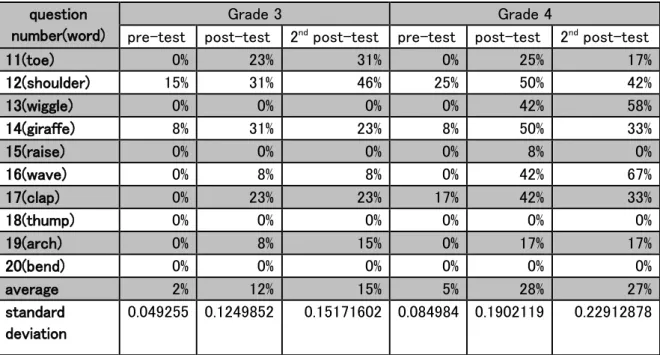
For the pre-test, both G3 and G4 students marked low. In the result of the first post- test, the correct answer percentage was higher than that of the pre-test for both graders; the highest was 50 % on the two words (N. 12. shoulder and N. 14. giraffe) (See Table 1). The average correct answer percentage among the ten words was raised from 2% (pre-test) to 12 % (the first post-test) for Grade 3 students, and 5% (pre-test) to 28% (the first post-test) for Grade 4 students. On the second post-test, the average of accuracy rate stayed in similar positions of the post-test both for Grade 3 and 4 students, and Grade 3 students remembered some of the ten words even longer (See Figure 1 and Figure 2). The average accuracy rates on the second post-test were 15% for G3 students and 27% for G4 students (See Table 2).
Table 1 Variation of the accuracy rate of the vocabulary tests (on each word) question
number(word)
Grade 3 Grade 4
pre-test post-test 2nd post-test pre-test post-test 2nd post-test
11(toe) 0% 23% 31% 0% 25% 17%
12(shoulder) 15% 31% 46% 25% 50% 42%
13(wiggle) 0% 0% 0% 0% 42% 58%
14(giraffe) 8% 31% 23% 8% 50% 33%
15(raise) 0% 0% 0% 0% 8% 0%
16(wave) 0% 8% 8% 0% 42% 67%
17(clap) 0% 23% 23% 17% 42% 33%
18(thump) 0% 0% 0% 0% 0% 0%
19(arch) 0% 8% 15% 0% 17% 17%
20(bend) 0% 0% 0% 0% 0% 0%
average 2% 12% 15% 5% 28% 27%
standard deviation
0.049255 0.1249852 0.15171602 0.084984 0.1902119 0.22912878
Table 2 Average of accuracy rate (%) of the vocabulary tests (in sum total) n A(pre-test) B(1st post-test) C(2nd post-test)
Grade 3 13 2 12 15
Grade 4 12 5 28 27
Figure1. Variation of accuracy rates on Figure 2. Variation of accuracy rates on vocabulary tests for Grade 3. vocabulary tests for Grade 4.
The contents of “incorrect” answers were divided into two parts: “I have never heard of it”
(red parts in Figure 3 and 4) and “I have heard of it” (blue parts in Figure 3 and 4). The results from the pre-test showed that more students answered “I have never heard of it” than
“I have heard of it” for both G3 and G4 students. That indicated children’s L2 knowledge before starting reading aloud sessions. The percentage of “I have heard of it.” on the first post-test increased in a great deal after three-times of reading aloud sessions, compared to the pre-test. Both G3 and G4 students answered “I have never heard of it.” much less. On the second post-test, the range of the “I have heard of it.” of G4 students remained large (See Figures 3 and 4).
Enlarging the receptive vocabulary area can be an effective threshold for learning languages and can make children obtain the skills of tolerance in learning their L2. I will discuss more about it in 3.6.
11 12 13 14 15 16 17 18 19 20 11 12 13 14 15 16 17 18 19 20
Figure 3. Two receptive areas from the Figure 4. Two receptive areas from the incorrect answers on the three tests for G3. incorrect answers on the three tests for G4.
Experiment 2:
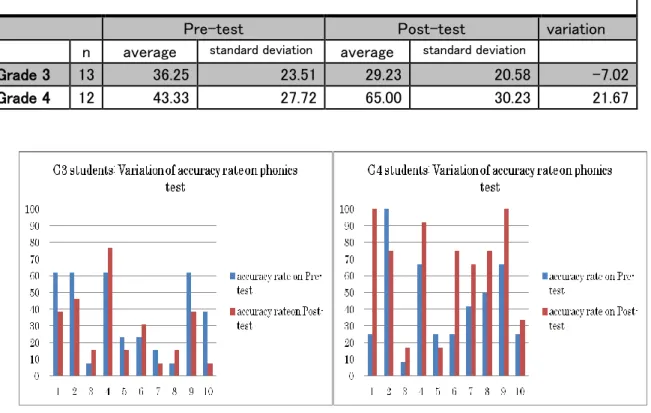
See Table 3, Figure 5, and Figure 6. The variation between the pre-test and the post- test on the phonics tests showed negative effect on G3 students (the average accuracy rate fell
11 12 13 14 15 16 17 18 19 20 11 12 13 14 15 16 17 18 19 20
11 12 13 14 15 16 17 18 19 20 11 12 13 14 15 16 17 18 19 20
11 12 13 14 15 16 17 18 19 20
11 12 13 14 15 16 17 18 19 20
down from 36.25% to 29.23%) while a development on G4 students (the average accuracy rate raised 43.33% to 65.00 %), after three-months reading aloud sessions of various picture books including the phonics book (Hop on Pop) to children. The 7.02% down on the average accuracy rate of G3 students seemed to show no effective factor the reading aloud sessions had, but the 21.67% of development on G4 students showed the opposite. There might be some other factors that influenced the results of Experiment 2. The first factor seemed the age of children’s developmental stage; the developmental gap between 9 and 10. G4 students were calmer than G3 students in the target school, and it was not only for this school but this tendency seemed general. According to Okamoto (1985), there seems to be a developmental gap around the age 9 (pp. 148-151), as Piaget mentions that the syncretism called Vebal Syncretism appears only after the age 7-8 (p. 128). The second factor seemed to be laid on the phonics learning experience of G4 students in the first semester in 2015.
Table 3 Average of accuracy rate of phonics test (%)
Pre-test Post-test variation
n average standard deviation average standard deviation
Grade 3 13 36.25 23.51 29.23 20.58 -7.02
Grade 4 12 43.33 27.72 65.00 30.23 21.67
Figure 5. Variation of the average accuracy Figure 6. Variation of the average accuracy rate on phonics tests for G3 students. rate on phonics tests for G4 students.
2.2.4 Analysis and Discussions Experiment 1: vocabulary acquisition
It was confirmed that three-times reading aloud sessions of picture books to children in an L2 was effective on their L2 learning through Experiment 1. I used only the L2 during the three sessions of reading aloud books, including some interactions with students.
According to Yamamoto (2013), the learner’s acquisition rate of the L2 is higher when listening to stories in an L2 fully than when listening to stories in an L2 with the L1 translation (p. 109), therefore, I followed this idea to conduct the experiment. In the first session, the children were listening to the story calmly; however, in the second and third sessions, children became more aggressive and active toward the target book. They moved their bodies to chants in the book, and copied the sounds or expressions on each page, such as
“Can you do it?”- “I can do it!” in a louder voice. When I showed the movements of the animals, some children copied them exactly saying “I can do it!” By moving the body, children seemed to learn the verbs smoothly and the meanings of the verbs remained in children.
One of the most remarkable points in Experiment 1 seemed that children made the range of their receptive area of their second language wider than expected. The receptive area for learning an L2 seems to be limited when children learn their L2 in an EFL environment, like Japan, because teachers tend to limit the range of vocabulary that they believe important and necessary for learners. However, if learners can encounter the
unknown area of the L2 vocabulary and expand it through authentic materials, their L2 will become natural even in EFL environments. To reinforce this important point, I strongly suggest that teachers should use picture books more often when they teach the L2.
Through listening to stories of picture books read aloud by the reader repeatedly, children changed the part “I have never heard of it” into “I have heard of it”, that is what I
recognize the receptive area of the L2. For example, there are some words that learners hardly encounter in the text books at school, such as “wiggle” (Question Number 13) in the tests of Experiment 1. The word ‘wiggle’ looks difficult to imagine when learners encounter it in written form. However, when learners see this word in a picture book and have some opportunity to hear it, it would turn out to be “an easy word” to acquire. Chances to listen to such words in picture books affect children to learn the L2 more effectively and to make it more enjoyable, and also enlarge children’s receptive area of the L2. The reason of using picture books to read aloud to children lies in the advantage of its authenticity. Experiment 1 was evaluated to be a means of confirmation to this point. It will be helpful for the further research related to this experiment that students might answer the questions easier if the answer sheets would have provided them a multiple choice, than writing the meanings of the words.
The second post-test on Experiment 1 showed that children acquired vocabulary through listening to the picture book read aloud and preserved the vocabulary for two months. To support this result, there is a research conducted by Mason (2005) for
investigating whether vocabulary acquisition through listening to stories could last longer than vocabulary acquisition in learners’ own ways of memorizing. The result of this research showed that vocabulary acquisition through listening to stories read aloud lasted longer than vocabulary acquisition in learners’ own ways of memorization (pp. 27-28). Considering this study and my research on Experiment 1, it can be said that vocabulary acquisition through listening stories read aloud is one of the most effective means.
Experiment 2: The phonological awareness
Despite of my prediction of the expected results of Experiment 2, G3 students could not extend their phonological skills after three-months of reading aloud picture books to them.
However, G4 students were able to expand their phonological skills in the same reading
aloud sessions for three months. The reader intentionally introduced the phonics book (Hop on Pop) once a month to let the children aware of L2 phonological patterns or differences of sounds, and the intention was effective on G4 students, but not on G 3 students who willingly repeated the words on the book. The causality of the trial to introduce phonics from picture books seems to depend not only on the characters of children but also on their developmental at the age of 10. G4 students were mostly calm and listened to stories quietly during the reading aloud sessions, and no one wanted to repeat the words on the book unless I asked them some interactions.
2.3 Reading aloud to older children in an L2 (the second-year students of I. G. Senior High School)
Are there any effects of reading aloud picture books to adolescents? Is it too late to read aloud books to learners when they grow old? When someone notices the importance of reading books and reading aloud books to children at a later stage, these questions have often bothered the people who might have regretted what they had done to their children.
Some researchers think that it is not too late to read books to children even after they grow older (Murakami, 1999, Serafini and Giorgis, 2003). Whenever children want us to read aloud books to them, it is the time to read them. For investigating this issue, I had one reading aloud session of an English picture book to high school students in Ise, in their English class.
I brought a picture book entitled, Caps for Sale (Slobodkina, 1968), which was a story of a peddler who could not sell his caps at all. The contents of the story were not hard to
understand despite of the word ‘peddler’, and the students were listening to the story closely and quietly, during the session. At first, the students were chatting loudly and it took more than five minutes to settle them down to their seats; however, once the reading aloud the book started, no one talked. After the reading, I started the workshop related to the contents
of the story (Appendix 2). The students were required to match the pictures and the
paragraphs of the story. At the end of the class, most of the students learned and understood the meaning of the word ‘peddler’ which seemed to be a high level of vocabulary for them.
The word ‘peddler’ is classified as the level 12 (the most difficult, the least frequently used) on Eijiro On the Web (EOW, the online dictionary).
Serafini and Giorgis (2001) show that, “Reading aloud provides students with easy access to new topics and gives them opportunity to discuss their ideas and questions as they discover new information and concepts. Picture books are well suited to content area discussions. These books increase students’ interest in new concepts and encourage them to develop into topics on their own.” (p. 9). Thus, reading aloud books to even older learners of the L2 seemed to be effective not only for learning some vocabulary but for developing learning skills including the enhancement of the listening skills.
2.4 The questionnaire research on Freshman of Faculty of Medicine at M University In Chapter 1, I hypothesized that there must be an effect on children’s L2 learning from children’s experience of listening to stories read aloud in an L1. So in order to investigate this question, I conducted questionnaire research on freshman of Faculty of Medicine of M University. In this research, I asked the students about their experience of being read aloud by adults both in L1 and L2. My prediction was that the students were benefitted from their experience of being read aloud by adults in both languages; however, the results showed that only being read aloud by adults in L2 influenced them on their L2 learning.
The students filled in the questionnaire in rating their own English skills (listening, speaking, reading, and writing) using a multiple choice as follows; 1) Very good at; 2) good at; 3) so-so; 4) not very good at; and 5) poor at. I gave a point on each choice, 1)=4, 2)=3,
3)=2, 2)=1, and 1)=0. (The students who think their skills very good at get 4 points, and those who think them poor at get 0 point.)
51 out of 57 students (89%) answered that they had experience of books read aloud by adults in an L1. 12 out of 57 students (21%) answered that they had experience of books read aloud in an L2. The average points of four skills of English (listening, reading, writing, and speaking) based on the students’ self-evaluation did not show a difference between students with experience of being read aloud by adults in an L1 (the average points of 2.74 out of 4.0) and students without experience of being read aloud by adults in an L1 (the average points of 2.75 out of 4.0) (Table 4). The results insinuate that there are not clear correlation between students’ L2 development and their experience of being read aloud by adults in their L1.
Table 4 The average points of students’ English proficiency on four skills based on their own evaluation (L1)
Proficiency of English 4 skills based on self-evaluation (average)
student number
Listening Speaking Reading Writing average of four skills
all the students 57 2.58 2.58 3.14 2.71 2.75
Students with reading aloud experience in L1
51 2.6 2.6 3.11 2.68 2.74
Students without reading aloud experience in L1
6 2.33 2.33 3.33 3.00 2.75
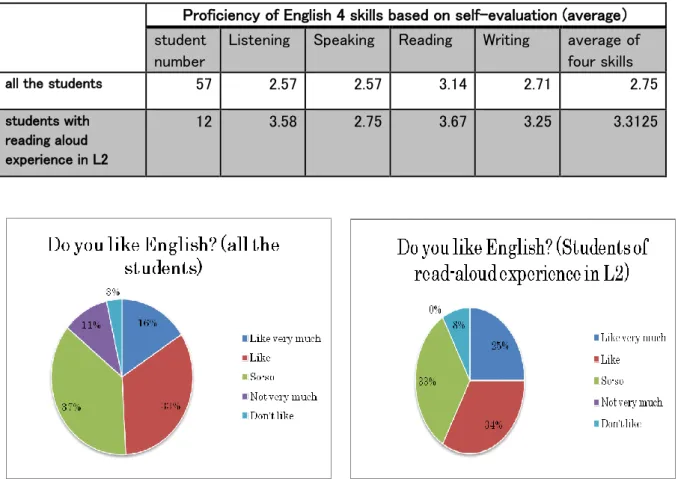
However, the students with experience of being read aloud books by adults in an L2 evaluated their L2 skills higher compared to those without experience of being read aloud books by adults in an L2 (Table 5). The L2 skills on every four category showed higher marks on the students with L2 reading aloud experience (Figure 8). As well as their
evaluation on the skills, almost 60% of the students with experience of being read aloud in L2 answered that they liked English (Figure 7). Also, 7 out of 12 (58%) students with experience of being read aloud books by adults in L2 answered that they have read through some whole books in L2 (Figure 9). From this research, it may be said that the students like English and
gained and maintained motivation to learn the language and read books in an L2, through their precious experience of being read aloud books by adults in an L2.
Table 5 The average points of students’ English proficiency on four skills based on their own evaluation (L2) Proficiency of English 4 skills based on self-evaluation (average)
student number
Listening Speaking Reading Writing average of four skills
all the students 57 2.57 2.57 3.14 2.71 2.75
students with reading aloud experience in L2
12 3.58 2.75 3.67 3.25 3.3125
Figure 7. Do you like English? Comparison between all the students and the students with experience of being read aloud by adults in an L2.
Figure 8. Conparison of the average English proficiency (self-evaluation) between all the students and the students with experience of being read aloud by adults in an L2.
Figure 9. Have you ever read a whole book written in English? In 12 students with experience of being read aloud by adults in an L2.
2.5 Reading-Aloud Hypothesis of my own 2.5.1 L1-L1 Model:
Here I hypothesize about L1 linguistic mastery that reading aloud books to children benefits not only directly but also through their self-independent reading. Because it is already proved that reading benefits children in a number of ways (Krashen, 2008), reading aloud books to children is the first step to benefit them. One of the roles of reading aloud to children is to encourage children to read by themselves (Figure 10).
Step1 Step 2
Figure 10. L1-L1 Model.
Step1:
Reading-aloud in an L1 is naturally beneficial to children in many ways. Krashen (1993) says, “Reading aloud has, apparently, multiple effects on literacy development”, and he continues on its indirect effect that “hearing stories and discussing stories encourages
Self-independent reading in L1
Adults read aloud to children in L1
Reading Benefits
reading, which in turn promotes literacy development” (p. 39). Thus, these benefits are called as ‘Reading Benefits’ in the circles shown in Figures 10-13. Also, some researchers discussed that children who have experience of being read aloud by adults read more by themselves (Lomax, 1976; Neuman, 1986), mentioned Krashen (p. 39). The strongest statement by the publication called Becoming a Nation of Readers (Anderson et al, 1985) that “the single most important activity for building the knowledge required for eventual success in reading is reading aloud to children”(p. 23) seems to prove that read-aloud is the best way to encourage children to read on their own.
Step 2
According to Krashen’s research (1993), “In-school free reading studies and ‘out of school’ self-reported free voluntary reading studies show that more reading results in better reading comprehension, writing style, vocabulary, spelling, and grammatical development” (p. 12). These factors are partly regarded as L1 proficiency. If the evidence is used to prove the L1-L1 model, the fact that read-aloud in an L1 contributes to L1 proficiency through children’s self-independent reading in an L1.
2.5.2 L2-L2 Model:
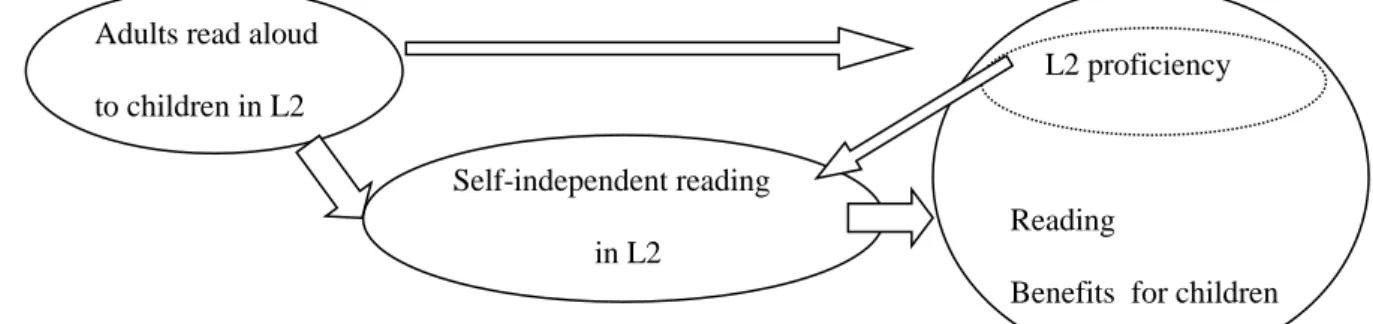
Reading aloud to children in an L2 benefits children with vocabulary acquisition and comprehension. Also reading aloud to children in an L2 will encourage children to read books written in an L2. L2 voluntary reading will lead children’s L2 proficiency (Figure 11).
Figure 11. L2-L2 Model.
Adults read aloud to children in L2
Self-independent reading in L2
Reading
Benefits for children L2 proficiency
Step1: Adults read aloud to children lead to children’s self-independent reading (the indirect effect)
When Oueini and others (2008) surveyed the impact of reading aloud to children in the classroom targeted Arabian kindergarteners learning French as their second language, they found that the reading aloud strategy had a great impact on learners’ vocabulary acquisition and reading comprehension (p. 152). Also children seemed to build up their own strategies to acquire the meaning of new words when they read independently; that meant children tended to read books easier in L2. In Elley’s research (1991), children who participated in his survey and had been flooded with interesting reading materials and read aloud by teachers or tape-recording, gained some good attitudes toward reading and books (p. 408).
Step 2: Reading aloud to children by adults in an L2 leads to children’s L2 proficiency (the direct effect)
By listening to stories read aloud in an L2, children can obtain phonological awareness, chances to see letters, and vocabulary. That can enhance children’s L2 proficiency directly.
Step 3: Self-independent reading to Reading benefits for children
Elley (1991) proved that book-based instruction (mainly reading aloud to children by teachers, but silent self-independent reading included too) not only made children’s reading ability improved but also made other literacy benefits such as writing and
speaking, transfer to other school subjects (p. 408). It may remain whether L2 proficiency should be included in Reading Benefits for children, but if the fact shown in L1-L1 Model is effective, I presume that L2 proficiency could be included as part of Reading Benefits.
2.5.3 L1-L2 Interactional Model:
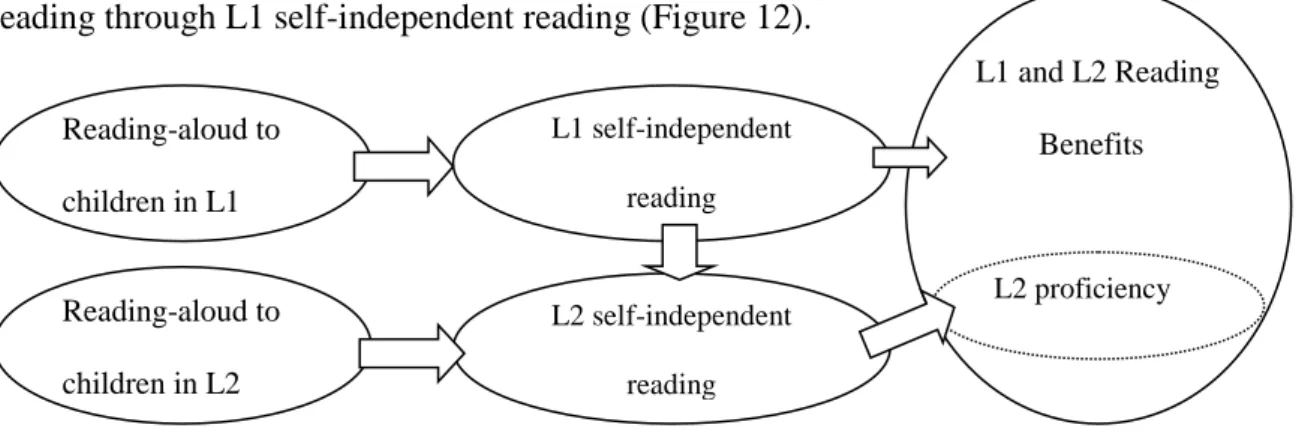
If children’s self-independent reading in an L1 influences their self-independent reading in an L2, children can enhance their L2 proficiency based on L2 self-independent reading through L1 self-independent reading (Figure 12).
Figure 12. L1-L2 Mutual model.
Step 1: Reading aloud to children by adults in an L1 leads to children’s self-independent reading in an L1
It has been already shown in L1-L1 Model.
Step 2: Self-independent reading in an L1 promotes to self-independent reading in an L2 Yamashita (2007) researched on the relationship of reading attitudes between an L1 and an L2 using Japanese university-level EFL students. Japanese students are often seemed to be reluctant to read books in English, so Yamashita’s survey seems to me an interesting one. In this survey, Yamashita concluded that “learners who have a positive attitude toward reading in an L1 are more or less likely to keep it in reading in an L2 even if they are, at a certain point of their development, not very successful L2 readers” (pp. 102-103) It may be true that learners tend to read books voluntarily in L1, and their positive attitude toward books or motivation to read can influence reading in L2.
2.4.4 ‘Reading aloud to children’-‘Self-independent reading’-‘Reading benefits’ Model From the above three hypothesized models, I build up the ‘Reading aloud to
children’-‘Self-independent reading’-‘Reading benefits’ Model (Figure 13). Firstly, starting with reading aloud to children in both an L1 and L2 can lead children to the self-independent
L1 and L2 Reading Benefits Reading-aloud to
children in L1
Reading-aloud to children in L2
L2 proficiency L1 self-independent
reading
L2 self-independent reading
reading. Secondly, reading aloud to children in an L2 can promote children’s L2 proficiency.
These two streams affect children to obtain reading benefits including L2 proficiency in a well-balanced way.
Starting with reading aloud to learners is the most important activity. If learners have already been proficient readers either in L1 or L2, there will be valuable chances for them to acquire higher linguistic proficiency in L2 based on Reading Benefits. If learners are
reluctant to read books in L2, then reading aloud to them both in an L1 and an L2 will be a good means, because reading aloud to them in an L1 may influence learners in motivating self-independent reading in an L1, and reading aloud to them in an L2 of course motivates learners to try to read self-independently in an L2. The more reading aloud to learners helps them, the more learners get motivated to read on their own. Thus, the power of self-
independent reading will enhance learners’ ability to improve their linguistic proficiency in L2.
Reading-aloud Voluntary Reading Reading Benefits
Figure 13. ‘Reading aloud to children’-‘Self-independent reading’-‘Reading Benefits’ Model.
As the Reading aloud hypothesis of my own has been shown in this section, reading aloud to children both in an L1 and an L2 are the first step of reaching to L2 linguistic
L1 self-independent Reading
L2 self-independent Reading
Reading aloud to children in L1
Reading aloud to children in L2
L1 and L2 Reading Benefits
Reading Benefits L2 Proficiency
proficiency. Also, to strengthen the Self-independent Reading both in an L1 and an L2 will be the success in language learning.
Chapter 3 Some effects of reading aloud picture books to children in an L2
In Chapter 1 and Chapter 2, it has been discussed that reading aloud to children both in an L1 and an L2 is the key factor for language learning. In this chapter, I would like to focus on reading aloud picture books to children who learn their L2. Based on my practices, I will discuss some effects of reading aloud picture books to children in terms of the following six points: 1) Enhancing children’s abilities to image by visual helps from picture books, 2) Emotional intelligence, 3) Developing comprehension skills through literatures, 4)
Motivating children to learn L2 and read books in an L2, 5) Phonological awareness, and 6) The importance of the expansion of the receptive area in an L2 for children.
3.1 Enhancing children’s abilities to imagine by visual helps from picture books
When I read picture books to children either in an L1 or L2, I always notice that children focus on pictures when they listen to stories read aloud. The visual help of pictures, sometimes colorful, sometimes monotonous, sometimes dynamic, or sometimes constraint, may stimulate children’s imagination. Information from pictures as well as sounds can help L2 learners to understand the contents and embed what they learn in mind. Ghosn (2002) mentions that, “Aesthetically pleasing illustrations that help to clarify the text; good illustrations provide opportunities for discussions in which the key vocabulary can be exploited” (p. 174). By seeing the pictures on pages, children can guess the meanings of the stories easily, and sometimes children can memorize some vocabulary. In Traverso’s study (2013), she mentions that “high-quality illustrations and pictures that synchronize with the text can both stimulate imagination and support understanding.”(p. 184). Choosing
appropriate literature is one of the factors that the reader need to recognize in order to attract children to stories.
I choose picture books to read aloud to L2 learners based on Matsumoto’s selecting standard; repetition, chosen forms of sentences and vocabulary, compellation to listeners, and rhythm and colorfulness (Matsumoto, 2015). In this way, visual help is one of the most important factors for L2 learners, when they receive reading aloud sessions.
3.2 Emotional intelligence
It has been well known that the emotional intelligence is another part of the multiple intelligences (propounded by Gardener in 1983). Goleman (1995)’s concept of emotional intelligence consists of “abilities such as being able to motivate oneself and persist in the face of frustrations; to control impulse and delay gratification; to regulate one’s moods and keep distress from swamping the ability to think; to empathize and hope.” (p. 36).When children have high emotional intelligence, they can cope with difficult troubles and obtain social communication skills. Thus, to enhance children’s emotional intelligence is one of the highest priorities for child education. It is inescapable for children to cope with some troubles in dealing with others, so the social ability of children must be crucial. “A key social ability is empathy, understanding other’s feelings and taking their perspectives, and respecting differences in how people feel about things” (Goleman, 1995, pp. 308-309). Also, because
“emotional aptitude is a meta-ability, determining how well we (children) can use whatever other skills we (children) have, including raw intellect” (Goleman, 1995, p. 38), children can choose and explore their ways for the future if they can gain or develop their emotional intelligence.
Is it possible to enhance children’s emotional intelligence through picture books?
The answer, I assume, is yes. It has been perceived that the limbic system of the brain relates to human’s emotion, and this idea has been introduced by Paul MacLean (1949) for more than fifty years ago. Recently, it has been scientifically experimented and proved that the
limbic system becomes active in the child’s brain when the child listens to stories read aloud by an adult (Taira, 2009). It means that using picture books in reading aloud to children is useful for enriching children’s emotions, which contributes to enhancing children’s emotional intelligence.
Here is one well known example of a girl who survived from a serious situation from her birth and developed her intelligence through her experience of being read aloud by her mother. Saito (2002) thinks that, “By listening to a number of books, Cushla came to have rich world in her mind. This will be an effective educational method for children with or without disability” (p. 115). The girl named Cushla started her book world by being read aloud picture books by her mother when she was a baby. The books she encountered enhanced her life quality (Butler, 2006).
Another research by Sakai and Kanda (2005), who study about extensive reading of English, introduces some practices of extensive reading classes, including classes of reading aloud picture books to children. One of the examples is of Mr. Chu’s class. In his class, he conducts reading-aloud book sessions and self-independent reading. “In the sessions of reading aloud books to children, children show the strong empathy that only a certain aged children can feel” (p. 147).
When we start activities of reading aloud to children early at home, it is definitely effective to build the bondage between parents and children, as Fox (2008) mentions that “the time spent reading together provides clear evidence to a child of a parent’s love, care, and focused attention” (p. 20). In addition, since literature can nurture emotional intelligence by providing vicarious emotional experiences that may help shape the brain circuits for empathy (Ghosn, 2001), children can develop communication skills towards other children around them and think of others’ feelings in a situation. For children, emotional intelligence can be obtained through the opportunities of literatures read aloud by adults.