九州大学学術情報リポジトリ
Kyushu University Institutional Repository
EVALUATION OF SHEAR STRENGTH CHARACTERISTICS OF UNSATURATED UNDISTURBED VOLCANIC ASH SOIL
SUBJECTED TO STATIC AND CYCLIC LOADING FOR SLOPE STABILITY ANALYSIS
オクリ, アスフィノ, プトラ
http://hdl.handle.net/2324/4110495
出版情報:九州大学, 2020, 博士(工学), 課程博士 バージョン:
権利関係:
EVALUATION OF SHEAR STRENGTH CHARACTERISTICS OF UNSATURATED
UNDISTURBED VOLCANIC ASH SOIL SUBJECTED TO STATIC AND CYCLIC LOADING FOR SLOPE STABILITY ANALYSIS
OKRI ASFINO PUTRA
SEPTEMBER 2020
EVALUATION OF SHEAR STRENGTH CHARACTERISTICS OF UNSATURATED
UNDISTURBED VOLCANIC ASH SOIL SUBJECTED TO STATIC AND CYCLIC LOADING FOR SLOPE STABILITY ANALYSIS
A THESIS SUBMITTED
IN PARTIAL FULFILLMENT OF THE REQUIREMENTS FOR THE DEGREE OF
DOCTOR OF ENGINEERING
BY
OKRI ASFINO PUTRA TO THE
DEPARTMENT OF CIVIL AND STRUCTURAL ENGINEERING GRADUATE SCHOOL OF ENGINEERING
KYUSHU UNIVERSITY FUKUOKA, JAPAN
2020
III
GEOTECHNICAL ENGINEERING LABORATORY
DEPARTMENT OF CIVIL AND STRUCTURAL ENGINEERING GRADUATE SCHOOL OF ENGINEERING
KYUSHU UNIVERSITY FUKUOKA, JAPAN
CERTIFICATE
The undersigned hereby certify that they have read and recommended to the Graduate School of Engineering for the acceptance of this dissertation entitled,
“EVALUATION OF SHEAR STRENGTH CHARACTERISTICS OF UNSATURATED UNDISTURBED VOLCANIC ASH SOIL SUBJECTED TO STATIC AND CYCLIC LOADING FOR SLOPE STABILITY ANALYSIS” by OKRI ASFINO PUTRA in partial fulfillment of the requirements for the degree of DOCTOR OF ENGINEERING.
Dated: July 2020
Supervisor:
Prof. Noriyuki YASUFUKU, Dr. Eng.
Examining Committee:
Prof. Hideki SHIMADA, Dr. Eng.
Assoc. Prof. Kiyonobu KASAMA, Dr. Eng
IV
ACKNOWLEDGMENT
First of all, I am very grateful to Allah the Almighty for His grace I managed to complete my Doctoral degree. During completing the research and Doctoral degree thesis, I have received invaluable help from many people. I would like to reflect on the people who have supported and helped me so much throughout this period.
I would like to express my special appreciation and sincere gratitude to my supervisor Prof. Noriyuki YASUFUKU, for his patience, enthusiasm, motivation, endless encouragement, immense knowledge, and guide throughout my three years of research. I’m so lucky to have a supervisor who is very kind and knowledgeable as he was. He has always been available to advise me even he is busy with daily routine work, make him a great mentor. Thank you for your kindness and for accepting me three years ago to experience your extensive knowledge in Geotechnical Engineering.
Besides my advisor, I would like to express my gratefulness to members of the examining committee, Prof. Hideki SHIMADA, and Assoc. Prof. Kiyonobu KASAMA for their treasured time, attentive evaluation, and valuable comments on my works.
I would also like to address my thanks to Assoc. Prof. Ryohei ISHIKURA for his worth guidance and valuable advice during my research and writing of this dissertation. My grateful appreciation is also addressed to Assoc. Prof. Ahmad RIFA’I for patient and kindness in guiding me and precious advice during my research works.
My thousand of appreciation also goes to Research Assistant Prof. Adel ALOWAISY for his crucial contribution, worth guidance and valuable advice during my research work. I would also like to thank and acknowledge with much appreciation
V
to the academic and technical staff in Geotechnical Engineering Laboratory, both past and present, Mrs. Aki ITO and Mrs. Shinobu SATO. Special thanks and appreciation goes to Mr. Michio NAKASHIMA for his great assistance and technical support in the laboratory testing. My special gratitude is given to present and past research college members in Geotechnical Engineering Laboratory for their friendship and support throughout my time at Kyushu University.
Finally, special appreciation and sincere gratitude from my deep heart to my beloved parents, ZAINAL ARIFIN, S.Pd, and ASNIARLIS, for their continuous support through every step of my life, where without them I would not have made it through my Doctoral degree. Special thanks also go to my brother ONI ASFINO MENDRA, S.Pd, and OTTRIALDO ASFINO WENDRA. In addition, I would like to thank and acknowledge with much appreciation to my fiancée DINNA PUSPITA, S.E., M.M, and “Mimi” IMELDA, S.H for their great support and efforts where without their contribution I would not have been able to reach this point.
VI
ABSTRACT
Major direct triggering factors of slope failures are rainfall and earthquake load which change pore pressure or stress in the slope and directly reduce the soil shear strength. There is a possibility for a combination of rainfall and earthquake load attack the same area especially Indonesia and Japan which has high annual precipitation and high intensity of earthquake event. However, a few studies discussed the combined factor between rainfall and earthquake load induced slope failures.
Recently in April 2016 an earthquake with a magnitude of 7.0 has struck the Kumamoto area and induced several slope cracks and failures. Where one of the massive failures occurred around the Aso mountain area. In addition, after the Kumamoto earthquake, the rainy season followed. Consequently, it will trigger a secondary disaster. Therefore, the investigation of soil shear strength behavior around the Aso mountain area is strongly needed. It was reported that orange-colored pumice deposits and the black volcanic ash soil are dominant in the affected area. Many researchers have studied the Kumamoto slope failures especially the orange-colored pumice. However, small attention was given to the black volcanic ash soil. In Japan, the black volcanic ash soil which is also known as Kuro-boku soil is a problematic type of soil and generally located in the top layer of the natural slopes above the groundwater table with degrees of saturation less than 100 %, which can be classified as an unsaturated state. In addition, for simplicity, the black volcanic ash in this research will be referred to as volcanic ash.
A key parameter in the soil slope stability analysis is estimating the strength of the soil. Reliable analysis can only be performed if the provided shear strength
VII
properties are reliable for the considered soil and representative for the investigated location. Extensive and detailed analysis for both the soil mechanical and hydrological properties is required to acquire a better understanding of slope stability when considering rainfall infiltration. Generally, the existing conventional approaches for soil mechanics are not enough to analyze such kind of complex problem. The limitations can be generally attributed to the simplified assumptions where the soil pore is assumed to be fully saturated with water. Adopting those methods lead to inaccurate estimation of the safety factor and the slip surface location. Therefore, an advanced analysis that incorporates unsaturated soil mechanics is strongly needed.
Several approaches and techniques to obtain unsaturated shear strength properties of soil were developed. Laboratory testing for unsaturated soils is difficult, high cost, and time-consuming. Consequently, researchers have been trying to propose empirical and theoretical formulas to predict the unsaturated shear strength properties. However, the accuracy of the obtained data is relatively low in comparison to the data directly determined in the laboratory.
This thesis aims at evaluating the shear strength characteristics of unsaturated undisturbed volcanic ash subjected to static and cyclic loading for slope stability analysis. In order to achieve the aim of this thesis, four main objectives were delineated, starting with identifying the shear strength behavior of the collected unsaturated undisturbed volcanic ash soil under static and cyclic loading. To identify the effect of the soil structure disturbance on the shear strength of the volcanic ash soil by reflecting the pore size distribution differences of undisturbed and disturbed samples. To develop a new suction controlled unsaturated direct shear box apparatus. The developed apparatus differs in its features and testing procedure in comparison to the
VIII
conventional testing apparatus. Finally, application of the experimental results in the unsaturated slopes stability analysis subjected to rainfall infiltration and earthquake loading. The thesis was divided into 7 chapters as follows:
Chapter 1 provides an introduction to this research, the current problems, and the motivation to conduct this research. The proposed aim, objectives, and scopes of this thesis are illustrated.
Chapter 2 includes a brief literature review illustrating the research that has been carried out in relation to the scopes considered in this thesis. This chapter starts with the elements of unsaturated soils, and methods to impose the suction before reviewing the existing laboratory testing techniques of unsaturated shear strength of soils. Next, a review of the conventional slope stability analysis is presented.
Chapter 3 presents the shear strength behavior of unsaturated undisturbed volcanic ash soil subjected to static and cyclic loading using the conventional direct shear box apparatus. It was found that under static shearing, unsaturated undisturbed volcanic ash soil samples exhibit a higher apparent cohesion and friction angle in comparison to the saturated samples. Furthermore, the normalized shear stress under cyclic loading of the unsaturated undisturbed sample was found to be relatively larger.
Chapter 4 provides the necessity to evaluate the effect of degree of disturbance on the volcanic ash soil which is directly related to the soil structure characteristics. It was found that the chemical composition of the volcanic ash soil is comprised mainly from allophane which accounts for as high as about 94%. The undisturbed samples exhibit a unimodal pore structure, while the disturbed samples exhibit a bimodal pore structure. Since the pore structure of the disturbed sample is unstable, the static shear strength tends to be lower, and the degradation index value is around 20 % higher than
IX
that of the undisturbed sample. It can be said that disturbed samples do not properly represent the field conditions with significant discrepancies that should be carefully considered when conducting slope stability analysis.
Chapter 5 focuses on the development of a new suction controlled unsaturated direct shear box apparatus. Using the standard soil, the suction-controlled system was confirmed. Furthermore, the shear strength and stiffness of the volcanic ash soil increase with the increase in the soil suction. The soil exhibits more dilative volumetric behavior as the suction increases. The internal friction angle (ϕ) of the volcanic ash soil is relatively constant, and the apparent cohesion (c) increases with increasing the suction value.
Chapter 6 presents the slope stability analysis considering reflecting the obtained experimental results. It was found that the discrepancies of the soil shear strength and the reduction of vertical stress under cyclic loading as represented by the degradation index between undisturbed and disturbed samples affected the safety factor of slope.
Furthermore, the safety factor of the slope decreases with increasing the soil layer thickness. However, during precipitation events, the smaller the layer’s thickness results in a higher average reduction in the safety factor. In addition, the safety factor of slope in the higher suction value significantly larger. It can be concluded that the suction value provides more resistance to the slope stability.
Chapter 7 summarizes the main findings of this dissertation and delineates the future work
X
TABLE OF CONTENTS
ACKNOWLEDGEMENT IV
ABSTRACT VI
TABLE OF CONTENTS X
LIST OF FIGURES XIV
LIST OF TABLES XX
LIST OF NOMENTCLATURE XXI
CHAPTER I: INTRODUCTION 1
1.1 INTRODUCTION ________________________________________ 1 1.2 KUMAMOTO SLOPE FAILURES __________________________ 3 1.3 RESEARCH OBJECTIVES AND ORIGINAL CONTRIBUTIONS 5 1.4 FRAMEWORK AND OUTLINES OF THE THESIS ___________ 6 REFERENCES _______________________________________________ 9
CHAPTER II: LITERATURE REVIEW 11
2.1 INTRODUCTION ________________________________________ 11 2.2 ELEMENT OF UNSATURATED SOILS _____________________ 11 2.3 VARIABLES OF UNSATURATED SOILS ____________________ 17
2.3.1 METHODS OF APPLYING SUCTION: AXIS-TRANSLATION
AND OSMOTIC TECHNIQUES _________________________ 23 2.3.2 METHODS OF MEASURING SUCTION: FILTER PAPER
AND TENSIOMETER ___________________________________ 27 2.4 UNSATURATED SOIL SHEAR STRENGTH _________________ 29 2.5 MEASUREMENT UNSATURATED SOIL SHEAR STRENGTH _ 34 2.5.1 TRIAXIAL TEST ON UNSATURATED SOILS _________________ 35 2.5.2 DIRECT SHEAR BOX TEST ON UNSATURATED SOILS _______ 39
XI
2.6 SLOPE STABILTY ANALYSIS _____________________________ 41 REFERENCES _______________________________________________ 49
CHAPTER III: SHEAR STRENGTH BEHAVIOR OF UNSATURATED UNDISTURBED VOLCANIC ASH SOIL UNDER
STATIC AND CYCLIC LOADING 52
3.1 INTRODUCTION ________________________________________ 52 3.2 PRINCIPLE OF DIRECT SHEAR BOX APPARATUS __________ 52 3.2.1 LIMITATION OF CONVENTIONAL DIRECT SHEAR BOX ______ 53 3.2.2 ADVANTAGES OF CONVENTIONAL DIRECT SHEAR BOX ____ 54 3.3 MATERIALS ____________________________________________ 55 3.3.1 SAMPLING METHODOLOGY _____________________________ 55 3.3.2 SAMPLING LOCATION ___________________________________ 57 3.3.3 BASIC PROPERTIES OF THE VOLCANIC ASH SOIL ___________ 57 3.4 METHODOLOGY ________________________________________ 60 3.5 STATIC SHEARING BEHAVIOR ___________________________ 63 3.6 CYCLIC (ONE SIDED AND TWO SIDED) SHEARING ________ 66 3.7 POST CYCLIC BEHAVIOR ________________________________ 71 3.8 SUMMARY ______________________________________________ 76 REFERENCES _______________________________________________ 77
CHAPTER IV: EFFECT OF SOIL STRUCTURE DISTURBANCE ON THE SHEAR STRENGTH VOLCANIC ASH SOIL 78
4.1 INTRODUCTION ________________________________________ 78 4.2 MATERIALS ____________________________________________ 80 4.3 METHODOLOGY ________________________________________ 82 4.3.1 CHEMICAL CONTENT ANALYSIS _________________________ 82 4.3.2 SHEARING TESTS ______________________________________ 82 4.4 CHEMICAL COMPOSITION _____________________________ 84 4.5 PORE SIZE DISTRIBUTION_______________________________ 87 4.6 STATIC SHEARING CHARACTERISTIC ___________________ 90
XII
4.7 CYCLIC SHEARING BEHAVIOR __________________________ 92 4.8 CORRELATION OF THE AVERAGE DEGRADATION INDEX AND THE PEAK SHEAR STRESS RATIO _______________________ 96 4.9 SUMMARY ______________________________________________ 97 REFERENCES _______________________________________________ 99
CHAPTER V: NEW SUCTION CONTROLLED UNSATURATED DIRECT SHEAR BOX APPARATUS AND TESTING
PROCEDURE DEVELOPMENT 101
5.1 INTRODUCTION ________________________________________ 101 5.2 SUCTION CONTROLLED NECESSITY ON UNSATURATED
SOIL TEST _______________________________________________ 102 5.3 NEW SUCTION CONTROLLED DIRECT SHEAR BOX
APPARATUS _____________________________________________ 103 5.4 MATERIALS ____________________________________________ 107 5.5 METHODOLOGY ________________________________________ 107 5.5.1 EQUILIBRIUM CONDITION _____________________________ 107 5.5.2 TYPE OF UNSATURATED TESTING _______________________ 109 5.6 OPTIMIZING OF TESTING PROCEDURE __________________ 112 5.7 CONFIRMATION OF THE SUCTION-CONTROLLED SYSTEM 116 5.8 UNSATURATED SHEAR STRENGTH OF BEHAVIOR OF
VOLCANIC ASH SOIL ____________________________________ 119 5.8.1 UNDRAINED WATER THROUGH CERAMIC DISC LINE TEST
(CLOSE VALVE) _________________________________________ 120 5.8.2 DRAINED WATER THROUGH CERAMIC DISC LINE TEST
(OPEN VALVE) __________________________________________ 127 5.9 SUMMARY ______________________________________________ 136 REFERENCES _______________________________________________ 137
CHAPTER VI: EVALUATION OF UNSATURATED VOLCANIC
ASH SOIL SLOPE STABILITY 139
XIII
6.1 INTRODUCTION ________________________________________ 139 6.2 THEORY (SLOPE STABILITY ANALYSIS) __________________ 139 6.2.1 INFINITE SLIP SURFACE ________________________________ 139 6.2.1.1 STATIC LOAD _______________________________________ 139 6.2.1.2 SEISMIC LOAD (PSEUDOSTATIC) ______________________ 141 6.2.2 NEWMARK METHOD ___________________________________ 143 6.2.3 CIRCULAR SLIP SURFACE _______________________________ 145 6.3 EFFECT OF SOIL STRUCTURE DISTURBANCE ON THE SAFETY
FACTOR OF SLOPE ______________________________________ 146 6.3.1 INFINITE SLIP SURFACE ________________________________ 147 6.3.2 CIRCULAR SLIP SURFACE _______________________________ 151 6.4 EFFECT OF PRECIPITATION EVENTS ON THE SLOPE STABILITY
BEHAVIOR ______________________________________________ 153 6.4.1 SLOPE STABILITY CHARACTERISTICS WITH VARIOUS
THICKNESS OF VOLCANIC ASH __________________________ 153 6.4.2 RELIABILITY OF DISTURBED SAMPLE SHEAR STRENGTH
PROPERTIES ON THE SLOPE STABILITY ___________________ 162 6.4.3 INFLUENCE OF INITIAL SUCTION VALUE ON THE SLOPE
STABILITY CHARACTERISTICS __________________________ 168 6.5 SUMMARY ______________________________________________ 173 REFERENCES _______________________________________________ 174
CHAPTER VII: CONCLUSIONS AND FUTURE WORK 175
7.1 CONCLUSIONS __________________________________________ 176 7.2 FUTURE WORK _________________________________________ 179
XIV
LIST OF FIGURES
Figure Description Page
Fig. 1.1 Slope failure after the torrential rain on July, 2017 in Hita, Oita (The Asahi Shimbun July, 2017)
2
Fig. 1.2 Slope failure after Kumamoto earthquake April 2016, Japan (https://mainichi.jp/)
2
Fig. 1.3 Distribution of the black volcanic ash soil in Japan (Yamauchi, 1983)
4
Fig. 1.4 Original contribution 7
Fig. 1.5 Framework and thesis organization. (Flow chart) 9 Fig. 2.1 Categorization of soil mechanics (Fredlund and Rahardjo, 1993) 12 Fig. 2.2 Division of soil mechanics (After Fredlund 1995) 13 Fig. 2.3 Structure types of an unsaturated soil (Wroth & Houlsby 1985):
(a) Continuous water and discontinuous air phases; (b) continuous water and air phases; and (c) discontinuous water and continuous air phases.
15
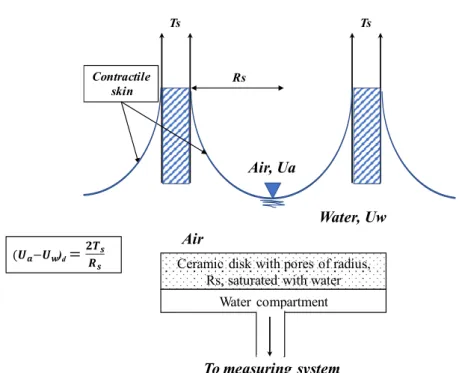
Fig. 2.4 Classification of the regions within soil profile. 16 Fig. 2.5 Physical model and capillary phenomenon. 22 Fig. 2.6 Scheme of operating principle of a high air entry ceramic disk
(after Fredlund and Rahardjo 1993).
25
Fig. 2.7 Approximation of suction range of various methods (Lu and Likos, 2004)
28
Fig. 2.8 The extended Mohr-Coulomb failure envelope for unsaturated soil
34
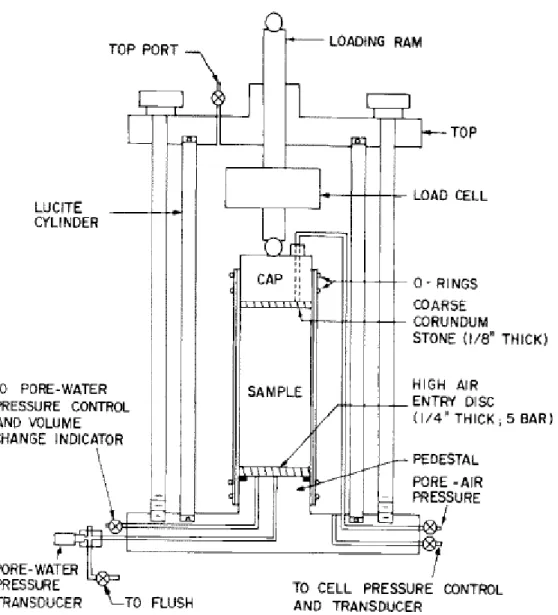
Fig. 2.9 Modification of conventional triaxial apparatus for unsaturated soil test (Ho and Fredlund, 1982)
36
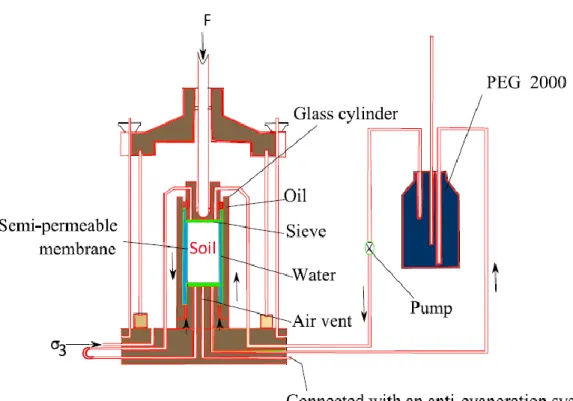
Fig. 2.10 Modification of conventional triaxial apparatus osmotic 38
XV
technique for unsaturated soil test (Ng and Chen, 2005 and 2006) Fig. 2.11 Modified direct shear apparatus for testing unsaturated soils
(from Gan and Fredlund, 1988)
41
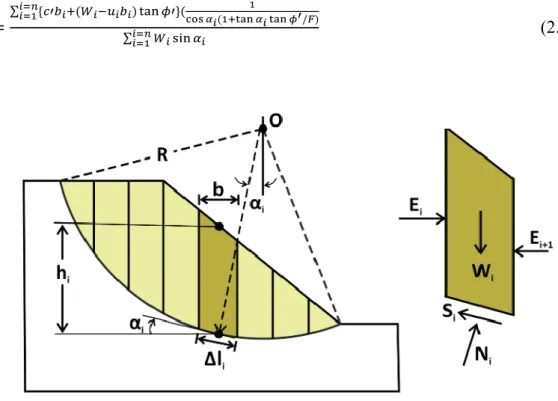
Fig. 2.12 Infinite slope and plane slip surface. 44
Fig. 2.13 Circular slip surface to a slice in the simplified Bishop method. 46 Fig. 2.14 Forces acting on a block resting on an inclined plane static
condition
47
Fig. 2.15 Forces acting on a block resting on an inclined plane dynamic condition
47
Fig. 2.16 Forces acting on triangular wedge of soil in pseudostatic analysis 48
Fig. 3.1 Sampling setup for undisturbed sample 55
Fig. 3.2 Sampling location for undisturbed sample 56
Fig. 3.3 Particle size distribution 58
Fig. 3.4 Relationship of specific gravity and organic content 58 Fig. 3.5 Relationship of plasticity index and liquid limit 59 Fig. 3.6 Consolidation test result of the volcanic ash soil 60 Fig. 3.7 Schematic diagram of conventional direct shear box apparatus 61 Fig. 3.8 Schematic of (one-sided and two-sided) cyclic loading 61 Fig. 3.9 Relationship of shear stress and shear displacement 64 Fig. 3.10 Stress path static test unsaturated and saturated sample 65 Fig. 3.11 Relationship of normalized shear stress at the end of shearing and
overconsolidation ratio
66
Fig. 3.12 Stress path cyclic one-sided shearing 67
Fig. 3.13 Stress path cyclic two-sided shearing 67
Fig. 3.14 Relationship between the vertical stress ratio and cumulative shear displacement one-sided shearing
68
Fig. 3.15 Relationship between the vertical stress ratio and cumulative shear displacement two-sided shearing
68
XVI
Fig. 3.16 Cyclic normalized shear stress - displacement behavior under one-sided and two-sided shearing for the overconsolidated condition
70
Fig. 3.17 Schematic of post cyclic analysis 71
Fig. 3.18 Relationship of normalized shear stress and shear displacement of overconsolidated samples (static and post cyclic)
72
Fig. 3.19 Relationship of normalized shear stress and shear displacement of overconsolidated samples (static and post cyclic)
72
Fig. 3.20 Stress path of overconsolidated samples (static and post cyclic) 73 Fig. 3.21 Stress path of normally consolidated samples (static and post
cyclic)
73
Fig. 3.22 Relationship of normalized vertical stress and shear displacement of overconsolidated samples (static and post cyclic)
75
Fig. 3.23 Relationship of normalized vertical stress and shear displacement of normally consolidated samples (static and post cyclic)
75
Fig. 4.1 Sampling location for undisturbed and disturbed samples 79 Fig. 4.2 Particle size distribution of the volcanic ash soil 81 Fig. 4.3 Consolidation test result of the volcanic ash soil 81 Fig. 4.4 Schematic diagram of conventional direct shear box apparatus 83 Fig. 4.5 Schematic of (one-sided and two-sided) cyclic loading 83 Fig. 4.6 Chemical composition of the volcanic ash soil 86 Fig. 4.7 Natural water content of allophanic soils in some areas compared
to their allophane content
87
Fig. 4.8 The SWCC of the volcanic ash soil 89
Fig. 4.9 The pore size distribution of the volcanic ash soil 89 Fig. 4.10 Relationship of shear stress and shear displacement 91 Fig. 4.11 Stress path of undisturbed and disturbed samples 91 Fig. 4.12 Degradation index (δ) over-consolidated sample 93
XVII
Fig. 4.13 Degradation index (δ) normally consolidated sample 93 Fig. 4.14 Normalized shear stress for one-sided shearing 94 Fig. 4.15 Normalized shear stress for two-sided shearing 95 Fig. 4.16 Relationship between average degradation index and peak static
shear stress ratio
97
Fig. 5.1 Photograph of unsaturated direct shear box test 105 Fig. 5.2 Schematic layout diagram of unsaturated direct shear box test 106 Fig. 5.3 Photograph of ceramic disk and metal porous 105
Fig. 5.4 Illustration of equilibrium condition 108
Fig. 5.5 Possibility water drainage in the unsaturated direct shear box apparatus
110
Fig. 5.6 Saturation process of the volcanic ash sample 112 Fig. 5.7 Testing flow diagram of unsaturated direct shear box test 113
Fig. 5.8 Equilibrium condition of sample 115
Fig. 5.9 Relationship between shear stress and shear displacement 116 Fig. 5.10 Relationship between vertical stress and shear displacement 117
Fig. 5.11 Stress path for Toyoura sand 117
Fig. 5.12 Distribution of water drainage 118
Fig. 5.13 Comparison result of vertical stress 119
Fig. 5.14 Comparison result of shear stress 120
Fig. 5.15 Relationship of shear stress and shear displacement (suction 60 kPa)
121
Fig. 5.16 Relationship of vertical stress and shear displacement (suction 60 kPa)
121
Fig. 5.17 Effects of the suction on (a) shear stress–shear displacement behavior; (b) volumetric behavior (net normal stress 20 kPa)
123
Fig. 5.18 Effects of the suction on (a) shear stress–shear displacement behavior; (b) volumetric behavior (net normal stress 40 kPa)
124
Fig. 5.19 Effects of the suction on (a) shear stress–shear displacement 125
XVIII
behavior; (b) volumetric behavior (net normal stress 60 kPa) Fig. 5.20 Shear strength versus matric suction with different net normal
stress
126
Fig. 5.21 Relationship of shear stress and shear displacement (suction 80 kPa)
128
Fig. 5.22 Relationship of vertical stress and shear displacement (suction 80 kPa)
128
Fig. 5.23 Effects of the suction on (a) shear stress–shear displacement behavior; (b) volumetric behavior (net normal stress 20 kPa)
129
Fig. 5.24 Effects of the suction on (a) shear stress–shear displacement behavior; (b) volumetric behavior (net normal stress 40 kPa)
131
Fig. 5.25 Effects of the suction on (a) shear stress–shear displacement behavior; (b) volumetric behavior (net normal stress 60 kPa)
132
Fig. 5.26 Schematic representation of spherical particles and forces involved
133
Fig. 5.27 Shear strength versus matric suction with different net normal stress
134
Fig. 5.28 Internal friction angle with different suction 135
Fig. 5.29 Cohesion with different suction 135
Fig. 6.1 Infinite slip surface model 140
Fig. 6.2 Infinite slip surface model considering the earthquake load 141 Fig. 6.3 The regional correction coefficient for each area in Japan 142
Fig. 6.4 The circular slope stability analysis 144
Fig. 6.5 The circular slope stability analysis with the seismic intensity 146 Fig. 6.6 The safety factor of slope under static load 148 Fig. 6.7 The safety factor of slope under seismic load 148 Fig. 6.8 The main shock of Kumamoto earthquake at 01:25 on April 16,
2016 and the yield seismic intensity
149
Fig. 6.9 The permanent displacement of the volcanic ash soil 150 Fig. 6.10 The safety factor of slope under static load 152
XIX
Fig. 6.11 The safety factor of slope under seismic load 152
Fig. 6.12 Stratigraphy of Kumamoto slope 154
Fig. 6.13 The observation points and the variety of depth layers 155 Fig. 6.14 The SWCC properties of volcanic ash soil 156 Fig. 6.15 The Effective and suction stress development with time 157 Fig. 6.16 The volumetric water content development with time 158 Fig. 6.17 Correlation safety factor of slope before precipitation (t = 0 h)
and observation point depth ratio
161
Fig. 6.18 Average reduction safety factor of slope and observation point depth ratio
162
Fig. 6.19 SWCC of disturbed and undisturbed samples 163
Fig. 6.20 The detail of observation points 163
Fig. 6.21 The volumetric water content development with time 164 Fig. 6.22 The Local Safety Factor (LSF) with rainfall intensity 166 Fig. 6.23 Local Safety Factor (LSF) discrepancies 167
Fig. 6.24 The detail of observation points 169
Fig. 6.25 Effective stress development with time 170 Fig. 6.26 The Local Safety Factor of slope before precipitation (t = 0 h) 172 Fig. 6.27 The Local Safety Factor of slope after precipitation (t = 5 h) 172
XX
LIST OF TABLES
Table Description Page
Table 3.1 Physical properties of the volcanic ash 57
Table 3.2 Test program for static and cyclic 63
Table 4.1 Physical properties of the volcanic ash 80 Table 4.2 Testing program for static and cyclic loading 85
Table 5.1 Test program for undrained test 109
Table 5.2 The testing program for drained 111
Table 6.1 Soil shear strength properties for the slope stability analysis 147 Table 6.2 The observation points and the variety of depth layers 156
Table 6.3 The input shear strength properties 168
XXI
LIST OF NOMENCLATURE
Nomenclature Meaning
CD Consolidated Drained
CU Consolidated Undrained
d Soil pore diameter
HAEV High Air Entry Value
LSF Local Safety Factor
MIP Mercury Intrusion Porosimetry
N Number of cycles
NC Normally consolidated
OC Over-consolidated
OCR Over-Consolidated Ratio
P Applied pressure
PEG Polyethylene glycol
PSD Pore-size distribution
Pc Yield stress
SEM Scanning Electron Microscope SWCC Soil-water characteristic curve
S1 Initial normalized vertical stress
XXII
SN Normalized vertical stress after N cycles
Ts Surface tension
XRF X-ray fluorescence analysis
Contact angle between the soil particles and the fluid
τ Shear stress
σ Vertical stress
δ Degradation index
δavg Average degradation index τp Peak static shear stress ratio
kr The relative permeability uw Pore water pressure
ua Pore air pressure
σ’ Effective stress
χ A soil parameter related to degree of saturation from 0 to 1
ψ Total suction
π Osmotic suction
𝜌𝑤 Density of water,
𝑅 Universal (molar) gas constant (R= 8.31432 J/(mol K)
𝑇 Absolute temperature
𝜔𝑣 Molecular mass of water vapour
XXIII
𝑥𝑤 Molecular fraction of water in the solution
𝑐′ Effective cohesion
ϕ′ Effective internal friction angle
𝜎 − 𝑢𝑤 Efective normal stress 𝑢𝑎− 𝑢𝑤 Matric suction
𝜙𝑏 The shear strength contribution due to matric suction r1 The small radius of this doughnut-shaped torus
r2 The distance from the center to the inside wall of the torus γt The unit weight of soil
H The soil thickness
β The slope inclination angle
kh The horizontal seismic intensity kv The vertical seismic intensity
σs Suction stress
1
CHAPTER I
INTRODUCTION
1.1 Introduction
Evaluating the stability of slopes is an important, interesting, and challenging aspect of geotechnical engineering. Concerns with slope stability have driven some of the most important advances in our understanding of the complex behavior of soils.
Extensive engineering and research studies were performed over the past 80 years that have provided a sound set of soil mechanics principles with which to face the practical problems of slope stability (Duncan, 2014).
In general, the major direct triggering factors of slope failures can be classified into three types of triggering factors which are rainfall events, earthquake load, and human activity. These triggering factors change the pore pressure or stress in the slope and directly reduce the soil shear strength. Futhermore, the triggering factors from the natural process can be categorized by rainfall events and earthquake load. Fig. 1.1 shows the slope failure in Hita July 2017 which the main triggering factor is the infiltration of rainfall. On the other hand, Fig. 1.2 illustartes the slope failure in Kumamoto April 2016 after an earthquake with a magnitude of 7.0 has struck the Kumamoto area and induced several slope failures around Aso mountain area.
There is a possibility for a combination of rainfall and earthquake load attack the same area especially Indonesia and Japan which has high annual precipitation and high intensity of earthquake event. However, a few studies discussed the combined factor between rainfall and earthquake load induced slope failures.
2
Fig. 1.1 Slope failure after the torrential rain on July, 2017 in Hita, Oita (The Asahi Shimbun July, 2017)
Fig. 1.2 Slope failure after Kumamoto earthquake April 2016, Japan (https://mainichi.jp/)
50 m
125 m
3
1.2 Kumamoto slope failures
Recently in April 2016 an earthquake with a magnitude of 7.0 has struck the Kumamoto area and induced several slope cracks and failures. Where one of the massive failures occurred around the Aso mountain area. In addition, after the Kumamoto earthquake, the rainy season followed. Consequently, it will trigger a secondary disaster. Therefore, the investigation of soil shear strength behavior around the Aso mountain area is strongly needed. It was reported that orange-colored pumice deposits and the black volcanic ash soil are dominant in the affected area. According to (Miyabuchi, 2016; Mukonoki et al., 2016; Kiyota et al., 2017; Chiaro et al., 2018), the critical factor that has led to those failures is the reduction in the total shear strength of the volcanic soil due to the earthquake load. Many researchers have studied the volcanic ash soil in Kumamoto slope failures especially the orange-colored pumice.
They investigated the shear strength by a series of static and cyclic triaxial tests.
However, small attention was given to the shear strength and characteristic of the black volcanic ash soil.
Black volcanic ash soil which is also known as Kuro-boku soil in Japan is a problematic type of soil (Kitazono et al., 1987; Mshana et al., 1993). Kuro-boku (organic cohesive volcanic ash soil) is usually rich with the allophane minerals, which are characterized by unique problematic properties. As reported by several researchers, black volcanic ash soil has high natural moisture content varying between 65-160%
(Kodani et al., 1975; Japan soil inventory, 2016).
The black volcanic ash soil is generally located in the top layer of natural slopes above the groundwater table with degrees of saturation less than 100 % which can be classified as an unsaturated state. It is well known that soil under unsaturated
4
conditions has higher strength and shear resistance in comparison to the saturated condition. However, under heavy rainfall events, the pore water pressure increases leading to the loss of shear strength and slope instability. The black volcanic ash soil covers approximately 31% of the total area of Japan, mainly within the volcanic zones (Yamauchi, 1983). In Kyushu Island, the black volcanic ash soil is generally found in the Aso mountain area, Kumamoto city. Fig. 1.3 illustrates the distribution of the black volcanic ash soil in Japan. In addition, for simplicity, the black volcanic ash in this research will be called as volcanic ash.
Fig. 1.3 Distribution of the black volcanic ash soil in Japan (Yamauchi, 1983) A key step in the soil slope stability analysis is measuring or estimating the strengths of the soils. Reliable analysis can only be performed if the provided shear strength properties are appropriate for the considered soil and representative for the investigated location. Extensive and detailed analysis for both the soil mechanical and hydrological properties is required to acquire a better understanding of slope stability
5
when considering rainfall infiltration. The existing conventional approaches for soil mechanics are not enough to analyze such kind of complex problem. The limitations can be generally attributed to the simplified assumptions where the soil pore is assumed to be either fully saturated with air (dry state) or fully saturated with water.
Those methods also ignore the negative pore water pressure above the ground-water table level. Adopting those methods result inaccurate estimation of the safety factor and the slip surface location. Therefore, an advanced analysis that incorporates unsaturated soil mechanics is strongly needed.
Several approaches and techniques to obtain unsaturated shear strength properties of soil were developed. The most reliable and accurate properties can be obtained by conducting direct laboratory testing. Many laboratory testing apparatus for unsaturated shear strength have been developed, such as the unsaturated triaxial and direct shear box apparatus (Ho and Fredlund, 1982, Tom et al., 2008 and Luky 2012). Laboratory testing for unsaturated soils is difficult, high cost, and time- consuming. Consequently, researchers have been trying to propose empirical and theoretical formulas to predict unsaturated shear strength properties, where such an approach is relatively easier than laboratory testing, cheaper and can be done in a relatively short time. However, the accuracy and reliability ot the obtained data are reltively low in comparison to the directly obtained in laboratory data.
1.3 Research Objectives and Original Contributions
This thesis aims at the evaluation of shear strength characteristics of unsaturated- undisturbed volcanic ash soil subjected to static and cyclic loading for slope stability analysis. Furthermore, in this study, the soil was collected at Kumamoto slope failure
6
2016. In order to achieve the aim of this thesis, the following objectives were delineated:
1. To identify the shear strength behavior of the collected unsaturated undisturbed volcanic ash soil under static and cyclic loading.
2. To identify the effect of the soil structure disturbance on the shear strength of the volcanic ash soil by reflecting the pore size distribution differences of undisturbed and disturbed samples.
3. To develop the new suction controlled unsaturated direct shear box apparatus.
The developed apparatus differs in its features and testing procedure in comparison to the conventional testing apparatus. The proposed procedure and apparatus configuration ensure easy testing, relatively short time, and low cost.
4. To analyze the stability of unsaturated slopes subjected to rainfall infiltration and earthquake loading. The analysis considers various loading and rainfall patterns and their influence on the slope stability adopting several slope stability evaluation methods.
Furrthemore, Fig. 1.4 illustrates some new finding is obtained to which are considered as the originality of this research
1.4 Framework and outlines of the thesis
To achieve the above-mentioned objective and scopes, this dissertation is organized in seven chapters following the framework presented in Fig. 1.5. The outlines of each chapter are briefly described as follows:
Chapter 1 presents an introduction to this research, the current problems, and the motivation to conduct this research. The proposed aim, objectives, and scopes of this
7
Fig. 1.4 Original contribution
thesis are illustrated. Besides, the original contributions of this study and the framework of the thesis are presented.
Chapter 2 briefly describes the present state of knowledge on unsaturated soils, especially related to the shear strength of unsaturated soils. This chapter starts with the elements of unsaturated soils, then proceeds to define the suction, and methods to impose the suction before reviewing the existing laboratory testing techniques of unsaturated shear strength of soils. Next, a review of the slope stability analysis considering infinite and circular slope is presented. The slope stability subjected to static and earthquake loading is described.
Through Chapter 3, the shear strength behavior of unsaturated undisturbed volcanic ash soil subjected to static and cyclic loading using the conventional direct shear box apparatus are discussed. The principle of direct shear box apparatus including limitations and advantages are explained. Finally, the static shear strength and cyclic shear strength of the black volcanic ash soil are discussed.
Chapter 4 discusses the effect of soil structure disturbance on the shear strength of the volcanic ash soil. The effect of soil structure disturbance on the shear strength
Describe the shear strength behavior of the natural volcanic ash soil which represent by unsaturated undisturbed sample under various loading condition
Influence of the disturbance on the shear strength of the volcanic ash soil using a simple method
Development of suction controlled unsaturated direct shear box apparatus reliability of unsaturated behavior of volcanic ash soil
Original contribution
Describe the stability behavior of unsaturated slopes subjected rainfall infiltration and earthquake loadingreflecting to experimental results
8
characteristics of the volcanic ash was evaluated using a simple methodology where the disturbance on soil micro-structure was indirectly considered by studying the pore size distribution variations which was reflected from the Soil Water Characteris Curve (SWCC) corresponding to disturbed and undisturbed samples. In addition, the chemical composition of the volcanic ash soil confirmed. The static shear strength of both undisturbed and disturbed samples was evaluated. In addition, the degradation index under cyclic loading and the post cyclic behavior is discussed.
Chapter 5 presents the newly developed suction controlled unsaturated direct shear box apparatus and testing procedure. The principle of new suction controlled direct shear box apparatus including the limitations and advantages are explained. In addition, the unsaturated shear strength results of standard soil are presented as a validation of the developed device. Finally, the unsaturated shear strength of volcanic ash soil with different suction values under the drying process [along the SWCC] was determined.
Chapter 6 discusses the unsaturated slope stability analysis of the volcanic ash soil. In order to get representative results, the Aso mountain area, Kumamoto slope properties was adopted. The infinite slope and circular slope stability were presented under static and earthquake load. Furthermore, the unsaturated shear strength results experimentally obtained using the conventional and the newly developed direct shear box apparatus were used to analyze. Finally, the effect of the rainfall infiltration on the slope stability using HYDRUS FEM software analysis is presented.
Chapter 7 summarizes the main findings of this dissertation, delineates the remaining issues to be solved, and defines goals for future research issues and scopes that need to be investigated in relation to this research main theme.
9
Fig. 1.5 Framework and thesis organization. (Flow chart)
References
Berti, M., Simoni, A., 2012. Observation and analysis of near surface pore pressure measurement in clay-shales slopes. Hydrological Process, 26: 2817-2205
Chiaro, G., Umar, M., Kiyota, T., Massey, C., 2018. The Takanodai landslide, Kumamoto, Japan: insights from post-earthquake field observations, laboratory tests, and numerical analyses. Proc. Geotechnical Earthquake Engineering and Soil Dynamics V, June 10-13, 2018, Austin, Texas: 98-111
Duncan, J.M., Wright, S.G., Brandon, T.L., 2014. Soil strength and slope stability.
Wiley
Froude, M.J., Petley, D.N., 2018. Global fatal landslide occurrence from 2004 to 2016.
Natural Hazards and Earth System Sciences, 18: 2161-2181
New suction controlled direct shear box apparatus
Chapter 4: Effect of soil structure disturbance on the shear strength volcanic
ash soil
Chapter 5: New suction controlled unsaturated direct shear box apparatus and
testing procedure development Evaluation of shear strength characteristics of unsaturated undisturbed volcanic
ash soil subjected to static and cyclic loading for slope stability analysis Chapter 1: Introduction
Chapter 2: Literature review
Chapter 3: Shear strength behavior of unsaturated undisturbed volcanic ash soil
under static and cyclic loading
Chapter 6: Evaluation of unsaturated volcanic ash soil slope stability
Chapter 7: Conclusions and future work
Conventional direct shear box apparatus
10
Ho, D.Y.F., fredlund, D.G., 1982. A multistage triaxial test for unsaturated soils.
Geotechnical Testing Journal, 5 (1): 18-25
Handoko, L., 2012. Evaluation of hydro-mechanical properties of unsaturated soils and non-woven geotextile under low confining pressure. Kyushu University.
Kitazono, Y., Suzuki, A., Kajiwara, M., Aramaki, S., 1987. Contribution of microstructure to repeated loading effect on compacted allophaneous volcanic ash soil.
Soils and Foundations, 27 (4): 23-33
Kiyota, T., Ikeda, T., Konagai, K., Shiga, M., 2017. Geotechnical damaged caused by the 2016 Kumamoto earthquake, Japan. International of Journal Geoengineering Case Histories, 4 (2): 78-95
Kodani, Y., Kuono, S., Uchida, K., 1975. Relation between Organic Matter, Content and Physical Properties of Kuroboku Soil. The Japanese Society of Irrigation, Drainage and Reclamation Engineering, 60: 7-13
Miyabuchi, Y., 2016. Landslide disaster triggered by the 2016 earthquake in and around Minamiaso village, western part of Aso caldera, southwestern Japan. Journal of Geography, 125 (3): 421-429
Mshana, N.S., Suzuki, A., Kitazono, Y., 1993. Effect of weathering on stability of natural slopes in north-central Kumamoto. Soils and Foundations, 33 (4): 74-87 Mukonoki, T., Kasama, K., Murakami, S., Ikemi, H., Ishikura, R., Fujikawa, T., Yasufuku, N., Kitazono, Y., 2016. Reconnaissance report on geotechnical damage caused by an earthquake with JMA seismic intensity 7 twice in 28 h, Kumamoto, Japan.
Soils and Foundations, 56 (6): 947-964
Santolo, A.S., Nicotera, M.V., Evangelista, A., 2005. Monitoring matric suction profiles in partially saturated pyroclastic topsoil slopes in Tarantino. Advanced Experimental Unsaturated Soil Mechanics. Taylor and Francis Group.
Thom, R., Shivakumar, V., Brown, J., Hughes, D., 2008. A simple triaxial system for evaluating the performance of unsaturated soils under repeated loading. Geotechnical Testing Journal, 31 (2): 107-114.
Tu, X.B., Kwong, A.K.L., Dai, F.C., Tham, L.G., Min, H., 2009. Field monitoring of rainfall infiltration in a loess slope and analysis of failure mechanism of rainfall induced landslides. Engineering Geology, 105: 134-150
Yamauchi, Y., 1983. Kyushu University Press, in Japanese
11
CHAPTER II
LITERATURE REVIEW
2.1 Introduction
Soil can be divided into saturated and unsaturated soils in the general field of soil mechanics. Saturated soils are two-phase materials (solid and liquid). Unsaturated soils have three phases, consisting of soil particles, water and air (solid, liquid and gas).
The pore spaces are filled with a mixture of two or more media, most commonly water and air in unsaturated soils. The presence of air along with water in the soil voids gives rise to two types of pore pressures: pore air pressure, ua and pore water pressure, uw. Interaction between the solid, liquid and gas phases produces the complex hydro- mechanical behavior of unsaturated soils.
This chapter briefly describes the present state of knowledge on unsaturated soils, especially related to the shear strength of unsaturated soils. This chapter starts with the elements of unsaturated soils, then continues by defining suction and methods to impose the suction and reviewing measurements of unsaturated shear strength for laboratory testing. Next, a review of the unsaturated slope stability analysis considering infinite and circular slope is presented. The slope stability under static and earthquake load is described.
2.2 Element of unsaturated soils
The development of soil mechanics for unsaturated soils began about two to three decades after the commencement of study of soil mechanics for saturated soils.
12
The basic principles related to the understanding of unsaturated soil mechanics were formulated mainly in the 1970s. The development of classical soil mechanics has led to an emphasis on particular types of soils. The common soil types are saturated sands, silts and clays, and dry sands. The general field of soil mechanics can be subdivided into that portion dealing with saturated soils and that portion dealing with unsaturated soils Fig. 2.1. The differentiation between saturated and unsaturated soils becomes necessary due to basic differences in their nature and engineering behavior. An unsaturated soil has more than two phases, and the pore-water pressure is negative relative to the pore-air pressure. Any soil near the ground surface, present in a relatively dry environment, will be subjected to negative pore-water pressures and possible desaturation.
Fig. 2.1 Categorization of soil mechanics (Fredlund and Rahardjo, 1993) Unsaturated soils have recently gained widespread attention in many studies and construction works all over the world, since many soils near the ground surface are considered unsaturated and also those compacted soils comprising the many earthworks constructed all over the world are most appropriately considered from an
13
unsaturated soils framework. Classical soil mechanics simply assumed that soil is either fully saturated with water or fully saturated with air (dry soils). Those, classical soil mechanics is also called as saturated soil mechanics. This simplicity considers that soil has two phases only: solid particle and water, or solid particle and air. Ground water table is a boundary to separate those two divisions. Water-saturated soil is located at below ground water table, while at above ground water table, soil is considered as air-saturated (or dry soils).
Fig. 2.2 Division of soil mechanics (After Fredlund 1995)
Nowadays, researchers realize that classical two-phase approach is not enough to describe some phenomena in geotechnical engineering problems. In real condition, soil at above ground water table is not air-saturated. Its pore does not consist of air only, but also water. A better approach has been developed recently, which consider soil to have more than two phases. Fredlund (1995) divides soil mechanics into two divisions. One is dealing with saturated soil condition and the other is dealing with unsaturated soil condition. Their nature and engineering behavior are the main factors
14
that distinguish them. Those two divisions are separated with ground water table as shown in Fig 2.2.
Saturated soil is located below the ground water level. It has two phases and subjected to positive pore water pressure. The soil pore is fully filled with water; thus, it has degree of saturation 100%. The unsaturated soil is located between the ground water table and the ground surface; it has more than two phases and subjected to negative pore pressure. The degree of saturation of an unsaturated soil is ranging from 0 to 100%.
According to Fredlund (1979), an unsaturated soil is consisted of three phases.
More recently, the realization of the important role of the air-water interface (i.e., the contractile skin) has warranted its inclusion as an additional phase when considering certain physical mechanisms (Fredlund and Rahardjo, 1993). It is because the air-water interface or contractile skin qualifies as a phase since it has (i) differing properties from that of the contiguous materials and (ii) definite bounding surfaces.
Lu and Likos (2004) divide the unsaturated soil zone into 3 regimes: (i) capillary fringe, which is remain in saturated condition but dealing with negative pore pressure, (ii) funicular regime, which is characterized by continuous water phase and (iii) residual or pendular regime which is characterized by discontinuous water phase.
Figure 2.3 describes the condition of air and water of each region in an unsaturated soil. The moisture content of unsaturated soils near surface for certain depth is depended on the climate change, i.e. precipitation and evaporation. Due to precipitation, the moisture content becomes higher and will decrease the negative pore water pressure, while due to evaporation, the effect is at the vice versa.
Fig 2.3 illustrates the type of structure of an unsaturated soil and Fig 2.4
15
describes a classification of the regions within soil profile together with the evolution of degree of saturation Sr and pore water pressure uw with depth.
The types of structures of an unsaturated soil can be grouped into three (3) categories depending on the air and water phase continuities (Wroth and Houlsby 1985) Rifa’i 2002, as shown in Fig 2.3. Fig 2.3(a) describes the continuous water and discontinuous air phases. The air phase exists in an occluded form. This category is found in narrow transition zone in natural soil, above the saturated soil with lower degree of saturation Sr and negative pore water pressure uw as shown in Fig 2.4, region (a). The relative permeability kr of air is zero and kr of water is almost 1. In other words, this zone is found in unsaturated soils having a very high degree of saturation (“almost saturated”).
Fig 2.3 Structure types of an unsaturated soil (Wroth & Houlsby 1985): (a) Continuous water and discontinuous air phases; (b) continuous water and air phases;
and (c) discontinuous water and continuous air phases.
The second category corresponds to continuous water and air phases (Fig 2.3(b)).
This type is found in natural soil above the previously mentioned zone as shown in region (b) of Figure 2.4. This phase has an intermediate degree of saturation and also a negative pore water pressure. The relative permeability of both air and water changes depending on the degree of saturation. The relative permeability of air increases and
16
the relative permeability of water decreases as the degree of saturation decreases. The pore air pressure may be zero if the continuous air phase is vented to the atmosphere.
Fig 2.4 Classification of the regions within soil profile.
The last category corresponds to discontinuous water and continuous air phases as illustrated in Fig 2.3(c). In this category, the soil has a very low degree of saturation (see region (c) of Figure 2.4) and the coefficient of permeability of water is almost zero. This situation is commonly found in the top layer at the ground surface in natural soil, but may be strongly influenced by rain infiltration.
17
2.3 Variables of unsaturated soils
The effective stress variable σ - uw commonly used in saturated soil mechanics is a stress state variable to which saturated soil behavior can be related. The effective stress variable is applicable to sands, silts, or clays and it is independent of the soil properties. The volume change process and the shear strength characteristics of a saturated soil are both controlled by effective stress variables. The effective stress state variable can be independently applied in each of the three Cartesian coordinate directions. In so doing, effective stress takes on the form of a stress tensor (i.e., a 3 × 3 matrix).
Soil mechanics as a science has been successfully applied to many geotechnical problems involving saturated soils. The success of the stress state variables is largely due to the ability of engineers to uniquely relate observed soil behavior to stress conditions in the soil. Terzaghi (1936) described the stress state variables controlling the behavior of saturated soils as follows: “The stresses in any point of a section through a mass of soil can be computed from the total principal stresses, σ1, σ2, σ3, which act at this point. If the voids of the soil are filled with water under a stress, uw, the total principal stresses consist of two parts. One part, uw, acts in the water and in the solid in every direction with equal intensity.
The effective stress concept provides a fundamental basis for studying saturated soil mechanics. The effective stress concept states that all mechanical behavior in a saturated soil is governed by effective stresses (and shear stresses) in each of the three Cartesian coordinate directions. Changes in volume and shear strength are controlled by changes in effective stress. An effective stress change (i.e., a change in pore-water pressure or a change in total stresses) will alter the equilibrium state of a saturated soil.
18
Consequently, the effective stress variables qualify as stress state variables.
In 1941, Biot proposed a general theory of consolidation for an unsaturated soil with occluded air bubbles. The constitutive equations relating stress and strain were formulated in terms of two independent stress state variables, namely, effective stress (𝜎 − 𝑢𝑤) and pore-water pressure, uw. It was recognized that there needed to be a separation between the effects of total stress changes and pore-water pressure changes when attempting to describe unsaturated soil constitutive behavior.
In 1963, Bishop and Blight reevaluated their previously proposed effective stress equation for unsaturated soils and noted that a variation in matric suction (𝑢𝑎− 𝑢𝑤) did not result in the same change in soil behavior as did a change in the net normal stress (𝜎 − 𝑢𝑎) . Laboratory test results were presented using three-dimensional graphical plots with matric suction and net normal stress forming independent orthogonal axes. In other words, net normal stress and matric suction were presented as independent stress variables.
In the 1970s (Fredlund, 1973; Fredlund and Morgenstern, 1977), a theoretical equilibrium analysis was formulated for an unsaturated soil element using concepts consistent with multiphase continuum mechanics. An unsaturated soil had generally been viewed as a three-phase system; however, it was shown that the contractile skin (i.e., the air-water interface) should be introduced as a fourth and independent phase when studying the equilibrium conditions for each phase. The equilibrium analysis on an unsaturated soil element provided justification for the use of independent stress state variables for an unsaturated soil. The soil particles were assumed to be incompressible and the soil was treated as being chemically inert. These assumptions have been historically applied in saturated soil mechanics.
19
The analysis concluded that any two of three possible stress state variables can be used to describe the stress state of an unsaturated soil. The three possible combinations which can be justified as stress state variables for an unsaturated soil are (1) (𝜎 − 𝑢𝑎) and (𝑢𝑎− 𝑢𝑤), (2) (𝜎 − 𝑢𝑤). and (𝑢𝑎− 𝑢𝑤), and (3) (𝜎 − 𝑢𝑎) and (𝜎 − 𝑢𝑤). Out of the three possible combinations of stress state variables that can be justified, it is the (𝜎 − 𝑢𝑎) and (𝑢𝑎− 𝑢𝑤) combination that received the widest acceptance in formulating unsaturated soil mechanics problems.
The stress state variables for an unsaturated soil take on the form of two independent stress tensors when considering a three-dimensional Cartesian coordinate system. The proposed stress state variables for unsaturated soils were experimentally tested by Fredlund (1973a) and subsequently used to formulate constitutive equations to describe shear strength behavior and volume change behavior.
Stress tensors that contain stress state variables form the basis for developing a science for both saturated and unsaturated soils. It is possible to write first, second, and third stress invariants for each stress tensor. While it is not imperative that the stress invariants be used in developing constitutive models, the stress invariants should be given consideration because all three Cartesian coordinates are independently taken into consideration.
In summary, it is the two independent stress tensors containing stress state variables [e.g., net normal stress (𝜎 − 𝑢𝑎) , matric suction (𝑢𝑎− 𝑢𝑤) , and shear stresses] that form a fundamental basis for the development of a science for unsaturated soil mechanics. Constitutive relationships connecting various state variables can then be used in conjunction with soil properties (and soil property functions) to solve practical engineering problems. All proposed constitutive
20
relationships must be tested for uniqueness in the laboratory on a variety of soil types.
The laboratory equipment must be able to independently control each stress component of the stress state variables.
There are theoretical and formulation limitations associated with the use of effective stress equations. Little attention is given to these equations; however, a brief summary is given of effective stress equations that have been proposed.
The oldest and most-often-referred-to single-valued effective stress relationship is that proposed by Bishop (1959). The equation is commonly referred to as Bishop’s effective stress equation for unsaturated soils and has the form
𝜎′ = (𝜎 − 𝑢𝑎) + 𝜒 (𝑢𝑎− 𝑢𝑤) (2.1) Where:
𝜎′ = effective stress
𝜒 = a soil parameter related to degree of saturation and ranging from 0 to 1.
Bishop’s equation relates net normal stress to matric suction through the incorporation of a single-valued soil property,χ. Bishop’s equation should not be referred to as a fundamental description of stress state for an unsaturated soil. The equation contains a soil property and should be referred to as a constitutive equation.
Within the context of continuum mechanics it is not proper to elevate the Bishop equation to the status of a stress state variable for an unsaturated soil.
Morgenstern (1979) explained the limitations of Bishop’s effective stress equation as follows: Bishop’s effective stress equation “proved to have little impact on practice. The parameter, χ, when determined for volume change behavior was found to differ when determined for shear strength. While originally thought to be a function
21
of degree of saturation and hence bounded by 0 and 1, experiments were conducted in which χ was found to go beyond these bounds. The effective stress is a stress variable and hence related to equilibrium considerations alone.”
Morgenstern (1979) went on to explain: Bishop’s effective stress equation
“contains the parameter, χ, that bears on constitutive behavior. This parameter is found by assuming that the behavior of a soil can be expressed uniquely in terms of a single effective stress variable and by matching unsaturated soil behavior with saturated soil behavior in order to calculate χ. Normally, we link equilibrium considerations to deformations through constitutive behavior and do not introduce constitutive behavior into the stress state.”
Edlefsen and Anderson (1943) referred soil suction as the free energy state of soil water (Fredlund and Rahardjo, 1993). Soil suction or total suction has two components, namely, matric suction and osmotic suction. Matric suction is defined as the difference between the pore-air pressure, ua, and the pore-water pressure, uw, while the osmotic suction is a function of the amount of dissolved salts in the pore fluid. The relation of total, matric and osmotic suction is described in Equation 2.2.
𝜓 = (𝑢𝑎− 𝑢𝑤) + 𝜋 (2.2)
Where:
𝜓 = effective stress.
𝜋 = osmotic suction.
The definition of matric suction is identical with the capillary pressure uc, so notations of capillary pressure and matric suction are equivalent. The matric suction component is commonly associated with the capillary phenomenon of the surface