29 Material
Introduction
The aorta and large arteries play an important role in the cardiovascular system, they not only act as blood conduits to the peripheral tissues, but also as a buffer for pressure changes resulting from intermittent ventricular ejection of blood. The large artery in the cardiothoracic region has rich elasticity, as a low-resistance conduit and as a cushion of flow pulsations at its input. By absorbing a proportion of the energy in systole and releasing it in diastole, they maintain coronary blood flow and avoid an increase in left ventricular afterload. Through the impairment of this buffering function, increases in arterial stiffness or reductions in arterial compliance contribute to elevations in systolic blood pressure, left ventricular hypertrophy, and coronary ischemia [1,2]. Indeed, higher arterial stiffness is associated with a greater rate of mortality in patients with end-stage renal failure and essential hypertension. Accordingly, any interventions that could act to increase arterial stiffness should be cautiously performed or even avoided. Arterial stiffness also increases with aging [3]. A high level of arterial stiffness is an independent risk factor that leads to arteriosclerotic cardiovascular diseases [4,5]. Lifestyle-related diseases such as hypertension, hyperlipidemia, diabetes mellitus and obesity are causes of arteriosclerotic disease. Arteriosclerotic disease is also recognized as a lifestyle-related disease. It is reported that arterial stiffness of the patients with lifestyle-related disease is especially high [6]. Meanwhile, it is known that increases in arterial stiffness are restrained by habitual aerobic exercise.
Aquakinetics is a popular aerobic exercise for middle-aged and elderly people. In the water, a body becomes weightless due to its buoyancy, which also alleviates the burden put on bones and joints. Therefore, aquakinetics is generally recommended for the middle-aged, the elderly, the obese and disabled people in order to improve their health.
Physical characteristics of water include water pressure, buoyancy [7], viscous resistance [8] and water temperature [8,9]. Body responses are also different from land. The blood pressure of young people, which is taken at the water level of xiphoid process, is usually lower in a standing position in water compared to a standing position on land. In addition, both systolic and diastolic blood pressures are lowered. On the other hand, it is reported that the blood pressure of middle-aged and elderly people is higher in a standing position in water than in a standing position on land [10,11]. It is known that water pressure has an influence on the body, and its influence extends to blood vessels. It seems to decrease the blood pressure of soft blood vessels. However, it increases the blood pressure of stiff blood vessels. It is known that reductions
(Accepted Apr. 21, 2011)
Key words: arterial stiffness, underwater blood pressure, lifestyle related disease, middle-aged and elderly
Nozomi MATSUMOTO
*and Sho ONODERA
**The Relationship between Arterial Stiffness and Under Water
Blood Pressure in Middle-aged and Elderly Women
*
Departmen of Preschool Education, Shujitsu Junior College, Okayama,Okayama 703-8516, Japan E-mail: [email protected]**
Department of Health and Sports Science, Faculty of Health Science and Technology, Kawasaki University of Medical Welfare, Kurashiki, Okayama 701-0193, JapanNozomi Matsumoto and Sho Onodera 30
in arterial compliance or increases in arterial stiffness with the aging are regarded as the factors of underwater blood pressure changes in middle-aged and elderly people [10]. We hypothesized that blood pressure and vascular property of the patients with lifestyle-related diseases may behave differently from those of normal healthy people.
We measured the blood pressure in people with lifestyle-related diseases and healthy people in order to examine the relationship between underwater blood pressure and arterial stiffness in middle-aged and elderly Japanese women.
Methods 1. Subjects
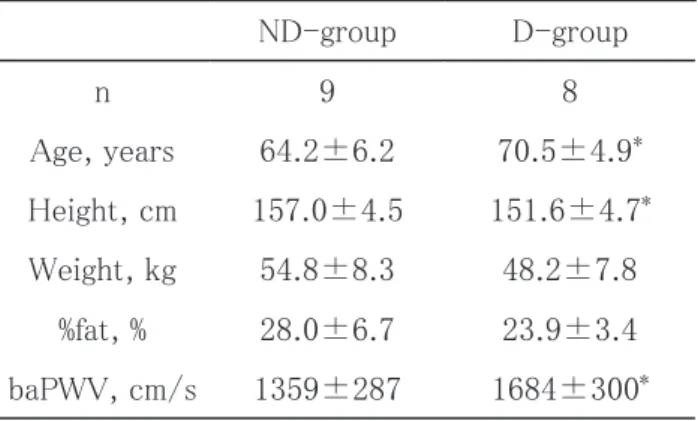
Seventeen middle-aged and elderly Japanese women participated in this study (mean+/-SD, age: 68+/-8years, Height: 154.0+/-5.4cm, Body weight: 51.4+/-8.4kg). Subjects gave written informed consent before the study. Physical characteristics of subjects showed in table 1. They were fitness club members and exercised regularly for more than one year. They got regular check-ups and exercised based on a prescribed plan. They were divided into two groups; a lifestyle related disease group (D-group) and a healthy group (ND-group). D-group had cardiovascular disease risk factors such as hypertension, hyperlipidemia and diabetes mellitus (table 2). ND-group had no risk factors for cardiovascular diseases.
Table 1 Physical characteristics of subjects
2. Measurements
a. Blood pressure and pulse
Blood pressure and pulse were measured at poolside and underwater. Subjects were placed in the seated position on land (Se-position), at standing position on land (St-position) and at standing position in the water (W-position) (figure 1). The water height was at the level of infra-axillary. Blood pressure was measured from the upper arm by stethoscopy. Pulse was taken on the radial artery for ten seconds while measuring the blood pressure. The measurement was carried out after a rest of several minutes. The poolside temperature was 29˚C, and the water temperature was 32˚C.
Table1. Physical characteristics of subjects
ND-group
D-group
n
9
8
Age, years
64.2±6.2
70.5±4.9
*Height, cm
157.0±4.5
151.6±4.7
*Weight, kg
54.8±8.3
48.2±7.8
%fat, %
28.0±6.7
23.9±3.4
baPWV, cm/s
1359±287
1684±300
*Mean±SD, *p<0.05
Fig. 1 Measurement method b. Arterial stiffness
Arterial stiffness was evaluated with pulse wave velocity between brachial and ankle arteries (baPWV). Pulse wave velocity (PWV) has been noted as a useful method for evaluating arterial stiffness, which is strongly associated with systemic atherosclerosis at various sites in the vascular tree [12]. The baPWV was measured by non-invasive, volume plethysmographic technique (formPWV/ABI, Omron Colin Co., Kyoto, Japan) [13]. All subjects were examined in the supine position in both groups out of water, sphygmomanometer cuffs were wrapped on both upper arms and ankles, and electrocardiogram electrodes were placed on both wrists. The cuffs inflated and deflated automatically, and pulse wave contours in the four extremities were recorded simultaneously. Pulse transit time between the upper arm and ankle regions was computed from these pulse wave volume recordings. The baPWV was determined from the pulse transit time and the distance between these two segments. The distance of each segment was calculated automatically, based on the height of subjects. If blood pressure and heart rate showed high levels, we measured them after rest. Arterial stiffness and blood pressure at poolside and in water were measured on different days.
3. Analysis
All data were presented as mean±SD. The data were analyzed by using an unpaired t-test and ANOVA. In addition, simple correlation analyses were used to analyze the relationships between baPWV and underwater blood pressure. Differences were considered significant when p<0.05.
Results
1. Blood pressure and pulse response
Figure 2 shows the change of blood pressure and pulse in Se-position, St-position and WS-position. In ND-group, the systolic blood pressure was significantly different in three positions (p<0.05). Pulse was higher in St-position than Se-position and WS-position (p<0.05). Systolic blood pressure and pulse changed in opposite ways. Diastolic blood pressure was not different in any of the three positions. On the
1) Se-position
2) St-position
3) WS-position
4) baPWV
Nozomi Matsumoto and Sho Onodera 32
other hand, in the D-group, the systolic blood pressure was significantly different in all positions (p<0.05). Regarding the diastolic blood pressure, it was higher in Se-position than in the St-position (p<0.05). Pulse was significantly different in three positions (p<0.05).
Systolic blood pressure of Se-position and WS-position was significantly higher in D-group than ND-group (p<0.05). Diastolic blood pressure of Se-position was higher in D-ND-group than ND-ND-group (p<0.05). Other positions did not show significant differences in either group.
Fig. 2 Change of systolic blood pressure, diastolic blood pressure and pulse beat at Se-position(seated), St-position(standing) and WS-position(standing in the water)
2. The relationship between blood pressure and arterial stiffness
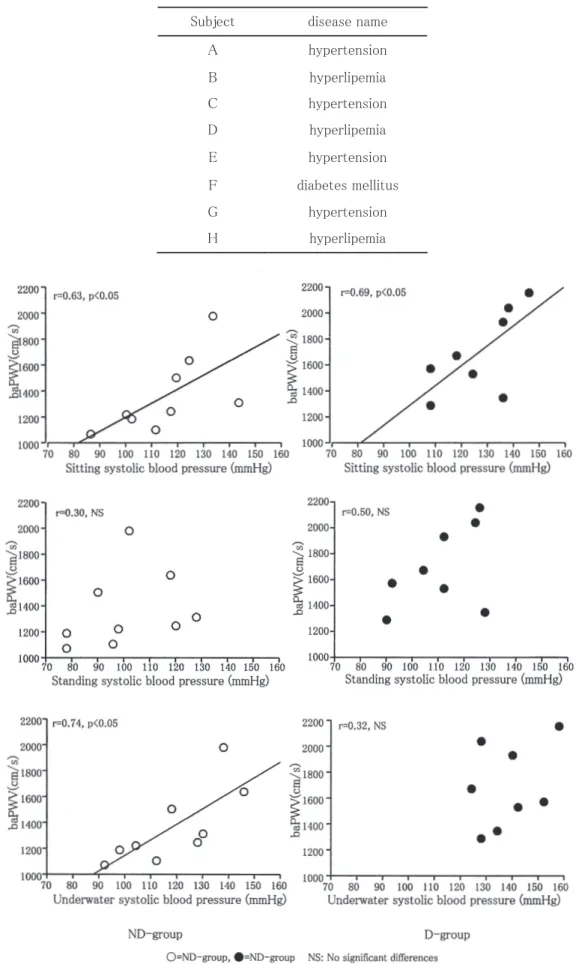
The baPWV in D-group was significantly higher than the baPWV in ND-group (p<0.05, Table 1). In the Se-position, the correlation of systolic blood pressure and baPWV, there was significant positive correlation with ND-group (r=0.63, p<0.05) and D-group (r=0.69, p<0.05). However, In W-position, the underwater systolic blood pressure positively correlated with baPWV in ND-group (r=0.74, p<0.05) while there was no significant relationship in D-group (r=0.32, NS). No significant correlation was seen at St-position in either group (Figure 3).
Table 2 The disease name of subjects in D-group
Fig. 3 Relationship between baPWV and underwater systolic blood pressure in ND-group and D-group Table2. The disease name of subjects in D-group
Subject disease name
A hypertension B C hyperlipemia hypertension D hyperlipemia E hypertension F diabetes mellitus G hypertension H hyperlipemia
Nozomi Matsumoto and Sho Onodera 34
Discussion
The earlier study reported that underwater blood pressure increased in middle-aged and elderly people [10,11]. It was thought that the increase of underwater blood pressure of middle-aged and elderly people was related to the increase of arterial stiffness. Blood pressure was higher underwater than on land similar to an earlier study. And this study also established that the people with a high level of arterial stiffness had higher blood pressure underwater.
Previous studies reported that a high positive correlation was seen between arterial stiffness and systolic blood pressure on land [13,14]. In this study, there was positive correlation between arterial stiffness and systolic blood pressure at Se-position in both groups. However, in D-group, the correlation disappeared in W-position underwater. People who were taking medicine were included in D-group. We could not completely remove the influence of medicine on their cardiovascular system. However, people in D-group were exercising based on the permission of their doctor, and they had been exercising for more than one year. In other words, they were used to aquakinetics, and their symptoms were mild enough to be able to engage in exercise. However, their blood pressure was unstable underwater. Meanwhile, there was no correlation in St-position in either group. We measured blood pressure right after the subject moved to a standing position from a seated position. We thought that there was not enough time for the circulatory system to functionally adapt. In water, we measured blood pressure about 5 minutes after water immersion. There is not a unified opinion about how long it should take for middle-aged and elderly people to adapt to water. Onodera et al. reported that blood pressure of middle-aged and elderly people was higher underwater than on land, and did not change from 0 to 15 minutes [10]. Meanwhile, Sudo et al. reported that the heart rate of patients with hypertension required about 105 seconds until a static state was reached [15]. In regard to cardiovascular responses, it is generally accepted that the hydrostatic pressure associated with water immersion induces a central shift in blood volume from the lower limbs and abdomen into the thoracic region. This blood shift is considered to bring about facilitated central venous return, with greater preload and stroke volume [16]. It is reported that this phenomenon occurs after water immersion for several minutes. Thus, we estimated that subjects of this study had adapted circulation responses to water immersion. In this study, the systolic blood pressure of D-group was higher in water. In addition, the underwater systolic blood pressure significantly increased in D-group compared with ND-group. It was also indicated that the increase in systolic blood pressure made up for the circular arterial blood volume due to arterial baroreflex in the water [17]. Meanwhile, pulse rate decreased in the water in both groups. Usually, the decrease in heart rate has to reduce blood pressure. Earlier studies reported that the underwater pulse rate was decreased because of the increase in the stroke volume and venous return induced by hydrostatic pressure [18,19]. In addition, we thought that this reduction is more than compensated by the increase of vascular resistance in the water to the increase of blood pressure.
Blood pressure is attributed to cardiac output, peripheral vascular resistance, arterial blood volume, blood viscosity and aortic elasticity [20]. The peripheral vascular resistance influences blood pressure most. The PWV evaluates the elasticity of arterial medium. This study investigated the relationship the elasticity of arterial medium blood pressure in the water. Therefore it was difficult to evaluate a buffer function of capillary consisting of endothelium in this index. We think that it is necessary to estimate underwater blood pressure variation and peripheral vascular resistance in future.
In ND-group, the arterial stiffness was related to systolic blood pressure in water and on land. However, in D-group, there was no relation. In addition, they also showed a higher underwater systolic blood pressure and arterial stiffness than ND-group. This implies that the vascular property of the subjects of D-group is already altered and advanced due to their disease and is not corrected by regular exercise. We intend to study further on this matter focusing on people with lifestyle-related diseases who do not exercise
regularly in the future. This study suggests that being underwater has a different effect on the blood pressure in people with lifestyle-related diseases. This indicated it is difficult to predict the underwater blood pressure of people with lifestyle-related diseases by their level of arterial stiffness. These people may require extra care and attention when they exercise in the water.
Conclusion
Underwater systolic blood pressure significantly increased in healthy middle-aged and elderly women compared with the people with lifestyle-related diseases. It was suggested that the increase of systolic blood pressure in middle-aged and elderly people in water was related to arterial stiffness. In addition, people with lifestyle-related diseases have unstable systolic blood pressure in water.
Acknowledgements
We thank the participants who gave their time to this study. And we also thank Mr. Hiroaki Yamanaka and the OSK medical fitness club staff for being so helpful.
References
1. Pak PH, Maughan L, Baughman KL, Kass DA: Marked discordance between dynamic and passive diastolic pressure-volume relations in idiopathic hypertrophic cardiomyopathy. Circulation 94: 52-60, 1996.
2. Rajkumar C, Cameron JD, Christophidis N, Jennings GL, Dart AM: Reduced systemic arterial compliance is associated with left ventricular hypertrophy and diastolic dysfunction in older people. J Am Geriatr Soc 45: 803-808, 1997.
3. Matsumoto N, Miyachi M, Takahashi K, Andou Y, Kobori H, Onodera S: Comparison of systemic arterial stiffness of exercise intervention or non-intervention in middle-aged and elderly women. Training Sci 22: 247-256, 2010.
4. Benetos A, Safar M, Rudnichi A, Smulyan H, Richard JL, Ducimetiere P, Guize L: Pulse pressure: a predictor of long-term cardiovascular mortality in a French male population. Hypertension 30: 1410-1415, 1997.
5. O’conner GT, Buring JE, Yusuf S, Goldhaber SZ, Olmstead EM, Paffenbarger RS, Jr Hennekens CH: An overview of randomized trials of rehabilitation with exercise after myocardial infraction. Circulation 80: 234-244, 1998.
6. Tomiyama H, Koji Y, Yamabe M, Shiina K, Gulnisa Z, Yamamoto Y, Yamashina A: Elevated C-reactive protein augments increased arterial stiffness in subjects with the metabolic syndrome. Hypertension 45: 997-1003, 2005.
7. Onodera S, Miyachi M, Yano H, Nakamura Y, Kimura K: Effect of differences in buoyancy of water on oxygen uptake and heart rate during swimming. Med Sport Sci Basel Karger 39: 126-130, 1994.
8. Onodera S, Miyachi M, Yano H, Kimura K, Nakamura Y, Ikeda A: Influence of viscous resistance and water temperature during treadmill walking in water. Kawasaki J Med Welfare 3: 167-174, 1993.
9. Nishimura K, Yoshioka A, Onodera S: Relationship between supine floating after cycle exercise and heart rate and cardiac parasympathetic nervous system modulation in middle-aged and elderly subjects. Kawasaki J Med
Welfare 19(2): 291-295, 2010.
10. Onodera S, Miyachi M, Yano H: Safety and validity of aquatic exercise for the aged considering from a viewpoint of blood pressure. Desant Sports Sci 17: 53-61, 1996.
11. Nishimura M, Yamamoto K, Hoshijima Y, Torigoe Y, Abo S, Miyachi M, Onodera S: Effect of relaxation in the water on heart rate, blood pressure and oxygen uptake in the elderly. Hiro.kyuyo 13: 93-100, 1998.
Nozomi Matsumoto and Sho Onodera 36
Hofman A, Witteman JC: Association between arterial stiffness and atherosclerosis: the Rotterdam Study.
Stroke 32: 454-460, 2001.
13. Tomiyama H, Yamashina A, Arai T, Hirose K, Koji Y, Chikamori T, Hori S, Yamamoto Y, Doba N, Hinohara S: Influence of age and gender on results noninvasive brachial-ankle pulse wave velocity measurement –a survey or 12517 subjects. Atherosclerosis 166: 303-309, 2003.
14. Yamashina A, Tomiyama H, Arai T, Koji Y, Yamabe M, Motobe H, Glunizia Z, Yamamoto Y, Hori S: Nomogram of the relation of brachial-ankle pulse wave velocity with blood pressure. Hypertens Res 26: 801-806, 2003. 15. Sudo A, Tsunoda N, Taguchi N, Ijiri K, Komiya S: Effects of intramuscular oxygen hemodynamics in
hypertensive patients in water immersion. Desant Sports Sci 25: 94-102, 2004.
16. Connelly TP, Sheldahl LM, Tristani FE, Wann LS, Sager KB, Levandoski SG, Ptacin MJ, Sobocinski KA, Morris RD: Effect of increased central blood volume with water immersion on plasma catecholamines during exercise. J Appl Physiol 66: 657-664, 1990.
17. Matsui T, Miyachi M, Ueno LM, Onodera S: Effects of bathing and post-exercise bathing on autonomic cardiovascular regulation in middle-aged and older men. Desant Sports Sci 25: 145-157, 2004.
18. Matsui T, Miyachi M, Saito T, Nakahara H, Koeda M, Hayashi N, Onodera S: Cardiovascular responses during moderate water exercise and following recovery. Biomech Med SwimmingⅧ 345-350, 1999.
19. Onodera S, Miyachi M, Nishimura M, Yamamoto K, Yamaguchi H, Takahashi K, In JY, Amaoka H, Yoshioka A, Matusi T, Hara H: Effect of water depth on abdominal [correction of abdminails] aorta and inferior cave during standing in water. J Gravit Physiol 8: 59-60, 2001.
20. Nichols WW, O’Rourke MF: M’cDonald’s Blood Flow in Arteries, Theoretical, Experimental, and Clinical Principles, 4th ed, London, Arnold, 1998.