著者
Gladman Tehmina Banatwala, Szarkowski Amy,
Curl Layton Seth
雑誌名
比較文化
巻
13
ページ
87-96
発行年
2007
Comparative Culture, 13: 87-96, 2007
Motivation for Second Language Learning: An
Exploratory Study in Japan
Tehmina Banatwala Gladman, Amy Szarkowski, and Layton Seth Curl
本論文は日本における第二外国語学習意欲の研究である。英語のみで教育を受ける 日本の大学生の内的意欲、外的意欲、意欲のなさ、多文化を理解したいという意 欲、旅行や仕事のために外国語を学びたいという意欲が計測された。過去の研究結 果(Gardner, 1985, Gardner & Smythe, 1975, Trafford, 1995, & Wright, 1999)から意欲につ いて年齢差と性別差があることが仮定された。総合的に女子の意欲の高さが仮定さ れた。大学一、二年生は高い内的意欲と意欲のなさを示す一方、大学三、四年生は 大学卒業後の生活を考慮し始める為に高い外的意欲を示すことが仮定された。この 大学の特性から、中退せずに在籍し続ける学生は総合的に意欲が高く、同時に意欲 のなさは低いことが仮定された。結果として三つの異なる分野の意欲においては性 別差が発見されたが、それらは仮定と相違していた。またひとつの分野の外的意欲 と意欲のなさにおいては年齢差が発見された。しかし、上記以外には、特に顕著な 相違は発見されなかった。今回発見された様々な相違についての可能な説明と日本 の大学における学習意欲の研究をこれからどう進めるべきかについて考察された。
This paper presents a study of second language learning motivation in the Japanese context. Students at a sheltered immersion English college in Japan were measured on the variables of intrinsic, extrinsic, and amotivation as well as integrative and instrumental motivation. Based on previous research (e.g. Clark & Trafford, 1995; Gardner, 1985b; Gardner & Smythe, 1975; Wright, 1999) it was hypothesized that there would be differences in motivation both by age and sex. Females were hypothesized to show higher levels of motivation overall. Younger students were hypothesized to show higher levels of intrinsic types of motivation and higher levels of amotivation, while older students were expected to show higher levels of extrinsic motivation as they begin to focus on their lives after
graduation from university. It was also hypothesized that based on the unique nature of the university, students who stayed would show high levels of motivation overall and
correspondingly low levels of amotivation. Results showed sex differences in the levels of intrinsic motivation—accomplishment; extrinsic motivation—introjected regulation; and extrinsic motivation—external regulation. However, these differences were not in the expected direction. Age differences were also found in levels of extrinsic motivation— external regulation and amotivation. However, aside from these specific domains of motivation, there were no major differences found across the spectrum of motivational levels. Discussion focused on possible explanations for the differences that were discovered as well as possible ways forward in researching motivation in Japanese universities.
otivation has been studied across many different fields and in many different ways over the years. This has lead to an understanding of the different ways in which motivation manifests itself depending on whether the field of study is education, psychology, sociology, or other social science fields. Generally, motivation can be defined as “internal processes that initiate, sustain and direct behavior” (Coon, 2000, p.378). However, when developing theories of motivation, researchers have subdivided this broad definition to more clearly
M
Tehmina Gladman teaches at Miyazaki International College. Amy Szarkowski works at The Children's Hospital of Boston (USA). Layton Seth Curl teaches at Metropolitan State College of Denver (USA). Correspondence may be sent to: MIC, 1405 Kano, Kiyotake-cho, Miyazaki-gun, Japan 889-1605, Tel: 0985-85-5931, Fax: 0985-84-3396, E-mail: [email protected]
delineate the various forms of motivation and the situations in which those forms might manifest themselves.
Motivation-General
In education, motivation has generally been defined as taking three forms; that of intrinsic motivation (IM), extrinsic motivation (EM) and amotivation (Deci, 1975).
Intrinsic Motivation
Deci (1975) defined intrinsic motivation as participating in an activity because it is fun and satisfying. Vallerand, Pelletier, and colleagues (1992) further divide intrinsic motivation into knowledge, accomplishment, and stimulation. IM-Knowledge can be defined as the feelings associated with exploring new ideas and gaining knowledge. IM-Accomplishment describes the sensations related to mastering a task or achieving a goal. Finally, IM-Stimulation is related to sensations that are stimulated by performance of the task, such as excitement or fun. As can be seen from these definitions, each level of intrinsic motivation is related to the types of feelings associated with a particular aspect of learning. Thus, we can feel the enjoyment of learning new things (IM-Knowledge), the satisfaction of a job well done Accomplishment), and/or the excitement of performing a task (IM-Stimulation). Each of these relate the personal feelings involved in the task being accomplished.
Extrinsic Motivation
Extrinsic motivation can be defined as “actions carried out to achieve some end, like receiving a reward or avoiding punishment” (Noels, Pelletier, Clement, & Vallerand, 2003, p.39). Again, extrinsic motivation research led to the development of three levels of motivation based on the amount of self-determination involved (Deci & Ryan, 1985). These have been termed external regulation, introjected regulation, and identified regulation (Vallerand, Pelletier, Blais, Briere, & et al., 1993; Vallerand et al., 1992). External regulation occurs when activities are determined by sources outside the person, such as benefits and costs. Introjected regulation is activity due to some kind of previous external pressure that the person has made internal. Finally, identified regulation is activity by an individual because they choose to do so for some personal external goal.
With each level of extrinsic motivation, the amount of external pressure decreases, and the internalization of motivation increases. Thus, external regulation involves motivation due completely to outside sources, such as studying in order to get an A or avoid failing a course or behaving honestly because a person wants to avoid prison. Introjected regulation is motivation due to internalized external pressures such as striving to do well in school because it will please parents, or choosing to go to medical school because father was a doctor. The most internalized form of extrinsic motivation, identified regulation, is motivation for personal external goals, such as a desire to be the valedictorian of the graduating class or be promoted to a position in management. In this case, the motivation is still extrinsic, but there is no pressure or cost/benefit analysis involved, rather, the motivation is self-oriented.
Motivation for Second Language: An Exploratory Study in Japan 89
Amotivation
When people see no relation between their action and the consequences, amotivation is the result (Noels et al., 2003). Instead, for these people, the consequences are seen as out of their control. In this case, a person would try to quit performing an activity as soon as possible (Noels et al., 2003). This often occurs in situations where the learner feels helpless to control their environment and views consequences of their actions as relatively random. As a result, they develop learned helplessness, which is often characterized by lethargy and unwillingness to attempt any activities.
Motivation-Language Learning Specific
Starting around the mid-1950s, researchers began to take note of motivational domains that appeared to be specific to the foreign language learning context (e.g. Cox, 1955; Gardner & Lambert, 1959; Lambert, Havelka, & Crosby, 1958). To this end, two language learning specific motivational forms have been theorized. Although similar to the general definitions of motivation discussed earlier, these forms take into consideration those aspects of individual values and attitudes which are seen to affect the learning of languages.
Integrative motivation refers to the desire to learn a language to become a part of the target community (Gardner & Lambert, 1959). There are three parts to this motivational type. They include integrativeness, attitude towards the learning situation, and motivation.
Integrativeness is an openness to identify, at least partly, with another language community. Recent research has indicated that of the three aspects of this domain, integrativeness can explain the greatest amount of variance in language learning outcomes (Csizer & Dornyei, 2005). Attitude towards the learning situation refers to the person’s reaction to the immediate context of the learning situation. This can range from a complete dislike of the time spent studying the language and a feeling that it is a waste of time to a belief that the study of the language is extremely useful and enjoyable (Randhawa & Korpan, 1973). Motivation is seen as goal-directed behavior and refers to how much time and effort is spent on the language of interest, including reading or watching TV and movies in the target language, studying for class work, and completing assignments in a timely manner for class (Gardner, 1985b).
The second language learning specific motivation is called instrumental motivation. This refers to the desire to learn a language for utilitarian purposes such as travel or work (similar to aspects of extrinsic motivation) (Gardner & Lambert, 1959).
Japanese Context
The Japanese context for this study is a sheltered immersion English four-year college which teaches all the major content areas, with the exception of Japanese Expression classes, in English. Although it is expected that all students at this college would be highly motivated to study English, having chosen an English immersion college program, the form their motivation takes would not necessarily be the same. Thus, MIC is a useful context in which to study what form motivation takes in university students studying foreign language. It is hoped that this study will be extended to look at students in traditional Japanese universities and compare them to students in the various English immersion programs that are
becoming popular in Japan to see if motivation is different both by age and by type of university attended.
Sex and Age
A surprising amount of research has been carried out which indicates that, at lower grade levels at least, there are definite sex and age differences in attitudes towards and motivation for learning foreign languages (e.g. Baker & MacIntyre, 2000; Clark & Trafford, 1995; MacIntyre, Baker, Clement, & Donovan, 2003; Wright, 1999). Most of these studies have focused on the French-Canadian context and have primarily studied students in middle and high school grades. However, the research is strong enough to warrant an expectation that similar findings would show up in other contexts and with other age groups.
For example, Clark and Trafford (1995) found that modern language study was viewed as a feminine topic of study. Related to this, Wright (1999) showed that not only did girls show more positive attitudes towards learning French in an adolescent sample, but that sex was the strongest predictor of attitudes towards learning the language. Interestingly, Baker and MacIntyre (2000) found that in a study of high school students in immersion and non-immersion French programs, male immersion students showed higher levels of extrinsic or instrumental orientation for work, while female non-immersion students showed higher levels of motivation for travel, knowledge, and personal achievement.
Other research has measured differences in attitude towards the target language by grade and found an inverse curve in the attitude towards learning a foreign language. A number of studies have shown that students first learning a foreign language show highly positive attitudes toward the target language which fade through the middle years of study and then seem to show an increase in positive attitudes in the final year of study of the language in middle and high school (Gardner & Smythe, 1975; MacIntyre et al., 2003).
Hypotheses
Based on the previously described research, three hypotheses were proposed to test in this study. First, based on the unique nature of the college environment the participants are expected to show high levels of all forms of motivation and correspondingly low levels of amotivation. It was also predicted that there would be both sex and age differences in both the level and type of motivation experienced by the participants. Women were predicted to show higher levels of motivation than men. In terms of age, first year students were predicted to show higher levels of intrinsic and integrative motivation as well as amotivation and lower levels of extrinsic and instrumental motivation than upper division students.
METHOD
Participants
Participants in this study were 60 college students of which 37 were female and 21 were male (two students did not list their sex). The sample was comprised of 35 first year students and 24 third/fourth year students (one student did not list their year). All were students attending a small liberal arts sheltered immersion college.
Motivation for Second Language: An Exploratory Study in Japan 91
Students were approached in various public spaces around campus and asked to complete a survey about motivation. They were informed that the survey would take approximately 15 minutes. Students were given the survey and told they could complete it in their own time and return it to a box in the lead author’s office during business hours. Data collection occurred during a one week period in the Fall of 2006
Materials
Students were given an instrument comprising the Academic Motivation Scale (AMS) (Vallerand et al., 1992) which was adapted to fit the specific situation of language learning rather than learning in general, and the Motivation Test Battery (MTB) which was adapted from the Attitude/Motivation Test Battery (Gardner, 1985a) as well as basic demographic questions.
The Academic Motivation Scale measures intrinsic motivation-knowledge, intrinsic motivation-accomplishment, intrinsic motivation-stimulation, extrinsic motivation-external regulation, extrinsic motivation-introjected regulation, extrinsic motivation-identified regulation, and amotivation. Participants read the question “Why do you study a foreign language?” and then read a set of 28 statements and mark how much they agree or disagree with each statement on a scale from one to seven in relation to the original question. The original AMS includes statements such as, “Because with only a high school degree I would not find a high paying job later on…” or “Honestly, I don’t know; I really feel I am wasting my time in school…” as well as statements such as, “Because I experience pleasure and satisfaction while learning new things.” These statements were adapted to a language context by changing specific situations to language-based contexts. For example, the first statement listed above was changed to “Because with only one language I would not find a high paying job later on.” While the last statement regarding pleasure and satisfaction was left as written. In all, ten statements were adjusted to show a more language-oriented context.
The Motivation Test Battery consists of thirty statements on a seven-point Likert scale that measure instrumental motivation, integrativeness, attitude toward the learning situation and motivational intensity. The scales of integrativeness, attitude toward the learning situation, and motivational intensity may be combined to determine a total score on integrative motivation.
This scale was originally written to measure the second language learning motivation of students studying French. It was adapted from the original with the change of the language listed such that for example, “I love learning French…” was changed to “I love learning English.”
Procedure
Before beginning the study, the survey instrument was translated into Japanese and then back-translated by a second individual to test for accuracy of the translation. Students were approached in public areas of the college and asked to complete and return the survey in their own time. The surveys were completed anonymously and placed in an envelope. Analysis consisted of calculating descriptive statistics and ANOVA by sex and year. As this study is exploratory in nature and a pilot test to determine the usefulness of further research, a Type I error level of 0.1 was chosen to maximize the possibility of finding significant results in the data.
RESULTS
Descriptive Statistics
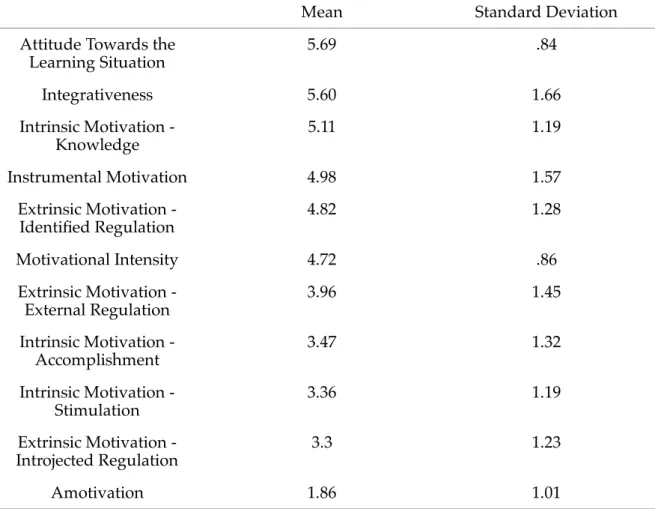
Cronbach's alpha for each scale was strong at .90 for AMS and .85 for MTB, indicating good inter-item reliability. Table 1 lists the means and standard deviations of each of the variables of interest.
Table 1. Descriptive Statistics ranked by mean
Mean Standard Deviation
Attitude Towards the
Learning Situation 5.69 .84 Integrativeness 5.60 1.66 Intrinsic Motivation -Knowledge 5.11 1.19 Instrumental Motivation 4.98 1.57 Extrinsic Motivation -Identified Regulation 4.82 1.28 Motivational Intensity 4.72 .86 Extrinsic Motivation -External Regulation 3.96 1.45 Intrinsic Motivation -Accomplishment 3.47 1.32 Intrinsic Motivation -Stimulation 3.36 1.19 Extrinsic Motivation -Introjected Regulation 3.3 1.23 Amotivation 1.86 1.01
ANOVA by Year and Sex
ANOVA was calculated for the various motivational variables by both sex and year in college. Sex differences were found in intrinsic accomplishment, extrinsic introjected regulation, extrinsic motivation-external regulation, as well as extrinsic motivation overall. Table 2 shows the mean, standard error, ANOVA statistics and significance for each of the measures where differences were found.
When comparing students by year, the ANOVA showed that only two of the variables showed a significant difference. These were extrinsic motivation-external regulation and amotivation. However, as with the sex differences, the overall level of extrinsic motivation was also found to be significantly different between lower and upper division students. Table 3 shows the ANOVA data by year.
Motivation for Second Language: An Exploratory Study in Japan 93
Table 2. Selected ANOVA Results by Sex
Sex Mean S.E. Source DF SS MS F Sig.
IM-Accomplish ment Female 3.20 .21 Sex 1 8.16 8.16 5.03 0.03 Male 3.98 .28 Error 56 90.88 1.62 EM-Introjected Regulation Female 3.08 .19 Sex 1 7.34 7.34 5.31 0.02 Male 3.82 .26 Error 56 77.40 1.38 EM-External
Regulation Female 3.74 .22 Sex 1 9.72 9.72 5.46 0.02
Male 4.60 .29 Error 56 99.75 1.78
EM-Total Female 3.86 .17 Sex 1 5.01 5.01 4.83 0.03
Male 4.48 .22 Error 56 58.10 1.04
Table 3. Selected ANOVA Results by College Level
Class
Level Mean S.E. Source DF SS MS F Sig.
EM-External
Regulation Lower 4.29 .24 Year 1 7.02 7.02 3.59 0.06
Upper 3.58 .29 Error 57 111.60 1.96
Amotivation Lower 2.09 .16 Year 1 4.33 4.33 4.41 0.04
Upper 1.54 .20 Error 57 55.97 0.98
EM-Total Lower 4.26 .18 Year 1 4.09 4.09 3.58 0.06
Upper 3.23 .22 Error 57 65.18 1.14
DISCUSSION
Before discussing how the results relate to the hypotheses first stated, it is important to look at the limitations of the study. First, the study uses a small sample size and so it is not possible at this time to generalize results beyond the current sample of students. Second, the sample was drawn from a single college with a unique mission in higher education in Japan. Again this limitation renders generalization to a wider context impossible. Finally, at the time of submission of the survey, some students expressed concern that some of the questions seemed strange and not easy to answer. This indicates that there is a possibility that a more emic approach to studying motivation in Japan may be needed in the future.
In looking at the results of the study each prediction was at least partly supported. As was predicted in hypothesis one, students at MIC show high levels of motivation overall and low levels of amotivation. More specifically, it was found that this sample shows high levels of intrinsic motivation for knowledge as well as two of the three subscales of integrative motivation, integrativeness and attitude toward the learning situation. The high levels of integrativeness in particular fit well with the statistical work done by Csizer and Dornyei (2005) who highlighted the importance of integrativeness in developing foreign language skills. It is, however, surprising that instrumental motivation was not more highly rated, as both integrative and instrumental motivation are seen as language specific types of motivation. This difference may indicate that this set of students, at least, are more highly motivated by a desire to be able to fit in with those who speak the target language than by pragmatic reasons. This may be due, in part, to the fact that they are attending a college where the majority of faculty are from outside of Japan, giving students a reason to try to fit in to what they perceive as the target culture of MIC.
This leads into an explanation for the high levels of intrinsic motivation for knowledge. As students at MIC, they have entered the college with an understanding that education is handled differently when compared to other colleges and universities in Japan, and that MIC uses a student-centered approach to learning. This may make them feel more in control of their surroundings and more able to take pleasure in learning for learning's sake, rather than merely as a means to some end.
Hypothesis two predicted that differences would be seen in the motivational types shown by upper and lower division students. Indeed, first year students showed significantly higher levels of amotivation than upper division students. However, it is important to reiterate that for all students the level of amotivation was extremely low and students in this sample, at least, seem to have very little feeling of being unable to control their situation, nor do they show much in the way of learned helplessness. It is, however, possible that as first year students are still relatively new to the MIC context, they are not yet sufficiently confident in their abilities to feel in control when compared to the upper division students who have had time to become acclimated to the unique teaching style and have the added benefit of having spent a semester studying abroad.
First year students also showed higher levels of external regulation and extrinsic motivation overall. As external regulation is, to a certain extent, motivation due to a cost-benefit analysis (Vallerand et al., 1993; Vallerand et al., 1992), it is probable that first year students are motivated to study because of some external set of benefits or costs to them. Perhaps, they are worried about disappointing their parents, or looking foolish in front of their peers. It would be useful to conduct interviews asking students for more detail about their specific reasons for studying English.
The significant difference between first year students and upper division in extrinsic motivation was in the opposite direction of that predicted. It was hypothesized by the authors that first year students would be eager and excited about the immersion context they were entering and would be motivated primarily by an interest in the target language culture as well as positive attitudes towards that culture. Also, based on anecdotal evidence it was thought that the first year students would be much more intrinsically motivated, while upper division students would have lost that initial enthusiasm and developed a more instrumental
Motivation for Second Language: An Exploratory Study in Japan 95
and extrinsic orientation towards the learning of English (Baker & MacIntyre, 2000; Gardner & Smythe, 1975).
Finally, the third hypothesis that there would be differences between men and women was also shown to be as predicted. Interestingly, in all three types of motivation where a significant difference was found, men scored higher than women. This comes as something of a surprise as most instructors would probably be able to tell many stories of high achieving women and low achieving men in their classrooms. However, men were found to show significantly higher levels of accomplishment, introjected regulation, and external regulation as well as extrinsic motivation overall. Perhaps the definitions of these types of motivation can give some clue as to why they would be higher for men in this sample. According to Vallerand and colleagues (1993), accomplishment is motivation to complete something for the feeling of mastery of the task while introjected regulation is an external pressure that has been internalized and external regulation is due to external sources. When viewed in relation to the work by Baker and Macintyre (2000), these results begin to make more sense. Baker and MacIntyre found similar gender differences across three of four orientations towards language learning in a sample of students in a French immersion program. Men showed a nonsignificant increase in orientation for job, orientation for meeting francaphones, and orientation for personal achievement. The only orientation where women in this study showed higher means was in the orientation for travel. These results at least partly support the findings of the current study.
CONCLUSION
This research represents a first step in understanding motivation to learn foreign languages in Japanese college students. Although there were only a few differences found between men and women and upper and lower division students, differences were found, lending support for developing a larger scale study to probe more deeply into foreign language learning motivation in Japan. The next step will be to expand this study both to other immersion style colleges as well as to more traditional public universities to determine if these results are unique to the MIC context, or can be generalized to Japanese students across Japan. Once this has been established, it is hoped that cross-cultural research can begin to determine similarities and differences between students of foreign languages in other countries and contexts.
References
Baker, S. C., & MacIntyre, P. D. (2000). The role of gender and immersion in communication and second language orientations. Language Learning, 50(2), 311-341.
Clark, A. J., & Trafford, J. (1995). Boys into modern langauges: An investigation of the disrepancy in attitudes and performance between boys and girls in modern language. Gender and Education, 7, 315-325.
Coon, D. (2000). Essentials of Psychology: Exploration and Application. Singapore: Thomson Learning.
Cox, F. N. (1955). The prediction of success and failure in learning foreign languages. Australian Journal of Psychology, 7, 56-65.
Csizer, K., & Dornyei, Z. (2005). The Internal Structure of Language Learning Motivation and Its Relationship with Language Choice and Learning Effort.
The Modern Language Journal, 89(1), 19-37.
Deci, E. L. (1975). Intrinsic motivation. Plenum Press: New York.
Deci, E. L., & Ryan, R. M. (1985). The general causality orientations scale: Self-determination in personality. Journal of Research in Personality, 19(2), 109-134. Gardner, R. C. (1985a). The Attitude Motivation Test Battery: Technical report.
London, Ontario, Canada: University of Western Ontario, Department of Psychology.
Gardner, R. C. (1985b). Social Psychology and Second Language Learning: The Role of
Attitudes and Motivation. London: Edward-Arnold.
Gardner, R. C., & Lambert, W. E. (1959). Motivational variables in second-language acquisition. Canadian Journal of Psychology, 13, 266-272.
Gardner, R. C., & Smythe, P. C. (1975). Second language acquisition: a social psychological approach (Research Bulletin No. 332): Department of Psychology, University of Western Ontario, London.
Lambert, W. E., Havelka, J., & Crosby, C. (1958). The influence of language-acquisition contexts on bilingualism. The Journal of Abnormal and Social
Psychology, 56(2), 239-244.
MacIntyre, P. D., Baker, S. C., Clement, R., & Donovan, L. (2003). Sex and age effects on willingness to communicate, anxiety, perceived competence, and L2 motivation among junior high school French immersion students. Language
Learning, 53(Suppl1), 137-166.
Noels, K. A., Pelletier, L. G., Clement, R., & Vallerand, R. J. (2003). Why are you learning a second language? Motivational orientations and self-determination theory. Language Learning, 53, 33-64.
Randhawa, B. S., & Korpan, S. M. (1973). Assessment of some significant affective variables and the prediction of achievement in French. Canadian Journal of
Behavioural Science Revue canadienne des Sciences du comportement, 5(1), 24-33.
Vallerand, R. J., Pelletier, L. G., Blais, M. R., Briere, N. M., & et al. (1993). On the assessment of intrinsic, extrinsic, and amotivation in education: Evidence on the concurrent and construct validity of the Academic Motivation Scale.
Educational & Psychological Measurement, 53(1), 159-172.
Vallerand, R. J., Pelletier, L. G., Blais, M. R., Briere, N. M., Senecal, C., & Vallieres, E. F. (1992). The Academic Motivation Scale: A measure of intrinsic, extrinsic, and amotivation in education. Educational & Psychological Measurement, 52(4), 1003-1017.
Wright, M. (1999). Influences on learner attitudes towards foreign language and culture. Educational Research, 41, 197-208.