The Characteristics of Self-care Ability and Self-care support for Successful Community Living among Schizophrenic Patients
Readmitted within 3 months of Discharge, or with Continued Hospitalization of more than 3 months in M-CBCM.
Natsuki Shimozono11, Shiori Usami2>, Yoko Nakayama3', Kiyoka Nozue'", Chisato Yano5)
Abstract '. The purpose of this study was to describe the characteristics of self-care ability &
self-care support among 29 schizophrenic patients who received M-CBCM. These patients were either readmitted within three months of their previous discharge or their hospitalization continued more than three months. This study got the permission from Research Ethical Committee of Kumamoto University in 2009. Twenty nine patients were provided M-CBCM, but finally, they were divided into two groups. C-group (N=17) was able to live in the commu nity for more than three months after discharge. But D-group(N=12) was either readmitted within 3 months of discharge. In C-group, significant improvements were recognized regarding self-care ability. Self-care ability and self-care support were analyzed qualitatively. In C-group, patients could make use of family support and they could learn from their experience. But in D-group, they had poor symptom & medication management, they were lack of insight to themselves, and they had poor impulsive control. Nurses provided individualized care for expected outcome in C-group, but there was unclear treatment goal in D-group. For patients' successful community living, nurses needed to set the goal and to spend time with patients for improvement of self-care ability which was needed in the community.
Key words '. Schizophrenia, Self-Care support, Successful community living, Modified Commu nity Based Care Management, Self-Care ability
zation group) and the rest (40%) are hospi- I . Introduction talized for longer than a year. The number of patients whose hospital stay is less than a At present, the average duration of hospi- year includes those who repeat hospitaliza- talization of psychiatric patients in Japan is tion within 3 months after the last discharge the longest in the world, 310.8 days. Of the and those who are hospitalized longer than 3 total number, 60% are hospitalized for less months,
than a year (a potential long-term hospitali- Among today's psychiatric medical services, 1) Graduate School of Health Sciences, Kumamoto University 2) Faculty of Life Sciences, Kumamoto University 3) School of Nursing, Fukushima Medical University 4) School of Medical and Nursing, Keio University 5) Kikuyo Hospital
Corresponding author: Natsuki Shimozono, Email; [email protected]
mtt&m&U&%&ft*iL%QS8 •£ (2012) Natsuki Shimozono et al.
division in the functions of psychiatric hospi tals is being promoted, and the number of the Acute-stage Care Unit and the Super Emergency Psychiatric Care Unit is increasing. At the same time, support for deinstitutionalization and community living is being emphasized. However, there are still many repeat readmissions shortly after dis charge, and many patients who tend to pro long their hospital stay; both of which imply that deinstitutionalization and/or community living support is not working effectively.
On the other hand, Japan is facing a shortage of physicians and regional dispari ties in medical services. This shortage is se vere enough that the government is promot ing an increase in the number of physicians, role division, and teamed medical services in volving the various medical professions". In such an environment it is not surprising that experienced Certified Nurse Specialists (CNS) who have completed graduate school and are certified by the Japanese Nursing Associa tion are very active in the field. The roles of the CNS includes direct care for psychiatric patients with severe mental illness, consulta tion with medical care staff members, educa tion for improving the care quality of hospi tals and the in-patient units, research study towards the improvement and maintenance of care quality, and mediate ethical issues when such matters arise. The role of any given CNS differs according to the individual insti tutional setting. In Japan at present, enlarg ing the scope of discretionary action of such advanced nurse practitioners as the CNS and attaining the right of professional discretion are being actively discussed in the medical service field. These caregivers, particularly
psychiatric nurses who attend patients with serious symptoms attempting discharge and settlement in the community after the long hospital stays, are expected to play an im portant role"'.
Usami et al. modified the internationally recognized Community Based Care Manage ment (CBCM) [formerly known as Intensive Care Management (ICM)] which focuses on discharge support and community settlement of patients who repeat admissions shortly af ter discharge and who are hospitalized for more than 3 months. The modification was based on a foundation of and thorough knowledge of the special features of psychiat ric medical care and the results of prior re search and studies. The Modified CBCM (M- CBCM) was conducted with subject patients and evaluated. Results clearly show a suc cessful reduction of readmissions within 3 months of discharge, and improvement of so cial functioning ability and daily life skills of schizophrenic patients31. However, regarding self-care support which is an important func tion of psychiatric nursing; the actual self- care conditions or self-care support methods among the long-term hospitalization reserve group were not known well to us. This study, therefore, is intended to shed light on the self-care conditions of the long-term hos pitalization reserve group and to gain a clearer understanding of the characteristics of self-care support in the M-CBCM.
The reserve group is defined as psychiatric patients with repeated admissions within 3 months of previous discharge, and those whose hospitalization is for more than 3 months, both of whom show similar or common properties as psychiatric patients
- 3 2 -
according to the results of our previous study4'.
II. Review of Literature
1 . Study Regarding Self-care of Psychiatric
Patients
Regarding self-care of the patient, the Orem-Underwood Model was introduced in 1985, which was a modification of the Orem theory, and this has been widely practiced in Japan. The Underwood definition of self-care ability invoked knowledge, skills, repertoire of the skill set, decision-making, insight and judgment, and motivation of the individual.
Underwood also defines self-care as the ac
tion of taking care of oneself using the abil ity to take care of oneself. She further stated that being able to make one's own decisions is also of utmost importance for psychiatric patients. It was called Self-determination.
Self-determination by oneself means to iden tify one's own needs in daily life and to set the identified needs as goals of one's self- care. This ability is to act according to some selected goals. Thus, self-care ability is a se ries of intentional processes5'.
After the introduction of this definition, studies of daily living and the self-care of psy chiatric patients slowly increased. Valimaki et al. interviewed 72 schizophrenic patients.
These interviews formed the base on which self-determination was categorized using the grounded theory approach. They sorted the patients into two groups; namely (1) 'Psychi
atric Patients with Self-Determination' - that is, they can conduct activities for them selves and they have a purpose for their ac tions, and (2) 'Patients with Limited Self-
Determination' or 'Patients Lacking Self- Determination' 6'.
McCann interviewed 9 psychiatric nurses on how to promote patient's self-care activi ties. In promoting self-care, McCann said that the important elements were (1) the nurse understands the purpose of the pa tient's actions, (2) reminding the patient to control himself/herself, and (3) to change the balance of the provided care and his/her
self-care7'.
Studies on the self-care of psychiatric pa tients in Japan are frequently conducted from the viewpoint of the patients' needs and their QOL improvement. Ando elucidated the daily living needs of 219 out-patients based on the elements of universal self-care. The most common daily-living-related needs of the patients were to get a job (male pa tients) and the stabilization of symptoms and restoration of health (female patients).
Regarding the professional help they receive, support from a psychiatrist was the top an swer followed by the Life Support Center staff and nurses. Regarding support from the people around them - family was number one followed by friends and peers. As for what the out-patients are most careful about in self-care; the use of fire, keeping oneself presentable by bathing and washing one's face, and keeping clean8'.
Shimasawa conducted an interview survey of seven psychiatric patients living at home in order to better understand the behavioral structure of their self-care actions. The sur vey reported such commonalities as 'eating meals, cleaning, and bathing', 'symptom man agement', 'medication management', 'daily schedule management', 'money management',
W*^g^$m^#fci^$ 8 tf (2012) Natsuki Shimozono et al.
'associating with others', 'spending time with family', "health management', 'spending time on what is enjoyed', 'having something one can spiritually rely on', and ' making prepa ration for future'9'.
Furthermore, Usami elucidated the self- care actions of 71 Schizophrenic patients liv ing in the community applying the Orem-
Underwood Self-Care Model and Deci's the ory on decision making as a research frame work. The self-care behaviors of Schizophrenic patients living in the community fall into two categories: one involving the practice of self-care decided by the patient her/himself, and the other practicing a habitual self-care or imposed self-care. Patients practicing self-
care under their own direction were in better mental health and their self-care decisions were influenced by symptoms. Further, they performed self-care for the purpose of im proving their existential value and QOL. In addition, those patients were trying to con trol their symptoms while managing their daily lives, and they regarded the creation of a structured daily life as being significant.
Even though each patient regarded different areas of daily life as more important, Usami reported that the selection of the important area by the patient was influenced by the length of associating with the symptoms, the seriousness of the symptoms, his/her social network, the psychological pain caused by the length of hospital stays and recurrences in the past11".
2 . Relation between the Efficacy of CBCM Abroad and the Self-Care of Psychiatric Pa tients
Since 1970, Intensive Care Management
(ICM), a community living support system, was developed abroad as a way to meet the needs of psychiatric patients who experienced repeated hospitalization or recurrences of symptoms. This support system has been re ferred to as Community Based Case Manage ment (CBCM) and has the same support content. Care/Case Management is one of the community care systems which helps psychiatric patients in the community take advantage of the diverse medical and social supports available for community living.
They are designed to provide continuous comprehensive support - from physiological to mental to social. In particular, CBCM has been given to patients with a long hospitali zation experience, those who have been re- hospitalized soon after their last discharge, those with repeat readmissions, frequent us ers of emergency units, those with severe ad dictions to drugs, and/or those having a criminal record. CBCM, being able to conduct crisis intervention in the community primar ily through management of symptoms and medication, provides support with nursing care and psycho-therapy in the patients' homes as well as providing counseling, fam ily therapy, daily living and job related sup port. Our experiences show that CBCM con tributes to prolonging the patient's commu nity living period. The details of support to the patients, the criteria of intervention, and the composition of the support team have not, however, been clarified.
Champney, Ruffolo, and Fransis respec tively conducted comparative studies on the correlation between provisions of ICM to the patients and their symptoms, and their self- care abilities. They reported that ICM
34-
improved symptoms and the self-care abilities of the patients as well as their feelings of satisfaction with the care they received1""13'.
However, the self-care of those who repeat hospitalization and the supporting methods to improve their self-care abilities have not been reported in details in the ICM studies.
Previous references recognize that Case Management of psychiatric patients improves their self-care. However, the actual self-care conditions of patients within a long-term hospitalization reserve group and the charac teristics of self-care support of patients are not yet clearly reported.
3. Evaluation Studies of CBCM and M-CBCM in Japan
CBCM, known abroad for its efficacy, was carried out by Usami et al. with 33 Schizo phrenic patients during the period from April, 2007 to March, 2008.4I. In this study, CBCM intervention helped in significantly improving psychiatric symptoms, daily life functioning, social functioning, and satisfac tion levels of the patient between the times of discharge and three months following dis charge. Comparing the duration of the pa tients' life in the community prior to last ad mission; with intervention the patients showed significant improvement (over three months) in the duration of home/community living.
The content of intervention is, however, mostly support for stabilizing symptoms. Support is not yet sufficient in satisfying the needs and self-actualization of the patients, and social resources were not put into good use in the community setting. The patients continue to face a difficulty in forming social networks as well. Challenges remain in the pursuit of
efficient support towards meeting the needs of patients.
Furthermore, Usami et al. created the Modi fied-CBCM (M-CBCM) to strengthen such points as providing patients a place to belong in the community3', social support, and pa tient's peer networks. Study and evaluation
were then carried out.
The subjects of the M-CBCM were 29 Schizophrenic patients who were readmitted within three months after the previous dis charge, or whose hospitalization was over three months. These patients were regarded as a long hospitalization reserve group. All agreed to take part in the study. M-CBCM evaluation were made on psychiatric symp toms, daily life functioning, social function ing, family attitude, and QOL at the times of re-admission, discharge, and three months after discharge. Seventeen out of the 29 (C Group, 58.8%) lived in the community more than three months after the last discharge, and 12 (D Group, 41.4%) either continued hospitalization or were re-admitted within three months after the previous discharge.
This, being compared with data from abroad, was regarded as a successful intervention3'.
Based on this study, M-CBCM were thought to be effective for these patients but it is not analyzed from the view point of self-care support. Therefore this study tries to ana lyze self-care support.
IE. Definitions of Terms
1 . Long-term hospitalization candidates re fers to Schizophrenic patients who were re-admitted within three months after the last discharge, or those patients who were
Ji**^E^8S«tt^^JKl»»8^ (2012) Natsuki Shimozono et al.
hospitalized for more than three months at the time of this survey.
2. Self-care ability means a series of inten tional processes wherein a goal is set regarding the patients' self-care needs con cerning symptoms, treatment, and daily living using the patients' knowledge, self-determination, repertoire of skills and techniques, and moti vation. The patient selects items of action
and acts on these selections in order to
achieve the goal which is then evaluated.
3. M-CBCM means psychiatric care manage ment for Schizophrenic patients which is modified in Japanese psychiatry.
4. Self-care support means nursing care for improvement of psychiatric patients' self-care ability.
IV. Method
1 . Subjects
The subjects of the study were 29 psychiat ric patients at K Psychiatric Hospital located in Kyushu and employing Psychiatric Certi fied Nurse Specialists (CNS). The patients and the hospital agreed to take part in the study. The patients included those who re peated admissions within 3 months of the previous discharge because of their symptoms and unstable self-care ability, and schizo phrenic patients hospitalized for more than 3 months as of August 2009. The records of the subjects' self-care ability and self-care support were also included as the subject of this study, and all patients received support from the M-CBCM team.
2. Method
The M-CBCM was conducted between August
01, 2009 through March 31, 2010 with the pa tients and hospital mentioned above. The medical records of 29 Schizophrenic patients were analyzed qualitatively. And some re searchers examined the validity of analysis.
3. Outline of M-CBCM as an Intervention
1) For CBCM overseas, psychiatric care man agement teams provide crisis intervention for patients from the time of their hospitaliza tion to a period of 3 to 6 months after dis charge. Regular psycho-therapy and home- visit nursing are offered more than once a week, however no clear standards were set for the performance of the intervention and time provided for care.
A multi-professional psychiatric care man agement team was formed with the chief out-patient unit nurse (full time) and a psy chiatric CNS (part time) serving as psychiat ric care managers at the time of the patient's admission.
The team held a care meeting biweekly and set a schedule of self-care support to be given once a week - each time for more than one hour - and interviewed his/her family once or more in two weeks during the patient's hospitalization. The goal of self-care support was for the patient to obtain those self-care abilities both needed and wanted by the pa tient after discharge. The biweekly care meeting after the patient's discharge was
continued and intervention was made with home-visit nursing in addition to meeting with the patient in his/her community-living setting (for supporting reconstruction of community living and symptom control) - both at a rate of once or more per week.
Regarding family support, biweekly interviews
36-
were provided to the family for the purpose of reducing psychological and physical stress, and for introducing and coordinating any needed social resources. Each interview lasted more than an hour.
Furthermore the following were added to
the M-CBCM:
- Weekly small-group psychotherapy during the period from the admission to three months post-discharge. A psychiatric CNS joined in the group in order to strengthen the poor social networks of the patients,.
- Utilization of a Discharge-Promotion Sup port Advisor
A Discharge-Promotion Support Advisor was introduced as a social resource with the advisor consulting with the psychiatric care management team once every 2 weeks. At the same time human resources were sought in the community where the patient lived so as to better securing the patients living envi rons through physical and mental assistance.
A Community Living Support Advisor (a psychiatric social worker) employed by the local government was selected as a Dis charge-Promotion Advisor instead of one working for a hospital so as to more objec tively examine social.
- Regular psychiatric care management team meetings
Psychiatric care management team meet ings were held every two weeks and a sup port plan was made based on the needs of the patients and their families. Role and re sponsibility were then assigned to respective professionals. During the meetings, role per formance of roles was evaluated, while, at the same time, it was discussed whether or not support relied too much on hospital
resources rather than on community social resources. Meetings also examined whether the needs of the patients were being met.
4. Ethical considerations in research
Approval for the study came first from the Kumamoto University Graduate School Life Science Committee on Ethics Regarding Stud ies on Epidemiology, Etc. (Ethics No.331), and then from the K Hospital Committee on Ethics. Permission was also obtained at the commencement of the study from the subject patients hospitalized in K Hospital after the following information and conditions were given:
1) the purpose, significance, and method of the study,
2) the freedom to decide whether to partici pate in the study or not, and the freedom to withdraw from the study at any time, 3) there would be no disadvantages/punish
ments for not participating,
4 ) data from the study would be analyzed in such a manner as to ensure the privacy of the patients.
5) the results would be published in a medi cal journal in such a way that the identity of the participating individuals and institu tions would not be revealed.
V. Results
1 . Characteristics of subjects reported in the previous study, and comparisons between, before, and after intervention
Results of the M-CBCM involving the 29 subject patients have been reported. The av erage age of the subjects was 39.14 (SD±12.
64), the average age of onset 22.79 (SD±9.
m*±^m^mm!m®.%®8^ (2012) Natsuki Shimozono et al.
26), CP conversion value 666.82 (SD±309.49), total days of hospitalization to date 5.33 years (SD±6.49), 12 males (37.93%) and 17 females (58.62%). Twenty-five (86.21%) lived with their families and four (13.79%) lived alone. Twenty-seven (93.10%) received some support from their families, the main sup
port coming from parent(s)-24 (88.89%)-fol lowed by sibling(s)- 2 (7.41%).
Among the subject patients, 24 (85.89%) had held no job previously, 18 (66,67%) had utilized some type of community resources - home-visit nursing, 7 cases (41.18%), and day-care service, 7 cases (41.18%).
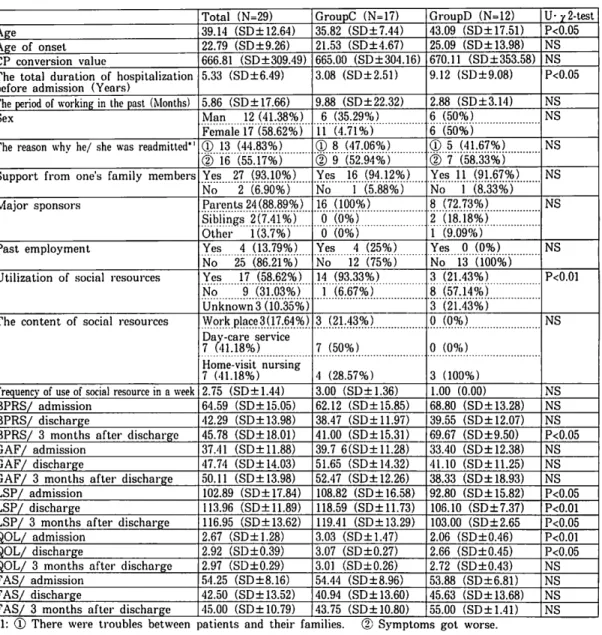
Table 1 Characteristics of subjects, symptom (BPRS: Brief Psychiatric Rating Scale), daily life skills/social functioning (GAF: Global Assessment of the Functioning, LSP: Life Skills Profile), family attitudes
(FAS: Family Attitude Scale), and assessment of QOL
Total (N=29) GroupC (N=17) GroupD (N=12) U- ^2-test
Age 39.14 (SD± 12.64) 35.82 (SD±7.44) 43.09 (SD± 17.51) P<0.05
Age of onset 22.79 (SD±9.26) 21.53 (SD±4.67) 25.09 (SD± 13.98) NS CP conversion value 666.81 (SD±309.49) 665.00 (SD±304.16) 670.11 (SD± 353.58) NS The total duration of hospitalization
before admission (Years) 5.33 (SD±6.49) 3.08 (SD±2.51) 9.12 (SD±9.08) P<0.05
The period of working in the past (Months) 5.86 (SD± 17.66) 9.88 (SD±22.32) 2.88 (SD±3.14) NS
Sex Man 12 (41.38%) 6 (35.29%) 6 (50%) NS
Female 17 (58.62%) 11 (4.71%) 6 (50%)
The reason why he/ she was readmitted*' ® 13 (44.83%) ® 8 (47.06%) ® 5 (41.67%) NS
<D 16 (55.17%) <D 9 (52.94%) © 7 (58.33%)
Support from one's family members Yes 27 (93.10%) Yes 16 (94.12%) Yes 11 (91.67%) NS No 2 (6.90%) No 1 (5.88%) No 1 (8.33%)
Major sponsors Parents 24(88.89%) 16 (100%) 8 (72.73%) NS
Siblings 2(7.41%) 0 (0%) 2 (18.18%)
Other 1(3.7%) 0 (0%) 1 (9.09%)
Past employment Yes 4 (13.79%) Yes 4 (25%) Yes 0 (0%) NS
No 25 (86.21%) No 12 (75%) No 13 "(iob%)
Utilization of social resources Yes 17 (58.62%) 14 (93.33%) 3 (21.43%) P<0.01 No 9 (31.03%) 1 (6.67%) 8 (57.14%)
Unknown 3 (10.35%) 3 (21.43%)
The content of social resources Workplace3(17.64%) 3 (21.43%) 0 (0%) NS Day-care service
7 (41.18%) 7 (50%) 0 (0%)
Home-visit nursing
7 (41.18%) 4 (28.57%) 3 (100%)
Frequencyof use of social resource in a week 2.75 (SD+1.44) 3.00 (SD±1.36) 1.00 (0.00) NS BPRS/ admission 64.59 (SD± 15.05) 62.12 (SD±15.85) 68.80 (SD± 13.28) NS BPRS/ discharge 42.29 (SD± 13.98) 38.47 (SD± 11.97) 39.55 (SD± 12.07) NS BPRS/ 3 months after discharge 45.78 (SD± 18.01) 41.00 (SD± 15.31) 69.67 (SD±9.50) P<0.05 GAF/ admission 37.41 (SD± 11.88) 39.7 6(SD±11.28) 33.40 (SD± 12.38) NS GAF/ discharge 47.74 (SD± 14.03) 51.65 (SD± 14.32) 41.10 (SD±11.25) NS GAF/ 3 months after discharge 50.11 (SD± 13.98) 52.47 (SD± 12.26) 38.33 (SD± 18.93) NS LSP/ admission 102.89 (SD± 17.84) 108.82 (SD± 16.58) 92.80 (SD± 15.82) P<0.05 LSP/ discharge 113.96 (SD± 11.89) 118.59 (SD±11.73) 106.10 (SD±7.37) P<0.01 LSP/ 3 months after discharge 116.95 (SD±13.62) 119.41 (SD±13.29) 103.00 (SD±2.65 P<0.05 QOL/ admission 2.67 (SD±1.28) 3.03 (SD±1.47) 2.06 (SD±0.46) P<0.01 QOL/ discharge 2.92 (SD±0.39) 3.07 (SD±0.27) 2.66 (SD±0.45) P<0.05 QOL/ 3 months after discharge 2.97 (SD±0.29) 3.01 (SD±0.26) 2.72 (SD±0.43) NS FAS/ admission 54.25 (SD±8.16) 54.44 (SD±8.96) 53.88 (SD±6.81) NS FAS/ discharge 42.50 (SD± 13.52) 40.94 (SD± 13.60) 45.63 (SD± 13.68) NS FAS/ 3 months after discharge 45.00 (SD± 10.79) 43.75 (SD± 10.80) 55.00 (SD±1.41) NS
*1: (D There were troubles between patients and their families. (2) Symptoms got worse.
- 3 8 -
Among the 29 patients, a comparison was made between those who could live in the community for more than 3 months (C group) and those who could not (D group).
C group had 17 of the patients (58.62%) and D group had 12 (41.18%). The average age of C group was 35.82 yrs (SD±7.44), and age at onset 21.53 (SD±4.67). The CP con version value was 665.00 (SD± 304.16), and the total length of hospitalization 3.08 yrs (SD±2.51). The number of patients who used social resources was 14(93.33%). The average age of D group was 40.09 yrs (SD
±17.51), and age at onset 25.09 (SD± 13.98) The CP conversion value was 670.11 (SD±
353.58), and the total length of hospitaliza tion 9.12yrs (SD±9.08). And the number of patients who used social resources was 3
(21.43%).
A significant difference was recognized in the ages, total length of hospitalization and utilization of social resources(P<0.05).: C group was younger and the hospital stay was shorter. Then C group could make use of social resources better than D group. Re garding family support, no significant differ ence was recognized with both groups receiv ing support from their families with the main support coming from parent (s). When symptoms, daily life skills/social functioning, and QOL were compared, a significant differ ence was seen in the symptoms at three months after discharge; in daily life skills at times of admission, discharge, and three months after discharge; and in QOL at time of admission and discharge (P<0.05). Both groups improved in daily life skills and also in QOL. At the three month point after dis charge (regarding D group at the time of C
group's discharge) a significant difference in symptoms and daily life skills was seen
(P<0.05).
Regarding family attitudes, both groups exhibited values indicating high emotional levels, however, no significant difference was recognized. But Group C received support in terventions for both patients and their fami lies. This study led us to the realization that optimum utilization of all the social re sources available to the community - includ ing resources for those with disabilities and difficulties and not necessarily tailored for patients with psychiatric disorders - pro motes a patient's stable settlement in the community after discharge from the hospital.
The results are shown in Table 1. These
quantitative results were reported and dis cussed in "The Japanese Journal of Nursing
Research in 20113).
2 . Characteristics of self-care and self-care support
1) The needs and goals of self-care
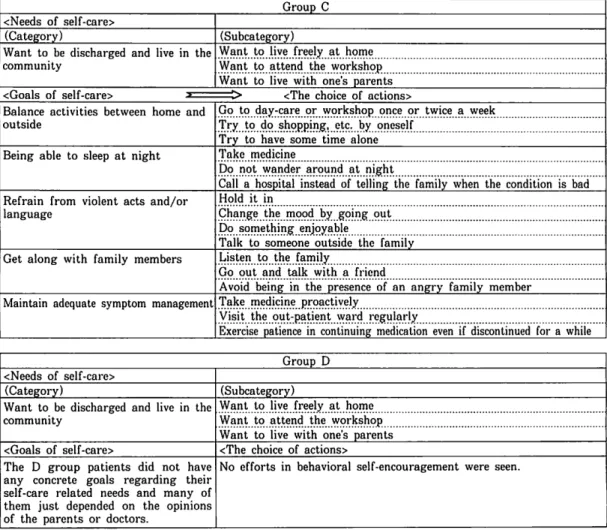
The intention-based process of self-care was qualitatively analyzed. Both groups dem onstrated strong self-care related needs and goals for "Want to be discharged and live in the community". This need was broken down into 'Want to live freely at home', 'Want to attend the workshop', and 'Want to live with one's parents'. The goals of self-care related needs were different from each group. The goals of C group patients were "Balance ac tivities between home and outside", "Being able to sleep at night", "Refrain from violent acts and/or language", "Get along with fam ily members", and "Maintain adequate symp tom management". On the other hand, the D
«*^E^^t^f4*fi^-er> 8 -y- (2012) Natsuki Shimozono et al.
group patients did not have any concrete goals regarding their self-care related needs and many of them just depended on the opin ions of the parents or doctors.
2 ) Actions towards self-care goals
Actions towards self-care related goals dif fered. In C group, their choices of actions for
"Balance activities between home and outside"
were broken down into 'Go to day-care or workshop once or twice a week', 'Try to do shopping, etc. by oneself, and 'Try to have some time alone'. For "Being able to sleep at night", the choices of actions were broken down into 'Take medicine', 'Do not wander around at night', and 'Call a hospital instead of telling the family when the condition is bad'. For "Refrain from violent acts and/or language", the choices were broken down into 'Hold it in', 'Change the mood by going out', 'Do something enjoyable', and 'Talk to some one outside the family'. "Get along with the family members" was broken down into 'Lis ten to the family', 'Go out and talk with a friend', and 'Avoid being in the presence of an angry family member'. Actions for "Main tain good symptom management" included 'Take medicine proactively', 'Visit the out patient ward regularly', and 'Exercise pa tience in continuing medication even if dis continued for a while'.
No efforts in behavioral self-encourage ment were seen in D group. And, while C group actually performed some action choices and evaluated and revised their actions based on their evaluations, D group did not make an effort to reflect on their acts, though the reasons for not doing so remain obscure.
3 ) The general characteristics of self-care ability
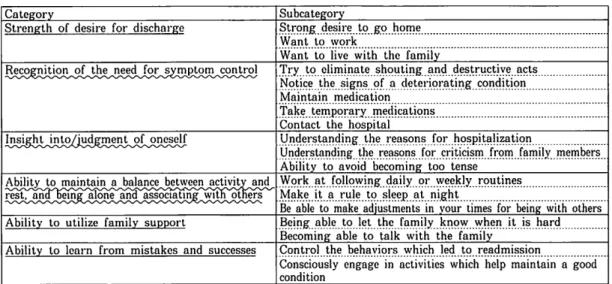
The self-care characteristics of each group are "Strength of desire for discharge", "Rec ognition of the need for symptom control",
"Insight into/judgment of oneself", "Ability to maintain a balance between activity and rest, and being alone and associating with others", and "Ability to utilize family sup port".
"Strength of desire for discharge" was di vided into 'Strong desire to go home', 'Want to work', and 'Want to live with the family'.
And "Recognition of the need for symptom control" was divided into 'Try to eliminate shouting and destructive acts', 'Notice the signs of a deteriorating condition', 'Maintain medication', 'Take temporary medications', and 'Contact the hospital'.
Then "Insight into/judgment of oneself"
was divided into 'Understanding the reasons for hospitalization', 'Understanding the rea sons for criticism from family members', and 'Ability to avoid becoming too tense'.
Furthermore "Ability to maintain a bal ance between activity and rest, and being alone and associating with others" involved 'Work at following daily or weekly routines', 'Make it a rule to sleep at night', and 'Be able to make adjustments in your times for being with others'.
"Ability to utilize family support" was di vided into 'Being able to let the family know when it is hard' and 'Becoming able to talk with the family'.
The last "Ability to learn from mistakes and success" was divided into 'Control the be haviors which led to readmission', and 'Con sciously engage in activities which help
- 4 0 -
maintain a good condition'.
These Results are shown in Tables 2 and 3.
4 ) Self-care support for Promoting Patient
Self-Care Abilities
The following types of support to promote self-care were provided to patients of C group:
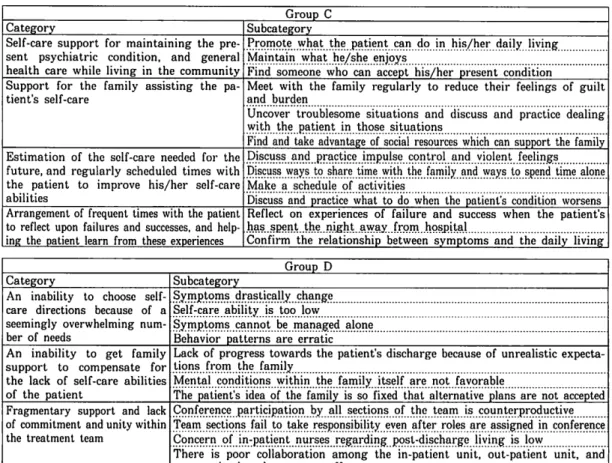
- "Self-care support for maintaining the pre sent psychiatric condition, and general health care while living in the community" was bro ken down to 'Promote what the patient can do in his/her daily living', 'Maintain what he/she enjoys', and 'Find someone who can accept his/her present condition'.
Table 2 The characteristics about needs of self-care of each group, goals for one's self-care, and the choice of actions Group C
<Needs of self-care>
(Category) (Subcategory)
Want to be discharged and live in the
community Want to live freely at home
Want to attend the workshop Want to live with one's parents
/"» l f i r *~ _ m i i . r i "
Balance activities between home and outside
Go to day-care or workshop once or twice a week Try to do shopping, etc. by oneself
Try to have some time alone Being able to sleep at night Take medicine
Do not wander around at night
Call a hospital instead of telling the family when the condition is bad Refrain from violent acts and/or
language
Hold it in
Change the mood by going out Do something enjoyable
Talk to someone outside the family Get along with family members Listen to the family
Go out and talk with a friend
Avoid being in the presence of an angry family member Maintain adequate symptom managementTake medicine proactively
Visit the out-patient ward regularly
Exercise patience in continuing medication even if discontinued for a while Group D
<Needs of self-care>
(Category) (Subcategory)
Want to be discharged and live in the
community Want to live freely at home
Want to attend the workshop Want to live with one's parents
<Goals of self-care> <The choice of actions>
The D group patients did not have any concrete goals regarding their self-care related needs and many of them just depended on the opinions of the parents or doctors.
No efforts in behavioral self-encouragement were seen.
- "Support for the family assisting the pa
tient's self-care" was broken down to 'Meet with the family regularly to reduce their feelings of guilt and burden', 'Uncover trou blesome situations and discuss and practice dealing with the patient in those situations',
and 'Find and take advantage of social re sources which can support the family'.
- "Estimation of the self-care needed for the
future, and regularly scheduled times with the patient to improve his/her self-care abili ties" was broken down to 'Discuss and
ftB**^K^»«ttS*$r*i3?*& 8•% (2012) Natsuki Shimozono et al.
practice impulse control and violent feelings', 'Discuss ways to share time with the family and ways to spend time alone', 'Make a schedule of activities', and 'Discuss and prac tice what to do when the patient's condition
worsens'.
- "Arrangement of frequent times with the
patient to reflect upon failures and successes, and helping the patient learn from these ex periences" was broken down to 'Reflect on ex periences of failure and success when the pa tient has spent the night away from hospital' and 'Confirm the relationship between symp toms and the daily living'.
Table 3 The self-care characteristics of each group are related discharge and community living
Category Subcategory
Strength of desire for discharge Strong desire to go home
Want to work
Want to live with the family
Recognition of the need for symptom control Try to eliminate shouting and destructive acts Notice the signs of a deteriorating condition
Maintain medication
Take temporary medications Contact the hospital
Insight into/iudgment of oneself Understanding the reasons for hospitalization
Understanding the reasons for criticism from family members Ability to avoid becoming too tense
AJbjhjtytoimiinJta^n^ Work at following daily or weekly routines Make it a rule to sleep at night
Be able to make adjustments in your times for being with others Ability to utilize family support Being able to let the family know when it is hard
Becoming able to talk with the family Ability to learn from mistakes and successes Control the behaviors which led to readmission
Consciously engage in activities which help maintain a good condition
♦The underlined parts were shown especially C group and the parts of the wavy line were shown especially D group.
The self-care support characteristics of D
group were:
- "An inability to choose self-care directions because of a seemingly overwhelming number of needs" was broken down to 'Symptoms drastically change", "Self-care ability is too low', 'Symptoms cannot be managed alone', and 'Behavior patterns are erratic'.
- "An inability to get family support to com pensate for the lack of self-care abilities of the patient" was broken down to 'Lack of progress towards the patient's discharge be cause of unrealistic expectations from the family', 'Mental conditions within the family itself are not favorable', and 'The patient's idea of the family is so fixed that alternative plans are not accepted'.
- "Fragmentary support and lack of commit ment and unity within the treatment team"
was broken down to 'Conference participation by all sections of the team is counterproduc tive', 'Team sections fail to take responsibil ity even after roles are assigned in confer ence', 'Concern of in-patient nurses regarding post-discharge living is low', and 'There is poor collaboration among the in-patient unit, out-patient unit, and community-based sup port staff.
The self-care supports for promoting pa tient self-care abilities were different from each group.
Support for promoting patients self-care were "Self-care for maintaining the present
-42-
psychiatric condition, and general health care while living in the community", "Support for the family assisting the patient's self-care",
"Estimation of the self-care needed for the future, and regularly scheduled times with the patient to improve his/her self-care abili ties", and "Arrangement of frequent times with the patient to reflect upon failures and successes, and helping the patient learn from these experiences".
On the other hand, the self-care support characteristics of D group were "An inability to choose self-care directions because of a seemingly overwhelming number of needs",
"An inability to get family support to com pensate for the lack of self-care abilities of the patient", and "Fragmentary support and lack of commitment and unity within the treatment team".
The results are shown in Table 4.
Table 4 The characteristics of support to promote self-care
Category Group C
Self-care support for maintaining the pre sent psychiatric condition, and general health care while living in the community
Subcategory
Promote:„what_the_j3atient can do jn his/her daily living Maintain what he/she enjoys
Find someone who can accept his/her present condition Support for the family assisting the pa
tient's self-care Meet with the family regularly to reduce their feelings of guilt and burden
Uncover troublesome situations and discuss and practice dealing with the .patient _in those situations
Find and take advantage of social resources which can support the family
Estimation of the self-care needed for the future, and regularly scheduled times with the patient to improve his/her self-care abilities
Discuss! and..practice impulse control and violent feelings Discuss ways to share time with the family and ways to spend time alone
Make a schedule of activities
Discuss and practice what to do when the patient's condition worsens Arrangement of frequent times with the patient
to reflect upon failures and successes, and help- ing the patient learn from these experiences
Reflect on experiences of failure and success when the patient's has .spent..the..night. away.from hqsjjital
Confirm the relationship between symptoms and the daily living Category
An inability to choose self- care directions because of a seemingly overwhelming num ber of needs
An inability to get family support to compensate for the lack of self-care abilities
of the patient
Fragmentary support and lack of commitment and unity within the treatment team
Subcategory Group D Symptoms drastically change Self-care ability is too low
Symptoms cannot be managed alone Behavior patterns are erratic
Lack of progress towards the patient's discharge because of unrealistic expecta tionsfromi the..family
Mental conditions within .the family itself are not^
The patient's idea of the family is so fixed that alternative plans are not accepted Conference participation by all sections of the team is counterproductive Team sections fail to take responsibility even after roles are assigned in conference Concern of in-patient ^
There is poor collaboration among the in-patient unit, out-patient unit, and community-based support staff
VI. Discussion
In both group, a significant difference was recognized in the ages, total length of hospi talization and utilization of social resources:
C group was younger and the hospital stay
was shorter. Then C group could make use of social resources better than D group.
However, in both group, there was no sig nificant difference about symptoms, social functioning and the amount of medication at the time of admission. It was thought that the patients of C group were easy to adapt
fl8$*^EW«tt^#*iiffie& 8 fl- (2012) Natsuki Shimozono et al.
the situations because of their young age.
When a comparison was made of C group members who were able to lead lives in their community for three months or longer and D group members who could not, the desire for discharge and community living was very strong in both groups. However, C group had clear and concrete goals for their self- care, were able to utilize the support of their family well, and were able to learn from
their failures and successes.
As for the health care aspect of patients living in the community, the patients made
time and effort to meet those self-care needs
after discharge. Families were able to help when the patients' self-care was not success ful, and were supportive in making time with the patients to reflect upon failures and suc
cesses.
McCann has said that critical factors in promoting self-care among psychiatric pa tients (based on their self-decision) are that the nurse must understand the goals of the patient, encourage the patient's self control,
and shift the balance between the care the
patient receives and the patient's self-care7;.
Furthermore, Shimasawa et al. reported that the identifying characteristics of psychiatric patients able to maintain life at home are found in: symptom and medication manage ment; ways of spending time and/or associ ating with family and friends; and the abil ity to prepare for future possibilities while having something that can be relied on psychologically91. Usami also reported that psychiatric patients who are living in the community are able to manage their symp toms and medication and maintain a social network. She also reported that the
psychological pain they experienced in past hospitalizations and recurrence of the disease is linked in some way with the ability to maintain community living10'.
The results of this study also indicate that in C group the nurse worked with the pa tient to achieve the goal of developing, through practice, the self-care skills needed after discharge. Thus, support was given on a practical level and encouraged the patient's learning. In D group, although showing no significant difference in symptoms or medica tion, the same or similar nursing approach was not found.
According to Sueyasu et al. the critical points for transitional support towards com munity living are: Deciding the case-based support direction, and creating, through fre quent nurse visits, an image of the patient's community life after discharge1". Inoue et al. has stated that the linkage of 'group sup port' and 'individual support' along with seam less collaborative support by the community support staff and hospital staff are the key factors of successful discharge support15'.
Characteristic of support for D group - whose members remained hospitalized con tinuously or failed to live in the community for more than three months after discharge - was that the support staff could not imag ine a successful post-discharge life for the patient due to his/her unstable psychiatric condition and low self-care skills, and a fail ure to empower family members needed to support the patient. In addition it was thought that although the support team did hold discussions, their individual case-based support was insufficient.
From these findings it is suggested that to
- 4 4 -
produce results as successful as C group, it is necessary to not only form a psychiatric care management team from the time of a patient's admission, but to also make an as sessment and build a support program that draws a positive and realistic image of the post-discharge life of the patient. For pa tients for whom it is difficult to provide dis charge support, Inoue et al. said that mutual support among patients as well as support by the staff can increase the motivation of the patient151.
It is our understanding that mindset change among the medical staff, improvement of a patient's motivation, support of a patient's family and the supporters of the patient, and empowerment of the psychiatric care man agement team are all necessary during the early stages of a case.
The number of the subject patients in this study was small and there is a limit to gen eralizing these results, therefore in the fu ture it will be necessary to increase the num ber of subject patients. We also recognize the importance of further discussing and im proving the support protocols of community living based on the results obtained through this study.
References
1 ) Ministry of Health, Labour and Welfare: Health Pol icy Bureau Notice No.1228001, 2007.
2) Ohta K.: Studies on the promotion of cooperation and role-sharing between doctors and nurses, Health and Labour Sciences Research Grants, Special Research of Health and Labour Sciences, Research Report Summary
: 303-312, 2008.
3) Usami S. et al.: An evaluation of modified community- based care management (M-CBCM) for psychiatric pa tients readmitted within 3 months of discharge, or with
continued hospitalization of more than 3 months. The Japanese journal of nursing research, 44(3): 318-332,
2011.
4 ) Usami S. et al.: Evaluation study of Community Based Care Management (CBCM) including care package. In ternational Nursing Review. 32(1): 88-95, 2009.
5) Usami, S. et al.: Evaluation study of direct care by Certified Nurse Specialist in Psychiatric Mental Health Nursing. Kango, 55(12): 67-74, 2003.
6 ) Valimaki, M.: Psychiatric patients' view on the con cept of self-determination, findings from a descriptive study. Journal of Clinical Nursing. 7: 59-66, 1998.
7) Mccann, T. V t al.: Advancing self-determination with young adults who have schizophrenia. Journal of Psy chiatric and Mental Health Nursing. 22: 12-20, 2004.
8) Andoh S.: Self-care and nursing needs of community life support center for people with psychiatric disabili ties. BULLETIN OF KOBE CITY COLLEGE OF NURS ING. 14: 21-29, 2010.
9) Shimasawa J.: Structure of Self-Care Behavior among mentally ill patients living at home. The Journal of Chiba Academy of Nursing Science. 12(1): 29-34, 2006.
10) Usami S.: The conditions of Self-Care behavior based on self-determination by community living patients with schizophrenia. The Japanese Journal of Evaluation Nursing Research. 31(3): 25-38, 1998.
11) Champney, T. F. et al.: Involvement in productive ac tivities and satisfaction with living situation among se verely mentally disabled adults. Hospital and Commu nity Psychiatry. 43(9): 899-903, 1992.
12) Ruffolo, M. C. et al.: Satisfaction and role perform ance of case managers in the mental health system.
Journal of Case Management. 3(1): 36-42, 1994.
13) Francis, P. et al.: Relationship of clinical case manage ment to hospitalization and service delivery for serious mentally ill clients. Issues in Mental Health Journal.
16(3): 257-274, 1995.
14) Sueyasu T.: Diffusion/ Training project for promoting effective use of services for welfare of persons with dis abilities about changing over to community living from psychiatric hospital. Report on The Japanese Psychiat ric Nurses Association. 30: 2011.
15) Inoue S. et al.: The handbook of discharge support in psychiatry: guidelines and practical approach, 167.
IGAKU-SYOIN, 2011