
the Aim of Realizing a Knowledge-Based Society
Kanji TaKeuchi
Minoru noMur a Information and Communications Research Unit
1 Introduction
It is generally accepted that the steam engine was the driving force of the Industrial Revolution in the 18th century. Steam is a type of power which is derived from fossil fuels such as coal and oil. However, with changing times, it appears that knowledge is replacing the fossil fuels as the driving force for social change. India, like Japan, is an Asian nation, and has drawn up strategies to become a knowledge-supplier for global society and is trying to secure its competitive advantage in the next-generation global economy on this basis.
India is also one of the BRICs countries (Brazil, Russia, India, and China), and is in the midst of rapid economic growth spurred by liberalization o f i t s e co n o m y a n d g r ow t h i n I T- r e l a t e d industries, giving the country a rapidly increasing presence in international society. According to one estimate, India is expected to become the world’s third largest economy by around 2032.[1]
According to a 2006 report that studied 100 emerging companies located in fast-growing regions including the BRICs,[2] Indian companies already account for 21 of these 100 companies, and seven of these are classified as “companies that have developed technological capabilities into innovation in the global economy”. As these reports suggest, India’s potential is already recognized by the world.
Unlike Japan, where the declining birthrate is a major problem, in India, young people under the age of 25, who will play a key role in the next
generation, account for 50% of the country’s total population of 1.1 billion. In addition to an abundant workforce, India’s competitive superiority can also be attributed to the fact that it is the world’s largest democratic country, its people have a high level of English proficiency, and labor wages are relatively low. However, the most important factor may be India’s social system, which continuously produces human resources with high potential.
A l t h o u g h t h e J a p a n - I n d i a S c i e n c e a n d Technology Cooperation Agreement was drawn up in 1985, the relationship between the two countries showed little subsequent development in science and technology. However, in the last few years, the respective leaders of Japan and India have successively visited their counterpart countries, and in August 2007, the Prime Minister of Japan visited India to make a joint statement on the “Roadmap for New Dimensions to the Strategic and Global Partnership between Japan and India,” reconfirming the framework for cooperation between the two countries in fields of science and technology including information a n d c o m m u n i c a t i o n t e c h n o l o g y ( I C T ) , nanotechnology, life science, and aerospace research. As seen in an example in life science, in which Japan’s RIKEN and the Ministry of Science and Technology of India concluded a science and technology cooperation agreement in December 2006, the countries also seem to be developing a closer relationship than in the past. Thus, the relationship between the two countries is continuing to develop rapidly.
Based on this background, this report reviews
the development of India’s IT sector and then summarizes trends in bioinformatics, which is highly compatible with IT and has the possibility to create a huge potential market. Various Indian projects for developing human resources are also discussed, as this is a prerequisite supporting the sustained growth of India as its targets a knowledge-based society and is already being i mplemented at var ious levels of i ndustr y, academia, and government.
2 IT industry in India
2-1 Strength of the software industry
India’s rapid growth is supported by IT-BPO (IT and Business Process Outsourcing: hereinafter refer red to as IT i ndustr y),*1 center i ng on software. In this industr y, hardware-related business accounts for a mere 20% of the whole, wh i le the enti re remai nder represents the contribution of software and service-related businesses.
India has grown to be a major global player in the software business. Figure 1 shows the changes in the market scale of the IT industry in India and its share of GDP. The entire market of the IT industry has achieved growth. Exports have achieved particularly remarkable growth and are estimated at US$31.9 billion in 2007, or almost 18 times more than in 1998 (US$1.8
billion).[3] This amounts to about 60% of world offshore IT-BPO (outsourcing to other countries).
As a result, the IT industry is projected to account for 5.4% of India’s GDP in 2007.
In par ticu lar, sof t ware development and services excluding hardware have grown by more than 30% annually, of which about 80% is exported, thereby becoming India’s largest export industry. Exports in 2006 were mostly to English- speaking countries, with 67% to United States and 25% to Europe (of which 15% was to the UK).
Only 1.5% was to Japan.[4] In the business area of software development and services excluding hardware, the direct labor force with a high level of expertise is forecast to reach 16.3 million in 2007 from 190,000 in 1998.[3] Although it is also necessary to consider the supporting labor force in addition to the direct labor force, it is possible to calculate that only 0.2 % or less of India’s population is creating 5.4% of GDP.
A detailed breakdown of software shows that business process outsourcing from companies in the US and Europe is the main component, followed by IT ser vices such as customized appl ic at ion de velopme nt a nd appl ic at ion management, and then by client relationship business such as call centers, and back office operations using IT, such as financial accounting and human resources management.
The style of India’s software business has
Figure 1 : Trend in market size of IT industry in India and its share GDP (* 2007 estimated)
* Including hardware. Phases correspond to those in Table 1
Prepared by the STFC based on Reference[3]
changed over time, and can be classified largely into 4 phases (Table 1). Until around 1995, India was mainly a subcontractor for European and American companies, and its attractiveness was based on low cost (Phase I). However, around 2000, not only India’s low cost, but also its high quality and productivity were recognized, and development businesses increased from simple subcontracting business (Phase II). Around 2005, in addition to cost, quality, and productivity, India was successful in winning the confidence of customers, which made it possible to receive orders for business that treats highly confidential information such as client data. Simultaneously, of fshore sof t ware development per for med locally in India has become the main stream, replacing the on-site business mode that required the subcontractor to visit the client (Phase III).
This contributes to cutting the overhead costs associated with software development, but can also be regarded as proof that Indian companies have succeeded in gaining the confidence of clients. Simultaneously with this change in business for ms, the relative impor tance of business for domestic consumption and foreign export has changed places, with exports now far exceeding domestic consumption (Figure 1). Since the year 2005, Indian companies have played an increasingly important role, as seen in the increase in orders for large global-scale system development projects such as integrating branch systems of multinational corporations scattered around the world (Phase IV).
This growth trend appears likely to continue for some time, and it is forecasted that exports of India’s IT industry will surpass US$60 billion by the year 2010.[4]
The current size of investment in research and development by India’s government is very
small compared to that of the US, the European countries, and China, and the budget of the Ministry of Information and Telecommunication of India is much smaller than those in other fields. However, the market in India generated by out s ou rc i ng of s of t wa r e r e s e a rch a nd development from other countries was US$1.3 billion in 2003, but is forecasted to reach US$9.1 billion in 2010.[5] At a glance, the amount of investment in R&D in India still seems to be small, but it is necessary to note the rising trend in the volume of advanced outsourcing work such as structural analysis using CAD/CAM, or
“engineering,” embedded software, and research and development. From this viewpoint, the actual picture is that outsourcing of research and development by foreign companies is providing substantial support for R&D in India. It is also noteworthy that major corporations outside of India have recently positioned India as a location for R&D facilities to further outsource
2005 ~ Phase IV Development of global scale systems Off shore
productivity, quality and security
Prepared by the STFC Table 2 : Examples of investment in India
by major overseas corporations Company name Investment period and investment
amount IBM, U.S US$ 6 billion during 2006~2009 Microsoft, U.S US$ 1.7 billion during 2005~2009 Cisco, U.S US$ 1.1 billion during 2006~2009 Intel, U.S Investment of US$ 1.0 billion including
US$ 0.25 billion in venture fund in India SAP, Germany 20 million Euros
Dell, U.S 30 million Euros during 2006-2009 BOSCH, Germany US$ 0.2 billion for the next 3 years
Boeing, U.S
US$ 100 million for maintenance-related facilities and more than US$ 85 million for training support facilities such as flight simulators
EADS(Airbus),
France US$ 2.6 billion for the next 15 years Prepared by the STFC based on Reference[3]
knowledge-based business processes (Table 2).
2-2 Effect of US orientation on
the development of India’s IT industry
The reason why India is focusing on the IT industry appears not to be the result of selection, but rather, the result of a process of elimination.
In the 1980s, India had a poor infrastructure, with domestic industries limited to agriculture, steel, and the like. At the same time, India had a culture which places a high value on education, and as a result, possessed a large pool of human resources with mathematics-based science and engineering backgrounds. As IT does not require a large infrastructure, it was one of the few options available for utilizing human resources with th is k i nd of science and engi neer i ng background. In addition, domestic circumstances peculiar to India accelerated the flow of human resources into the IT industry. The IT industry in India was focused on overseas markets from the outset, and as such, the development of a merit system was a natural outcome. Aspiring to a career in the IT industry offered a chance to escape the traditionally-prescribed way of life and play an important role in business. Thus, talented human resources concentrated in the IT industry in a very natural fashion and won an excellent reputation in the global economy, resulting in today’s growth in India.
Up to the present, India, which achieved outstanding growth in the IT industry, has been consistently oriented toward the United States as an object of business. As mentioned earlier, about 70% of software and service exports are to the US. The background reasons for this were that both countries use English as their first language, and many students from India went to US universities to study advanced IT and/or academic subjects. In 2006, 76,000 students from India were enrolled in schools in the US, making India the largest “supplier” of overseas students for the US.[ 6] Of that number, 74%
were in graduate schools. This suggests that Indian brainpower is playing an important role in cutting-edge research in the US, including software development.
Most overseas students find jobs in US, and
after a few years of hard work, are accepted in society and advance to higher positions.[7]
Recently, these talented people have returned to India, thus creating a return flow of intellectual talent to both domestic companies and American corporations in India. It is difficult to offer exact figures, but during the two years 2003-2004, the number of returning US residents of Indian descent is estimated to be somewhere between 10,000 and 40,000.[8] Even more than the cheap labor cost in India, the fact that these talented people had become accustomed to the American way of life and business practices, extending as far as product development methods, was extremely attractive for American corporations from the viewpoint of actual business. In this context, the relationship between India and the US is growing progressively stronger.
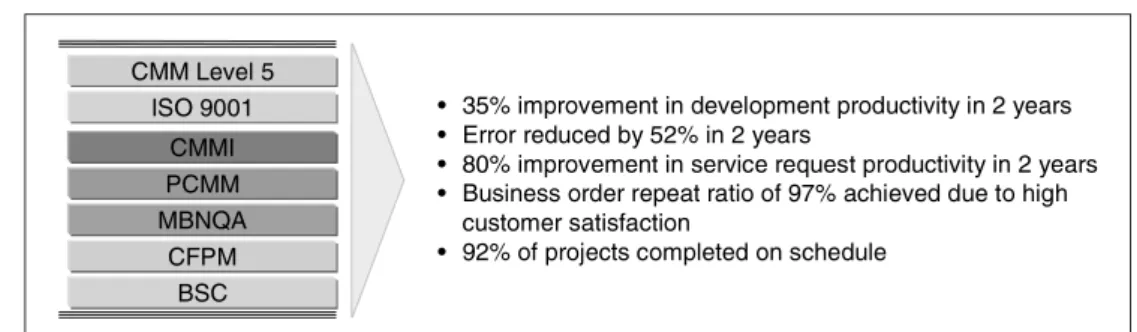
One example of India’s focus on the US can be seen in the active acquisition of software quality certifications by Indian companies. In the US, there is a tendency to emphasize the importance of quality-related certifications such as CMM (Capability Maturity Model)*2 when outsourcing sof t ware-related busi ness. Worldwide, 120 companies have achieved Level 5 in CMM, which is the most difficult level, and of this number, 90 are in India.
In addition to CMM, many companies in India have obtained various quality certifications which American companies emphasize when outsourcing to non-US companies (Figure 2).
Although there are varying opinion as to whether the acquisition of those certifications actually guarantees the quality of software, at least it is a fact that many companies in India have actually acquired various quality certification that are considered difficult to achieve, and such certification helps them in winning new business.
The emphasis on quality may be only one example, but India’s consistent orientation toward the US level in education and business has had the effect of building the country’s actual capabilities as a world-class player in business. In other words, the US has cultivated world-standard capabilities in India, and this has contributed to the development of India’s IT industry.
3 Bioinformatics as the next target for the IT industry
The biotechnology field is attracting active investment in R&D in Japan as well as in Europe and the US. Within the field, bioinformatics, which is highly compatible with the IT industry, is expected to become fundamental technology.
Among trends in biotechnology worldwide, the main stream is comprehensive data measurement, which is termed High Throughput. The volume of data which must be obtained when using this technology has become extremely large, and has reached a level where data measurement and analysis are beyond human capabilities, making reliance on information technology inevitable.
Bioinformatics is a new academic field of science and technology which has developed at the border between biological science and computer science in order to grapple with problems like those mentioned above.[13] In fact, recently, there have been a rapidly increasing number of examples in which new findings were obtained through the use of information technologies such as comprehensive analysis technologies employing applied mathematics e m p l o y i n g e x t e r n a l d a t a b a s e w h i c h a r e simultaneously massive in size and diverse in content.
Figure 3 shows the technologies included in bioinformatics on the axes of life information and application/development. To advance into the post-genome era and commercialize products on this basis, it is necessary to handle large volumes of life information. In order to cope
with the increase in life information, research on bioinformatics is progressing in a form in which biology is supported by information technologies such as simulation technologies (algorithms, etc.) and database management technologies.
Bioinformatics is positioned as a fundamental tech nolog y for biotech nolog y and has the potential for application in a wide range of areas such as biofuels and agriculture, in addition to life science industr y applications such as drug discovery, diagnostics, therapy, and so on, giving enormous market potential to research results. Considering the fact that the global bioinformatics market is forecast to reach US$2 billion by 2010 from US$0.7 billion in 2001,[10,11]
future growth can be expected in this research area.
“ S c i e n c e a n d Te c h n o l o g y Tr e n d s” h a s reported twice on trends in bioinformatics, b u t b o t h r e p o r t s d i s c u s s e d t h e U S a n d Europe.[12,13] Therefore, this report will focus on bioinformatics in India. Although India’s market presence is still small, bioinformatics is attractive as a field where the country can take advantage of its strengths in the IT industry and future growth is also expected. The following will discuss bioinformatics in India from this viewpoint.
3-1 Focus on bioinformatics
F i g u r e 4 s h ow s t h e s e g m e n t s h a r e s o f biotechnology industry in India and the export ratios of bioinformatics and biopharmaceuticals.
The size of the biotechnology-related market in India in 2004-2005 was about US$1.1 billion. By segment, the Bio Pharma segment, as represented by generic drugs, held a predominant share.
Figure 2 : Example of quality improvement initiatives taken by major software corporations in India CMMI Capability Maturity Model Integration
PCMM People Capability Maturity Model MBNQA Malcolm Baldrige National Quality Award CFPM Cross Functional Process Mapping BSC Balanced Score Card
Source: Reference [9]
Although the market scale of generic drugs is large, the important point in this segment is how to synthesize off-patent components and to provide them cheaper. This means the i mpor t a nce of R & D ba sed on science a nd technology is low. On the other hand, although bioinformatics has a rather small segment share of about 2%, the larger part of the bioinformatics market is for export, unlike Bio Pharma, whose
market is 60% domestic. From this, it can be understood that India’s technical strength in bioinformatics is highly appreciated in the overseas market.
As noted above, India is beginning to focus on bioinformatics due to its potential market size and its compatibility with the IT industry, in which India has a global competitive advantage.
The 10th 5-year national program, which lays Figure 3 : Target technologies of bioinformatics
Prepared by the STFC based on Reference [14]
Figure 4 : Share of biotechnology industry in India by segment and share of exports (2004-05) Prepared by the STFC based on Reference [15]
out national strategies from 2002 to 2007, clearly noted the need for research on bioinformatics in the field of information technology,[16] and the i mpor tance of bioi n for matics is bei ng emphasized in the working group discussion for the pending 11th 5-year national program.[17] In addition, in 2002, NASSCOM, an association of software and service companies,*3 has positioned bioinformatics as one new emerging sector of the future IT industry.[18]
However, as a business, bioinformatics in India is still in an early stage. Although the market size is still small, this field recorded an annualized growth rate of more than 20%, with US$ 23 million in 2004 rising to US$33 million in 2006.[15]
3-2 Efforts in the early stage
Bioinformatics in India is said to have started from research on structure analysis of protein around 1986.[7] This was 10 years before the word of bioinformatics came into widespread u se, demon st r at i ng t h at I nd i a recog n i zed the i mpor tance of i n for mation tech nolog y in contemporar y biology instantly. In 1986,
“Biotechnology Information System Network ( BTISnet)” which connects major domestic research institutions, was launched through an initiative of the Biotechnology Agency.
This network continued expanding over time, and now connects 61 research institutions and is used for training of researchers, simulations, and various other purposes.
As early as 1987, University of Pune began offering a master course in bioinformatics. It is surprising to note that India was already aware of the importance of bioinformatics at this time and not only built up a network before the related infrastructure was adequate, but also emphasized the importance of education. Following this, various universities began specialized courses.
As India’s domestic market for bioinformatics was essentially nonexistent in the 1980s, it can be assumed that India was aiming at education of human resources with a view to overseas markets from the very beginning.
3-3 Current research trend
Thanks to the Indian government’s early focus on bioinformatics, many researchers from India are active in key scientific or leadership positions in bioinformatics research in the US and Europe.[7]
To f u l l y u n d e r s t a n d t h e s i t u a t i o n o f bioinformatics in India, the authors examined the database on current biology-related projects administered by the Ministry of Science and Technology, Division of Biotechnology of India (DBT).[19] The results showed that there are 42 bioinformatics-related projects under way at present. Because no mention was made of the details of the projects in the open database, it must be noted that most of what follows are guesses from the titles listed. About half of the database concerned genome and protein analysis and protein structure analysis, followed by Figure 5 : Breakdown of bioinformatics-related projects under control of Department of Biotechnology,
Ministry of Science and Technology in India
Prepared by the STFC
database creation and maintenance, support for drug discovery and medical treatment (Figure 5).
The breakdown by research institutions shows 5 projects each at the India Institute of Science (IISc) and India Institute of Technology (IIT), and 3 projects each at the Center for Cellular and Molecular Biology and at Madras University.
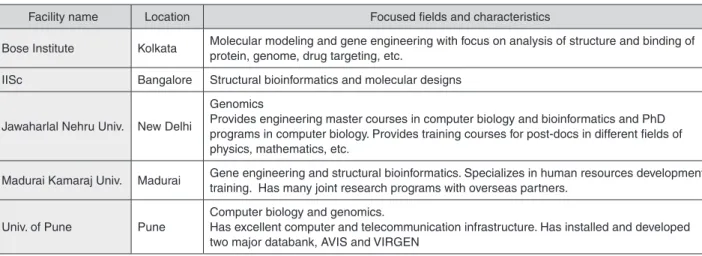
The Department of Biotechnology has also selected 5 center-of-excellence (COE) research facilities to promote these projects in order to stimulate bioinformatics research (Table 3).
Each research institute is involved in a cutting- edge research program, but as will be discussed later, human resources development is also incorporated in the program.
In addition, major IT software companies in India also regard bioinformatics as one of the next growth fields, and the movement toward establishing bioinformatics divisions within these companies is notable.
3-4 Supercomputer facilities specialized in bioinformatics
The effectiveness of simulation technologies is immense, as trials and tests can be executed as many times as time permits and meaningful r e s u l t s t h a t h a d b e e n o v e r l o o ke d c o u l d be recaptured. For th is reason, si mu lation tech nolog ies a re a l so posit ioned a s a key technology for bioinformatics research in India.
The supercomputer is the key to a successful simulation, especially, in fields of science and technology involving problems that require extremely long calculation time. However, in India, moves to pursue the world’s most advanced
hardware performance are rarely seen. Rather, the focus appears to be on research to develop original calculation algorithms and improve sof tware performance. Because large-scale parallel computing is a prerequisite for higher speed in the calculation process, and there are limits to the maximization of computing performance based on hardware speed alone, it is important to develop computational algorithms that maximize computer performance through parallel processing. India is considered to be strong in mathematics and algorithms, and thus is highly competitive in this field.
India has several supercomputers for use in scientific and technical calculations. However, the following discussion will be limited to two facilities with supercomputers that specialize in bioinformatics.
(1) C-DAC (Center for Development of Advanced Computing)
C-DAC is a research and development institution which was established in 1988 as a science society within the Department of Information Technology, Ministr y of Telecommunication and Technology Information of India, based on advanced information and telecommunication technology. Like Japan, the US, and China, India has developed commercial supercomputers dome s t ic a l l y. C - DAC i s a m a i n s t ay of t he development of supercomputers and provides a supercomputer series called PARAM.
In Febr uar y 2007, C-DAC announced that it will launch a new supercomputer specially designed for bioinformatics applications.[22]
Table 3 : Research facilities for bioinformatics in India
Facility name Location Focused fields and characteristics
Bose Institute Kolkata Molecular modeling and gene engineering with focus on analysis of structure and binding of protein, genome, drug targeting, etc.
IISc Bangalore Structural bioinformatics and molecular designs
Jawaharlal Nehru Univ. New Delhi
Genomics
Provides engineering master courses in computer biology and bioinformatics and PhD programs in computer biology. Provides training courses for post-docs in different fields of physics, mathematics, etc.
Madurai Kamaraj Univ. Madurai Gene engineering and structural bioinformatics. Specializes in human resources development training. Has many joint research programs with overseas partners.
Univ. of Pune Pune
Computer biology and genomics.
Has excellent computer and telecommunication infrastructure. Has installed and developed two major databank, AVIS and VIRGEN
Prepared by the STFC based on Reference [20, 21]
The aim with this supercomputer is calculation performance of 1.5 TFLOPS. The supercomputer is to be integrated first into the network called Genome Grid, which connects major 40 research institutions in India, and will then be connected with industr y for mutual use. Gr ids are an effective method for connecting remotely-located computer systems physically through a network for efficient use of existing resources. Because this scheme enables many research laboratories and universities to share expensive computing systems, applications, huge volumes of data, and other resources, the cost burden can be reduced, thereby lowering the entr y barrier for new researchers.
(2) SCFBio (Supercomputing Facility for Bioinformatics & Computational Biology) SCFBio was established in 2002 at the Delhi Campus of the India Institution of Technology with financial aid from multiple institutions, including the Department of Biotechnology and others. Its purpose is to develop completely new scientific methods and new software for genome analysis.[23] Priority is placed on research on simulation methods rather than on simulation results. This supercomputer was constructed
by combining modules made in the US and has computing performance of 600 GFLOPS. Some of the bioinformatics-related software and tools that have been developed are open to the public.[24]
4 Initiatives to develop human resources through collaboration among industry, education institutions, and government
4-1 Human resources supply system
T he r apid g row t h of I nd i a i s suppor ted by h ig h ly educated hu man resou rces with eng i neer i ng backg rou nds. Fig u re 6 shows the trend in the number of universities and enrollment in institution of higher education.
In India, universities and colleges that offer the academic degree of Diploma are classified as institutions of higher education. Compared to 1986-1987, the number of universities more than doubled in 2004-2005, reaching 360. The number of colleges has also increased similarly to universities, to 16,000. This was more than 40 times greater than the number of universities in 2004 -2005. The aggregate enrollment in institutions of higher education, including both universities and colleges, is more than 10 million.
Figure 6 : Annual trend in number of universities and enrollment in institutions of higher education Prepared by the STFC based on Reference [26]
Limited to engineering (but excluding science), it is forecast that more than 530,000 students will graduate in 2007-2008, and of that number, approximately 300,000 will be IT engineers with majors in computer science, electrical/electronic eng i nee r i ng , a nd telecom mu n ic at ion s.[ 25 ] Compared to other countries which are candidate offshore IT development sites, India supplies 2.5 times more human resources with engineering background than 2nd ranking China (Figure 7).
Particularly outstanding human resources are supplied by the country’s leading universities, which include the Indian Institute of Science (IISc), Indian Institute of Technology (IIT), and India Institute of Information Technology (IIIT). However, these institutions graduate only 10,000 students each year. In addition, numerous colleges and professional schools specialize in IT. From this, it can be understood that the supply of human resources that supports India’s rapid growth comes mostly from colleges and professional schools specialized in IT.
A s t u d y o f t h e co mp a t i b i l it y o f hu m a n re s ou rce s b et ween i n st it ut ion s of h ig her education and industry reported that the number of human resources with the skills to be effective immediately upon entering an IT company is limited to 25% of new graduates from universities with technology backgrounds and about 10% of graduates from colleges.[28] If no measures are taken, a shortage of 500,000 persons out of total demand of 2.3 million in IT-BPO-related business is forecast in 2010. The problems associated with this shortage of human resources may have a ripple effect on the whole range of industries based on IT, and an impact on bioinformatics, which relies heavily on IT, is also conceivable.
Quantitatively, the number of human resources that are immediately effective seems quite large.
However, India believes that even this number will be insufficient. This suggests that India has a higher awareness of the critical nature of the shortage of human resources than Japan.
One reason for such concern can be found in the background strategy of transforming India from the conventional outsourcing of the past to knowledge-based outsourcing. India is attempting to transform itself into a knowledge-based society
through the accumulation of the world’s most advanced knowledge. From this viewpoint, it is obvious that the shortage of human resources may be a formidable barrier not only to sustained economic growth, but also to increasing the country’s international competitiveness.
Recently, India’s government has drawn up plans to invest US$32 billion to establish 370 new colleges, in addition to 8 new branches of the Indian Institute of Technology (IIT), 7 branches of the Indian Institute of Management (IIM), and 20 branches of the India Institute of Information Technology (IIIT)[29,30] in order to expand and improve its institutions of higher education.
The following presents examples of such initiatives with the focus on human resources development in India through collaboration between industry, academia, and government to date.
4-2 Initiative by government and NASSCOM
The Ministry of Human Resources Development of India, which is responsible for educational policies, and NASSCOM, the National Association of Software and Service Companies in India, have adopted a concept called the P yramid Approach to improve the incompatibility between the image of the human resources supplied by academia and that expected by industry in IT-related fields. This approach will establish a
Figure 7 : Ratio of human resources population with expertise in IT offshore candidate countries (2005)
Prepared by the STFC based on Reference [27]
hierarchy (Figure 8) classified by the skills that industry considers essential in order to ensure that technologies are mastered corresponding to the level of the educational institution. In this approach, the levels are categorized as ToP, Top of the Pyramid, which aims to ensure that students master the skills required in the future, MoP, Middle of the Pyramid, which aims to ensure mastery of skills that form the core of actual work, and BoP, Base of the Pyramid, which aims to ensure mastery of basic technologies so that the level of IT human resources as a whole can be improved and thereby create a structure pool of talented people that will be useful to industry.
This approach to human resources development is outlined below.
(1) ToP: Top of the Pyramid
“Top of the Pyramid” programs are designed to teach high end technologies that may not be required currently but will be necessary in 2-3 years, such as bioinformatics, embedded sof t ware, product architecture, DSP, V LSI, program management, etc. The Ministr y of Human Resources Development of India is planning to establish 20 branches of the India Institute of Information Technology in the next few years as research centers for this purpose with industry cooperation. Five institutions are to
that students master these core skills. This level is assumed to be the area where India will face the largest human resources shortage in the future. Specifically, The Ministr y of Human Resources Development of India and NASSCOM are implementing the following programs in academia.
(a) Introduction of student evaluation standards This program is designed to introduce industry- wide student evaluation standards in order to assist students in understanding their own capabilities. This is also used as an index for measuring the employment aptitude of applying students.
(b) Introduction of Finishing School (Pilot phase) This program is designed to provide technical and software skills to engineering graduates.
Before joining a company, the program offers opportunities for training by consultants in IT industry so that students can learn industry- specific knowledge, skills, management, etc.
This is one program on which companies place high expectations as a program for training human resources who can function effectively immediately upon employment. Eight institutions, including IIT Roorkee, are conducting this program as a pilot program for about 8 weeks starting in May 2007.
(c) Execution of IT human resources development program
As a means of filling the gap between industry and academia, this program is designed to offer opportunities for mutual understanding through workshops, training programs, and similar activities. Faculty Training Workshop and the Sabbatical Program offer good opportunities for the teaching staff of universities to find ways to improve their teaching methods and better Figure 8 : Human resources development program by
Ministry of Human Resources Development in India and NASSCOM
(The Pyramid Approach)
Prepared by the STFC based on Reference [31]
approaches to important issues.
(3) BoP: Base of the Pyramid
This program is designed to provide basic skills such as network technologies, hardware maintenance, and so on. The NAC (NASSCOM’s Assessment Competence) test is conducted to ensure that human resources are suitable for employment through training. Last year, the NAC test was conducted experimentally in Rjasthan State with 2,500 applicants. The results of the test were announced in March 2007, and a Job Fair was organized under the co-sponsorship of the Ministry of Information and Telecommunication of India and the state government. The NAC test is scheduled to be offered in various parts in India by the end of 2007.
4-3 Human resources development for bioinformatics at universities and research institutions
A s o n e e x a m p l e o f h u m a n r e s o u r c e s d e velopme nt for bioi n for m at ic s, I nd i a i s involved in a program which specializes in human resources development at bioinformatics research centers (COE) (Table 3). It is especially interesting that Jawaharlal Nehru University is offering training programs to transform post- docs from different fields such as physics and mathematics into bioinformatics researchers.
Apar t from these COEs, various research institutions throughout the nation are also offering seminar programs to train people to use bioinformatics as a tool, and are actively promoting human resources development in the field. In 2005, these short term training programs included more than 80 courses with more than 3,000 researchers, teaching staff, and students who are studying the use of bioinformatics in
various fields of biotechnology.[21]
4-4 Initiatives by software companies
(1) Training program spanning industry and academia
In addition to programs to educate human resources who can be effective immediately on employment while such persons are still students, some major software companies in India are also attempting to attract global human resources from abroad (Table 4). This shows an intention to attract excellent human resources who are likely to be future leaders from around the world, and to learn the needs and cultures of their original countries.
Most of the companies provide substantial internal training programs, some of which have facilities that can train 5,000 employees at a time.
In most cases, companies provide internal off-the- job training for several months in order to train employees in advanced skills.
One reason why such huge human resource development programs are possible is full-time recruitment of numbers of teaching staff from universities as internal training experts. There is also a system to enable current teaching staff of universities to use sabbaticals to learn the needs of companies and leading technologies. This system promotes reeducation of the teaching staff of universities and ultimately is reflected in the university’s education program so as to fill the gap between industry and academia.
(2) Movement toward acquisition of human resources at the global scale
Even with India’s rapid economic growth, the rapid rise in the salaries of IT engineers has become a problem. The annual income of employees i n the IT i ndustr y is al ready
Table 4 : Example of human resources development programs by a major software corporation
Name of program Details
Campus Connect
Initiatives to further strengthen ties between industry and academia to develop IT industry, started in 2004.
Provides technical training courses, seminars, and so on to train students in the needs of industry and to develop IT experts who can step into industry and be effective immediately.
Global Talent Program Human resources employment program especially for students studying in U.S universities.
InStep Global internship program starting in 1999. Program is active all the year round, with 12,000 applications submitted from around the world so far.
Prepared by the STFC based on Reference [9]
lower labor costs in the Indian IT industry. As an additional problem, the increasing number of overseas companies setting up operations in India, as mentioned previously, has made it more difficult to secure high quality human resources in India than before.
Indian companies are looking overseas in order to cope with these problems. One example of such efforts is the application of a “Global Delivery Model.” Although this approach was originally considered to be a framework for a decentralized management system for optimizing projects, securing excellent human resources now appears more important. In spite of Indian’s 1.1 billion population, Indian companies are accelerating moves to recruit excellent human resources internationally.
One example of application of this approach can be seen in China.
India is tr ying to strengthen its ties with China, which has rich human resources in the IT field and is also enjoying the same remarkable economic grow th.[32 ] Like India, China has achieved rapid progress in its IT industry recently, and has the second largest supply of human resources after India, but the annual salary of China’s IT engineers has not risen as sharply as in India. Therefore, major software companies in India have established operations in China and are developing a large-scale presence in that country in order to secure excellent human resources, as well as to win orders from Western companies with operations in China and take advantage of the huge Chinese market. One example is a company that already has operations in Shanghai, Beijing, Dalian, and Guangzhou and is planning to establish a Global Delivery Campus (GDC) in Nanjing[33] which will be large enough to accommodate a staff of 2500 and includes a development center, training center, convention center, recreation facilities, and accommodation facilities. Some companies
capabilities. Consequently, this appears to be a win-win relationship that serves the interests of both countries.
In addition to China, India is attempting to establish a similar relationship with Brazil, which ser ves mainly as an offshore base for North America.
5 Conclusion
The rapid economic growth of India in recent years has been supported by the IT industry, center ing on sof t ware. India has grown to become a major power in software with a 60%
world share of the IT offshore market. As India’s domestic demand was small, the country was inevitably forced to look to the global market. The current positive economic spiral is considered to be the result of India’s orientation to the United States, which has led the world in both the educational and business fields from the dawn of the IT age. Nevertheless, India would not have achieved such impressive growth without human resources with the knowledge and skills to win recognition in the US, which is the world’s leader in the IT industry. Moreover, there is no doubt that India’s strength in software has contributed to the current economic strength of India as a whole.
The next target market for India is the huge biotechnology industry. In particular, the country as a whole is starting to focus on bioinformatics, which is compatible with the IT industry and is an infrastructure technology for biotechnology.
The size of the potential market which may result from research outcomes in bioinformatics is incalculable. It is surprising that India realized the importance of bioinformatics 10 years before the term itself began to be used, and not only constructed networks in an environment with inadequate infrastructure, but also have focused on the education of human resources for the field.
Human resources with engineering training received in higher education have supported this industrial growth. However, even India, with the second largest population in the world, is facing difficulties in securing the necessary hu ma n resou rces due to excessively r apid economic growth. The shortage of necessary human resources will of course be detrimental to the sustained growth of the economy, and will become a serious barrier to improving international competitiveness. Therefore, India is implementing various initiatives in order to develop human resources to fill the gap between the human resources produced by academia and the needs of industry by expanding and improving its institutions of higher education.
India has a high awareness of the critical nature of the shortage of human resources, and is active in both human resources development and securing human resources internationally.
As the reason for this, India aims to develop as a knowledge-based society and recognizes that its human resources will be a driving force in pioneering the coming new era. India’s aim is nothing other than development as a knowledge- based societ y by transforming its economy from conventional outsourcing to outsourcing in knowledge industries based on outstanding human resources. India has a population of more than 500 million under the age of 25, and is steadily increasing the number of institutions of higher education. However, we should note the fact that even India is tr ying to secure outstanding human resources at the global scale.
Acknowledgements
The authors of this report would like to thank Professor Aftab Seth, Global Security Research Institute of Keio University (Former Ambassador of India to Japan); Mr. Yuji Sugimoto, Assistant to Professor Aftab Seth; Professor Makoto Kojima, Faculty of International Studies, Takushoku University; Mr. Vijay Kumar Chaudhary, Human Resource Manager, Infosys Technologies Ltd.;
Mr. Jo Ando, Marketing and Strategy Manager, Asia Pacific Operations, Infosys Technologies Ltd.; Mr. Harikrishna Bhat, Vice President and Representative Director, Wipro Japan KK; Mr.
Mohan Gopal, Vice President-Japan, Covansys
(Asia Pacific) Private Ltd.; Dr. Toru Yao, Advisor, Genomic Sciences Research Center, Riken; Mr.
Reiji Nagashima, Senior Stuff for International Cooperation and Research Coordination, General Affairs Division, Riken; and Mr. Soh Osuka, Research Priority Planning Member, Research Priority Committee, Riken, for the valuable advice and insights to all of the above.
Glossary
*1 According to the definition of India’s National A s soci at ion of S of t wa re a nd S er v ice s C o mp a n i e s ( N A S S C OM ) , t h e t e r m o f IT-BPO means the entire i ndustr y that includes IT services, BPO (Business Process Outsourcing), Engineering Services and R&D, Software Products, and Hardware. In this report, we use the term “IT industry” in basically the same sense.
*2 CMM: Capability Maturity Model. CMM was developed by the Software Engineering I n s t i t u t i o n ( SE I ) o f C a r n e g i e M e l l o n University in the US with the support of the National Defense Agency to systemize and popularize best practice in software d e ve l o p m e nt o p e r a t i o n . T h e p r o j e c t organization prescribes 5 stages based on the capability maturity level.
*3 NASSCOM: National Association of Software and Service Companies. This is a business association consisting from more than 1100 member companies, of which 250 are overseas companies.
Abbreviations
C-DAC: Center for Development of Advanced Computing
DBT: Department of Biotechnology DSP: Digital Signal Processor
IIIT: I n d i a n I n s t i t u t e o f I n f o r m a t i o n Technology
IIM: Indian Institute of Management IISc: Indian Institute of Science IIT: Indian Institute of Technology NASSCOM:
National Association of Software and Service Companies
SCFBio: Supercomputing Facility for Bioinformatics
& Computational Biology
C o mp a n i e s f r o m R api d l y D e velopi ng Economies are Changing the World” (2006 May) :
http://www.bcg.com/publications/files/New _Global_Challengers_May06.pdf
[3] NASSCOM, “Strategic Review 2007”
[4] NASSCOM, “Indian IT Industry Factsheet (2007)”:
http://www.nasscom.in/upload/5216/Indian _IT_Industry_Factsheet_Feb2007.pdf
[5] National Institute of Science and Technology Policy, Science and Technology Foresight Center: “Relationship between Noteworthy Economic Expansion of India and Science and Technology”, August 2006. (Japanese) [6] Institute of International Education, “Open
Doors 2006 Country Fact Sheets”: http://
opendoors.iienetwork.org/file_depot/0 - 10000000/ 0 -10000/3390/folder/56369/
India+2006.doc
[7] T . Y a o , “ S c i e n c e a n d Te c h n o l o g y Interchanges, Research Committee Report on new partnership with India,” Global Industrial and Social Progress Research Institute, March 2007. (Japanese)
[8] NASSCOM, “Strategic Review 2005”
[9] I n f o s y s Te c h n o l o g i e s L t d ., M e e t i n g memorandum
[10 http://biospectrumindia.ciol.com/content/
GuestColumn/10506138.asp
[11] http://biospectrumindia.ciol.com/content/
BioBusiness/10510114.asp
[12] M . S h o j i a n d S . M o t e g i , “ Tr e n d s i n Bioinformatics” “Science and Technology Trends,” No. 9 December 2001. (Japanese) [13] A . N o g i a n d S . K o t s u k i , “ Tr e n d s i n
Bioinformatics Technology”, “Science and Technology Trends,” No. 22 January 2003.
(Japanese)
[14] Japan Patent Of f ice, “Research Repor t on Trend s of Tech nolog ies for Patent Application: Bioinformatics”
planrel/fiveyr/10th/volume2/v2_ch7_4.pdf [17] India Planning Commission 11th 5-year Plan,
Science and Technology Working Group:
http://planningcommission.nic.in/aboutus/
committee/wrkgrp11/wg11_subdbt.pdf [18] http://surya.bic.nus.edu.sg/web03/abstracts/
web03-bansal.pdf
[19] Ministr y of Science and Technolog y of India, Department of Biotechnology, Project Database:
h t t p : / / d b t i n d i a . n i c . i n / p r o j e c t s d b t / databasemain.html
[20] Ministry of Science and Technology of India, Department of Biotechnology, BTISNet:
http://www.btisnet.nic.in/files/coe.htm [21] Ministr y of Science and Technolog y of
India, Department of Biotechnology, Annual Report 2005-2006:
http://dbtindia.nic.in/annualreports/2005-06/
Ch-8-eng.pdf
[22] C-DAC: http://www.cdac.in/html/press/
1q07/spot596.asp [23] IIT Delhi SCFBio:
http://www.scfbio-iitd.res.in/
[24] IIT Delhi SCFBio Software and Tool release page:
http://www.scfbio-iitd.res.in/bioinformatics/
bioinformaticssoftware.htm
[25] NASSCOM, “Knowledge Professionals Fact Sheet (2006)”:
http://www.nasscom.in/upload/5216/NASSC OM%20Knowledge%20Professionals%20Fact sheet%202006.pdf
[26] Ministr y of Human Resources of India, Department of Higher Education, “Selected Educational Statistics 2004-2005”:
h t t p : // w w w. e d u c a t i o n . n i c . i n / s t a t s / SES2004-05.pdf
[27] The World Bank, “All The World’s A Stage”:
h t t p : / / s i t e r e s o u r c e s . w o r l d b a n k . o r g / I N T E DE V E L OPM E N T/ Re s ou r ce s / RandeepSudajn.pdf

![Figure 4 : Share of biotechnology industry in India by segment and share of exports (2004-05) Prepared by the STFC based on Reference [15]](https://thumb-ap.123doks.com/thumbv2/123deta/6927104.2265933/6.892.84.812.78.553/figure-share-biotechnology-industry-segment-exports-prepared-reference.webp)
![Figure 6 : Annual trend in number of universities and enrollment in institutions of higher education Prepared by the STFC based on Reference [26]](https://thumb-ap.123doks.com/thumbv2/123deta/6927104.2265933/9.892.204.678.79.510/figure-annual-universities-enrollment-institutions-education-prepared-reference.webp)


