実践研究
Effect of training on physical fitness in once weekly
college physical education class
Keisuke Ishikura1), Yamato Sato2), Masamitsu Tomikawa3)
週一回の大学体育授業におけるトレーニングが
身体に及ぼす影響
石倉 恵介
1 *),佐藤 和
2),富川理充
3)Abstract
To determine the effect of training in a once weekly PE class, we measured the physical fitness and body composition of 47 university students (37 male, 10 female) at pre- and post-training period. They set the goal to either “increase muscle strength or hypertrophy (MS)”, "cardiorespiratory fitness (CF)”, or “fat reduction (FR)”. After the training period, muscle strength and muscle mass increased significantly in the MS group. However, there was no effect in the FR group. The CF group was very small (n=2) and though they did improve no strong conclusions can be drawn from these results. These findings suggest that training in a PE class, even once a week, increases muscular strength. However, the training once a week is not sufficient to achieve fat reduction.
Key words: Improve Muscular strength, Cardiorespiratory fitness, Fat reduction, Training effect,
college physical education
キーワード: 筋力増加,全身持久力,減量,トレーニング効果,大学体育
1)崇城大学総合教育センター 2)千葉工業大学創造工学部教育センター体育教室 3)専修大学スポーツ研究所 1*)石倉恵介 〒 860-0082 熊本県熊本市西区池田 4-22-1
ン,シーテッドレッグカール,ペクトラルフラ イ,ラットプルダウン,チェストプレスの 5 種目 で筋力測定を実施した.被験者は各種目で任意の 重量を選択し,最大努力で反復した.Fleck and Kraemer (1987) より改変して作成された負荷強度 と Repetition Maximum (RM) の関係 ( 石井 2007, p.148) を基に,拳上重量と反復回数から 1RM を推 定した.尚,反復回数が 20 回を超えてしまうこ とは,負荷が軽すぎることを意味していることを 伝え,20 回を超えてしまう場合には重量を増加し てやり直しをさせた. D.全身持久力(PWC170値)の測定 全身持久性能力として負荷―心拍応答から求 められる心拍数 170 拍 / 分時になされる仕事率 PWC (Physical work capacity) 170を自転車エルゴ
レーニング期間前後における平均の差を比較する にあたり,対応のある t 検定を行った.変数間の 関連性については,Pearson の相関関係 (r) を求め た.すべての統計処理において危険率の有意水準 は 5% とした.
Ⅲ.結果
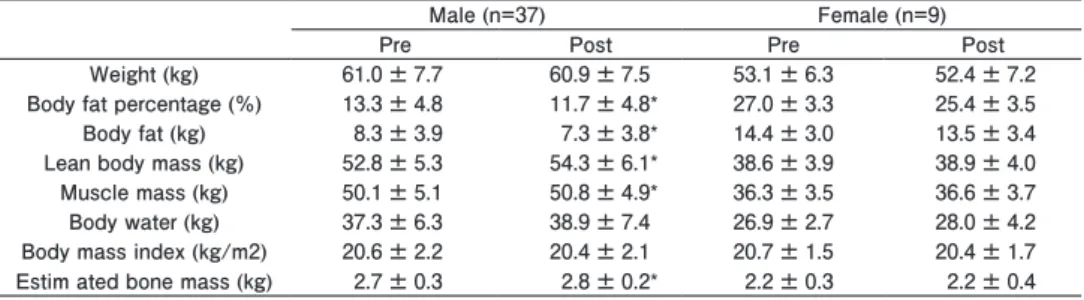
A. トレーニング期間前後の形態測定結果 Table 1 に授業 3 回目 (Pre) と同 14 回目 (Post) の形態測定結果を示した.男子では,体脂肪率, 脂肪量が有意に減少し,除脂肪量,筋肉量,推定 骨量が有意に増加した.女子では,男子と同様な 変化の傾向が認められたが,統計的な有意差を認 めなかった. B. トレーニング期間前後の推定 1RM ならびに PWC170値の変化 Table 2 に全対象者のトレーニング期間前後に おける筋力測定を実施した 5 種目の推定 1RM な らびに PWC170値の変化を示した . 男子では,測定 した全 5 種目の筋力ならびに PWC170値において, トレーニング前に比べてトレーニング後で有意に 増加した.女子では,測定した項目において有意 な変化がなかった. C. 目的別グループにおけるトレーニング期間前後 の推定 1RM ならびに PWC170値の変化 1) 筋力向上・筋肥大を目的としたグループのト レーニング期間前後におけるレッグエクステン ション,シーテッドレッグカール,ペクトラル フライ,ラットプルダウン,チェストプレスの 変化を Table 3 に,体重,体脂肪率,脂肪量, 除脂肪量ならびに筋肉量の変化を Table 4 に示 した.男子では,全 5 種目の筋力ならびに筋肉 量は有意に増加し,体脂肪量,体脂肪率は有意 に減少した.女子は 2 名であったので,統計 処理を実施していない.また,筋力測定した 5 種目の筋力の増加割合 (%) と筋肉量の増加割合 (%) との間についての相関係数を Table 5 に示 した.筋力の増加割合と筋肉量の増加割合の間 に関連は認められなかった. 2) 減量目的のグループのトレーニング期間前後の 体重,体脂肪率,脂肪量,除脂肪量ならびに筋 肉量の変化を Table 6 に示した.すべての項目 において,男女共に有意な変化を認めなかった. 3) 全身持久力向上を目的としたグループのトレー ニング期間前後の PWC170値の変化を Table 7 に 示した.男女それぞれ 1 名であったので,いず れも統計処理を実施していない.Table 1. Changes in weight, body fat percentage, body fat, lean body mass, muscle mass, body water, body mass index, and estimated bone mass pre- and post-training.
Values are means ± S .D .*, Significant difference compared with value pre-training.
Male (n=37) Female (n=9)
Pre Post Pre Post
Weight (kg) 61.0 ± 7.7 60.9 ± 7.5 53.1 ± 6.3 52.4 ± 7.2
Body fat percentage (%) 13.3 ± 4.8 11.7 ± 4.8* 27.0 ± 3.3 25.4 ± 3.5
Body fat (kg) 8.3 ± 3.9 7.3 ± 3.8* 14.4 ± 3.0 13.5 ± 3.4
Lean body mass (kg) 52.8 ± 5.3 54.3 ± 6.1* 38.6 ± 3.9 38.9 ± 4.0
Muscle mass (kg) 50.1 ± 5.1 50.8 ± 4.9* 36.3 ± 3.5 36.6 ± 3.7
Body water (kg) 37.3 ± 6.3 38.9 ± 7.4 26.9 ± 2.7 28.0 ± 4.2
Body mass index (kg/m2) 20.6 ± 2.2 20.4 ± 2.1 20.7 ± 1.5 20.4 ± 1.7
Table 3. Changes in leg extension, seated leg curl, pectoral fly, lat pull down, and chest press pre- and post-training in the muscle strength group.
Values are means ± S .D .*, Significant difference compared with value pre-training.
Male (n=32) Female (n=2)
Pre Post Increase rate Pre Post Increase rate
Leg extension (kg) 93.8 ± 26.3 103.3 ± 21.9* 13.3 ± 19.1 54.2 ± 27.1 56.8 ± 30.1 3.6 ± 5.1
Seated Leg Curl (kg) 75.9 ± 16.3 83.2 ± 19.1* 10.7 ± 19.6 38.1 ± 35.9 35.9 ± 15.3 -7.5 ± 10.9
Pectoral Fly (kg) 62.3 ± 17.0 70.1 ± 18.4* 15.3 ± 22.7 30.0 ± 14.1 33.9 ± 18.1 11.1 ± 8.0
Lat Pull down (kg) 68.4 ± 14.4 72.0 ± 14.1* 6.0 ± 12.3 40.0 ± 18.8 41.0 ± 17.5 3.6 ± 5.0
Chest Press (kg) 60.8 ± 16.4 69.8 ± 20.5* 17.3 ± 24.3 28.2 ± 17.0 31.4 ± 21.6 8.1 ± 11.4
Table 5. Correlation coefficients between increasing rate of muscle strength power and muscle mass in the muscle strength power group.
Correlations am ong data were expressed by Pearson's correlation coefficient. n=34
Leg Extension Seated Leg Curl Pectoral Fly Lat Pull Down Chest Press
Muscle mass -0.04 0.10 0.03 -0.16 0.19
Table 4. Changes in weight, body fat percentage, body fat, lean body mass, muscle mass, and body water pre- and post-training in the muscle strength power group.
Values are means ± S .D .*, Significant difference compared with value pre-training.
Male (n=32) Female (n=2)
Pre Post Pre Post
Weight (kg) 60.2 ± 7.0 60.1 ± 6.9 48.5 ± 3.0 48.8 ± 4.0
Body fat percentage (%) 12.5 ± 4.6 10.8 ± 4.4* 22.7 ± 0.6 21.6 ± 3.7
Body fat (kg) 7.7 ± 3.7 6.6 ± 3.5* 11.0 ± 1.0 10.6 ± 2.7
Lean body mass (kg) 52.6 ± 4.8 54.3 ± 6.0 37.4 ± 2.0 38.2 ± 1.4
Muscle mass (kg) 49.8 ± 4.6 50.7 ± 4.5* 35.3 ± 1.8 36.1 ± 1.3
Body water (kg) 36.5 ± 4.1 37.3 ± 4.0 26.0 ± 1.98 26.6 ± 1.6
Table 6. Changes in weight, body fat percentage, body fat, lean body mass, and muscle mass pre- and post-training in the weight loss group.
Values are means ± S. D.
Male (n=4) Female (n=6)
Pre Post Pre Post
Weight (kg) 69.7 ± 8.5 69.3 ± 7.7 54.7 ± 7.1 53.6 ± 8.4
Body fat percentage (%) 18.3 + 2.0 17.0 ± 2.8 28.2 ± 2.9 26.6 ± 3.0
Body fat (kg) 12.9 ± 2.7 11.9 ± 3.1 15.4 ± 2.9 14.4 ± 3.5
Lean body mass (kg) 57.0 ± 5.8 57.4 ± 4.7 39.1 ± 4.7 39.2 ± 5.1
Muscle mass (kg) 54.1 ± 5.5 54.4 ± 4.4 36.8 ± 4.3 36.9 ± 4.7
Table 2. Changes in leg extension, seated leg curl, pectoral fly, lat pull down, chest press and PWC170 pre- and post-training.
Values are means ± S .D .*, Significant difference compared with value pre-training. PWC, physical work capacity. #, n=35 for Male.
Male (n=37) Female (n=9)
Pre Post Pre Post
Leg extension (kg) 93.4 ± 26.2 102.2 ± 23.6* 55.5 ± 16.1 58.6 ± 15.5
Seated Leg Curl (kg) 75.0 ± 16.5 82.3 ± 20.3* 39.0 ± 9.5 35.1 ± 14.3
Pectoral Fly (kg) 62.6 ± 18.6 69.0 ± 18.7* 29.2 ± 8.6 32.7 ± 10.0
Lat Pull down (kg) 67.3 ± 13.7 71.6 ± 13.5* 40.7 ± 11.3 42.9 ± 9.6
Chest Press (kg) 59.5 ± 15.8 68.8 ± 19.7* 27.0 ± 7.4 28.0 ± 8.73
Ⅳ.考察
本研究は PFC を受講した学生に「筋力向上・ 筋肥大」,「減量」,「全身持久力向上」の 3 つの目 的別に各自がトレーニングを実践し,そのトレー ニング効果を検討した.その結果,「筋力向上・ 筋肥大」を目的としたグループにおいて,有意な 筋力向上と筋肉量の増加が示唆された. レジスタンストレーニングによる筋力向上の効 果を Metaanalysis によって検討した報告によれ ば,非鍛錬者の場合,60% 1 RM,4 セット,1 週間に 3 回,そして鍛錬者では,80% 1RM,1 週 間に 2 回が最も効果的であるとしている (Rhea et al., 2003).また American College Sports Medicine ( 以下 ACSM) でも筋力向上させるためには,60-70 % 1RM 強度で 8-12 回を 2-4 セット,1 週間に 2-3 回実施することを推奨している (Garber et al., 2011).一方,数は少ないものの週 1 回のレジス タンストレーニングによって筋力が向上したとの 報告もある ( 林・宮本 2009; 磨井・柳川 2013).筋 肥大を惹起させるためには,60-80% 1RM の強 度で 10-15 回を数セット実施することが有効であ ることをトレーニング開始前に講義し,実施した トレーニングをワークシートに記入させた.1 週 間に 1 回の授業時のトレーニングでは,先行研究 や ACSM で推奨している 1 週間に 2-3 回の頻度に 遠く及ばず,筋力向上は期待できないと考えられ たものの,男子で平均 12.6 (6.4 ~ 16.8) %,女子で は低下した種目があったが,平均 3.8 (-7.5 ~ 11.1) % の効果が認められた.レジスタンストレーニ ングに伴う筋力増加には,神経性要因と筋肥大に 依存し (Moritani and deVries, 1979),トレーニン グ開始初期においては神経性要因の貢献度が大き く,トレーニング期間の延長に伴い,筋肥大要因 の貢献度が増加する (Moritani and deVries, 1979;Kraemer et al., 1996).Akima et al. は短期間のア イソキネティックトレーニングによって有意な筋 肥大は認められなかったが,筋力増加を認め,そ の理由として筋収縮活動の増加,すなわち神経 性要因が改善されたためであると報告している (Akima et al., 1999).本研究においては,週 1 回, 6 ~ 7 週間のトレーニング期間の前後で男子の筋 力,筋肉量は両者ともに有意に増加したものの, 筋力の増加割合と筋肉量の増加割合には相関関係 が認められなかった.一方,シェトランドポニー を対象とした研究ではあるものの,気温が高い時 期には低い時期に比して体水分量が多いとの報告 がある (Brinkmann et al., 2013).「筋力向上・筋肥 大」グループのトレーニング期間後の体水分量は 有意ではないものの,増加傾向にあった.トレー ニング期間前後の測定は,それぞれ 4 月,7 月で あり,この測定時期の気温差が体水分量に影響 し,推定筋量を押し上げた可能性がある.本研究 のトレーニング期間は 6 ~ 7 週間であり,認めら れた筋力増加は,主に神経性あるいは力発揮に関 与する運動単位数の増加の要因が大きいと考える のが妥当であろう.本研究の限界として,授業以 外のトレーニングや運動の実施についてはコント ロールしていない.実際,「筋力向上・筋肥大」 を目的としたグル―プ中に,運動部または運動系 のサークルに男子 4 名,女子 1 名が所属しており, 得られた結果が週 1 回のトレーニングによっての みで得られた効果であるかは不明であり,更なる 検討が必要である. 本研究において,「減量」を目的とした授業に おけるトレーニング効果は認められなかった.運 動と減量の効果について Metaanalysis によって検 討した報告によれば,内臓脂肪・体重減少率と運 動量 (METs × h/w: Metabolic Equivalents × h/w) と負の相関を示すことから,内臓脂肪減少には,
Table 7. Changes in PWC170 pre- and post-training in the cardiorespiratory fitness group.
Values are means ± S. D. PWC, physical work capacity.
Male (n=1) Female (n=1)
Pre Post Pre Post
週当たり少なくとも 10METs × h/w の有酸素運 動が必要であることを示唆している (Ohkawara et al., 2007).10METs × h/w の運動は,「減量」を 目的にした学生の平均体重 ( 男子 69.7,女子 52.7 kg) を基に算出すると,男女でそれぞれ 731.9, 553.3kcal に相当する.「減量」を目的とした学生 のワークシートの記載から,毎授業時に 20 ~ 40 分,100 ~ 300kcal 程度の有酸素トレーニングを実 施していたが.10METs × h/w の運動にはほど遠 く,脂肪量を減少させるには週 1 回の授業のみで は十分ではなかったことを示唆するものである. 10METs × h/w に相当する消費カロリーを達成す るには,授業以外での取り組みが必要であろう. ただし,Pre の BMI は男子 1 名(25.1kg/m2)以 外は男女ともに標準範囲でありながらも、トレー ニング期間前後で体脂肪量を 1kg ほど減少させる ことには貢献していた可能性が考えられた. PWC170テストは全身持久能力のうち身体作業能
Ⅶ.文献
Akima, H., Takahashi, H., Kuno, S.Y., Masuda, K., Masuda, T., Shimojo, H., Anno, I., Itai, Y., and Katsuta, S. (1999) Early phase adaptations of muscle use and strength to isokinetic training. Med. Sci. Sports Exerc., 31: 588-594.
Brinkmann, L., Gerken, M., and Riek, A. (2013) Seasonal changes of total body water and water intake in Shetland ponies measured by an isotope dilution technique. J. Anim. Sci., 91: 3750-3758.
Fleck, S. and Kraemer, W. (eds.) (1987) Designing Resistance Training Programs (4th ed.). HUMAN KINETICS.
藤沢政美 (2011) 女子学生のボディイメージとライ フスタイル . 園田学園女子大学論文集 , 45: 53-63 Garber, C.E., Blissmer, B., Deschenes, M.R.,
Franklin, B.A., Lamonte, M.J., Lee, I.M.,
Nieman, D.C., and Swain, D.P. (2011) Quantity and quality of exercise for developing and maintaining cardiorespiratory, musculoskeletal, and neuromotor fitness in apparently healthy adults: guidance for prescribing exercise. Med Sci Sports Exerc 43: 1334-1359.
Haff, G. and Burgess, S. (2012) Resistance Training for Endurance Sports. In: Ben, R. (ed.) Developig Endurance : National Strength & Conditioning Association, pp.135-180. 萩府智恵・蓮井理沙・細田明美・山本由喜子 (2006) 若年女性のやせ願望の現状と体型に対する自覚 及びダイエット経験 . 大阪市立大学生活科学研 究誌 , 5: 1-9 林 直亨・宮本忠吉 (2009) 週 1 回の大学授業にお ける筋力トレーニングが筋力に与える影響 . 体 育學研究 , 54: 137-143. 石井直方 (2007) 究極のトレーニング. 講談社. p.148 カルプマン・ベロツェルコフスキー・グドコフ : 太田順暢訳 (1976) スポーツマンの体力測定 , PWC170テストの理論と実際 . ベースボール・マ ガジン社 . 小林勝法 (2013) 保健体育科目のカリキュラムと担 当組織 . 大学教育学会課題研究 , 2010 年度~ 2012 年度 「共通教育のデザインとマネジメン ト」: 99-108. 厚生労働省 (2016) 平成 27 年度国民健康・栄養 調 査 の 概 要.http://www.mhlw.go.jp/file/04- Houdouhappyou-10904750-Kenkoukyoku-Gantaisakukenkouzoushinka/kekkagaiyou.pdf, ( 参照日 2016 年 11 月 20 日 )
Kraemer, W.J., Fleck, S.J., and Evans, W.J. (1996) Strength and power training: physiological mechanisms of adaptation. Exerc. Sport Sci. Rev. 24: 363-97.
松坂晃,富樫泰一.(1996) 心拍数からみたサイク リングの運動強度とエネルギー消費量.茨城大 学教養部紀要 (30): 225-235
Moritani, T. and deVries, H.A. (1979) Neural factors versus hypertrophy in the time course of muscle strength gain. Am. J. Phys. Med., 58: 115-130. Ohkawara, K., Tanaka, S., Miyachi, M.,
Ishikawa-Takata, K., and Tabata, I. (2007) A dose-response relation between aerobic exercise and visceral fat reduction: systematic review of clinical trials. Int. J. Obes., 31: 1786-1797.
Paavolainen, L., Hakkinen, K., Hamalainen, I., Nummela, A., and Rusko, H. (1999) Explosive-strength training improves 5-km running time by improving running economy and muscle power. J. Appl. Physiol., (1985) 86: 1527-1533. Pirke, K.M., Schweiger, U., Strowitzki, T., Tuschl,
R. J., Laessle, R.G., Broocks, A., Huber B, Middendorf, R. (1989) Dieting causes menstrual irregularities in normal weight young women through impairment of episodic luteinizing hormone secretion. Fertil. Steril., Feb., 51(2): 263-268.
高橋亜矢子・宮川豊美 (2004) 女子学生の身体状況 ならびに体形意識とダイエットに関する研究調 査 , 和洋女子大学紀要 . 43: 20-26 谷口公二 (2006) 男子学生の持久性能力 . 室蘭工業 大学紀要 , 56: 41-45. 磨井祥夫・柳川和優 (2013) 週 1 回の授業における レジスタンストレーニングが大学生の筋力に及 ぼす影響 . 広島体育学研究 , 39: 1-10.