芝 浦 工 業 大 学
博 士 学 位 論 文
非正規従業員の働くモチベーションに影響を与える要因の経時変化
-飲食チェーンでの実証研究-
Chronological Changes in Factors
Affecting the Work Motivation of Non-regular Employees
-An Empirical Study of Restaurant Chains-
令和 2 年(2020 年)9 月
研究の軌跡
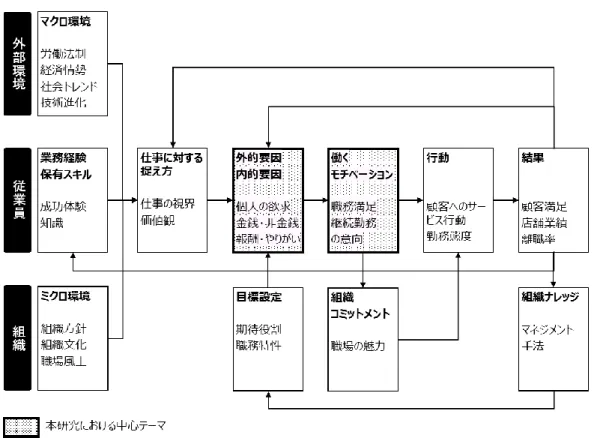
図 7 働くモチベーションに関する研究領域の全体像
さらに, 金銭的報酬の負の影響に言及する研究もある.Kohn (1993)は, 報酬が効果的でな い理由を挙げている.すなわち, 報酬は「罰になる」, 「人間関係を破壊する」, 「理由を無視 する」, 「冒険に水をさす」などとしている.Deci(1995)は, 一旦報酬を使いだしたら簡単に後 戻りはできず, 報酬を獲得するために最短であるが好ましくないやり方を選ぶことになるとデメ リットを挙げている.安藤 (2017)は, 経済合理性を追求したアプローチの弊害として, 従業員 が会社側の望まない行動をとる可能性を指摘している.これらの研究は, 内発的な動機づけ にこそ真に従業員を仕事に向かわせることができることを示唆している. 非金銭的報酬 金銭以外が従業員の働くモチベーションに影響するという, 非金銭的報酬の考えも古くから 議論されている.例えば, 最近の研究では, O'Donohue and Ferguson (2001)は, Skinner の研 究を紹介し, 行動心理学の視点からオペラント条件付け(operant conditioning)を研究し, 罰 や報酬によって自らの行動が生み出す結果について示している.Erickson and Gratton (2007) は, シグニチャーエクスペリエンス(その組織らしさを経験すること)が従業員の働くモチベーシ ョンを高めるとしている.そして, 優秀な人材を採用するためには, その組織で働くことで得ら れる, その組織ならではの職務経験の提供が有効であるとしている.
Lawrence, Nohria, and Wilson (2001)は, 人間の行動に繋がる要因として「地位などの獲得」, 「他者との絆」, 「世界への理解」, および「自身の防御」の 4 つを示し, Sun, Aryee, and Law (2007)は, 教育, 褒章および会合への参加などの人事施策が, 高級ホテルの従業員の自発 的な行動に影響し, 組織の生産性に寄与すると論じている.Eriksson and Kristensen (2014)は, 非金銭的報酬の効果が年齢, 性別, 所得などの属性によって異なることを調査している. こ のように, 非金銭的報酬に関する研究は多岐に亘っている.
ーションや業績に重要であるとしているが, この理論は企業における上司部下との関係にも当 てはめることができる.
2.2.2 内発的動機づけ要因(内的要因)
金銭や食べ物, 名誉など, 外から与えられる外的報酬に基づかず(VandenBos, 2013), 従 業員が自らの働くモチベーションを高く維持できることは, 経営にも望ましい影響を与える.池 田 (2017)は, ワーク・モチベーションの研究の中で, 「自己制御理論」(Carver & Scheier, 1998)および「自我枯渇理論」(Baumeister, Bratslavsky, Muraven, & Tice, 2017)を紹介し, 目 標に対してのフィードバックを他者から受け取ることで, 自身の行動を制御することができると している.Hackman (1980)は, 職務満足を高めるための職務特性要件を定量的な評価項目 (MPS: motivation potential score)にしている.仕事の意義や責任感および結果に対しての知 識が高い内的職務モチベーション, 高い成長満足感, 高い職務満足感, および高い職務効 力感に繋がるとしている.社会心理学者の Deci (1971)は, 「自己決定論」を提唱し, 大学生に 対して, 活動を推進するために金銭が与えられると内発的な動機が低下し, 逆に言葉による 肯定的なフィードバックを与えることで内発的動機が向上することを説明し, 内発的動機づけ 要因としての有能感と自己決定感の存在を示し, 内発的動機づけには有能感と自己決定感 が強く影響するとした.また, Ryan and Deci (2000)は「有機的統合理論(OIT: organismic integration theory)」において, 自律性の程度による動機づけの段階に分け, 無動機づけと最 も自立性の高い内発的動機付けの間に「①外的調整の段階」, 「②取り入れ的調整の段階」, 「③同一化敵調整の段階」, 「④統合的調整の段階」の 4 段階に外発的動機付けを分類して おり, 櫻井 (2012)は, この理論を踏まえて自律性の高い動機づけの方が, パフォーマンスや 精神的な健康の面で優れていることも理論化されていると述べている. Vroom (1964)は, 期 待と行動に対する報酬がその行動に対するモチベーションに影響するという「期待理論」を唱 え, 従業員にとっては自身の行動が肯定的な結果を生み出す確率が高いほど, 行動が促進 されると主張している.Oettingen and Mayer (2002)は, 学生の就職活動や恋愛など, 将来的 な期待が努力とパフォーマンスの動機づけになるかを研究している.堀江・犬塚・井川 (2009) は, 製品開発組織における内発的動機づけについて調査を行い, 組織目標, 自由度がとも に高いレベルにある時, 知識創造行動を促進させることを主張している.
2.3.2 近年の理論研究
表 3 Herzberg の理論を活用した主な実証研究
さらに, 本研究では, 結果に対する実務者にインタビューを行い, 第三者評価を得ることで実 態を反映していることを確認する.
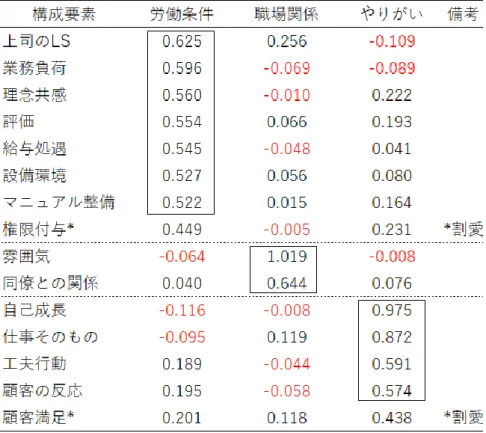
の要素を持ち, 3 つの中で要素が最も強い因子に分類をした.表 14 は Herzberg の「二要因 論」で使用されている 16 項目(A 群)と本研究で使用した 15 項目(B 群)の比較である.
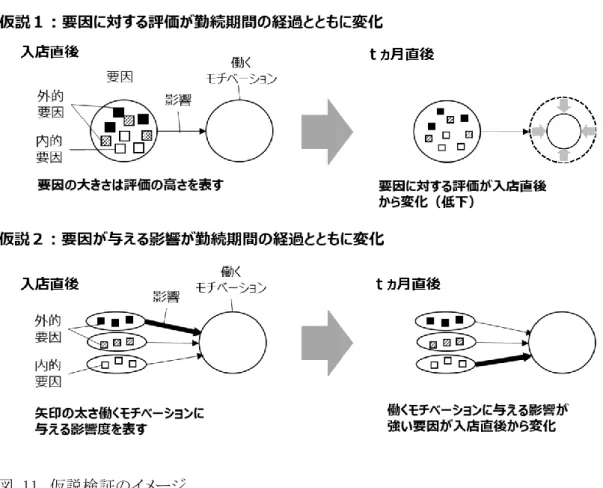
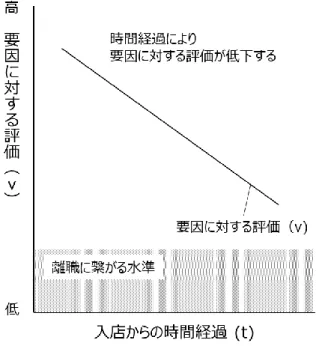
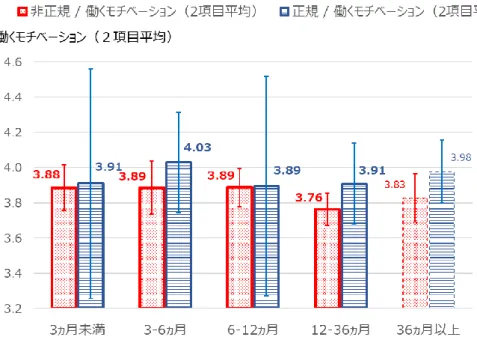
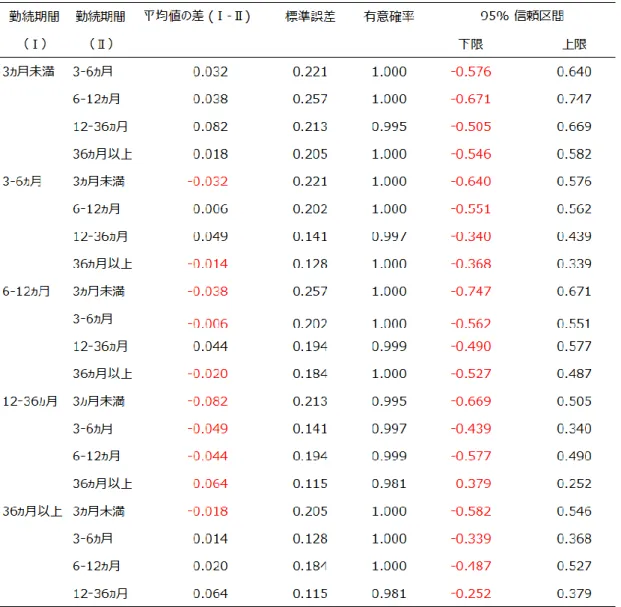
4.4 仮説検証の手順 仮説 1, 2 の検証手順について, 以下に説明する. 4.4.1 検証手順 1: 素点の平均値による勤続期間および就業区分ごとの比較 仮説 1 の「勤続期間の経過とともに, 非正規従業員の働くモチベーションに影響を与える要 因に関する評価が低下し, その変化は正規従業員とは異なる」を検証するために, 働くモチ ベーションおよびそれに影響を与える要因の経時変化の有無を分析する.まず, 抽出された 標本を勤続期間ごとのグループに分け, 要因 15 項目の素点(5 段階)の平均値を勤続期間の グループごとに集計する. このグループごとの勤続期間による素点の平均値を経時変化と捉 える. 変化の測定は, 勤続期間ごとの数値の差が有意にあるかを多重比較(Tukey HSD: honestly significant difference)によって検定する.同様に, 働くモチベーション 2 項目につい ても同様の分析を行う.もし, 隣り合う勤続期間において有意な差があれば, 要因の評価また は働くモチベーションが増減したとみなす.また, 上記の分析については非正規従業員のみ ならず正規従業員にも行う.就業区分による違いを比較することで, 非正規従業員ならではの 特徴なのか, 飲食チェーンで働く従業員すべてに共通する変化なのかを確認するのが目的 である. 4.4.2 検証手順 2: 共分散構造分析によるモデルの検証および多母集団同時分析による 勤続期間グループでの比較 仮説 2 の「勤続期間の経過とともに, 非正規従業員の働くモチベーションに対して, 外的要 因よりも内的要因への影響力が強くなる」検証するために, 4.3 で抽出した 3 因子に, 観測変 数である「従業員満足度」, 「職場定着度」の 2 項目を従属変数として構成する「働くモチベー ション」を加えて, 3 因子からの影響を示した店舗運営モデルを設計し, パス図で表現した(図 14).その上で, 前述のアンケート調査データを当モデルに利用して , 共分散構造分析 (covariance structure analysis), 多母集団同時分析(multiple group analysis)を実施する.
共分散構造分析
図 15 働くモチベーションに影響を与える要因の勤続期間による違い
ベーションへの影響力が強まっており, 仮説 2「勤続期間の経過とともに, 非正規従業員の働 くモチベーションに対して, 外的要因よりも内的要因への影響力が強くなる」を裏付ける結果 であると解釈した.なお, 36 ヵ月以上は上限の期間が定まっていないことから経時変化を検証 するうえでの比較は不適当と考え参考値とした.
上段:アルバイトスタッフ G 氏 下段:アルバイトスタッフ H 氏
務における真実の瞬間を踏まえて店舗のオペレーションの改善に参画することができれば, 全従業員の 1, 2 割に過ぎない正規従業員だけの改善施策よりも, 遥かに店舗のサービス品 質向上の可能性が広がる.一方で, サービス品質の向上を実現するための場面が無数にあ ることは, 非正規従業員が日常の意識をこれらの場面に向け, 改善への参画を果たすことが できれば, 働くモチベーションを常に高め続けることができる.店舗の改善案を出したらインセ ンティブを支払うという外的要因に依存したものではなく, 店舗の改善そのものの面白さや改 善された時の効力感を与えるような意識づけをすることが重要である. 成長実感を与える評価, 賞賛の仕組み 多くの時間を費やし, 職務を遂行する対価として非正規従業員が得るものは金銭的報酬だ けではない.自分が仕事を通じて成長実感を持てるときに喜びを感じるのは就業区分に別を 問わない.太田 (2010)は, 派遣社員が派遣先で承認されている集団とそうでない集団を分け て意識の変化を調査しているが, 「承認あり」群は自己効力感, キャリア・モチベーション, 仕 事・組織へのコミットメント などが強く, 仕事のパフォーマンスも高い.承認されることで, さら にその行動が強化されるという循環が形成されると説明している.この例を飲食業界に適用す れば, スタッフの技能の習熟度に応じて名札やエプロンなどにシールや刺繍を施していくとい った仕組みを多くの飲食チェーンが導入しているが, 働くモチベーションを高めるために有効 な施策であるといえる.企業内の資格そのものに社会的な価値があるというよりも, 自身の行 動が承認され, 可視化されることが働くモチベーションになると考えられる.また, 接客の技術 などを競い合い, 上位者のノウハウ共有とともに表彰を行うなど自身の成長や有能感を実感で きるような施策が効果的である.被表彰者のみならず, 高い技術と矜持をもって活躍する表彰 者の姿を見て, 他の非正規従業員も刺激を受け, 目標を持つことができる. 組織からの支援
図 26 飲食チェーンにおける職務拡大と職務充実化のイメージ
8.2 新たな要因の探索に関する先行研究
新たな要因を探索する必要性を示唆する先行研究として, 田中 (2009)は, Herzberg のフレ ームワークに「生活の満足感」(Hoppock, 1935)という概念を加えて, 職務満足への影響を検 証している. また, Rosso, Dekas, and Wrzesniewski (2010)は, 従業員が認識する仕事の重要 性には, 個人特性の差があることを説明している.岡田・中谷(2006)は, 1 つの理由や動機づ けのみが影響していることはわずかであり, むしろいくつかの動機づけが複合的に作用するこ とで行動を規定すると述べている.これらの研究は, 画一的な要因を繰り返し提供するのでは なく, 要因のバリエーションを増やし使い分けすることが, 店舗運営の有効なヒントとなることを 示唆している.
表 24 上位 3 項目を除き正規従業員および非正規従業員の特徴的なキーワード
補論 2 人的資源管理の効果を予測するシミュレーションの開発
本章では, 店舗運営のヒントを店舗管理者やチェーン経営者へ伝えるため, 「システム・ダ イナミクス(SD: system dynamics)」を用いた店舗経営のシミュレーションを設計する.第 1 節で は, シミュレーション開発の意義について述べる.第 2 節では, 先行研究, 第 3 節では, 店舗 運営のモデル設計について説明する.第 4 節では分析方法を説明し, 第 5 節では,シミュレー ションの結果に対する考察を行い, 実務者より評価を得る. 9.1 人的資源管理の効果予測シミュレーション開発の意義れば, 複数店舗を監督するエリア責任者が, 店舗によるパフォーマンスの差異や課題を特定 する支援ツールになり得る. 非正規従業員の活用が極めて重要な飲食チェーンにおいて, いかに働くモチベーションを 持続させ, 店舗のサービスレベルを高めるかが店舗運営の巧拙を分ける.そこで, 働くモチベ ーションが定着率やサービスレベルに与える影響をモデル化し, 非正規従業員の働くモチベ ーション向上への投資が時間経過とともに与える財務的影響をシミュレーションで可視化する. 施策の効果が見え難い人事施策において効果の予測ができることは, 店舗管理者や経営者 とのコミュニケーション上も役立つツールになると考えた.
表 27 シミュレーションに使用した方程式 対組織・従業員の働くモチベーションに関する部分
1 組織の働くモチベーション=MIN((モチベーション初期値-(( 人 間 関 係 へ の 不 満 + 労 働 条 件 へ の 不 満 )/2)*RANDOM NORMAL(0, 0.2 , 0.1 ,0.05 ,0 ))*IF THEN ELSE(時給>=時給上 限,0.8,1),100)*IF THEN ELSE(サービスレベル>=70, 1.1,1) 2 モチベーション初期値=70 人事施策・外的要因に関する部分 3 MGR教育=3(教育レベル みっちり:3, ふつう:2, 最 低限:1 まったく:0) 4 コミュニケーション施策(社内 SNS)=3
5 ガス抜き飲み会=IF THEN ELSE(人間関係への不満 >100, 50 , 0 )
6 時給= INTEG (IF THEN ELSE(時給>=時給上限,0, IF THEN ELSE(賃上げ検討>=50, 50 , 0 )),時給初 期値)
7 時給上限=1200 8 時給初期値=1000
9 賃上げ検討=IF THEN ELSE(労働条件への不満>100, 50 , 0 ) 10 労 働 に 対 す る 精 神 ・ 肉 体 的 負 担 感 =RANDOM NORMAL(0, 5 ,2 ,1 , 0 ) 従業員の不満に関する部分 11 賃金が上がらないことへの不満=RANDOM NORMAL(0, 5 ,2 ,1 , 0 ) 12 MGR への不満=RANDOM NORMAL(0, 5-MGR 教 育 ,2 ,1 , 0 ) 13 労働条件への不満= INTEG ((労働に対する精神・肉体 的負担感+賃金が上がらないことへの不満)-賃上げ検 討,10) 14 人間関係への不満= INTEG (MGR への不満+職場の人 間関係への不満-ガス抜き飲み会,10) 15 職場の人間関係への不満=RANDOM NORMAL(0, 5-コミュニケーション施策(社内 SNS) ,2 ,1 , 0 ) 店舗規模による必要人員に関する部分 16 残席率=2-席稼働率 17 座席数=100 18 席稼働率=(来店客数/30)/座席数 19 店舗必要人数=座席数*0.2 20 充足率=稼働従業員数/店舗必要人数 21 稼働従業員数= INTEG (採用数-離職数, 店舗必要人 数) 採用・離職に関する部分
22 採用数=IF THEN ELSE(充足率<1,(店舗必要人数 *(1-充足率)),0)*1.5 23 自然離職率=0.025 24 離職意向→離職のタイムラグ=3 25 従業員の継続就業意向率=DELAY1((1-(自然離職率 +((100-組織の働くモチベーション)*0.01)^2)),2) 26 離職数=DELAY1((MAX((稼働従業員数*(1-従業員 の継続就業意向率)),0)),離職意向→離職のタイムラグ) サービスレベルに関する部分 27 サービスレベル初期値=50-高単価期待値調整 28 高 単 価 期 待 値 調 整 =IF THEN ELSE( 顧 客 単 価
>5000, 10 , 0 )
29 サービスレベル= INTEG (IF THEN ELSE( (離職数/稼 働 従 業 員 数 )>0.2,RANDOM NORMAL(-1,0,-0.5,0.2,0) 来店客数に関する部分 30 来店客数= INTEG (リピート客数+新規来店数-来店客 数*0.8,30*100) 31 新 規 来 店 数 =( 広 告 宣 伝 費 /300)*RANDOM NORMAL(0.5,2,1,0.3,1) 32 リピート客数= INTEG (((新規来店数+リピート客数)*リ ピート比率)-リピート客数,0) 33 リピート比率=DELAY1(サービスレベル,1)/100 業績に関する部分 34 収支(累積)= INTEG (利益,0) 35 利益=売上-コスト 36 売上=来店客数*顧客単価 37 顧客単価=4000 円 38 コスト=人事施策コスト+人件費+採用広告費+広告宣 伝費+他コスト(原価・光熱費など) 39 人事施策コスト=稼働従業員数= INTEG (採用数-離 職数, 店舗必要人数) 40 人件費=稼働従業員数*時給*8*30
41 広告宣伝費=IF THEN ELSE(席稼働率<=2,残席率 *1e+06,0)
42 採用広告費=採用数*50000
43 他コスト(原価・光熱費など)=(顧客単価*0.4)*来店 客数
Cronbach αは削除しない時と比較して低い値を示していることから, 労働条件 7 項目, やり がい 4 項目, 職場環境 2 項目より割愛すべき項目はないと判断した.(表 29).
図 29 因子のスクリープロット
Ⅳ 検証的因子分析:設計したモデルの確認
標本となる回答者全員および, モデルの妥当性を確認するために検証的因子分析を行っ た.結果, モデルの適合度は許容範囲内であった.
Ⅵ アンケート調査に関する補足
アンケート調査では, 各項目に対して以下の設問, および選択肢を使用した.
Ⅸ 実務者インタビューで使用した資料(イメージ)
インタビューでは, 実験結果について説明をしたうえで, その納得度や現場での事例など について情報を収集した.所要時間は約 60 分であった.なお, 資料は本論文で記載している 分析方法や結果を要約したものであるためイメージのみ図 35 に示す.
Appendix 2 研究対象を取り巻く環境および先行研究の補足
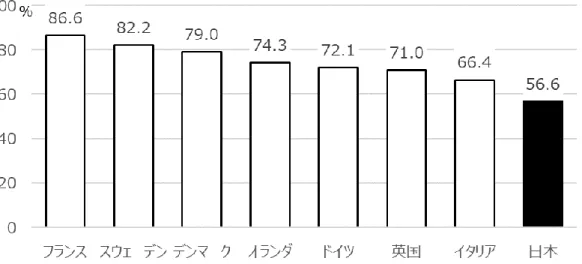
Ⅹ 働く目的(内閣府調査)
働く目的についての設問では, 「お金を得るために働く」が最も多いが, 年代による差があり, 40 代以降は低下傾向が見られる.
Ⅺ 飲食チェーンの開廃業率
飲食チェーンは国内の業界の中でも開業率, 廃業率が高い.参入障壁が低いが持続して 利益を上げていくことが難しいビジネスモデルであるといえる.
参考・引用文献
阿部 智和 (2013). オフィス空間のデザインと組織内コミュニケーション: メンバー間の距離の影響に関 する考察.北海道大学大学院経済学研究科經濟學研究, 2. 163-174.
安達 智子(1998). セールス職者の職務満足感, 心理学研究, 69(3), 223-228.
Addison, J. T., & Belfield, C. R. (2001). Updating the determinants of firm performance: Estimation using the 1998 UK workplace employee relations survey. British Journal of Industrial Relations, 39(3), 341-366.
Albrecht, K., & Zemke, R. (2002). Service America in the new economy. New York: The McGrow-Hill Companies. (アルブレヒト, K.・ゼンケ, R. 和田 正春(訳) (2003). サービスマネジメント: ダイヤ モンド社)
Alderfer, C. P. (1969). An empirical test of a new theory of human needs. Organizational Behavior & Human Performance, 4(2), 142-175.
Amabile, T., Kramer, S. (2011). The progress principle: Using small wins to ignite joy, engagement, and creativity at work. Watertown, MA: Harverd Business Review Press. (アマビール, T.・クレイマー, S. 樋口 武(監訳), 中竹 竜(訳) (2017). マネジャーの最も大切な仕事 -95%の人が見過ごす 「小さな進捗」の力: 英治出版) 安藤 正人 (2011). 雇用形態によるモチベーション構造の違いに関する研究. 広島大学マネジメント 研究, 11, 21-42. 安藤 至大 (2017). 金銭的・非金銭的報酬とワークモチベーション. 日本労働研究雑誌, 59(7), 26-36. 有賀 健・神林 龍・佐野 嘉秀 (2008). 非正社員の活用方針と雇用管理施策の効果. 日本労働研究 雑誌, 50(8), 78-97. 有吉 美恵・池田 浩・縄田 健悟・山口 裕幸 (2018). 定型業務がワークモチベーションを抑制する心 理プロセス: 職務意義の媒介効果. 実験社会心理学研究, 58(1), 53-61.
Arthur, J. B. (1994). Effects of human resource systems on manufacturing performance and turnover. Academy of Management Journal, 37(3), 670-687.
朝野 煕彦・鈴木 督久・小島 隆矢 (2005). 入門共分散構造分析の実際 講談社
渥美 俊一 (2009). フードサービス業チェーン化入門 柴田書店
(監訳), 本明 寛・野口 京子・春木 豊・山本 多喜司(訳) (1997). 激動社会の中の自己効力, (pp.1-41), 金子書房)
Barnard, C. I. (1968). The functions of the executive. Watertown, MA: Harverd Business Review Press. (バーナード, C. I. 山本 安次郎・田杉 競・飯野 春樹(訳) (1968). 経営者の役割: ダイヤモンド 社)
Bassett‐Jones, N., & Lloyd, G. C. (2005). Does Herzberg's motivation theory have staying power?, Journal of Management Development, 24(10), 929-943.
Boselie, P., & van der Wiele, T. (2002). Employee perceptions of HRM and TQM, and the effects on satisfaction and intention to leave. Managing Service Quality: An International Journal, 12(3), 165-172.
Bowen, D. E., & Lawler, E. E. (1992). The empowerment of service workers: what, why, how, and when. MITSloan Management Review, 33(3), 31-39.
Bridges, W. (2003). Managing transitions: making the most of change. Boston, MA: Nicholas Brealey Publishing.
Brislin, R., MacNab, B., Worthley, R., Kabigting, F., & Zukis, B. (2005). Evolving perceptions of Japanese workplace motivation -An employee manager comparison-. International Journal of Cross Cultural Management, 5, 87-104.
Bušatlić, S., & Mujabašić, A. (2018). Herzberg's two-factor theory of job satisfaction-comparative study between private and public high school teachers in Canton Sarajevo. The International Journal of Business and Management Research, 8, 27-48.
Carlzon, J. (1989). Moments of truth. New York, NW: Harper Business. (カールソン, J. 堤 猶二 (訳) (1990). 真実の瞬間: SAS (スカンジナビア航空) のサービス戦略はなぜ成功したか: ダイヤモンド 社)
Casuneanu, C. (2011). The Romanian employee motivation: An empirical analysis of Herzberg model. International Journal of Mathematical Models and Methods in Applied Sciences, 5, 923-930.
Cattell, R. B. (1966). The scree test for the number of factors. Multivariate Behavioral Research, 1(2), 245-276.
Chandler, D., & Kapelner, A. (2013). Breaking monotony with meaning: Motivation in crowdsourcing markets. Journal of Economic Behavior and Organization, 90, 123-133.
中小企業庁 (2016). 平成28年度(2016年度)の中小企業の動向. Retrieved from
Csikszentmihalyi, M. (2004). Good business: Leadership, flow, and the making of meaning: London, UK: Hodder & Stoughton. (チクセントミハイ, M. 大森 弘(監訳) (2008). フロー体験とグッドビジネス -仕事と生きがい-: 世界思想社)
Deci, E. L. (1971). The Effects of externally mediated rewards on intrinsic motivation. Journal of Personality and Social Psychology, 18, 105-115.
Deci, E. L., & Flaste, R. (1995). Why we do what we do -The dynamics of personal autonomy-. New York, NY: G.P. Putnum’s Sons. (デシ, E., フラスト, R. 櫻井 茂男(監訳) (1999). 人を伸ばす 力 -内発と自律のすすめ-: 新曜社)
Delery, J. E., Gupta, N., Shaw, J. D., Jenkins Jr, G. D., & Ganster, M. L. (2000). Unionization, compensation, and voice effects on quits and retention. A Jounrnal of Economy and Society, 39(4), 625-645.
DIAMONDハーバードビジネスレビュー編集部(編) (2009). 【新版】動機づける力 モチベーションの 理論と実践 ダイヤモンド社
ディップ総合研究所 (2019). アルバイト・パートスタッフの離職事情 ~早期離職防止・長期定着に必 要な対策とは~. Retrieved from https://www.baitoru.com/dipsouken/all/detail/id=261 (2020年 6月20日)
江夏 幾多郎 (2011). 正規従業員と非正規従業員の間での均衡処遇と組織パフォーマンス. 経営行 動科学, 24(1), 1-16.
榎本 博 (2015). モチベーションの新法則 日本経済新聞出版社
Erickson, T., & Gratton, L. (2007). What it means to work here. Harvard Business Review, 85, 104-112.
Eriksson, T., & Kristensen, N. (2014). Wages or fringes? Some evidence on trade-offs and sorting. Journal of Labor Economics, 32(4), 899-928.
Feldman, D. C. (1990). Reconceptualizing the nature and consequences of part-time work. Academy of Management Review, 15(1), 103-112.
Fischer, C., Malycha, C. P., & Schafmann, E. (2019). The influence of intrinsic motivation and synergistic extrinsic motivators on creativity and innovation. Frontiers in Psychology, 10, 137.
Forrester, J. W. (1958). Industrial dynamics A major breakthrough for decision makers. Harvard Business Review, 36(4), 37-66.
Freudenberger, H. J. (1975). The staff burn-out syndrome in alternative institutions. Psychotherapy: Theory, Research & Practice, 12(1), 73-82.
Fugar, F. (2007). Frederick Herzberg's motivation-hygiene theory revisited: The concept and its applicability to clergy (A study of fulltime stipendiary clergy of the global evangelical church, Ghana). Journal of Science and Technology (Ghana), 27(1), 119-130.
蒲生 智哉 (2008). サービス・マネジメントに関する先行研究の整理 -その研究の発展と主要な諸説 の理解. 立命館経営学, 47(2), 109-125.
玄田 有史 (2008). 内部労働市場下位層としての非正規. 経済研究, 59(4), 340-356.
魏 佩儀 (2016). 職務満足と組織の定着の関係. 紀要本文 人文・社会科学研究 東京国際大学大学 院, 1, 67-90.
Hackman, J. R. (1980). Work redesign and motivation. Professional Psychology, 11(3), 445-455.
原 ひろみ (2011). 非正社員の企業内訓練についての分析 (2010年労働政策研究会議報告 非正規 雇用をめぐる政策課題). 日本労働研究雑誌, 53, 33-48.
Hasan, A., & Pinjani, R. (2020). Prioritizing Herzbergs' motivator factors: A case of Siemens Inc. Paper presented at Annual London Conference on Money Economy and Management, Imperial College, London, UK.
林 伸二 (2014). 人と組織を変える自己効力 同文舘出版
Herzberg, F. (1968). One more time: How do you motivate employees?. Brighton, MA, Harvard Business Review, 81(1), 87-96.
Herzberg, F., Mausner, B., & Snyderman, B. B. (1959). The motivation to work. New York, NY: Wiley.
Heskett, J. L., Jones, T. O., Loveman, G. W., Sasser, W. E., & Schlesinger, L. A. (1994). Putting the service-profit chain to work. Harvard Business Review, 72(2), 164-174.
Heskett, J. L., Sasser, W. E., & Schlesinger, L. A. (1997). The service profit chain: How leading companies link profit and growth to loyalty, satisfaction, and value. New York, NY: Free Press.
平野 光 (2010). 三層化する労働市場--雇用区分の多様化と均衡処遇. 組織科学, 44(2), 30-43.
Hochschild, A. R. (1979). Emotion work, feeling rules, and social structure. American Journal of Sociology, 85(3), 551-575.
本田 一成 (2004). 職場のパートタイマー: 基幹化モデルを手がかりにした文献サーベイ. 労働政策 研究・研修機構. Retrived from https://dl.ndl.go.jp/info:ndljp/pid/10159533 (2020年6月20日)
堀 啓造 (2005). 因子分析における因子数決定法 -平行分析を中心にして. 香川大学経済論叢, 77(4), 35-70.
堀江 常稔・犬塚 篤・井川 康夫 (2009). 内発的モチベーションの知識創造行動への効果. 技術と経 済, 504, 66-71.
Hoppock, R. (1935). Job satisfaction. New York, NY: Harper.
Jowett, S. (2008). What makes coaches tick? The impact of coaches' intrinsic and extrinsic motives on their own satisfaction and that of their athletes. Scandinavian Journal of Medicine & Science in Sports, 18, 664-673.
鹿毛 雅治 (1995). 内発的動機づけと学習意欲の発達. 心理学評論, 38(2), 146-170.
鹿毛 雅治 (2012). Theory 1 好きこそものの上手なれ 内発的動機づけ 鹿毛 雅治(編) モティベー ションをまなぶ12の理論: ゼロからわかる「やる気の心理学」入門! (pp.19-44) 金剛出版
Kahneman, D., & Deaton, A. (2010). High income improves evaluation of life but not emotional well-being. Proceedings of the National Academy of Sciences, 107(38), 16489-16493.
Kalleberg, A., & Rognes, J. (2000). Employment relations in Norway: Some dimensions and correlates. Journal of Organizational Behavior, 21, 315-335.
咸 惠善 (1991). パートタイマーの組織コミットメントに関する実証分析. 経営行動科学, 6(1), 1-13.
神野 由香里 (2018). パートの基幹化に伴う人事施策 : 正社員の職域に近づいたパートへ考慮する 要因を中心に. 北海学園大学経営論集, 15(4), 135-146.
Karasek, R., Baker, D., Marxer, F., Ahlbom, A., & Theorell, T. (1981). Job decision latitude, job demands, and cardiovascular disease: a prospective study of Swedish men. American Journal of Public Health, 71(7), 694-705.
Kazaz, A., Acıkara, T., & Er, B. (2016). Evaluation of factors affecting labor productivity in Turkey by using Herzberg motivation-hygiene theory. Paper presented at the The World Congress on Engineering 2016, London, UK, 754-756.
北垣 武文 (2012). ハーズバーグの研究方法に関する一考察 : 実効性の高いやる気のマネジメント の実現に向けて. オイコノミカ, 48(2), 43-59.
Kohn, A. (1993). The troubte with gold stars, incentive plans, A’s, praise, and other bribes. Boston, MA: Rewards. (コーン, A., 田中 英史(訳)(2001). 報酬主義をこえて: 法政大学出版局)
厚生労働省 (2008). 平成20年版 労働経済の分析 -働く人の意識と雇用管理の動向-. Retrieved from https://www.mhlw.go.jp/wp/hakusyo/roudou/08/ (2020年6月20日)
厚生労働省 (2012a). 非正規雇用の現状. Retrieved from
https://www.mhlw.go.jp/stf/shingi/2r9852000002k8ag-att/2r9852000002k8f7.pdf (2020年6月 20日)
厚生労働省 (2012b). 平成24年版 労働経済の分析 第2章 貧困・格差の現状と分厚い中間層の復 活に向けた課題. Retrived from https://www.mhlw.go.jp/wp/hakusyo/roudou/12/ (2020年6月 20日) 厚生労働省 (2015). ストレスチェック制度導入ガイド. Retrived from https://www.mhlw.go.jp/bunya/roudoukijun/anzeneisei12/pdf/160331-1.pdf (2020年6月20日) 厚生労働省 (2016). 労働安全衛生法に基づくストレスチェック制度実施マニュアル. Retrived from https://www.mhlw.go.jp/content/000533925.pdf (2020年6月20日) 厚生労働省 (2017). 平成29年就労条件総合調査の概況. Retrieved from http://www.mhlw.go.jp/toukei/itiran/roudou/jikan/syurou/17/dl/gaikyou.pdf (2020年6月20日) 厚生労働省 (2018). 「働き方改革を推進するための関係法律の整備に関する法律案要綱」の答申. Retrieved from https://www.mhlw.go.jp/stf/houdou/0000177380.html (2020年6月20日)
厚生労働省 (2019a). 労働経済の推移と特徴 -雇用・失業情勢の動向-. Retrieved from https://www.mhlw.go.jp/wp/hakusyo/roudou/18/dl/18-1-1-2.pdf (2020年6月20日)
厚生労働省 (2019b). 平成30年版厚生労働白書 第二章 働き方改革の推進などを通じた労働環境の 整備など. 253-299 Retrieved from https://www.mhlw.go.jp/wp/hakusyo/kousei/18/dl/all.pdf (2020年6月20日)
厚生労働省 (2020a). パート・有期労働ポータルサイト. Retrieved from https://part-tanjikan.mhlw.go.jp/ (2020年6月20日)
厚生労働省 (2020b). 職業別一般職業紹介状況[実数](常用(含パート)). Retrieved from https://www.mhlw.go.jp/content/11602000/G35-3012.pdf (2020年6月20日)
Latham, G. P. (2007). Work motivation. Thousand Oaks, CA: Sage Publications. (レイサム, G. 金井 壽宏(監訳), 依田 卓巳(訳)(2009). ワーク・モティベーション: NTT出版)
Lawrence, P. R., Nohria, N., & Wilson, E. O. (2001). Driven: How human nature shapes our choices. San Francisco, CA: Jossey-Bass.
Locke, E. A., & Latham, G. P. (1990a). Work motivation: The high performance cycle: Oxfordshire, UK: Taylor & Francis Group.
Locke, E. A., & Latham, G. P. (1990b). A theory of goal setting & task performance. Upper Saddle River, NJ: Prentice Hall.
MacClelland, D. C. (1961). The achieving society. New York, NY: Free Press.
Maidani, E. A. (1991). Comparative study of Herzberg's two-factor theory of job satisfaction among public and private sectors. Public Personnel Management, 20(4), 441-448.
槙谷 正人 (2018). ビギナーズ経営組織論 中央経済社
Malik, M. E., & Naeem, B. (2013). Towards understanding controversy on herzberg theory of motivation. World Applied Sciences Journal, 24, 1031-1036.
Manolopoulos, D. (2007). An evaluation of employee motivation in the extended public sector in Greece. Employee Relations, 30, 63-85.
Maslow, A. H. (1943). A theory of human motivation. Psychological Review, 50(4), 370–396.
McGregor, D., & Cutcher-Gershenfeld, J. (1960). The human side of enterprise. New York, NY: McGraw-Hill. (マグレガー, D. 高橋 達夫(訳) (1966). 企業の人間的側面 統合と自己統制に よる経営: 産業能率短期大学出版部)
Meadows, D. H., & Wright, D. (2008). Thinking in systems: A primer: White River Junction, VT, Chelsea Green Pub.
湊 宣明 (2016). 「実践」システム・シンキング: 論理思考を超える問題解決のスキル 講談社
森川 正之 (2014). サービス産業の生産性分析: ミクロデータによる実証 日本評論社
森田 慎一郎 (2006). 日本の会社員における定着志向と職務満足感との関連. 心理学研究, 76(6), 534-539.
Morrow, P. C. (1993). The theory and measurement of work commitment. Stamford, CT: JAI Press.
Mukherjee, P. N. (2006). Total quality management. New Delhi, India: PHI Learning.
村杉 健・大橋 岩雄・羽石 寛寿・地代 憲弘 (1982). 動機づけ衛生理論の対人関係因子: ハーズバ ーグのM-H理論の実証的研究(第5報). 日本経営工学会誌, 33(2), 148-153.
村杉 健・三木 信一 (1990). ワーク・モチベーションの2様2重体系仮説の検証: 作業組織における MM理論の実証的研究(第1報). 日本経営工学会誌, 41(3), 178-184.
永瀬 伸子 (2003). 非正社員と正社員の賃金格差の納得性に関する分析. 国立女性教育会館研究 紀要, 7, 3-19.
内閣府 (2019). 国民生活に関する世論調査 働く目的は何か. Retrieved from https://survey.gov-online.go.jp/r01/r01-life/2-3.html (2020年6月20日) 中原 淳 (2017). フィードバック入門: 耳の痛いことを伝えて部下と職場を立て直す技術 PHP研究所 西本 万映子・今野 浩一郎 (2003). パートを中心にした非正社員の均衡処遇と経営パフォーマンス 日本労働研究機構 農林水産省 (2019). 働く人も企業もいきいき食品産業の働き方改革検討会(第四回)配付資料 資料1 外食・中食産業における働き方の現状と課題について. Retrieved from https://www.maff.go.jp/j/shokusan/kikaku/hatarakikata_shokusan/04_haifu.html (2020年6月20 日)
O'Donohue, W., & Ferguson, K. E. (2001). The psychology of B F Skinner: Thousand Oaks, CA: Sage Publications.
Oettingen, G., & Mayer, D. (2002). The motivating function of thinking about the future: Expectations versus fantasies. Journal of Personality and Social Psychology, 83(5), 1198-1212.
小川 悦史 (2015). 高業績型人的資源管理と非正規従業員のストレス・態度・行動との関係. 大阪経 大論集, 66(3), 81-104. 小川 悦史 (2016). 人的資源管理施策が非正規従業員の職務態度及びリテンションに及ぼす影響-マ ルチレベル分析から. 大阪経大論集, 66(6), 127. 荻野 七重・斎藤 勇 (1995). 多変量解析からみた心理発生的欲求の分類と構造(人文・社会科学篇). 白梅学園短期大学紀要, 31, 125-141. 王 明潔・大浦 洋子 (2010). 中国人留学生の学習意欲の変化に影響を及ぼす要因. 九州情報大学 研究論集, 12, 13-19. 岡田 謙介 (2015). 心理学と心理測定における信頼性について -Cronbachのα係数とは何なのか, 何でないのか-. 教育心理学年報, 54, 71-83. 岡田 涼・中谷 素之 (2006). 動機づけスタイルが課題への興味に及ぼす影響, 教育心理学研究, 54(1), 1-11. 奥西 好 (2008). 正社員および非正社員の賃金と仕事に関する意識 (特集 労働契約法と改正パート 労働法). 日本労働研究雑誌, 50(7), 54-69.
大沢 武志 (1993). 心理学的経営: 個をあるがままに生かす PHP研究所
太田 肇 (2010). 承認の効果に関する研究--派遣社員を対象として. 同志社政策研究, 4, 96-107.
Paul, A. K., & Anantharaman, R. N. (2003). Impact of people management practices on organizational performance: Analysis of a causal model. International Journal of Human Resource Management, 14(7), 1246-1266.
Pink, D. H. (2011). Drive: The surprising truth about what motivates us. London, UK: Penguin Publishing Group.
リクルートキャリア (2007). 転職理由と退職理由の本音ランキングBest10. Retrived from https://next.rikunabi.com/tenshokuknowhow/archives/4982/ (2020年6月20日)
リクルートワークス研究所 (2014). 人手不足の実態に関するレポート. Retrived from
https://www.works-i.com/research/works-report/item/140724_hit.pdf (2020年6月20日)
Robbins, S. P. (2005). Essentials of organizational behavior: London, UK: Pearson Education.(ロビンス, S. P. 高木 晴夫(訳) (2009). 組織行動のマネジメント: ダイヤモンド社)
Robbins, S. P., DeCenzo, D. A., & Coulter, D. M. (2004). Fundamentals of management. London, UK: Pearson Education.(ロビンス, S. P.・ディチェンゾ, D. A.・コールター, D. M. 高木 晴夫(訳) (2014). マネジメント入門: ダイヤモンド社)
Rosso, B. D., Dekas, K. H., & Wrzesniewski, A. (2010). On the meaning of work: A theoretical integration and review. Research in Organizational Behavior, 30, 91-127.
労働政策研究・研修機構 (2005). 働き盛り世代の仕事と生活に関する追跡調査. Retrieved from https://www.jil.go.jp/institute/research/2005/013.html (2020年6月20日)
労働政策研究・研修機構 (2018). パートタイム(短時間)労働者の賃金水準. データブック国際労働比 較2018. Retrived from https://www.jil.go.jp/kokunai/statistics/databook/2018/index.html (2020年6月20日)
Ryan, R. M., & Deci, E. L. (2000). Intrinsic and extrinsic motivations: Classic definitions and new directions. Contemporary Educational Psychology, 25(1), 54-67.
Ryan, R. M., & Deci, E. L. (2020). Intrinsic and extrinsic motivation from a self-determination theory perspective: Definitions, theory, practices, and future directions. Contemporary Educational Psychology, 101860, 1-11.
蔡 芢錫 (2016). 非正規従業員と組織からの支援認識 (特集 性別・年齢と非典型雇用). 日本労働研 究雑誌, 58(7), 40-51. 佐久間 智広 (2016). マネジャーの個人差が意思決定・業績に与える影響 -株式会社ドンクの店舗 データを用いた定量的検証-. 管理会計学, 24(1), 27-46. 櫻木 晃裕 (2006). 職務満足概念の構造と機能. 豊橋創造大学紀要, 10, 37-47. 櫻井 茂男 (2012). Theory 2 夢や目標をもって生きよう! 自己決定理論 鹿毛 雅治(編) モティベ ーションをまなぶ12の理論: ゼロからわかる「やる気の心理学」入門! (pp.45-72) 金剛出版 佐野 幸子・若林 満 (1995). 女性パートの仕事満足と仕事意欲に関する研究. 経営行動科学, 10(1), 45-54. 佐藤 博 (2004). 若年者の新しいキャリアとしての「未経験者歓迎」求人と「正社員登用」機会. 日本労 働研究雑誌, 46, 34-42. 関谷 大 (2016). あなたの仕事, 感情労働ですよね? 花伝社
Shamir, B., House, R., & Arthur, M. (1993). The motivational effects of charismatic leadership: A self-concept baased theory. Organization Science,4, 577-594.
Sheridan, J. E. (1992). Organizational culture and employee retention. Academy of Management Journal, 35(5), 1036-1056. 島貫 智行 (2007). パートタイマーの基幹労働力化が賃金満足度に与える影響 -組織内公正性の考 え方をてがかりに. 日本労働研究雑誌, 49(11), 63-76. 島津 明人 (2014). ワーク・エンゲイジメント : ポジティブ・メンタルヘルスで活力ある毎日を 労働調査 会 総務省統計局 (2020). 労働力調査 2019年(令和元年)平均(速報) Retrieved from https://www.stat.go.jp/data/roudou/sokuhou/nen/dt/pdf/index1.pdf (2020年6月20日).
田村 尚子 (2018). 感情労働マネジメント: 対人サービスで働く人々の組織的支援 生産性出版
Tan, T. H., & Waheed, A. (2011). Herzberg’s motivation-hygiene theory and job satisfaction in the Malaysian retail sector: mediating effect of love of money. Asian Academy of Management Journal, 16, 73-94.
田中 規子 (2009). 職務満足の規定要因 -フレデリック・ハーズバーグの「動機づけ衛生理論」を手 がかりとして. 人間文化創成科学論叢, 12, 257-266.
田尾 雅夫 (1989). バーンアウト : ヒューマン・サービス従事者における組織ストレス. 社会心理学研 究, 4(2), 91-97.
Taylor, F. W. (1911). The principles of scientific management. New York and London: Harper and brothers .
Tichaawa, T., & Idahosa, L. (2020). Adapting Herzberg: predicting attendees' motivation, satisfaction and intention to re-visit a festival in Cameroon using an ordered logit approach. Tourism Review International, 1-32.
To, S. M., & Tam, H. L. (2014). Generational differences in work values, perceived job rewards, and job satisfaction of Chinese female migrant workers: Implications for social policy and social services. Social Indicators Research, 118(3), 1315-1332.
冨山 禎信・井沢 良智 (2017). 中小企業の早期離職に対応する「内発的動機付け」の効用と限界. 九 州情報大学研究論集, 19, 63-72. 豊田 秀樹 (1998). 共分散構造分析: 構造方程式モデリング 朝倉書店 筒井 義郎・大竹 文雄・池田 新介 (2009). なぜあなたは不幸なのか. 大阪大学経済学, 58(4). 20-57. 内野 明 (1982). システム・ダイナミックス手法による企業モデルについて. 横浜商大論集, 15(1), 75-106.
Uddin, M., Hoque, N., Ibrahim, M., & Mamun, A. (2014). Work motivation: A study on regular and part-time employees of Bangladesh. International Journal of Management and Business Research 4, 235-245.
上原 衞・福田 紗也・浅井 怜衣 (2015). 正規従業員と非正規従業員の職務満足に関する研究. 愛 知淑徳大学論集, 11, 31-45.
梅崎 修・池田 心豪・藤本 真 (2020). 労働・職場調査ガイドブック: 多様な手法で探索する働く人た ちの世界 中央経済社
Usugami, J., & Park, K.-Y. (2006). Similarities and differences in employee motivation viewed by Korean and Japanese executives: empirical study on employee motivation management of Japanese-affiliated companies in Korea. The International Journal of Human Resource Management, 17(2), 280-294.
VandenBos, G. R. (Ed.). (2013). APA dictionary of psychology. Washington, DC: American Psychological Association. (ファンデンボス, G. R. (編). APA心理学大辞典: 培風館)
Vroom, V. H. (1964). Work and motivation. New York, NY: Wiley.
Walumbwa, F., Wang, P., Lawler, J., & Shi, K. (2004). The role of collective efficacy in the relations between transformational leadership and work outcomes. Journal of Occupational and Organizational Psychology, 77, 515-530. 八巻 直躬 (1976). QWL と IE. 日本経営工学会誌 27(3), 226-230. 山本 寛 (2009). 人材定着のマネジメント: 経営組織のリテンション研究 中央経済社 山下 京・向井 有理子 (2017). 非正規従業員の意識構造とその類型化. 商経学叢, 64(2), 305-320. 安田 雪 (2011). パーソナルネットワーク: 人のつながりがもたらすもの 新曜社 吉田 稔・中川 裕志 (2010). テキストマイニングの活用. 情報の科学と技術, 60(6), 230-235.
研究業績(2020 年 6 月 20 日時点)
査読論文:英文
Matsuki, T. & Nakamura, J. (2019). What do employees want in a job? A case study of chain stores in the food service industry. Journal of Strategic Management Studies (JSMS),11(1), 51-66.
Matsuki, T. & Nakamura, J. (2019). Effect of employees’ values on employee satisfaction in Japanese retail & service industries. Advances in Human-Computer Interaction (AHCI), 4951387.
Matsuki, T. & Nakamura, J. (2018). Survey of motivation to work among non-regular employees in the food services companies. International Journal of Systems & Service-Oriented Engineering (IJSSOE), 8(2). 41-61.
査読論文:日文
松木 知徳・中村 潤(2020) サービスチェーンにおける非正規従業員の働くモチベーションが業績に 繋がるメカニズム -飲食チェーン3社での実証研究-. マーケティングレビュー, 1(1). 76-84.
学会発表:国際学会
Matsuki, T. Nakamura, J. (2017, August). Effects of employee satisfaction on service by employment pattern: The ES-CS model. Paper session presented at the workshop of International Joint Conference on Artificial Intelligence (IJCAI), RMIT University, Melbourne. 口頭発表(査読あり).
Abstract
Chronological Changes in Factors Affecting the Work Motivation of Non-regular Employees
-An Empirical Study of Restaurant Chains-
Human-resource management of non-regular employees is increasingly important for restaurant chains, since non-regular employees comprise most of their workforce. In particular, the motivation management is an important issue in store operations and service quality. However, the mechanism of work motivation has not been clarified, and store operation depends on the managerial skill of the managers; no effective indications for improvement have yet been found.
The purpose of this study was twofold: to clarify the chronological changes in factors affect the work motivation of non-regular employees in restaurant chains, and to provide store and restaurant-chain managers with management guidelines based on the work motivation of non-regular employees. Such motivation constitutes a business challenge today.
Looking at previous studies in this area, there are few empirical studies on the work motivation of non-regular employees. Moreover, chronological changes in their work motivation have not been elucidated. Therefore, this study considered the mechanism of chronological changes in relation to the work motivation of non-regular employees, and elucidated business countermeasures. A questionnaire survey was conducted to determine the factors that affected the work motivation of regular employees and non-regular employees at three restaurant chains.
The chronological changes were clarified by classifying the respondents into groups based on their length of employment and comparing the responses of the groups. In addition, an exploratory factor analysis on the factors affecting work motivation was conducted, and the relationship between the factors and the work motivation of non-regular employees was modeled. The model structure and hypotheses were verified by covariance structure analysis, and differences in the influence of the factors on work motivation for each period of employment were verified by a multi-population simultaneous analysis.
artifact of the critical incident method. To respond to such criticisms, the factors were revised based on industry characteristics and structured models using exploratory factor analysis, and the mechanisms were verified by quantitative analysis of the employee surveys.
The analysis produced three results. First, the number of factors that affected work motivation decreased with time, and the tendencies of non-regular employees differed from those of regular employees. Second, based on exploratory factor analysis, the factors affecting work motivation were: working conditions, workplace relationships, and reward, with the nature of these factors shifting from extrinsic factors to intrinsic factors. Third, the factors interacted with each other.
Furthermore, evaluation by practitioners confirmed the validity of these results in the business field, and their value to managers of stores and restaurant chains seeking to improve store operations. Finally, the results have several implications for business. From the viewpoint of work motivation, measures for improving the retention and morale of non-regular employees are proposed. Many companies in Japan have recognized the essential role of non-regular employees as an important issue, one associated with legal changes.
This study contributes to both academic and business interests. From an academic aspect, the first contribution is the finding that chronology affects the work motivation of non-regular employees, and the second is the performance of an empirical study that applied Herzberg’s theory. The third is the evaluation of the store operation model based on practitioner interviews. Regarding the business aspect, one contribution is that of scientifically elucidating the work motivation of non-regular employees rather than simply relying on managers’ experience and intuition. Another is the number of points suggested related to store-management awareness of practitioners.
This study was an empirical study at three restaurant chains. There is more to be done in researching the factors that affect work motivation in various industries. For example, a comparison of work motivation based on industry characteristics could be undertaken using cross-industry research.