九州大学学術情報リポジトリ
Kyushu University Institutional Repository
ベンジル位ソルボリシスに於ける共鳴要求度に関す る研究
中田, 和秀
九州大学理学研究科化学専攻
https://doi.org/10.11501/3081162
出版情報:Kyushu University, 1994, 博士(理学), 課程博士 バージョン:
権利関係:
THE STUDY ON THE RESONANCE DEMAND
IN BENZYLIC SOLVOLYSES
KAZUHIDE NAKATA
KYUSHU UNIVERSITY
1995
Chapter 1
Chapter 2
Chapter 3
Chapter 4
Chapter 5
Contents
Introduction
Substituent Effect on the Solvolysis of 2,2-Dimethylindan-1-yl Chlorides
Substituent Effect on Gas Phase Stabilities of a-t-Butyl-a-methylbenzyl Cations
Ab Initio Calculation for Some Benzylic Cations
Experimental
Acknowledgment
1
39
60
74
134
145
chapter 1 Introduction
The linear free energy relationship is an extremely useful
tool in the exploration of reaction mechanisms in a wide variety of situations .1) In particular the Yukawa-Tsuno (LArSR) Eq. (1-1) 2) is one of the most useful tool to predict characters of transition state whose reaction center is affected by benzene 1t-system, and was widely applied to a lot of substrates with success.3-4)
log ( k/k0 ) (1-1)
This equation is characterized by empirically obtained resonance demand parameter r which indicates the degree of resonance interaction between the reaction center and benzene 1t-system. The
r value has been found to change widely with the reactions; r = 1. 00 for solvolysis of a-cumyl chloride by definition, r = 1. 15 for the secondary a-methylbenzyl system,3d) and r = 1.30 for the
primary benzyl system. 3c) In addition, r values of 1. 39 and 1. 51 were found for highly deactivated carbocationic solvolyses of a- me t h y l-a- t r i f l u o r o m e t h y l b e n z yl s y s t e m3 b ) and a -
trifluoromethylbenzyl system,3a) respectively. The r value
increases in proportion to instability of cation. Thus the r value should be a measure of the resonance demand reflecting the stability of cationic transition state and provides very important
information to evaluate the nature of the transition state.
Substituent effect on the solvolysis of a-methyl benzyl chlorides gave the r value of 1.15 which is referred to the higher
resonance demand of this secondary system than the a+ reference
system. However, the incursion of solvent participation is suggested for this borderline solvolysis. 5) If this is the case, solvent participation might become important as the substituent becomes more electron attracting and give a monotonically concave a+ correlation. It has thus often been claimed in the literature
that the higher r value observed in such a case will be meaningless.6) The solvolysis of a-(t-butyl)benzyl tosylates where there is little possibility of solvent participation can be an alternative reference for secondary SN1 solvolysis system.
Nevertheless, this system may not generate a coplanar cation with benzene n-system in the transition state due to bulkiness of the t- Bu group at a position.3e) The intrinsic resonance demand of secondary benzylic systems has not been determined yet. In order to prove the origin of the r values relating to the inherent stabilities of a series of the benzylic cation, the r value which reflects the fully conjugated secondary system is needed. Thus the substituent effect on the solvolysis of 2, 2-dimethylindan-1-yl chlorides,3g) where the vacant p-orbital developed at the benzylic position is fixed in preferred conformation to overlap with the benzene 1t-system, was analyzed by LArSR Eq. (1-1). The neopentyl skeleton of this system will solvolyze via SN1 mechanism.
Moreover, this system will attain a full resonance stabilization in the transition state because of the fused five membered ring, and then provide an standard r value anticipated for the inherent secondary benzylic solvolysis system.
Results of substituent effect analysis of 2,2-dimethylindan-1- yl chloride at 2 5°C are shown below.
1 o g ( k I k 0 ) = -6 . 121 a+
(n=11, R=O. 999, SD=±O .16)
log (k/k0) = -5.80( a0 +1.11�cr
;
)( n=11, R=O. 999, SD=±O .1 2)
(1-2)
(1-3)
The LArSR plot was shown in Fig. 1-1. Comparison of p+a+ and LArSR
correlations clearly shows that the LArSR equation can describe the present reaction more precisely than the Brown p+a+ treatment; the
SD value are 1.5 times larger than those of the LArSR correlation.
Both the large negative p value and the enhanced r value
larger than unity suggest that this solvolysis proceeds through a highly charged transition state of a rate-determing kc-ionization leading to a carbocation intermediate. Furthermore this linear relationship should be free of either nucleophilic solvent assistance or neighboring methyl participation. Thus the r value
of 1.11 may be referred to as the reference value characteristic of open secondary benzylic carbenium ion which is essentially coplanar
and capable of exerting essentially maxi mum conjugative stabilization interaction with the benzene n system.
It has been noted that most systems favored by the LArSR treatment are secondary substrates in nucleophilic solvents and such systems may also be subject to nucleophilic solvent
4.0
2.0
0.0
-2.0
-4.0
-1.0 -0.5
Cl
x�"
5-MeS in BOA at 25°
5-PhO
•5-Me0-6-CI 5,6-Me2
5-Me 5-t-Bu
5-Br
a
scale
0.0
6-Me H
6-CI 6-Br
0.5
Fig. 1-1. LArSR plot for the solvolysis of 2,2-dimethylindan-1-yl chlorides in BOA at 25°C; open circle cr+, closed cr0, and squares
a
for r=l.l1.
. t . 5)
par t ic1p a 1o n , and that the high r value o f 1. 15 for a- methylbenzyl chloride is an artifact arising from such mechanistic co mplexity. The r value (1.11) for 2,2-dimethylindan-1-yl chloride which solvolyzes through kc mechanism is higher than that (1.00) for a-cumyl chloride reflecting instability of secondary system.
It is almost identical to the r value of 1.153d) for the solvolysis of a-methylbenzyl chlorides in BOA. This solvolysis indeed shows a str ictly linear free energy relationship against the 2, 2- dimethylindan-1-yl solvolysis with a R=0.994 and SD=±O.OB as shown
in Table 1-1. Consequently, the exalted r value of 1.15 obtained for a-methylbenzyl system is the intrinsic resonance demand reflecting the stability of secondary benzylic cations.
Table 1-1. Substituent Effects of Secondary Benzylic Solvolyses vs.
2,2-Dimethylindan-1-yl Chlorides.
System Solv. temp/OC Slope
a-methylbenzyl BOA 45 0.907±0.010 11 O.OB 0.9994 a-t-Bu-benzyl BOA 25 0.929±0.011 12 0.10 0.9993 a-t-Bu-2-Me-benzyl BOA 25 0.917±0.037 7 0.22 0.9960 a-t-Bu-
2,2-Me2-benzyl BOA 25 O.B14±0.024 4 0.09 0.9992
a) Number of substituents involved. b) Standard deviation. c) Correlation coefficient.
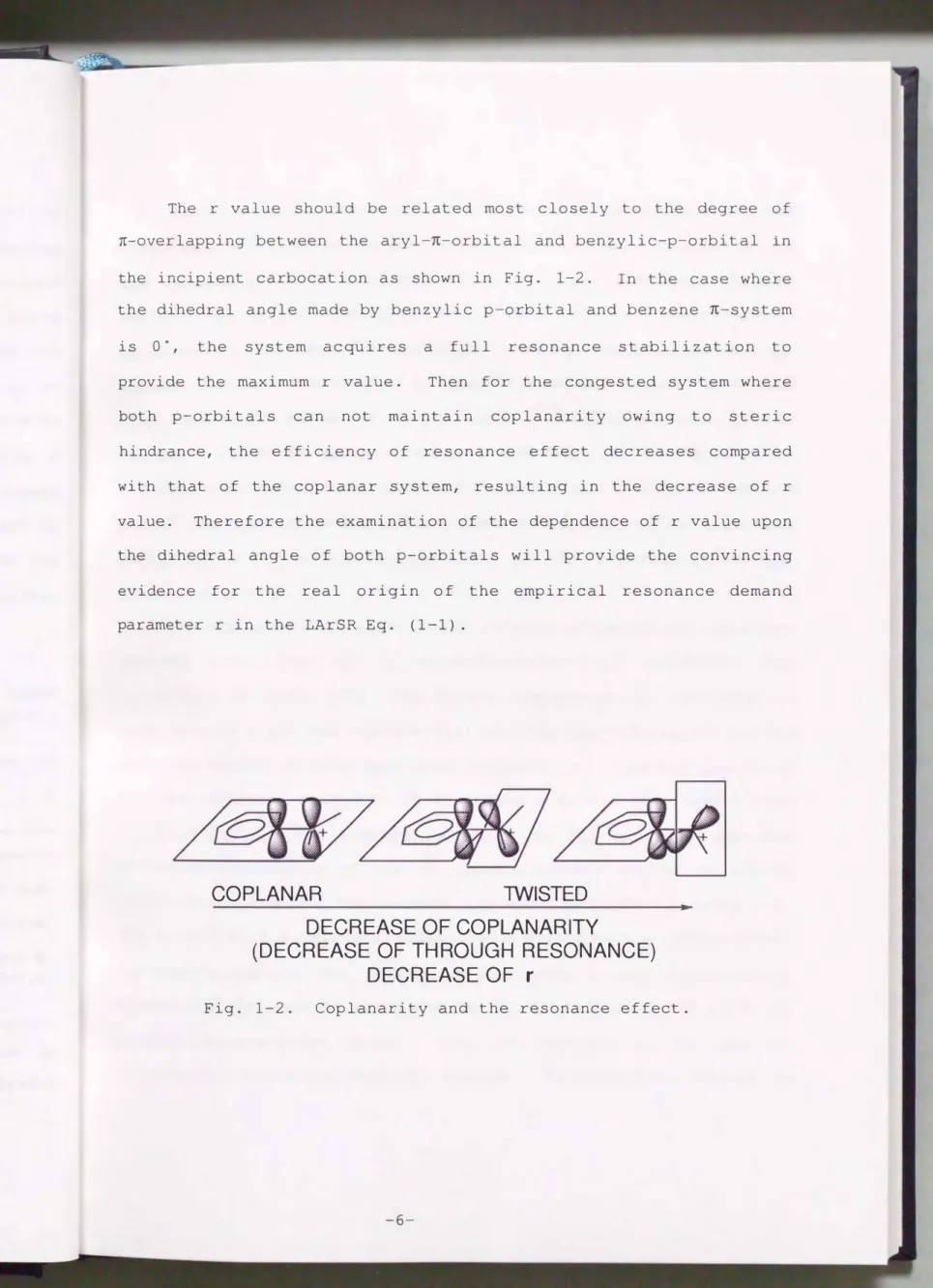
The r value should be related most closely to the degree of n-overlapping between the aryl-n-orbital and benzylic-p-orbital ln
the incipient carbocation as shown in Fig. 1-2. In the case where the dihedral angle made by benzylic p-orbital and benzene n-system
is 0 · , the system acquires a full resonance stabilization to
provide the maximum r value. Then for the congested system where both p-orbi tals can not maintain coplanari ty owing to steric hindrance, the efficiency of resonance effect decreases compared with that of the coplanar system, resulting in the decrease of r value. Therefore the examination of the dependence of r value upon the dihedral angle of both p-orbitals will provide the convincing evidence for the real origin of the empirical resonance demand parameter r in the LArSR Eq. (1-1) .
COPLANAR TWISTED
DECREASE OF COPLANARITY
(DECREASE OF THROUGH RESONANCE) DECREASE OF
rFig. 1-2. Coplanarity and the resonance effect.
From this point of view, the benzylic kc solvolyses where the incipient carbenium center p-orbitals are sterically twisted out of
the coplanarity with the aryl ring have been studied. In the substituent effect on the solvolyses of secondary a - ( t -
butyl)benzyl tosylates3e) and their a-methyl analogues, a-methyl and o,o-dimethyl substituted series,3f) r value of 1.09, 1.01, and
1. 02 were reported by using Eq. ( 1-1) . No significant loss of
resonance for these systems compared with coplanar 2,2-dimethyl-1- indanyl system has been observed. Increased steric congestion around the carbenium ion center does not appear to be effective enough to cause a significant loss of the coplanari ty in the transition state.
The comparison of substituent effects of secondary congested systems with that of 2,2-dimethylindan-1-yl chlorides are summarized in Table 1-2. The direct comparison of logarithms of rate constants for two systems will provide the information on the relative degree of the resonance interaction. The solvolysis of a-(t-butyl)benzyl tosylates in 80A shows a good linear free energy
relation against the indanyl system. One can conclude that the resonance efficiency of the a-( t-butyl) benzyl system lS almost
identical to that of the indanyl system. As shown in Table 1-2, the substituent effect correlation for a-(t-butyl)-2-methylbenzyl
solvolysis against for indanyl system gave a poor correlation, suggesting the loss of resonance in the transition state of a-(t-
butyl)-2-methylbenzyl system.
a-(t-butyl)-2,2-dimethylbenzyl
The same tendency can be seen for system. Consequently, it can be
said that qualitative loss of resonance interaction for these
systems exist.
The r value of 1.11 is regarded as a reference rmax value,
i.e., an intrinsic r value characteristic of the coplanar sec.
benzylic carbocation. The efficiency of resonance interaction can be accounted for in terms of cos2e where 8 is the dihedral angle of
twisting out of coplanari ty. 7) The ratio of the r value for a given solvolysis relative to the rmax may reflect the efficiency of the resonance effect of that system and the r value for a twisted benzylic system can be given by Eq. (1-4),
r = rmax cos28. (1-4)
The decrease of r values of a-methyl and o, a-dimethyl a- ( t- butyl)benzyl systems from rmax of 1.11 should be attributed to a
loss of the resonance interaction between the carbocation center and the benzene n-system in the solvolysis transition state caused by the steric hindrance. Thus the torsional angle Sobs at the transition state can be calculated to be 8° for a-(t-butyl)benzyl,
and 17° for both a-methyl and o,o-dimethyl solvolysis based on Eq.
(1-4). Torsional angles of these congested secondary systems increase in proportion to the bulkiness around the reaction center, although these twisting angles are not very serious compared with those of tertiary systems reported.3h) The stabilization by the extended n-delocalization should be the most predominant driving force to promote ionization in the ordinary benzylic solvolysis.
The transition state should be able to attain the maximum
stabilization to over come the large steric st rain required for the most p refer red confor mation. For tertiary solvolysis systems, r=0.91 for a-t-butyl-a-methylbenzyl chlorides and r=0.26 for a, a- di-t-butylbenzyl OPNBs were observed against r=l. 00 of a-cumyl
chlorides which is considered to be coplanar. Torsional angles of 17" a-t-butyl- a-methylbenzyl and 59" for a, a- di- t-butylbenzyl
systems were estimated based on Eq. (1-4). Larger steric effect can be seen for tertiary systems than that for secondary systems.
Sub stituent ef fect s on the gas-phase st abilities of benzylic cations can be des c ribed in ter ms of
equation (1-5) excel lent ly, 2) simila r ly a s solvolysis.
the LArSR seen in
(1-5)
where r is the pa r a meter measu ring the deg ree of r esonance interaction between benzene 1t-system and cationic center.
In continu ous stu dies on gas this l aborat o r y, the r value
ethyl- a-methylbenzyl,4e) 1.14 for benzyl,4 c) 1. 41
phase benzylic cations in 1.00 for a-cumyl4f) and a- for a -phenylethyl,4 d) 1. 29 for a-methyl-a- trifluor omethylbenzyl,4b) and 1. 54 for a
trifluor omethylbenzyl 4a) cations a r e ob tained by Eq. (1- 5) • It has been dem onst rated that the r va lues of substituent effect s on the gas phase st abilities a re in c omp lete ag reement with those in the co r r esp onding solvolyses f o r these sys t ems.4a) This resu l t lea d s t o the
important concept for kc benzylic solvolysis; the structure of transition state should be similar to that of cation. However this phenomenon has not been confirmed
for both secondary and tertiary hindered resonance systems. In order to confirm the identity of r values between in solution and ln gas phase, substituent effect analysis on gas phase stabilities for congested system must be done. Intrinsic stability of cation in
phase can be easily measured using ICR (ion resonance) method. The substituent effect on
the gas cyclotron gas phase benzylic concerning the r value for twisted
stabilities carbocation substituent
system has effect on gas
not yet been examined. The phase stabilities of a-t-butyl- a-methylbenzyl cations (14) is chosen for this purpose as a sterically hindered carbocation. The twisted structure of the cation 14 may be
a-groups, and therefore
produced by the bulkiness of two a reduced r value may be expected
similarly for this The gas phase
solvolysis.
stabilities of a-t-butyl-a-methylbenzyl cations (14) were determined by the equilibrium constants for the proton transfer reaction of the corresponding 2-
aryl-3,3-dimethyl-1-butene with suitable reference cations of known stability by means of a pulsed ion cyclotron resonance mass spectrometer at 343K as described in detail in experimental chapter.
application of the LArSR Eq.
As shown (1-5) to
in Fig.
14 provides
1-3, an r
an of
0
E
--
co (.)
� 0
(j
<j
t-010
p-MeO
•8 p-MeS
•in gas phase
6 p-MeO-m-CI
---e� 3,5-Me2
4 p-Me
� m-Me
2 D
1�
0 H
�
-2 -4 �
• 0 D ()0 a+ () -m-CI m-F
p
=-12.5 -6
r =0.86
-8
-0.5 0.0
cr
scale
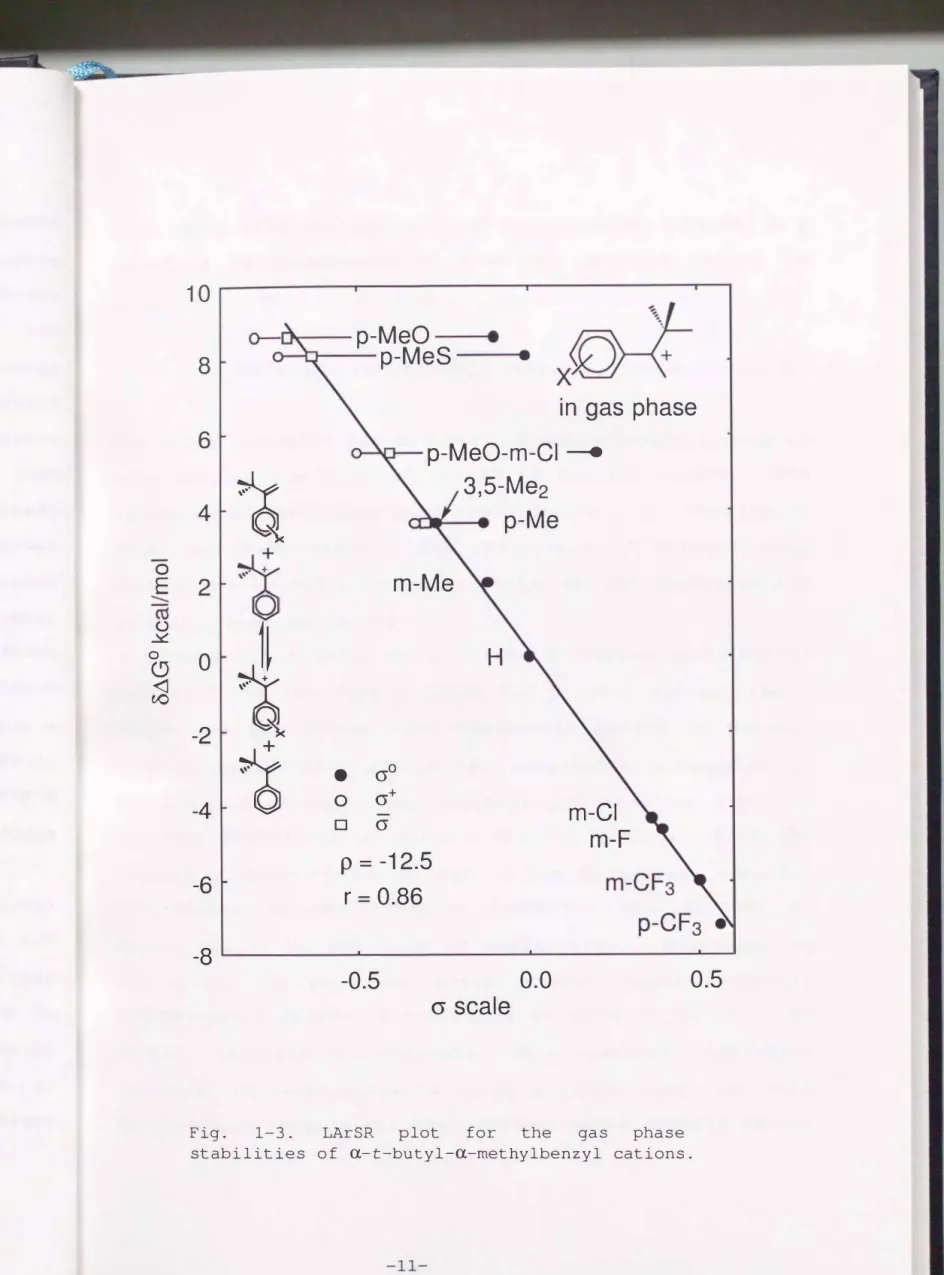
Fig. 1-3. LArSR plot for the gas phase stabilities of a-t-butyl-a-methylbenzyl cations.
0.5
0. 8 6 lower than the unity for a-cumyl cation, whereas a p of -12.5 is comparable to that for a-cumyl cation (-
13.0) .4f)
( 1-6)
The r=0.86 obtained for a-t-butyl-a-methylbenzyl cation is only reduced one-tenth of r=1. 00 of a-cumyl cation. The resonance effect close to cr+-conjugation still remains in this congested cation. The efficiency of 7t-interaction between 1t-ring and a vacant p-orbital of the carbenium ion
is not so much decreased.
Since the r value of 1. 0 1 for a-ethyl-a-methylbenzyl cations4e) is the same r value for a-cumyl system, the r value does not change with electronic effect of a-alkyl substituents. This allows the reasonable assumption of the r value of unity
cations, regardless of
for coplanar and varying a-alkyl
tertiary groups.
benzylic Thus the
reduced r value of 14 is due to the decreased resonance interaction between benzylic p-orbital and benzene 1t-
system caused by the loss of coplanari ty. According to Eq. (1-4), the torsional angle between vacant p-orbital and benzene 1t-system of cat ion 1 4 i s given to be 2 2 ° • Ab initio calculation supports this result; optimized structure of carbocation 14 using a 6-3 1G* basis set with Hartree-Fock level gives the dihedral angle between vacant
benzylic p-orbital and benzene 1t-system 24° as described
later.
The gas phase stability of unsubstituted a-t-butyl-a-
rnethylbenzyl cation is found to be than the corresponding a-cumyl
lower by cation;
1.1 kcal mol-l this may be
attributed to polar effect or increased internal strain due to replacing the a-methyl group by bulky t-butyl
group, or the overlapping of
loss of both p
resonance stabilization and 7t-orbitals due to
by reduced congestion
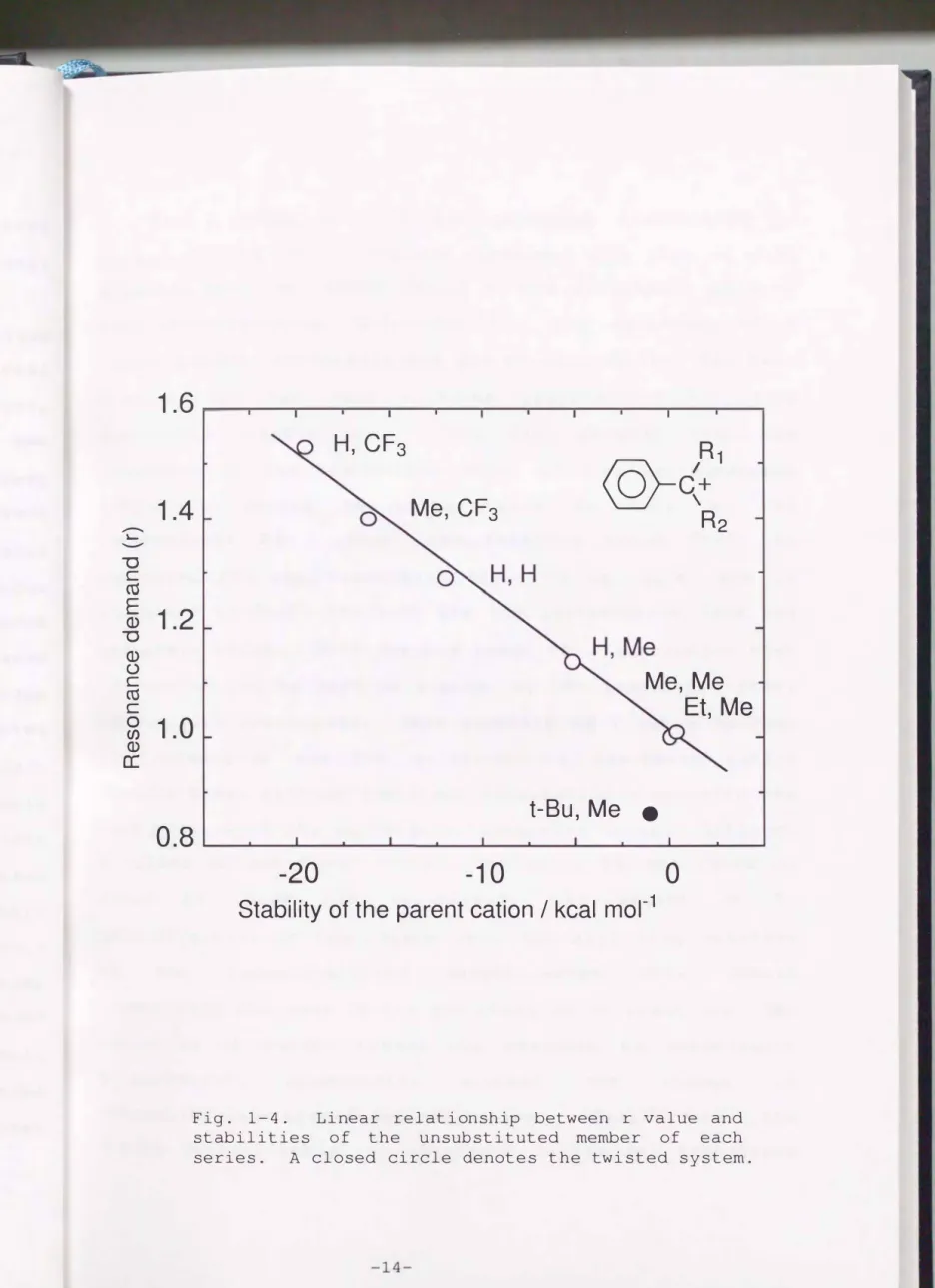
bulkiness around the cation center in 14. The LArSR r values were plotted against relative
substrate (ring substituent H) benzylic cations in Fig. 1-4.
stabilities of parent for a-substituted Only a-tert-butyl-a-
rnethylbenzyl system (14) shows a different behavior; the parent cation is more destabilized than a-cumyl system although 14 has reduced r value. The plot for 14 deviates clearly from the
plots of other between the r
line which systems.
value and
is linearly Consequently
correlated with good
the intrinsic
relation stability discriminates hindered resonance system such as 14 . In turn, it is concluded that this linear relationship is
generally retained for benzylic system as far as the benzene 1t-orbital and a vacant p-orbital lie on the same
plane.
benzylic
That is, the intrinsic stability of the parent carbocation lS a factor which govern the resonance demand.
,.-...
� _.
"'0
c
co E
"'0 Q)
Q) (.)
c
ro
c0 (/) Q) a:
1.6
H, CF3 R1
1.4 Me, CF3 @-<+ R2
1.2
Me, Me
1.0 Et, Me
t-Bu, Me • 0.8
-20 -10 0
Stability of the parent cation I kcal mor1
Fig. 1-4. Linear relationship between r value and
stabilities of the unsubstituted member of each
series.
Aclosed circle denotes the twisted system.
The r value of
0.86
for gas-phase stabilities of carbocation14
is in complete agreement with that of0.91
obtained from the recent result of the solvolysis of a-t- butyl-a-methylbenzyl chlorides.3i) The agreement of r values between solvolysis and gas phase stability has been observed for not only carbocations alsosterically twisted one.
coplanar
This fact reveals
but
that the structure of the transition state of the corresponding close to that the solvolysis should
intermediate
14.
be quite
Thus, the twisting angle
of
8=21
° is by Eq.(1-4)
and is estimatedidentical
for the to
8=22°
transition state
assigned for the intermediate from the
gas-phase value. This further leads to a conclusion that the cation can be used as a model of the transition state of benzylic solvolysis. This identity of r value between the solvolysis and the corresponding gas-phase cation stability may provide important information concerning the
real picture of the solvolysis transition state. Although
P
values of gas phase cations including14
are twice as large as those for solvolysis, the degree of 1t-delocalization of the charge into the aryl ring relative to the inductive/field stabilization will remain essentially the same in the gas phase as in
solvation of cation lowers the response
solution. The to substituent perturbation, essentially without
intramolecular charge-delocalization.
charge delocalization or structure in
the change in Furthermore, the the
SNl
transitionstate in the benzylic solvol ysis should also be q uite c lose to those of the carbocation interme diate, so that one can use the cation as a model of transition state of SN1
solvolysis. This suggests that the benzylic cations are very important species to interpret the r value theoretically.
In organic chemistry, the "resonance theory" which is derived from valence bond theory is of course important concept to predict reactivity. This theory estimates changes of physical constants (stabilization energy, bond length, charge density, bond order, and so on) qualitatively, which is affected by resonance. Thus the existence of good correlation between the r values and physical quantities of benzylic cations which is calculated by molecular orbital theory provides the real origin of the r value.
From this point of view, the geometries of benzylic cations
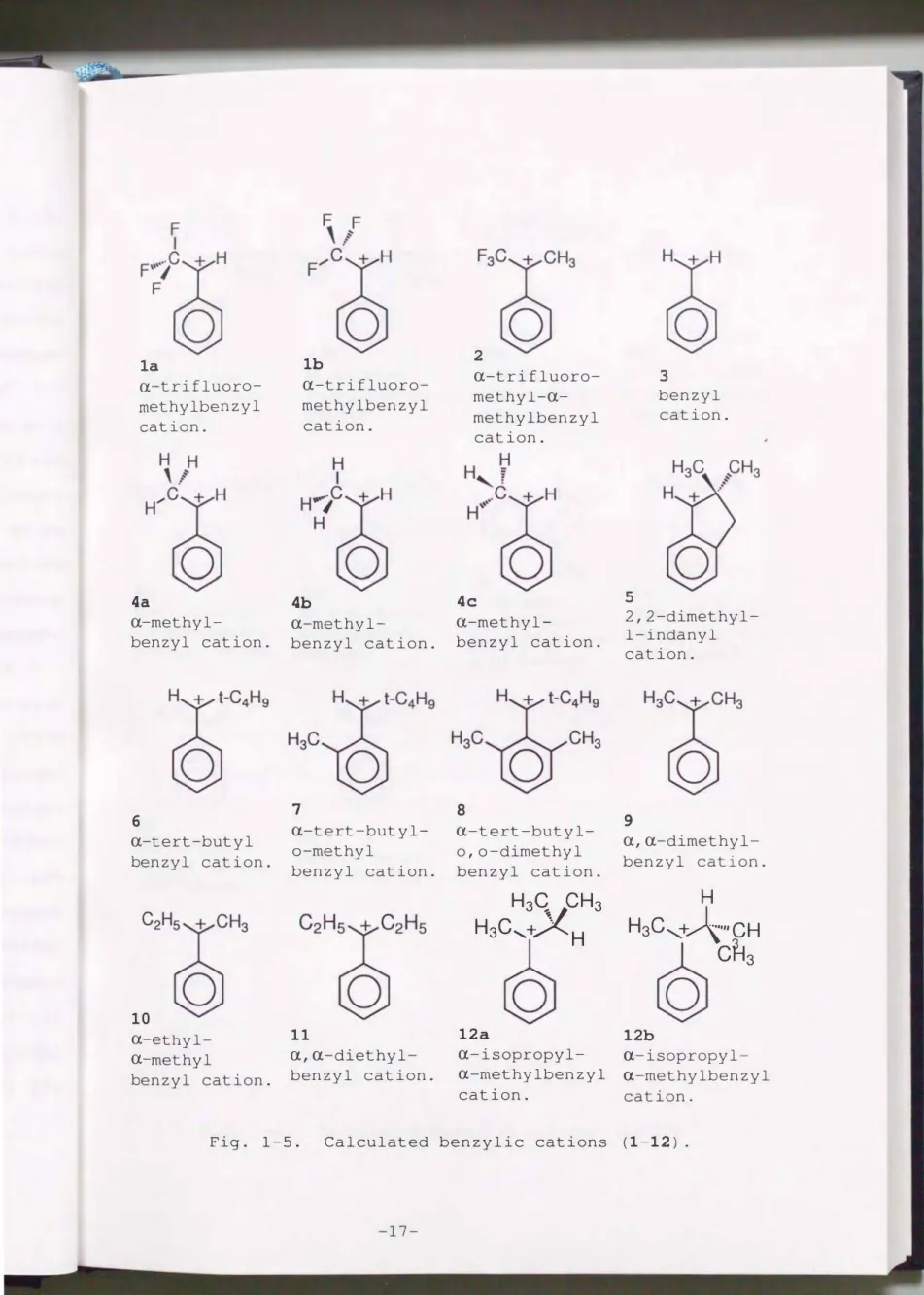
were optimized by ab initio MO methods with some kinds of basis sets. The ab initio LCAO-MO methodS) was used for the study of a-
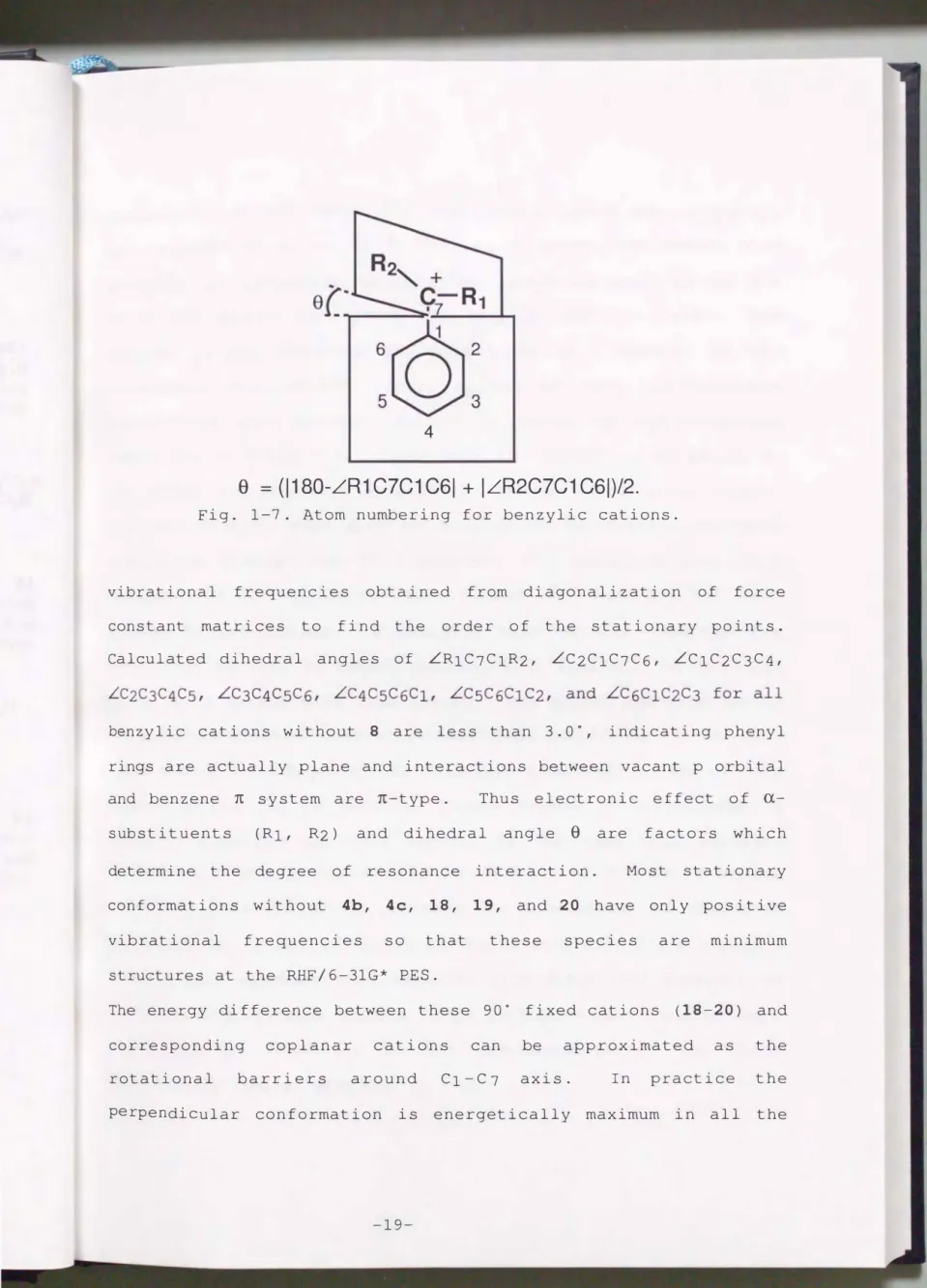
substituted benzyl cations. Structural formulas of calculated cations were shown in Fig. 1-5 (1-10) and Fig. 1-6 (11-20). The numbers of atom and the dihedral angle e correspond to those in Fig. 1-7. All calculations were performed on the IBM RS/6000
computer with GAUSSIAN-92 suite of programs. 9) Geometries were optimized completely by the gradient procedure1 0) at the C1
symmetry. The closed-shell restricted Hartree-Fock level with ST0- 3G, 3-21G, and 6-31G* basis sets was applied to find stationary points on the potential energy surface (PES). At RHF/6-31G* level all optimized structures were checked by analysis of harmonic
1a
a-trifluoro
methylbenzyl cation.
4a
a-methyl
benzyl cation.
6
a-tert-butyl benzyl cation.
10
a-ethyl- a-methyl
benzyl cation.
1b
a-trifluoro
methylbenzyl cation.
4b
a-methyl
benzyl cation.
7
a-tert-butyl- a-methyl
benzyl cation.
11
a,a-diethyl- benzyl cation.
2
a-trifluoro
methyl-a
methylbenzyl cation.
4c
a-methyl
benzyl cation.
8
a-tert-butyl- o,o-dirnethyl benzyl cation.
H3Q CH3 H3c,+XH
©
12a
a-isopropyl- a-rnethylbenzyl cation.
3
benzyl cation.
5
2,2-dimethyl- 1-indanyl cation.
9
a, a-dimethyl- benzyl cation.
H3C,+ � H "·CH
© cH3
12b
a-isopropyl- a-rnethylbenzyl cation.
Fig. 1-5. Calculated benzylic cations (1-12).
13a
a,a-diiso- propylbenzyl cation.
H
15
a-tert-butyl- a-isopropyl-
benzyl cation.
H3C,, ... �H
©
19
a-methyl
benzyl cation ( 90 ° fixed) .
Fig. 1-6.
13b
a,a-diiso- propylbenzyl cation.
16
a,a-di-tert- butylbenzyl cation.
20
benzyl cation ( 90 ° fixed) .
13c
a,a-diiso- propylbenzyl cation.
+
©q)
17
CH3
4-methyl- benzobicyclo
[2.2.2]octen- 1-yl cation
14
a-tert-butyl- a-methylbenzyl
cation.
H3C '#,··� CH3
©
18
a, a-dimethyl- benzyl cation (90° fixed) .
Calculated benzylic cations (13-20) .
4
e
=(I180-LR1C7C1C61
+ILR2C7C1C61)/2.
Fig. 1-7. Atom numbering for benzylic cations.
vibrational frequencies obtained from diagonalization of force constant matrices to find the order of the stationary points.
Calculated dihedral angles of LR1C7C1R2, LC2C1C7C6 , LC1C2C3C4,
benzylic cations without 8 are less than 3.0°, indicating phenyl rings are actually plane and interactions between vacant p orbital and benzene n system are n-type. Thus electronic effect of a- substit uents (Rl, R2) and dihedral angle 8 are factors which
determine the degree of resonance interaction. Most stationary conformations without 4b, 4c, 18, 19, and 20 have only positive vibrational frequencies so that these species are minimum structures at the RHF/6-31G* PES.
The energy difference between these 90° fixed cations (18-20) and corresponding coplanar cations can be approximated as the rotational barriers around C1-C 7 axis. In practice the perpendicular conformation is energetically maximum in all the
rotamers for benzyl cation,ll) while steric effect may exists for the coplanar structure of 9 (8=5 °) • Moreover, the normal mode analysis in frequency calculation indicates that 18-20 are
transition states concerning the rotation of C1-C7 axis. The barrier to the rotation has been used as a measure of the
"resonance energy".12) Thus, we can estimate the resonance energies for these species. Rotational barrier for each cation was summarized in Table 1-2. Basis sets and electron correlation do not affect the barriers seriously. At our fin a 1 1 eve 1 ( MP 2 I 6- 31G*//RHF/6-31G*) which does not include ZPE correlation, barriers
(resonance energy) are 4 9. 3 kcal/mol for benzyl cation, 33.8 kcal/mol for a-methylbenzyl cation, and 20.7 kcal/mol for a, a-
dimethylbenzyl cation. Previously Houk et al. reported the rotational barrier of benzyl cation (45. 4 kcal/mol) at HF/3-21G level which agrees with this result. One methyl substitution to the benzylic position lowers the rotational barrier by 15 kcal/mol, which can be attributed to the resonance interaction. The primary benzyl cation (3) is required larger degree of conjugation in order to stabilize the total energy. On the other hand, tertiary a,a-dimethylbenzyl cation (9) is stabilized by the inductive effect of a-methyl group, so that the requirement of resonance stabilization is small. It is worthy to note that the r value in Yukawa-Tsuno equation runs parallel with rotational barriers of corresponding benzylic cations. This is instructive, because the r value can be connected to the resonance energy for these structurally similar species.
Table 1-2. Rotational barriera) (kcal mol-l) of benzylic cation.
species RHF/
ST0-3G
benzyl cation
47.086 a-methylbenzyl cation
34.548 a,a-dimethylbenzyl cation
22.011
RHF/
3-21G
45.390
31.840
19.045
RHF/
6-31G*
45.887
32.440
19.685
MP2 /6-31G*//
RHF/6-31G*b)
49.302
33.771
20.740
a) Rotational barriers were estimated by the total energy difference between coplanar and 90° fixed structure; E(l8)-E(9) for a, a-dimethylbenzyl cation, E (19) -E (4a) for a-methylbenzyl cation, and E (20) -E ( 3) for benzyl cation.
included.
b) ZPE are not
For benzylic cations, bond length of c1-C7 and average bond
should be affected by the degree of resonance interaction between benzylic p orbital and benzene n system. The "resonance theory"
predict the elongation of C1-c2 and C3-C4, and shortening of C1-C7 and c2-C3 as increases the conjugation. As shown in Fig. 1-8, these bond lengths at RHF/6-31G* are plotted against r values. For cations 7 and 8, C1-C7 and c1-C2 are correlated poorly. This may be attributed to the steric interaction between o-Me and a-alkyl group. In cases of cations 5 and 17, C1 -C 7 fail below the
1.5
-
iC
�
.,--("')
<.0 I
20
--LL
I a:
-
o<(
--
• 8
• 7
R2'Ci'R1
I
... c1, cs 0 c2
I I
Cs, ,c3 c4
c1-c2
£1.4
0')c Q) _J
"'0 c 0 (()
c1-c7
1.3
0.0 0.5 1.0 1.5
r
value
Fig. 1-8. Bond length vs r values in Yukawa-Tsuno equation for benzylic cations. Numbers correspond those for species in Figures
1-5
and 1-6.correlated line due to the steric strain of the ring structure.
Although c1-C7 of 90° fixed cations (18, 19, and 20) also failed slightly, satisfactory correlation exists as a whole. This plot is not basis set dependent.
When r=O, bond length of C1-C7 comes to
1.52A
which is almost same as normal carbon-carbon single bond length(1.54A
in ethane).The c1-C7 become shorter in proportion to increase of the r value.
When r=l.Sl (1), C1-C7 is
1.35A
which is almost same as normal carbon-carbon double bond length(1.33A
in ethylene). When r=O,same as carbon-carbon bond length of benzene. As the r value increases, C1-c2 and C3-C4 increase but C2-C3 decrease.
varies twice as large as C3 -C
4.
These tendency agree with the prediction of the resonance theory. Contributions of five resonance structures shown in Fig. 1- 9 elucidate partial alternation of single and double bonds in the benzene ring. Thus this plot is evidence that the r value is the parameter indicating the degree of the resonance interaction.+
II Ill IV v
Fig.
1-9.
Resonance structures of bezylic cations.As shown in Fig. 1-9, contributions of II, III, and IV become
larger according to increase of resonance interaction between benzylic p orbital and benzene n system. This should be detected
as a change of Wieberg bond order13) of c1-C7 and average bond orders of c1-c2 and C6-C1, C2-C3 and Cs-C6, and C3-C4 and C4-C5.
The plots of bond order against the r value are shown in Fig. 1-10.
In case of c1-C7, bond order converge to 1. 0 when r=O, reflecting the importance of unconjugated structure (I and V). The index
increases in proportion to the r value, indicating the increasing contribution of structures II, III, and IV. c1-C7 connects the cationic center and aromatic moiety. Thus this way of change
reveals that the r value shows the degree of overlapping between benzylic p orbital and benzene n orbital. Bond orders of C1-c2, c2-C3, and C3-C 4 also change reflecting the importance of contribution of each structure (I-V) in Fig. 1-9. When r=O, the
Wieberg indices take 1.4, which is an intermediate value between single and double bond. As the r increases, bond order of c2-C3 increases but C1 -c2 and C3-C4 decrease. All the behavior is consistent to the prediction of resonance theory. Consequently this indicates the increasing interaction between C7 and aromatic moiety as the r value increases.
In organic chemistry "charge" is reaction mechanisms and molecular
very useful tool to predict properties. Resonance
stabilization of conjugated cations is equivalent to charge delocalization. Thus the charge distribution should be related to the r value, if the r value in the Yukawa-Tsuno Eq. (1-1) is a parameter indicating resonance degree. Unfortunately charge is not
1.7
1.6
1.5
'-Q)
"'0
'-
R2,6>· ... R
1c 17
/ 1,
cs I o c2 I
Cs, ,....c3
c4
001.4
"0 c 0 en
0)
1.3
'-Q)
_Q 13all
Q) 10
� 1.2
9 •• 671
• 58 3
1.1
21a
0
1.0
0.0 0.5 1.0 1.5
r
value
Fig. 1-10. Wieberg bond orders from NBO analtsis (RHF/6-31G*) vs r values in Yukawa-Tsuno equation for benzylic cations. Numbers correspond those for species in Figs. 1-5 and 1-6.
quantum mechanically observable though it is easy to understand intuitively. Several arbitrary method have been proposed to estimate atomic charges. 14) The Mulliken population analysis (MPA)15) and natural population analysis (NPA)16) were selected in order to discuss the relation between charges and the r value.
These methodology seem overestimate the polarity of C-H bond, group charges should be used. Thus the charge on a hydrogen was summed up into that on the carbon atom which connect to hydrogen atoms.
The charges on ortho position for 5, 7, 8, and 17 can not be compared to those for other species because of their carbon substituted structures. The plots of atomic charges (given by MPA) on o-, m-, and p-positions for benzylic cations against the r values are shown in Fig. 1-11. At a first glance, charges are related to the r values in each position. For 5, 7, 8, and 17, charges are poorly correlated to not only a-position but also p
and m-positions; ortho substitution may have additional influence to charge distribution. In the case of 18, 19, and 20, the atomic charges seem to deviate from the correlation lines; this may be attributed to the mixing of 0" orbitals of a-substituents to benzene n orbitals. Charges of other species are correlated in
every position as shown below.
(hereafter P(ortho)) given by MPA,
For charges on ortho position
P(ortho) 0 . 12 5 r + 0 . 0 1 6 , ( R = 0 . 9 8 7 S D =± 0 . 0 0 7 0 ) . ( 1-7 )
For charges on meta position (P(meta)),
P(para)
0.2
87�
..-
*
C)
�
cry I
<0
--LL
I a:
<{
a_
� 0.1
-...,.,
Q) 0>
L ro
..s::
0
3 1a0 0
0 14 0 0110 2
15 13a
P(meta)
5 0
0.0
0.0 0.5 1.0 1.5
r value
Fig. 1-11. Mulliken population (summed into heavy atom) on ortho (P(ortho)), meta (P(meta)), and para (P(para)) position of phenyl ring (RHF/
6-31G*) vs r values in Yukawa-Tsuno equation for benzylic cations. Numbers correspond to those for species in Figs. 1-5 and 1-6.
p (meta) 0 . 0 0 3 r + 0 . 0 4 0 , ( R = 0 . 1 7 6 S D =± 0 . 0 0 6 6 ) .
For charges on para position (P(para)),
P (para) 0 . 12 3 r + 0 . 0 4 5 , ( R = 0 . 9 91 S D =± 0 . 0 0 5 7 ) •
(1-8)
( 1-9)
Fairly good correlations exist on o- and p-lines but on m-line.
When r=O, all correlation lines converge in a narrow range of 0.015-0.045; degrees of delocalization without resonance effect are nearly the same in all positions. As the r value increases, P(ortho) and P(para) increase to +0.2 (r=1.5) with the same slope, while P (meta) do not change very much. This suggests that efficiency of resonance interaction on ortho and para position are nearly the same. As a result, the way of charge delocalization for conjugative benzylic cations can be predicted qualitatively by the resonance theory.
Sum of atomic charges on phenyl ring should be a probe which measure conjugative interaction between C7 and aromatic moiety.
Charges (MPA) on aromatic moiety was plotted against the r values as shown in Fig. 1-12. For species without those of ortho substituted or 90° fixed species, good correlations are found in both MPA and NPA. For Mulliken charges on aromatic moiety (P(Ar)),
P (Ar) 0 . 4 2 5 r + 0 . 0 51 , ( R = 0 . 9 6 6 S D =± 0 . 0 3 9 ) . (1-10)
0.8
1a
�
Cf)
� 0.6
ILJ_
I a:
<{
0...
� 0.4
..__
Q) 0>
ro �
...c
0 0.2
0.0
��--���������������0.0 0.5 1.0 1.5
r
value
Fig. 1-12. Sum of Mulliken population on phenyl ring (RHF/6-31G*) vs r values in Yukawa-Tsuno equation for benzylic cations. Numbers correspond to those for species in Figs. 1-5 and 1-6.
Charges on aromatic moiety increase in proportion to the r values.
This suggests that delocalization to the phenyl ring is the controlling factor of the r value. The result given by NPA analysis was the same as that given by MPA.
As described before , the r value should also be related most closely to the degree of n-overlapping between the aryl n-orbital and benzylic p-orbital in the incipient carbocation. Accordingly the effect should be a factor which controls the r value of congested systems. Dihedral angle 8 represents the bulkiness of a-substituents. Thus the dependence of the r value on the dihedral angle 8 may provide the real origin of the r value.
Calculated dihedral angles 8, experimental 8 which are estimated by
Eq. (1-4), and r values for tertiary benzylic system are summarized in Table 1-3. The resonance demand decreases as the bulkiness of a-substituents increases. Torsional ang les 8 in s o l v o l ysis and gas phase study agr e e with each other suppor ti ng intrinsical l y the same structure between transition state and corr esponding cation as ar gued before . As shown in Fig. 1-13,
theoretical l y
fair l y obtained
good corre lation 8 (RHF/6-31G*) and
exists between
estimated 8sol for t ert. be n z y lic cations.
experim e ntal ly The impor tant
thing in the MO calculation is whether the l e v e l of theory and basis set are satisfac tor y to de scribe the phe nom ena or no t. Especia l l y int eratomic orbital interac tion be comes important in the congested systems. One may suggest that e l ectron corre lation must be consid ered for
Table 1-3. Calculated torsion angles in unit of ea) ) between
alkyl groups and benzene ring for some tertiary benzylic cations and the comparison with the experimental data.
species MP2/
6-31G*//
RHF/ RHF/ RHF/ RHF/
ST0-3G 3-21G 6-31G* 6-31G*b) rsolc)Ssold)rgase)Sgasf)
9 0 5 5 4. 3 1.0 0 0 1.ook) 0
10 2 2 3 1.0 4g) 0 1.0 11) 0
11 1 1 0 1.0 2h) 0
13a 10 11 1 0 1 0 0 1 g) 0
14 20 24 24 23.8 0 .91i) 17 0. 87m) 21
15 31 37 33 o.6sh) 34
16 55 77 76 71. 0 0 .26
j
) 5917 90 90 90 0 90
a) e is the angle of the a-c-e bond with respect to the aromatic plane. Also see Fig. 1-9. b) Given by 6-31G*+MP2. See text. c)
r value given in Yukawa-Tsuno substituent effect analysis for the solvolysis of each system. d) rsol/rsolmax = cos2Ssol. e) r value
given in Yukawa-Tsuno substituent effect analysis for the gas phase stabilities of each system. f) rgas/rgasmax=cos2Sgas. g) Ref. 3h.
h) Unpublished results in this laboratory. i) Ref. 3 i.
j)
Ref.3j.
k) Ref. 4f. 1) Ref. 4e. m) Ref. 4g.(]) 0 16 (])
�
C>
""0 (]) -- 60 (])
C>
c ro
ro '"0
�...c (])
"'0
co (.)
+-'
(])
�
0 ...c (])
+-'
30 15
14 0
0
0 30 60 90
experimental dihedral angle I degree
Fig. 1-13. Calculated dihedral angle 8 (refer to Figure 1-7) at RHF /6-31G* vs. torsion angle 8 estimated by r/rmax=cos28, where r is the resonance demand in Yukawa-Tsuno equation obtained from solvolysis of the corresponding precursors. Numbers correspond to those for species in Figs. 1-5 and 1-6.
such species. Un f o r t u n a tely geometry optimization at MP2 o r larger level of theories can not be performed for these bulky syst e m s because of t h e li mitation of the h a r d wa r e.
Thus, in or d e r t o d i sc u s s the effe ct of elect ron co rrelatio n on the torsion angle 8, single point calculation at MP2 level17) about 9, 14, and 16 were carried out with the ge ometry whose dihedral angle 8 was swung with ±5° from the RHF/6- 31G* optimized geometry. Total energy at each dihedral angle are plotted against that of equilibrium structure in Fig. 1-14. The abscissa is additional angle against the equilibrium e. The plots
of every species are correlated in second order functions. For 9 and 14, correlation curve is also symmetrical to both sides of the equilibrium 8 at RHF/6-31G*; electron correlation does not affect
the optimized structure. For 16, single point calculation was extended to the e which is swung 10° to the direction of coplanar structure, since a monotonical correlation curve was obtained for these three plots. As a result asymmetric curve plot was obtained;
electron correlation is a factor to determine structure for this conjugated system. However minimum 8 for 16 is calculated 71° in
the assumption of second order correlation. That is electron correlation effect decreases 8 in only 5°. Consequently electron
correlation is not so important for these tertiary benzylic cations. Force constants are estimated in the assumption that the
potential of the rotation is obeyed in the second order function.
7.35 kcal/mol, 28.5 kcal/mol, and 17.0 kcal/mol are estimated for 9, 14, and 16 successively. Rigid structure for the rotation were
,_.
I
0
E
Cd
(.)� --
>.
0>
'--
Q) c w Q) >
+-J
Cd a: Q)
0.6
0.4
0.2
0.0
-0.2
-0.4
'---'---...___ ____ ____.-10 -5 0
Dihedral Angle /degree
Fig. 1-14. Fixed dihedral angle vs. energy for a,a-dirnethylbenzyl (open circle), a-t-buthyl-a
rnethylbenzyl (closed circle), and a,a-di-t
butylbenzyl (open square) cations.
5
given for congested cations. The requirement of resonance
stabilization which forces the structure coplanar is still large tor 14. The requirement of steric effect which makes the perpendicular structure also exist. This is the reason why the 8 is rigidly determined for 14. For secondary systems, the r values, and calculated and experimental estimated e are summarized
in Table 1-4. 2,2-Dimethyl-1-indanyl system (5) is supposed to be a standard of secondary system. The r values do not change dramatically compared to those for tert. systems. This may be attributed to the large resonance degree which is intrinsic to secondary systems. Sobs and 8calc fairly agree with each other.
This support that the r value is the parameter indicating the resonance degree.
Table 1-4. Calculated torsion angles in unit of ea)) between alkyl groups and benzene ring for some secondary benzylic cations and the comparison with the experimental data.
species 8calc
5
4a 6 7 8
RHF/ RHF/
ST0-3G 3-21G
0 0
0 0
0 0
16 25
rsolb) 8sol c) RHF/
6-31G*
0 1. 11 d) 0
0 1.15e) 0
0 1. ogf) 8
0 1.01g) 17
22 1.02g) 17
a) 9 is the angle of the a-c-e bond with respect to the aromatic Plane. Also see Fig. 1-9. b) r value given in Yukawa-Tsuno substituent effect analysis for the solvolysis of each system. c) rsol/rsolmax = cos28sol. d) Ref. 3g. e) Ref. 3d. f) Ref. 3e. g) Ref. 3f.
References
1) J.
Shorter, Correlation Analysis in Chapman and J. Shorter, Plenum Press:Chemistry, New York
ed by N. B.
(1978).
J.Shorter, Correlation Analysis of Organic Reactivity, Wiley, Research Studies Press: Chichester
(1982).
2)
Y. Yukawa andY. Tsuno, Bull. Chem. Soc. Jpn.,32, 971 (1959);
Y. Yukawa, Y. Tsuno, and M. Sawada, Bull. Chem. Soc. Jpn.,
39, 2274 (1966) .
3)
a) A. Murata, M. Goto, R. Fujiyama, M. Mishima, M. Fujio, and Y. Tsuno, Bull. Chem. Soc. Jpn.,63, 1129 (1990).
b) A.Murata, S. Sakaguchi, R. Fujiyama, M. Fujio, and Y. Tsuno,
Bull. Chem. Soc. Jpn., 63, 1138 (1990). c) M. Fujio, M. Goto,
T. Susuki, I. Akasaka, M. Mishima, and Y. Tsuno, Bull. Chem.
Soc. Jpn.,
63, 1146 (1990);
M. Fujio, M. Goto, T. Susuki, M.Mishima, and Y. Tsuno, J. Phys. Org. Chem.,
3, 449 (1990).
d)Y. Tsuno, Y. Kusuyama, M. Sawada, T. Fujii, and Y. Yukawa,
Bull. Chem. Soc. Jpn.,
48, 3337 (1975);
M. Fujio, T. Adachi, Y. Shibuya, A. Murata, and Y. Tsuno, Tetrahedron Lett.,25, 4557 (1984).
e) Y. Tsuji, M. Fujio, andY. Tsuno, Bull. Chem.Soc. Jpn.,
63, 856 (1990). f)
M. Fujio, Y. Tsuji, T. Otsu, and Y. Tsuno, Tetrahedron Lett.,32, 1805 (1991).
g) M. Fujio, K.Nakata, Y. Tsuji, T. Otsu, and Y. Tsuno, Tetrahedron Lett.,
33, 321 (1992).
h) M. Fujio, K. Nakata, T. Kuwamura, H.Nakamura, Y. Saeki, M. Mishima, S. Kobayashi, and Y. Tsuno,
Tetrahedron Lett.,
34, 8309 (1993).
i) M. Fujio, H. Nomura, K.Nakata, Y. Saeki, M. Mishima, S. Kobayashi, T. Matsushita, K.
Nishimoto, and Y. Tsuno, Tetrahedron Lett.,
35, 5005 (1994).
j)
M. Fujio, T. Miyamoto, Y. Tsuji, andY. Tsuno, Tetrahedron L e t t ., 3 2
,2 9 2 9 ( 1 9 9 1 )
. k ) M . F u j i o , K . N aka s h i rna , E .Tokunaga, Y. Tsuji, and Y. Tsuno, Tetrahedron Lett., 33 , 345 (1992).
4) a) M. Mishima, H. Inoue, M. Fujio, and Y. Tsuno, Tetrahedron Lett., 3 0, 2101 (1989). b) M. Mishima, H. Inoue, M. Fujio, and Y. Tsuno, Tetrahedron Lett., 31, 685 (1990). c) M. Mishima, K.
Arima, S. Usui, M. Fujio, andY. Tsuno, Mem. Fac. Sci., Kyushu Univ., Ser. C, 15(2), 277 (1986); M. Mishima, K. Arima, S.
Usui, M. Fujio, andY. Tsuno, Chem. Lett., 1047 (1987). d) M.
Mishima, S. Usui, M. Fujio, and Y. Tsuno, Nippon Kagaku Kaishi, 1269 (1989). e) M. Mishima, H. Nakamura, K. Nakata, M.
Fujio, andY. Tsuno, Chem. Lett., 1607 (1994). f) M. Mishima, S. Usui, H. Inoue, M. Fujio, and Y. Tsuno, Nippon Kagaku Kaishi, 1262 (1989). g) M. Mishima, K. Nakata, H. Nomura, M.
Fujio, and Y. Tsuno, Chem. Lett., 2435 (1992); K. Nakata, H.
Nomura, M. Mishima, Y. Saeki, K. Nishimoto, T. Matsushita, M.
Fujio, and Y. Tsuno, Mem. Fa c. Sci., Kyushu Uni v., Ser. c, 18 (2) ' 287 (1992).
5) V. J. Shiner, Jr., W. E. Buddenbaum, B.L.Murr, and G. Lamaty, J. Am. Ch em. Soc . , 9 0, 4 18 ( 19 6 8 ) ; K. Okamoto, N. Uchida, S.
Saito, and h. Shingu, Bull. Chem. Soc. Jpn., 39, 307 (1966);
S. Usui, Y. Shibuya, T. Adachi, M. Fujio, and Y. Tsuno, Mem.
Fac. Sci., Kyushu Univ., Ser. C, 14 (2), 35 5 (1984); A. D.
Allen, V. M. Kanagasabapathy, and T. T. Tidwell, J. Am. Chem.
Soc., 107, 4513 (1985); J. P. Richard and W. P. Jencks, J.
Am. Chem. Soc., 106, 1373 (1984).
6) K.-T. Liu and C.-F. Shu, Tetrahedron Lett., 21, 4091 (1980);
K.-T. Liu, M.-Y. Kuo,and C.-F. Shu, J. Am . Chem. Soc., 104, 211 (1982).
7) P. B. D . de la M a re, E . A. Johnson, a n d J. S. L o mas, J.
Ch em. Soc., 5 31 7 (1964); K . Oh kata, R. L. Paquette, and L. A . Paquett e , J. Am . Chem. Soc., 1 01 , 6687
(1979)
J. M. Tanka, N. Kamrudin, and J. F. Blackert,J.
Org. Chem.,56 , 6 395 (1991).
8)
w. J. Hehre, L. Radom, P. v. R. Schleyer, and J. A. Pople, Ab initio Molecular Orbital Theory; Wiley: New York(1986).
9)
M. J. Frisch, G. W. Trucks, M. Head-Gordon, P. M. W. Gill, M.w. Wong, J. B. Foresman, B. G. Johnson, H. B. Schlegel, M. A.
Robb, E. S. Replogle, R. Gemperts, J. L. Andres, K.
Raghavachari, J. S. Binkley, C. Gonzalez, R. L. Martin, D. J.
Fox, D. J. DeFrees, J. Baker, J. J. P. Stewart, and J. A.
Pople, GAUSSIAN
92;
Gaussian Inc.: Pittsburgh, PA(1992)
10)
H. B. Schlegel, J. Comput. Chem.,7, 359 (1986).
11)
A. E. Dorigo, Y. Li, and K. N. Houk, J. Am. Chem. Soc.,111, 6942 (1989).
12)
H. Mayr, W. Forner, and P. v. R. Schleyer, J. Am. Chem. Soc.,101, 6032 (1979).
13)
K. B. Wieberg, Tetrahedron, 24,1083 (1968).
14)
For a review , see: S. M. Bachrach, Reviews in Computational Chemistry Vol. V, Chap.3;
K. B. Lipkowitz and D. B. Boyd, Eds; VCH: Germany(1993).
15)
R. S. Mulliken, J. Chem. Phys., 23,1833 (1955).
16)
A. E. Reed, R. B. Weinstock, and F. Weinhold, J. Chem. Phys.,83, 735 (1985);
A. E. Reed, L. A. Curtiss, and F. Weinhold, Chem. Rev.,88, 899 (1988);
J. E. Carpenter and F. J.Weinhold, J. Mol. Struct.,
169, 41 (1988).
17)
C. M0ller and M. S. Plesset, Phys. Rev.,46, 618 (1934).
chapter 2 Substituent Effect on the Solvolysis of 2,2-Dimethylindan-1-yl Chlorides1)
The LArSR (Yukawa-Tsuno) equation (2-1)2) is widely applied to substituent effect analysis of many benzylic solvolyses.
log ( k/k0 ) (2-1)
where r (resonance demand) is the parameter measuring the degree of resonance interaction between the reaction center and benzene n-
system. The r value changes widely with the reactions; r = 1.00 for solvolysis of a-cumyl chloride by definition, r = 1.15 for the secondary a-methylbenzyl system (1), 3) and r = 1. 30 for the
primary benzyl system. 4) In addition, r values of 1.39 and 1.51 were given for highly deactivated carbocationic solvolyses of a
methyl-a-trifluoromethylbenzyl 5 ) and a-trifluoromethylbenzyl systems,Sb) respectively. The r value increases in proportion to instability of cationic reaction center. Thus the r value is a measure of the resonance demand reflecting the stability of cationic transition state and provides very important information to evaluate the nature of the transition state.
Substituent effect on the solvolysis of a-me t hylbenzyl
chlorides (1) gave the r value of 1.15 which is referred to the higher resonance demand of this secondary system than the cr+
reference system. However, the incursion of solvent participation is suggested in this borderline solvolysis.6) If this is the case, solvent participation might become important as the substituent
becomes more electron attracting and give a monotonically concave a+ correlation. It has thus been claimed in the literature that
the higher r value observed in such a case will be meaningless.7) The alternative secondary SNl solvolysis system of a- ( t- Butyl)benzyl tosylates (2) where there is little possibility of solvent participation may not generate a coplanar cation with the benzene n-system in the transition state due to bulkiness of the t- Bu group at a position. 8) In order to prove the origin of the r values relating to the inherent stabilities of a series of the benzylic cations, the r value which reflects the fully conjugated secondary system is needed. That is, the system which has a different r value from that of this standard system should give important informations on the physical meaning of the r value.
Thus the substituent effect on the solvolysis of 2,2-dimethylindan- 1-yl chlorides (3),1) where the vacant p-orbital developed at the benzylic position is fixed in the
overlapping with the benzene n-system,
preferred conformation was analyzed by LArSR Eq.
(2-1) in this chapter. The neopentyl skeleton of 3 will be expected to solvolyze via SNl mechanism. Moreover, this system will attain a full resonance stabilization in the transition state due to the fused five membered ring, and then provide an standard r
Cl
4
1 3
value anticipated for the inherent secondary benzylic solvolysis system.
Results
A series of 5- or 6-substituted 2, 2-dimethylindan-1-yl
chlorides were prepared by dimethylation and reduction of the corresponding indanones, and subsequent chlorination. Substituted indan-1-ones were prepared by the Friedel-Crafts ring-closure of substituted 3-chloropropiophenones, or by the Friedel-Crafts ring closure of aryl propionic acids.
The solvolysis rates of 2,2-dimethylindan-1-yl chlorides in 80% (v/v) aqueous acetone (80A) were determined conductometrically
at the initial chloride concentrations of 1o-4-1o-5 mol dm-3. The rate constants are summarized in Table 2-1 together with the activation parameters.
The rate data of slow solvolyzing 6-Cl and 6-Br derivatives, and those of fast 5-MeS, 5-PhO, and 5-Me0-6-Cl ones were extrapolated from rate data at other temperatures by means of the Arrhenius equation.
The rate constants for all derivatives were unable to be determined in a single 80A solvent, because the reactivity varies remarkably with substituent changes over a range of nine powers of ten. Solvolysis rates in 90A and 50A were similarly determined and the results are listed in Tables 2-2 and 2-3, respectively. The rate for the most reactive 5-MeO derivative was not precisely
Table 2-1. Solvolysis Rates of 2.2-Dimethylindan-1-yl Chlorides in 80% aq Acetone.
�H:t:25°C �s=t=25oc Subst. Temp./OC 105k;s-1 kcal mol-l e.u.
p-MeO 25 324ooob)
p-MeS -20 41.90
0 532.5
10 1705
25 814oa) 17.0 -6.6
p-PhO -20 12.65
0 198.8
10 652.7
25 354oa) 18.2 -4.3
p-MeO-m-Cl -25 4.855
-15 22.31
0 177.4
15 973.7
25 308oa) 18.3 -4.1
3.4-Me2 -15 1.397
0 12.42
15 82.96
25 254.9 19.3 -5.5
p-Me 0 4.675
15 32.27
25 102.7 19.4 -7.1
p-t-Bu 25 41.91 18.9 -10.6
45 331.1
Table 2-1. Continued.
Subst. Temp./OC
m-Me 15 25 45
H 25
45
ro-MeO 25
45
p-Br 25
45 55
m-Cl 25
45 55 75
m-Br 25
45 55 75
rn-CN 25
p-CN 25
1.323 4.312 43.23
1.744 17.50
3.596 34.90
0.2326 2.666 7.759 0.0133a) 0.1692 0.5575 4.535 0.0116a) 0.1493 0.4734 3.977 0.0004B2C) 0.000139c)
�H*2soc kcal mol-l
20.6
21.1
20.B
22.2
23.5
23.5
e.u.
-9.2
-9.4
-9.0
-9.9
-11.2
-11.5
a) Extra po lated from rate data at oth er temperatures. b)
Calculated from 90A at 25°C. c)
linear logarithmic rate Calculated from linear between BOA and 50A at 25°C.
relati on between BOA and logarithmic rate relati on
Table 2-2. Solvolysis Rates of 2.2-Dimethylindan-1-yl Chlorides in 90% aq Acetone.
Subst.
p-MeO
p-MeS
p-PhO
p-MeO-m-Cl
3. 4-Me2
p-Me
p-t-Bu
m-Me
H
m-MeO
Temp./OC
-25 -15 0 25 0 25 0 25 -15 0 15 25 0 15 25 45 15 25 45 25 45 25 45 55 25 35 45 75 25 45
63.35 215.1 1264 151ooa)
30.94 421.5
12.72 188.3
1.461 10.46 58.66 162.3
0.8336 5.324 16.07 115.4
1.970 6.118 47.14
2.763 23.63
0.315a) 2.881 7.873 0.109a) 0.3414 1.012 17.51
0.2778 2.769
L1H*25°C kcal mol-l
15.6
16.3
16.9
17.4
18.3
18.7
19.6
20.3
20.4
21.1
a) Extrapolated from rate data at other temperatures.
e.u.
-10.1
-14.7
-14.5
-12.8
-14.5
-15.2
-13.5
-15.7
-17.5
-13.3
Table 2-3. Solvolysis in 50% aq Acetone.
Subst. Temp./OC
m-Me -15
0 25
H -15
0 25
m-MeO 0
25
p-Br 25
45
m-Cl 25
45
m-Br 25
45
m-CN 25
45 55 75
p-CN 25
45 75
Rates of 2.2-Dimethylindan-1-yl Chlorides
11Hf25°C 11s:f2soc lOsk;s-1 kcal mol-l e.u.
6.536 57.16
1044 18.8 -4.6
2.260 21.07
403.2 19.2 -5.1
28.55
575.3 18.8 -5.6
45.12 19.9 -7.1
396.9
2.341 21.3 -8.2
23.96
2.007 21.4 -8.4
20.63
0.0693a) 23.0 -9.7 0.8059
2.817 20.39
0.0186a) 23.5 -10.6 0.2385
6.331
a)Extrapolated from rate data at other temperatures.
followed in BOA by the present method even at low temperatures.
The rate data of this derivative in BOA at 25·c was estimated from the rate in 90A at 25 ° c, using a linear logarithmic rates relation (R = 0.9997, so = ±0.030, and n = B) between 90A (25.C) and BOA (25.C),
1.034 log(k/kH)9oA(25·c) - 0.049.
On the other hand, the rates of strongly deactivated 6-CN and 5-CN derivatives were too slow in BOA to be obtained directly by the present conductometric measurement. The rate data for these derivatives in BOA at 25·c were estimated from the rates in 50A at 2s·c, using a linear logarithmic rates relation (R = 0.9999, SO =
±0.013, and n = 5) between 50A (25.C) and BOA (25.C),
0.9469 log(k/kH)50A(25·c) + 0.006.
The rate data estimated for these derivatives were also included in Table 2-1. As shown in Tables 2-1, 2-2, and 2-3, the 6-MeO derivative reacts consistently faster than unsubsti tuted derivative for all solvents, and is different from the normal behavior expected by the standard crm value of 0.050. Ohkata et al.
also observed a similar rate acceleration for m-MeO derivatives in solvolysis of spiro [cyclopropane-1,2 1 -indan] -11 -yl9) and 3, 4- benzotricyclo[4.3.1.01,6]dec-3-en-2-yl p-nitrobenzoates.lO) The m- MeO group behaves actually as a slightly electron-donating group and this seems to be characteristic of these congested indanyl
systems. Thus substituent effect analysis for the present indanyl
system was treated excluding 6-MeO derivative.
The LArSR Eq. (2-1) was applied to the rate constants in BOA
at 25 • C by the least-squares method. The substituent parameters employed in this analysis are listed in Table 2-4, and are employed for the analysis of substituent effects of a- ( t-butyl) ben zyl
systems.B) The 5- and 6-positions of 2,2-dimethyl-1-indanyl system correspond to p- and m-positions, respectively. Results of substituent effect analysis of 2,2-dimethylindan-1-yl chloride at 2s·c are shown in Table 2-5. For a comparison, the Brown
p+cr+
Eq.(2-2)'
log ( k/k0 ) (2-2)
has also been applied, and the result was included in Table 2-5.
The LArSR plots are shown in Fig. 2-1.
Discussion
Comparison of
p+cr+
and LArSR correlations in Table 2-5 clearly shows that the LArSR equation describes the present reaction more precisely than the Brownp+cr+
treatment; the SD value is 1.5 times larger inp+cr+
than in the LArSR correlation.Both the large negative
p
value and the enhanced r value larger than unity suggest that this solvolysis proceeds through a highly positive charged transition state of a rate-determing kc- ionization leading to a carbocation intermediate. Furthermore thisTable
2-4. Substituent Constants.Subst.a)
p-MeO -0.100 -0.720
p-MeS 0.120 -0.720
p-PhO 0.063 -0.590
p-MeO-m-Cl 0.220 -0.690
p,m-Me2 -0.183 -0.187
p-Me -0.124 -0.187
p-t-Bu -0.155 -0.100
m-Me -0.069 0.000
H 0.000 0.000
p-Br 0.296 -0.146
m-Cl 0.373 0.000
m-Br 0.391 0.000
m-CN 0.600 0.000
p-CN 0.670 0.000
a)
p- and m-positions correspond 5- and 6-positions for 2, 2- dimethyl-1-indanyl system.Table 2-5. Results of Substituent Effect Analysis of 2, 2- Dimethylindan-1-yl Chlorides
(3) .
Correlation
p
p+cr+
-6.121±0.095LArSR -5.798±0.127
r
(1.00) 1.11
a)
Numb er of substituents involved.Correlation coefficient.
14 14
sob)
0.16 0.12
0.9985 0.9992
b) Standard deviation. c)
4.0
2.0
0.0
-
0>
0
-2.0
-4.0
-1.0 -0.5
5-MeS
•
5-PhO
5-Me0-6-CI
5,6-Me2 5-Me
5-t-Bu
5-Br
a
scale 0.0
6-Me H
6-CI 6-Br
0.5
Fig. 2-1. LArSR plot for the solvolysis of 2,2-dimethylindan-1-yl chlorides in BOA at 25°C; open circle cr+, closed cr0, and squares
a
for r=l.11.