Phytochemical Characterization of Major Allium Cultivated Vegetable Crops toward Improving Biotic and
Abiotic Stress Adaptations
⏕≀ⓗ࣭㠀⏕≀ⓗࢫࢺࣞࢫ㐺ᛂᛶࡢᨵⰋྥࡅࡓせ
ࢿࢠᒓ㔝⳯ࡢ᳜≀Ꮫⓗ≉ᛶホ౯
Nur Aeni Ariyanti
2017
Phytochemical Characterization of Major Allium Cultivated Vegetable Crops toward Improving Biotic and
Abiotic Stress Adaptations
⏕≀ⓗ࣭㠀⏕≀ⓗࢫࢺࣞࢫ㐺ᛂᛶࡢᨵⰋྥࡅࡓせ
ࢿࢠᒓ㔝⳯ࡢ᳜≀Ꮫⓗ≉ᛶホ౯
A thesis submitted as part fulfillment for a PhD in AGRICULTURE
The United Graduate School of Agricultural Sciences Tottori University
JAPAN
Nur Aeni Ariyanti
2017
Major Supervisor
Masayoshi Shigyo
Collage of Agriculture, Graduate School of Sciences and Technology for Innovation, Yamaguchi University
Supervisor 1. Shin-Ichi Ito
Collage of Agriculture, Graduate School of Sciences and Technology for Innovation, Yamaguchi University
2. Nobuo Kobayashi
Department of Agricultural and Forest Sciences, Faculty of Life and Environmental Sciences, Shimane University
TABLE OF CONTENTS
Page
Chapter 1: GENERAL INTRODUCTION ………. 1
Chapter 2: COMPARATIVE STUDY ON PHYTOCHEMICAL VARIATIONS IN JAPANESE F1 VARIETIES OF BULB ONIONS AND SOUTH-EAST ASIAN SHALLOT LANDRACES Introduction ………... 6
Materials and Methods ……….. 8
Results ………... 15
Discussion ………. 24
Chapter 3: PHYTOCHEMICAL ANALYSES OF AMINO ACIDS AND PRECURSOR COMPOUNDS FOR S-ALK(EN)YL-L- CYSTEINE SULFOXIDES IN BULB ONIONS AND SHALLOTS Introduction ………... 29
Materials and Methods ……….. 30
Results ………... 33
Discussion ………. 41
Chapter 4: MORPHOLOGYCAL AND PHYTOCHEMICALS CHARACTERIZATION OF HEAT-TOLERANT CULTIVARS IN THE JAPANESE BUNCHING ONION (ALLIUM FISTULOSUM L.) Introduction ………... 46
Materials and Methods ………... 48
Results ………... 54
Discussion ………. 65
Chapter 5: PRODUCTION AND CHARACTERIZATION OF ALIEN CHROMOSOME ADDITION LINES IN ALLIUM FISTULOSUM CARRYING EXTRA CHROMOSOMES OF ALLIUM ROYLEIUSING MOLECULAR AND CYTOGENETIC ANALYSES Introduction ………... 69
Materials and Methods ………... 71
Results ………... 79
Discussion ………. 89
Chapter 6: GENERAL DISCUSSION ………. 93
LITERATURE CITED ………... 99
SUMMARY ………... 114
JAPANESE SUMMARY ………... 118
LIST OF PAPERS RELATED TO THE THESIS ……….. 120
ACKNOWLEDGMENT ……… 121
1
Chapter 1. GENERAL INTRODUCTION
Allium, recognized as the larger genus of monocotyledon plants, has more than 800 species (Friesen et al., 2006; Kamenetsky and Rabinowitch, 2006). They are distributed all over the world, from the frozen zone to the dry subtropics. The species’
diversity in a certain area has been influenced by local climatic conditions, which has led to natural selection and, also, local consumer preference regarding taste and flavor.
Some varieties are very famous as spices and, also, for their medical benefits, such as onion (Allium cepa Common onion group), shallot (Allium cepa Aggregatum group), Japanese bunching onion (Allium fistulosum L.), and garlic (Allium sativum L.).
Moreover, Keusgen et al. (2002) mentioned that both A. sativumand A. cepaextracts have high antibiotic activity against some infections in the human body. Furthermore, Griffiths et al. (2002) reported the two main compounds in bulb onion are flavonoids and S-alk(en)yl cysteine sulfoxides (ACSOs), which have perceived benefits for human health, including anticarcinogenic properties, antiplatelet activity, antithrombotic activity, antiasthmatic and antibiotic effects. ACSO compounds themselves act as flavor precursors that will produce a unique flavor and taste when they react with alliinase (Schwimmer and Weston, 1961; Whitaker, 1976). The nutrients that are beneficial to human health have led to the increase in Allium consumption. However, from 2012 to 2014, production quantity (± 4 million tons) of bulb onions, Japanese bunching onions, and shallots stagnated, according to figures released by the Food and Agriculture Organization (FAO). Japan contributes 0.007% from the total worldwide production and has become the second largest production country in Asia. This
2
stagnation may be due to some biotic (pathogen, fungi, bacteria) or abiotic stress (such as heat, cold, and salinity) (Mittler, 2006).
The bulb onion and shallot are two species of the Allium genus that have been used as food spices and for their medical properties (Ross et al., 2007). In daily consumption, bulb onions and shallots can be eaten raw or processed with other ingredients to produce an appetizing food. Their specific taste and health qualities come from the interaction between organosulfur compounds and sulfur-containing enzymes that can scavenge oxidizing agents, avoid fatty acid oxidation and bacterial growth, and inhibit the formation of pro-inflammatory messengers (Wilson and Demmig-Adams, 2007). Moreover, shallots also produce higher amounts of phenolic compounds and higher scavenging activity as compared to spring onions (Gayathri et al., 2009).
Nevertheless, due to some differences in the production area that lead to physiological and developmental differences between bulb onions and shallots, research on the phytochemical variations between them is very promising for breeding objectives.
Various methods were used to determine the phytochemical properties of bulb onions and shallots, including HPLC, LC-MS/MS, and advanced metabolomics. In the near future, by using molecular biology and genetic engineering, either shallots or bulb onions will contribute to improving the others, due to their close relationship (Rabinowitch and Kamenetsky, 2002).
The world consumption of Allium species, especially bulb onions, shallots, and Japanese bunching onions, is rising year after year not only because they can enhance food flavor but also for their contribution to human health. For those reasons, it is necessary to improve their disease resistance, abiotic stress tolerance, and taste quality.
However, due to their high diversity, including countless varieties and landraces,
3
selection based on their own characteristics—morphological and phytochemical—is needed. One species could generate more specific good traits than another and vice versa. That characterization process is very important for the breeding mechanism, where the breeder would easily select the most essential trait for a specific cultivation area and time. Furthermore, consumer preferences in one area and or country may differ from those of others as their environment and climatic conditions also differ.
Along with the emergence of global warming, the demand for new cultivars with abiotic stress tolerance is rising. One abiotic stress that contributes to yield losses is heat stress. In countries with four seasons, especially Japan, farmers must deal with high temperatures during summer cultivation. High temperatures can affect JBO production quantity and quality, as the optimum temperature for A. fistulosum production is around 15–20°C (Brewster, 2008). A high daytime temperature will cause heat stress and negatively impact plant growth and development (Liu and Huang, 2000;
Wang et al., 2003). Heat-tolerant varieties were defined as varieties that could produce a high yield with higher economic quality and greater survival under heat conditions as compared to the standard cultivar (Hall, 1992). As a defense mechanism to heat stress and high UV radiation, the plant will produce an antioxidant compound, such as a phenols, ascorbic acid, or flavonoid (Gill and Tuteja, 2010). Furthermore, production of secondary metabolites, such as flavonoids and ascorbic acid, will increase the nutritional quality of JBOs.
Breeding programs that work with the objectives of improving ofAlliumdisease resistance and high consumer quality are needed. In the breeding of cultivated Allium, the use of disease-resistant wild relatives is possible and promising (Kik, 2002). A.
fistulosum is very susceptible to some important diseases, such as Fusarium wilt
4
(Disnayake et al., 2009) and downy mildew (Maude, 1990). Otherwise, there are more than 120 registered Japanese bunching onion (JBO) varieties with some improved tolerance to biotic and abiotic stress (Inden and Asahira, 1990).Allium royleiis one of the wild relatives from the genus Allium that exhibit downy mildew resistance.
Moreover, A. roylei is indicated to be an important bridge species that could assist genetic resource introgression from other related species of section Cepa into the onion (Khrustaleva and Kik, 1998, 2000). Long before, McCollum (1982) reported the successful crossing between A. royleiand A. fistulosumfor the first time. Later, Vu et al. (2012) reported the first time that hypo-allotriploid (CCR-nR, 2n=23) and allotriploid (CCR, 2n=24) of A. cepa–A. roylei showed high resistance to downy mildew, whereas some AMALs of A. cepa–A. roylei exhibited partial resistance to downy mildew infection.
In this study, bulb onion F1 varieties and shallot landraces from Indonesia and Vietnam were used 1) to study the variation in chemical properties responsible for taste.
Further analyses using the same specimen were done by HPLC and LC-MS methods to characterize 2) the amino acid properties and 3) the S-alk(en)yl cysteine sulfoxide biosynthesis differences between bulb onions and shallots. Several F1 heat-tolerant varieties of A. fistulosumwere examined 4) to study the effect of summer cultivation on the morphological and phytochemical contents of some JBO summer cultivars. A.
fistulosumand A. royleiwere exploited in order 5) to produce alien addition lines of A.
fistulosum with extra chromosome(s) from A. roylei, 6) to characterize extra chromosome(s) from A. royleiin A. fistulosumaddition lines, and 7) to understand the effect of alien chromosome addition(s) on several phenotypic expressions regarding chemical contents and antifungal activity in A. fistulosum.
5
This chapter is the first of a total six chapters in this dissertation. Chapter 2 deals with objectives 1. Chapter 3 deals with objective 2 and 3. Chapter 4 contains information about objectives 4. Chapter 5 refers to objectives 5, 6 and 7. Chapter 6 is a general discussion based on the results provided in chapters 2, 3, 4, and 5. This dissertation is a compilation of the results of studies conducted at the Laboratory of Vegetable Crop Science, Division of Agrobiology, Department of Biological and Environmental Sciences, Faculty of Agriculture, Yamaguchi University, Japan, from 2012 to 2017, with the objectives reported above (Ariyanti et al., 2015, 2017).
6
Chapter 2. COMPARATIVE STUDY ON PHYTOCHEMICAL VARIATIONS IN JAPANESE F
1VARIETIES OF BULB ONIONS
AND SOUTH-EAST ASIAN SHALLOT LANDRACES
Introduction
Bulb onions (Allium cepa Common onion group) and shallots (Allium cepa Aggregatum group) are two of more than 800 Allium species that have been used by humans for their unique characteristics of taste, odor, and health benefits. In the human diet, both bulb onions and shallots are consumed raw or processed as a spice in foods or sauces because of their particular taste and their ability to increase the taste of other foods (Fattorusso et al., 2002; Kopsell and Randle, 1997). Although those two species differ in appearance, color, and taste, they may have similar biochemical, phytochemical, and nutraceutical contents (Benkeblia, 2004). The shallot is commonly used as a condiment in South-east Asian countries, including Indonesia, Malaysia, Vietnam, and the Philippines, whereas the bulb onion is widely used fresh or processed in Europe, America, and East Asia, including China and Japan. In Japan, there are two types of bulb onion cultivars, short day and long day (Shigyo and Kik, 2008), according to their photoperiod requirements for bulb formation, as suggested by Brewster (2008).
A Japanese seed company developed three different F1varieties—‘Okhotsk 222’ (early season), ‘Kitamomiji 2000’ (mid-season), and ‘Super Kitamomiji’ (late season)—as long-day types suitable for the Hokkaido area. By using these three types through half of the year, farmers can harvest bulb onions from early to late September. In the same way, seven different F1 varieties were developed as short-day types for the southwestern part of Japan, and can be harvested continuously from late April to early June before the rainy season. These leading varieties can be cultivated predominantly
7
in the areas of main bulb onion production from north (Hokkaido) to south (Awaji and Saga) in Japan. Even so, no one knows the metabolomic profiles of the two complete sets for long- as well as short-day bulb onion varieties.
Consumer preferences for bulb onions and shallots depend on their eating quality.
As mentioned by Kays and Yan (2000), the eating quality is generally considered to be the combination of odor, flavor, and taste. The amounts of some chemical compounds—including sulfur, soluble sugars, amino acids, and flavonoids—will determine the overall taste of the bulb onion or shallot. Sulfur compounds are responsible for the characteristics of flavors, odors, and taste in Allium species, including bulb onions and shallots (Randle and Lancaster, 2002). S-alk(en)yl-L- cysteine sulfoxides (ACSOs), which produce volatile compounds, affect the flavor and pungency (Block, 1992). The quality of bulb onions and shallots, especially their sweet or bitter tastes, is affected by their soluble sugar and flavonoid contents (Tamaki et al., 2002). Southeast Asian consumers prefer a pungent taste and soft texture for raw consumption, such as in salads (Sulistyaningsih, personal communication), while sweetness and firmness are vital for quality when processed (Kimura et al., 2014).
Several studies have reported on the potentially important agronomic traits of shallots for plant-breeding purposes. Vu et al. (2012) discovered a novel gene of resistance to Fusarium oxysporum, the cause of Fusarium wilt in the Japanese bunching onion (Allium fistulosum), located on chromosome 2 of the shallot. Abdelrahman et al.
(2015) estimated the responses of doubled haploid shallots (DHAs), doubled haploid onions (DHCs), and F1 hybrids to some abiotic stresses by means of omics technology.
Their results showed that several key genes and metabolites responsible for abiotic stress responses could be up-regulated in DHA and F1genotypes, as compared to those
8
of DHC. Moreover, it is important to gather definite and reliable information on phytochemical contents for a wider range of varieties and/or landraces in order to reinforce the potential usefulness of A. cepa.
In this research, we obtained several groups of data sets for different kinds of chemical compounds from bulb onions and shallots in order to study the variation in chemical properties responsible for the taste of F1varieties of Japanese bulb onions and Southeast Asian shallot landraces.
Materials and Methods
Plant materials
This study was conducted in two years, 2014 and 2015. Ten F1 varieties of Japanese bulb onion (A. cepa Common onion group), including seven short-day and three long-day bulb onion varieties, were examined. The short-day bulb onions were cultivated in Kagawa Prefecture (34° N, 134° E), and the long-day bulb onions were grown in Hokkaido Prefecture (43° N, 142° E). To maintain the originality of the samples, we collected identical shallot landraces from their original growing areas over two years. Twelve shallot (A. cepa Aggregatum group) landraces, divided into nine landraces from Indonesia (Bantul Region 7.9° S, 110.4° E; Probolinggo 7.7° S, 113.2°
E; Nganjuk 7.6° S, 111.9° E) (Fig. 1) and three landraces from Vietnam (Ly Son Island 15.3° N, 109.1° E; QuҧQJ1JmL3URYLQFH1(6yF7UăQJ3URYLQFH
N, 105.9° E), were collected from farmers or local markets. The names and origins of
9
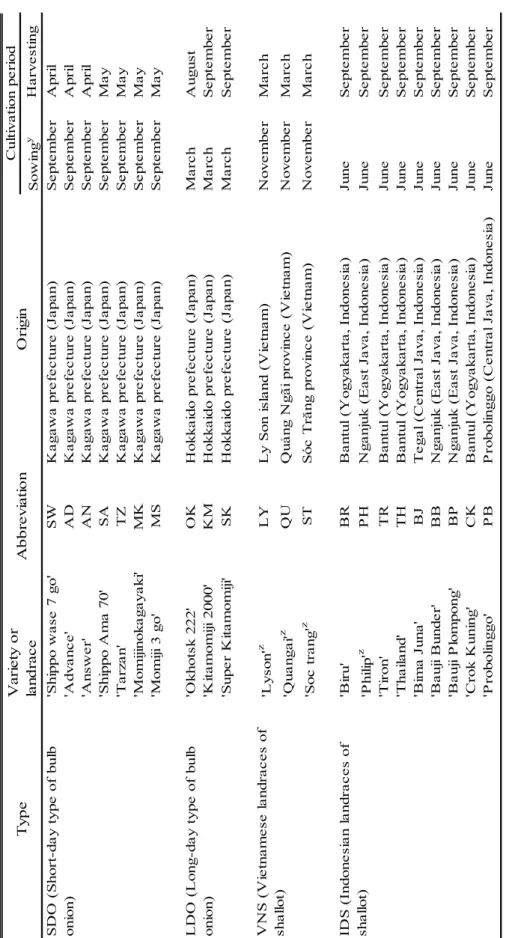
all samples, including cultivation periods, are indicated in Table 1, since a sufficient number of bulbs could be collected in some areas.
Fig. 1. Unpeeled (upper) and peeled (lower) bulbs of eight Indonesian shallot landraces collected in 2015. Bar indicates 1 cm.
Extraction and determination of S-alk(en)yl-L-cysteine sulfoxides (ACSOs)
High-performance liquid chromatography (HPLC) was employed to determine the sulfur compounds of bulb onion varieties and shallot landraces. Three onion bulbs were usually used for each variety as biological replicates. Each onion bulb was cut into quarters from top to bottom. The first part was used for hot ethanol extraction, and the second part was used to determine the ACSO content using water extraction. For shallot samples, however, two to three bulbs of each of the usual three replicates were used for water extraction. The extraction method adopted was the same as that described by Vu et al. (2013).
10
To analyze S-2-propenyl (allyl)-L-cysteine sulfoxide (AlCSO) and S-1-propenyl- L-cysteine sulfoxide (PeCSO), a 10-time dilution of the sample was filtrated using a disposable membrane filter (DISMIC®-13 HP ADVANTEC; Toyo Roshi Kaisha, Ltd., Tokyo, Japan). A 25-ȝ/VDPSOHZDVLQMHFWHGLQWRWKH+3/&V\VWHPIRUTXDQWLILFDWLRQ Twenty mg·mLí1 of 1-propil CSO and a mix of allyl (Al) and propenyl (Pe) CSO, produced by House Foods Corporation, Japan, was used as the standard. The HPLC system included a pump, a degasser, a column oven, a diode array detector set (220 nm, L-2450; HITACHI High-Technologies Corporation, Tokyo, Japan), a data collection system (EZChrom EliteTM; HITACHI High-Technologies Corporation) and an AQUASIL column (4.6 mm Ø × 25 cm long). The solvent, 0.005% trifluoroacetic acid (TFA), flowed for 15 min at a flow rate of 0.6 ml·miní1.
The S-methyl-L-cysteine sulfoxide (MeCSO) content was determined by using an amino acid analysis method because the method previously used to identify AlCSO and PeCSO produces an overlapping peak of MeCSO, making it difficult to quantify. One KXQGUHGȝ/RIWKHVDPSOHDQGȝ/RIWKHDPLQRDFLGVWDQGard were dried in a vacuum using Spin Dryer Lite VC-36R (Taitec Co., Ltd., Saitama, Japan). For derivatization, ȝ/ RI IUHVKO\ SUHSared methanol : H2O : triethylamine : phenylisothiocyanate (7:1:1:1) was added to the dried sample and vortexed. The mixture was incubated for 20 min at room temperature for the reaction process before being dried again in a vacuum condition. The VXSHUQDWDQW ZDV GLVVROYHG LQ ȝ/ RI P0 VRGLXP phosphate, pH 7.6, containing 5% acetonitrile. A quantitative analysis method using HPLC apparatus from Nihon Waters (Tokyo, Japan) followed the procedure described by Masamura et al. (2011), with some minor modifications. The injection volume was ȝ/DQGWKHFROXPQWHPSHUDWXUHZas 43°C. HPLC analysis was carried out by using
11
the following solvent system. Solvent A: 19 g of sodium acetate trihydrate and 2 mL of triethylamine were dissolved in 1 L of high purity water. The solution was adjusted to pH 6.08 by the addition of glacial acetic acid. To make up a 10% acetonitrile solution, a 950-mL solution was supplemented by 50 mL of acetonitrile. Solvent B: 60%
acetonitrile and 40% high purity water (v/v) were mixed. The transmission of the gradient elution and the flow rate were obtained as described by Masamura et al. (2011).
Extraction and determination of total flavonoid content
The total flavonoid content was determined by the colorimetric method using hot 70% ethanol extract. The method of flavonoid extraction was applied as described by Vu et al. (2013). A 500-ȝ/VDPSOHDQGȝ/ of 100% hexane were mixed in the (SSHQGRUIDQGWKHQLQFXEDWHGXQWLOWKHPL[WXUHVHSDUDWHGLQWRWZRSDUWV)LIW\ȝ/RIWKH GRZQSDUWZDVWDNHQDVDVDPSOHWRDQDO\]HZLWKȝ/RIHWKDQRODQGȝ/RI 2% aluminum chloride. The mixture was homogenized thoroughly by pipetting on the microplate and incubated for one hour before analysis. Different concentrations of quercetin—DQGȝ/āP/í1—were used as standards. Moreover, a solution RIȝ/RI(W2+DQGȝ/RIDOXPLQXPFKORULGHZDVused as the blank.
The total flavonoid content was quantified using the iMark Microplate Reader (Serial number 16548; BIO-RAD Laboratories, Tokyo, Japan) at 420 nm, and the data was read using Microplate Manager 6. To obtain the mean values, all chemical extractions were prepared for three biological replicates. Each extraction was applied to chemical determinations three times.
12 Extraction and determination of sugar content
The soluble sugar content—including fructose, glucose, and sucrose—was determined by the HPLC method using hot 70% ethanol extract. The method of sugar extraction adopted was the same as that described by Vu et al. (2013). The obtained extract was filtered using a 0.45-ȝP V\ULQJH ILOWHU ',60,&®-13 HP ADVANTEC; Toyo Roshi Kaisha, Ltd.) before being analyzed using a Shimadzu Solusi LC (CBM-20A) HPLC machine equipped with an RI detector (Shimadzu, Kyoto, Japan), an LC-20AD pump (Shimadzu, 3.5 MPa Max 18.0 Min 0.0), and a Shimadzu SIL-20AC autosampler.
Sugars from a 20-ȝ/VDPSOHZHUHVHSDUDted on a LiChrospher 100 NH2 250-4.0 column (Kanto Chemical Co., Inc., Tokyo, Japan). Separation was obtained with 80%
acetonitrile with a 35°C column temperature and a flow rate of 0.8 ml·miní1.
The fructan content was determined using the thiobarbituric acid method (Percheron, 1962) from a 70% ethanol extract. Preparations for fructan analysis were carried out as described by Vu et al. (2013). Fructan quantification was achieved using a spectrophotometer (U-2001; HITACHI High-Technologies Corporation) at a 432-nm wavelength. Chemical extractions were pre- pared for three replications in order to obtain mean values. Each extraction was applied to triplicate chemical determinations.
Qualification of sugar content
Thin-layer chromatography (TLC) was used to separate the sugar fraction of each sample. A hot 70% ethanol extract was spotted on TLC plates before development using a solvent system consisting of 1- buthanol : acetic acid : distilled water (2:1:1) in a glass chamber. Sugar fractions were visualized by applying a coloring reagent for fructooligosaccharides (diphenylamine : aniline : 85% phosphoric acid : acetone
13
(1:1:10:100), w/v/v/v) using an ink brush and were heated at 115°C, and 0.025%
fructose, glucose, sucrose, 1-kestose, and nystose were used as standard chemicals.
Statistical analysis
All of the data sets obtained from content determinations were used to conduct an F-test together with Tukey’s honestly significant difference (HSD) test. Principal component analysis (PCA) was conducted to obtain the similarities and differences among all bulb onion varieties and shallot landraces. Regression analysis was carried out to clarify the reliability of the data using two years of data from 2014 and 2015 data sets. All statistical analyses were performed using IBM SPSS statistics 19 (IBM, New York, USA).
14
Table 1.Plant material used in this study and relevant information. z Not analyzed in the second year (2015). y Seed sowing in bulb onions bulbs.
SowingyHarvesting 'Shippo wase 7 go'SWKagawa prefecture (Japan)SeptemberApril 'Advance'ADKagawa prefecture (Japan)SeptemberApril 'Answer'ANKagawa prefecture (Japan)SeptemberApril 'Shippo Ama 70'SAKagawa prefecture (Japan)SeptemberMay 'Tarzan'TZKagawa prefecture (Japan)SeptemberMay 'Momijinokagayaki'MKKagawa prefecture (Japan)SeptemberMay 'Momiji 3 go'MSKagawa prefecture (Japan)SeptemberMay 'Okhotsk 222'OKHokkaido prefecture (Japan)MarchAugust 'Kitamomiji 2000'KMHokkaido prefecture (Japan)MarchSeptember 'Super Kitamomiji'SKHokkaido prefecture (Japan)MarchSeptember 'Lyson'zLYLy Son island (Vietnam)NovemberMarch 'Quangai'zQU4XҧQJ1JmLSURYLQFH9LHWQDPNovemberMarch 'Soc trang'zST6yF7UăQJSURYLQFH9LHWQDPNovemberMarch 'Biru'BRBantul (Yogyakarta, Indonesia)JuneSeptember 'Philip'zPHNganjuk (East Java, Indonesia)JuneSeptember 'Tiron'TRBantul (Yogyakarta, Indonesia)JuneSeptember 'Thailand'THBantul (Yogyakarta, Indonesia)JuneSeptember 'Bima Juna'BJTegal (Central Java, Indonesia)JuneSeptember 'Bauji Bunder'BBNganjuk (East Java, Indonesia)JuneSeptember 'Bauji Plompong'BPNganjuk (East Java, Indonesia)JuneSeptember 'Crok Kuning'CKBantul (Yogyakarta, Indonesia)JuneSeptember 'Probolinggo'PBProbolinggo (Central Java, Indonesia)JuneSeptember
Cultivation period SDO (Short-day type of bulb onion) LDO (Long-day type of bulb onion) VNS (Vietnamese landraces of shallot) IDS (Indonesian landraces of shallot)
TypeVariety or landraceAbbreviationOrigin
14
15 Results
S-alk(en)yl-L-cysteine sulfoxides (ACSOs)
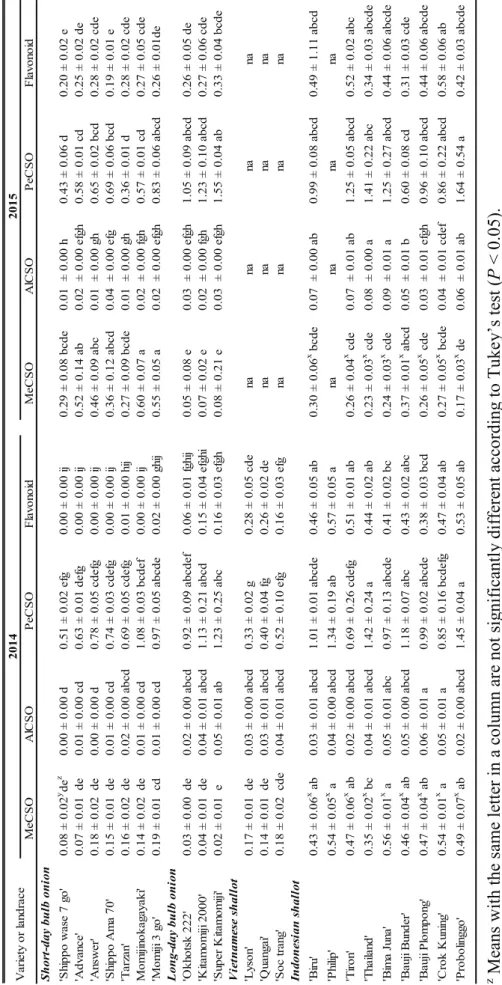
MeCSO in shallot landraces from Indonesia was difficult to identify using the first HPLC method. Overlapping peaks were found in the MeCSO peak area, making it impossible to determine which peak represented the MeCSO content. Therefore, the method of amino acid analysis was used to determine the MeCSO content in Indonesian shallot landraces. All of the data sets of three different ACSOs—MeCSO, AlCSO, and PeCSO—from the samples collected in 2014 and 2015 are shown in Fig. 2 and/or Table 2. The MeCSO of 2014 was not significantly different among short-day and long-day varieties of bulb onion. However, Indonesian shallot landraces produced higher MeCSO than shallot landraces from Vietnam and both bulb onion types. Data from the next year showed a different tendency. Short-day bulb onions produced significantly higher MeCSO than the long-day bulb onions and Indonesian shallot landraces. Results of regression analysis showed that the MeCSO data of 2015 did not correlate with those of 2014 (r= 0.016) (Fig. 3A).
In the 2014 and 2015 trials, the AlCSO contents of bulb onion varieties were lower than those of shallot landraces. There were no significant differences in AlCSO content between bulb onion varieties. However, two shallot landraces from Indonesia,
‘Thailand’ and ‘Bima Juna,’ produced significantly higher AlCSO (0.08 mg·gí1 FW and 0.09 mg·gí1 FW, respectively) than bulb onion varieties in 2015. There was a correlation of AlCSO content between the 2014 and 2015 trials (r= 0.491*) (Fig. 3B).
Table 2 shows that the PeCSO contents of bulb onion varieties were not significantly different from those of shallot landraces throughout the two years. As compared to bulb onion PeCSO contents, a relatively higher level of accumulation was observed in one
16
Indonesian shallot landrace, ‘Probolinggo’ (1.45 mg·gí1FW in 2014 and 1.64 mg· gí1 FW in 2015), as compared with short-day and long-day bulb onions. Moreover, the PeCSO contents of long-day bulb onions were significantly higher than those of short- day bulb onions. Furthermore, the PeCSO data of 2014 were highly correlated with those of 2015 (r= 0.800**) (Fig. 3C).
Flavonoid content
In the 2014 and 2015 trials, a significant difference in flavonoid content was detected between bulb onion varieties and shallot landraces (Fig. 2 and/or Table 2). In shallots, one Indonesian landrace, ‘Philip’ had a relatively higher level of flavonoid content (0.57 mg·gí1 FW) than that of Vietnamese landraces. Although significant differences between varieties were not observed, long-day bulb onion varieties produced a higher amount of flavonoids than short-day varieties. Furthermore, shallots showed higher flavonoid contents than bulb onions. The same tendency was found in both experimental years, as the correlation test showed a highly significant correlation (r= 0.863**) between the flavonoid data of 2014 and 2015 (Fig. 3D).
17
Fig. 2. Quantification of MeCSO (A), PeCSO (B), and flavonoid (C) contents in seven short-day onions (SDO), three long-day onions (LDO), three Vietnamese shallots (VNS), and nine Indonesian shallots (IDS) in 2014 and 2015. Each value is the mean ± SE of three replications. na = not analyzed.
18
Table 2. Contentsof ACSOs and flavonoid (mg.g-1 FW) in bulb onions and shallots for 2014 and 2015. MeCSO AlCSO PeCSO Flavonoid MeCSO AlCSO PeCSO Flavonoid Short-day bulb onion 'Shippo wase 7 go'0.08 ± 0.02y dez 0.00 ± 0.00 d0.51 ± 0.02 efg0.00 ± 0.00 ij0.29 ± 0.08 bcde0.01 ± 0.00 h0.43 ± 0.06 d0.20 ± 0.02 e 'Advance'0.07 ± 0.01 de0.01 ± 0.00 cd0.63 ± 0.01 defg0.00 ± 0.00 ij0.52 ± 0.14 ab0.02 ± 0.00 efgh0.58 ± 0.01 cd0.25 ± 0.02 de 'Answer'0.18 ± 0.02 de0.00 ± 0.00 d0.78 ± 0.05 cdefg0.00 ± 0.00 ij0.46 ± 0.09 abc0.01 ± 0.00 gh0.65 ± 0.02 bcd0.28 ± 0.02 cde 'Shippo Ama 70'0.15 ± 0.01 de0.01 ± 0.00 cd0.74 ± 0.03 cdefg0.00 ± 0.00 ij0.36 ± 0.12 abcd0.04 ± 0.00 efg0.69 ± 0.06 bcd0.19 ± 0.01 e 'Tarzan'0.16 ± 0.02 de0.02 ± 0.00 abcd0.69 ± 0.05 cdefg0.01 ± 0.00 hij0.27 ± 0.09 bcde0.01 ± 0.00 gh0.36 ± 0.01 d0.28 ± 0.02 cde Momijinokagayaki'0.14 ± 0.02 de0.01 ± 0.00 cd1.08 ± 0.03 bcdef0.00 ± 0.00 ij0.60 ± 0.07 a0.02 ± 0.00 fgh0.57 ± 0.01 cd0.27 ± 0.05 cde 'Momiji 3 go'0.19 ± 0.01 cd0.01 ± 0.00 cd0.97 ± 0.05 abcde0.02 ± 0.00 ghij0.55 ± 0.05 a0.02 ± 0.00 efgh0.83 ± 0.06 abcd0.26 ± 0.01de Long-day bulb onion 'Okhotsk 222'0.03 ± 0.00 de0.02 ± 0.00 abcd0.92 ± 0.09 abcdef0.06 ± 0.01 fghij0.05 ± 0.08 e0.03 ± 0.00 efgh1.05 ± 0.09 abcd0.26 ± 0.05 de 'Kitamomiji 2000'0.04 ± 0.01 de0.04 ± 0.01 abcd1.13 ± 0.21 abcd0.15 ± 0.04 efghi0.07 ± 0.02 e0.02 ± 0.00 fgh1.23 ± 0.10 abcd0.27 ± 0.06 cde 'Super Kitamomiji'0.02 ± 0.01 e0.05 ± 0.01 ab1.23 ± 0.25 abc0.16 ± 0.03 efgh0.08 ± 0.21 e0.03 ± 0.00 efgh1.55 ± 0.04 ab0.33 ± 0.04 bcde Vietnamese shallot 'Lyson'0.17 ± 0.01 de0.03 ± 0.00 abcd0.33 ± 0.02 g0.28 ± 0.05 cde na na na na 'Quangai'0.14 ± 0.01 de0.03 ± 0.01 abcd0.40 ± 0.04 fg0.26 ± 0.02 de na na na na 'Soc trang'0.18 ± 0.02 cde0.04 ± 0.01 abcd0.52 ± 0.10 efg0.16 ± 0.03 efg na na na na Indonesian shallot 'Biru'0.43 ± 0.06x ab0.03 ± 0.01 abcd1.01 ± 0.01 abcde0.46 ± 0.05 ab0.30 ± 0.06x bcde0.07 ± 0.00 ab0.99 ± 0.08 abcd0.49 ± 1.11 abcd 'Philip'0.54 ± 0.05x a0.04 ± 0.00 abcd1.34 ± 0.19 ab0.57 ± 0.05 a na na na na 'Tiron'0.47 ± 0.06x ab0.02 ± 0.00 abcd0.69 ± 0.26 cdefg0.51 ± 0.01 ab0.26 ± 0.04x cde0.07 ± 0.01 ab1.25 ± 0.05 abcd0.52 ± 0.02 abc 'Thailand'0.35 ± 0.02x bc0.04 ± 0.01 abcd1.42 ± 0.24 a0.44 ± 0.02 ab0.23 ± 0.03x cde0.08 ± 0.00 a1.41 ± 0.22 abc0.34 ± 0.03 abcde 'Bima Juna'0.56 ± 0.01x a0.05 ± 0.01 abc0.97 ± 0.13 abcde0.41 ± 0.02 bc0.24 ± 0.03x cde0.09 ± 0.01 a1.25 ± 0.27 abcd0.44 ± 0.06 abcde 'Bauji Bunder'0.46 ± 0.04x ab0.05 ± 0.00 abcd1.18 ± 0.07 abc0.43 ± 0.02 abc0.37 ± 0.01x abcd0.05 ± 0.01 b0.60 ± 0.08 cd0.31 ± 0.03 cde 'Bauji Plompong'0.47 ± 0.04x ab0.06 ± 0.01 a0.99 ± 0.02 abcde0.38 ± 0.03 bcd0.26 ± 0.05x cde0.03 ± 0.01 efgh0.96 ± 0.10 abcd0.44 ± 0.06 abcde 'Crok Kuning'0.54 ± 0.01x a0.05 ± 0.01 a0.85 ± 0.16 bcdefg0.47 ± 0.04 ab0.27 ± 0.05x bcde0.04 ± 0.01 cdef0.86 ± 0.22 abcd0.58 ± 0.06 ab 'Probolinggo'0.49 ± 0.07x ab0.02 ± 0.00 abcd1.45 ± 0.04 a0.53 ± 0.05 ab0.17 ± 0.03x de0.06 ± 0.01 ab1.64 ± 0.54 a0.42 ± 0.03 abcde
Variety or landrace20142015 z Means with the same letter in a column are not significantly different according to Tukey’s test (P<0.05). y Each value is the mean ± SE (n = 3). x Analyzed using amino acid analysis method. na : not analyzed
18
19 Soluble sugar content
The sweetness of bulb onions and shallots seems to be affected by the composition of the soluble sugar content. The total soluble sugar content—including fructose, glucose, and sucrose—was determined in this research using the HPLC method (Fig. 4 and/or Table 3). The statistical analysis data demonstrated that the fructose contents of short-day bulb onions were significantly higher than those of long-day bulb onions and shallots. The same tendency was also observed in the glucose content of bulb onion and shallot samples. No significant differences were found in the sucrose contents of bulb onion varieties and shallot landraces from different areas. However, one Indonesian shallot landrace, ‘Thailand’ produced a higher sucrose content in the 2014 and 2015 observations. The same tendency was found throughout the two years, as regression analysis showed a significant correlation for fructose (r = 0.866**) (Fig. 3E), glucose (r= 0.959**) (Fig. 3F), and sucrose (r= 0.705**) (Fig. 3G) contents between 2014 and 2015.
Fig. 3. Relationships between data from 2014 and 2015 in MeCSO (A), AlCSO (B), PeCSO (C), flavonoid (D), fructose (E), glucose (F), sucrose (G) and fructan (H) contents of bulb onions and shallots in 2014 and 2015 * Significant at P<
0.05 and ** Significant at P< 0.01.
20
Table 3. Contents of soluble sugars (mg.g-1 FW)in bulb onions and shallots for 2014 and 2015 Fructose Glucose Sucrose Fructan Fructose Glucose Sucrose Fructan Short-day bulb onion 'Shippo wase 7 go'16.35 ± 1.73y az 15.03 ± 0.48 abc 6.71 ± 0.75 bcde0.78 ± 0.13 h27.63 ± 2.00 abc34.97 ± 0.86 cde13.19 ± 3.26 de0.12 ± 0.03 f 'Advance'19.42 ± 1.11 a16.43 ± 0.66 ab 2.85 ± 1.22 e0.18 ± 0.04 h22.14 ± 0.72 cde31.28 ± 1.83 ef 5.75 ± 3.57 e0.06 ± 0.02 f 'Answer'18.83 ± 0.70 a17.03 ± 0.98 ab 5.64 ± 1.78 cde0.29 ± 0.03 h28.98 ± 3.07 abc27.30 ± 1.99 f24.98 ± 0.76 abcd0.15 ± 0.05 f 'Shippo Ama 70'16.85 ± 0.28 a15.88 ± 0.78 abc 4.13 ± 0.68 de0.39 ± 0.03 h30.81 ± 2.46 abc31.79 ± 0.87 def 9.78 ± 2.96 de0.05 ± 0.02 f 'Tarzan'17.22 ± 0.46 a18.18 ± 0.87 a 5.86 ± 1.22 cde0.53 ± 0.07 h36.23 ± 1.32 a44.90 ± 0.89 a20.72 ± 1.23 abcde0.16 ± 0.02 f Momijinokagayaki' 9.33 ± 1.15 b15.44 ± 1.32 abc 8.38 ± 0.81 bcd0.91 ± 0.09 h24.50 ± 0.74 bcd38.28 ± 2.65 abcde23.14 ± 1.23 abcd0.69 ± 0.11 ef 'Momiji 3 go'10.10 ± 1.98 b15.69 ± 1.16 abc 7.21 ± 0.82 bcde0.98 ± 0.11 h33.77 ± 4.78 ab36.60 ± 2.64 bcde12.95 ± 5.60 de0.22 ± 0.14 f Long-day bulb onion 'Okhotsk 222' 8.55 ± 0.38 b12.82 ± 0.21 c 9.11 ± 1.20 bc0.81 ± 0.27 h15.21 ± 1.73 defgh39.09 ± 093 abcd17.84 ± 4.91 bcde0.94 ± 0.05 ef 'Kitamomiji 2000' 7.84 ± 0.14 bc15.06 ± 1.07 abc 8.59 ± 0.78 bc1.01 ± 0.22 h15.81 ± 3.10 defg36.53 ± 3.02 bcde21.22 ± 2.39 abcde0.73 ± 0.08 ef 'Super Kitamomiji' 9.10 ± 0.92 b13.64 ± 0.61 bc 8.53 ± 1.02 bcd1.10 ± 0.25 h17.14 ± 1.75 def42.56 ± 1.36 ab20.34 ± 2.56 abcde1.10 ± 0.13 ef Vietnamese shallot 'Lyson' 8.57 ± 0.62 b 8.61 ± 0.33 d 6.32 ± 0.18 bcde4.23 ± 1.01 efg na na na na 'Quangai' 9.21 ± 0.54 b 8.71 ± 0.25 d 6.84 ± 0.27 bcde3.49 ± 0.65 fg na na na na 'Soc trang'10.04 ± 0.45 b 8.25 ± 0.32 d 9.70 ± 0.32 abc2.05 ± 0.47 gh na na na na Indonesian shallot 'Biru' 0.59 ± 0.12 d 0.11 ± 0.04 e 7.82 ± 0.45 bcd14.80 ± 0.54 a 9.92 ± 0.87 fgh 2.18 ± 0.48 g31.24 ± 3.23 ab3.16 ± 0.40 de 'Philip' 0.74 ± 0.05 d 0.72 ± 0.25 e 5.91 ± 0.22 cde13.14 ± 0.93 ab na na na na 'Tiron' 1.64 ± 0.40 d 0.62 ± 0.04 e 6.73 ± 0.27 bcde12.49 ± 0.29 b 6.37 ± 0.50 gh 1.66 ± 0.20 g17.36 ± 3.19 bcde4.29 ± 1.39 cd 'Thailand' 3.46 ± 0.08d 1.16 ± 0.07 e13.84 ± 0.67 a 4.47 ± 0.29 ef 5.96 ± 0.40 gh 2.25 ± 0.07 g35.16 ± 2.52 a2.84 ± 0.42 de 'Bima Juna' 1.16 ± 0.14 d 1.07 ± 0.09 e 7.95 ± 0.53 bcd 6.19 ± 0.20 de 9.17 ± 1.31 fgh 2.01 ± 0.24 g17.50 ± 1.23 bcde5.20 ± 0.84 cd 'Bauji Bunder' 1.07 ± 0.30 d 0.52 ± 0.16 e 9.92 ± 0.29 abc 7.68 ± 0.83 cd 5.76 ± 0.65 h 1.16 ± 0.36 g24.46 ± 1.92 abcd8.20 ± 0.75 ab 'Bauji Plompong' 1.25 ± 0.09 d 0.61 ± 0.20 e 8.28 ± 0.40 bcd 9.28 ± 0.25 c 5.59 ± 0.43 h 2.11 ± 0.28 g19.02 ± 2.71 bcde9.30 ± 0.72 a 'Crok Kuning' 1.33 ± 0.49 d 0.53 ± 0.06 e 7.98 ± 0.14 bcd 7.83 ± 0.29 cd10.16 ± 0.82 fgh 2.21 ± 0.19 g29.21 ± 1.91 abc3.98 ± 0.33 d 'Probolinggo' 1.47 ± 0.17 d 0.58 ± 0.23 e 9.29 ± 0.27 bc 7.98 ± 1.13 cd12.50 ± 1.18 efgh 1.95 ± 0.19 g24.20 ± 0.93 abcd6.65 ± 0.56 bc
Variety or landrace20142015 z Means with the same letter in a column are not significantly different according to Tukey’s test (P<0.05). y Each value is the mean ± SE (n = 3). na : not analyzed.
20
21
Fig. 4. Quantification of sugar contents including fructose (A), glucose (B), sucrose (C), and fructan (D) in seven short-day onions (SDO), three long-day onions (LDO), three Vietnamese shallots (VNS) and nine Indonesian shallots (IDS) in 2014 and 2015. Each value is the mean ± SE of three replications. na = not analyzed
22
More than 50% of the sugar contents of bulb onions were monosaccharides (fructose and glucose), and the major sugar content in shallot landraces was sucrose.
This result was derived from the qualification of soluble sugar content using the TLC method for the 2014 samples. Figure 5 shows that bulb onion varieties had higher amounts of monosaccharides, and that shallot landraces were rich in disaccharides (sucrose) and poly- saccharides (1-kestose and nystose). A significantly higher amount of fructans, known as fructose polymers, could be detected in shallot landraces from Indonesia. The coefficient correlation of fructans contents between 2014 and 2015 was significantly high (r= 0.728**) (Fig. 3H).
Fig. 5. TLC profile of soluble sugars in seven short-day bulb onions (SDO), three long- day bulb onions (LDO), three Vietnamese shallots (VNS), and nine Indonesian shallots (IDS). Fructose (F), glucose (G), sucrose (S), 1-kestose (K), and nistose (N) were used as standard compounds.
Principal component analysis
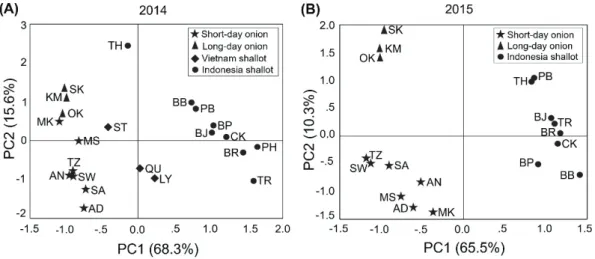
The phytochemical properties—including ACSOs, flavonoids, and sugars—of 10 long-day bulb onion varieties, 3 short-day bulb onion varieties, 3 Vietnamese shallot landraces, and 9 Indonesian shallot landraces were analyzed in 2014 and 2015. The PCA of 2014 yielded 2 principal components, accounting for 83.9% of the total variations, divided into 68.3% of the PC1 and 15.6% of the PC2 (Fig. 6A). The loading
23
values of fructose and glucose in the PC1 were found to be negaWLYH í DQG í0.920, respectively), as also observed in the PC1 of the 23&$íDQGí respectively). The PC2 in 2014 consisted of sucrose (0.918), PeCSO (0.750), and AlCSO (0.577). However, in the PC2 of 2015, which was only 10.3% of the total YDULDWLRQWKLVFRPSRQHQWFRQVLVWHGRI0H&62íDQG3H&62 ,QWKH PCA analysis of 2015, the PC1 explained 65.5% of the total variations (Fig. 6B). Both the PCA analyses of 2014 and 2015 could clearly discriminate short-day bulb onions from long-day bulb onions and shallots from a phytochemical point of view.
Fig. 6. Plot of the first and second principal components obtained from a data set of chemical composition analyses in bulb onions and shallots for 2014 (A) and 2015 (B).