神戸市外国語大学 学術情報リポジトリ
A sustainable public procurement system for
large-scale natural disasters : the case of
the temporary housing program after The East
Japan Earthquake
著者
Tanaka Satoru
journal or
publication title
Kobe city university of foreign studies
working paper series
number
45
page range
1-20
year
2012-09-01
KobeCityUniversityofForeignStudies(045
WorkingPaperSeries
InstitutehrForelgnStudies
KobeCityUniversityofForeignStudieS
Nishi−ku,Kobe,651−2187,Japan
A Sustainable Public Procurement System for
Large-Scale Natural Disasters:
The Case of The Temporary Housing Program
after The East Japan Earthquake
Satoru Tanaka
Kobe City University of Foreign Studies
September, 2012
A Sustainable Public Procurement System for Large-Scale
Natural Disasters: The Case of The Temporary Housing Program
after The East Japan Earthquake(*)
By
Satoru Tanaka
tSeptember 2012
ABSTRACT
After large-scale natural disasters, governments must procure enormous amounts of many sorts efficiently without delay by concluding the discrete contracts. In addition, these procurements should not impede recovery by individual in market economies. In this paper, by focusing Japanese temporary housing program after East Japan Earthquake, I consider the important factors necessary to achieve desired public procurement during emergency period. After explaining Japanese pre-disaster rules and post-disaster response after the earthquake, I show that the price of temporary house was influenced heavily by the introduction of ad hoc program using a statistic analysis. Based on this discussion, I point out that this ad hoc policy may cause time-inconsistency problem, and adverse impact on the prevention for hazards. In this meaning, to maintain time-consistency is very important for executing public procurement after hazards.
(*) In the process of this research, I conducted surveys based on interviews to Iwate prefecture (on 5th
September, 2011), Sumida town in Iwate prefecture (on 7th September, 2011) and JAPC (on 7th
February, 2012). I would like to thank Mr. S.Tanifuji, Mr. T.Miura (Iwate Prefecture), Mr. K.Tada, Mr. N.Kanno (Sumida town), Mr. N.Takahashi, Mr. J.Kikuchi, Mr. H.Sora (JAPC) for providing useful information about temporary housing program.
t professor of Economics, Kobe City University of Foreign Studies, 9-1 Gakuen-Higashi-machi, Nishi-ku, Kobe 651-2187, JAPAN. E-mail:
1. INTRODUCTION
On March 11, 2011, a very large.::scale earthquake, of 9.0 magnitude on the Richter scale, struck the northeast part of Japan. Because the epicenter of the earthquake was at the bottom of the sea, the tsunami produced by the quake surged toward the coast of the Tohoku district. This powerful tsunami killed thousands of people and destroyed various types of structures in the district. In addition, the subsequent meltdown of the Fukushima Daiichi Nuclear Power Plant, due to the earthquake and tsunami, forced a prolonged evacuation of the residents of the surrounding areas for several months.
Although Japan has often experienced many large earthquakes, the East Japan Earthquake demonstrated remarkable characteristics different from past earthquakes. First, the damage that resulted from the earthquake was enormous for a developed country. Table 1 shows the extent of the damage caused by the quake. Compared with the damage brought by the Hanshin-Awaji Earthquake in 1995 that caused large-scale devastation, the East Japan Earthquake was significantly greater both in terms of loss of human life and physical destruction. Second, it is worth noting that the East Japan Earthquake affected vast areas. In fact, according to the Japanese National Police Agency, this quake caused loss of life in 12 (13) prefectures, although the main stricken areas were Iwate, Miyagi, and Fukushima prefectures. Third, as a result of the nuclear power plant accident, the situation with regard to damage became more complex. Especially, in Fukushima prefecture, those harmed were affected not only by the earthquake and/or tsunami but also by the radioactive materials.
<See Table 1>
In general, after large-scale natural disasters, governments must procure enormous amounts of different sorts of materials efficiently and without delay. In addition to this, because those adversely affected by natural disasters are required to rebuild their lives as quickly as possible using their own resources in market economies, their recovery should not be impeded by public procurement efforts. However, these objectives are often in conflict with each other during an emergency period. For example, relief procurement is an urgent matter, but the pursuit of this objective may mean forgoing the competition between bidders that is necessary to attain efficiency. Therefore, as Thai (2007) pointed out, governments may face
trade-off: prompt procurement versus efficient procurement m emergency contracting.
The purpose of this paper is to consider the important factors that achieve a balance among different objectives by focusing on the Japanese public procurement after the East Japan Earthquake. Although the types of procurement after a natural disaster are extremely diverse, they can be divided into two groups: procurement for rehabilitation and that for relief. Obviously, the former requires a lot of time and is ongoing, whereas the latter is completed within a relatively short time. Hence, with regard to the latter, we focus on the public procurement of temporary housing whose data I was able to collect systematically.
Many studies have been conducted on the temporary housing programs during post-disaster periods (For example, see Bolin & Stanford (1991), Davis (1977), Quarantelli (1995)). However, these literatures mainly focus on the recurrent cultural and sociological issues involved in the programs. Recently, Johnson (2007) emphasized the necessity of (ex ante) strategic planning for temporary housing. Although she pointed out important considerations for the procurement of temporary housing, her approach does not mainly focus on the issues of public procurement. Only a very few researches approach the temporary housing programs from the perspective of public procurement.
In this paper, we discuss the importance of consistency between pre-disaster rules and post-disaster response for executing public procurement during an emergency period. As Kydland & Prescott (1977) showed in the macroeconomics field, it is well known that the time-inconsistency problem between rules and discretionary policy, that is, the best action to be taken given the current situation, is an obstacle to attaining optimal economic performance. In the following, we show that the Japanese government's post-disaster response for procuring temporary houses may have caused a time-inconsistency problem because of its ad hoc planning. Section 2 explains the Japanese pre-disaster rules for the supply of temporary housing. Section 3 discusses the post-disaster procurement policy pursued by the Japanese government after the East Japan Earthquake. Section 4 clarifies the determinant of the price of temporary housing, through a statistical analysis that uses the collected data on the supply of temporary housing. Section 5 shows that the lack of consistency between pre-disaster rules and post-disaster response may produce confusion with regard to the supply of temporary housing. Section 6 concludes.
2. JAPANESE PRE-DISASTER (EX ANTE) RULES OF RELIEF
In general, countries have an institutional system of hazard prevention and preparedness in order to effectively minimize the damage from them. Because this system prescribes the scope of responsibility and the method of governmental response after a disaster, it is described as the pre-disaster (ex ante) rules for public procurement after disasters. These rules take various forms such as laws, guidelines, plans, agreements, and precedents. Thus, we define pre-disaster rules as the codified information the government refers to when faced with a disaster and on which people expect that the government's responses will be based. In this section, we shall explain the Japanese pre-disaster rules, focusing especially on the procurement of temporary houses that are provided to affected persons as part of relief aid following a disaster.
Needless to say, the basis of Japanese pre-disaster rules is the law. Japan's Basic Law of Measures against Disaster, which is the most basic law on hazard prevention, determines where the responsibility lies and prescribes various measures aimed at the prevention of damage. Especially, this law requires that every local government have in place a plan to cope with disasters (Regional Plan for Prevention of Damage). Its principles are "the principle of complementarity" and "the principle of providing goods in kind." The former means that the lower level of government near the affected areas is responsible for dealing with any hazard. Only when the damage caused by a disaster is so large that the lower level government cannot deal with it, does the upper level of government provide physical and financial assistance to the affected areas. On the other hand, the latter means that the government should support affected persons not by giving pecuniary aid but by providing goods and services in kind, except in the case of the Law for Supporting the Rebuilding of Disaster Victims' Livelihood 1, which was enacted after the
Hanshin-Awaji Earthquake. The Japanese government adheres to this principle that is based on the idea that government should not contribute to increasing private property.
Japan's Disaster Relief Law, whose principle is based on Japan's Basic Law of
1 This law is enacted in purpose of supporting for sufferers by natural disasters to recovery their living by their own efforts. The affected person entitled to be supported by this law receives financial aids by the prefecture.
Measures against Disaster, describes the concrete relief activities that the government should engage in immediately after a natural disaster. This law requires the prefecture where the disaster occurred to embark on nine concrete activities2 • On the basis of this law, the government procures goods and services necessary to engage in these activities. The supply of temporary houses for affected persons that we shall focus on is included in the above-mentioned nine activities.
A concrete method of procuring is described in the guidelines, plans, agreements, and precedents. In the case of the temporary housing program, the Japanese government has formulated The Guidelines Related to the Supply of Temporary Houses and clarified the following: the persons eligible under the program, the specifications of houses (within 29.8 m2 per house), upper limit of the
cost of the main parts of the houses that the government can subsidize (within 2,387,000 yen ($29,838)), the time of starting construction (within 20 days after the disaster) and the term for which the houses will be provided (2 years). However, in the case of a large-scale natural disaster, it may be very difficult for the government (prefecture) to adhere to these criteria. Therefore, in that case, the Japanese government determines special criteria by considering the situation of affected persons in the related prefectures, referring to precedents set in the responses to other natural disasters. Because these criteria are not necessarily detailed, there is ample room for the government to pursue a discretionary policy after a large-scale natural disaster.
The prefecture makes the actual procurement of goods after a natural disaster on the basis of the Regional Plan for Prevention of Damage formulated by each local government that describes the process for procurement of goods and services. The government often concludes appropriate agreements (Agreement for Aid after Disaster) with the industry associations for it to procure various goods and services in order to execute the plan. Thus, actual procurement often progresses in line with these agreements. Typically, the government concludes discrete contracts with the association or member of the association, and engages in the actual procurement.
In the case of the temporary housing program, each prefecture concludes an agreement with the Japan Association of Prefab Construction (JAPC) in order to
2 The kinds of relief that should be provided by the prefecture are as follows: a) provision of facilities for victims (including temporary houses), b) supply offood and drink, c) supply of necessities of life, d) provision of medical and birthing services, e) rescue operations, :0 temporary repair of damaged houses, g) provision of work tools h) provision of school supplies, i) provision of burial service.
supply temporary houses after a disaster. In fact, as figure 1 shows, all 47 prefectures in Japan have concluded this agreement with it currently. Note that this agreement was entered into by several prefectures after the Hanshin-Awaji Earthquake in 1995. According to this agreement, JAPe introduces to the prefecture the construction firms that can supply the . temporary houses at specified construction sites, and the prefecture concludes discrete contracts with the relevant construction firms. Typically, the member firms that belong to the standardized construction section of JAPe 3, which specializes in the supply of temporary
constructions, supply the temporary houses after a disaster. However, when the necessary number of temporary houses exceeds the capacity of these member firms, the prefecture concludes contracts with other member firms of JAPe on the basis of this association's recommendation. In addition, in this case, the prefecture also chooses suppliers after inviting tenders from the public. Moreover, the local government such as city and town can procure temporary houses by its own budget.
<See Figure 1>
3. POST-DISASTER RESPONSE
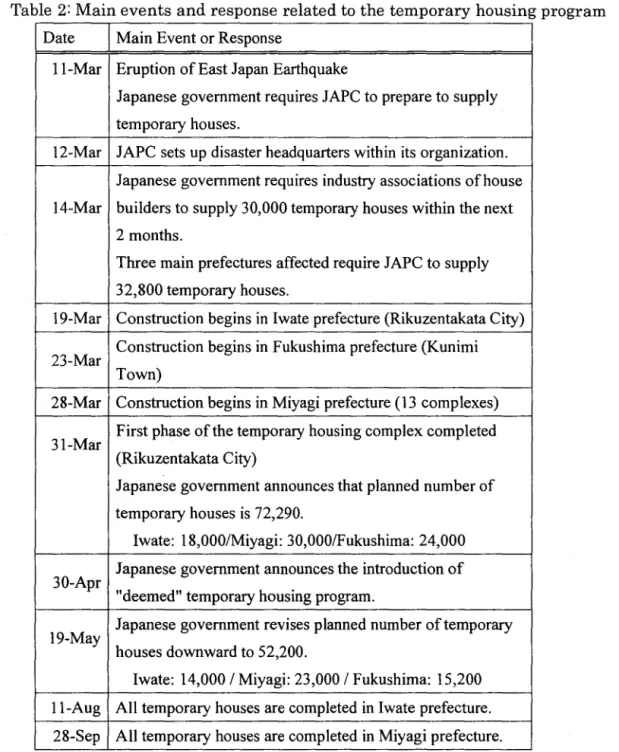
Mter the East Japan Earthquake, the Japanese government and local governments in the affected areas began procuring goods and services for relief activities on the basis of the ex-ante rules mentioned in the previous section. Obviously, since this disaster caused very extensive damage, the Japanese government helped local governments (prefectures) with the procurement of temporary housing, as it did after the Hanshin-Awaji Earthquake. Table 2 shows the main events and response related to the temporary housing program. As this table shows, with help from the Japanese government, the prefectures in the affected areas required the industrial associations of housing (mainly the standardized construction section of JAPe) to supply temporary houses in line with pre-disaster rules. As a result, by the end of March, not only had the construction of houses begun, but the number of temporary houses that should be constructed was also calculated. In fact, on March 31, 2011, the Japanese government announced
3 JAPC consists of the following three sections according to the main business area: standard construction section, housing section, and PC construction section.
that the planned number of temporary houses was 72,290 (18,000 III Iwate
Prefecture/ 30,000 in Miyagil24,000 in Fukushima).
<See Table 2>
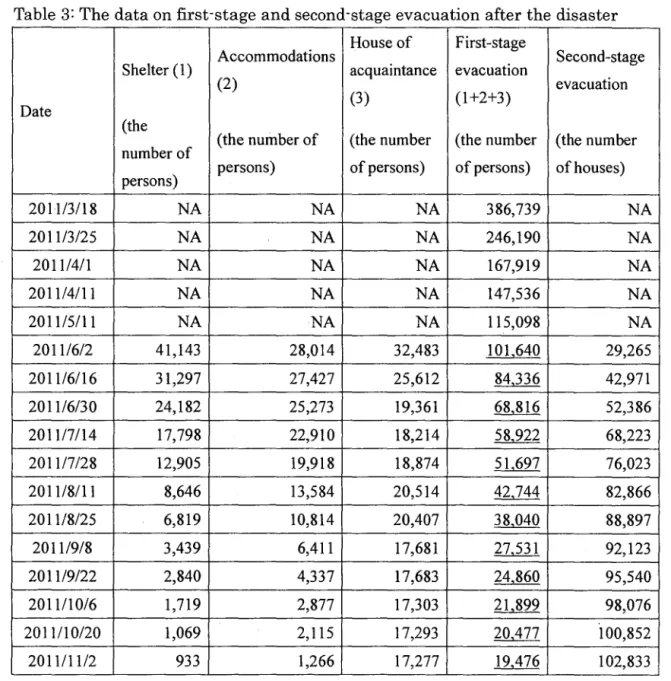
However, the environment of the shelter, school, or community center where those affected by the disaster typically evacuated, as the first-stage place of refuge after the disaster, was very inferior. Thus, the government was under pressure to supply urgently the second-stage place of evacuation. On the other hand, there were difficulties in finding building sites for the construction of temporary houses. In order to overcome this situation, the Japanese government announced the introduction of the "deemed" temporary housing program on April 30. This program provided for affected persons to rent a flat for themselves, which was then deemed as a temporary house under certain conditions, and the responsibility for paying the rent for the flat would be borne by the government for two years. Table 3 presents the data on the first-stage and second-stage evacuation after the East Japan Earthquake. As this table shows, with this program's introduction, there was a rapid transition from first-stage evacuation to second-stage in June and July, while the supply of temporary houses remained at half the planned number4. In fact,
according to the Japan Reconstruction Agency ("The transition of the number of "deemed" temporary houses"), there were 54,244 houses in use in the three main affected prefectures under this program on September 7, which amounted to about 60% of the total temporary houses that affected persons lived in as second-stage evacuation (see table 3).
<See Table 3>
This program seems desirable, but it was an ad hoc response planned after the disaster. This type of policy often produces unfavorable side effects. In fact, this program encouraged disaster victims to substitute "deemed" temporary houses for "typical" ones. As a result, the Japanese government was forced to revise the planned number of temporary houses downward from 72,290 to 52,200 on May 19. Especially, in the three main affected prefectures, the planned number was revised
4 According to JAPe documents, the number of temporary houses completed was 19,670 on June 17 and 22,869 on July 17.
from 18,000 to 14,000 in Iwate, from 30,000 to 23,000 in Miyagi, and from 24,000 to 15,200 in Fukushima. Because this downward revision amounted to about 30% of the original number, it led to "demand shock" among the suppliers of temporary houses. We will analyze the impact of this shock empirically in the next section.
More importantly, this program may have deviated from the Japanese pre-disaster rules. As pointed out in the previous section, these pre-disaster rules apply the principle that the governments only provide goods and services in kind for victims. Moreover, the rules prohibit in principle that the governments provide pecuniary aid directly to affected persons except in the case of the Law for Supporting the Rebuilding of Disaster Victims' Livelihood. The private flats rented by the government were provided as one type of temporary housing since the Hanshin-Awaji Earthquake, but to adopt the policy in which the flat rented by the victim herself is interpreted as a temporary house was novel in Japan. Although this program satisfies formally pre-disaster rule by changing from the contract between sufferer and lessor to one between government and lessor, the affected person who uses this program is given a type of "voucher" for the temporary house. Thus, this program factually deviates from the Japanese ex-ante rule for disaster.
4. EMPIRICAL ANALYSIS OF THE TEMPORARY HOUSING PROGRAM AFTER THE EAST JAPAN EARTHQUAKE
What impacts did the post-disaster responses mentioned in the previous section give on the effective prices oftemporary housing that reflects trade-off between urgency and efficiency? In this section, we shall examine this question using simple regression analysis of the systematic data on temporary houses procurement. In the case of their procurement, governments (prefectures) enter into a discrete contract with a construction firm. Considering that this discrete contract is concluded for each temporary housing complex, I collected information on each complex and constructed systematic data on the temporary housing in the three main
affected prefectures (lwate, Miyagi, and Fukushima)5. This dataset consists of the information on 942 complexes (51,207 houses) in 3 prefectures, which amounts to 96.5% of the total planned number (53,077 houses). The data I collected on each complex are as follows: the number of houses, the number of meeting places and parlors, date of contract, the amount as stated in the contract, the name of the supplier, whether the contract is based on a lease or sale, whether the procurement is based on inviting tenders from the public.
Note that dependent variable, the effective prices of temporary housing, should consider the trade-off between urgency and efficiency. To this end, I define the dependent variable as the following:
10g(ZPRICE)=log(the price per temporary house/(730-dates of contract from the disaster)
dates of contracts from disaster are measured by the date elapsed from the disaster
Because the term for which the houses will be provided is 2 years (730days), ZPRICE is interpreted as the price of residual housing service. Note that this variable is smaller when the price of temporary houses is lower (procurement is efficient) and when the procurement is more promptly (procurement is conducted urgently).
Governments negotiate with suppliers in the process of concluding the discrete contracts, so the effective price of the temporary houses depends on the market environment, the characteristics of the complex, and the nature of the contract. Regarding the market environment, we pay attention to two variables in the statistical analysis. One is the monthly effective ratio of job vacancies to job applicants (LABOR), which is available in each affected prefecture6•
Obviously, constructing the temporary housing requires many construction workers. Because an increase in this ratio means a tighter relation between supply and demand in the labor market, it is expected that the effective price of temporary housing has a positive relation to this ratio. The other is a variable (DEMAND), which represents negative demand shock brought about by the
5 I collected the data from the following sources: a) Iwate prefecture, The official gazette of Iwate prefecture, no.l1l15 (on l1th November, 20l1), b) Iwate prefecture, "On the plan progressing for the construction of temporary houses" (on 15th December, 20l1), c) Miyagi prefecture, "The list of the temporary houses in Miyagi prefecture" (on 18th January, 2012), d) Fukushima prefecture, "The number of starting construction of temporary houses" (on 1st February, 2012). I complemented
insufficiency of the data in Miyagi and Fukushima prefectures by requesting disclosure of information to the prefectures.
6 In Japan the Labour Bureau in each prefecture discloses this data. In addition, the ratios are seasonally adjusted figures.
introduction of the "deemed" temporary housing program mentioned in the previous section. Considering that this program led to the downward revision of the planned number of temporary houses, we construct a dummy variable weighted by the scale of the downward revision. For example, in Iwate prefecture, the original number of houses planned was 18,000, but the Japanese government announced it had been revised to 14,000 on May 19. In this case, we assign 1 to the contract concluded before May 19 in Iwate prefecture, whereas we assign 14,000118,000 to the one after May 29. Because this shock meant a decrease in the demand for temporary housing, we could expect that the effective price of housing would have a negative relation to this variable.
Regarding the characteristics of the complex, we consider three variables. The first variable is the number of houses of the complex (HOUSES). In general, since the construction of a large-scale complex enjoys economies of scale by means of the division of labor, an increase in the number of houses decreases the construction cost per house and leads to a fall in price. The second variable is the number of meeting places and parlors contained in the complex
(MEETING). Obviously, these facilities are subsidiary, and an increase in their number causes an increase in price. The third is the dummy variable (PREFAB), which is equal to 1, assigned to the supplier that belongs to the standardized construction section of the JAPe. As pointed out in Section 2, the member firms of this section specialize in temporary construction whereas other suppliers produce normal houses. As a result, the quality of the product of the former may be relatively lower than the latter. Therefore, it is expected that the effective price of housing has a negative relation to this dummy variable.
Regarding the nature of the contract, two explanatory variables are considered in our analysis. One is the dummy variable (SALES), which assigns 1 to the sales contrace. By presupposing that temporary housing is provided for a period of two years, it is conceivable that the price of houses procured by lease contract would be lower than that procured by sales contract. Hence, we expect that the effective price of housing has a positive relation to this variable. The other is the dummy (PUBLIC), which shows whether the contract is based on inviting tenders from the public. Although discrete contracts are used to procure the temporary housing, there is an element of competition in the procurement when it involves inviting tenders from the publicS. Therefore, it is conceivable that the price of housing has a negative relation to
7 The member firms of the standard construction section of JAPe typically lease the houses to the prefecture unless the total number of temporary houses exceeds about 10,000. On the other hand, other firms normally sell the houses.
8 As mentioned in the end of section 2, the local government such as city and town can procure temporary houses by its own budget. In fact, after the East Japan Earthquake some local governments decided to procure temporary houses by their own judgment. The existence ofthis type of procurement may also promote competition. A remarkable example is the case of Sumida town in Iwate prefecture.
this variable.
Finally, it should be noted that each prefecture has the responsibility for procuring temporary houses. In the light of the different constraints that each prefecture faces, they each take a different stance on procurement. To control for this difference, I introduce the dummy variables in my regression, assigning (IWATE) to Iwate prefecture and (FUKUSHIMA) to Fukushima prefecture whenever a discrete contract was concluded. Summary statistics of these variables are represented in Table 4.
<See Table 4>
Using these explanatory variables, we estimate the following simple linear regression equation.
10g(ZP RlCE)=a
+
~p iX
+
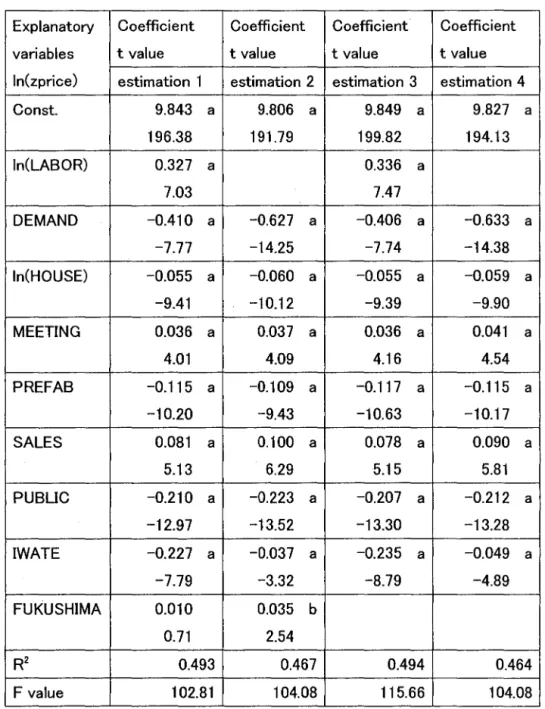
c,The result of OLS analysis based on this equation is shown in Table 5. From this table, we observe that all coefficients of the explanatory variables have expected signs. In addition, almost all the explanatory variables determine the dependent variable at a 5% significance level, except the coefficients of (FUKUSHIMA). Thus, it is confirmed that the above-mentioned factors actually play an important role in determining the price of the temporary housing. Especially, we should notice that the negative demand shock brought about by an ad hoc post-disaster response had a very effective impact on the procurement of temporary housing.
<See Table 5>
5. INCONSISTENCY BETWEEN PRE-DISASTER RULES AND POST-DISASTER RESPONSE
As Kydland & Prescott (1977) demonstrated in the framework of dynamic control theory, time-inconsistency is a very important problem when considering various economic policies. Their point is that discretionary policy, even when it is the best action given the situation at that time, is an obstacle to attaining optimal economic performance. In order to describe this point in a simpler manner, consider
Sumida town concluded discrete contract with the construction firms located in this town immediately after the disaster, and procured temporary houses (made of wood) at a low price.
the famous example suggested by Fischer (1980). Suppose that in a university, a professor wants her students to study hard. To encourage the students to study, she announces a term examination at the end of the semester. However, on the date of the exam, both the professor and students find that to sit an examination is not optimal, because the professor incurs opportunity cost to set the examination and the students have studied hard for the exam. Therefore, when the students anticipate that the professor will deviate from her announcement, the students will not study hard in the fIrst place. Discretionary policy often leads people to anticipate deviation, and impedes the attainment of desired policy goals.
A similar mechanism may be at work in the Japanese public procurement of temporary housing program. As discussed in Section 3, after the disaster, the Japanese government introduced the "deemed" temporary housing program in which a flat rented by the affected person herself is deemed as a temporary house under certain conditions. On the other hand, the general principle of Japanese pre-disaster rules was that government provided goods in kind that contributed to the victims' relief, as pointed out in Section 2. Moreover, the negative demand shock brought about by the introduction of this policy in fact had a strong impact on the procurement of temporary housing complexes, as shown in the previous section. Although this type of policy may be desirable for providing cheaper temporary housing promptly, glVen the post-disaster situation, it could cause the time-inconsistency problem by deviating from the pre-disaster rules. This may change the incentives and behaviors of the economic agents, and lead to adverse impacts on the society. In addition, in the case of the East Japan Earthquake, the extensive damage, which the Japanese government did not expect, forced it to pursue various discretionary policies that were vague under pre-disaster rules. This may also have contributed to magnifying the time-inconsistency problem.
Actually, this problem may have caused some confusion with regard to the supply of temporary houses after the disaster. First, the negative demand shock meant that many suppliers that had prepared for the production of the original planned number of houses were overstocked with the materials for temporary housing. This experience may make the current suppliers unwilling to provide temporary houses. Second, the introduction of the "deemed" temporary housing program meant that the evacuees who had thought of renting a flat for themselves were also given a type of "voucher" for the "deemed" temporary houses. Obviously, this policy, which deviated from the Japanese pre-disaster rules, hampers incentives for individuals to work at preventing damage in future disasters and
hinders the pursuit of important policy objectives during the post-disaster period, namely, the preparedness for future disasters by individuals. Third, the policy may also confer negative effects on the equity among affected persons. The flats that the victims rent for themselves are designed for normal residence, whereas, on the contrary, the temporary houses are not necessarily designed that way. Thus, the quality between the former and the latter is different. In addition to this, the various types of temporary houses that were constructed in response to this large-scale disaster may have magnified this difference. As a result, the victims that were affected in the same way are treated differently, with adverse effects on the equity among them,
As this case suggests, an ad hoc policy that is planned after a disaster, even when it seems to be desirable given the situation at the time, may not only bring the side effects but also have negative effects on the preparedness for future disasters. As the discussion on the time-inconsistency problem shows, an ad hoc policy often influences the incentives and behaviors of various economic agents for the future. In the meantime, to execute public procurement for relief after a large-scale disaster, it is crucial that the government follow ex-ante rules before a disaster and not deviate from these rules.
6. CONCLUDING REMARKS
In this paper, by focusing on the Japanese temporary housing program after the East Japan Earthquake, I considered the important factors necessary to achieve the desired public procurement. Mter I explained the Japanese pre-disaster rules and post-disaster response, using empirical analysis, I showed that the effective price of temporary housing that is account of the trade-off between efficiency and quickness of emergency procurement was heavily influenced by the introduction of the ad hoc program. On the basis of this discussion, I pointed out that this ad hoc policy may cause a time-inconsistency problem and not only brings side effect but also has an adverse impact on the prevention of disasters. Then, we clarified that it is very important to maintain time-consistency for effective public procurement after disasters.
It is well-known that a commitment to policy rule by government is necessary to avoid a time-inconsistency problem. Of course, to this end, the government should clarify its pre-disaster rules for the public, as a World Bank report (2010)
emphasized. The design for these rules, which should be prepared before disasters, are very difficult task for the government. Moreover, designed rules are not always desirable ex post to the society. Nevertheless, the Japanese experience teaches us that government should minimize pursuing a discretionary policy and should not pursue a policy that deviates from ex-ante rules. Although post-disaster situations often tempt the government to introduce discretionary policy, the government should follow the narrow path that is consistent with pre-disaster rules.
Of course, this narrow path is a very difficult one for the government to pursue. Needless to say, in order for the government to follow that path, it is crucial that it maintains transparent procurement activity. In other words, the appropriate disclosure of ex-ante rules and post-disaster response methods will encourage the commitment to rules and avoid the time-inconsistency problem.
References
Bolin, R, & L. Stanford (1991), "Shelter, Housing and Recovery: A Comparison of US Disasters," Disasters, vol. 15 (1): pp.24-34.
Davis, I. (1977), "Emergency Shelter," Disasters, vol. 1: pp.23-40.
Fischer, S. (1980), "Dynamic Inconsistency, Cooperation and the Benevolent Dissembling Government," Journal of Economic Dynamics and Control, vo1.2 (1): pp.93-107.
Johnson, M. (2007), "Strategic Planning for Post-Disaster Temporary Housing,"
Disasters, vol.31 (4): pp.435-459.
Kydland, F.E. & E.C. Prescott. (1977), "Rules rather than Discretion: The Inconsistency of Optimal Plans," Journal of Political Economy, vol.85 (3): pp.473-492.
Quarantelli, E.L. (1995), "Patterns of Shelter and Housing in US Disasters,"
Disaster Prevention and Management, vol.4 (3): pp.43-53.
Thai,
K.v.
(2007), "Emergency Contracting in the US Federal Government," Journal of Public Procurement, vol. 7 (1): pp.84-103.World Bank (2010), Natural Hazards, Unnatural Disasters: The Economics of Effective Prevention, World Bank.
Table 1: The extent of damage brought about by the East Japan and Hanshin-Awaji earthquakes
East Japan Hanshin-Awaji Earthquake Earthquake
Date March 11,2011 January 17, 1995 Magnitude (Richter scale) M9.0 M7.3
The number of deaths 15,854 6,434 The number of missing 3,143 3 The number of destroyed houses 129,286 104,906 The number of seriously damaged houses 254,632 144,274 The amount of direct damage 16.9 trillion Yen 9.6 trillion Yen
($203.6 billion) ($120 billion)
Source: This table is created by organizing the figures of the following sources.
1) Japanese National Police Agency, "The situation of damages resulted by Tohoku
Earthquake and the police activities after the quake" (on 28th March, 2012),
2) Japanese Cabinet Office, "On the estimation of the amount of direct damages caused
by East Japan Earthquake" (on 24th June, 2012),
3) Japanese Fire and Disaster Management Agency, "On the Hanshin-Awaji
Figure 1: The number of prefectures concluding agreements with JAPe 50 - r - - ."'---""'~ 45 ~ ~40 &:l:35
'S.
~30 -+---"S9-
_D I-t ll20~15
Jho
~ 5 +-o
-!-'·----r----'T--·-r-~·-·T---r---' --~, .-A~-·1·--_____r_-~----I---"'.!' "1' 0) 0) ~ ~ "'.!' "'.!' to m m m00
6
~ to to 0) 0) ~00
to (D (j) 0) Q:;a
(.0 O'l ~ (D 0) 00 (.0l-o
0 Q:;a
l - l--0) 0) ~00
l-0) QTable 2: Main events and response related to the temporary housing program
Date Main Event or Response
II-Mar Eruption of East Japan Earthquake
Japanese government requires JAPC to prepare to supply temporary houses.
12-Mar JAPC sets up disaster headquarters within its organization. Japanese government requires industry associations of house I4-Mar builders to supply 30,000 temporary houses within the next
2 months.
Three main prefectures affected require JAPC to supply 32,800 temporary houses.
19-Mar Construction begins in Iwate prefecture (Rikuzentakata City)
23-Mar Construction begins in Fukushima prefecture (Kunimi
Town)
28-Mar Construction begins in Miyagi prefecture (13 complexes)
31-Mar First phase of the temporary housing complex completed
(Rikuzentakata City)
Japanese government announces that planned number of temporary houses is 72,290.
Iwate: 18,000/Miyagi: 30,000/Fukushima: 24,000
30-Apr Japanese government announces the introduction of
"deemed" temporary housing program.
19-May Japanese government revises planned number of temporary
houses downward to 52,200.
Iwate: 14,000 I Miyagi: 23,000 I Fukushima: 15,200
II-Aug All temporary houses are completed in Iwate prefecture. 28-Sep All temporary houses are completed in Miyagi prefecture.
Note: In Fukushima prefecture, the construction of temporary houses is in progress at present. Source: This table is created by organizing the information ofthe following sources.
1) The documents provided by JAPe, 2) The notice by Japanese Ministry of Health, Labour and Welfare, "On
the treatment of requisitioning of private rented flat as temporary houses" (on 30th April, 2011), 3) Japanese
Ministry of Land, Infrastructure, Transport and Tourism, "On the Outlook (revision) for the completion of
temporary houses" (on 19th May, 2011), 4) Iwate Prefecture, "On the plan progressing for the construction of
temporaryhouses .. (http://www.pref.iwate.jp/view.rbz?nd=4294&of=1&ik=1&pnp=53&pnp=4201&pnp=4293 &pnp=4294&cd=31658), 5) Miyagi Prefecture, "Report on the construction of temporary houses in Miyagi prefecture" (http://www.pref.miyagi.jp/juutaku/saigaijouhou/201201 1 8kensetu houkoku.pdf).
Table 3: The data on first-stage and second-stage evacuation after the disaster
House of First-stage
Accommodations Second-stage
Shelter (1) acquaintance evacuation
(2) evacuation
Date (3) (1+2+3)
(the
(the number of (the number (the number (the number
number of
persons) persons) of persons) of persons) of houses)
2011/3118 NA NA NA 386,739 NA 201113/25 NA NA NA 246,190 NA 20111411 NA NA NA 167,919 NA 201114111 NA NA NA 147,536 NA 201115111 NA NA NA 115,098 NA 201116/2 41,143 28,014 32,483 101,640 29,265 201116116 31,297 27,427 25,612 84,336 42,971 201116/30 24,182 25,273 19,361 68,816 52,386 201117114 17,798 22,910 18,214 58,922 68,223 201117/28 12,905 19,918 18,874 51,697 76,023 201118111 8,646 13,584 20,514 42,744 82,866 2011/8/25 6,819 10,814 20,407 38,040 88,897 2011/9/8 3,439 6,411 17,681 27,531 92,123 2011/9122 2,840 4,337 17,683 24,860 95,540 2011110/6 1,719 2,877 17,303 21,899 98,076 2011110/20 1,069 2,115 17,293 20,477 100,852 201111112 933 1,266 17,277 19,476 102,833
Note: The facilities for second-stage evacuation are public housing, temporary houses, "deemed" temporary houses and hospitals.
Table 4: Summary statistics of the variables
Variables Mean Std.Dev. Min Max In(zprice) 9.059 0.185 8.217 9.862 In(LABOR) -0.473 0.300 -0.821 0.010 DEMAND 0.860 0.129 0.633 1.000 In(HOUSE) 3.575 0.929 1.386 5.756 MEETING 0.701 0.604 0.000 4.000 PREFAB 0.586 0.493 0.000 1.000 SALES 0.861 0.346 0.000 1.000 PUBUC 0.161 0.368 0.000 1.000 IWATE 0.326 0.469 0.000 1.000 FUKUSHIMA 0.213 0.410 0.000 1.000
Table 5: Result of regression analysis
Explanatory Coefficient Coefficient Coefficient Coefficient
variables t value t value t value t value
In(zprice) estimation 1 estimation 2 estimation 3 estimation 4
Const. 9.843 a 9.806 a 9.849 a 9.827 a 196.38 191.79 199.82 194.13 In(LABOR) 0.327 a 0.336 a 7.03 7.47 DEMAND -0.410 a -0.627 a -0.406 a -0.633 a -7.77 -14.25 -7.74 -14.38 In(HOUSE) -0.055 a -0.060 a -0.055 a -0.059 a -9.41 -10.12 -9.39 -9.90 MEETING 0.036 a 0.037 a 0.036 a 0.041 a 4.01 4.09 4.16 4.54 PREFAB -0.115 a -0.109 a -0.117 a -0.115 a -10.20 -9.43 -10.63 -10.17 SALES 0.081 a 0.100 a 0.078 a 0.090 a 5.13 6.29 5.15 5.81 PUBLIC -0.210 a -0.223 a -0.207 a -0.212 a -12.97 -13.52 -13.30 -13.28 IWATE -0.227 a -0.037 a -0.235 a -0.049 a -7.79 -3.32 -8.79 -4.89 FUKUSHIMA 0.010 0.035 b 0.71 2.54 R2 0.493 0.467 0.494 0.464 F value 102.81 104.08 115.66 104.08
Note: