
言語学習者のピアレビューを読み手と書き手の立場から考察する
13
0
0
全文
(2) ? t % B R B A Y E Z (RB?%%E) %60f %2 3 Journal of Hokkaido University of Education (Education) Vol. 60, No.2. %a22+2 8 February, 2010. Language Learners' Peer Review Sessions from the Perspectives of a Reviewer and a Writer SAWAYA Yusuke, YOKOYAMA Yoshiki * and LA FAY Michelle * English Education, Graduate School of Education, Sapporo-Iwamizawa Campus, Hokkaido University of Education * ~ e p a r t m e nof t English Education, Sapporo Campus, Hokkaido University of Education. In a peer review session, language learners develop their skill to critically review their partners' essays (a reviewer's role). They also develop their skill to incorporate the reviewers' comments in their writing (a writer's role). This is a pilot study which investigates a dual role assigned to language learners as a reviewer and a writer. Through careful observation of Japanese students of English when reviewing the peers' essays and receiving the peer comments, this study examined how the types of comments the peer made and the quality of revisions the writer made were related to each other. Due to the small number of participants, we failed to find they were closely related in most aspects of writing. However, as a reviewer, some students made comments about the content, which the peers could easily incorporate in their essays; as a writer, they selectively incorporated the comments the partners made. Finally both of these actions enabled them to develop the content of their writing in the subsequent drafts. Key words: Second language writing, peer review, reviewers, writers, writing quality. INTRODUCTION Peer review has been widely acknowledged as an essential component of the writing process in L2. It is sometimes referred to as peer response, peer review, peer rating, peer assessment, or peer editing. It can be defined as "the use of learners as sources of information and interactants for each other in such.
(3) a way that learners assume roles and responsibilities normally taken on by a formally trained teacher, tutor, or editor in commenting on and critiquing each other's drafts in both written and oral formats in t h e process of writing" (Liu and Hansen, 2002, p.1) Peer review is also supported by theoretical frameworks, including process writing, collaborative learning theory, Vygotsky's Zone of Proximal Development, and interaction and second language acquisition (Liu and Hansen, 2002; Hansen and Liu, 2005). In a peer review session, language learners take a dual role as a reviewer and a writer. Thus they can benefit from the peer review not only by receiving suggestions on their essays but also by reviewing peers' essays. There have been some studies conducted from a reviewer's perspective (Tsui and Ng, 2000; Min, 2005; 2008; Kamimura, 2006; Lundstrom and Baker, 2009) and others from a writer's perspective (Nelson and Murphy, 1993; Mendonca and Johnson, 1994; Villamil and De Guerrero, 1998; Kamimura, 2006; Min, 2006). A peer review session is considered an essential part of process writing, since it enhances a sense of audience and ownership of text, encourages collaborative learning and contributes to awareness raising (Tsui & Ng, 2000). We will give a brief overview of the studies frorn a reviewer's perspective. Karnirnura (2006) explored the effect of peer review in Japanese EFL writing classrooms. The writing quality, peer comments and responses to the comments were compared in two proficiency groups: high-proficient and low-proficient groups. Each group consisted of twelve students. T h e results shows that the highproficient learners tended to make global and discourse level comments, while the low-proficient learners provided specific sentential comments. In a series of Min's research (2005; 2006; 2008), eighteen EFL learners were trained for peer review for two months, doing in-class demonstrations and modeling in the first phase, and a thirty-minute teacher-student conference in the second phase. As a result, after the training, their comments became more relevant and specific, namely the number of comments which referred to global issues such as idea development and organization increased (Min, 2005). In addition, Min (2008) revealed a dominant prescriptive stance among reviewers before the training, while a more collaborative stance was seen after the training. Lundstrom and Baker (2009) investigated whether it is more beneficial to give or to receive peer feedback, using two different proficiency groups. While they could not reach any significant differences in the intermediate proficient group, they found that rather than receiving comments from their peers, giving comments generated gains in global aspects such as organization, development and cohesion. However, this research utilized essays which the researchers had already prepared and did not analyze learners' own papers to control for differences in student writing. The content of peer comments the participants made was not considered, either. Consequently, we can conclude that this study did not clearly establish the relationship between the peer comments learners make and the improvement in writing quality. On the other hand, there are some studies which looked at the writer's perspective, i.e., improving their writing by incorporating the reviewer's comments in their essays (Nelson and Murphy, 1993; Mendonca and Johnson, 1994; Villarnil and De Guerrero, 1998; Karnirnura, 2006; Min, 2006). Nelson and Murphy (1993) investigated whether or not four ESL students incorporated their peers' comments when revising drafts. Their study found that they did so in most cases. In addition, the degree to which they incorporated peer comments in their essays depended substantially on the nature of their interaction with.
(4) the peers. Mendonca and Johnson (1994) investigated twelve advanced ESL writers, suggesting that the negotiation that occurs during peer review sessions functions to shape their revision activities. During the sessions, participants asked questions, offered explanations, gave suggestions, and restated what their peers had written or said. They also maintained that the students selectively incorporated the peer comments in their revised drafts. Villamil and De Guerrero (1998) investigated Spanish-speaking ESL learners to consider the effect of peer review on writers' final drafts in two rhetorical modes; narration and persuasion. Their results showed that 74% of the comments in the sessions were incorporated into the revisions, and self-revision was also observed, which suggested a pattern of behavior conducive to self-regulation among writers. With regard to the two modes, the students focused equally on grammar and content in revising the narration, while they predominantly focused on grammar in the persuasion mode. Min (2006) showed that EFL learners who received peer review training incorporated most of the peer comments into their subsequent drafts, which she claimed contributed to a better quality of writing. Kamimura (2006) mentioned that in response to the peer comments, both high- and low-proficient learners accepted almost all of the comments. However, she states that the high-proficient students tended to attempt Inore substantial revisions whereas the low-proficient students worked primarily on local revisions. In terms of writing quality, the score of their pre-and post-tests showed that high-proficient learners showed more improvement than low-proficient learners. Comparing the drafts they wrote before t h e peer review with t h e revised ones, t h e low-proficient learners improved more than t h e high-proficient learners. Although substantial impact of peer review on learners from each perspective was found, few researches investigated how the dual role of peer review enhances learners' writing quality. Therefore the current study will analyze the relationships between the peer comments and the writing quality, addressing the following research questions. 1 What types of comments do EFL learners make in the peer review sessions?. 2 What aspect of writing is improved after the peer review sessions? 3 How is a comment related to the quality of writing?. METHODS Participants. The participants were sixteen students enrolled in an academic writing course at a national university in Hokkaido, Japan. They have studied English in an EFL setting for at least six years. We chose four of them who suited the purpose of our study for analysis. Procedure. The study was conducted from October, 2008 to February, 2009. Before the experiment, we conducted a training session, which was supposed to help L2 students' irnprovernent of writing performance (Berg, 1999). In the session, we explained the benefits of implementing the peer review session in the process of writing. Second, we demonstrated what the participants would be asked to do when actually doing peer review. Next, the participants were given a sample essay modified by the instructor. Finally,.
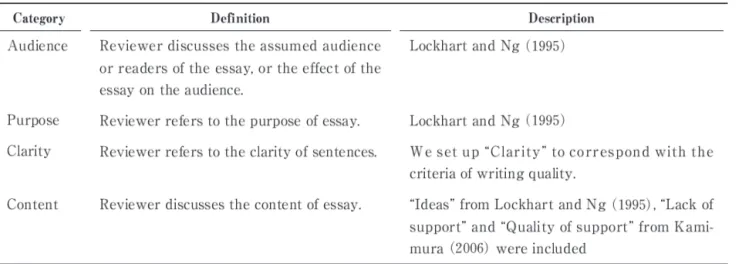
(5) each participant was assigned to groups and practiced reviewing peers' essays with two or three different partners. After the training session, they worked on the first topic for two weeks and then on the second topic for another two weeks. One writing session was sequenced as follows: First, they wrote the first drafts in class. They were then given two copies of their group members' drafts to write reviews on at home. The next week, they worked in their own groups showing the review sheets and giving oral feedback. They then wrote the final drafts at home to hand in the next week. Materials. The first writing topic was "Should students wear school uniforms?" and the second one was "Should English majors write their graduation theses in English?" We did not give them any time limits for the in-class writing sessions. However, they took approximately fifty minutes each time to complete their essays. Analysis. All peer comments collected were coded using the following coding schema (See Table 1). T h e criteria were basically adopted from Lockhart and Ng (1995). However, we modified their categories to make them appropriate for the purpose of this study. Table 1. The Coding Schema of Peer Comments Category. Definition. Description. Audience. Reviewer discusses the assumed audience or readers of the essay, or the effect of the essay on the audience.. Lockhart and Ng (1995). Purpose. Reviewer refers to the purpose of essay.. Lockhart and Ng (1995). Clarity. Reviewer refers to the clarity of sentences.. We set up "Clarity" to correspond with the criteria of writing quality.. Content. Reviewer discusses the content of essay.. "Ideas"from Lockhart and Ng (1995), "Lack of support" and "Quality of support" from Kamimura (2006) were included. As for qualitative measures, written products were analyzed following Kobayashi and Rinnert (1992). The instructor in this course rated their writings from 1-5 (Poor to Excellent) according to the following criteria: Content. 1 Clarity: Presentation of ideas easy to understand, not confusing. 2 Specifics: Vivid examples, supporting details Organization. 1 Sequence: Tdeas following logically within paragraphs Style. 1. Vocabulary use: Sophisticated range, variety, appropriate register.. 2. Variety of forms: Variety of sentence beginnings, particle phrases, subordinate clauses and discourse markers..
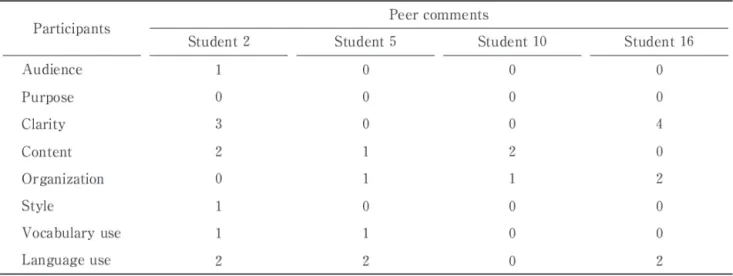
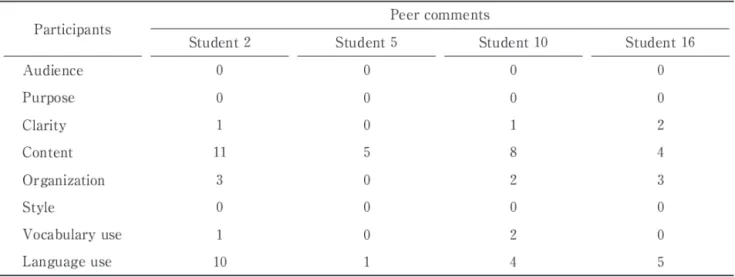
(6) Table 1. T h e Coding Schema of Peer Comments (continued) Definition. Description. Organization. Reviewer discusses the organization of essay.. "Introduction", "Conclusion" and "Coherence" from Lockhart and Ng (1995), "Unity", "Logical order", and "Logical division" from Kamimura (2006) were ncluded.. Style. Reviewer discusses the formality and style of language used in the essay.. We included "Formality of language", "Style of language use" from Lockhart and Ng (1995), "Sentence structure" from Kamimura (2006). Vocabulary use. Reviewer discusses vocabulary used in the essay.. We combined "Vocabulary", "Phrasing/ Wording", and "Word choice" belonging to "Style of language use" from Lockhart and Ng (1995). Language use. Reviewer refers to grammatical, punctuation, and orthographic conventions.. "Punctuation" from Lockhart and Ng (1995), "Grammar", and "Mechanics" from Kamimura (2006). Category. RESULTS As a result of the first research question, Table 2 shows the number of peer comments participants gave their peers on the first topic in each category. Student 2 gave the most comments among four participants. We also noticed that her comments covered most aspects in the coding categories. She was the only one who gave comments on audience. On the other hand, Student 10 made less comment than three other participants. She focused only on two aspects, content and organization. Among the four participants, Student 16 gave the most comments on clarity and organization. Table. 2. T h e Types of Peer Comments: T h e Participants and the 1st Topic Peer comments. Participants Audience. Student 2. Student 5. Student 10. Student 16. 1. 0. 0. 0. 2. 2. 0. 2. Purpose Clarity Content Organization Style Vocabulary use Language use. Cornpared with the results frorn the first topic, all participants gave rnore feedback on the second topic (Table 3), although that might be because w e gave them more guided questions in this session. While Student 2 still gave t h e most comments, Student 10 w a s remarkable in giving more comments than s h e did on t h e first topic. I n regard to t h e types of peer comments, both participants paid more.
(7) attention to the content. In addition, Student 2 also commented on language use. Second, we will discuss writing quality to answer the second research question. Table 4 and 5 show the evaluation of the first draft and second draft for both topics. Student 2 improved from 3 to 4 points on the first draft of the second topic and was able to get the same score with respect to the second draft. Student 5 received a 3 in sequence points while working on the first topic. However, she improved to 4 points in on the first draft of the second topic and received 4 points in on the second draft. In terms of the specifics, although Student 10 only had 2 points up on the first draft of the second topic, her next draft improved from 2 to 4 points. Also as well as specifics, the same thing occurred in variety of forms. Her draft improved in the second draft of the second topic. Table 3. The Types of Peer Comments: The Participants and the 2nd Topic. Peer comments. Participants. Student 2. Student 5. Student 10. Student 16. 0. 0. 0. 0. Audience Purpose Clarity Content Organization Style Vocabulary use Language use. Table 4. The Quality of 1st and 2nd Draft on The 1st Topic. Quality Participants. Clarity 1st. Specifics. 2nd. 1st. 2nd. Sequence 1st. 2nd. Vocabulary 1st. 2nd. Forms 1st. 2nd. -. Student 2. 4. 4. 3. 3. Student 5. 4. 4. 4. 3. Student 10. 3. 3. 2. 2. Student 16. 3. 4. 4. 4. 4. 4. 3. 3. 4. 3. Table 5. The Quality of 1st and 2nd Draft on the 2nd Topic. Quality Participants. Clarity 1st. Specifics. 2nd. 1st. 2nd. Sequence 1st. 2nd. Vocabulary 1st. 2nd. Forms 1st. 2nd. -. Student 2. 4. 4. 4. 4. 3. 3. 4. 4. Student 5 Student 10 Student 16. 3. 4. 3. 3. 3. 3.
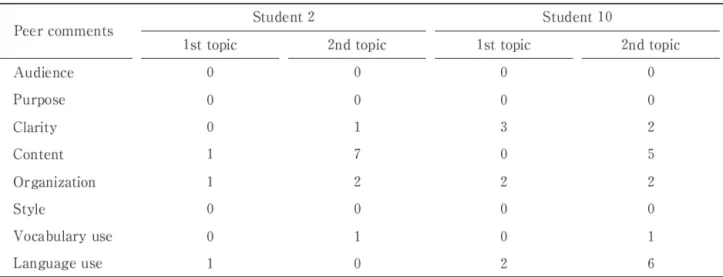
(8) From the results of research question 1 and 2, we could see that certain types of comments contributed to enhancing the quality of specifics. Both Student 2 and 10 wrote more comments on content than any other aspect for both topics. The fact that they commented about content in their partners' essays can be considered to be strongly related to their improvement in the specifics of writing. These results suggested the possibility that giving comments on content enabled learners to improve the details or examples to support their opinions in their own essays. Up until here, we found that both Student 2 and 10, who focused on the content while reviewing their peers' essays, improved their writing in terms of specifics. However, since in peer review sessions, L2 learners play a dual role as a reviewer and a writer, we needed to consider how playing each role de-. veloped their writing qualities. In the following sections, we will attempt to investigate what types of peer comments both learners incorporated into their subsequent drafts to improve their specifics of writing (a writer's role). Next, we will make clear that reviewing on the content improved their specifics of writing in a detailed way (a reviewer's role). First, we will analyze what kinds of comments each learner received and what sorts of revisions they made. Table 6 shows the comments both participants received from their peers. Table 6. The Types of Peer Comments Student 2 and 10 Received. Peer comments Audience. Student 2. Student 10. 1st topic. 2nd topic. 1st topic. 2nd topic. 0. 0. 0. 0. 1. 0. 2. 6. Purpose Clarity Content Organization Style Vocabulary use Language use. Student 2. With respect to the first draft of the first topic, Student 2 received only one comment on content from her peers as shown in Table 6. That comment referred to an interesting point in her essay, but it did not include any suggestion that might lead to revision. We will then investigate where her revisions came from. According to the note she wrote a t the additional oral peer review session, she realized that she had to give an opinion first by herself. We did not collect any recorded data during the oral peer review in this study. However, we suppose that the discussion in her group gave her some clues so she could notice that point. Tn addition, she added some information to her conclusion. Perhaps she noticed that her conclusion was still weak and therefore she self-revised her conclusion as well. Referring to the second topic, she got many comments on content from her peers. However, she did not use any of them for the second draft, which is the same pattern we saw on the first topic. Again seen.
(9) from her note from the oral session, she received two comments referring to the clarity of her essay. She incorporated one of them into the second draft. Also she realized by herself that her conclusion was short, which she revised in her subsequent draft. Student 10. As for the first topic, Student 10 did not get any comments on content. However, she received some comments about clarity instead. One of the comments stated that her peer did not understand one part Student 10 wrote. This comment also requested clarification of the part her peer could not understand. Student 10 incorporated that comment into her second draft. In regard to the second topic, although she got five comments on content, she did not use any of them. However, similar to the first topic, she accepted one of the clarification requests in a peer comment and used it. We have found that both Student 2 and 10, when acting in the writer's role, selectively incorporated the comments on clarity instead of the comments on content. Then we supposed that receiving peer comments not on content, but on clarity contributes to the specifics of writing quality. As a result of Student 2's self-revision, we discovered one possibility, namely that paying attention to organization enables learners to describe better supporting details during revisions. That is to say, to explain the things their peers were not able to understand, eventually adding more information. The added information led to the better sentences to support their opinion. Also there is a possibility that reconstruction of the organization worked to produce effective support details. Again in peer review, the participants play the dual role of reviewerdwriters. We needed to confirm other factors, especially how reviewing someone else's papers enhances their own writing quality. Then we needed to confirm the hypothesis we made from the results of the first and second research questions; reviewing on content improved their specifics. Next we will explore Student 2 and 10's behaviors as reviewers. Student 2. In the first topic, Student 2 gave a comment requesting her peer to give some positive opinions about school uniforms. With respect to the second draft, she wrote a comment which asked for specific examples of good points on writing a thesis in English. Also she suggested that there should be some opinions from other people. All these comments implied that she referred to the specifics of the essay. Student 10. As for the first topic, Student 10 listed the opinions she liked best in her peer's writing. Then in the second topic, she pointed out a contradiction in examples, which were supposed to support her peer's opinion. To summarize, we can see that as reviewers, both students gave their peers comments focusing on the supporting details or examples, which referred to the specifics of writing. We considered that it was important for L2 learners to have enough knowledge to point out problems in the specifics of writing as a reviewer. Then as writers, when being asked for clarification, they integrated the peers' comment into their subsequent drafts. Finally they were able to produce revisions which had better quality in terms of specifics..
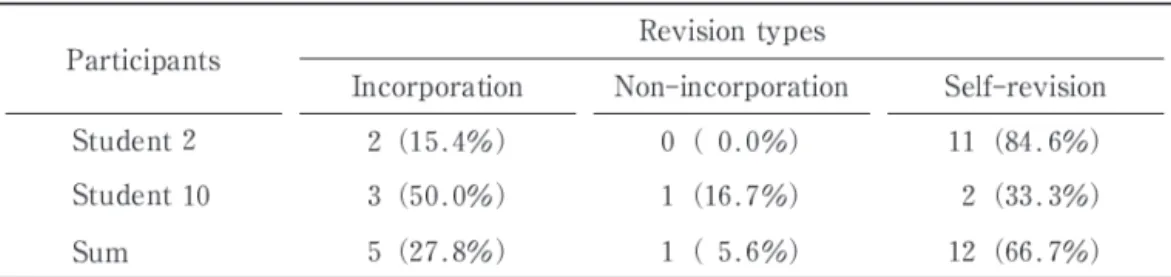
(10) DISCUSSION Up to this point, we found in peer review how the dual role of reviewer and writer improved the specifics of writing. Also we found that as writers, both Student 2 and 10 selectively incorporated peer comments in their revised drafts as mentioned in Nelson and Murphy (1993) and Mendonca and Johnson (1994). However, in regard to Student 2, not only did she choose the comments to revise her essay, but she also noticed independently the part she needed to correct, especially concerning organization. Then she self-revised those parts. As seen from her behaviors, Student 10's self-revisions were not crucial to improve her specifics, so there must be a possibility that Student 2's self-revisions were relevant to the improvement in her writing quality. That is why we needed to investigate if their revision types also affected their results. First, in order to confirm the effect of self-revisions, we will show Student 2 and 10's revision types for each session; incorporation of the peer comments, non-incorporation of the peer comments, or self-revision only. Tables 7 and 8 show Student 2 and 10's revision types. Villamil and De Guerrero (1998) stated that in the majority of cases, learners pointed out problems in written form but in some cases, trouble sources were discussed only through oral sessions in peer review. That is why this time we included the suggestions they received during additional oral sessions into the data also, since it is considered that those suggestions affected their results as well. Table 7. The Participants' Revision Types in the 1st Topic. Participants Student 2. Revision types Incorporation. Non-incorporation. Self-revision. 2 (15.4%). 0 ( 0.0%). 11 (84.6%). Student 10 Sum Table 8. The Participants' Revision Types in the 2nd Topic. Participants. Revision types Incorporation. Non-incorporation. Self-revision. Student 2. 1 ( 9.1%). 2 (18.2%). 8 (72.7%). Student 10. 5 (100.0%). 0 ( 0.0%). 0 ( 0.0%). Sum. 6 ( 37.5%). 2 (12.5%). 8 (50.0%). We will compare our results with the one study that investigated how many peer comments the learners incorporate (Mendonca and Johnson, 1994). In their study, 53% of revisions came from peer comments. However, in 37% of the participants' revisions, they revised things which had not been brought up in peer review sessions. Also they found that the participants did not revise all the given parts even though they have been discussed in peer review sessions, which occupies the remaining 10%. Combining both participants' results in our study, the number of self-revisions was higher; the first topic, 66.7%, the second topic, 50.0%. Next was the incorporation of peer comments; the first topic, 27.8%, the second topic, 37.5%. Finally what was discussed in peer review but was not incorporated, 5.6%, the.
(11) second topic, 12.5%. Eventually the results in our study were different from the ones in Mendonca and Johnson (1994). Next we will analyze each student separately. In each session, Student 2 tended not to utilize peer comments. She revised things which had not been in each peer review session. On the other hand, through two peer review sessions, Student 10 came to rely on the suggestions from her peers. We could see how each student showed different behavior in terms of revision types. However, both students improved the specifics of writing in the end. Therefore it is difficult to regard revision types as factors which strongly affected the results. That is why we supposed that although the revision type is different, looking at the comments about their peers' essays indicate that providing categories for these aspects of writing itself, may have a possible affect on their results. Next, we will analyze each participant's revisions according to the aspects. Tables 9 and 10 show both participants' revision types for each aspect. We could tell both participants incorporated relatively more comments on clarity. However, we found that both students also paid attention to language use for both incorporation and self-revision while revising their essays. Actually, there was another study which reached almost the same results. Villamil and De Guerrero (1998) showed when revising in persuasive mode, among five aspects; content, organization, grammar, vocabulary and mechanics, students make more revisions in grammar than any other aspects. They listed three possibilities to explain why these results appeared. One is that intermediate learners a r e still unstable in language structure, so they felt the need to work on aspects of form. T h e Table 9. Student 2's Reuision Tyfies According to the Asfiecis. Revision types. Clarity. 2nd topic. 1st topic. Aspects Incorporation. Self-revision. Incorporation. Self-revision. 1 (50.0%). 0 ( 0.0%). 1 (100.0%). 0 ( 0.0%). 1 (50.0%). 3 (27.3%). Content Organization Style Vocabulary use Language use. Table 10. Student 10's Revision Tyfies According to the Asfiects. Revision types. Clarity Content Organization Style Vocabulary use Language use. 2nd topic. 1st topic. Aspects Incorporation. Self-revision. Incorporation. Self-revision. 1 (33.3%). 0 ( 0.0%). 1 (20.0%). 0 (0.0%).
(12) second one is that they thought linguistic anomalies might have obscured the meaning of the text. The last one is that students followed their habitual tendencies, which developed from the effects of their background in form-oriented L2 instruction. Especially in the EFL setting in Japan, there is still a trend to focus on language form. We supposed that the last possibility must be the best explanation for our participants. However, it was still unclear why more self-revisions were seen in Student 2's revision. Villamil and De Guerrero (1998) stated the presence of self-revision in final drafts indicated that the writers worked considerably on their own based on their previous peer work. They also pointed out what the participants did after peer review might be symptoms of self-regulatory behaviors. We supposed that her self-revisions came from not only previous peer work but also from what she learned in class. Again by looking a t her additional note from the oral peer review session and her final drafts, she self-revised some points on organization each session. Her peers certainly pointed out good points on her organization, not her weak points. I t means she utilized the knowledge she received through in-class instruction. Tn conclusion, peer review activities "develop in students the crucial ability of reviewing their writing with the eyes of another" (Zarnel, 1982, p. 206) and allow them to modify their written texts to meet the needs of their audience (Liu and Hansen, 2002). Again Student 2 and 10 gave their peers a high rate of comments on content. Also we mentioned the participants had enough knowledge to point out problems on the specifics of writing as a reviewer. Then as a writer, they did not just incorporate the suggestions they received into their subsequent drafts. They selectively chose the suggestions needed to develop their own essays. We also found that the knowledge accumulated through previous instruction or experience led to learners' self-revision and helped learners choose the suggestions for revision as well. In other words, we can conclude that the ability which enabled L2 learners to point out problems in content also enabled them to choose the comments they needed. We also saw the tendency for students to use the knowledge which had been generated in peer reviews and in-class instruction.. CONCLUSION This study attempted to find out how enacting both the roles of a reviewer and a writer are related to each other in order to improve learners' writing quality in peer review sessions. We found that the ability they have as reviewers to point out problems in content enabled the learners to utilize the information given by their peers for further revision as writers. Then those behaviors enhanced the quality of writing in terms of specifics. However, there are still some other problems we need to assess. First, the number of participants in this study is too small to obtain statistically analyzed proof. For further studies, we need more participants in order to carry out quantitative analysis to find a more concrete relationship between peer comments and subsequent drafts. Second, we did not ask the participants about their previous experience of writing essays in English and doing peer review in a second-language writing classroom. We conducted the training session at the beginning. However, the lack of experience in a second-language writing classroom might have prevented the students from making the most of their abilities. Since, in this study, we failed to find the relationship between the types of peer comments and the quality of revisions, the lack of experience might be considered as one of the reasons. Also we sup-.
(13) posed the perception toward peer review will affect L2 learners' performance. For further studies, the learners' perception change also needs to be investigated through sessions using questionnaires taken from the perspectives of reviewer and writer.. REFERENCES Berg, E.C. (1999). The Effects of Trained Peer Response on ESL Students' Revision Types and Writing Quality. Journal of. Second Language Writing 8 (3), 215-241. Hansen, J. & Liu, J. (2005). Guiding Principles for Effective Peer Response. E L T Journal., 59, 31-38. Kamimura, T. (2006). Effects of p e e r feedback on EFL s t u d e n t w r i t e r s a t different levels of English proficiency: A Japanese context. TESL Canada Journal, 23, 12-39. Lundstrom, K., & Baker, W. (2009). T o give is better than to receive: T h e benefits of peer review to the reviewer's own writing Journal of Second Language Wm'ting, 18, 30-43. Liu, J. & Hansen, J. (2002). Peer Response in Second Language Writing Classroom. Ann Arbor, MI: University of Michigan Press. Mendonca, C., & Johnson, K. (1994). Peer review negotiations: Revision activities in ESL writing instruction. TESOL. Quarterly, 28, 745-769. Min, H.T (2005). Training students to become successful peer reviewers. System, 33, 293-308. Min, H.T (2006). The effects of trained peer review on EFL students' revision types and writing quality. Journal of Second. Language Writing, 15, 118-141. Min, H.T (2008). Reviewer stances and writer perceptions in EFL peer review training. English for Specific Purposes, 27, 285-305. Nelson, G., & Murphy, J. (1993). Peer response groups: Do L2 writers use peer comments in revising their drafts? TESOL. Quarterly, 27, 135-142. Tsui, A. B. M., & Ng, M. (2000). Do secondary L2 writers benefit from peer comments? Journal of Second Language Writ-. ing, 9, 147-170. Villamil, 0. S. & De Guerrero, M.C.M. (1998) . Assessing the Impact of Peer Revision on L2 Writing. Applied Linguistics, 19, 491-514. Zamel, V. (1982). Writing: The process of discovering meaning. TESOL Quarterly, 16, 195-209..
(14)
図
+3

関連したドキュメント
人は何者なので︑これをみ心にとめられるのですか︒
文字を読むことに慣れていない小学校低学年 の学習者にとって,文字情報のみから物語世界
(2006) .A comparative of peer and teacher feedback in a Chinese EFL writing class. ( 2001 ) .Interaction and feedback in mixed peer response
口文字」は患者さんと介護者以外に道具など不要。家で も外 出先でもどんなときでも会話をするようにコミュニケー ションを
今回の調査に限って言うと、日本手話、手話言語学基礎・専門、手話言語条例、手話 通訳士 養成プ ログ ラム 、合理 的配慮 とし ての 手話通 訳、こ れら
本センターは、日本財団のご支援で設置され、手話言語学の研究と、手話の普及・啓
断するだけではなく︑遺言者の真意を探求すべきものであ
話題提供者: 河﨑佳子 神戸大学大学院 人間発達環境学研究科 話題提供者: 酒井邦嘉# 東京大学大学院 総合文化研究科 話題提供者: 武居渡 金沢大学
