*Correspondence to: Yu, Y.: [email protected]
(Supplementary material: refer to PMC https://www.ncbi.nlm.nih.gov/pmc/journals/2350/) ©2021 The Japanese Society of Veterinary Science
Prevalence of hemoplasmas and Bartonella
species in client-owned cats in Beijing and
Shanghai, China
Yingxin ZHANG
1), Zhixuan ZHANG
1), Yinying LOU
1)and Yonglan YU
1)*
1)College of Veterinary Medicine, China Agricultural University, Beijing 100193, ChinaABSTRACT. A year-round molecular epidemiological survey (2017 to 2018) was conducted on three hemoplasmas and two Bartonella species with zoonotic potential in client-owned cats in Beijing and Shanghai. Among 668 specimens, the overall hemoplasma-positive rate was 4.9% (3.4% for Candidatus Mycoplasma haemominutum, 0.9% for Mycoplasma haemofelis and 1.2% for Candidatus Mycoplasma turicensis). The overall Bartonella-positive rate was 8.5% (4.8% for
B. henselae and 4.3% for B. clarridgeiae). Age, breed, ectoparasiticide use and stray history, but
not city, season and gender, were significantly associated with the positive rates of one or more pathogens. This is also the first report on the prevalence of Candidatus Mycoplasma turicensis in cats in China.
KEY WORDS: Bartonella, China, feline, hemoplasma, risk factor
Hemoplasmas (aka hemotropic mycoplasmas) and Bartonella are vector-transmitted gram-negative bacterial pathogens in animals. Hemoplasmas adhere to and disrupt erythrocytes, causing hemolytic anemia in animals. Cats may be infected by Mycoplasma haemofelis (Mhf), “Candidatus Mycoplasma haemominutum” (CMhm), “Candidatus Mycoplasma turicensis” (CMt), and “Candidatus Mycoplasma haematoparvum-like” (CMhp) species [18, 19]. Among them, Mhf may cause severe to fatal hemolytic anemia in cats. CMhm is typically low virulent, but can cause severe clinical signs when co-infected with other pathogens and/or if the animal is under stressed or immunodeficient condition [18]. CMt can induce mild to moderate anemia in experimentally infected cats in the acute infection phase [24], while the clinical significance of CMhp is not fully understood.
Bartonella species are intracellular pathogens infecting animals including cats and dogs. Cats can serve as reservoir host for B. henselae, B. clarridgeiae and B. koehlerae. Among them, B. henselae and B. clarridgeiae are the causative agents of cat scratch disease (CSD) in humans [15]. However, naturally infected cats usually exhibit no clinical signs even after long-term experience of bacteremia [10]. Fleas are believed to be the predominant vector responsible for the transmission of Bartonella species.
Despite their importance in animal health and zoonotic potential, there were limited studies on the prevalence of feline hemoplasma and Bartonella in China. The presence of feline Mhf and CMhm in the mainland China was first reported in 2010, in which the scale of the study was limited and the prevalence of CMt was not evaluated [27]. A few other studies investigated the prevalence of Bartonella in stray or pet cats in some regions in China [25, 26]. However, the prevalence of feline hemoplasma and Bartonella in Beijing, the nation’s capital with high population densities of human residents and pets, has not been reported.
In the present study, we conducted a year-round molecular survey between 2017 and 2018 on the prevalence of three
hemoplasmas (Mhf, CMhm and CMt) and two Bartonella species (B. henselae and B. clarridgeiae) in client-owned cats in Beijing and Shanghai, two of the most populated cities in the north and south regions in China, and analyzed associated risk factors to expand epidemiological information.
For specimen collection, a total of 668 blood samples were collected from client-owned cats at four veterinary hospitals in Beijing and one in Shanghai between March, 2017 to March, 2018. Specimens were shipped to the College of Veterinary Medicine, China Agricultural University for storage at −20°C until use. During sample collection, the following information on cats was recorded by veterinarians or collected from clients: city (Beijing, Shanghai), season (spring, summer, autumn, winter), age (≤1 year, 1–10 years, ≥10 years), gender (male, female), breed (purebreds, mixed including crossbreeds or unknown breeds), stray history, and ectoparasiticide use in the past 6 months. The animal use protocol was reviewed and approved by the Laboratory Animal Welfare and Animal Experimental Ethics Committee, China Agricultural University (permit number: AW21012020-2). Prior to specimen collection, permission was obtained from animal owners.
Received: 30 November 2020 Accepted: 21 February 2021 Advanced Epub:
18 March 2021
J. Vet. Med. Sci.
83(5): 793–797, 2021 doi: 10.1292/jvms.20-0681
For molecular detection by PCR, genomic DNA was extracted from 200 µl of each blood sample using a QIAamp DNA Blood Mini Kit according to the manufacturer’s instructions (Qiagen, Hilden, Germany), eluted in 100 µl elution buffer and stored at −20°C until use. Hemoplasmas and Bartonella species were detected by nested PCR that amplified a 16S-23S rRNA intergenic transcribed spacer (ITS). Primary PCR used genus-specific primers, while secondary PCR used species-specific primers as described (Supplementary Table 1) [12, 16, 22, 23]. PCR was performed in 25 µl volume containing 12.5 µl of 2 × PCR Starmix (GenStar BioSolutions, Beijing), 1.0 µM each of specified primers and 2.0 µl sample DNA for primary PCR (or 1.0 µl primary PCR product for secondary PCR), using thermal cycling conditions described in Supplementary Table 1. DNA elution buffer and hemoplasma or Bartonella DNA samples were used for negative and positive controls, respectively. PCR products were electrophoresed in 2% agarose gels. All samples were tested at least twice. PCR products were extracted from gels and submitted to Beijing Majorbio Sanger Bio-pharm Technology for bi-directional automated sequencing using ABI Prism 3730XL DNA Analyzer (Applied Biosystems, Foster City, CA, USA). Hemoplasmas and Bartonella DNAs detected in the present study were compared with genomic sequences in the GenBank by BLAST search.
The association between individual risk factors and infections of hemoplasma or Bartonella was evaluated by Chi-square (χ2)
test or by a two-tailed Fisher’s exact test when expected numbers of observations were less than five using SPSS (version 20). Variables with P-values <0.05 in the univariant analysis were further tested using a multivariable logistic regression model. A P-value <0.05 was considered statistically significant in both univariate and multivariate analyses.
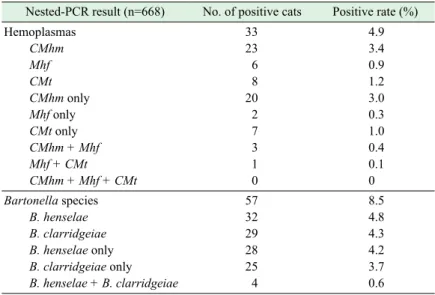
The results showed that the overall positive detection rate by nested PCR for hemoplasmas was 4.9% (n=33 of the total 668 specimens) (Table 1). Among them, CMhm was the most prevalent species (n=23; 3.4%), followed by CMt (n=8; 1.2%) and Mhf (n=6; 0.9%). Coinfections by two hemoplasma species were observed in some cats, including three specimens with CMhm and Mhf (0.4%) and one with Mhf and CMt (0.1%), but none with three hemoplasma species (i.e., CMhm, Mhf and CMt). The positive rate of hemoplasmas (i.e., 4.9%) is much lower than an earlier study conducted in a southern city Guangzhou, China, (i.e., 41.4%) [27], and those reported in other countries, including Japan (26.4%) [21], Thailand (38.1%) [3], South Korea (47.9%) [6], Iran (22%) [4], the United States (18% to 27%) [19, 20], and the United Kingdom (18% to 27%) [14].
The overall positive detection rate for Bartonella spp. in this study was 8.5% (n=57 of the total 668 specimens), which was much higher than that of hemoplasmas. It included 4.8% (n=32) for B. henselae and 4.3% (n=29) for B. clarridgeiae. Among them, 0.6% (n=4) of the Bartonella-positive specimens were coinfected both species (Table 1). The overall positive rate of 8.5% was between the two values reported earlier for feline Bartonella in other regions in China, i.e., 3.9% in cats from the southern city Shenzhen [26], and 12.7% in cats from 7 provinces (Beijing not included) [25]. In comparison with studies in other regions, the overall prevalence of Bartonella in our study is comparable to those reported in Japan (4.6%) [16], Turkey (9.4%) [1], Greece (8.5%) [13], and Ireland (5.2%) [8], but lower than that those in Thailand (16.3%) [7], South Korea (41.8% to 44.1%) [9] Taiwan (19.1%) [2], and Israel (18.7 to 30.7%) [5].
Our results indicated that hemoplasmas and Bartonella species were commonly present as a potential health risk to cats in China. The presence of zoonotic B. henselae and B. clarridgeiae was also an indication of potential risk for CSD in humans. Indeed, several CSD cases have already been reported in China [11], suggesting the necessity for veterinarians to educate pet owners regarding the risk of CSD in contacting with cats.
In risk factor analysis, we observed no significant differences between Beijing and Shanghai in the overall positive detection rates of feline hemoplasmas or Bartonella (P=0.285 to 0.856 by the univariant test) (Table 2). Although both bacterial groups had the highest positive rates in the spring, season was not a significant risk factor (P=0.344 to 0.935). Gender was also not a significant risk factor for infections of hemoplasma or Bartonella species (P=0.690 to 0.910). However, age, breed, ectoparasiticide
Table 1. PCR results for hemoplasma and Bartonella infections in 668 cat samples
Nested-PCR result (n=668) No. of positive cats Positive rate (%)
Hemoplasmas 33 4.9 CMhm 23 3.4 Mhf 6 0.9 CMt 8 1.2 CMhm only 20 3.0 Mhf only 2 0.3 CMt only 7 1.0 CMhm + Mhf 3 0.4 Mhf + CMt 1 0.1 CMhm + Mhf + CMt 0 0 Bartonella species 57 8.5 B. henselae 32 4.8 B. clarridgeiae 29 4.3 B. henselae only 28 4.2 B. clarridgeiae only 25 3.7 B. henselae + B. clarridgeiae 4 0.6
use and stray history were significantly associated with the positive detection rates of one or more pathogens (Table 2). For age, significantly higher hemoplasma-positive rates were observed in 1 to 10-year old cats (8.0%) than in younger (≤1 year) or older (≥10 years) animals (2.6%, P=0.006); while significantly higher positive rates of Bartonella species were observed in both ≤1 year and 1 to 10-year old groups (5.6% to 7.2%) than in older animals (≥10 years) (1.3% to 1.7%, P=0.019 to 0.025).
Between the two breed types, mixed breeds had significantly higher positive rates (6.7% to 7.6%) than purebreds (2.1% to 2.6%) for both hemoplasmas and Bartonella spp. (P=0.002 to 0.008). Cats with stray history had >2 times higher positive rates (8.0% to 9.1%) than those without stray history (2.7% to 3.5%, P=0.001 to 0.015). Further analysis by multiple logistic regression indicated that age (P=0.018) and breed (P=0.025) were significantly associated with hemoplasma infections after the adjustment for stray history (Table 3). Age (P=0.014 and 0.044), stray history (P=0.028) and ectoparasiticide use (P=0.022) were significantly associated with B. henselae infection, while only age (P=0.012 and 0.032) was significantly associated with B. clarridgeiae infection (Table 3).
The fact that both hemoplasma and Bartonella infections are more frequently observed in mixed breed cats than purebreds may relate to their living environments, since mixed breed cats are more likely to be allowed for outdoor activities in China. Outdoor cats are more prone to the exposure to arthropod vectors that potentially carry pathogens. Another possibility is that most mixed breed cats are adopted from places where they were housed in groups with higher chances to socialize with infected-cats. The behavior changes in cats over the age might also be a contributor to the variation of infection. For instance, higher hemoplasma-positive rates were observed in 1 to 10-year old cats that are generally more aggressive in interacting with each other, thus
increasing the risk of infection. On the other hand, older cats (≥10 years) might spend less time roaming outside [17], thus reducing the risk of vector exposure, resulting in lower infections for both hemoplasmas and Bartonella. Among other risk factors, the significantly higher prevalence of hemoplasmas and Bartonella in cats with stray history, and that of B. henselae in cats without ectoparasiticide use, were apparently related to the higher chances of animal exposure to vectors (e.g., fleas).
We were able to retrieve medical records of 224 sampled cats from veterinarians in Beijing for analyzing the relationship between infection and anemia, but observed that the overall hemoplasma-positive rate was not statistically different between cats with and without anemia (9.2% vs. 12.9%; P=0.372) (Table 2). This observation suggested that hemoplasma infection contributed no more than other possible factors to the overall rate of feline anemia in Beijing. However, there is a lack of more direct evidence
Table 2. Univariate analysis of risk factors for infection of feline hemoplasmas and Bartonella spp. in cats
Risk factors Total No. Hemoplasmas B. henselae B. clarridgeiae
No. of positive cats (%) P No. of positive cats (%) P No. of positive cats (%) P
City 668 33 (4.9%) 0.285 32 (4.8%) 0.580 29 (4.3%) 0.856 Beijing 516 28 (5.4%) 26 (5.0%) 22 (4.3%) Shanghai 152 5 (3.3%) 6 (3.9%) 7 (4.6%) Season 668 0.360 0.344 0.935 Spring 200 13 (6.5%) 14 (7.0%) 10 (5.0%) Summer 122 3 (2.5%) 5 (4.1%) 5 (4.1%) Autumn 132 5 (3.8%) 4 (3.0%) 6 (4.5%) Winter 214 12 (5.6%) 9 (4.2%) 8 (3.7%) Age 668 0.006 0.025 0.019 ≤1 year 153 4 (2.6%) 11 (7.2%) 10 (6.5%) 1–10 years 286 23 (8.0%) 17 (5.9%) 16 (5.6%) ≥10 years 229 6 (2.6%) 4 (1.7%) 3 (1.3%) Breed 668 0.002 0.008 0.003 Mixed breeds 327 25 (7.6%) 22 (7.0%) 22 (6.7%) Purebreds 341 8 (2.3%) 9 (2.6%) 7 (2.1%) Gender 668 0.690 0.910 0.848 Male 403 21 (5.2%) 19 (4.7%) 17 (4.2%) Female 265 12 (4.5%) 13 (4.9%) 12 (4.5%) Ectoparasiticide use 668 0.608 0.029 0.901 Yes 292 13 (4.5%) 8 (2.7%) 13 (4.5%) No 376 20 (5.3%) 24 (6.4%) 16 (4.3%) Former stray 668 0.002 0.015 0.001 Yes 187 17 (9.1%) 15 (8.0%) 16 (8.6%) No 481 16 (3.3%) 17 (3.5%) 13 (2.7%) Anemia status 224 0.372 Yes 131 12 (9.2%) No 93 12 (12.9%)
on the relationship between hemoplasma-infection and anemia because the medical records were not individually paired between anemia status and hemoplasma infection. We could only retrieve four paired records, showing three (75%) of the four Mhf-positive cats had anemia, weakly supporting Mhf as a potential cause of feline anemia.
In summary, our year-round survey between 2017 and 2018 indicated the presence of three hemoplasmas and two Bartonella species in cats in two Chinese metropolitan cities. Age of animals and their stray history are the two major factors positively associated with the infection rates. The presence of zoonotic Bartonella species indicates a significant risk for CSD in humans. CONFLICT OF INTEREST. The authors declare no conflict of interest with respect to the publication of this manuscript.
ACKNOWLEDGMENTS. We would like to thank participating veterinarians from China Agricultural University Veterinary Teach-ing Hospital, Meilian Zhonghe Animal Hospital, Puppy Town Animal Hospital and Kang Cheng Pet Hospital for their assistance in sample collection. The positive control DNA samples of hemoplasmas and Bartonella species were kindly provided by LPet Veterinary Diagnostic Center (Beijing, China) and Dr. Qiyong Liu at the National Institute for Communicable Disease Control and Prevention, Chinese Center for Disease Control and Prevention, Beijing.
REFERENCES
1. Celebi, B., Kilic, S., Aydin, N., Tarhan, G., Carhan, A. and Babur, C. 2009. Investigation of Bartonella henselae in cats in Ankara, Turkey. Zoonoses Public Health 56: 169–175. [Medline] [CrossRef]
Table 3. Multivariate analysis of risk factors for infection of feline
hemoplasmas and Bartonella spp. in cats
OR (CI95) P 1. Hemoplasmas Age (n=668) ≤1 year 1.030 (0.283–3.745) 0.964 1–10 years 3.099 (1.209–7.943) 0.018 ≥10 years Ref. Breed (n=668) Mixed breed 2.888 (1.139–7.321) 0.025 Purebreds Ref. Former strays (n=668) Yes 1.436 (0.629–3.278) 0.390 No Ref. 2. Bartonella henselae Age (n=668) ≤1 year 4.325 (1.342–13.940) 0.014 1–10 years 3.147 (1.029–9.627) 0.044 ≥10 years Ref. Former strays (n=668) Yes Ref. No 2.283 (1.093–4.772) 0.028 Ectoparasiticide use (n=668) Yes 2.610 (1.145–5.949) 0.022 No Ref. 3. Bartonella clarridgeiae Age (n=668) ≤1 year 5.424 (1.452–20.258) 0.012 1–10 years 3.988 (1.124–14.144) 0.032 ≥10 years Ref. Breed (n=668) Mixed breed 2.631 (0.973–7.116) 0.057 Purebreds Ref. Former strays (n=668) Yes Ref. No 1.878 (0.778–4.532) 0.161
OR=odds ratio, CI95=95% confidence interval. Bold values denote statistical significance at the P<0.05 level.
2. Chang, C. C., Lee, C. C., Maruyama, S., Lin, J. W. and Pan, M. J. 2006. Cat-scratch disease in veterinary-associated populations and in its cat reservoir in Taiwan. Vet. Res. 37: 565–577. [Medline] [CrossRef]
3. Do, T., Kamyingkird, K., Bui, L. K. and Inpankaew, T. 2020. Genetic characterization and risk factors for feline hemoplasma infection in semi-domesticated cats in Bangkok, Thailand. Vet. World 13: 975–980. [Medline] [CrossRef]
4. Ghazisaeedi, F., Atyabi, N., Zahrai Salehi, T., Gentilini, F., Ashrafi Tamai, I., Akbarein, H. and Tasker, S. 2014. A molecular study of hemotropic mycoplasmas (hemoplasmas) in cats in Iran. Vet. Clin. Pathol. 43: 381–386. [Medline] [CrossRef]
5. Gutiérrez, R., Morick, D., Gross, I., Winkler, R., Abdeen, Z. and Harrus, S. 2013. Bartonellae in domestic and stray cats from Israel: comparison of bacterial cultures and high-resolution melt real-time PCR as diagnostic methods. Vector Borne Zoonotic Dis. 13: 857–864. [Medline] [CrossRef]
6. Hwang, J., Gottdenker, N., Oh, D. H., Lee, H. and Chun, M. S. 2017. Infections by pathogens with different transmission modes in feral cats from urban and rural areas of Korea. J. Vet. Sci. 18: 541–545. [Medline] [CrossRef]
7. Inoue, K., Maruyama, S., Kabeya, H., Kawanami, K., Yanai, K., Jitchum, S. and Jittaparapong, S. 2009. Prevalence of Bartonella infection in cats and dogs in a metropolitan area, Thailand. Epidemiol. Infect. 137: 1568–1573. [Medline] [CrossRef]
8. Juvet, F., Lappin, M. R., Brennan, S. and Mooney, C. T. 2010. Prevalence of selected infectious agents in cats in Ireland. J. Feline Med. Surg. 12: 476–482. [Medline] [CrossRef]
9. Kim, Y. S., Seo, K. W., Lee, J. H., Choi, E. W., Lee, H. W., Hwang, C. Y., Shin, N. S., Youn, H. J. and Youn, H. Y. 2009. Prevalence of Bartonella henselae and Bartonella clarridgeiae in cats and dogs in Korea. J. Vet. Sci. 10: 85–87. [Medline] [CrossRef]
10. Kordick, D. L., Wilson, K. H., Sexton, D. J., Hadfield, T. L., Berkhoff, H. A. and Breitschwerdt, E. B. 1995. Prolonged Bartonella bacteremia in cats associated with cat-scratch disease patients. J. Clin. Microbiol. 33: 3245–3251. [Medline] [CrossRef]
11. Liu, Q., Eremeeva, M. E. and Li, D. 2012. Bartonella and Bartonella infections in China: from the clinic to the laboratory. Comp. Immunol. Microbiol. Infect. Dis. 35: 93–102. [Medline] [CrossRef]
12. Messick, J. B., Berent, L. M. and Cooper, S. K. 1998. Development and evaluation of a PCR-based assay for detection of Haemobartonella felis in cats and differentiation of H. felis from related bacteria by restriction fragment length polymorphism analysis. J. Clin. Microbiol. 36: 462–466.
[Medline] [CrossRef]
13. Mylonakis, M. E., Schreeg, M., Chatzis, M. K., Pearce, J., Marr, H. S., Saridomichelakis, M. N. and Birkenheuer, A. J. 2018. Molecular detection of vector-borne pathogens in Greek cats. Ticks Tick Borne Dis. 9: 171–175. [Medline] [CrossRef]
14. Peters, I. R., Helps, C. R., Willi, B., Hofmann-Lehmann, R. and Tasker, S. 2008. The prevalence of three species of feline haemoplasmas in samples submitted to a diagnostics service as determined by three novel real-time duplex PCR assays. Vet. Microbiol. 126: 142–150. [Medline] [CrossRef]
15. Regier, Y., O Rourke, F. and Kempf, V. A. 2016. Bartonella spp. - a chance to establish One Health concepts in veterinary and human medicine. Parasit. Vectors 9: 261. [Medline] [CrossRef]
16. Sato, S., Kabeya, H., Negishi, A., Tsujimoto, H., Nishigaki, K., Endo, Y. and Maruyama, S. 2017. Molecular survey of Bartonella henselae and Bartonella clarridgeiae in pet cats across Japan by species-specific nested-PCR. Epidemiol. Infect. 145: 2694–2700. [Medline] [CrossRef]
17. Sordo, L., Breheny, C., Halls, V., Cotter, A., Tørnqvist-Johnsen, C., Caney, S. M. A. and Gunn-Moore, D. A. 2020. Prevalence of disease and age-related behavioural changes in cats: past and present. Vet. Sci. 7: 85. [Medline] [CrossRef]
18. Sykes, J. E. 2010. Feline hemotropic mycoplasmas. J. Vet. Emerg. Crit. Care (San Antonio) 20: 62–69. [Medline] [CrossRef]
19. Sykes, J. E., Drazenovich, N. L., Ball, L. M. and Leutenegger, C. M. 2007. Use of conventional and real-time polymerase chain reaction to determine the epidemiology of hemoplasma infections in anemic and nonanemic cats. J. Vet. Intern. Med. 21: 685–693. [Medline] [CrossRef]
20. Sykes, J. E., Terry, J. C., Lindsay, L. L. and Owens, S. D. 2008. Prevalences of various hemoplasma species among cats in the United States with possible hemoplasmosis. J. Am. Vet. Med. Assoc. 232: 372–379. [Medline] [CrossRef]
21. Tanahara, M., Miyamoto, S., Nishio, T., Yoshii, Y., Sakuma, M., Sakata, Y., Nishigaki, K., Tsujimoto, H., Setoguchi, A. and Endo, Y. 2010. An epidemiological survey of feline hemoplasma infection in Japan. J. Vet. Med. Sci. 72: 1575–1581. [Medline] [CrossRef]
22. Watanabe, M., Hisasue, M., Soma, T., Namikawa, K., Segawa, K., Neo, S. and Tsuchiya, R. 2011. Detection of new hemoplasma “Candidatus Mycoplasma turicensis” infection in domestic cats in Japan. Nippon Juishikai Zasshi 64: 150–153.
23. Watanabe, M., Hisasue, M., Hashizaki, K., Furuichi, M., Ogata, M., Hisamatsu, S., Ogi, E., Hasegawa, M., Tsuchiya, R. and Yamada, T. 2003. Molecular detection and characterization of Haemobartonella felis in domestic cats in Japan employing sequence-specific polymerase chain reaction (SS-PCR). J. Vet. Med. Sci. 65: 1111–1114. [Medline] [CrossRef]
24. Willi, B., Boretti, F. S., Cattori, V., Tasker, S., Meli, M. L., Reusch, C., Lutz, H. and Hofmann-Lehmann, R. 2005. Identification, molecular characterization, and experimental transmission of a new hemoplasma isolate from a cat with hemolytic anemia in Switzerland. J. Clin. Microbiol. 43: 2581–2585. [Medline] [CrossRef]
25. Yuan, C., Zhu, C., Wu, Y., Pan, X. and Hua, X. 2011. Bacteriological and molecular identification of Bartonella species in cats from different regions of China. PLoS Negl. Trop. Dis. 5: e1301. [Medline] [CrossRef]
26. Zhang, X. L., Li, X. W., Li, W. F., Huang, S. J. and Shao, J. W. 2019. Molecular detection and characterization of Bartonella spp. in pet cats and dogs in Shenzhen, China. Acta Trop. 197: 105056. [Medline] [CrossRef]
27. Zhuang, Q. J., Zhang, H. J., Lin, Q., Yuan, Z. G., Liang, X. J., Qin, X. W., Pu, W. J. and Zhu, X.Q. 2010. The occurrence of Mycoplasma haemofelis and Candidatus mycoplasma haemominutum in cats in china confirmed by sequence-based analysis of ribosomal DNA. J. Anim. Vet. Adv. 9: 635–638. [CrossRef]