
JAIST Repository: 一次構造を制御したプロピレン-エチレンコポリマーの熱安定性に関する検討
6
0
0
全文
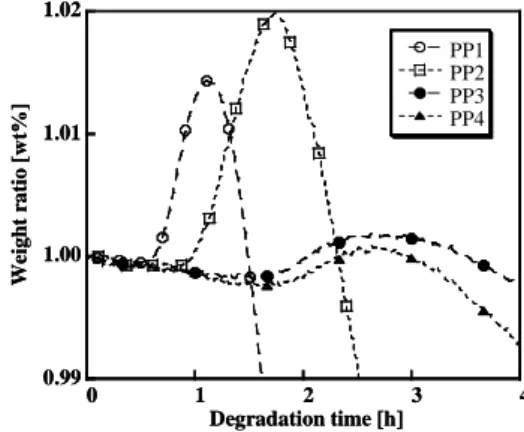
(2) Effects of ethylene comonomer on the thermal stability of propylene-ethylene copolymer Takamasa Tanaka Introduction Polypropylene (PP) is one of the most important commercial polyolefins. Due to its advantages, such as, environment low load, ease of processavility, low cost, high melt index and light weight, Nowadays, 40 million tons PP are produced in a year in the world, which is the maximum production among various plastic materials. The weakest point of PP is ease of degradation by thermal and photo stimulations, and catalyst residues, because radical is easily and steady generated on tertiary carbon atoms a material is achieved by adding stabilizer, but stability of PP it self is required from a viewpoint of long-term use, recycling and reuse. Auto oxidative degradation mechanism of PP explained radicals may then quickly react with O2 by the auto oxidation scheme1). In a previous research, the thermo-oxidative degradation of PP was examined in terms of stereoregularity of the primary chain, where syndiotactic PP was reported as being more stable than isotactic PP(iPP) against thermo-oxidative degradation.2) Suzuki et al. examined the effect of the stereoregularity of PP on the thermo-oxidative reaction. They prepared four PPs with different tacticity characterized in Table 1, and their degradation behaviors at 145°C were evaluated by Thermogravimetry(TG). They found that the stereoirregularity of mmmm under 80 mol% significantly delayed the start and progress of the degradation (Figure 1). 3). 1.02 PP1 PP2 PP3 PP4. Weight ratio [wt%]. Table 1 Characterization of fractioned PPs mmmm Sample. Mn. MWD. (mol%). PP1. 74000. 8.5. 91 87. PP3. 25000 18000. 3.2 5.1. PP4. 11000. 4.6. 76 52. PP2. 1.01. 1.00. 0.99. 0. 1. 2 3 Degradation time [h]. 4. Figure 1 Degradation behavior of fractionated PPs. 1.
(3) The photo-oxidative stability of ethylene-propylene random copolymer with a low ethylene content was also investigated, resulting in the improvement of the photo-stability from that of iPP. The effect of the ethylene comonomer was prominent for a long irradiation time.4) Manabe etal knowledge obtained by thermal oxidative degradation of a polypropylene impact copolymer was examined using transmission electron microscope equipped with an energy dispersive X-ray system, the oxidation resistance of the ethylene-propylene rubber phase was found to be higher than that of the PP matrix. 5). The content of the ethylene of polypropylene impact copolymer at this time was 5.6 and 12.8 mol% ethylene content. On the contrary to the effect of tacticity of PP on the thermal oxidative degradation, the effect of the ethylene content is not understood in details, in spite of the previous reports. Therefore, in this study, I synthesized propylene-ethylene copolymer(rPP) with different ethylene contents as irregularity within primary structures, and examined the detailed effect of of the ethylene comonomer. It was found that ethylene content over 5.3 mol% was significantly stabilize rPP.. Experiments Materials rPPs having different contents of ethylene were synthesized using TiCl4/dibutyl phtalate/MgCl2,triethylaluminum (TEA) was used as the co-catalyst, diluted by toluene, Ziegler-Natta catalyst. cyclohexyl dimethoxy silane (CMDMS) was added as an external donor. Toluene was purified by passing through the molecular sieves 13X column. N2(Uno Sanso Corp.), propylene and TEA were used without further purification.. 2.
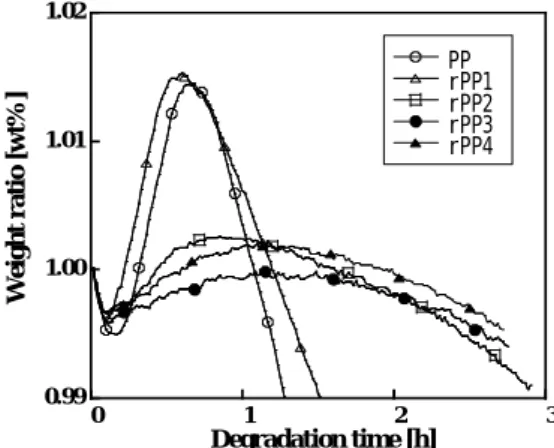
(4) Polymerization The contents of ethylene were controlled by flow rate ratio of propylene and ethylene at 1 atm. Polymerizations were performed with 100 of Al/Ti molar ratio at 60°C in 30 minutes, using toluene as a solvent. In order to remove catalyst residues, the synthesized rPPs were reprecipated from a boiling xylene solution into excess amounts of methanol.. Characterization of propylene-ethylene copolymers The number average molecular weight (Mn) and molecular weight distribution (MWD) of the obtained rPP samples were determined by Gel Permeation Chromatography (GPC: Senshu, SSC-7100) with styrene-divinylbenzene gel columns (SHODEX, HT-806M) at 140°C, where the samples were dissolved in o-dichlorobenzene containing 2,6-di-t-butyl-p-cresol as an antioxidant. The primary structure was determined by 13C-NMR measurement using a Varian Gemini-300 spectrometer at 120°C, where hexachloro-1,3-butadiene was used as a solution (sample/solvent ratio was 20% (w/v)). 1,1,2,2-tetrachloroethane-d2 was added as an internal chemical shift reference.. Thermal degradation Analysis The weight ratios of the rPP samples during thermal oxidative degradation at 145°C was measured by a thermo gravimetric(TG, METTER TG50) under 50 ml/min of air flow. The thermal analyzer was calibrated using the ‘Curie point’ of nickel as a reference.. Results and Discussion The synthesized PP and rPP samles are charaterized in Table 2. The ethylene contents were successfully controlled to 3.3, 5.3, 16.6, and 18.6 mol%, where the increases of the ethylene contens accompany the decrease of mmmm. Moreover, the nE values, 1-2, mean that the ethylene monomer was randomly distributed even with 18.6 mol% of E.C. Figure 1 showed the results of TG at 145°C. The changes in the weight ratios of the PP and rPPs display a multi-stage behavior in 3.
(5) progress of degradation,6), 7) a period of constant weight, namely induction period, is initially seen, and then the weight ratio sharply increase, so called auto-acceleration period, where the fast incorporation of oxygen into the polymer chains causes the mass gain. Once the curve arrives at the maximum, the weight ratio begins to decrease steadily, where evaporation of volatile species, as a result of chain scission, exceeds the mass gain by the O2 incorporation into the polymer. 8) And finally the weight ratio becomes negative. As was previously stated, the duration of the induction period, after which the auto-accelerated degradation starts, strongly depends on the tacticity of PP. Seen in Figure 2, the contents of ethylene had little influence on the duration of the induction periods. The increasing speeds of the weight ratios, which correspond to the speed of the spread of the oxidized region, are similar between the PP and rPP with 3.3 mol% of ethylene content, but significantly suppressed over 5.3 mol% of E.C. The weight-decrease speeds after the maximum also followed the same tendency, namely, significant stabilization over 5.3 mol%. From Table 2, it is found that the E.C. over 5.3 mol% corresponds to mmmm under 80 mol%. The 80 mol% of mmmm is the very value, from which the disarray of the stereoregularity largely suppressed the degradation. Thus, we found that 80 mol% of mmmm is the critical value to achieve significant stabilization for both E.C. and disarray of the stereoregularity.. Table 2 Characterization of the PP and rPP samples Sample. Mn. MWD. PP rPP1 rPP2 rPP3 rPP4. 36000 32000 25000 13000 14000. 6.5 5.6 7.3 11.3 5.5. nE mmmm E.C. (mol%) (mol%) (mol%) 96.6 90.7 79.8 61.9 55.4. 0.0 3.3 5.3 16.6 18.6. 0.0 1.4 1.2 1.6 1.6. Weight ratio [wt%]. 1.02 PP rPP1 rPP2 rPP3 rPP4. 1.01. 1.00. 0.99. 0. 1. 2. 3. Degradation time [h] Figure 2 Degradation behavior of the PP and rPP samples. 4.
(6) Conclusion The effect of ethylene comonomer on the stability of rPP against thermal oxidative degradation was examined by varying ethylene content of rPPs from 3.3 mol% to 18.6 mol%. I found that the ethylene content, which led to less than 80 mol% of mmmm signigicantly suppressed the progress of degradation.. References 1) W. L. Hawkins “Thermal and Oxidative degradation of polymers”, SPE Transactions, 187 (1969) 2) Mori H., Hatanaka T., Terano M., Macromol. Rapid Commun., 18, 157(1997) 3) H. Nakatani, S. Suzuki, T. Tanaka, M. Terano, Polymer 46, 12366-12371 (2005) 4) M. S. Alam, H. Nakatani, B. G. S. Goss, T.Ichiki, B. Liu, M. Terano, J. Polym. Sci., 86, 1863 (2002) 5) N. Manabe, Y. Yokota, H. Nakatani, S. Suzuki, B. Liu, M. Terano, Polym. Bull. 54, 141-147 (2005) 6) L. Audouin, L. Achimsky, J. Verdu. ln: Handbook of Polymer Degradation (2nd end) S. H. Hamid Ed., Marcel Dekker, New York, 727, (2000) 7) J. Rychly, L. Matisova-Rycha, K. Csmorova, L.Achimsky, L. Audouin, A. Tcharkhtchi, J. Verdu. Polym. Degrad. Stab., 58, 269, (1997) 8) L. Audouin, L. Achimsky, J. Verdu. ln: Handbook of Polymer Degradation (2nd end) S. H. Hamid Ed., Marcel Dekker, New York, 727-763, (2000). 5.
(7)
図
関連したドキュメント
Eskandani, “Stability of a mixed additive and cubic functional equation in quasi- Banach spaces,” Journal of Mathematical Analysis and Applications, vol.. Eshaghi Gordji, “Stability
An easy-to-use procedure is presented for improving the ε-constraint method for computing the efficient frontier of the portfolio selection problem endowed with additional cardinality
If condition (2) holds then no line intersects all the segments AB, BC, DE, EA (if such line exists then it also intersects the segment CD by condition (2) which is impossible due
The inclusion of the cell shedding mechanism leads to modification of the boundary conditions employed in the model of Ward and King (199910) and it will be
Keywords: continuous time random walk, Brownian motion, collision time, skew Young tableaux, tandem queue.. AMS 2000 Subject Classification: Primary:
This paper is devoted to the investigation of the global asymptotic stability properties of switched systems subject to internal constant point delays, while the matrices defining
The main problem upon which most of the geometric topology is based is that of classifying and comparing the various supplementary structures that can be imposed on a
Classical definitions of locally complete intersection (l.c.i.) homomor- phisms of commutative rings are limited to maps that are essentially of finite type, or flat.. The
