FORMULATION OF VISUAL SECRET SHARING SCHEMES ENCRYPTING MULTIPLE IMAGES
Manami Sasaki and Yodai Watanabe
Department of Computer Science and Engineering, University of Aizu Aizu-Wakamatsu City, Fukushima 9658580, Japan
ABSTRACT
Secret sharing is a method of generating multiple shares from secret information so that only a qualified set of shares can be employed to recover this secret information. Visual secret sharing (VSS) is an example of secret sharing; its decryption can be performed by using human eyes without a computer.
This paper provides a formulation of encryption for multiple secret images, which is a generalization of the existing ones, and also a general method of constructing VSS schemes en- crypting multiple secret images.
Index Terms— Visual secret sharing, Information-theoretic security, Multiple secret images
1. INTRODUCTION
A secret sharing (SS) scheme is a method of generating mul- tiple shares from a secret so that any qualified set of shares can be employed to recover the secret, but no forbidden set of shares reveals any information about the secret. Therefore, an SS scheme can be used to control participants’ access to secret information and to diversify risks of leaking of secret information. A(k, n)-threshold SS scheme [1, 2] is a typical example of the SS schemes; this is a method of sharing a se- cret amongnparticipants in such a way that anykor more participants can recover the secret with their shares, but no k−1 or less participants can obtain any information about the secret from their shares.
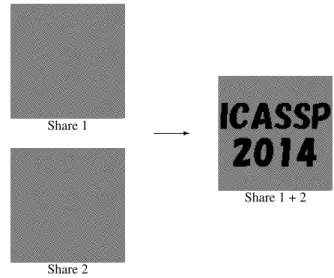
There exist SS schemes whose decryption requires no nu- merical computations but can be performed by a human. A vi- sual secret sharing (VSS) scheme [3] is an example of such SS schemes. In VSS schemes, secrets and shares are both visual data such as printed texts, hand written notes, pictures, and so on. The VSS schemes encrypt a visual secret into visual shares so that humans can recover the visual secret with their eyes by superposing a qualified set of visual shares printed on transparencies. Figure 1 illustrates an example of two shares and their superposition of a(2,2)-threshold VSS scheme.
This work was supported in part by a Grant-in-Aid for Young Scientists (B) No. 21700021, and Fukushima Prefectural Foundation for Advancement of Science and Education.
Share 2 Share 1
Share 1 + 2 -
Fig. 1. Two shares and their superposition of a (2,2)- threshold VSS scheme
Table 1. Comparison among the existing works and this work Restriction on access structure EVCS [4] Each share has to be an image
VSS-q-PI [5] The forbidden sets have to be identical This work No restrictions
There have been proposed two types of VSS schemes encrypting multiple images: extended visual cryptography schemes (EVCS) [4] and VSS schemes for plural secret im- ages (VSS-q-PI) [5]. In EVCS, additional secret images are associated with each share, while in VSS-q-PI, multiple se- cret images are associated with the corresponding qualified sets of shares but the forbidden sets of shares have to be identical. The aim of this paper is to generalize the formu- lation of encryption for multiple images so that those of the existing schemes may be included as a special case. Table 1 summarizes the existing works as well as this work.
The rest of this paper is organized as follows. In Sec- tion 2, we provide notations and definitions that will be used later. Section 3 is devoted to providing a formulation and a construction method of VSS schemes encrypting multiple se-
cret images. Section 4 concludes this paper with mentioning a problem for future work.
2. PRELIMINARIES
In this section, we provide definitions and notations that will be used later. For details of definitions in information theory and secret sharing, see e.g. [6, 7].
2.1. Basic definitions and notations
Forn∈N, let[n]denote the set of natural numbers less than or equal ton: [n] = {k ∈ N|k ≤ n}. The power set of a setS (i.e. the set of all the subsets ofS) is denoted by2S. For a subsetAof a power set partially ordered by inclusion, let(A)− denote the set of the minimal elements of A with respect to this order:
(A)−={a∈A|∀a0∈A(a0 6⊂a)}.
For random variablesXandY over the same domain, we writeX ∼Y ifXandY have the same probability distribu- tion. For a setS, letSU denote a probabilistic function which outputs an element ofSaccording to the uniform distribution overS.
Forx∈ {0,1}n,b∈ {0,1}andi∈[n], letxxi=bdenote the stringxwith thei-th elementxireplaced byb:
xxi=b= (x1,· · ·, xi−1, b, xi+1,· · · , xn).
The gray levelGray(x)ofx∈ {0,1}nis given by Gray(x) ={i|xi= 1}
n .
2.2. Access structure and secret sharing
LetP ={P1, P2,· · · , Pn}be the set of all the shares. The subset of2P whose elements can decrypt the secret is called thequalified set and is denoted by AQ. The subset of 2P whose element can obtain no information about the secret is called theforbidden set and is denoted byAF. The pairΓof the qualified and forbidden sets,Γ ={AQ, AF}, is called an access structure onP. Any access structure has to satisfy the followingmonotonicity:
A∈AQ∧A⊆B ⇒B∈AQ, B∈AF∧A⊆B ⇒A∈AF,
for anyA, B⊆ P. A qualified setAQis uniquely determined by its minimal elements(AQ)−:
(AQ)− = (A0Q)− ⇒AQ=A0Q.
An access structure is calledperfectif every subsets of the shares are included in either the qualified set or the forbidden set. The perfect access structure can be determined by only a qualified set.
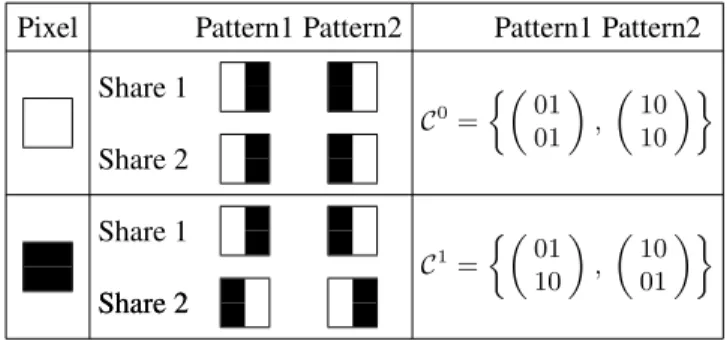
Table 2. How to encrypt a single pixel, and the setsC0and C1of representing matrices (0: white, 1: black, row: share, column: subpixel in share)
Pixel Pattern1 Pattern2 Pattern1 Pattern2
Share 2 Share 1 Share 2 Share 1 Share 2
C0= {(01
01 )
, (10
10 )}
C1= {(01
10 )
, (10
01 )}
Example 2.1((k, n)-threshold access structure). LetPbe a finite set of sizen. A (k, n)-threshold access structure on P consists of the qualified setAQ and the forbidden setAF
given by AQ ={
a⊆ Pk≤ |a|}
and AF ={
a⊆ Pk >|a|} .
A secret sharing scheme realizing a(k, n)-threshold access structure is called a(k, n)-threshold secret sharing scheme.
2.3. Visual secret sharing
In the ordinary SS schemes, the secret information and shares are both numerical data, and their decryption can be per- formed by computers. In contrast, in the VSS schemes, the secret information (secret image) and shares are both visual, and their decryption can be performed by human eyes. Each black-white pixel in a secret image is encrypted into a set of black-white subpixels in shares. Hence, the encryption of each pixel can be represented as a pair of matricesCb= (cbij) withb ∈ {0,1}, whereb = 0for a white pixel in a secret image andb = 1 otherwise, andcbij = 0 for a whitej-th subpixel in thei-th share andcbij = 1otherwise.
For an illustrative purpose, let us consider a (2,2)- threshold VSS scheme. A secret image is encrypted into two shares (Figure 1: left). Each share is indistinguishable from noise images, and so leaks no information about the secret. On the other hand, the secret image can be recovered when both of the shares are superposed (Figure 1: right). This can be constructed as follows. A pixelein the secret image is encrypted into two subpixels in each of the two shares. Ife is white (resp. black), then Pattern 1 or Pattern 2 in the upper (resp. lower) row of Table 2 is chosen at random. The su- perposition of the two shares has one black subpixel and one white subpixel (resp. two black subpixels) ifeis white (resp.
black). This construction can be represented by the setsC0 andC1of matrices in Table 2; more precisely, the above en- cryption and decryption can be represented by the functions
Enc : {0,1} → {0,1}2×2 andDec : {0,1}2×2 → {0,1}2 given by
Enc(b) :=CUb and Dec(M) = (m11∨m21, m12∨m22) forb ∈ {0,1} andM = (mij) ∈ {0,1}2×2, respectively, where∨denotes the OR operation.
The relative difference in gray level between superposed shares that come from a white pixel and a black pixel in the secret image is called thecontrast. In the above example, the reconstructed pixel has a gray level of22 = 1ifeis black, and a gray level of12ifeis white. Therefore, Contrast=22−12 =
1
2. The higher contrast makes it easier to recognize recovered images. A VSS scheme is calledoptimalif it has the highest contrast.
2.4. Notations for matrices
In the same way as [5], we introduce an equivalence relation
∼on the setM={0,1}nmofn×mmatrices forn, m∈N; for two matricesAandBof the same size,A∼Brepresents thatAcan be obtained by a column permutation of B. For R∈ M, lethRidenote the set of all the matricesAsuch that A∼R, i.e.
hRi={A∈ M |A∼R}.
By using this notation,C0andC1in Table 2 (see section 2.3) can be written as
C0= D(01
01 )E
and C1= D(01
10 )E
.
For an ordered setS= (s1, s2,· · ·, sk)of finite size, the order ofsi inS is denoted byordS(si): ordS(si) = i. Let P ={P1, P2,· · · , Pn}be an ordered set of sizen, andabe an ordered subset ofP. For ann×mmatrixM = (mij) (wheren =|P|), let[M]adenote the|a| ×msubmatrix of M defined by
([M]a)orda(Pi)j=mij
forPi∈a. For a|a|×mmatrixM = (mij), let[M]adenote then×mmatrix defined by
([M]a)ij =
{ morda(Pi)j ifPi∈a, 1 otherwise.
For two matricesAandB of the same number of rows, let A|Bdenote the concatenation ofAandB.
3. VISUAL SECRET SHARING SCHEMES ENCRYPTING MULTIPLE IMAGES 3.1. Formulation and construction
We first extend the definition of an access structure to the case for multiple secrets.
Definition 1(Access structure for multiple secrets). LetPbe a finite set, andq∈N. Fori∈[q], letAiQandAiFbe subsets of2Psuch thatAiQ∩AiF =∅. The pairsΓqof the subsetsAiQ andAiF,Γq ={
(AiQ, AiF)}q
i=1, is called anaccess structure onPforqsecretsifAiQandAiF satisfy the monotonicity:
A∈AiQ∧A⊆B⇒B∈AiQ, B ∈AiF∧A⊆B⇒A∈AiF, for anyA, B⊆ Pandi∈[q], and the uniqueness:
(AiQ)−∩(AjQ)−=∅
for anyi, j ∈ [q] such thati 6= j. For an access structure Γq = {
(AiQ, AiF)}q
i=1,AiQ andAiF are called thequalified setand theforbidden set for thei-th secret, respectively. An access structure Γq = {
(AiQ, AiF)}q
i=1 is called minimally refinedif|(AiQ)−|= 1for anyi∈[q].
If we pose the restriction
(AiQ)− ={{Pi}}withq=|P|+ 1 (
resp.AiF =AF) for alli, then the above definition coincides with that intro- duced by [4] (resp. [5]). Therefore, the above definition can be considered as a generalization of the existing ones.
We next give a definition of VSS schemes encrypting mul- tiple secret images.
Definition 2 (VSS schemes encrypting multiple images).
Let P be a finite set, m, q ∈ N andq0 ∈ [q]. Let Γq = {(AiQ, AiF)}q
i=1 be an access structure on P for q secrets.
LetEncbe a probabilistic function from{0,1}q to{0,1}qm and Dec be a deterministic function from {0,1}q0m to {0,1}m. The pairV SSof functionsEncandDec,V SS = (Enc,Dec), is called avisual secret sharing scheme realizing Γq if Decis given as the bitwise OR of the rows of input matricesM = (mij):
(Dec(M))j= ∨
i∈[q0]
mij
for anyj∈[m], andEncandDecsatisfy the following con- ditions:
∀a∈(AiQ)− (
min
b∈{0,1}qgi(a;b,1)> max
b∈{0,1}qgi(a;b,0) )
,
∀a∈AiF∀b∈ {0,1}q(
[Enc(bbi=0)]a ∼[Enc(bbi=1)]a
),
for anyi∈[q], where
gi(a;b, b0) = Gray(Dec([Enc(bbi=b0)]a)).
To provide a construction of VSS schemes encrypting multiple images, we introduce a notation for representing matrices. Forb ∈ {0,1}andn ∈ N, letC(n,n)b denote ma- trices such that
C(n,n)0 and
C(n,n)1
constitute the sets of
representing matrices for an (n, n)-threshold VSS scheme.
For example,
C(1,1)0 = ( 0 ), C(2,2)0 = (01
01 )
, C(3,3)0 = (0011
0101 0110
) ,
C(1,1)1 = ( 1 ), C(2,2)1 = (01
10 )
, C(3,3)1 = (1001
1010 1100
)
have been shown to give optimal (n, n)-threshold VSS schemes forn= 1,2,3, respectively [3].
Construction 1. LetP be a finite set, andq∈N. LetΓq = {(AiQ, AiF)}q
i=1be a minimally refined access structure onP forqsecrets. Fori ∈ [q], letaiq be the element of(AiQ)−: (AiQ)− ={aiq}withaiq ⊆ P. Forb∈ {0,1}andi∈[q], let Cib = [C(nb
i,ni)]aiqwithni=|aiq|. DefineEncby Enc(b) :=
C1b1|C2b2| · · · |Cqbq
U
forb∈ {0,1}q, andDecas in Definition 2.
From the above definition ofCib, it is straightforward to verify the following theorem. Since any access structure can be transformed into a minimally refined one (with the dupli- cation of secret images allowed), Construction 1 applies to general access structures for multiple secrets.
Theorem 1. Let P be a finite set, and q ∈ N. LetΓq = {(AiQ, AiF)}q
i=1be a minimally refined access structure onP forqsecrets. Then,V SS = (Enc,Dec)given by Construc- tion 1 is a visual secret sharing scheme realizingΓq.
3.2. Illustrative example
We now construct a VSS scheme according to Construction 1.
LetP = {P1, P2, P3} be a set of shares. We consider the following minimally refined perfect access structure Γ7 = {(AiQ, AiF)}7
i=1for seven secret images{vi}7i=1of the same size, where
(A1Q)−={{P1}}, (A2Q)−={{P2}}, (A3Q)−={{P3}}, (A4Q)−={{P1, P2}}, (A5Q)−={{P1, P3}},
(A6Q)−={{P2, P3}}, (A7Q)−={{P1, P2, P3}},
with(AiF)− = 2P −AiQ for alli ∈[7]. It should be noted that no existing schemes, neither EVCS [4] nor VSS-q-PI [5], can realizeΓ7. From the definition ofCib, we have
C10= (0
1 1
) , C20=
(1 0 1
) , C30=
(1 1 0
) , C70=
(0011 0101 0110
) ,
C11= (1
1 1
) , C21=
(1 1 1
) , C31=
(1 1 1
) , C71=
(1001 1010 1100
) ,
Share 1 (v1) Share 2 (v2) Share 3 (v3)
Share 1+2 (v4) Share 1+3 (v5) Share 2+3 (v6)
Share 1+2+3 (v7)
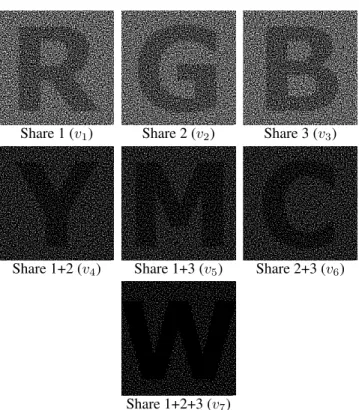
Fig. 2. VSS scheme realizingΓ7with secret images{vi}7i=1
representing the additive mixture of the primary colors
C40= (01
01 11
) , C50=
(01 11 01
) , C60=
(11 01 01
) ,
C41= (01
10 11
) , C51=
(01 11 10
) , C61=
(11 01 10
) .
Suppose that the top-left pixels of the secret images{vi}7i=1
have valuesb ∈ {0,1}7, wherebi = 0if the corresponding pixel inviis white andbi = 1otherwise. Then, the encryp- tion of valuesbof the top-left pixels is given byEnc(b) :=
C1b1|C2b2| · · · |C7b7
U. All the other pixels of the secret im- ages are encrypted in the same way. Figure 2 shows an exam- ple of this VSS scheme1.
4. CONCLUSION
In this paper, we generalized the formulation of VSS encryp- tion for multiple secret images so that those of the existing schemes, EVCS [4] and VSS-q-PI [5], may be included as a special case. We then provided a general method of construct- ing VSS schemes encrypting multiple secret images. We also provided an example of VSS schemes which cannot be for- mulated as the existing ones. It will be the subject of future work to examine the optimality of Construction 1.
1In this example,C1b1,Cb22andC3b3are concatenated twice to make the pixel expansionma square:m= 1×3×2 + 2×3 + 4 = 42. Hence, Contrast =162 for{vi}3i=1and161 for{vi}7i=4.
5. REFERENCES
[1] George Robert Blakley, “Safeguarding cryptographic keys,” in Proceedings of the National Computer Con- ference, Monval, NJ, USA, 1979, pp. 313–317, AFIPS Press.
[2] Adi Shamir, “How to share a secret,”Communications of the ACM, vol. 22, no. 11, pp. 612–613, 1979.
[3] Moni Naor and Adi Shamir, “Visual cryptography,” in Proceedings of Advances in Cryptology – Eurocrypt ’94, Perugia, Italy, 1994, vol. 950 ofLecture Notes in Com- puter Science, pp. 1–12, Springer-Verlag.
[4] Giuseppe Ateniese, Carlo Blundo, Alfredo De Santis, and Douglas R. Stinson, “Extended capabilities for visual cryptography,” Theoretical Computer Science, vol. 250, no. 1–2, pp. 143–161, 2001.
[5] Mitsugu Iwamoto and Hirosuke Yamamoto, “A construc- tion method of visual secret sharing schemes for plural secret images,”IEICE Trans. Fundamentals, vol. E86-A, no. 10, pp. 2577–2588, 2003.
[6] Thomas M. Cover and Joy A. Thomas, Elements of In- formation Theory, Wiley-Interscience, 2nd edition, 2006.
[7] Douglas Robert Stinson, Cryptography: Theory and Practice, Chapman & Hall, CRC, 3rd edition, 2005.