• 検索結果がありません。

IDENTIFICATION OF NOVEL GENETIC MUTATIONS IN JAPANESE PATIENTS WITH SEVERE CONGENITAL HYPOTHYROIDISM

N/A
N/A
Protected

Academic year: 2021

シェア "IDENTIFICATION OF NOVEL GENETIC MUTATIONS IN JAPANESE PATIENTS WITH SEVERE CONGENITAL HYPOTHYROIDISM"

Copied!
8
0
0

読み込み中.... (全文を見る)

全文

(1)

IDENTIFICATION OF NOVEL GENETIC MUTATIONS IN  JAPANESE PATIENTS WITH SEVERE 

CONGENITAL HYPOTHYROIDISM

Hiroyuki Adachi, Ikuko Takahashi, Hirokazu Arai and Tsutomu Takahashi (received 17 May 2013, accepted 12 June 2013)

Department of Pediatrics, Akita University Graduate School of Medicine, Akita 010

-

8543, Japan

Abstract

Objective : The prevalence of genetic mutations in congenital hypothyroidism (CH) remains undetermined. The objective of this study was to determine the prevalence of mutations in DUOX2, TSHR, TG, PAX8, and TPO among severe permanent primary CH.

Methods : Between April 1999 and March 2011, 114,733 newborns were screened for CH in Akita Prefecture, Japan. Among them, 330 were suspected of having CH and were referred to pediatricians. We recruited 40 patients who were referred to our institute. Among them, we identified 9 permanent primary CH patients who were severely affected with an initial TSH ≥20 mU/l upon newborn screening and performed direct sequencing of the 5 candidate genes.

Results : 3 of 9 patients (33%) had mutations in PAX8, TPO, and TSHR. Among the severely affected subjects, 60% had thyroid dysgenesis (TD), while for patients with initial TSH upon screening <20 mU/l only 12% had TD.

Conclusions : Despite the high frequency of TD, the detection rate of mutations among severe permanent primary CH was higher than expected. This study suggests that the genetic analysis of 5 genes, namely, DUOX2, TSHR, TG, PAX8, and TPO, is useful for the diagnosis of CH, and that the actual prevalence of genetic mutations among CH might be higher than as previously estimated.

Key words : congenital hypothyroidism, genes, mutation, prevalence

Correspondence : Ikuko Takahashi, M.D.

Department of Pediatrics, Akita University Graduate School of Medicine, 1

-

1

-

1 Hondo, Akita 010

-

8543, Japan Tel : 81

-

18

-

884

-

6159

Fax : 81

-

18

-

836

-

2620

E

-

mail : [email protected]

-

u.ac.jp

cent evidence points to the possibility of a genetic com- ponent

1)

. One study reported that 2% of CH patients with TD have a positive familial history

3)

. In contrast, DH is generally transmitted in an autosomal recessive manner. Hereditary defects in virtually all of the steps of thyroid hormone biosynthesis and secretion have been described

1)

.

 The prevalence of single genetic mutations in CH re- mains undetermined. Previous molecular genetic stud- ies have shown that a subset of TD is caused by at least 4 genetic mutations, including TSHR

4-6)

, PAX8

7)

, NKX2

-

1

8)

, and FOXE1

9)

. Similarly, at least 7 genes have been im- plicated in DH, including TG

10)

, TPO

11)

, SLC5A5

12)

, SL- C26A4

13)

, DUOX2

14)

, DUOXA2

15)

, and IYD

16)

. A previous review estimated the prevalence of single genetic muta- tions in CH to be 5

-

10%

17)

. However, only a few genetic Introduction

 Congenital hypothyroidism (CH) is a highly heteroge-

neous disorder.   CH is classified into permanent and

transient CH, which in turn is divided into primary, sec-

ondary, or peripheral CH. Most cases of CH are due to

primary causes

1)

. Thyroid dysgenesis (TD) accounts for

75

-

85% of permanent primary CH, while thyroid dyshor-

monogenesis (DH) accounts for 15

-

20% of cases

2)

. TD

is generally thought to be a nongenetic disease, but re-

(2)

screening studies of CH patients have been conducted and the actual prevalence of most genetic mutations among all CH patients or in the general population has not been investigated.

 Recently, Japanese studies have confirmed that more than 20% of permanent primary CH patients have single genetic mutations as determined systematic genetic screening

20-22)

. These studies have reported the preva- lence of different genetic mutations among 102 CH patients : in descending order of frequency, they occur in DUOX2, TSHR, TG, PAX8, and TPO.

 In this study, we examined the prevalence of genetic mutations in DUOX2, TSHR, TG, PAX8, and TPO among severe permanent primary CH patients with an initial TSH ≥20 mU/l upon newborn screening in our institute.

Materials and Methods Subjects

 Between April 1999 and March 2011, 114,733 new-

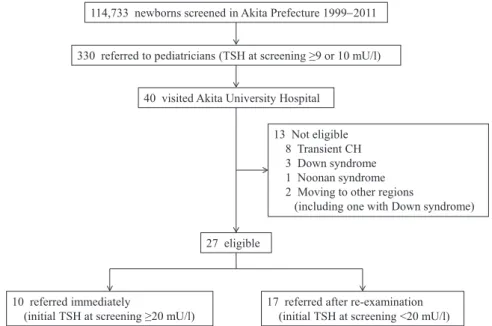
borns were screened for CH in Akita Prefecture, which is a northern area of Japan (Fig. 1).   Among them, 330 with TSH upon screening (whole blood) ≥10 mU/l (April 1999 to July 2004) or ≥9 mU/l (August 2004 to March 2011) were suspected of having CH and were referred to pediatricians. We recruited 40 patients who were re- ferred to the Department of Pediatrics, Akita University Hospital. Of them, 13 were excluded because they had transient CH, chromosomal abnormalities, and showed movement to other regions. The remaining 27 patients were diagnosed with or suspected of having permanent primary CH and were enrolled in this study. Moreover, the participants were classified into 2 groups according to the severity of their disease : 10 patients had initial TSH upon screening ≥20 mU/l (i.e., referred immediately) and 17 patients had initial TSH upon screening <20 mU/l (i.e., referred after re

-

examination).

 We selected the 10 severely affected CH patients with initial TSH upon screening ≥20 mU/l for genetic analysis. Written informed consent to participate in the

Fig. 1. Study subject enrollment. In total, 114,733 newborns were screened for CH in Akita Prefecture between April 1999 and March 2011. Three hundred thirty newborns with TSH upon screening (whole blood) ≥10 mU/l (April 1999 to July 2004) or ≥9 mU/l (August 2004 to March 2011) were referred to pediatricians. Among them, 40 were referred to our institute. Of these patients, 27 were diagnosed with or suspected of having permanent primary CH and were enrolled in this study. Moreover, according to the severity of their disease, the participants were classified into 2 groups : 10 patients with initial TSH upon screening ≥20 mU/l (i.e., referred immediately) and 17 patients with initial TSH upon screening <20 mU/l (i.e., referred after re

-

examination).

114,733 newborns screened in Akita Prefecture 1999−2011

13 Not eligible 8 Transient CH 3 Down syndrome 1 Noonan syndrome 2 Moving to other regions

(including one with Down syndrome) 27 eligible

10 referred immediately

(initial TSH at screening ≥20 mU/l) 17 referred after re-examination (initial TSH at screening <20 mU/l) 40 visited Akita University Hospital

330 referred to pediatricians (TSH at screening ≥9 or 10 mU/l)

Fig. 1

(3)

study was obtained from the patients or their parents. 

This study was approved by the ethical committee of the Akita University Graduate School of Medicine.

Evaluation of patients

 During the first visit to our institute, the patients were evaluated for serum levels of TSH, free triiodothyronine (FT3), free thyroxine (FT4), and if possible, thyro- globulin.   Thyroid morphology was evaluated by using ultrasonography on all of the patients. For those pa- tients that were 3

-

6 years of age, their thyroid function was reevaluated after discontinuation of treatment to dis- tinguish between permanent and transient CH. The pa- tients were evaluated for serum levels of TSH, FT3, FT4, and thyroglobulin. Thyroid morphology was evalu- ated using both ultrasonography and

123

I scintigraphy. 

The patients who had serum TSH at reevaluation ≥5 mU/l or who had TD were diagnosed with permanent pri- mary CH.

 If

123

I uptake was increased (≥20%), a perchlorate dis- charge test was performed. A perchlorate discharge rate >90% indicates the presence of a total iodine organi- fication defect, whereas a rate of 10

-

90% indicates the presence of a partial iodine organification defect.

Candidate genes

 The patients who were diagnosed with or suspected of having permanent primary CH were divided into 3 subgroups : TD (i.e., hypoplasia, aplasia, or ectopia), DH (i.e., iodine organification defect, thyroglobulin synthesis defect, or others), and normal thyroid morphology. 

TSHR and PAX8 were sequenced for the TD or normal thyroid morphology patients. TPO and DUOX2 were sequenced for DH patients who had an iodine organifica- tion defect. TG was sequenced for DH patients who had a thyroglobulin synthesis defect and consequently have typically very low levels of thyroglobulin. Other forms of DH were not included in the study.

Genetic analysis

 Genomic DNA was extracted from peripheral blood leukocytes by following a standard technique. Amplifi- cation of coding exons and the exon

-

intron boundary of the candidate genes was performed by using the poly-

merase chain reaction (PCR) with genomic DNA. The PCR products were purified by using Wizard SV Gel and a PCR Clean

-

Up System (Promega, Madison, WI, USA). 

They were then sequenced directly with an ABI Prism BigDye Terminator Cycle Sequencing Ready Reaction Kit (Applied Biosystems, Foster City, USA) by using an automated sequencer ABI Prism 310 Genetic Analyzer (Applied Biosystems).

In silico analysis of novel genetic mutations  In order to predict the functional effects of the novel genetic mutations that we identified, we performed in silico analysis by using PolyPhen

-

2 (http://genetics.bwh.

harvard.edu/pph2/)

23)

. This online tool can be used to predict the possible impact of an amino acid substitution on the structure and function of a human protein. The genetic mutations were classified as being “benign”,

“possibly damaging”, or “probably damaging”. In addi- tion to the PolyPhen

-

2 analysis, we investigated the spe- cies conservation among human and other vertebrates of the mutated amino acids by using Evola (http://www.h

-

invitational.jp/evola/)

24)

.

Results

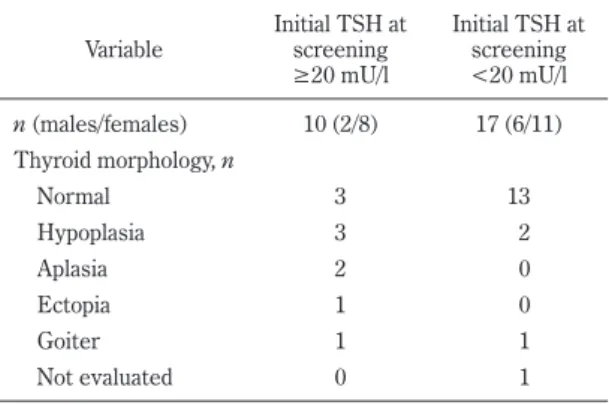
Evaluation of patients and genetic analysis  The thyroid morphology of the 2 groups with 27 partic- ipants is shown in Table 1. Among the patients with ini- tial TSH upon screening ≥20 mU/l, 6 of 10 patients (60%) had TD. In contrast, among the patients with ini- tial TSH upon screening <20 mU/l, only 2 of 17 patients

Fig.Table 1

Table 1. Thyroid morphologies of the participants

Variable Initial TSH at screening

≥20 mU/l

Initial TSH at screening

<20 mU/l n (males/females) 10 (2/8) 17 (6/11) Thyroid morphology, n

 Normal 3 13

 Hypoplasia 3 2

 Aplasia 2 0

 Ectopia 1 0

 Goiter 1 1

 Not evaluated 0 1

(4)

(12%) had TD.

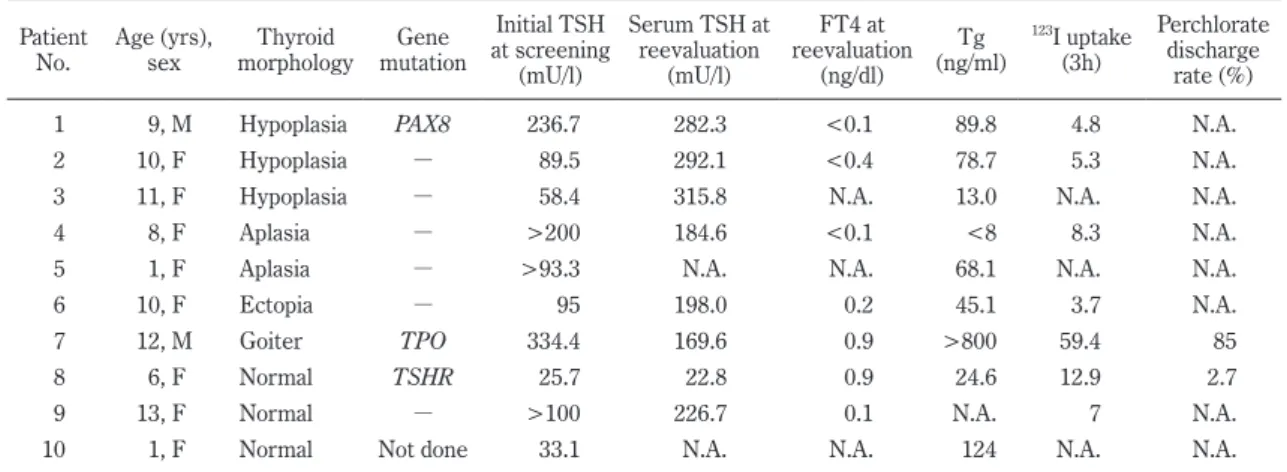
 The clinical phenotypes of the patients who had initial TSH upon screening ≥20 mU/l are shown in Table 2. 

For patient 1

-

6 who had TD and patient 8 and 9 who had normal thyroid morphology, TSHR and PAX8 were sequenced. For patient 7 who had DH that was indica- tive of a partial iodine organification defect, TPO, and DUOX2 were sequenced.   For patient 10 who had nor- mal thyroid morphology, genetic analysis could not be conducted because she was an infant at the time of en- rollment and her thyroid function could not be reeva- luated. No patients were suspected to have a thyroglob- ulin synthesis defect.

 Three of 9 patients (33%) had mutations in PAX8, TPO, and TSHR (Table 2). The results of their se- quences and family studies of the mutation carriers are shown in Fig. 2 and Fig. 3, respectively. Patient 1 suf- fered from thyroid hypoplasia and had a novel PAX8 mu- tation (heterozygous for p.I34K) (Fig. 2). This missense mutation comprised 2 consecutive point mutations : c.101T > A and c.102C > A. Both of the patient’s par- ents had none of these point mutations (Fig. 3). Patient 7 suffered from a partial iodine organification defect and had a novel TPO mutation (compound heterozygous for p.R540X and p.W732L) (Fig. 2). The nonsense mutation for p.R540X was previously reported

25)

, but the missense mutation for p.W732L was novel. The mother of this patient was heterozygous for p.R540X and the father was

heterozygous for p.W732L (Fig. 3). Patient 8 exhibited normal thyroid morphology and had a TSHR mutation (homozygous for p.R450H) (Fig. 2), which is common in Japan

26)

. The genotypes of the parents were not deter-

Fig. 2. Three genetic mutations identified in severe permanent primary CH patients. The identified PAX8 mutation is heterozygous for a novel mutation p.I34K. This missense mutation comprises 2 consec- utive point mutations : c.101T > A and c.102C > A. 

The identified TPO mutation is compound heterozy- gous for p.R540X and p.W732L with the latter being a novel mutation. The identified TSHR mutation is homozygous for p.R450H, which is common in Japan.

Fig. 2

PAX8 TSHR

TPO Heterozygous

I34K Homozygous

R450H

Heterozygous

R540X Heterozygous

W732L Table 2. The clinical phenotypes of the patients with initial TSH at screening ≥20 mU/l Patient

No. Age (yrs),

sex Thyroid

morphology Gene mutation

Initial TSH at screening

(mU/l)

Serum TSH at reevaluation

(mU/l)

FT4 at reevaluation

(ng/dl)

(ng/ml) Tg

123
I uptake (3h)

Perchlorate discharge

rate (%)

1 9, M Hypoplasia PAX8 236.7 282.3 <0.1 89.8 4.8 N.A.

2 10, F Hypoplasia - 89.5 292.1 <0.4 78.7 5.3 N.A.

3 11, F Hypoplasia - 58.4 315.8 N.A. 13.0 N.A. N.A.

4 8, F Aplasia - >200 184.6 <0.1 <8 8.3 N.A.

5 1, F Aplasia - >93.3 N.A. N.A. 68.1 N.A. N.A.

6 10, F Ectopia - 95 198.0 0.2 45.1 3.7 N.A.

7 12, M Goiter TPO 334.4 169.6 0.9 >800 59.4 85

8 6, F Normal TSHR 25.7 22.8 0.9 24.6 12.9 2.7

9 13, F Normal - >100 226.7 0.1 N.A. 7 N.A.

10 1, F Normal Not done 33.1 N.A. N.A. 124 N.A. N.A.

  FT4, free thyroxine ; Tg, thyroglobulin ; M, male ; F, female ; N.A., not available ; -, not detectable

(5)

mined (Fig. 3).

In silico analysis of novel genetic mutations  For the PolyPhen

-

2 analysis, 2 novel mutations (I34K in PAX8 and W732L in TPO) were predicted to be “prob- ably damaging.” These mutated amino acids (isoleucine at position 34 of PAX8 and tryptophan at position 732 of TPO) were strictly conserved among 12 other verte- brates.

Discussion

 We performed genetic analyses of 5 genes, namely, DUOX2, TSHR, TG, PAX8, and TPO, for 9 severe per- manent primary CH patients with initial TSH ≥20 mU/l upon newborn screening. DUOX2, TG, and TPO were sequenced for the DH patients. TSHR and PAX8 were sequenced for the non

-

goitrous patients (i.e., TD or nor- mal thyroid morphology) because the thyroid morpholo- gies of these genetic mutations were highly variable : normal, ectopic, hypoplastic, or slightly enlarged

7,20,21,27)

.  Our study showed that 3 of 9 (33%) subjects had single genetic mutations in PAX8, TPO, and TSHR. Recently, Japanese studies have confirmed by the systematic ge- netic screening of a population

-

based cohort of Japanese patients that 23 of 102 (23%) permanent primary CH pa- tients had single genetic mutations

20-22)

. These studies identified 8, 6, 5, 2, and 2 mutation carriers in DUOX2, TSHR, TG, PAX8, and TPO, respectively. Although our study subjects were limited to severely affected patients

and the sample size was small, our detection rate for mu- tation carriers was compatible with these studies.   Our study suggests that the actual prevalence of single genet- ic mutations among permanent primary CH patients is higher than was previously estimated

17)

.

 In our study, 6 of 10 patients (60%) with initial TSH

≥20 mU/l upon screening had TD, while only 2 of 17 pa- tients (12%) with initial TSH <20 mU/l had TD. This tendency was also observed in another study.   Narumi et al. reported that 48 of 70 patients (69%) with serum TSH

≥10 mU/l (under discontinuation of treatment) had TD, while only 3 of 32 patients (9%) with serum TSH <10 mU/l had TD

20)

. In addition, recently in Italy the use of a low TSH cutoff for newborn screening revealed that in- cidence of CH is about two times greater than was previ- ously thought, mainly because of the detection of mild CH within the thyroid gland in situ

28)

. This fact sug- gests that TD patients are disposed to high TSH levels upon newborn screening.

 Because TD is generally thought to be a non

-

genetic disease

1)

, we anticipated a low detection rate for genetic mutations among our severely affected subjects including for the 6 TD patients. In fact, only one of the 6 TD pa- tients had genetic mutations (PAX8).   However, the overall detection rate for genetic mutations among our subjects was higher than expected. Our study indicates that severe CH patients may be predisposed to having TD but that genetic analysis may be useful to an extent, especially for DUOX2, TSHR, TG, PAX8, and TPO.

 We identified one PAX8 mutation carrier among the 6 TD patients. Macchia et al. identified 5 PAX8 mutation carriers among 145 TD patients

7)

and Narumi et al. iden- tified 2 PAX8 mutation carriers among 51 TD patients

21)

.  According to these studies, the prevalence of a PAX8 mutation is estimated to be 3

-

4% among TD patients. 

Notably, almost all of the PAX8 mutation carriers in our study and the earlier studies had thyroid hypoplasia ex- cept for one case that had thyroid ectopia. However, this patient also showed reduced gland size

7)

.   Indeed, most cases of TD are not hereditary, but PAX8 mutations can be found rarely in some cases of thyroid hypoplasia.

 Among our 9 subjects, we found only one DH patient who had a TPO genetic mutation. Mutations in TPO ap- pear to be the most common cause of DH with perma- Fig. 3. Family studies of the 3 mutation carriers. 

Both parents of Patient 1 with a PAX8 mutation had no mutation. Both parents of Patient 7 with a TPO muta- tion were heterozygous for R540X and W732L, respectively. The genotypes of the parents of Patient 8 with a TSHR mutation were not determined.

PAX8 TPO TSHR

Fig. 3

(6)

nent primary CH . Recently, Avbelj et al. detected TPO mutations in 20 of 43 (46%) permanent primary CH pa- tients with DH in Slovenia, Bosnia, and Slovakia

29)

. In Japan, DUOX2 mutations have been estimated to be the leading cause of permanent primary CH with DH (1 : 44,000 newborns)

22)

, and the estimated Japanese prevalence of TPO mutations (1 : 177,000 newborns)

22)

is lower than the Slovene prevalence (1 : 20,000 new- borns)

29)

and the Dutch prevalence (1 : 66,000 new- borns)

18)

. However, if CH patients show total iodine or- ganification defects or extremely severe thyroid hormone insufficiency, TPO then remains the most likely candidate gene for DH.

 Japanese studies noted mutations in DUOX2, TG, or TPO in 93% of DH patients (13 of 14) who had at least a goiter (≥2SD), high

123

I uptake (≥40%), high perchlorate discharge rate (≥10%), or low saliva

-

to

-

plasma

123

I ratio (<10%)

22)

. We found only one DH patient among our subjects, but this patient had a goiter (+3.6SD), high

123

I uptake (59.4%), and a high perchlorate discharge rate (85%). In fact, we were able to identify a genetic muta- tion in TPO. Although DH accounts for a small propor- tion of cases of permanent primary CH, the actual preva- lence of genetic mutations among DH patients is likely to be fairly high.

 We identified one bi

-

allelic TSHR mutation carrier among 8 non

-

goitrous patients (13%). Our TSHR muta- tion carrier had normal thyroid morphology and milder phenotypes than our PAX8 and TPO mutation carriers did. The phenotypes of bi

-

allelic TSHR mutations are variable : mild to severe CH and normal to severe hypoplasia

5,6,20)

. The prevalence of TSHR mutations has been presumed to be rare, but a recent Korean study

27)

found 13 TSHR mutation carriers (16.5%) among 79 pa- tients that were indicative of TD. Similarly, a recent Japanese study

20)

found 6 TSHR mutation carriers (8%) among 80 non

-

goitrous patients : 3 patients had bi

-

allelic mutations with moderate to severe CH and 3 patients had monoallelic mutations with mild CH.   The preva- lence of TSHR mutations could be relatively high among non

-

goitrous CH patients with phenotypic heterogeneity.

 In this study, we did not perform functional analysis of the two novel mutations, PAX8 I34K and TPO W732L. 

However, there are some reports suggesting the roles of

the mutations. Functional analysis of PAX8 R31H and Q40P

30)

showed that these mutations, which are located in the paired domain of PAX8, resulted in reduction of the DNA

-

binding ability of this transcription factor. The PAX8 I34K mutation is also located in the paired domain, and considered to produce the same effect. Functional analysis of TPO R665W and G771R showed that these mutated TPO proteins did not migrate to the plasma membrane

31)

.   The TPO W732L mutation is located be- tween R665W and G771R in the extracellular region

32)

, and may exhibit the same effect.

 A limitation of our study is that the sample size was very small. In Akita Prefecture, the average number of births over the past 13 years has been 8,000

-

9,000 a year, from which permanent primary CH occurrences are esti- mated to be 2

-

3 patients a year. Furthermore, only 12%

of the suspected CH patients (40 of 330) were referred to our institute. Another limitation of our study was that genetic mutations were searched for only in the coding region. De Felice et al. have pointed out the possibility that mutations in introns or regulatory regions may have been unnoticed and that the prevalence of genetic muta- tions in TD patients could be underestimated

33)

. None- theless, we believe that our overall detection rate of ge- netic mutations among severely affected CH patients is valid, because the characteristics of our subjects and our detection rate of genetic mutations are compatible with those of a recently conducted, population

-

based Japanese study

20-22)

.

 In conclusion, we identified 2 novel mutations in PAX8

and TPO, and one previously reported mutation in TSHR

among 9 severe permanent primary CH patients with ini-

tial TSH upon screening ≥20 mU/l. In spite of the high

frequency of TD (60%), the overall detection rate of ge-

netic mutations among our subjects was higher than

expected. Our study suggests that the genetic analysis

of 5 genes, namely, DUOX2, TSHR, TG, PAX8, and TPO,

is useful for the diagnosis of CH, and that the actual prev-

alence of genetic mutations among CH patients might be

higher than was previously estimated. Further studies

are required to clarify the roles of the novel mutations,

PAX8 p.I34K and TPO p.W732L, in the pathogenesis of

primary CH.

(7)

Disclosure

 None of the authors have any potential conflicts of in- terest associated with this research.

References

1) Rastogi, M.V. and LaFranchi, S.H. (2010) Congeni- tal hypothyroidism. Orphanet. J. Rare. Dis., 5, 17.

2) Grüters, A., Krude, H. and Biebermann, H. (2004) Molecular genetic defects in congenital hypo thy- roidism. Eur. J. Endocrinol., 151 (Suppl 3), U39

-

44.

3) Castanet, M., Lyonnet, S., Bonaïti

-

Pellié, C., Polak, M., Czernichow, P. and Léger, J. (2000) Familial forms of thyroid dysgenesis among infants with con- genital hypothyroidism. N. Engl. J. Med., 343, 441

-

442.

4) Sunthornthepvarakui, T., Gottschalk, M.E., Hayashi, Y. and Refetoff, S. (1995) Brief report : resistance to thyrotropin caused by mutations in the thyrotro- pin

-

receptor gene. N. Engl. J. Med., 332, 155

-

160.

5) Biebermann, H., Schöneberg, T., Krude, H., Schultz, G., Gudermann, T. and Grüters, A. (1997) Muta- tions of the human thyrotropin receptor gene causing thyroid hypoplasia and persistent congenital hypothyroidism. J. Clin. Endocrinol. Metab., 82, 3471

-

3480.

6) Abramowicz, M.J., Duprez, L., Parma, J., Vassart, G.

and Heinrichs, C. (1997) Familial congenital hypo- thyroidism due to inactivating mutation of the thyro- tropin receptor causing profound hypoplasia of the thyroid gland. J. Clin. Invest., 99, 3018

-

3024.

7) Macchia, P.E., Lapi, P., Krude, H., et al. (1998) PAX8 mutations associated with congenital hypothyroidism caused by thyroid dysgenesis. Nat. Genet., 19, 83

-

86.

8) Devriendt, K., Vanhole, C., Matthijs, G. and de Zegher, F. (1998) Deletion of thyroid transcription factor

-

1 gene in an infant with neonatal thyroid dys- function and respiratory failure. N. Engl. J. Med., 338, 1317

-

1318.

9) Clifton

-

Bligh, R.J., Wentworth, J.M., Heinz, P., Crisp, M.S., John, R., Lazarus, J.H., Ludgate, M. and Chat- terjee, V.K. (1998) Mutation of the gene encoding human TTF

-

2 associated with thyroid agenesis, cleft palate and choanal atresia. Nat. Genet., 19, 399

-

401.

10) Ieiri, T., Cochaux, P., Targovnik, H.M., Suzuki, M., Shimoda, S., Perret, J. and Vassart, G. (1991) A 3′

splice site mutation in the thyroglobulin gene res- ponsible for congenital goiter with hypo thy roidism. 

J. Clin. Invest., 88, 1901

-

1905.

11) Abramowicz, M.J., Targovnik, H.M., Varela, V., Coch- aux, P., Krawiec, L., Pisarev, M.A., Propato, F.V., Juvenal, G., Chester, H.A. and Vassart, G. (1992)  Identification of a mutation in the coding sequence of the human thyroid peroxidase gene causing congeni- tal goiter. J. Clin. Invest., 90, 1200

-

1204.

12) Fujiwara, H., Tatsumi, K., Miki, K., Harada, T., Miyai, K., Takai, S. and Amino, N. (1997) Congenital hypothyroidism caused by a mutation in the Na+/I

-

symporter. Nat. Genet., 16, 124

-

125.

13) Everett, L.A., Glaser, B., Beck, J.C., et al. (1997)  Pendred syndrome is caused by mutations in a puta- tive sulphate transporter gene (PDS). Nat. Genet., 17, 411

-

422.

14) Moreno, J.C., Bikker, H., Kempers, M.J., van Trot- senburg, A.S., Baas, F., de Vijlder, J.J., Vulsma, T. and Ris

-

Stalpers, C. (2002) Inactivating mutations in the gene for thyroid oxidase 2 (THOX2) and congeni- tal hypothyroidism. N. Engl. J. Med., 347, 95

-

102.

15) Zamproni, I., Grasberger, H., Cortinovis, F., et al.

(2008) Biallelic inactivation of the dual oxidase maturation factor 2 (DUOXA2) gene as a novel cause of congenital hypothyroidism. J. Clin. Endocrinol.

Metab., 93, 605

-

610.

16) Moreno, J.C., Klootwijk, W., van Toor, H., Pinto, G., D’Alessandro, M., Lèger, A., Goudie, D., Polak, M., Grüters, A. and Visser, T.J. (2008) Mutations in the iodotyrosine deiodinase gene and hypothyroidism. 

N. Engl. J. Med., 358, 1811

-

1818.

17) Krude, H., Biebermann, H., Schnabel, D., Ambrug- ger, P. and Grüters, A. (2000) Molecular pathogen- esis of neonatal hypothyroidism. Horm. Res., 53 (Suppl 1), 12

-

18.

18) Bakker, B., Bikker, H., Vulsma, T., de Randamie, J.S., Wiedijk, B.M. and De Vijlder, J.J. (2000) Two decades of screening for congenital hypothyroidism in The Netherlands : TPO gene mutations in total iodide organification defects (an update). J. Clin.

Endocrinol. Metab., 85, 3708

-

3712.

19) Hishinuma, A., Fukata, S., Nishiyama, S., et al. (2006) 

(8)

Haplotype analysis reveals founder effects of thyro- globulin gene mutations C1058R and C1977S in Japan. J. Clin. Endocrinol. Metab., 91, 3100

-

3104.

20) Narumi, S., Muroya, K., Abe, Y., Yasui, M., Asakura, Y., Adachi, M. and Hasegawa, T. (2009) TSHR mutations as a cause of congenital hypothyroidism in Japan : a population

-

based genetic epidemiology study. J. Clin. Endocrinol. Metab., 94, 1317

-

1323.

21) Narumi, S., Muroya, K., Asakura, Y., Adachi, M. and Hasegawa, T. (2010) Transcription factor mutations and congenital hypothyroidism : systematic genetic screening of a population

-

based cohort of Japanese patients. J. Clin. Endocrinol. Metab., 95, 1981

-

1985.

22) Narumi, S., Muroya, K., Asakura, Y., Adachi, M. and Hasegawa, T. (2011) Molecular basis of thyroid dyshormonogenesis : genetic screening in popula- tion

-

based Japanese patients. J. Clin. Endocrinol.

Metab., 96, E1838

-

1842.

23) Adzhubei, I.A., Schmidt, S., Peshkin, L., Ramensky, V.E., Gerasimova, A., Bork, P., Kondrashov, A.S. and Sunyaev, S.R. (2010) A method and server for pre- dicting damaging missense mutations. Nat. Meth- ods, 7, 248

-

249.

24) Matsuya, A., Sakate, R., Kawahara, Y., et al. (2008)  Evola : Ortholog database of all human genes in H

-

InvDB with manual curation of phylogenetic trees. 

Nucleic Acids Res., 36, D787

-

792.

25) Bikker, H., Vulsma, T., Baas, F. and de Vijlder, J.J.

(1995) Identification of five novel inactivating mutations in the human thyroid peroxidase gene by denaturing gradient gel electrophoresis. Hum.

Mutat., 6, 9

-

16.

26) Tsunekawa, K., Onigata, K., Morimura, T., Kasahara, T., Nishiyama, S., Kamoda, T., Mori, M., Morikawa, A. and Murakami, M. (2006) Identification and functional analysis of novel inactivating thyrotropin receptor mutations in patients with thyrotropin resistance. Thyroid, 16, 471

-

479.

27) Lee, S.T., Lee, D.H., Kim, J.Y., Kwon, M.J., Kim, J.W., Hong, Y.H., Lee, Y.W. and Ki, C.S. (2011) Molecular screening of the TSH receptor (TSHR) and thyroid peroxidase (TPO) genes in Korean patients with nonsyndromic congenital hypothyroidism. Clin.

Endocrinol., 75, 715

-

721.

28) Corbetta, C., Weber, G., Cortinovis, F., Calebiro, D., Passoni, A., Vigone, M.C., Beck

-

Peccoz, P., Chium- ello, G. and Persani, L. (2009) A 7

-

year experience with low blood TSH cutoff levels for neonatal screen- ing reveals an unsuspected frequency of congenital hypothyroidism (CH). Clin. Endocrinol. (Oxf), 71, 739

-

745.

29) Avbelj, M., Tahirovic, H., Debeljak, M., Kusekova, M., Toromanovic, A., Krzisnik, C. and Battelino, T. (2007)  High prevalence of thyroid peroxidase gene muta- tions in patients with thyroid dyshormonogenesis. 

Eur. J. Endocrinol., 156, 511

-

519.

30) Congdon, T., Nguyen, L.Q., Nogueira, C.R., Habiby, R.L., Medeiros

-

Neto, G. and Kopp P. (2001) A novel mutation (Q40P) in PAX8 associated with con- genital hypothyroidism and thyroid hypoplasia : evidence for phenotypic variability in mother and child. J. Clin. Endocrinol. Metab., 86, 3962

-

3967.

31) Umeki, K., Kotani, T., Kawano, J., Suganuma, T., Yamamoto, I., Aratake, Y., Furujo, M. and Ichiba, Y.

(2002) Two novel missense mutations in the thy- roid peroxidase gene, R665W and G771R, result in a localization defect and cause congenital hypothy- roidism. Eur. J. Endocrinol., 146, 491

-

498.

32) Libert, F., Ruel, J., Ludgate, M., Swillens, S., Alexan- der, N., Vassart, G. and Dinsart C. (1987) Thyro- peroxidase, an auto

-

antigen with a mosaic structure made of nuclear and mitochondrial gene modules. 

EMBO J., 20, 4193

-

4196.

33) De Felice, M. and Di Lauro, R. (2004) Thyroid

development and its disorders : genetics and molec-

ular mechanisms. Endocr. Rev., 25, 722

-

746.

Fig. 1. Study subject enrollment. In total, 114,733 newborns were screened for CH in Akita Prefecture between  April 1999 and March 2011. Three hundred thirty newborns with TSH upon screening (whole blood) ≥10 mU/l  (April 1999 to July 2004) or ≥9 mU/l (Au
Table 1. Thyroid morphologies of the participants
Fig. 2. Three genetic mutations identified in severe  permanent primary CH patients. The identified  PAX8 mutation is heterozygous for a novel mutation  p.I34K. This missense mutation comprises 2  consec-utive point mutations : c.101T &gt; A and c.102C &gt

参照

関連したドキュメント