博士学位論文
速効性インスリン分泌促進薬:ミチグリニド
-糖尿病治療における併用薬としての有用性評価-
Rapid-acting insulin secretagogue : Mitiglinide
- evaluation of the usefulness of
mitiglinide combined with antidiabetic drugs
for the treatment of diabetes-
博士(薬学)・学位論文
2018 年3月
赤羽 研二(kenji Akahane)
3.2 実験材料 ... 44 3.2.1 実験動物および選択理由 ... 44 3.2.2 使用薬物 ... 44 3.3 試験方法 ... 45 3.3.1 ZF ラットにおける OGTT 時のダパグリフロジンとミチグリニドの併用効 果 ... 45 3.3.2 STZ-NA ラットにおける OGTT 時のダパグリフロジンとミチグリニドの併 用効果... 46 3.3.3 STZ-NA ラットにおける OGTT 時のカナグリフロジンとミチグリニドの併 用効果... 47 3.3.4 生化学パラメーターの測定 ... 47 3.3.5 統計解析 ... 47 3.4 結果 ... 48 3.4.1 ZF ラットにおける OGTT 時のダパグリフロジンとミチグリニドの併用効 果 ... 48 3.4.2 STZ-NA ラットにおける OGTT 時のダパグリフロジンとミチグリニドの併 用効果... 50 3.4.3 STZ ラットにおける OGTT 時のカナグリフロジンとミチグリニドの併用 効果 ... 53 3.5 考察 ... 56 3.6 章括 ... 58 4. 第 4 章 DPP-IV 阻害薬(シタグリプチン)との併用効果 ... 60 4.1 序論 ... 60 4.2 実験材料 ... 61 4.2.1 実験動物および選択理由 ... 61 4.2.2 使用薬物 ... 61 4.3 試験方法 ... 62 4.3.1 DPP-IV 活性に対する阻害作用 ... 62 4.3.2 STZ-NA ラットにおける OGTT 時のシタグリプチンとの併用時におけるミ チグリニドと SU 薬(グリベンクラミド)の効果の比較 ... 63 4.3.3 血液検体の生化学パラメータの測定 ... 64 4.3.4 統計解析 ... 64 4.4 結果 ... 65
4.4.1 DPP-IV 活性に対する阻害作用(in vitro,in vivo) ... 65
4.4.2 STZ-NA ラットにおける OGTT 時のシタグリプチンとの併用時におけるミ チグリニドと SU 薬(グリベンクラミド)の効果の比較 ... 66
4.5 考察 ... 71
4.6 章括 ... 73
略語一覧
AUC :area under the curve
CMC :carboxymethyl cellulose
DPP-IV :dipeptidyl peptidase-4(EC3.4.14.5)
GLP-1 :glucagon-like peptide-1
GHb :glycohemoglobin(hemoglobin A1c)
HbA1c :hemoglobin A1c
HEPES :4-(2-hydroxyethyl)-1-piperazineethanesulfonic acid
MC :methyl cellulose
NA :nicotinamide
OGTT :oral glucose tolerance test
OSTT :oral sucrose tolerance test
PPAR :peroxisome proliferator-activated receptor
SD :Sprague Dawley
SGLT1 :sodium-glucose cotransporter 1
SGLT2 :sodium-glucose cotransporter 2
STZ :streptozotocin
SU :sulfonylurea
SUR1 :sulfonylurea receptor 1
ZDF :Zcker diabetic fatty
緒言 糖尿病の歴史は古く,多尿,口渇,化膿症を伴う病態とされ,病名は古代ギリ シャの医師が多尿の状態をたとえて,常に水が流れ出るサイフォンを意味するギ リシャ語 diabetes という言葉を使用したことに由来する[1]。日本においても平安 時代の「小右記」に藤原道長について,「昼夜なく水を飲みたくなる,口が渇いて 脱力感がある。しかし食欲は以前と変わりはない」と記載されており,糖尿病を 罹患していたと考えられている[2]。人類の歴史の進展とともに糖尿病患者は増加 し,近年では,患者数が年々史上最高を更新する悪循環をたどっている。現時点 での患者数は約 4.2 億人に達し,1980 年のそれの約 4 倍に増加している[3](Fig. 1)。
Fig.1 The unrelenting march of diabetes % prevalence and number of adults with diabetes by WHO region in 1980 and 2014.
This figure was quoted from a document of reference 3.
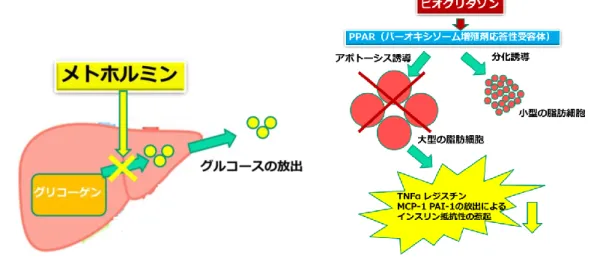
療法およびインスリン補充に加え,経口血糖降下薬の使用が標準的な薬物治療法 となっている。現在,我が国において,膵ランゲルハンス島 β 細胞の膜表面にあ る ATP 依存性 K+チャネルのスルホニル尿素受容体(SUR)に結合し,インスリン を分泌することにより血糖値を低下させる SU 薬,肝臓での糖新生を抑制し,筋肉 および脂肪細胞へのグルコースの取り込みを増大させることで血糖値を低下させ るビグアナイド薬,α-glucosidase を阻害し二糖類のグルコースへの加水分解を阻害 することで小腸からのグルコース吸収量を減少させ食後の高血糖を是正する
α-glucosidase 阻害薬(α-GI),脂肪細胞の核内受容体 PPARγ 受容体を刺激し,インス
Fig.2 Selection of an oral hypoglycemic drug according to disease condition.
This figure was quoted from a document of reference 96.
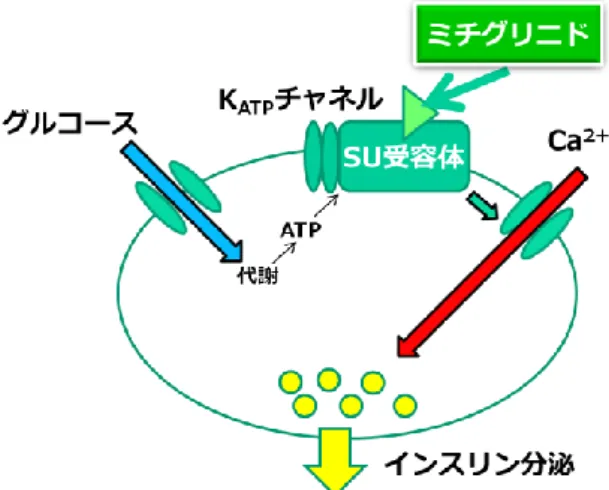
ン分泌が遅延かつ減弱される。インスリンは血糖低下作用だけでなく肝臓での糖 新生抑制に加え細胞内の代謝で同化を促進させ,その結果,脂質およびタンパク 質の代謝にも深く関与することが示されている。糖尿病患者ではインスリン分泌 能の低下により,他のホルモンとの平衡が障害され生体の恒常性への悪影響が誘 発される[27]。グリニド薬の早期かつ短期間のインスリン分泌作用を介して,食後 のインスリン分泌動態が生理的な作用と同様に維持されることは他の薬物には無 い特徴のため,併用を考える際にグリニド薬の適用は大きな治療上の利点となる。
Fig. 3 The effects of mitiglinide.
ことで,糖尿病治療のための併用薬としてのミチグリニドの有用性を検証するこ ととした。そこで,本試験では 2 型糖尿病モデル動物であるニコチンアミド前処 置ストレプトゾトシン誘発 2 型糖尿病ラット(STZ-NA ラット),Zucker diabetic fatty(ZDF)ラットおよび肥満・高インスリン血症モデル Zucker fatty(ZF)ラッ トを用いた。
Fig.4 The features of each animal model.
1.
第 1 章インスリン抵抗性改善薬(メトホルミン,ピオグリタゾン)と
の併用効果
1.1 序論 ビグアナイド薬のメトホルミンは,肝臓での糖新生を抑制し筋肉および脂肪細 胞へのグルコースの取り込みを増加させることでインスリン抵抗性を改善する[7, 42](Fig. 5)。チアゾリジン薬のピオグリタゾンは,脂肪細胞の核内受容体 PPARγ に刺激薬として作用し,インスリン抵抗性を改善する[7, 43](Fig. 5)。インスリン 抵抗性の改善で,主に食間および夜間の高血糖が改善される[7, 42, 43]。これらの 薬物は,肥満などの合併でインスリン抵抗性が上昇しており,かつ内因性インス リン分泌能は保持されている患者に有効とされる[7]。これらの薬物にミチグリニ ドを併用することで,メトホルミンあるいはピオグリタゾンの単独投与よりも食 後早期のインスリン分泌に伴う食後の高血糖の改善効果が加わると期待される。 さらに,ミチグリニドの単独投与よりも加わる薬物の作用でインスリンの感受性 改善の効果も期待される。 本章では ZF ラットを用い,ミチグリニドにメトホルミンあるいはピオグリタゾ ンと併用の血糖値および血漿インスリン値に及ぼす効果について検討した。
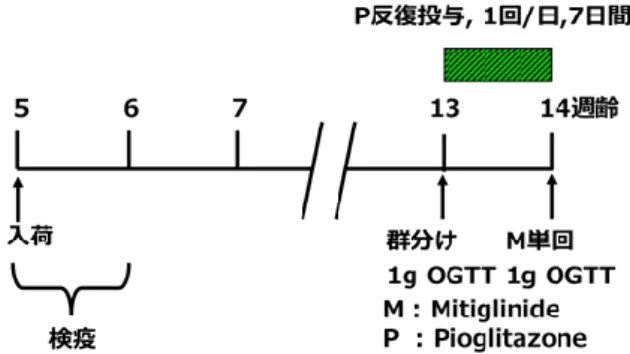
Fig. 6 Outline of combined test of mitiglinide and metformin.
1.2.2.3 血液検体の生化学パラメータの測定
血漿中グルコース濃度測定にはラボアッセイ™グルコース®(和光純薬工業株式
会社,大阪)を,血漿中インスリン濃度測定にはラットインスリン測定キット®
(株式会社森永生科学研究所,神奈川)をそれぞれ用いて測定した。 1.2.2.4 統計解析
統計解析には,SAS system version 9.3(SAS Institute Inc., North Carolina, USA)を 使用し,二元配置分散分析(two-way ANOVA)を実施した。病態モデルラットの 経口グルコース負荷試験より算出された各 AUC を二元配置分散分析の目的変数と して取り扱い,ミチグリニドとメトホルミンを要因とした統計解析を実施した。 それぞれの要因に対する解析結果よりミチグリニドとメトホルミンの主効果を評 価し,両薬物の交互作用の解析によって相加および相乗効果を決定した。危険率 は 5%未満を有意水準(両側検定)として採用した。 1.2.3 結果 1.2.3.1 ZF ラットにおける糖負荷時のメトホルミンとミチグリニドの併用効果 OGTT では,コントロール群の血糖値は 30 分目から 1 時間目で最大値に達し,2 時間目から 3 時間目には投与前の値付近まで戻った(Fig. 7A)。この ZF ラットに おいてミチグリニドは OGTT での血糖低下作用を示した。糖負荷 2 時間目までの 血糖値の推移は,コントロール群に対して低値を示し,糖負荷 2 時間目までの血 糖 AUC(AUC0-2h)は,コントロール群のそれに対して低下した(ミチグリニド:
F(1, 44)= 9.7, P = 0.0032, Fig. 7A, 7B,two-way ANOVA)。インスリン抵抗性改善薬
であるメトホルミンの単独投与群の血糖値はコントロール群のそれよりも低値で
推移し,AUC0-2hは低下した(メトホルミン:F(1, 44) = 8.45, P= 0.0057, Fig. 7A, 7B,
two-way ANOVA)。このメトホルミンにミチグリニドを併用すると,それぞれの単
独投与に対して投与 2 時間目までの各時点における血糖値は低値となった(Fig.
かったことからミチグリニドとの併用投与による血糖低下作用はそれぞれの単独 投与の作用に対して相加的な効果を示すと考えられた(ミチグリニド+メトホルミ ン:F(1, 44)= 0.67, P= 0.4181, Fig. 7B, two-way ANOVA)。
Fig.7 Effects of mitiglinide, metformin, and their combination on plasma glucose levels in OGTT (1 g/kg).
(A) Temporal transition of plasma glucose levels during OGTT in ZF rats. (B) Plasma
glucose AUC0–2h during OGTT in ZF rats. Data are means ±SEM of 12 animals. N: normal,
C: control, M: mitiglinide, Met: metformin.
ZF ラットはインスリン抵抗性を示すことが知られているが,本実験結果でも, 血漿インスリン値は,正常動物のそれよりも高いレベルであったが,OGTT で,血 漿インスリン値のさらなる上昇が観察された(Fig. 8A)。OGTT 時,高インスリン 血症を示す ZF ラットでもミチグリニド群で糖負荷後 1 時間目までのインスリン分 泌がコントロール群のそれよりも高値となった(Fig. 8A)。ミチグリニド群のイン スリン AUC0-1h は,コントロール群のそれよりも増加した(ミチグリニド:F(1,
44) = 5.15, P= 0.0283, Fig. 8A, 8B, two-way ANOVA)。
メトホルミン投与群ではコントロール群に対し,空腹時の血中インスリンレベ ルの低下および糖負荷 1 時間目以降のインスリン分泌量が低値となり,インスリ
ン AUC0-1hを減少させた(メトホルミン:F(1, 44)= 4.24, P= 0.0454, Fig. 8A, 8B,
two-way ANOVA)。一方,メトホルミンとミチグリニドとの併用投与群ではインスリン
それよりも低値となった。両薬物の併用投与では,ミチグリニドのインスリン分 泌促進作用とメトホルミンのインスリン分泌量の減少効果の両者の作用が反映さ れた結果と考えられた(ミチグリニド+メトホルミン:F (1, 44)= 1.71, P= 0.1977,
Fig. 8B, Two-way ANOVA)。
Fig.8 Effects of mitiglinide, metformin, and their combination on plasma insulin levels in OGTT (1 g/kg).
(A) Temporal transition of plasma insulin levels during OGTT in ZF rats. (B) Plasma
insulin AUC0–1h during OGTT in ZF rats. Data are means ±SEM of 12 animals. N: normal,
Fig. 9 Outline of combined test of mitiglinide and pioglitazone.
1.3.2.3 血液検体の生化学パラメータの測定 1.2.2.3 の方法を参照
1.3.2.4 統計解析
統計解析には,SAS system version 9.3(SAS Institute Inc., North Carolina, USA)を 使用し二元配置分散分析を実施した。病態モデルラットの経口液体飼料負荷試験 より算出された各 AUC を二元配置分散分析の目的変数として取り扱い,ミチグリ ニドとピオグリタゾンを要因とした統計解析を実施した。それぞれの要因に対す る解析結果よりミチグリニドとピオグリタゾンの主効果を評価し,両薬物の交互 作用の解析によって相加および相乗効果を決定した。危険率は 5%未満を有意水準 (両側検定)として採用した。 1.3.3 結果 1.3.3.1 ZF ラットにおける液体飼料負荷時のピオグリタゾンとミチグリニドの併用 効果 液体飼料負荷により,コントロール群の血糖値は負荷後 15 分目から 30 分目で 最大値に達し,2 時間目から 3 時間目の間には投与前の値付近まで戻った(Fig. 10A)。ミチグリニドは液体飼料負荷後でも OGTT と同様な血糖低下作用を示し, その AUC0-2h はコントロール群のそれよりも低値となった(ミチグリニド:F(1,
56)= 11.17, P= 0.0015, Fig. 10A, 10B,two-way ANOVA)。インスリン抵抗性改善薬
AUC0-2hも減少した(ピオグリタゾン:F(1, 56)= 60.32, P< 0.0001, Fig. 10A, 10B,
two-way ANOVA)。ピオグリタゾンとミチグリニドを併用すると,投与 2 時間目ま
での各時点の血糖値がそれぞれの単独投与でのそれよりも低値となった(Fig.
10A)。この併用投与による AUC0-2h の交互作用は認められなかったことから,ミ
チグリニドとの併用投与による血糖低下作用はそれぞれの単独投与の作用に対し て相加的なものと考えられた(ミチグリニド+ピオグリタゾン:F(1, 56)= 0.17, P=
0.6817, Fig. 10B, two-way ANOVA)。
Fig.10 Effects of mitiglinide, pioglitazone, and their combination on plasma glucose levels in oral meal tolerance test (15 kcal/kg).
(A) Temporal transition of plasma insulin levels during oral meal tolerance test in ZF rats.
(B) Plasma insulin AUC0–1h during oral meal tolerance test in ZF rats. Data are means
±SEM of 14-15 animals. N: normal, C: control, M: mitiglinide, P: pioglitazone.
血漿インスリンレベルでも OGTT と同様のミチグリニドによるインスリン分泌 促進作用が液体飼料負荷試験でも観察された(ミチグリニド:F(1, 56)= 4.81, P= 0.0324, Fig. 11A, 11B, two-way ANOVA)。ピオグリタゾンのみの処置でも血漿インス
リンレベルは常に低値で,インスリン AUC0-1h を減少させた(ピオグリタゾン:
F(1, 56)= 15.86, P= 0.0002, Fig. 11A, 11B, two-way ANOVA)。両薬物の併用投与によ
るインスリン分泌の AUC0-1hはコントロール群のそれと同レベルであり,ミチグリ
両薬物の併用投与では血漿インスリンレベルはコントロール群のそれと同様のも のとなった。つまり,ミチグリニドのインスリン分泌促進作用とピオグリタゾン のインスリン分泌量の減少効果が反映された結果と考えられた(ミチグリニド+ピ オグリタゾン: F (1, 56) = 0.77, P= 0.3840, Fig. 11B, Two-way ANOVA)。
Fig.11 Effects of mitiglinide, pioglitazone, and their combination on plasma insulin levels in oral meal tolerance test (15 kcal/kg).
(A) Temporal transition of plasma insulin levels during oral meal tolerance test in ZF rats.
(B) Plasma insulin AUC0–1h during oral meal tolerance test in ZF rats. Data are means
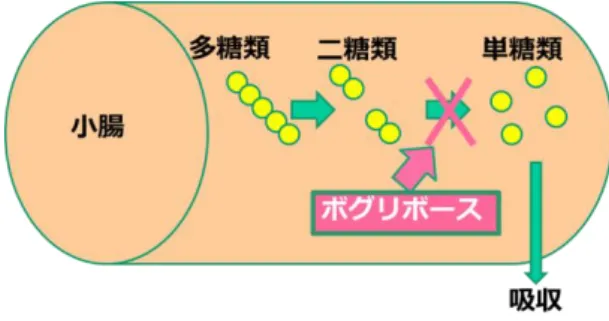
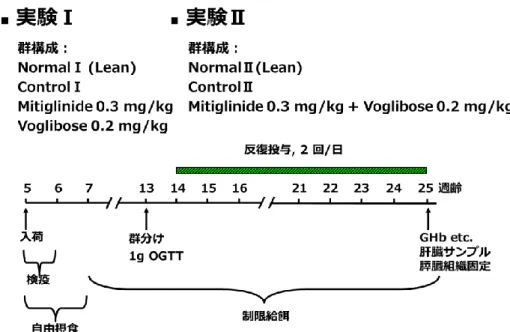
2. 第 2 章α-グルコシダーゼ阻害薬:ボグリボースとの併用効果 2.1 序論 α-GI 薬のボグリボースは,α-グルコシダーゼを阻害する。そのため,二糖類か らグルコースへの加水分解が阻止されるので小腸からのグルコース吸収が抑制さ れ,食後の高血糖が是正されることとなる[45](Fig. 12)。ボグリボースによる糖 の吸収抑制とミチグリニドによる食後早期のインスリン分泌の組合せにより,強 力な食後の血糖値上昇の抑制が期待される。 本章において,まずミチグリニドとボグリボースの併用単回投与の効果を STZ-NA ラットにて検討した。次に,食後高血糖の継続的な是正が糖尿病の病態進展抑 制と結びつく可能性について,ZDF ラットを用い,これら薬物の併用反復投与の 効果を検討した。
Fig. 12 The effects of voglibose.
Fig. 13 Outline of combined test of mitiglinide and voglibose.
2.3.3.3 TUNEL 法による膵ランゲルハンス島細胞のアポトーシスの解析
血漿中のインスリン,グルコース,トリグリセリド,総コレステロール,遊離 脂肪酸およびアディポネクチン濃度は,それぞれラットインスリン測定キット
(株式会社森永生科学研究所,神奈川)ラボアッセイ™グルコース®,トリグリセラ
イド E-テストワコー®,コレステロール E-テストワコー®, NEFA C-テストワコー
®(以上,和光純薬工業株式会社,大阪)および Rat Adiponectin ELISA kit®(メル
2.4 結果 2.4.1 STZ-NA ラットにおける OSTT 時のボグリボースとミチグリニドの併用効果 STZ-NA ラットにおける OSTT 後の血糖推移は,ミチグリニド投与により正常群 の血糖推移と同様のものとなった。つまり,ミチグリニド投与により,AUC0-2h は コントロール群よりも低値となった(ミチグリニド:F(1, 20)= 17.01, P= 0.0005, Fig.
14A, 14B two-way ANOVA)。ミチグリニド投与によりインスリン分泌不全に陥った
STZ-NA ラットでもコントロール群のインスリン分泌に対し高値で推移し,インス
リン AUC0-1hを増大させた(ミチグリニド:F(1,20)= 4.55, P= 0.0455, Fig. 15A, 15B,
two-way ANOVA)。
Fig.14 Effects of mitiglinide,voglibose, and their combination on plasma glucose levels in OSTT (2.5 g/kg).
(A) Temporal transition of plasma glucose levels during OSTT in STZ-NA rats. (B) Plasma
glucose AUC0–2h during OSTT in STZ-NA rats. Data are means ±SEM of 6 animals. N:
normal, C: control, M: mitiglinide, V: voglibose.
STZ-NA ラットへの OSTT 後の血糖値は,ボグリボース投与により投与後 2 時間
目まで正常群の血糖値を下回り,AUC0-2h もコントロール群のそれよりも低値とな
った(ボグリボース:F(1, 20)= 45.74, P< 0.0001, Fig. 14A, 14B, two-way ANOVA)。 ボグリボース群のインスリン分泌についてもコントロール群のそれよりも低値で
Fig.15A, 15B, two-way ANOVA)。
Fig.15 Effects of mitiglinide,voglibose, and their combination on plasma insulin levels in OSTT (2.5 g/kg).
(A) Temporal transition of plasma insulin levels during OSTT in STZ-NA rats. (B) Plasma
insulin AUC0–1h during OSTT in STZ-NA rats. Data are means ±SEM of 6 animals. N:
normal, C: control, M: mitiglinide, V: voglibose.
れた。コントロール群の遊離脂肪酸濃度(NEFA)およびアディポネクチンを除くす べての血液指標(血糖値,GHb,TG,総コレステロール値)および肝臓中のトリ グリセリド(TG)および総コレステロール値でも正常群のそれよりも高値を示し た(Table.1)。 実験 I では,コントロール群の血漿グルコース濃度に対し,ミチグリニド単独群 では血漿グルコース濃度が低下する傾向が観察された(ミチグリニド:P= 0.1047, Table.1)。一方,ボグリボース単独群の血漿グルコース濃度は,コントロール群の それよりも低値を示した(Table.1)。実験終了時における各薬物単独群の GHb は低 下傾向を示した(ミチグリニド:P= 0.2444,ボグリボース:P= 0.0893, Table.1)。 その他の血液中および肝臓中の指標でもコントロール群とミチグリニド単独群ま たはボグリボース単独群との間に有意な差は観察されなかった(Table. 1)。
Table.1 Summary of body weight, blood and liver parameters in Experiment I ( single drug administration experiment ).
Data are mean ± standard error of the mean (SEM) of 5-6 animals. #:p < 0.05 vs. control I (Student’s t test). M0.3:mitiglinide 0.3 mg/kg,V0.2:voglibose 0.2 mg/kg
ントロール群で GHb 上昇,血漿グルコース濃度上昇および血漿インスリン濃度の 継時的上昇が観察された。ミチグリニドとボグリボースの併用反復投与によりこ れらのパラメータが抑制されることが示された(Table. 2)。実験 II の終了時に,コ ントロール群のアディポネクチン濃度は正常群のそれよりも低値となったが,ミ チグリニドとボグリボースの併用反復投与群では,低下したアディポネクチンの 濃度が正常群レベルまで回復した(Table. 2)。実験 II の血中および肝臓中の TG と 総コレステロール値は,コントロール群で増加したのに対し(Table. 2),併用群の それは低値となった(Table. 2)。これらの結果から,単独では十分な改善効果を示 さない投与量のミチグリニドとボグリボースを併用反復投与することにより,血 液および肝臓中の評価項目の値が改善された(Table. 2)。
Table.2 Summary of body weight, blood and liver parameters in Experiment II (drug combination administration experiment).
Data are mean ± standard error of the mean (SEM) of 6 animals. #:p < 0.05 vs. control II (Student’s t test). M0.3:mitiglinide 0.3 mg/kg,V0.2:voglibose 0.2 mg/kg 2.4.2.2 膵ランゲルハンス島の病理組織学的評価
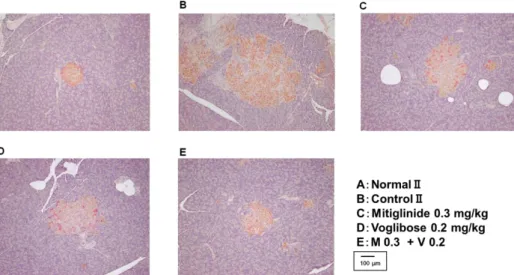
実験 I および実験 II のコントロール群で,病態の進展に伴い ZDF ラットの膵ラ
ンゲルハンス島に占める β 細胞の面積の割合が低下し,線維化面積の割合が上昇
した(Fig. 16, 17, 18A, 18B)。これに対し,11 週間のミチグリニドとボグリボース
面積の割合の上昇がともに抑制された(Fig. 18B)。一方,ミチグリニドの単独投 与で膵ランゲルハンス島に占める β 細胞の面積の割合の低下が改善されたものの, 線維化面積の割合に対するミチグリニドの効果は観察されなかった(Fig. 18A)。 ボグリボース単独投与では,膵ランゲルハンス島の病理組織学的な改善効果は観 察されなかった(Fig. 18A)。非 β 細胞面積は,実験 I および実験 II ともにコント ロール群で病理組織学的な変性が観察された。しかしながら,それぞれの薬物の 単独投与あるいは併用投与は非β 細胞面積に影響しなかった(Fig. 18A, 18B)。
Fig. 16 Observation of pancreatic islets by insulin immunostaining.
Fig. 17 Observation of pancreatic islets by Masson's Trichrome staining.Masson
trichrome staining are shown in blue. M 0.3: Mitiglinide 0.3 mg/kg, V 0.2: Voglibose 0.2 mg/kg.
Fig. 18 The area of the pancreatic β cells, non-β cells and the fibrosis area of the pancreatic islets.
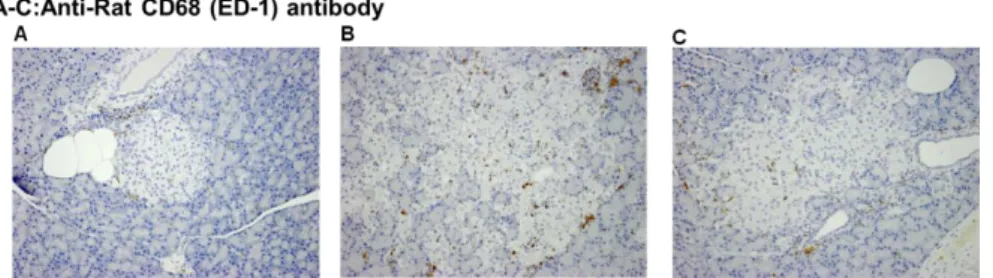
A:Experiment I (single drug administration experiment),B:Experiment II (drug combination administration experiment). Data are mean ± standard error of the mean (SEM) of 5–6 animals. #:p < 0.05 vs control (Student’s t test).M0.3:mitiglinide 0.3 mg/kg, V0.2: voglibose 0.2 mg/kg. 次に,膵ランゲルハンス島 β 細胞の増殖能と細胞死に対する薬物の効果につい て検討した(Table. 3, 4)。TUNEL 染色による細胞死に対して,コントロール群の 陽性細胞数が正常群のそれより高値となり,ZDF ラットの病態進展に伴う膵ラン ゲルハンス島での死細胞数が増加した。一方,ミチグリニドの単独投与およびミ チグリニドとボグリボースの併用投与は,増加した TUNEL 陽性細胞数を減少させ た(Table. 3, 4)。 続いて,抗 CD68 抗体を用いて膵ランゲルハンス島における炎症反応について検 討した。実験 I および実験 II ともにコントロール群で CD68 陽性単核細胞数(マク ロファージ)が正常群より高値となった。つまり,ZDF ラットの膵ランゲルハン ス島でマクロファージの増加が示された(Fig. 19, Table. 3, 4)。ボグリボースの単 独投与並びにミチグリニドとボグリボースの併用投与は,膵ランゲルハンス島中 の CD68 陽性単核細胞数を減少させた(Table. 3, 4)。
Fig. 19 Observation of pancreatic islets by CD68 (ED-1) staining.
Table.3 Summary of parameters in single drug administration experiment (Experiment I) by TUNEL method and CD68 immunostaining.
In each cases, parameters are indicated by the number of positive cells per islet cells. Data are mean ± standard error of the mean (SEM) of 5-6 animals. #:p < 0.05 vs. control I(Student‘s t test). M0.3:mitiglinide 0.3 mg/kg, V0.2:voglibose 0.2 mg/kg
Table.4 Summary of parameters in drug combination administration experiment (Experiment II) by TUNEL method and CD68 immunostaining.
In each cases, parameters are indicated by the number of positive cells per islet cells. Data are mean ± standard error of the mean (SEM) of 6 animals. #:p < 0.05 vs. control II (Student‘s t test). M0.3:mitiglinide 0.3 mg/kg, V0.2:voglibose 0.2 mg/kg.
Fig.20 The effects of dapagliflozin and canagliflozin.
This figure was quoted and modified from Endocr Rev.2011;32:515-31
Fig.21 Outline of combined test of mitiglinide and dapagliflozin.
として採用した。 3.4 結果 3.4.1 ZF ラットにおける OGTT 時のダパグリフロジンとミチグリニドの併用効果 OGTT では,コントロール群の血糖値はグルコース負荷 30 分目から 1 時間目で 最大値に達し,2 時間目までに投与前値付近に回復した(Fig. 22A)。本試験で用い た ZF ラットは群間での空腹時の血糖値に差があったため,投与前値から 2 時間目 までの血糖値の変化量を指標としたΔAUC を用いて,薬物の血糖降下作用を評価 した。コントロール群のΔAUC0-2h は,正常群のそれと比較して高値を示した
(P<0.0001,Fig. 22A,t-test)。血糖低下作用への two-way ANOVA 解析で,ミチグ リニドおよびダパグリフロジンの主作用には有意差があった(ミチグリニド:F(1, 44)=5.84, P= 0.0199, ダパグリフロジン:F(1, 44)= 14.25, P< 0.0001, Fig. 22B, two-way ANOVA)。一方,両薬物の併用による交互作用に統計的差異はなかった(ミチ グリニド+ダパグリフロジン:F(1, 44)= 0.98, P= 0.3276, Fig. 22B, two-way ANOVA)。つまり,ミチグリニドおよびダパグリフロジンの併用は ZF ラットの血 糖値を相加的に低下させることが示された。 ZF ラットの血漿インスリン値は,正常動物のそれよりも高いレベルであった。 ZF ラットへの OGTT で,さらなる血漿インスリン値の増大が観察された(Fig. 23A)。ミチグリニドはインスリンの AUC0-1h をコントロール群のそれよりも増加 させ,その一方でダパグリフロジンはインスリンの AUC0-1hを減少させた(ミチグ リニド:F(1, 44)= 21.39, P< 0.0001, ダパグリフロジン:F(1, 44)= 20.72, P< 0.0001,
Fig. 23B, two-way ANOVA)。Fig. 23B に示すように,両薬物の併用投与によるイン
Fig.22 Effects of mitiglinide, dapagliflozin, and their combination on plasma glucose levels in OGTT (1 g/kg).
(A) Temporal transition of plasma glucose levels during OGTT in ZF rats. (B) glucose
AUC0–2h during OGTT in ZF rats. Data are means ±SEM of 12 animals. N: normal, C:
control, M: mitiglinide, D: dapagliflozin.
Fig.23 Effects of mitiglinide, dapagliflozin, and their combination on plasma insulin levels in OGTT (1 g/kg).
(A) Temporal transition of plasma insulin levels during OGTT in ZF rats. (B) insulin AUC0–
1h during OGTT in ZF rats.. Data are means ±SEM of 12 animals. N: normal, C: control, M:
mitiglinide, D: dapagliflozin.
リフロジン;9.1±0.6 mL 及び併用群;7.3±1.0 mL Fig. 24A)。ZF ラットにおける 6 時間目までの尿糖排泄量を Fig. 24B に示す。尿糖排泄量は,ダパグリフロジン投 与群で著しく増加した。ミチグリニドとダパグリフロジンの併用投与群でも尿糖 排泄量は高いレベルにあったが,ダパグリフロジン投与群のそれの約 50%となっ た。尿糖排泄に対する two-way ANOVA 解析で,ミチグリニドとダパグリフロジン の主作用に有意差があった(ミチグリニド:F(1, 20)= 5.25, P= 0.0329, ダパグリ フロジン:F(1, 20)= 50.61, P< 0.0001, Fig. 24B, two-way ANOVA)。さらに,ミチ グリニドとダパグリフロジンの交互作用でも有意差があった(ミチグリニド+ダパ グリフロジン:F(1, 20)= 5.23, P= 0.0332, Fig. 24B, two-way ANOVA)。これらの結果 からミチグリニドはダパグリフロジンにより促進される尿糖排泄促進作用を減少 させることが示された。
Fig.24 Effects of mitiglinide, dapagliflozin, and their combination on urinary volume and glucose secretion in OGTT (1 g/kg).
(A) Effects of mitiglinide, dapagliflozin, and their combination on urinary volume until 6 h in ZF rats. (B) Effects of mitiglinide, dapagliflozin, and their combination on glucose secretion until 6 h in ZF rats Data are means ±SEM of 6 animals. N: normal, C: control, M: mitiglinide, D: dapagliflozin.
3.4.2 STZ-NA ラットにおける OGTT 時のダパグリフロジンとミチグリニドの併用効 果
ミチグリニドおよびダパグリフロジン単独投与は OGTT 後の血糖値上昇を抑制し た。両薬物の併用投与による血糖値低下作用は単独投与でのそれよりも強力で, 血糖値推移は正常群のそれとほぼ同様であった(Fig. 25A)。糖負荷後 2 時間目ま
での血糖 AUC0-2h値を Fig. 24B に示す。コントロール群の AUC0-2hは正常群のそれ
よりも高値となった(P= 0.0006, Fig. 25B, t-test)。ミチグリニドとダパグリフロジ ンの併用効果について two-way ANOVA 解析を実施したところ,併用による交互作 用に有意差は認められなかった(ミチグリニド+ダパグリフロジン:F(1, 20)= 3.73,
P= 0.0678, Fig. 25B, two-way ANOVA)。その一方で,両薬物の血糖低下に対する主
作用には有意差があった(ミチグリニド:F(1, 20)= 21.53, P= 0.0002, ダパグリフロ ジン:F(1, 20)= 24.47, P< 0.0001, Fig. 25B, two-way ANOVA)。これらの結果から, ミチグリニドとダパグリフロジンとの併用は血糖値を相加的に低下させることが 示された。
Fig.25 Effects of mitiglinide, dapagliflozin, and their combination on plasma glucose levels in OGTT (1 g/kg).
(A) Temporal transition of plasma glucose levels during OGTT in STZ-NA rats. (B) glucose AUC0–2h during OGTT in STZ-NA rats. Data are means ±SEM of 6 animals. ** P < 0.01 vs.
normal. N: normal, C: control, M: mitiglinide, D: dapagliflozin.
なかった(Fig. 26A)。さらに,両薬物の併用によるインスリン分泌は,ミチグリ ニド単独投与のインスリン分泌の経時変化と同程度となった。
Fig.26 Effects of mitiglinide, dapagliflozin, and their combination on plasma insulin levels in OGTT (1 g/kg).
(A) Temporal transition of plasma insulin levels during OGTT in STZ-NA rats. (B) Insulin
AUC0–1h during OGTT in STZ-NA rats. Data are means ±SEM of 12 animals. N: normal, C:
control, M: mitiglinide, D: dapagliflozin.
尿糖については,各個体で排尿までの時間にばらつきが生じたため負荷後 6 時 間目まで採尿した値を比較した(Fig. 27A, 27B)。OGTT 下,6 時間までの尿量には 群間での差異はなかった(正常群 5.1±0.7 mL,コントロール群;6.1±0.5 mL,ミ チグリニド;5.9±0.6 mL,ダパグリフロジン;7.2±0.6 mL 及び併用群;4.6±0.3 mL, Fig. 27A)。ダパグリフロジン投与群の尿糖排泄量は増加した。一方,併用群 の尿糖排泄量は,ダパグリフロジン投与群のそれの約 50%抑制となった。尿糖排 泄量への two-way ANOVA 解析で,ミチグリニドとダパグリフロジンの主作用には 有意差があった(ミチグリニド:F(1, 20)= 7.81, P= 0.0112, ダパグリフロジン:F(1,
20)= 54.44, P< 0.0001, Fig. 27B, two-way ANOVA)。さらに,ミチグリニドとダパグ
リフロジンの交互作用でも有意差があった(ミチグリニド+ダパグリフロジン:
F(1, 20)= 7.87, P= 0.0109, Fig. 27B, two-way ANOVA)。これらの解析結果より,ミチ
Fig.27 Effects of mitiglinide, dapagliflozin, and their combination on urinary volume and glucose secretion in OGTT (1 g/kg).
(A) Effects of mitiglinide, dapagliflozin, and their combination on urinary volume until 6 h in STZ-NA rats. (B) Effects of mitiglinide, dapagliflozin, and their combination on glucose secretion until 6 h in STZ-NA rats Data are means ±SEM of 6 animals. N: normal, C: control, M: mitiglinide, D: dapagliflozin.
3.4.3 STZ ラットにおける OGTT 時のカナグリフロジンとミチグリニドの併用効果 ミチグリニドあるいはカナグリフロジンの単独投与により,OGTT 後のコントロ ール群での血糖値上昇を減弱した(Fig. 28A)。両薬物の併用投与による OGTT 後 血糖値上昇を低下させる作用は単独投与でのそれよりも強力となり,正常群の血
糖推移よりも低いものとなった(Fig. 28A)。糖負荷後 2 時間目までの血糖 AUC0-2h
Fig.28 Effects of mitiglinide, canagliflozin, and their combination on plasma glucose levels in OGTT (1 g/kg).
(A) Temporal transition of plasma glucose levels during OGTT in STZ-NA rats. (B)
Glucose AUC0–2h during OGTT in STZ-NA rats.. Data are means ±SEM of 6 animals. N:
normal, C: control, M: mitiglinide, Ca: canagliflozin.
ミチグリニド投与はインスリン分泌の経時変化を正常群のそれに近似させた。 その一方で,カナグリフロジン投与はインスリン分泌能を低下させた(ミチグリ ニド:F(1, 19)= 10.98, P= 0.0036, カナグリフロジン:F(1, 19)= 9.14, P= 0.007, Fig.
29A, 29B, two-way ANOVA)。さらに,両薬物の併用によるインスリン分泌能もミ
チグリニド単独投与のそれよりも減弱し,コントロール群のそれと同様のものと なった(ミチグリニド+カナグリフロジン:F(1, 19)= 0.96, P= 0.3404, Fig. 29A, 29B,
two-way ANOVA)。これはミチグリニドのインスリン分泌促進作用とカナグリフロ
Fig.29 Effects of mitiglinide, canagliflozin, and their combination on plasma insulin levels in OGTT (1 g/kg).
(A) Temporal transition of plasma insulin levels during OGTT in STZ-NA rats. (B) Insulin
AUC0–1h during OGTT in STZ-NA rats.. Data are means ±SEM of 12 animals. N: normal,
C: control, M: mitiglinide, Ca: canagliflozin.
OGTT 後 8 時間目までの尿量は,カナグリフロジン単独投与群でのみ増加した (ミチグリニド:F(1, 20)= 4.1, P= 0.0565,カナグリフロジン:F(1, 20)= 9.52, P=
Fig.30 Effects of mitiglinide, canagliflozin, and their combination on urinary volume and glucose secretion in OGTT (1 g/kg).
(A) Effects of mitiglinide, canagliflozin, and their combination on urinary volume until 6 h in STZ-NA rats. (B) Effects of mitiglinide, canagliflozin, and their combination on glucose secretion until 6 h in STZ-NA rats Data are means ±SEM of 6 animals. N: normal, C: control, M: mitiglinide, Ca: canagliflozin.
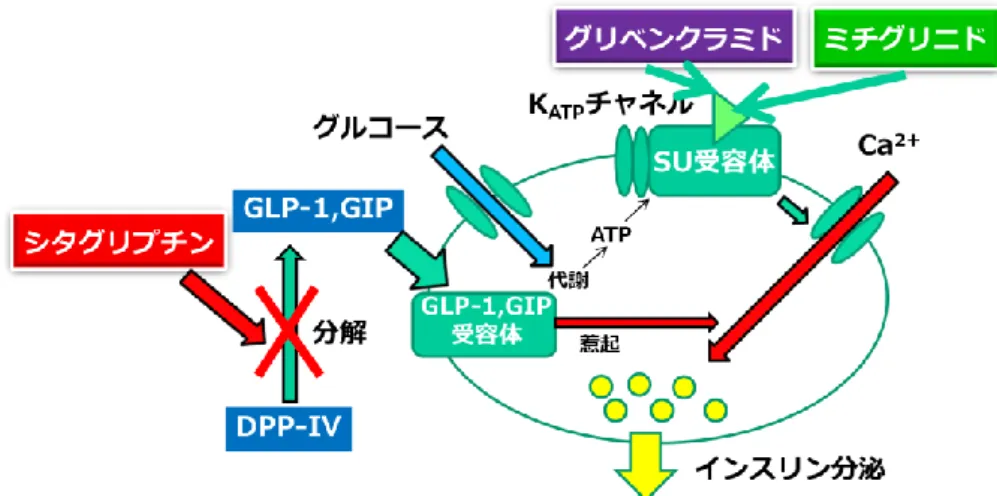
Fig. 31 The effects of mitiglinide, glibenclamide and sitagliptin.
4.2 実験材料 4.2.1 実験動物および選択理由 STZ-NA ラットの選択理由については 2.2.1 に準じた。 SD 系 雄性ラットは SLC 社から購入した。Wistar 系雄性ラットは日本チャール スリバー株式会社(神奈川)から購入した。8 週齢の実験動物の倫理を含めた飼育 および実験については動物は 1.2.1.1 に準じた。 4.2.2 使用薬物 ミチグリニド(キッセイ薬品工業)およびグリベンクラミド(和光純薬工業) は 0.5%カルボキシメチルセルロースナトリウム(0.5%CMC)溶液に懸濁し,シタ グ リ プ チ ン ( Sequoia Research Products 社 ,UK ) は 0.25% メ チ ル セ ル ロ ー ス (0.25%MC)溶液に溶解して,実験動物に経口投与した。In vitro 実験系では,ミチ グリニド,グリベンクラミドおよびシタグリプチンを dimethyl sulfoxide(DMSO,
Sigma-Aldrich Co.St. Louis, MO, USA)に溶解し,さらに 80 mM MgCl2含有の緩衝
4.3 試験方法 4.3.1 DPP-IV 活性に対する阻害作用 4.3.1.1 ラット血漿を用いた DPP-IV 活性への阻害作用 DPP-IV 活性の測定は,Fukushima らの方法[81]を一部変更して行われた。ラット 血漿に薬物を添加した 80 mM MgCl2含有の緩衝液(25 mM HEPES, 140 mM NaCl, 1% BSA, pH 7.8)を混和し,室温でプレインキュベーションした後,0.05 mM の基 質(H-Gly-Pro-7-amino-4-methylcoumarin (AMC)を緩衝液で調製)を加えた。室温, 遮光下で 25 分間インキュベーションし,25% 酢酸溶液を加えて反応を停止させた。 蛍光強度(励起波長 380 nm,蛍光波長 460 nm)をマイクロプレートリーダー
(SPECTRA MAX GEMINI®
4.4 結果
4.4.1 DPP-IV 活性に対する阻害作用(in vitro,in vivo)
正常ラットの血漿中 DPP-IV 活性に及ぼすミチグリニド, グリベンクラミドおよ びシタグリプチンの効果を Fig. 32 に示す。シタグリプチンは濃度依存的に DPP-IV 活性を阻害し,その IC50値は 1.6×10⁻⁷ mol/L であった。一方,ミチグリニドおよ びグリベンクラミドは,いずれも 1×10⁻⁴ mol/L までの濃度では DPP-IV 活性に影 響しなかった(Fig. 32)。
Fig.32 Effect of mitiglinide, glibenclamide, and sitagliptin on plasma DPP-IV activity in normal rats in vitro.
Fig.33 Effects of mitiglinide (A), glibenclamide (B), sitagliptin, and their combinations on plasma DPP-IV activity in STZ-NA rats ex vivo.
Data point represents the mean value ± SEM of measurements in 5 animals. M+S: mitiglinide + sitagliptin, M+G: glibenclamide + sitagliptin.
4.4.2 STZ-NA ラットにおける OGTT 時のシタグリプチンとの併用時におけるミチグ リニドと SU 薬(グリベンクラミド)の効果の比較 STZ-NA ラットに OGTT を実施した。糖負荷後の血糖値の推移へのミチグリニ ド,シタグリプチンおよび両薬物の併用作用を Fig. 34A に示した。ミチグリニド はグルコース投与 1 および 2 時間目までの血糖上昇を,シタグリプチンはグルコ ース投与後 1 時間目までの血糖上昇をコントロール群のそれよりも軽減した(ミ チグリニド: 1h P< 0.0001, 2h P= 0.001, Fig. 34A, シタグリプチン:1h P=0.0052,
Fig. 34A, Tukey test)。グルコース投与後 3 時間目以降でミチグリニド群およびシタ
グリプチン群の血糖値はいずれもコントロール群のそれと同様の値となった(ミ チグリニド: 3h P= 0.232, 5h P= 0.4796, Fig. 22A,シタグリプチン:3h P=0.9833, 5h
P= 0.9903, Fig. 34A, Tukey test)。ミチグリニドおよびシタグリプチンの併用投与群
グルコース投与 2 時間目までなので,その血糖 AUC0-2hを Fig. 34B に示す。ミチグ
リニドおよびシタグリプチンの血糖 AUC0-2hは,コントロール群のそれよりも低値
であったが(ミチグリニド: F(1, 59)= 43.09, P< 0.0001, シタグリプチン: F(1,
59)=20.93, P< 0.0001, Fig. 34B, two-way ANOVA), 血糖 AUC0-2hに対する両薬物の
交互作用に有意差は無かった(ミチグリニド+シタグリプチン: F(1, 59)=0.06, P=
0.8073, Fig. 34B, Two-way ANOVA)。
Fig.34 Effects of mitiglinide, sitagliptin, and their combination on plasma glucose levels in OGTT (1 g/kg).
(A) Temporal transition of plasma glucose levels during OGTT in STZ-NA rats. (B)
Glucose AUC0–2h during OGTT in STZ-NA rats.. Data are means ±SEM of 10-16 animals.
*** p <0.001* p <0.05 vs control. (Mitiglinide, 1 h: p < 0.0001, 2 h: p =0.0004; Sitagliptin, 1 h p = 0.0052; Mitiglinide + Sitagliptin, 15 min: p =0.0488, 0.5h: p <0.0001 , 1h: p <0.0001, 2h: p <0.0001).## p <0.01 vs Mitiglinide. ††† p <0.001 vs Sitagliptin. (Mitiglinide + Sitagliptin, 1h: p = 0.0034 vs. mitiglinide; 1h: p < 0.0001 vs. sitagliptin). N: normal, C: control, M: mitiglinide, S: sitagliptin.
れた血糖値の上昇度合いが軽減されたが,2 時間目以降では血糖値の降下作用は観 察されなかった(シタグリプチン:0.5h P= 0.0172, 1h P< 0.0001, Fig. 35A, Tukey
test)。グリベンクラミドとシタグリプチンの併用投与群の血糖値の推移は,グルコ ース投与後 2 時間目まではシタグリプチン単独と,5 時間目まではグリベンクラミ ド単独のそれと同様の推移を示した(Fig. 35A)。グリベンクラミド投与により血 糖値が降下したグルコース投与後 2 から 5 時間目までの血糖 AUC2-5hを Fig. 35B に 示す。グリベンクラミド群の血糖 AUC2-5hは,コントロール群のそれに対して低値 となったが,シタグリプチン群の血糖 AUC2-5hはコントロール群のそれと同程度で あった。両薬物の併用による血糖 AUC2-5hはグリベンクラミド群のそれとほぼ同程 度であり(グリベンクラミド:F(1, 56)= 104.61, P< 0.0001, シタグリプチン:F (1, 56)= 0, P= 1 Fig. 35B,two-way ANOVA),交互作用に有意差は認められなかっ た(グリベンクラミド+シタグリプチン:F(1, 56)= 0.09, P= 0.7653 Fig. 35B, two-way
ANOVA)。
Fig.35 Effects of glibenclamide, sitagliptin, and their combination on plasma glucose levels in OGTT (1 g/kg).
(A) Temporal transition of plasma glucose levels during OGTT in STZ-NA rats. (B)
Glucose AUC0–2h during OGTT in STZ-NA rats.. Data are means ±SEM of 10-16 animals.
STZ-NA ラットの OGTT 後の血漿インスリン濃度に及ぼすミチグリニド,シタ グリプチンおよび両薬物の併用効果を Fig. 36A に示す。ミチグリニド群の血漿イ ンスリン濃度はグルコース投与後 0.25 時間目で,コントロール群のそれよりも高 値となり,インスリン分泌量の増大を示した(ミチグリニド:0.25h P= 0.009, Fig.
36A, Tukey test)。ミチグリニドとシタグリプチンの併用群の血漿インスリン濃度は,
それぞれの単独投与群のそれよりも高値で推移し,グルコース投与後 0.25 および 0.5 時間目でインスリン分泌の増大が認められた(ミチグリニド+シタグリプチ ン:0.25h P= 0.0014, 0.5h P= 0.0001, Fig. 36A, Tukey test)。ミチグリニド投与後に, 血漿インスリン濃度の上昇作用がみられたグルコース投与後 1 時間目までのイン
スリン AUC0-1hを Fig. 36B に示す。ミチグリニドおよびシタグリプチンのインスリ
ン AUC0-1hは,コントロール群のそれよりも高値となったが(ミチグリニド: F(1,
59)=14.56, P=0.0003,シタグリプチン: F(1, 59)=6.71, P=0.0121, Fig. 36B, two-way
ANOVA),インスリン AUC0-1hに対する両薬物の交互作用に有意差は無かった(ミ
チグリニド+シタグリプチン:F(1, 59)=0.66, P=0.4198, Fig. 36B, Two-way ANOVA)。
Fig.36 Effects of mitiglinide, sitagliptin, and their combination on plasma insulin levels in OGTT (1 g/kg).
(A) Temporal transition of plasma insulin levels during OGTT in STZ-NA rats. (B) Insulin
AUC0–1h during OGTT in STZ-NA rats.. Data are means ±SEM of 10-16 animals. *** p
mitiglinide, S: sitagliptin.
Fig.37 Effects of glibenclamide, sitagliptin, and their combination on plasma insulin levels in OGTT (1 g/kg).
(A) Temporal transition of plasma insulin levels during OGTT in STZ-NA rats. (B) Insulin
AUC1–5h during OGTT in STZ-NA rats.. Data are means ±SEM of 10-16 animals. ** p
<0.01 * p <0.05 vs control. (Sitagliptin, 15 min, p = 0.0071; Glibenclamide, 3 h, p = 0.0033; Glibenclamide +Sitagliptin, 15 min, p = 0.0023, 0.5h, p = 0.0171). N: normal, C: control, G: glibenclamide, S: sitagliptin.
観察されなかった(Fig. 37A)。グリベンクラミド群で,血漿インスリン濃度上昇
がみられたグルコース投与後 1~5 時間目までのインスリン AUC1-5hを Fig. 37B に
示した。グリベンクラミド群のインスリン AUC1-5hはコントロール群のそれよりも
高値となった(グリベンクラミド: F(1, 56)=9.98, P= 0.0026, シタグリプチン: F
(1, 56)=1.61, P=0.2097, Fig. 37B, two-way ANOVA)。シタグリプチン群のインスリン
のの,食間のインスリン分泌促進は観察されなかった。ミチグリニドとシタグリ プチンとの併用でも,ミチグリニドはシタグリプチンの糖負荷直後のインスリン 分泌に上乗せしたものの,食間のインスリン分泌には全く影響しなかった。これ らのことから,ミチグリニドと DPP-IV 阻害薬の併用は,シタグリプチンの作用を 増強させ,かつこれら薬物の併用で食間の低血糖リスクを回避できる可能性が示 された。 上述したように,ミチグリニドは DPP-IV 阻害薬との併用で,食後血糖値の上昇 のみを抑制し,食間の血糖値を低下させた SU 薬の作用とは異なることを示した。 本実験結果から血糖値を適切にコントロールするには,血糖値を降下させるため のインスリンを分泌させるタイミングおよび分泌時間の重要性が示された。臨床 でも,ミチグリニドとシタグリプチンとの併用は単独投与に比較して強力な血糖 降下作用を示すだけでなく,低血糖を誘発しないことが報告されている[33, 34]。 一方,SU 薬は DPP-IV 阻害薬との併用により,低血糖リスクを 50%増加させるこ とも報告されている[93-95]。これらのことから,本モデルを用いたミチグリニド と併用薬の効果の評価は妥当であるとともに,得られた実験結果が臨床成績を裏 付けるものであることが示された。つまり,ミチグリニドと DPP-IV 阻害薬との併 用投与は,食後の血糖降下作用を増強させ,かつ食間の低血糖リスクは小さい薬 物療法が可能であることを提示した。 4.6 章括 本章では正常および STZ-NA ラットを用い,シタグリプチンの DPP-IV 阻害活性 へのミチグリニドの作用について検討した。さらに,シタグリプチンとミチグリ ニドの併用あるいはグリベンクラミドの併用が血糖値,血漿インスリン値および DPP-IV 阻害活性に及ぼす効果について検討した。
(1) In vitro 実験系または STZ-NA ラットでミチグリニドは DPP-IV 阻害活性を示さ
ず,さらにシタグリプチンとの併用でもシタグリプチンの DPP-IV 阻害作用に 影響しなかった。
(2) シタグリプチンは,血糖値依存的にインスリン分泌を促進させることで血糖降
7. 主論文目録
本学位論文は以下の学術論文を主論文とした。
1) Akahane K, Inoue T, Yokoyama A, Yaguchi A, Ojima K, Kiguchi S, Maruyama K,
Kobayashi M, Mori Y. Efficacy of Mitiglinide Combined with Dapagliflozin in Streptozotocin-nicotinamide-induced Type 2 Diabetic Rats and in Zucker Fatty Rats. Drug Res. 2015; 65: 416-21.:第 3 章
2) Akahane K, Ojima K, Yokoyama A, Inoue T, Kiguchi S, Tatemichi S, Takeda H,
Kobayashi M. Comparison of the Effects of Mitiglinide and Glibenclamide Administered in Combination with the Dipeptidyl Peptidase-IV Inhibitor Sitagliptin in Rats with Streptozotocin-Nicotinamide-Induced Type 2 Diabetes. Drug Res. 2017; 67: 396-403.: 第 4 章
3) Akahane K, Ojima K, Yokoyama A, Inoue T, Kiguchi S, Tatemichi S, Takeda H, Imai Y. .
Effects of combination of mitiglinide with various oral antidiabetic drugs in streptozotocin-nicotinamide-induced type 2 diabetic rats and zucker fatty rats. Clin Exp Pharmacol Physiol. 2017; 44: 1263-1271.:第 1 章,第 2 章,第 3 章
8. 参考文献目録
本学位論文は以下の学術論文を参考文献とした。
1) 生島 一真, 中嶋 郁美, 赤羽 研二,井上 俊浩,戸前 昌樹,小泉 隆,保
10. 引用文献 1) 赤沼 安夫, 本田 律子,戸辺 一之.糖尿病の歴史 日本内科学会雑誌 創立 100 周年記念号 2002;91:135-41 2) 島 健二 余田 充.藤原道長の糖尿病についての文献的考察,Diabetes Frontier 2015;26:625-31
3) World Health Organization. Global report on diabetes; 2016. p. 20-33.
4) Weyer C, Bogardus C, Mott DM, Pratley RE. The natural history of insulin secretory
dysfunction and insulin resistance in the pathogenesis of type 2 diabetes mellitus. J Clin Invest. 1999; 104: 787-94.
5) Pratley RE, Weyer C. The role of impaired early insulin secretion in the pathogenesis of
Type II diabetes mellitus. Diabetologia. 2001; 44: 929-45.
6) Tanabe M, Motonaga R, Terawaki Y, Nomiyama T, Yanase T. Prescription of oral
hypoglycemic agents for patients with type 2 diabetes mellitus: A retrospective cohort study using a Japanese hospital database. Diabetes Investig. 2017; 8: 227–34.
7) Singh S, Bhansali A. Randomized placebo control study of insulin sensitizers
(Metformin and Pioglitazone) in psoriasis patients with metabolic syndrome (Topical Treatment Cohort). BMC Dermatol 2016; 16:12.
8) Tuccori M, Filion KB, Yin H, Yu OH, Platt RW, Azoulay L. Pioglitazone use and risk
of bladder cancer: population based cohort study. BMJ 2016; 352: i1541.
9) Fujisawa T, Ikegami H, Inoue K, Kawabata Y, Ogihara T. Effect of two
alpha-glucosidase inhibitors, voglibose and acarbose, on postprandial hyperglycemia correlates with subjective abdominal symptoms. Metabolism 2005; 54: 387-90.
10) Johnsson KM, Ptaszynska A, Schmitz B, Sugg J, Parikh SJ, List JF. Urinary tract
infections in patients with diabetes treated with dapagliflozin. J Diabetes Complications 2013; 27: 473-8.
11) Nathan DM, Buse JB, Davidson MB, Heine RJ, Holman RR, Sherwin R, Zinman B.
Management of hyperglycemia in type 2 diabetes: A consensus algorithm for the initiation and adjustment of therapy: a consensus statement from the American Diabetes Association and the European Association for the Study of Diabetes. Diabetes Care. 2006; 29: 1963–72
12) Ceriello A, Quagliaro L, Piconi L, Assaloni R, Da Ros R, Maier A, Esposito K,
Giugliano D. Effect of postprandial hypertriglyceridemia and hyperglycemia on circulating adhesion molecules and oxidative stress generation and the possible role of simvastatin treatment. Diabetes. 2004 ;53:701-10.
13) Monnier L, Lapinski H, Colette C. Contributions of fasting and postprandial plasma
glucose increments to the overall diurnal hyperglycemia of type 2 diabetic patients: variations with increasing levels of HbA(1c). Diabetes Care. 2003; 26: 881–85
14) DECODE Study Group. Glucose tolerance and cardiovascular mortality: comparison of
fasting and 2-hour diagnostic criteria. Arch Intern Med 2001; 161: 397-405
15) Shiraiwa T, Kaneto H, Miyatsuka T, Kato K, Yamamoto K, Kawashima A, Kanda T,
an important predictor of the incidence of diabetic microangiopathy in Japanese type 2 diabetic patients. Biochem Biophys Res Commun 2005; 336: 339-45
16) Abbatecola AM, Rizzo MR, Barbieri M, Grella R, Arciello A, Laieta MT, Acampora R,
Passariello N, Cacciapuoti F, Paolisso G. Postprandial plasma glucose excursions and cognitive functioning in aged type 2 diabetics. Neurology 2006; 67: 235-40
17) Gapstur SM, Gann PH, Lowe W, Liu K, Colangelo L, Dyer A. Abnormal glucose
metabolism and pancreatic cancer mortality. JAMA 2000; 283: 2552-58
18) Michaud DS, Fuchs CS, Liu S, Willett WC, Colditz GA, Giovannucci E. Dietary
glycemic load, carbohydrate, sugar, and colorectal cancer risk in men and women. Cancer Epidemiol Biomarkers Prev 2005; 14: 138-47
19) Lajous M, Willett W, Lazcano-Ponce E, Sanchez-Zamorano LM, Hernandez-Avila M,
Romieu I. Glycemic load, glycemic index, and the risk of breast caner among Mexican women. Cancer Causes Control 2005; 16: 1165-69
20) Sorkin JD, Muller DC, Fleg JL, Andres R.. The relation of fasting and 2-h
postchallenge plasma glucose concentrations to mortality: data from the Baltimore Longitudinal Study of Aging with a critical review of the literature. Diabetes Care 2005;28:2626–32.
21) Ohkubo Y, Kishikawa H, Araki E, Miyata T, Isami S, Motoyoshi S, Kojima Y,
Furuyoshi N, Shichiri M. Intensive insulin therapy prevents the progression of diabetic microvascular complications in Japanese patients with non-insulin-dependent diabetes mellitus: a randomized prospective 6-year study. Diabetes Res Clin Pract 1995; 28: 103–17
22) Shiraiwa T1, Kaneto H, Miyatsuka T, Kato K, Yamamoto K, Kawashima A, Kanda T,
Suzuki M, Imano E, Matsuhisa M, Hori M, Yamasaki Y. Post-prandial hyperglycemia is an important predictor of the incidence of diabetic microangiopathy in Japanese type 2 diabetic patients. Biochem Biophys Res Commun 2005; 336: 339–45
23) Levitan EB1, Song Y, Ford ES, Liu S. Is nondiabetic hyperglycemia a risk factor for
cardiovascular disease? A meta-analysis of prospective studies. Arch Intern Med 2004;
164: 2147–55
24) Hanefeld M1, Cagatay M, Petrowitsch T, Neuser D, Petzinna D, Rupp M. Acarbose
reduces the risk for myocardial infarction in type 2 diabetic patients: meta-analysis of seven long-term studies. Eur Heart J. 2004; 25: 10–16
25) Woerle HJ, Neumann C, Zschau S, Tenner S, Irsigler A, Schirra J, Gerich JE, Göke B.
Impact of fasting and postprandial glycemia on overall glycemic control in type 2 diabetes Importance of postprandial glycemia to achieve target HbA1c levels. Diabetes Res Clin Pract 2007; 77: 280–85
26) Hanefeld M, Koehler C, Schaper F, Fuecker K, Henkel E, Temelkova-Kurktschiev T.
Postprandial plasma glucose is an independent risk factor for increased carotid intima-media thickness in non-diabetic individuals. Atherosclerosis 1999; 144: 229-35
27) Barthel A, Schmoll D. Novel concepts in insulin regulation of hepatic gluconeogenesis.
Am J Physiol Endocrinol Metab. 2003;285:685-92.
28) Ohnota H, Kitamura T, Kinukawa M, Hamano S, Shibata N, Miyata H, Ujiie A. A
hyperglycemia and diabetic complications in streptozotocin-induced non-insulin-dependent diabetes mellitus rats. Jpn J Pharmacol.1996; 71: 315-23
29) Ohnota H, Koizumi T, Tsutsumi N, Kobayashi M, Inoue S, Sato F. Novel rapid- and
short-acting hypoglycemic agent, a
calcium(2s)-2-benzyl-3-(cis-hexahydro-2-isoindolinylcarbonyl) propionate (KAD-1229) that acts on the sulfonylurea receptor: comparison of effects between KAD-1229 and gliclazide. J Pharmacol Exp Ther.1994;
269: 489-95
30) Gregorio F, Ambrosi F, Boemi M, Carle F, Filipponi P. Effects of S 21403 on hormone
secretion from isolated rat pancreas at different glucose concentrations. Eur J Pharmacol. 2002; 456: 141-47
31) Konya H, Katsuno T, Tsunoda T, Yano Y, Kamitani M, Miuchi M, Hamaguchi T,
Miyagawa J, Namba M. Effects of combination therapy with mitiglinide and voglibose on postprandial plasma glucose in patients with type 2 diabetes mellitus. Diabetes Metab Syndr Obes 2013; 6: 317-25
32) Tatsumi F, Hashiramoto M, Hirukawa H, Kimura T, Shimoda M, Tawaramoto K,
Kanda-Kimura Y, Anno T, Kawasaki F, Mune T, Matsuki M, Kaku K. Concomitant use of miglitol and mitiglinide as initial combination therapy in type 2 diabetes mellitus. Diabetes Res Clin Pract.2013; 35: 35-44
33) Jung JA, Kaku K, Kim JH, Kim JR, Ko JW, Lee SY, Huh W. Additive postprandial
glucose-lowering effects of mitiglinide and sitagliptin in patients with type 2 diabetes mellitus. Adv Ther.2013; 30: 1018-29
34) Kaku K, Inagaki N, Kobayashi N. Long-term Effects of Mitiglinide in Japanese
Diabetics Inadequately Controlled with DPP-4 Inhibitor or Biguanide Monotherapy. Diabetes Ther. 2014;5:97-111
35) Masiello P, Broca C, Gross R, Roye M, Manteghetti M, Hillaire-Buys D, Novelli M,
Ribes G. Experimental NIDDM: development of a new model in adult rats administered streptozotocin and nicotinamide. Diabetes. 1998;47:224-9.
36) Ichikawa K, Yamato T, Ojima K, Tsuji A, Ishikawa K, Kusama H, Kojima M. Effect of
KAD-1229, a novel hypoglycaemic agent, on plasma glucose levels after meal load in type 2 diabetetic rats. Clin Exp Pharmacol Physiol 2002; 29: 423-427.
37) Kodama K, Tojjar D, Yamada S, Toda K, Patel CJ, Butte AJ. Ethnic differences in the
relationship between insulin sensitivity and insulin response: a systematic review and meta-analysis. Diabetes Care. 2013;36:1789-96.
38) Martin RJ, Harris RB, Jones DD. Evidence for a central mechanism of obesity in the
Zucker fatty rat (fa/fa). Proc Soc Exp Biol Med. 1986 Oct;183:1-10.
39) Clark JB, Palmer CJ, Shaw WN. The diabetic zucker fatty rat. Proc Soc Exp Biol Med
1983; 173: 68-75.
40) Tokuyama Y, Sturis J, DePaoli AM, Takeda J, Stoffel M, Tang J, Sun X, Polonsky KS,
Bell GI. Evolution of beta-cell dysfunction in the male zucker diabetic fatty rat. Diabetes 1995; 44: 1447-57.
41) Janssen SW, Martens GJ, Sweep CG, Ross HA, Hermus AR. In zucker diabetic fatty
42) Mehnert H. Metformin, the rebirth of a biguanide: mechanism of action and place in
the prevention and treatment of insulin resistance. Exp Clin Endocrinol Diabetes. 2001;109:259–64.
43) Liao HW, Saver JL, Wu YL, Chen TH, Lee M, Ovbiagele B. Pioglitazone and
cardiovascular outcomes in patients with insulin resistance, pre-diabetes and type 2 diabetes: a systematic review and meta-analysis. BMJ Open. 2017 5;7
44) 環境省. 実験動物の飼養及び保管並びに苦痛の軽減に関する基準,2016
45) Kumar RV, Sinha VR. Newer insights into the drug delivery approaches of
α-glucosidase inhibitors. Expert Opin Drug Deliv. 2012; 9: 403-16.
46) Bligh EG, Dyer WJ. A rapid method of total lipid extraction and purification. Can J
Biochem Physiol 1959 37; 911-7.
47) Koyama K, Chen G, Lee Y, Unger RH. Tissue triglycerides, insulin resistance, and
insulin production: implications for hyperinsulinemia of obesity. Am J Physiol Endocrinol Metab 1997; 273: E708-13.
48) Zhou YP, Cockburn BN, Pugh W, Polonsky KS. Basal insulin hypersecretion in
insulin-resistant zucker diabetic and zucker fatty rats: Role of enhanced fuel metabolism. Metabolism 1999; 48: 857-64.
49) Daniels A, Linz D, van Bilsen M, Rütten H, Sadowski T, Ruf S, Juretschke HP,
Neumann-Haefelin C, Munts C, van der Vusse GJ, van Nieuwenhoven FA.. Long-term severe diabetes only leads to mild cardiac diastolic dysfunction in Zucker diabetic fatty rats. Eur J Heart Fail 2012 ;14:193-201.
50) Futamura M, Yao J, Li X, Bergeron R, Tran JL, Zycband E, Woods J, Zhu Y, Shao Q,
Maruki-Uchida H, Goto-Shimazaki H, Langdon RB, Erion MD, Eiki J, Zhou YP. Chronic treatment with a glucokinase activator delays the onset of hyperglycaemia and preserves beta cell mass in the Zucker diabetic fatty rat. Diabetologia 2012;55:1071-80.
51) Szöcs Z, Brunmair B, Stadlbauer K, Nowotny P, Bauer L, Luger A, Fürnsinn C.
Age-dependent development of metabolic derangement and effects of intervention with pioglitazone in zucker diabetic fatty rats. J Pharmacol Exp Ther 2008; 326: 323-9.
52) Topp BG, Atkinson LL, Finegood DT. Dynamics of insulin sensitivity, β-cell function,
and β-cell mass during the development of diabetes in fa/fa rat. Am J Physiol Endocrinol Metab 2007; 293: E1730-5.
53) Uyeda K, Yamashita H, Kawaguchi T. Carbohydrate responsive element-binding
protein (ChREBP): a key regulator of glucose metabolism and fat storage. Biochem Pharmacol 2002; 63: 2075-80.
54) Kim JB, Sarraf P, Wright M, Yao KM, Mueller E, Solanes G, Lowell BB, Spiegelman
BM. Nutritional and insulin regulation of fatty acid synthetase and leptin gene expression through ADD1/SREBP1. J Clin Invest 1998; 101: 1-9.
55) Kadowaki T, Yamauchi T. Adiponectin and adiponectin receptors. Endocr Rev 2005;
26: 439-51.
56) Matsuzawa Y. Establishment of a concept of visceral fat syndrome and discovery of
adiponectin. Proc Jpn Acad Ser B Phys Biol Sci 2010; 86: 131-41.