Physiopsychological Evaluation of the Effect of Music on Autonomic Nervous Activity Using a Newly Developed Wavelet Analysis of Heart Rate Fluctuation
著者 Iida Norihiko
journal or
publication title
関西大学社会学部紀要
volume 34
number 3
page range 1‑8
year 2003‑03‑25
URL http://hdl.handle.net/10112/00022305
ISSN 0287-6817
Physiopsychological Evaluation of the Effect of Music on Autonomic Nervous Activity Using a Newly Developed
Wavelet Analysis of Heart Rate Fluctuation.
Norihiko IIDA, MD
Abstract
The effect of music on autonomic nervous activity was studied with a newly developed Wavelet system analyzing the power spectrum of heart fluctuation (Fluclet®).
Autonomic nervous activity (the High Frequency component and the ratio of the Low Frequency component to the High Frequency component) was measured twice, before and after listening to music, in 16 healthy volunteers. A musical box playing "Pachelbel's Canon" was employed.
After listening to music in the first trial, no change of the High Frequency component among our subjects was predominant (68.8%), and half of the subjects showed mild suppression of the ratio of the Low Frequency component to the High Frequency component.
Our results suggest that music had a mild effect on sympathetic nervous activity and "Fluclet®" is useful for assessing the precise power spectrum of heart rate fluctuation.
Keywords: Autonomic nervous activity, Wavelet system, Music, Power Spectrum of Heart Rate Fluctuation, Healthy Volunteers
f'.P
jijffil., < lffl~~tI,t.:,C,,:fB~0)/{'7-:J.~:1
I-7A'Kf/iMJr"to '7.X.-71/
o/r
01/A TA(it!itlbi';: 77 :1 v
o/
t-) 'K !fl v> -r EHf~£H
1~0)r.!imlJ"'-O)if*0)3tJJ*xi!lvf~
~nt.:o
16 J--.0)$'ii\''1,i- 7
'1/T 1 7H1~ t
t.,-r, ir*~lli1iru~ 2 @I,
ITT"4 @IEHf~£Uf~r.sm!J(High Frequency ll!JUo J: V1 Low Frequency ll!* /:: High Frequency ll!*O).lt) Hltl~L-t.:o ir*li::t
1v:f-1v1.: J: o1 /{
o/ "'-lv~Jt.,O) ;/J / '1/
J Xl~Jflv> 1:>h,f.:
0ir*~!li(~, High Frequency ll!*l.:~ftxif,h. i:,tI,t:,:xi,-:>fdJ O)xif:ql
~ ~<,
~~O) 68.8 %Ti.oIJ,
~~~O)*~Tl;I: Low Frequency ll!* /:: High Frequency ll!*O).!:tO)ft/3tO)j!plfji]Xlfli!(,l/J I:>
h,f.:obh,bh,O)~*k.t-:3'.t~~~*"'-O)if*O)ffJ3t0)3tJJ*O)"°
o;: /:: /::, 7 7 :1 v
o/J--bt,C,,:fs~O)/{
'7-7.~:1r7J..'KW~"tof.:,llJ~WJflT;.oo::t'K~~L-f.:o
"f-'7-r: E1$~~*mm11.
?.:r.-7"vo/J--:,,:J.rJ.., if*, ,c.,:ts~/{'7-:J.~:1 t-7J.., f.fl!'il\';]{7';/7
17Introduction
Since the era of the legend of King Solomon in ancient Israel or of anecdotal ancient Greek myths, music has been well known as one of the most effective management system in the psychiatric domain.
However, there are still only a few studies, which demonstrate a causal relationship between music and physical functions, including autonomic nervous activity (Mori and Yasumoto 1998, Rauscher et al. 1993).
In this study we aimed to elucidate the relationships between music cognition and autonomic nervous activity, and to evaluate the usefulness of a newly developed instrument using the Wavelet system continuously to measure the power spectrum of heart rate fluctuation.
II Methods
Our subjects were 16 healthy volunteers aged between 20 and 38 (male 6: female 10), who were requested to observe the following conditions;
(a) No food and no excessive exercise within three hours of the performance,
(b)
No alcohol, no smoking and no caffeine from the day before.
We regarded a high frequency component of 0.2Hz and higher (HF) as the index of parasympathetic nervous activity and the ratio of the low frequency component less than 0.2Hz (LH) to the high frequency component (LH / HF) as one of sympathetic activity in the power spectral analysis.
In order to continuously analyze the power spectrum of heart rate fluctuation, we utilized a newly developed instrument using the Wavelet system by Dainippon Pharma- ceutical Company, called "Fluclet®" (Nagai and Nagata 1995, Nagai and Nagata 1996, Fig. 1).
A musical box playing the famous Baroque tune of "Pachelbel's Canon" was
Methods of CWT(co11ti;1.1.l!.. (JUS wavelet tm11sf_.o..r111)
Signal ! !
Mother wavelet Power
Time
Thl' continuolL<.; n·avelet transfo1m (ll\"T) in this fluctuation analysis usl.'d Gal,or·s \\'il\'t>h•t .is motlwr 11,n-t>ll't.
Methods of ROP(l'esolutio11 of ovel'lapped peaks)
,LF
range, HF range'
' '
LF ~cak HF peak :
L . ,
(cjcpcnd.on respiration ratcv: . - - - . . : I
. . '
. . '
jffi
--- f">- • - - ' :
f~ ; '
0.2 frequency (Hz)
2
Figure 1. Methods of CWT (continuous wavelet transform) (presented by Dainippon Pharmaceuti- cal Company)
music in each one as follows.
Initially, it was measured for 15 minutes at rest (Al), and then while listening to music for 5 minutes (Bl), then measured again for 15 minutes at rest (A2), and finally, it was measured for 5 minutes after a 3 minute- interval following listening to music for 5 minutes (B2).
For statistical analyses, discrete data were reported as frequencies, while continuous
data were reported as mean±standard deviation. We used the chi-square test or
Fisher's exact test for discrete variables and the t-test , Wilcoxon test and correlation
coefficient for continuous variables. All probability values were two-tailed, and a value
of probability less than 0.05 was considered significant.
Ill Results
The results obtained were as follows.
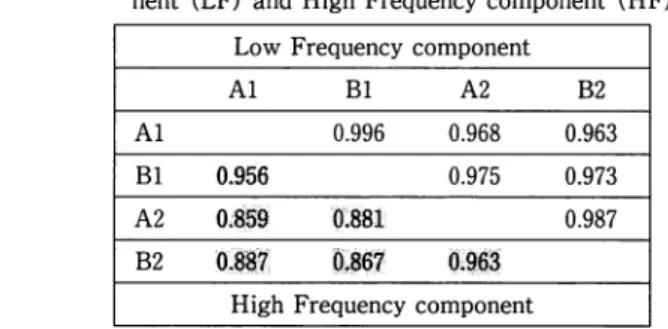
All the values of autonomic nervous activity (HF, and LF) through two consecutive trials, totaling four measurements, showed a close correlation with each other by the correlation coefficient (Tab. 1, P < 0.0001).
Table
1.Correlation Matrix between Low Frequency compo- nent (LF) and High Frequency component (HF)
Low Frequency component
Al
BlA2 B2
Al 0.996 0.968 0.963
Bl
0.956 0.975 0.973
A2 0:85Q '0:881 0.987
B2 Mit Q,~1 f1~ta
High Frequency component
Al : at rest, Bl : after listening to music in the first trial A2 : at rest, B2 : after listening to music in the second trial Upper: LF, I.pwer:::HF
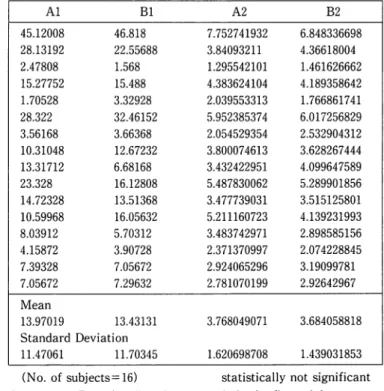
Evaluating changes of autonomic nervous activity after listening to the music, those who showed a change within±30% of HF among our subjects were predominant (no change group, 11/16 : 68.8%) in the first trial (Tab. 2 and Tab. 3). This result suggested less influence of music on parasympathetic nervous activity.
Table 2. Change of High Frequency component (HF) and the ratio of Low frequency component to High Frequency component (LH / HF)
The First trial The Second trial
HF LF/HF HF LF/HF
EXITING 2
40 2
INHIBITORY 3 8 0
4NO CHANGE
114 16 10
Table 3. Change of High Frequency component (HF: parasympa- thetic nervous activity) after music listening
Al Bl AZ B2
45.12008 46.818 7.7527 41932 6.848336698
28.13192 22.55688 3.84093211 4.36618004
2.47808 1.568 1.295542101 1.461626662
15.27752 15.488 4 .383624104 4.189358642
1.70528 3.32928 2.039553313 1.766861741
28.322 32.46152 5.95238537 4 6.017256829
3.56168 3.66368 2.054529354 2.532904312
10.31048 12.67232 3.80007 4613 3.628267 444 13.31712 6.68168 3.432422951 4.09964 7589
23.328 16.12808 5.487830062 5.289901856
14.72328 13.51368 3.477739031 3.515125801 10.59968 16.05632 5.211160723 4.139231993
8.03912 5.70312 3.4837 42971 2.898585156
4.15872 3.90728 2.371370997 2.07 4228845
7.39328 7.05672 2.924065296 3.19099781
7.05672 7.29632 2.781070199 2.92642967
Mean
13.97019 13.43131 3.768049071 3.684058818 Standard Deviation
11.47061 11.70345 1.620698708 1.439031853 (No. of subjects= 16) statistically not significant Al : at rest, Bl : after listening to music in the first trial A2 : at rest, B2 : after listening to music in the second trial
In the first trial, half of the subjects showed a reduction of over 30% in the ratio of LF / HF through peaceful music, which was most likely to reveal a mild suppression of sympathetic nervous activity (Tab. 2 and Tab. 4)
In the second trial, our subjects revealed no outstanding alteration of heart rate
fluctuation by the power spectrum analysis, mainly because of the probable response
of the accommodation mechanism.
Table 4. Change of The ratio of Low Frequency component to High Frequency component (LF / HF: sympathetic nervous activity) after music listening
Al Bl A2 B2
0.373537 0.297119 0.905249 0.71342646
0.169009 0.059849 0.673247 0.216166
0.020363 0.126515 1.851604 1.146927
0.285244 0.126215 1.957505 1.164591
474.9347 144.3357 29.35066 33.9634
4.46643 3.571182 2.93574 2.740197
3.343426 0.655079 3.187495 2.728655
0.773157 1.270441 1.543258 2.509612
0.078503 0.036781 0.668807 0.60169
1.419897 2.295414 2.630095 3.261636
0.626208 0.713948 1.482003 1.658483
0.172365 0.277484 1.454099 1.633951
2.567313 2.49515 3.328108 3.618486
0.176164 0.120272 3.505782 1.014487
0.264404 0.076735 0.552514 0.944413
0.483643 0.117431 0.711485 0.840396
Mean
30.63465 9.785957 3.546103 3.672282
Standard Deviation
114.7248 34.75593 6.735219 7.883382
(No. of subjects= 16) statistically not significant Al : at rest, Bl : after listening to music in the first trial A2: at rest, B2 : after listening to music in the second trial
IV Discussion
Recent advances in the study of the higher brain functions have shown the influence of music on some activities controlled by the brain.
Rausher et al. (1995) reported that subjects performed better on abstract/ spatial reasoning tests after listening to Mozart than after listening to either a relaxation tape or to nothing in their study on the "Mozart-Effect".
Ito (1999) concluded from the results of POMS (Profile of Mood State) that a
1 • Effect of music on autonomic nervous activity
Our results indicated that peaceful music (Pachelbel's Canon in this study) had a temporal effect of some suppression of sympathetic nervous activity (relaxation effect), while it had less influence on parasympathetic nervous activity.
In general, the more exciting parasympathetic nervous activity is, the more the level of vigilance lowers (the state of drowsiness), and this phenomenon is often found when taking tranquilizers as an adverse effect of pharmacological blockade (Inoue 2000).
Therefore, music has a temporal mild effect on suppressing the state of excitement, while not inducing drowsiness like many tranquilizers. Hence, music is expected to be effective complementary and alternative management systems without inducing an unpleasant state drowsiness.
2. A newly developed instrument using the Wavelet system of "Fluclet®"
Several characteristic features of the Wavelet system, which called "Fluclet®"
(Nagai and Nagata 1995, Nagai and Nagata 1996) include;
(a) The improvement of time- resolution rather than fast Fourier transforms effec- tiveness at the peak of quick reactions,
(b)