• 検索結果がありません。

Science and Technology Trends in Fire Protection and Disaster Management 6

N/A
N/A
Protected

Academic year: 2021

シェア "Science and Technology Trends in Fire Protection and Disaster Management 6"

Copied!
13
0
0

読み込み中.... (全文を見る)

全文

(1)

6

Science and Technology Trends in Fire Protection and Disaster Management

— A Consideration of Characteristics and Directions in Science and Technology for Safety

and Peace of Mind —

Y OSHIYUKI M ATSUBARA (Affiliated fellows) * K UNIKO U RASHIMA (Environment and Energy Research Unit) **

**

*

*Yoshiyuki Matsubara Research Managing Director, National Research Institute of Fire and Disaster http://www.fri.go.jp/cgi-bin/hp/index.cgi

1 Introduction

T he W h it e P ap e r o n Fi r e a nd D i s a s t e r Management compiled annually by the Fire and Disaster Management Agency of the Ministry of Internal Affairs and Communications brings together information on a truly wide variety of disasters and accidents, including fires, accidents at hazardous materials facilities and complexes, windstorms and floods, wildfires, earthquakes, and accidents related to gases, toxins, deleterious substances, and nuclear power. According to statistics in the White Paper on Fire and Disaster Management, the number of fires in Japan has been increasing since 1998, and over 2,000 people have died in fires since 1997

[1]

.

The 2003 White Paper on Fire and Disaster Management includes an urgent report on “The increase in corporate accidents and responses thereto.” As can be seen in Table 1, 2003 saw the frequent occurrence of fires, explosions, and accidents at industrial facilities around Japan.

Although it is not included in Table 1, many readers will recall the April 11, 2003, explosion at a fireworks factory in Kagoshima Prefecture that killed 10 and injured 4. On the other hand, 2004 saw damage from numerous natural disasters, such as several typhoons, especially No. 23, as well as landslides caused by the Niigata-Chuetsu Earthquake. Many industrial disasters occurred in

FY 2003, while many natural disasters occurred in FY 2004. After the landslides caused by the Niigata-Chuetsu Earthquake, increasing the safety of fire protection and the disaster management response to landslides became an issue. In December, as if to punctuate this year of natural disasters, a major earthquake in the ocean off Sumatra brought tsunamis causing damage of historical proportions to coastal areas all around the Indian Ocean.

Regarding policy on the allocation of resources

such as budgets and personnel for science and

technology in FY 2005

[2]

(Council for Science

and Technology Policy, May 26, 2004), “strategic

and comprehensive promotion of science and

technology for new efforts on national and

social problems” was established as a new

area of strategic emphasis. The comprehensive

and cross - sectional promotion of science and

technology to build a safe society that provides

peace of mind is one example of this policy. In

The Japanese and the Jews, Isaiah Ben-Dasan

wrote that the Japanese are a people who

believe that safety and water are free. While

Japan has taken its safety and peace of mind for

granted, there is now a real sense that it is time

to emphasize science and technology policy to

build a society that is safe and provides peace

of mind. To build such a society, it is essential

that we understand the causes of accidents and

disasters and that we fully discuss prevention and

(2)

response. Science and technology is necessary for th is. I n the eva luation of science a nd technology in recent years, increasing emphasis is being placed on the extent to which results are being reflected in people’s everyday lives.

Science and technology to build a safe society that provides peace of mind cover a wide array of research areas, from academic research on the mechanisms that generate natural disasters to practical research directly tied to mitigating damage when disasters occur. Even within the field of science and technology, to build a safe society that provides peace of mind, scientific and technical issues related to fire protection and disaster management are the areas closest to people’s daily lives because they protect lives and property from damage due to disasters. From this perspective, this article analyzes current conditions and the near-future outlook for fire protection and disaster management science and technology, a practical side of science and technology for safety and peace of mind, and offers suggestions for the direction of this science and technology based on its characteristics.

2 Current conditions in

fire protection and disaster management science and technology

2-1 Fire protection and disaster management prevention and response

Fire protection separated from the police in 1948. During the half centur y since fire protection was undertaken by local governments, fire protection and disaster management began with firefighting activities and response to fires after they broke out, later expanding to include areas such as fire prevention, response to hazardous materials accidents, first aid and rescue activities, response to natural disasters such as earthquakes, response to nuclear power accidents, and so on.

Fig u r e 1 d e pic t s t he c u r r e nt appr o ach to prevention and emergenc y response i n f i re protection a nd disaster ma nagement.

Preventative responses to potential disasters include the evaluation of the effect of long-period ear thquakes on g iant tan ks, f i re sa fet y at waste facilities, and improved safety in fire Table 1 : Major industrial accidents in 2003

Date Deaths and

injuries Description

Fire at Idemistu Kosan’s Hokkaido oil refinery

26-Sep None

Immediately after the 2003 Tokachi earthquake, a fire broke out at an oil storage tank (about 33,000 kiloliters) and the attached pipes. The fire burned for about 7 hours.

28-Sep None About 54 hours after the earthquake, a fire broke out in front of a naphtha storage tank (about 33,000 kiloliters). It burned for about 44 hours.

Fire at Bridgestone’s

Tochigi factory 8-Sep None

A fire broke out near a refining mixer at a Banbury factory for manufacturing rubber panels for tires, and the entire factory (40,885 m

2

) burned with the loss of about 165,000 tires. Along with two days of firefighting, the fire required the evacuation of 5,032 people from 1,708 households.

Fire at Nippon Steel’s

Nagoya works 3-Sep 15 injured

A gas holder (about 50 m high and 35 m in diameter) inside the plant holding roughly 40,000 m3 of gas for fuel exploded and burned. Workers inside the plant were injured, and windows were broken in nearby homes.

Fire at ExxonMobil’s

Nagoya oil tanks 29-Aug 6 dead 1 injured

A fire broke out near a gasoline tank in a storage facility. The tank was undergoing renovation, so the gasoline had been drained. The fire broke out while waste oil at the bottom of the tank was being transferred to trucks.

Fire at Mie Prefecture refuse-derived fuel (RDF) electric power generation plant

14-Aug 2 dead 1 injured

On August 14, a fire broke out, injuring 4 workers. The Fire Department conducted firefighting and cooling work. On August 19 at 2:17 p.m., an RDF tank exploded, and two firefighters working on its roof were thrown off. The roof flew about 200 meters, damaging the building that housed the power plant's control room.

Fire at Nippon Steel’s

Yawata works 11-Jul 1 dead

2 injured

A vat of molten metal (about 150 tons) with a truck attached was being lowered by crane onto a scale when the vat tipped over, spilling the molten metal and burning the plant's walls.

Source: 2003 White Paper on Fire and Disaster Management

(3)

protection activities at landslide sites. Examples of administrative responses (improvement of standards, etc.) after disasters occurred include revision of the Fire Defense Law following a fire in a small, multipurpose building in Tokyo’s Kabukicho, sloshing - prevention technology for petroleum tanks, and improved standards following a fire in the Taegu, South Korea, subway. These examples demonstrate that fires both inside and outside Japan are considered in such efforts.

Emergency responses included firefighting and hazard removal at the Tomakomai oil tank fire, fire protection activities following the explosion of a storage tank for refuse-derived fuel (RDF) in Mie Prefecture, and fire protection activities at a landslide in Niigata's Myoken district. Cases requiring investigation into the cause of fire included the Tomakomai oil tank fire and an explosion at the Aeon Shopping Center in Yamato City.

2-2 Overview of the Strategic Plan

for the Advancement of Fire Protection and Disaster Management Science and Technology

As the areas to which fire protection responds have expanded, the relationsh ip bet ween fire protection and disaster management and science and technology has changed in the following two respects: (1) the appearance of

new disaster types as science and technology develop and (2) improvement of fire protection activities through science and technology. Figure 2 shows the research fields of the National Research Institute of Fire and Disaster (NRIFD) and organizations (not including universities) conducting related research, while Figure 3 shows the course of research undertaken by the NRIFD from the second half of the 1980s into the first half of the 1990s. As can be seen in the charts, themes based in the field are essential to NRIFD’s research, and they form NRIFD’s mission. In November 2001, the Fire and Disaster Management Agency of the Ministry of Internal Affairs and Communications set and published the Strategic Plan for the Advancement of Fire Protection and Disaster Management Science and Technology (hereinafter “the Strategic Plan”)

[3]

, bearing in mind the forward-looking approach of the NRIFD and incorporating the discussions of an advisory group of outside experts on fire protection and disaster management science and technology chaired by Yoichi Uehara, Professor Emeritus of Yokohama National University. This is the first strategic plan to be set since the start of fire protection by local governments in 1948.

Against the background of changes in NRIFD’s

research fields as shown in Figure 3, it is generally

intended to be applied by about FY 2005. The

1995 Great Hanshin -Awaji Earthquake (Kobe

Earthquake), which was an urban - epicenter

Figure 1 : Interrelationship between fire and disaster management and prevention

(4)

Figure 2 : National Research Institute of Fire and Disaster research fields and relationships with other organizations

Figure 3 : Interrelationships among research topics in the National Research Institute of Fire

and Disaster’s research fields

(5)

earthquake, raised the issue of information blanks that may occur immediately following a large, widespread disaster. The Strategic Plan incorporates issues such as the problem of exposure of rescue personnel to radiation during criticality accidents, as occurred at the uranium fuel processing facility in Tokaimura, Ibaraki Prefecture, in 1999, and the hazard potential of new substances, as demonstrated by a hydroxylamine explosion at a chemical plant in Gunma Prefecture in 2000.

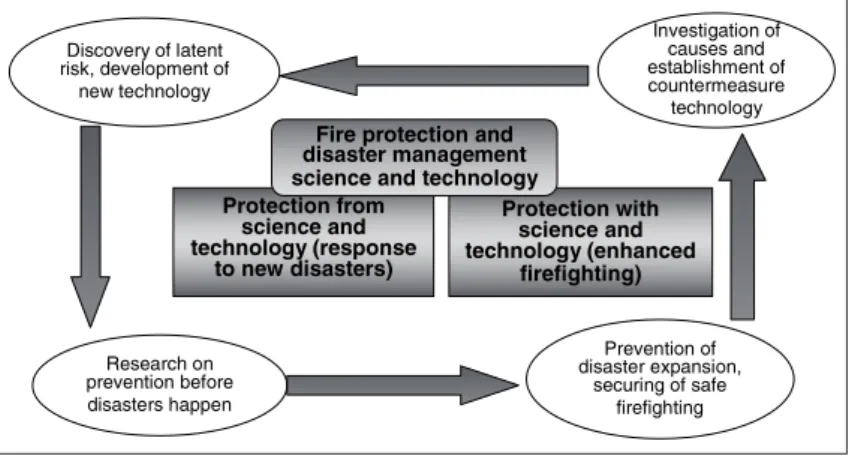
Fire protection and disaster management science and technology should form a proactive PDCA cycle*

1

that includes prior response, post response, and analysis of causes. Figure 4 shows the safety cycle for fire protection and disaster management science and technology.

Expectations are high for the use of new technologies such as information technology, s en sor tech nolog y, a nd new m ater i a l s a s

science and technology for disaster prevention and resistance. The Strategic Plan organizes topics related to fire protection and disaster management science and technology into the following nine main areas.

(1) Enhancement of disaster information communications systems

(2) Promotion of household fire prevention measures

(3) I mprovement of disaster prevention capability

(4) Enhancement of fire protection support facilities, fire protection equipment, and so on

(5) Strengthening of special disaster prevention policies

(6) Improvement of security measures at hazardous materials facilities

(7) Enhancement of first aid and rescue work Figure 4 : Relationship between prevention and emergency response in fire protection and disaster management

Table 2 : Priority fields in fire protection and disaster management R&D (1) Promotion of computerization

in disaster response

To promote computerization in disaster response, research and development of equipment for understanding and analyzing disasters, for simulations to assess and predict disasters, for transmission of information during disasters, and for use by firefighters and other line personnel, systems to integrate such devices, and enhancements.

(2) Ensuring the safety of elderly people and others especially vulnerable to disasters

Development of devices to support evacuation and other measures for elderly people, infants, people with disabilities, and others who require care during a disaster, devices to transmit information, devices for evacuation, and research and development of methods for evaluating such devices and setting their technical standards.

(3) Enhancement of technologies for firefighting, first aid, and rescue

To enhance technology for firefighting, first aid, and rescue, research and development of fire and rescue robots, support systems for fire and rescue activities deep underground, enhanced first aid activities, firefighting methods for materials that are difficult to put out, and equipment and facilities for fire and rescue.

(4) Safety assessment of hazardous materials and hazardous materials facilities

To ensure the security of hazardous waste facilities, research and development on risk assessment of new materials, incident analysis methods for effective accident prevention, methods to predict the occurrence and expansion of hazardous materials accidents, and methods to assess safety.

(5) Promotion of environmental protection

Research and development on firefighting technology that contributes to the social issue of

protecting the environment by having a small environmental impact and on technology to prevent,

detect, and respond to hazardous materials leaks.

(6)

(8) Concern for the environment (9) Response to internationalization

Based on these areas, the Strategic Plan proposes prioritization of fire protection and disaster management research and development in the five fields shown in Table 2.

3 Concerns related to safety and peace of mind

in the near future

3-1 Fire protection and disaster management in an aging society

Currently, the death rate per 100,000 persons from household fires is 27.4 times greater for those aged 81 and above than for those between 21 and 25. As society ages, increased harm to elderly people is a concern.

3-2 Contradictions between environmental issues and a safe society that provides peace of mind

In the past, chlorine - based chemicals were used a s f i re ret a rd a nt s to ma ke product s difficult to burn, but because they generate tox ic mater ia ls, t hey were replaced wit h bromine-based chemicals. However, there is also concern regarding the environmental and health impacts of bromine. In addition, they are also causative agents for the generation of dioxins during incineration. It is therefore problematic to use bromine-based fire retardants in computers and other products, but non-use can increase fire risk in homes and offices. Furthermore, Japan’s refuse-derived fuel (RDF) facilities, which were introduced as an environmental measure, have been plagued by malfunctions, including

explosions, becoming a safety problem in their own right.

3-3 Disasters due to arson and other crimes and due to terrorism

Fires caused by or suspected of being caused by arson account for 22.9 percent of all fires (14,553 cases in 2002) and continue to increase. The September 1, 2001, fire in a small multipurpose building in Tokyo’s Kabukicho that killed 44 is believed to have been caused by arson. The fire in the subway in Taegu, South Korea, was caused by arson with gasoline, requiring a rethinking of the conditions hypothesized for fire and evacuation measures in subways.

3-4 Accidents accompanying aging infrastructure

As exemplified by the accident at the Mihama nuclear power plant caused when a corroded pipe burst and released steam, deterioration of major facilities over time is causing concern. In particular, fires and leaks at hazardous materials facilities, which had been slowly declining since about 1980, began to increase in 1994. Figure 5 shows the trend in fires and leaks at outdoor storage tanks, while Figure 6 shows that in hazardous materials facilities. In 2002, there were 170 fires and 331 leaks, totaling 501 incidents.

C or r o s io n w a s t he mo s t co m mo n c au s e, accounting for 35.1 percent of the cases.

3-5 Large earthquakes and other natural disasters

On September 26, 20 03, a mag n it ude - 8

ea r t hqu a ke str uck t he sea of f Tok ach i i n

Hokkaido. The earthquake caused a fire at some

petroleum tanks in Tomakomai City, which

Figure 5 : Leaks due to corrosion and other deterioration at outdoor oil storage tanks

(7)

burned for 44 hours. In the end, firefighting was impossible, and the fire was allowed to burn itself out. An earthquake of this scale was expected to occur only every 100 to 200 years, but this time, it happened after only 50, so the period of recurrence is being reexamined. Preventative measures are particularly necessary for oil tanks in the earthquake-prone areas shown in Figure 7.

4 Outlook for priority fields in the near future

Based on the above concerns, priority research

fields such as the following should be promoted.

4-1 Response to an aging society

To reduce damage caused by household fires, it is important to widely disseminate the use of fire detectors. The NRIFD is conducting research on applied technology to utilize common household appliances such as air conditioners to detect fires. Prototype air conditioners equipped with smoke detectors that not only flash lights and give audio alarms, but also use wireless technology to break into television screens and display warnings as well as utilize the telephone to call Figure 6 : Fires and leaks at hazardous materials facilities

Figure 7 : Earthquakes feared likely to occur in the vicinity of Japan

[4]

Source: Headquarters for Earthquake Research Promotion, Ministry of Education, Culture, Sports, Science and

Technology (2004)

(8)

for outside emergency assistance. In addition, technology is being developed for people such as the elderly or those with disabilities who have hearing difficulties. Scent is one method, but it requires basic data on what type of smell should be released in what quantity in order to be recognized as a fire alarm. Other methods being researched include the shaking of bedding or pillows for fires that occur while people are sleeping, as well as flashing lights. Furthermore, research on com mu n ications net works to automatically inform outside entities in the event of a fire must be pursued. This kind of technical development is expected to result in decreased damage

[5]

.

4-2 Environmentally-friendly fire retardation and innovations in firefighting technology

(1) Towards forbidding the use of ozone-layer-damaging materials

Along with the prohibition of the production of halon, which damages the ozone layer, new types of extinguishants and firefighting technologies are being developed. Among these extinguishants, some have been reported to actually ignite materials under certain conditions, or to promote the generation of hydrogen fluoride or other substances harmful to humans as discharge from burning. To use extinguishants safely, advanced quantitative simulations are needed to clarify their ignition and quenching phenomena and the processes by which they generate discharges.

One candidate to replace halon in firefighting e q u ip m e nt i s w a t e r m i s t . T h i s r e fe r s t o firefighting equipment that uses water, but i n a way t hat pays more at tention to t he distribution of the sprayed water droplets than do conventional sprinklers or misters. Water mist can achieve the same fire suppression effect as conventional sprinklers, while using only a fraction of the water, enabling water damage such as flooded rooms or property that are unusable after becoming soaked to be minimized. Because the principles of water mist firefighting have not all yet been clearly established, it is necessary to divide fires into several stages, define the optimal conditions for water mist firefighting at each stage, and clarify usage policy. In addition to use

in ceilings and so on as fixed fire suppression equipment, use in fire hoses by fire crews is also being studied

[6]

.

(2) Innovations in firefighting technology in the energy sector

In December 1995, a sodium leak and fire occurred in the secondary cooling system pipe room at the Monju fast breeder reactor. Since the accident, the combustion behavior of sodium has been carefully observed and research into firefighting conditions is progressing. Sodium cannot burn in extremely low concentrations of ox ygen, but will reignite under cer tain temperature conditions and displays specific oxidation reactions under low-oxygen conditions.

In other words, even after a sodium fire appears to be out, i f cer tai n temper atu re and gas saturation conditions are met, it may reignite.

To suppress sodium-leak fires with certainty, clarification of the mechanism of stabilization of the remaining sodium and of re - ignition of the combustion residue at environmental temperatures, and exploration of extinguishants not made from inert gases, are needed.

L ith iu m is a metal that requ i res f u r ther attention from the perspective of combustion.

Because lithium-ion batteries offer advantages such as high energy density and reusability, they are widely utilized in mobile telephones, computers, video cameras, and so on. Because lithium reacts with water, the use of gas and powder extinguishants may be considered when there is a fire. Along with research to understand the degree to which rare-gas and powder fire suppression is effective, research on fighting lithium fires concerning whether lithium has specific combustion behavior as sodium does, and other aspects of lithium's burn characteristics, is needed.

Research into new forms of energy offering

advantages in cost, performance, environmental

responsiveness, and so on is progressing. As

conditions for the spread of such new energies,

evaluation of their safety from the perspectives

of fire prevention and disaster management is

essential. For example, the fuel-cell automobiles

now being tested generally utilize hydrogen,

which will require safety measures for parking

(9)

garages and tunnels. There is a very real danger that the same firefighting methods that have been used until now with gasoline vehicles may not have the same fire suppression effect. It is therefore essential that appropriate firefighting and prevention technologies be developed

[7]

. (3) Innovations in fire protection and

disaster management technology for waste processing facilities

Through efforts to separate waste by type in recent years, waste processing facilities are collecting massive amounts of refuse that is not for incineration. Plastics are categorized as non-burnable waste, but some of them generate large amounts of heat. In addition, flammable materials such as batteries, aerosol cans, and gas cylinders are also sometimes mixed in with non - burnable garbage. At waste processing facilities, sparks from impact or friction during crushing or other processing, as well as chemical reactions, can cause ignition leading to fires.

Therefore, first an examination of conditions at waste processing facilities is needed, followed by research on fire prevention and firefighting systems that respond to the characteristics of such fires.

4-3 Innovations in technology in response to the declining safety and increasing vulnerability of large, complex structures as public safety declines

Large, complex structures are designed and constructed to ensure safety against ordinary causes and types of fire. In the event of fire started by arson or terrorism, however, the spread of gasoline and so on can cause the size and spread of fire to be greater than expected, and large, complex structures such as underground facilities are vulnerable because evacuation and firefighting activities are difficult.

To respond to this situation, research to clarify the environments that fire crews and citizens will encounter is needed. At the same time, exposure of the potential dangers of large fires that would make firefighting and evacuation difficult, and technical innovation leading to the development of evacuation guidance systems and of protective clothing to reduce injuries from firefighting and

evacuation are necessary.

4-4 Innovations in technology for

inspection and maintenance of aging social infrastructure

Through rust, metal fatigue, cracking, and so on, oil tanks deteriorate over time. Moreover, they are located near the ocean and face repeated heav y loads as they are filled and emptied.

The damage that oil tanks incur under these harsh conditions can lead to catastrophes such as leaks, fires, and pollution. Most damage is caused by aging or by ear thquakes. The corrosion environment is complex, and even earthquake damage depends on the strength of the earthquake, the type of seismic waves, the foundation ground, tank structure and content volume, and so on. Safety assessment must therefore be conducted considering tank conditions, and it is important to take aging and earthquake resistance into account at the same time. Along with assessing the health of tank bottoms through acoustic emission (AE), it is necessary to establish safety evaluation methods such as computer simulation to analyze oil tank conditions considering expected earthquake strength.

4-5 Preparation for major earthquakes and other natural disasters, elucidation of the impact of long-period seismic motion, and disaster prevention data systems

Research on robots to rescue earthquake victims is advancing. Research is progressing on combining multiple self-propelled, compact, lightweight robots to form protective walls against radiation or to gather around a victim, change his/her position for easier transport, and pull him/her to safety. Compact robots developed by the NRIFD weigh about 5 kg each, are radio - controlled, and move in groups of multiple units. Leader robots are operated by fire crewmembers, but other compact robots follow the light emitted by the leader and move independently. The compact robots are divided into protective wall groups and dragging groups.

Each individual joins the link in its own role and

carries out its own function. In addition, research

on robots that climb up and down apartment

(10)

buildings by following along their verandas is also underway. Robots that can detect people buried under rubble will be another ongoing research theme.

Ear thquake damage to storage tanks is a complex phenomenon that depends on the interplay among factors such as seismic motion characteristics, tank structure, the type of ground the tank stands on, the properties of the material stored, and so on. It is therefore necessary to utilize various analytic methods in elucidating through computer simulation of multiple types of seismic wave the mechanism of damage from buckling caused by tank floors rising due to seismic motion, and to develop safety evaluation systems for smaller tanks. Research thus far has demonstrated that if seismic waves can be predicted, tank strength can be evaluated. In addition, precise computer simulations that can predict damage in advance are needed to ensure safety. Oil tanks, which are large structures, may resonate with long-period seismic motion during earthquakes, causing sloshing (movement of the liquid within the tank). Research on improving the accuracy of sloshing prediction based on the concept of “seismotectonics zoning” is therefore underway. For short-period seismic motion as well, research on methods to accurately predict short-period seismic motion by utilizing ground boring data is being conducted

[8, 9]

.

In addition, for example, it is difficult to prevent expansion once an accident at a nuclear reactor occurs. The tsunamis caused by the earthquake off Sumatra caused massive damage and took as many as 220,000 lives. In the case of structure fires as well, firefighters cannot arrive until about five minutes have passed, so primary damage from explosions and so on cannot be mitigated. The larger the disaster, the more important and effective is a preventative rather than a subsequent response. In other words, to ensure safety and peace of mind for the public, prevention as well as response is essential, and in true emergencies, both are needed.

5 Proposals

Based on the above analysis of the current state and f uture outlook of trends in “fire

protection and disaster management science and technology,” in this section, we offer proposals for science and technology to build a safe society that provides peace of mind.

5-1 Make outputs to outcomes

To apply the fruits of fire protection and disaster management science and technology towards achieving a safe society that provides peace of mind, the public must understand these fruits and utilize them. Users of fire protection and disaster management science and technology include not only those who work in fire protection, but the general public as well. The utilization of science and technology to prevent accidents before they happen is a matter of course, but at the same time, people must be educated so that they can properly understand, manage, and use them. Various budgets are allocated for research directly linked to technology, but funds should be allocated for preventative education and so on in the same way. Like pure scientific research, the results may not be tangible, but this education is essential in constructing a safe society that provides peace of mind. One can easily imagine that when an earthquake occurs, damage will vary widely by location. Therefore, providing all residents in a given area with disaster drills through virtual reality and other simulations can be effective from the perspective of damage mitigation

[10]

. In the event of an actual disaster, what percentage of people could handle fire extinguishers? According to a survey by the Tokyo Fire Department in FY 2000, the use of fire extinguishers was necessary in 1,199 of 1,921 fires, but they were actually used in only 624 cases. Because fire extinguishers were available and needed but not used in almost half the cases, regular training and practice in actual use is needed not only in schools but in workplaces and for all residents.

5-2 Effective interdisciplinary research

If we look at the fire protection and disaster management science and technology fields that should be promoted, in terms of the “four priority research fields” and “four other fields”

found in the second Science and Technology

(11)

Basic Plan, we can see that fire protection and disaster management science and technology is an interdisciplinary field.

For example, to achieve “the building of a society that provides elderly people with sa fet y a nd peace of m i nd rega rd i ng f i res and other disasters,” the union and fusion of research results in the fields of “information c o m m u n i c a t i o n t e c h n o l o g y,” “e n e r g y,”

“m a nu f ac t u r i ng tech nolog y,” a nd “s o c i a l infrastructure” are essential. The four other priority research fields for fire protection and disaster management science and technology also require the union and fusion of research results from multiple fields. As can be seen in Figure 8, science and technology related to fire protection and disaster management is an interdisciplinary research field spanning all the priority areas of the second Science and Technology Basic Plan.

Researchers who conduct this interdisciplinary research in science and technology for fire protection and disaster management need the ability to flexibly change research themes and to be aware of unusual phenomena that have yet to occur. The former is needed because fire protection and disaster management science and technology are interdisciplinary fields. The latter is necessary because researchers must uncover research themes to prevent accidents before they happen. To prevent accidents, it is just as important to be aware of potential causes (including causes that check accident damage) as it is to learn from past events.

Currently, the evaluation of researchers by their results is increasingly widespread and becoming

more i mpor ta nt. I n most such resea rcher evaluations, changing research fields may not be advantageous because it can cause a temporary drop in publications and presentations. To foster interdisciplinary researchers, it is therefore desirable to devise evaluation methods that integrate contributions over time into building a safe society that provides peace of mind.

5-3 Using openness to expand the market for utilization of results

Within science and technology for safety and peace of mind, fire protection and disaster management science and technology have the characteristic of being a practical discipline that makes a clear contribution to society. This contribution is made from both the aspect of prevention through regulatory systems and the aspect of fire protection response after disasters occur. In contrast with research on terrorism and emergencies and information security, which also aims to contribute to safety and peace of mind, research in science and technology for fire protection and disaster management is quite different in its characteristic openness.

Numerous national research organs, such as the National Institute of Information and Communications Technolog y, the National Re s e a rch I n st it ute for E a r t h S cience a nd Disaster Prevention, the Public Works Research Institute, and the National Institute of Public Safety, as well as universities, have utilized this openness for research in fire protection and disaster management from a variety of perspectives and through various links among Figure 8 : Relationship of fire protection and disaster management science and technology to the priority fields of

the second Science and Technology Basic Plan

(12)

themselves. In the future as well, research in fields such as nanotechnology and information technology that will probably be given priority in the next Science and Technolog y Basic Plan, and their strengthened promotion, will be vital to the progress of fire protection and disaster management science and technology.

It is necessary not that priority fields be set, but rather that the existence of interdisciplinary research and development fields such as science and technology for safety and peace of mind be recognized.

There are issues involved with implementing fire protection science and technology and contributing the results to society. The market scale is small, so there is little motivation to develop equipment in accordance with the frontline needs of fire protection, and it is difficult to adopt the most advanced results of research in science and technology to combat disasters. The key to overcoming the small market scale is the utilization of openness in science and technology for fire protection and disaster management.

In other words, in principle, research results both for prevention and for countermeasures in science and technology for fire protection and disaster management should be open. An effective and efficient research system with f u l l - f ledged cooper ation a mong i ndustr y, a c a d e m i a , a n d g o v e r n m e n t , a s w e l l a s intra-governmental cooperation, is needed. Such cooperative systems could enable the fruits of fire protection and disaster management science and technology to enter the general market, expanding the target market for research and development.

5-4 Adding strategy to fire protection and disaster management science and technology

Using the example of fire protection and disaster management robots, we offer suggestions on strategy for fire protection and disaster management science and technology.

Some believe that because practical robots for everyday-life environments do not yet exist, robots for the more difficult environment of fire protection activities cannot be manufactured.

However, by limiting the environments they

encounter and how they respond, fire protection a nd d i s a s t e r m a n a ge me nt r o b o t s c a n b e sufficiently developed from existing research and development. Indeed, by adding conditions such as:

• Limiting the kinds of disaster for which they will be used,

• Limiting their possible activities,

• Limiting their operating time, and

• Providing human operators (remote control rather than full automation)

The practicality of introducing fire protection and disaster management robots is quite high.

To break through the current situation in which such robots “move too slowly to be used on-site,”

“are not durable,” “do not behave dependably,”

and so on, manufacturers and robot scientists must find the idea of realizing fire protection robots attractive enough to create systems for full-fledged work on them.

To make fire protection robots attractive to the market, these processes must be added to intra-governmental cooperation:

• Preparation of a practical environment through the creation of a fire protection equipment standardization and distribution plan (Fire and Disaster Management Agency of the Mi n istr y of Inter nal A f fai rs and Communications)

• F o r m a t i o n o f t h e i n i t i a l m a r k e t f o r

c o m m e r c i a l i z a t i o n ( f i r e p r o t e c t i o n

procurement; Fire and Disaster Management

Agency of the Ministry of Internal Affairs

and Communications and local governments)

and industry creation and fostering (Ministry

of Internal Affairs and Communications,

Ministry of Economy, Trade and Industry)

A vision and systems can be constructed to

take the next steps to enable even local fire

departments to adopt robot technology within

10 years based on the fruits of robot research and

development achieved through industry-academi

a-government cooperation, and to link them with

the market for general-care robots.

(13)

Period 1: Achieve performance and

price-enabling adoption by national rescue teams.

Period 2: Achieve performance and

price-enabling independent adoption by major fire departments.

Period 3: Achieve performance and price-enabling adoption by all fire departments.

The environmental resistance and performance required for frontline fire protection activities is equivalent to or greater than that required by military technology. While the scientific and technical issues to be solved are advanced, the cost effectiveness required is closer to that of the civil sector.

It is simple to open up the results of fire protection and disaster management science and technology. Compared with the United States of America, the world's policeman that leads in science and technology through its military technology, Japan may be able lead the world in fire protection through breakthroughs in the science and technology of disaster prevention and mitigation, contributing to the global community.

To effectively utilize fire protection and disaster management science and technology and contribute its achievements to society, such visions and systems are vital.

Glossary

*1 PDCA cycle

The cycle comprising Plan, Do, Check, Act.

References

[1] White Paper on Fire and Disaster Management:

http://www.fdma.go.jp/html/hakusho/h16/h 16/index.html

[2] Policy on allocation of resources such as budget and personnel for science and technology in FY 2005:

http://www.mext.go.jp/b_menu/shingi/gijy utu/gijyutu4/siryo/008/04081901/007/007.pdf [3] Strategic Plan for the Advancement of Fire

Protection and Disaster Management Science and Technology:

http://www.fdma.go.jp/html/new/131126yo bo410-2.pdf

[4] Headquarters for Earthquake Research Promotion: http://www.jishin.go.jp/main/

[5] How to i n for m t he elderly a nd ot her especially vulnerable people of fires:

http://www.fri.go.jp/cgi-bin/hp/index.cgi?ac 1=JRR1&ac2=21&ac3=108&Page=hpd_view [6] Description of research: http://www.fri.go.j p/cgi-bin/hp/index.cgi?Page=hpd_view&ac 1=JRR1&ac2=21&ac3=112

[7] Supporting fire safety in

environmentally-friendly technologies:

http://www.fri.go.jp/cgi-bin/hp/index.cgi?ac 1=JRR1&ac2=21&ac3=113&Page=hpd_view [8] “Oil tank sloshing and long-period seismic

motion through the ear thquake in the sea southeast of the Kii Peninsula,” Ken Hatayama, et al., Autumn Con ference, Seismological Society of Japan

[9] Risk prediction and management for oil tanks:

http://www.fri.go.jp/cgi-bin/hp/index.cgi?ac 1=JRR1&ac2=21&ac3=117&Page=hpd_view [10] Simulated experience of fires through virtual

reality (VR):

http://www.fri.go.jp/cgi-bin/hp/index.cgi?ac 1=JRR1&ac2=21&ac3=109&Page=hpd_view

(Original Japanese version: published in March 2005)

Fig u r e  1  d e pic t s  t he  c u r r e nt  appr o ach  to  prevention  and  emergenc y  response  i n  f i re  protection  a nd  disaster  ma nagement
Figure 3 : Interrelationships among research topics in the National Research Institute of Fire and Disaster’s research fields
Table 2 : Priority fields in fire protection and disaster management R&D (1)  Promotion of computerization
Figure 7 : Earthquakes feared likely to occur in the vicinity of Japan [4]

参照

関連したドキュメント

Standard domino tableaux have already been considered by many authors [33], [6], [34], [8], [1], but, to the best of our knowledge, the expression of the

An example of a database state in the lextensive category of finite sets, for the EA sketch of our school data specification is provided by any database which models the

This research was supported by Natural Science Foundation of the Higher Education Institutions of Jiangsu Province (10KJB110003) and Jiangsu Uni- versity of Science and

In Section 3 using the method of level sets, we show integral inequalities comparing some weighted Sobolev norm of a function with a corresponding norm of its symmetric

Arnold This paper deals with recent applications of fractional calculus to dynamical sys- tems in control theory, electrical circuits with fractance, generalized voltage di-

Arnold This paper deals with recent applications of fractional calculus to dynamical sys- tems in control theory, electrical circuits with fractance, generalized voltage di-

Wro ´nski’s construction replaced by phase semantic completion. ASubL3, Crakow 06/11/06

Should Buyer purchase or use onsemi products for any such unintended or unauthorized application, Buyer shall indemnify and hold onsemi and its officers, employees,