博士学位論文
フレアースカートの局所的自重変形と これに及ぼす布地の力学特性の影響
-重回帰分析を用いて-
Influence of the Mechanical Characteristics of the Fabrics on Local Deformation of Flared Skirts under the Clothing’s Own
Weight
- Using Multiple Regression Analysis -
2017 年 6 月
文化学園大学大学院
生活環境学研究科 被服環境学専攻
瀨尾 香
i
Influence of the Mechanical Characteristics of the Fabrics on Local Deformation of Flared Skirts under the Clothing’s Own Weight
- Using Multiple Regression Analysis -
Abstract
Recently, in the apparel field, it has become imperative to speed up planning and accelerate the production cycle. At the design and apparel production site, a problem is caused by the gap created between the toile (an early version of a finished garment made up in cheap material so that the design can be tested and perfected) and the actual production, as well as by using the same pattern and changing only the fabric. Since changing the fabric will change the silhouette shape, the patterner is forced to correct the pattern for each fabric. Until now, patterners have corrected them at their own empirical discretion, with insufficient results. If it becomes possible to predict the deformation of clothing from the mechanical characteristics of fabric, it will lead to more efficient garment design. In addition, even if different fabrics are used, knowledge about the relationship between material properties and deformation is required in order to make it possible to reproduce without a finished image while maintaining the shape of the clothing of toile. In particular, the shape of a flared skirt varies greatly depending on the material, and the significant deformation appears. Many studies have investigated the relation between silhouette and mechanical properties, but there are no studies of local deformation.
From the above viewpoint, in this study, a flared skirt was manufactured using 14 types
ii
of fabrics with different composition and structure, and the deformation in the gravity and orthogonal directions of each part was measured using the circular stamp method.
The skirt was put on a body and the parts were measured. The waist of the skirt was fixed with a hanger and left in a constant temperature and humidity chamber. Multiple regression analysis was used to investigate the influence of the mechanical properties of the fabric and local deformation of the flared skirt under its own weight.
Chapter 1.Introduction
In this chapter, we examined the social background and previous research of this subject and described the purpose and significance of this research.
Chapter 2. Comparison between virtual (three-dimensional virtual wearing simulation) and real (actual production)
In this chapter, a three-dimensional pattern created using the surface development function of the new-type apparel three-dimensional CAD and a plane pattern drawn using the upper body prototype and the lower body prototype of Bunka formula were compared. In addition, a flare skirt pattern for experiments was prepared in the same way, and simulation was carried out using a three dimensional virtual wearing system. The simulated skirt and the actual skirt were then comparatively examined.
In the comparison between the three-dimensional pattern and the planar pattern, even if the finished dimensions are the same, there is a difference in fitness between the two – the three-dimensional pattern developed from the surface of the virtual body was closer to the intended silhouette, and the fit was high.
Regarding the comparison between simulation and actual production in Hitoto and Pattern Magic II
iii
3D, in both cases dissociation was recognized between real production such as a silhouette and the number of nodes, node height.
For the 3D fit view, the representation of the pattern was very real and almost unchanged from the real thing, but dissociation was recognized with the actual skirt, such as fabric difference, silhouette and the number of nodes, node height.
Regarding the possibility of a new type of apparel CAD, the usefulness for a surface development function of a virtualized body was confirmed. However, in the three-dimensional virtual wearing simulation, it was shown that there was a problem with reproducibility.
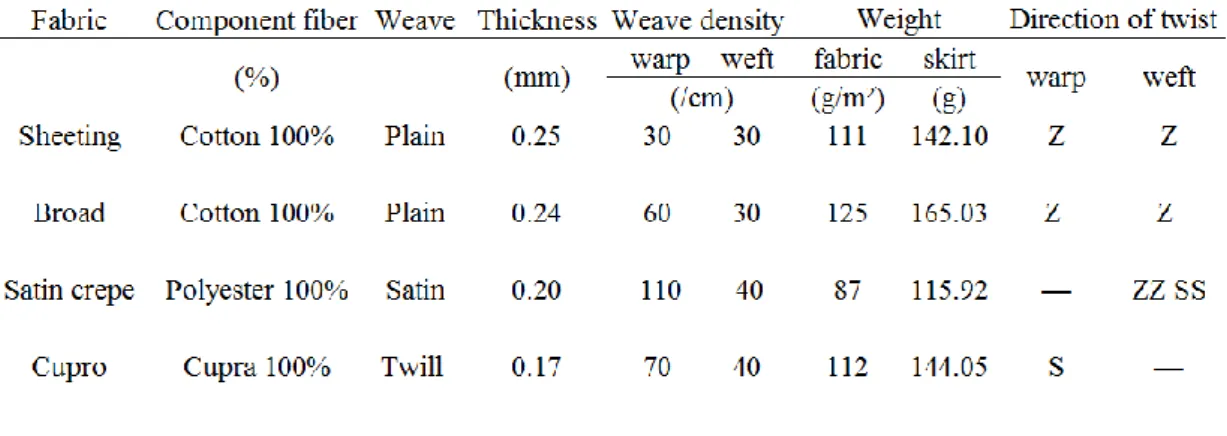
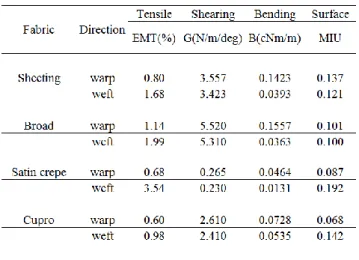
Chapter 3. Local deformation on flared skirts under clothing’s own weight using 4 kinds of fabrics In this chapter, the deformation of a long flared skirt with a skirt length of 80 cm was made using 4 kinds of fabrics – sheeting, broad, satincrepe and cupra – under the skirt’s own weight after leaving it for 2 weeks was measured. The measurement points were 40 intersection points at each row and each column of the skirt. For the measurement, the rate of change in the gravity direction and the orthogonal direction was estimated using an ellipse equation based on measured values of internal line, vertical, horizontal and diagonal with a diameter of 20 mm, using the circular stamp method.
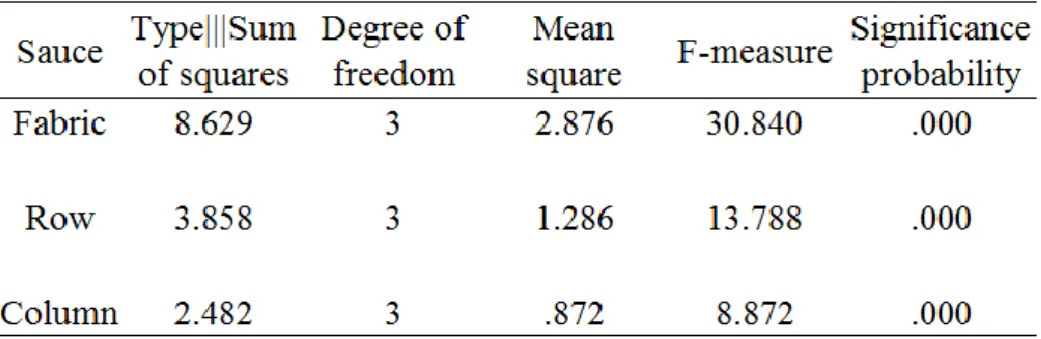
It was shown that the rate of change for each part became elongated in the gravity direction and contracted in the orthogonal direction. The results of the 3-way ANOVA test based on fabric, row and column showed that deformation was more significant as followed : fabric (satincrepe> cupra>
sheeting≒broadcloth), row (2nd> 3rd> 1st> 4th), and column (side>center).
The swing of the side line of the flare skirt was thought to be due to the difference between the local deformation of the right bias and the left bias.
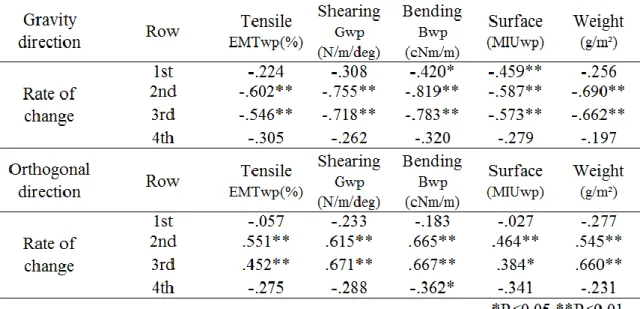
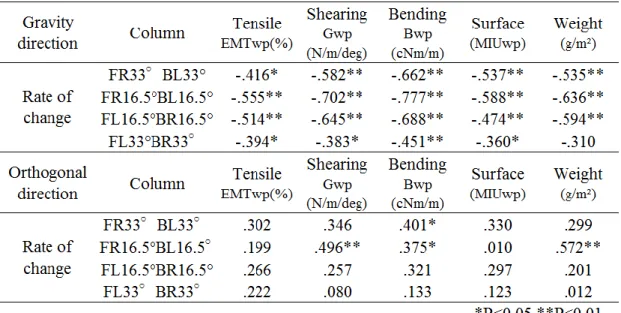
The local deformation of the 2nd row and the 3rd row showed high correlation (p<0.01) with the
iv
mechanical properties of the fabric, especially bending and shearing.
Chapter 4. Mechanical properties of the sample fabric
In this chapter, structural, mechanical and drape properties of 14 kinds of sample fabrics were measured and investigated. In addition, based on the specifications of the fabric and the mechanical property values, principal component analysis was performed to extract the features of each sample.
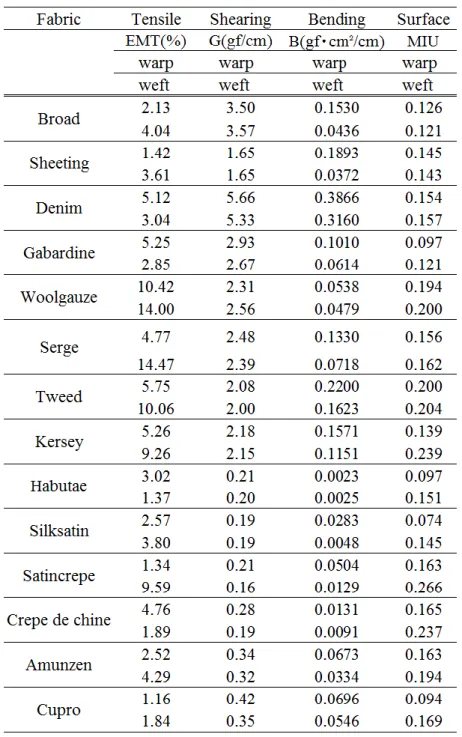
Fourteen kinds of sample fabrics with different fiber composition and tissue were selected. The structural properties of the sample such as the weave structure, thickness, weight, weave density, direction of twist, crossing point of each sample were measured, four items: tensile characteristics, shear characteristics, bending characteristics, and surface characteristics of the sample fabric were measured using a KES-FB texture measurement system. As for the drape property, the drape coefficient and the area of each sample were measured using a drape tester and examined together with the shape of the cross section of the skirt. Based on these measurements, principal component analysis of 12 items was attempted. For that item, it was thickness, weave density, weight, crossing point, EMTwp, EMTwf, Gwp, Gwf, Bwp, Bwf, MIUwp, MIUwf. It was considered to explain the degree of stiffness and thickness of the fabric in the first principal component, the degree of elongation of the fabric and magnitude of the frictional resistance in the second principal component and the crossing point in the third principal component. Fourteen sample fabrics were divided into five groups, and it was confirmed that a wide range of sample fabrics was selected.
Chapter 5. Relationship between local deformation of the skirt under its own weight and mechanical properties using 14 kinds of fabric
In this chapter, for flared skirts of the same pattern made from 14 kinds of different fabrics, the local
v
deformation of the skirt under its own weight at each of the 40 points was measured by the circular stamp method, and the characteristics of deformation of each site were analyzed and the influence of the mechanical properties of the fabric on the local deformation was investigated.
Regarding the rate of change by site, the results of the 3-way ANOVA test based on fabric, row and column, in the fabric, all three factors showed a significant difference in risk of less than 1%. As a result of multiple comparisons, deformations such as silksatin, Habutae were large, and deformation such as broad, sheeting and denim was small. In the row, the deformation was large in the order of (2nd> 3rd ≓1st> 4th), in the column, the deformation was large in the order of (side>middle>center).
As a result of multiple regression analysis with the KES value as the explanatory variable, in the gravity direction of the first row, the tensile elongation percentage in the warp direction was extracted for all of the rows, and in the orthogonal direction, influencing factors coexisted. In the 2nd and 3rd rows, the left and right side lines where the deformation was large, more than two causes influenced the deformation. It was shown that the influence of shearing stiffness is large in both gravity and orthogonal directions of each row. In the gravitational direction of the left and right intermediate lines, the influence of bending stiffness in the vertical direction and the horizontal direction was large, and in the orthogonal direction, the influence of the shearing stiffness in the vertical direction was large.
For the 4th row, the change was small, but the weave density was extracted. Each measurement point of the skirt was classified into ten sections showing similar characteristics and a multiple regression equation for estimating each local deformation was obtained.
Analysis was attempted by adding the drape coefficient, which is a composite characteristic, to the explanatory variable. Although the contribution rate was slightly lower than when only the mechanical characteristic value was analyzed as an explanatory variable, it was extracted as the first explanatory variable in the 2nd and 3rd rows. If the effectiveness of the evaluation method by the drape tester is
vi
demonstrated, analysis that adds the drape coefficient as an explanatory variable was also considered to be effective.
The local deformation of the left and right side lines showed a difference between the right bias and the left bias, which suggests that this is the cause of the twist observed in the flared skirt side line.
Chapter 6. Summary
In this chapter, the results of each chapter are summarized, and future prospects are described.
In this study, the local deformation of a skirt under its own weight using 14 different fabrics was measured by the circular stamp method, and the influence of the mechanical properties of fabric on deformation was investigated by multiple regression analysis. The factors of fabric, row, and column showed significant differences. It was revealed that the influence of the mechanical properties of the fabric on the local deformation varies depending on the part of the skirt. It was therefore possible to show the possibility of predicting the local deformation of a flared skirt under itsown weight from the mechanical properties of the fabric. These results are useful for designing and modifying patterns and can be applied or extended for simulation. In the future, it is necessary to verify the accuracy of the multiple regression equation with a new fabric. Moreover, in order to make use of it in pattern design, examination of pattern modification methods for each fabric and verification of items other than flared skirts are also important.
vii 目 次
Abstract ⅰ 目 次 ⅶ List of Tables ⅺ List of Figures ⅷ
第 1 章 序 論
1.1 ファッション産業を取り巻く社会の変化 ... 1
1.2 ファッション・テクノロジー融合化時代におけるパタンナーの役割 ... 8
1.3 衣服変形に関連するフレアースカートの文献的背景 ... 14
1.4 本論文の目的と構成 ... 20
引用文献 ... 22
第 2 章 バーチャル(三次元仮想着装シミュレーション)とリアル(実物製作)との比較 2.1 緒 言 ... 26
2.2 研究方法 ... 30
2.2.1 原型の検討... 30
1)バーチャルボディを使用した立体パターンと文化式上半身原型及びスカート原型 の作図法による平面パターンの作成 ... 30
2)フレアースカートのパターン作成 ... 34
2.2.2 フレアースカートの実物製作 ... 38
1)試料布と地の目 ... 38
2)地直し ... 39
3)裁 断 ... 39
4)縫 製 ... 40
5)用 具 ... 40
6)製作時の室内環境と撮影条件 ... 41
2.2.3 三次元仮想着装シミュレーションの実行 ... 42
1)hitoto 及び CREACOMPOⅡによるシミュレーション ... 42
2)3D fit view によるシミュレーション ... 45
2.3 結果及び考察... 46
2.3.1 立体パターンと平面パターンとの比較 ... 46
2.3.2 バーチャルとリアルとの比較 ... 51
viii
2.4 総 括 ... 59
引用文献 ... 61
参考文献 ... 62
第 3 章 4 種の布地を用いたフレアースカートの局所的自重変形 3.1 緒 言 ... 63
3.2 研究方法 ... 64
3.2.1 試料布(4 種) ... 64
3.2.2 計測方法... 66
1)計測線・計測点の設定 ... 66
2)計測方法 ... 67
3)スカートの重力・直交方向変化率の推定 ... 68
3.2.3 分析方法... 69
3.3 結 果 ... 69
3.3.1 スカート各列長さの変化 ... 69
3.3.2 スカートの局所変形 ... 71
1)布地の影響... 74
2)段の影響 ... 75
3)列の影響 ... 76
3.3.3 スカートの局所変形と力学特性との関係 ... 77
1)スカート各段の部位別変化率と布地の力学特性との相関 ... 77
2)スカート各列の部位別変化率と布地の力学特性との相関 ... 78
3.4 考 察 ... 79
3.5 総 括 ... 82
引用文献 ... 83
参考文献 ... 84
第 4 章 試料布の物理特性 4.1 緒 言 ... 85
4.2 研究方法 ... 87
4.2.1 試料布の選定 ... 87
4.2.2 測定項目及び測定方法 ... 88
4.2.2.1 試料布の諸元 ... 88
1)織組織 ... 88
2)厚 さ ... 88
3)糸密度・撚り方向 ... 89
ix
4)平面重 ... 89
5)交錯点 ... 90
6)糸の太さ... 90
4.2.2.2 KES-FB 風合い計測 ... 90
4.2.2.3 ドレープ性 ... 91
4.3 結果及び考察... 92
4.3.1 試料布の諸元 ... 92
4.3.2 KES-FB 計測システムによる各試料布の力学特性について ... 101
1)引張り特性... 128
2)せん断特性... 129
3)曲げ特性 ... 130
4)表面特性 ... 131
4.3.3 ドレープ性... 132
4.3.4 布地の主成分分析 ... 137
4.4 総 括 ... 141
1) 構造特性 ... 141
2) 力学特性 ... 141
3) 主成分分析 ... 142
引用文献 ... 143
参考文献 ... 145
第 5 章 フレアースカートの局所的自重変形とこれに及ぼす布地の力学特性の影響 5.1 緒 言 ... 146
5.2 研究方法 ... 147
5.2.1 試料布(14 種) ... 147
5.2.2 実験用スカートの製作 ... 148
5.2.3 自重変形の計測 ... 149
1) 計測線・計測点... 149
2) 計測方法 ... 149
5.2.4 分析方法... 150
5.3 結 果 ... 151
5.3.1 スカート各列長さの変化 ... 151
5.3.2 スカートの局所変形 ... 152
5.3.3 スカート各列長さの自重変形に関わる布地の力学特性の抽出 ... 157
5.3.4 スカートの局所的自重変形に関わる布地の力学特性の抽出 ... 158
5.4 考 察 ... 166
x
5.5 総 括 ... 170
引用文献 ... 172
参考文献 ... 173
第 6 章 研究の総括 ... 176
謝辞
xi
List of Tables
Table
Page
Table 2-1 Basic fabric information ... 39
Table 3-1 Mechanical characteristics of fabrics measured by KES (warp and weft direction) ... 64
Table 3-2 Mechanical characteristics of fabrics measured by KES (right and left bias direction) 64 Table 3-3(a) Local strain at each measuring point on the front skirt in gravity / orthogonal directions (Sheeting) ... 71
Table 3-3(b) Local strain at each measuring point on the back skirt in gravity / orthogonal directions (Sheeting) ... 71
Table 3-4(a) Local strain at each measuring point on the front skirt in gravity / orthogonal directions (Broad) ... 71
Table 3-4(b) Local strain at each measuring point on the back skirt in gravity / orthogonal directions (Broad) ... 71
Table 3-5(a) Local strain at each measuring point on the front skirt in gravity / orthogonal directions (Satin crepe) ... 72
Table 3-5(b) Local strain at each measuring point on the back skirt in gravity / orthogonal directions (Satin crepe) ... 72
Table 3-6(a) Local strain at each measuring point on the front skirt in gravity / orthogonal directions (Cupro) ... 72
Table 3-6(b) Local strain at each measuring point on the back skirt in gravity / orthogonal directions (Cupro) ... 72
Table 3-7(a) Result of 3-way ANOVA (Gravity direction) test ... 73
Table 3-7(b) Result of 3-way ANOVA (Orthogonal direction) test ... 73
Table 3-8 Correlation coefficients for local strain on each row and mechanical characteristics of fabrics (Upper: gravity direction, Lower: orthogonal direction) ... 77
Table 3-9 Correlation coefficients for local strain on each column and mechanical characteristics of fabrics (Upper: gravity direction, Lower: orthogonal direction) ... 78
Table 4-1 List of basic mechanical characteristics of the fabrics ... 90
Table 4-2 General information ... 94
Table 4-3 Mechanical characteristics of the fabrics measured by KES (warp and weft direction) ... 101
Table 4-4 Drapability of fabric measured by the drape tester ... 133
Table 4-5 Component matrix ... 139
Table 4-6 Result of principal component analysis ... 139
xii
Table 5-1 General information and the mechanical characteristics of the fabrics measured by KES
(warp and weft direction) ... 148
Table 5-2 Change of the skirt length in each column After 24 hours and after 2 weeks hanging ... 152
Table 5-3(a) Result of 3-way ANOVA (Gravity direction) test ... 153
Table 5-3(b) Result of 3-way ANOVA (Orthogonal direction) test ... 153
Table 5-4 Multiple comparisons among fabrics (Upper: gravity direction, Lower: orthogonal direction ) ... 154
Table 5-5 Position of local deformation with multiple regression analysis (1) ... 157
Table 5-6 Result of multiple regression analysis of the skirt length ... 157
Table 5-7 Position of local deformation with multiple regression analysis (2) ... 160
Table 5-8(a) Result of multiple regression analysis of the local deformation (Gravity direction) ... 160
Table 5-8(b) Result of multiple regression analysis of the local deformation (Orthogonal direction) ... 161
xiii
List of Figures
Figures
Page
Fig.1-1 Tweed setup with hand-sewn 3D parts by Chanel ... 2
Fig.1-2 Danit Peleg’s fashion collection by 3D printed design ... 3
Fig.1-3 Katie Gallagher’s fashion collection by 3D printed design ... 3
Fig.1-4 Fast fashion shop in the world ... 5
Fig.1-5 Product development process of “conventional type” and “fast fashion type” ... 6
Fig.1-6 Common workflow for pattern making ... 10
Fig.1-7 Michael Kors “2015 - 16 A-W New York Collection” ... 17
Fig.2-1 Deformation of virtual body (upper body) ... 32
Fig.2-2 Deformation of virtual body (lower body) ... 32
Fig.2-3 Three-dimensional pattern made by peeling the surface of the virtual body... 33
Fig.2-4 The upper body prototype and the skirt prototype were made by the BUNKA formula ... 33
Fig.2-5 Deformation of virtual body for pattern making ... 35
Fig.2-6 The basic skirt pattern developed from the virtual body ... 36
Fig.2-7 Patterns of an experimental flared skirt ... 37
Fig.2-8 Microscope images of 4 kinds of fabrics ... 38
Fig.2-9 Flare skirt cut drawing ... 40
Fig.2-10 BUNKA type nude body No. 7 used ... 41
Fig.2-11 Deformation of virtual body for simulation ... 42
Fig.2-12 Virtualization of BUNKA type nude body No. 7 ... 43
Fig.2-13 Body size and virtual body of 3D fit view ... 45
Fig.2-14 Completed the three- dimensional pattern and the prototype of BUNKA formula (Upper body) ... 48
Fig.2-15 Completed the three- dimensional pattern and the prototype of BUNKA formula (Lower body) ... 48
Fig.2-16 Toile check of three-dimensional pattern by peeling the surface of the virtual body (Upper body) ... 49
Fig.2-17 Toile check of planar pattern by using the prototype of Bunka formula (Upper body) ... 49
Fig.2-18 Toile check of three-dimensional pattern by peeling the surface of the virtual body (Lower body) ... 50
Fig.2-19 Toile check of planar pattern by using the prototype of Bunka formula (Lower body) ... 50
Fig.2-20 3D simulation by Hitoto (Sheeting) ... 53
xiv
Fig.2-21 3D simulation by CREACOMPOⅡ(Sheeting) ... 54
Fig.2-22 Real skirt wearing image (Sheeting) ... 54
Fig.2-23 Hemline shape in cross section by 3D simulation (Sheeting), Left is Hitoto / Right is CREACOMPOⅡ ... 55
Fig.2-24 Hemline shape in cross section of real skirt (Sheeting) ... 55
Fig.2-25 3D simulation by 3D fit view (Broad) ... 56
Fig.2-26 Real skirt wearing image (Broad)... 56
Fig.2-27 3D simulation by 3D fit view (Satincrepe) ... 57
Fig.2-28 Real skirt wearing image (Satincrepe) ... 57
Fig.2-29 Hemline shape in cross section of 3D simulation by 3D fit view, Left is Broad / Right is Satincrepe ... 58
Fig.2-30 Hemline shape in cross section of real skirt, Left is Broad / Right is Satincrepe ... 58
Fig.3-1 Measurement lines and the position of stamps ... 66
Fig.3-2 Stamp used and scenery for measurement... 67
Fig.3-3 Cut drawing ... 68
Fig.3-4 Calculation of strain in gravity / orthogonal directions from original measurement of strain through ellipsis function ... 68
Fig.3-5 Change of the skirt length in each column after 2 weeks hanging ... 70
Fig.3-6 Multiple comparisons among fabrics (Upper: gravity direction, Lower: orthogonal direction) ... 74
Fig.3-7 Multiple comparisons among rows (Upper: gravity direction, Lower: orthogonal direction) ... 75
Fig.3-8 Multiple comparisons among columns (Upper: gravity direction, Lower: orthogonal direction) ... 76
Fig.4-1 Digital microscope ... 88
Fig.4-2 Thickness gauge ... 88
Fig.4-3 Loupe ... 89
Fig.4-4 electronic balance ... 89
Fig.4-5 Drape tester ... 91
Fig.4-6 Microscope image and organization chart of Broad ... 95
Fig.4-7 Microscope image and organization chart of Sheeting... 95
Fig.4-8 Microscope image and organization chart of Denim ... 95
Fig.4-9 Microscope image and organization chart of Gabardine ... 96
Fig.4-10 Microscope image and organization chart of Woolgauze ... 96
Fig.4-11 Microscope image and organization chart of Serge ... 96
Fig.4-12 Microscope image and organization chart of Tweed ... 97
xv
Fig.4-13 Microscope image and organization chart of Kersey ... 97
Fig.4-14 Microscope image and organization chart of Habutae ... 97
Fig.4-15 Microscope image and organization chart of Silksatin... 98
Fig.4-16 Microscope image and organization chart of Satincrepe ... 98
Fig.4-17 Microscope image and organization chart of Crepe de chine ... 98
Fig.4-18 Microscope image and organization chart of Amunzen ... 99
Fig.4-19 Microscope image and organization chart of Cupro ... 99
Fig.4-20 Thickness ... 100
Fig.4-21 Weave density (warp & weft) ... 100
Fig.4-22 Weight ... 100
Fig.4-23 Tensile characteristic of Broad, Sheeting, Denim (Upper: warp direction, Lower: weft direction) ... 102
Fig.4-24 Tensile characteristic of Gabardine, Woolgauze, Serge, Tweed, Kersey (Upper: warp direction, Lower: weft direction) ... 103
Fig.4-25 Tensile characteristic of Habutae, Silksatin (Upper: warp direction, Lower: weft direction) ... 104
Fig.4-26 Tensile characteristic of Satincrepe, Crepe de chine, Amunzen, Cupro (Upper: warp direction, Lower: weft direction) ... 105
Fig.4-27 Shearing characteristic of Broad, Sheeting, Denim (Upper: warp direction, Lower: weft direction) ... 106
Fig.4-28 Shearing characteristic of Gabardine, Woolgauze, Serge, Tweed, Kersey (Upper: warp direction, Lower: weft direction) ... 107
Fig.4-29 Shearing characteristic of Habutae, Silksatin (Upper: warp direction, Lower: weft direction) ... 108
Fig.4-30 Shearing characteristic of Satincrepe, Crepe dechine, Amunzen, Cupro (Upper: warp direction, Lower: weft direction) ... 109
Fig.4-31 Bending characteristic of Broad, Sheeting, Denim (Upper: warp direction, Lower: weft direction) ... 110
Fig.4-32 Bending characteristic of Gabardine, Woolgauze, Serge, Tweed, Kersey (Upper: warp direction, Lower: weft direction) ... 111
Fig.4-33 Bending characteristic of Habutae, Silksatin (Upper: warp direction, Lower: weft direction) ... 112
Fig.4-34 Bending characteristic of Satincrepe, Crepe de chine, Amunzen, Cupro (Upper: warp direction, Lower: weft direction) ... 113
Fig.4-35 Surface characteristic of Broad (Upper: warp direction, Lower: weft direction) ... 114
Fig.4-36 Surface characteristic of Sheeting (Upper: warp direction, Lower: weft direction) ... 115
xvi
Fig.4-37 Surface characteristic of Denim (Upper: warp direction, Lower: weft direction) ... 116
Fig.4-38 Surface characteristic of Gabardine (Upper: warp direction, Lower: weft direction) ... 117
Fig.4-39 Surface characteristic of Woolgauze (Upper: warp direction, Lower: weft direction) ... 118
Fig.4-40 Surface characteristic of Serge (Upper: warp direction, Lower: weft direction) ... 119
Fig 4-41 Surface characteristic of Tweed (Upper: warp direction, Lower: weft direction) ... 120
Fig.4-42 Surface characteristic of Kersey (Upper: warp direction, Lower: weft direction) ... 121
Fig.4-43 Surface characteristic of Habutae (Upper: warp direction, Lower: weft direction) ... 122
Fig.4-44 Surface characteristic of Silksatin (Upper: warp direction, Lower: weft direction) ... 123
Fig.4-45 Surface characteristic of Satincrepe (Upper: warp direction, Lower: weft direction) ... 124
Fig.4-46 Surface characteristic of Crepe de chine (Upper: warp direction, Lower: weft direction) ... 125
Fig.4-47 Surface characteristic of Amunzen (Upper: warp direction, Lower: weft direction) .... 126
Fig.4-48 Surface characteristic of Cupro (Upper: warp direction, Lower: weft direction) ... 127
Fig.4-49 Measurement results of tensile characteristics of 14 kinds of fabrics ... 128
Fig.4-50 Measurement results of shear characteristics of 14 kinds of fabrics ... 129
Fig.4-51 Measurement results of bending characteristics of 14 kinds of fabrics ... 130
Fig.4-52 Measurement results of surface characteristics of 14 kinds of fabrics ... 131
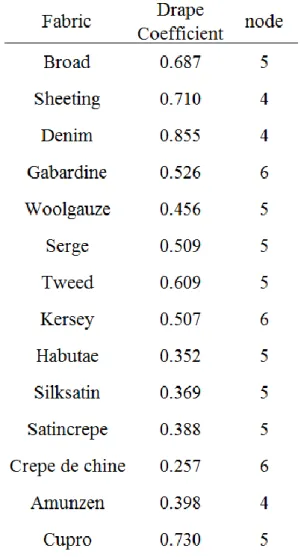
Fig.4-53 Drape Coefficient ... 134
Fig.4-54 Drape tester node ... 134
Fig.4-55 Hanging projection drawing of 14 kinds of fabrics by the drape tester ... 135
Fig.4-56 Distribution of the first and second principal component scores ... 140
Fig.4-57 Distribution of the first and third principal component scores ... 140
Fig.4-58 Distribution of the second and third principal component scores ... 140
Fig.5-1 Multiple comparisons among fabrics (Upper: gravity direction, Lower: orthogonal direction) ... 154
Fig.5-2 Multiple comparisons among rows (Upper: gravity direction, Lower: orthogonal direction) ... 155
Fig.5-3 Multiple comparisons among columns (Upper: gravity direction, Lower: orthogonal direction) ... 156
Fig.5-4 Relationship between predicted value and observed value using multiple regression equation (1st row , 2nd row , 3rd row , 4th row) Gravity direction ... 162
Fig.5-5 Relationship between predicted value and observed value using multiple regression equation (1st row , 2nd row , 3rd row , 4th row) Orthogonal direction ... 164
第 1 章 序論
1 1.1 ファッション業界を取り巻く社会の変化
近年,アパレル分野でも 3D(三次元,three dimensions の略,以下 3D とする)機能を搭 載した新型アパレル三次元 CAD が急速に普及し始めた.ファッションとテクノロジーの融合 が活発化し,コンピュータネットワークを媒体とした電子商取引(electronic commerce)E コマース(略称)や消費者間取引(C2C)など,これらの新潮流は,成長が頭打ちの日本経済 において,右肩上がりで伸びていると言われている.「スマートフォン」と「ソーシャルメデ ィア」が消費者の心理に与える影響は大きいとされ,アパレル分野でも,こうした電子商取 引のツールとして,テキスタイルや衣服のシミュレーションが実用化しており,これらにお いては,衣服設計の効率化も期待されている.また,3DCAD や 3DCG などの普及に伴い,3D プリンター(3D prin-ter,ウィキペディア1)も一般化し,今では,一般家庭でも低価格の 個人用 3D プリンターの導入が可能となってきている.シャネルは,2015 年秋,アイコニッ クなシャネルツイードに 3D パーツを手縫いするなど,3D プリンティング技術を駆使したオ ートクチュールコレクションを発表した(GIGAZINE=ウェブメディア2)(図 1-1).また,イ ッセイ・ミヤケは,2017 年春夏コレクションで,電子ペーパーを用いて,柄が変化するクラ ッチバックを登場させ,そのデザイン性の高さで顧客の購買意欲を刺激した(SO-EN 2017 Jan.1)).他にも多くのクリエイターたちが,3D プリンターを使用したコレクションを展開し ている(Lemontrend=ウェブメディア3,Materialise=ウェブメディア4,ジャポンタ=ウェブ メディア5)(図 1-2,1-3).他の業界と比較して,アナログな部分が多いと指摘される(DiFa=
ウェブメディア6)ファッション業界であるが,ファッションとテクノロジー,インターネッ トとテクノロジーといった新潮流は,今後,ファッション業界の仕組みや慣習をも変える先
1 https://ja.wikipedia.org/wiki/3D%E3%83%97%E3%83%AA%E3%83%B3%E3%82%BF%E3%83%BC 2 http://gigazine.net/news/20150925-chanel-couture-3d-printing/
3 http://lemontrend.com/designers/3d-print-fashion-show-by-ddani-peleg/
4 http://www.materialise.com/blog/3d-printinp-spotted-ny-fashion-week-katie-gallaghers-springsummer-2015-collection/
5 http://japontimes.livedoor.biz/archives/39927076.html
6 http://www.fashionsnap.com/the-posts/2016-07-02/fashiontech-startup/
2
駆けとなるのであろうか.長きに渡って,デザイナーの思想やブランドの伝統といったコン テクストを尊重しながら,アナログ的な価値を重んじてきた業界であるが(SO-EN 2017 Jan.1)),新潮流によって,これまでの古い体質は一新されるのであろうか.
現状,3D プリンターにおいては,樹脂(プラスチック)素材の利用が中心である.また,縫 製技術の進歩により,無縫製ウエアなども実現しているが,使用できる素材は限定されてい る.しかしこれらにおける技術革新はまだ始まったばかりで,今後もさらに進化し続けると 考えられる.
Fig.1-1 Tweed setup with hand-sewn 3D parts by Chanel
Source: URL:http://gigazine.net/news/20150925-chanel-couture-3d-printing/
3 Fig.1-2 Danit Peleg’s fashion collection
by 3D printed design
Source: URL:
http://lemontrend.com/designers/3d-print-fashion-show-by-danit-peleg/
Fig.1-3 Katie Gallagher’s fashion collection by 3D printed design
以上が,昨今のファッション業界の新潮流であるが,アパレル産業の企画・生産部門にお いては,それよりも前の 2000 年代半ばに,ある転機を迎えていた.ファストファッション(図 1-4)の台頭である.ファストファッションは,最新の流行を取り入れながら,低価格に抑え た衣料品を,短いサイクルで,世界的に大量生産・販売し,現在も売り上げを伸ばしている.
それは,2008 年 9 月のリーマンショックを契機に,数年で一気に広がり,デフレ不況に伴う 消費者の節約志向により,支持されてきた.年代を問わず,流行のアイテムを安く手に入れ たいという消費動向は,社会情勢が消費者意識を変化させたことを意味する.これまでと製 品開発プロセスが全く異なるこのファストファッションの台頭は,旧態依然のアパレル産業 にとって大きな転換期となり,これを境に企画の早期化,生産サイクルの加速化が進んでい った.
ここで,北村2)の文献を参考に,「従来型」の製品開発プロセスと「ファストファッション 型」の製品開発プロセスを比較し(図 1-5),アパレル産業の企画・生産部門の現状と問題点
Source: URL:http://www.materialise.com/blog/3d-pri nting-spotted-ny-fashion-week-katie-gallaghers-springs ummer-2015-collection/
4
を探ってみる.図 1 -5 に示す通り「従来型」では,実シーズンの約 2 年~1 年半前に,国際 流行色委員会(インターカラー)から「トレンドカラー」が発表され,約 1 年半前に,トレ ンドを予測・提案する企業(スタイリング・オフィス)から,情報誌「トレンドブック」が,
カテゴリーごとに年 2 回発行される.1 年半~1 年前に,パリやミラノで糸や生地の展示会が 開かれ,世界各国からデザイナーやバイヤーなどが訪れる.主催者は,糸や生地のメーカー に対して,見本はインターカラーで染めるよう依頼し,トレンドカラーの流行を促進させて いるという. 1 年~半年前になると,それまでに提案された色・トレンド・素材をもとにデ ザインされたプレタポルテ(高級既製服)のコレクションが開催される.このコレクション は,四大コレクションと言われ,ニューヨーク,ロンドン,ミラノ,パリの順で春夏・秋冬 年 2 回ずつ開催される.国内の大手アパレル企業は,それを参考にして製品を企画しサンプ ルを作って展示会にかける.半年前~実シーズンになると,国内の中小アパレルが,百貨店 やセレクトショップに並び始めた商品を見て情報収集し,製品企画及び生産を行う.以上が
「従来型」の一般的な製品開発プロセスである.それに対して「ファストファッション型」
は,実シーズン直前ないし実シーズンに入ってから,製品の企画・生産を行い,1 か月程度 で商品を店頭に並べる.その為,商品は流行を反映したもので,ファッション性も高く,手 の届きやすい低価格となる.また,頻繁に新商品が生産されるため,製品の鮮度が常に高く,
値下げに頼らずとも製品を売り切ることができる.このように,「従来型」と「ファストファ ッション型」とでは,製品開発プロセスにおける,トレンド情報の収集,製品の企画及び生 産,それらにかかる時間的,金銭的コストなどが全く異なる(北村2)).
2008 年~2009 年にかけて,外資系企業の日本進出が相次ぎ,ファストファッションに対す る社会的な注目と人気が高まった.国内アパレル製造卸企業全体の売り上げのうち,約 1,000 億円分がファストファッションに奪われたという(北村2)).また,ファストファッションを 購入する日本の若者たちの特徴について,辻3)はこう述べている.彼らはファッション情報
5
に敏感で,流行を取り入れることが上手な若者である.ファストファッションを流行として 捉え,サイクルの速さ,目新しさ,安価で身近であることなどが,若者たちの購入の理由だ としている.今やファストファッションは,若者のみならず,広い購買層にも浸透している.
そこからは,「従来型」のブランドやメーカーが,生存競争の生き残りをかけて,企画を早期 化し,生産サイクルを加速化せざるを得なかったことが伺える.
Fig.1-4 Fast fashion shop in the world
Source: https://matome.naver.jp/odai/2140729806194658401
6
Fig.1-5 Product development process of “conventional type” and “fast fashion type”
約2年前 約1年
半前 約1年前 約半年前 実シーズン
ト レ ン ド カ ラ ー 決 定
ト レ ン ド ブ ッ ク 発 行
( 年 2 回
)
パ リ
・ ミ ラ ノ で 糸や 生 地 の 展 示 会
プ レ タ ポ ル テ の コ レ ク シ ョ ン 開 催
( 春 夏 秋 冬 年 2 回
)
国 内 の 中 小 ア パ レ ル 製 品 企 画 及 び 生 産 開 始
<従来型>
製 品企 画 及び 生 産開 始
<ファストファッション型>
約1ヶ月前 実シーズン
7
このように,製品開発プロセスが全く異なる双方であるが,「従来型」が「ファストファッ ション型」に追随することでの弊害も問題視されている.皆廣4)は,個性の没落,環境問題,
人権問題などを挙げ,スピード感のあるマーケティングを求めた結果,品質や環境への配慮 が二の次になっていると警告している.またファストファッションは,ハイブランドのトレ ンドを模倣し低価格で販売しているがゆえに,これ以上低価格競争が激化すると,ハイブラ ンドの品質やブランド力が低下し,やがてはファッション業界全体の衰退へと繋がっていく のではないかと憂慮している.
8
1.2 ファッション・テクノロジー融合化時代におけるパタンナーの役割
以上のようなファッション業界を取り巻く社会の変化の中で,企画業務と縫製業務との要 に位置するパタンナーの役割とそのワークフローの現状はどのようになっているのだろうか.
ファッション業界の企画部門は,MD と呼ばれるマーチャンダイザー(商品開発から販売計 画,予算管理に至るまでを総合的に管理する仕事 FINES TOKYO=ウェブメディア7)とデザイ ナー(新しいファッションを生み出す人のこと apparel-fashion wiki=ウェブメディア8)及 びコーディネーター(ブランディングや商品企画,イベントや販促の戦略全般を考える仕事 FINES TOKYO=ウェブメディア9)で構成され,生産(設計・管理)部門は,パターンメーカー とグレーダー(グレーディングを行う専門技術者のこと apparel-fashion wiki=ウェブメデ ィア10)及びマーカー(衣料の生産工程のうちで無駄がでないように合理的に型紙をはめ込 んでいく作業のこと apparel-fashion wiki=ウェブメディア11)や品質管理などで構成されて いる(プロダクト・パターンメーキング 5)).設計を担当する“パターンメーカー”(patter n maker)=和製英語の“パタンナー”(ウィキペディア12)は専門職で(以下パタンナーと する),デザイナーのイメージしたデザイン画をもとに,型紙(=パターン,pattern)を作 る人のことを指し,フランス語では modelist,イタリア語では modellista と呼ばれている
(ウィキペディア12).イメージを具現化するというその仕事は,高い技術力と専門知識とを
7
http://www.fines-net.com/media/%E8%B2%A9%E5%A3%B2%E3%81%A0%E3%81%91%E3%81%98%E3%82%83%E3%81%A A%E3%81%84%EF%BC%81%E3%82%A2%E3%83%91%E3%83%AC%E3%83%AB%E4%BC%81%E6%A5%AD%E3%82%92
%E6%94%AF%E3%81%88%E3%82%8B%E8%81%B7%E7%A8%AE%E3%81%A8/
8
http://apparelfashionwiki.com/?cmd=read&page=%E3%83%95%E3%82%A1%E3%83%83%E3%82%B7%E3%83%A7%E3%83%B 3%E3%83%87%E3%82%B6%E3%82%A4%E3%83%8A%E3%83%BC&word=%E3%83%87%E3%82%B6%E3%82%A4%E3%8 3%8A%E3%83%BC
9
http://www.fines-net.com/media/%E3%83%95%E3%82%A1%E3%83%83%E3%82%B7%E3%83%A7%E3%83%B3%E3%82%B3
%E3%83%BC%E3%83%87%E3%82%A3%E3%83%8D%E3%83%BC%E3%82%BF%E3%83%BC%E3%81%AE%E4%BB%95%
E4%BA%8B%E5%86%85%E5%AE%B9/
10 http://apparelfashionwiki.com/?%E3%82%B0%E3%83%AC%E3%83%BC%E3%83%80%E3%83%BC 11
http://apparelfashionwiki.com/?cmd=read&page=%E3%83%9E%E3%83%BC%E3%82%AB%E3%83%BC&word=%E3%83%9E%
E3%83%BC%E3%82%AB%E3%83%BC
12 https://ja.wikipedia.org/wiki/%E3%83%91%E3%82%BF%E3%83%B3%E3%83%8A%E3%83%BC
9
要する.洋服の良し悪しは,パタンナーの経験的裁量,工場の縫製職人の腕などに左右され るところが大きいといっても過言ではない.いい意味でのマンパワーである.しかし,企画 の早期化,生産サイクルの加速化によって,そのしわ寄せが製作の現場にも及び,キャパシ ティを超えた業務の一部(パターンの作成)をアウトソーシングすることがある.アウトソ ーシングとは文字通り,企業の業務遂行の一部を外部に委託することで,業種にかかわらず,
現在では特に珍しいものではないとされている.企画業務と縫製業務との要に位置する設計 業務をアウトソーシング化することによるメリットについては,「①高い専門性のある外部の 知見を活用することができる.②自社のマンパワーが乏しい領域について人件費を固定化す ることなく取り組むことができる.」など,主に人件費の抑制や本来の業務に割く時間の確保 などが挙げられている.デメリットについては,「①社外人材であることから高い専門性は,
必ずしも自社の戦略の理解にはつながっていない.②品質管理のマネージメントコストが新 たに発生する.」(NOC 日本アウトソーシング株式会社=ホームページ13)といったことが挙げ られている.現実問題としてアパレル分野でも,自社の戦略についての理解が十分でないこ とが殆どで,最終的には,社内のパタンナーが手を加えることになり,外部委託に丸投げす ることはない.
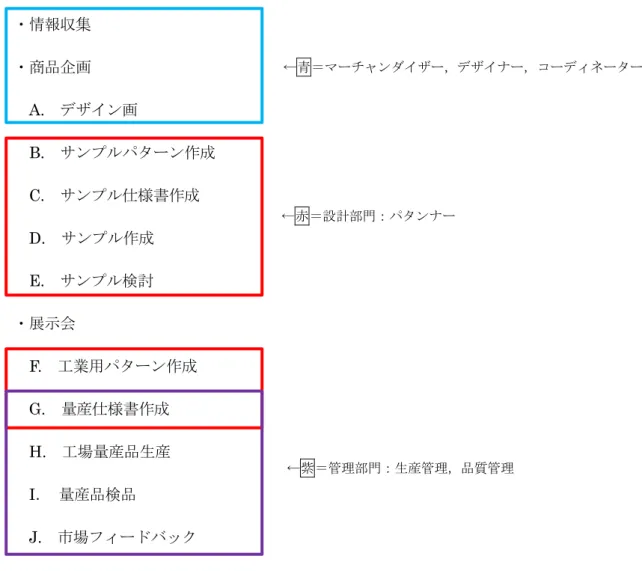
パターンメーキングのワークフローを図 1-6 に示す.ワークフローは,各企業の生産シス テム・方針により異なる.この図は(プロダクト・パターンメーキング 5))に記載されてい る某大手アパレル企業の一例である.
13 https://www.noc-net.co.jp/blog/2016/04/column_128/
10
・情報収集
・商品企画 A. デザイン画
B. サンプルパターン作成 C. サンプル仕様書作成 D. サンプル作成 E. サンプル検討
・展示会
F. 工業用パターン作成 G. 量産仕様書作成 H. 工場量産品生産 I. 量産品検品
J. 市場フィードバック
Fig. 1-6 Common workflow for pattern making
図 1-6 の「工業用パターン作成」にはパターン修正のほか,グレーディング,マーキング などの作業も含まれる.これも企業によって異なるが,すべての業務をパタンナーが行うと ころもあれば,グレーディングは外注し,マーキングは生産管理が行う場合もある.恐らく 後者の方が多いのではないかと推察する.何故ならパタンナーは,その時期すでに,次シー ズンの型出し作業が始まっているからである.次に,「量産仕様書作成」について,これも一 般的な例であるが,サンプル仕様書をもとに,パタンナーは主にパターン及び縫製に関する
←青=マーチャンダイザー,デザイナー,コーディネーター
←赤=設計部門:パタンナー
←紫=管理部門:生産管理,品質管理
11
事項を記入し,生産管理は量産分の生地,副資材,付属部品等に関する事項を記入する.特 に量産業務においては,この仕様書だけで必要な事項がすべて伝達できるように作成しなけ ればならない.このようにパタンナーは,アパレル企業の企画部門と縫製工場とを結ぶ重要 な役割を担っている.
アパレル三次元 CAD の開発が始まったのは,今から 45 年程前になる.1971 年 7 月に AGMS 株式会社(旧旭化成工業株式会社)が着手し,1975 年 4 月に,アパレル CAD システム「AGMS」
の販売を開始した.そして 1990 年には,JIAM (国際アパレル機器&繊維産業見本市)に三 次元シミュレーション・ソフトを出展.2001 年の学会誌6)で「AGMS-3D ソフト」を紹介して いる.東レ ACS 株式会社も,1975 年にミニコンピューター版アパレル CAD システムの販売を 開始.1990 年代初頭から,シミュレーション技術の開発に取り組み,その後,1998 年には Windows 版アパレル CAD システム「CREACOMPO®(クレアコンポ)」の販売を開始している.こ の「CREACOMPO®(クレアコンポ)」に関しては,アパレルメーカーや縫製工場をはじめとして,
独立したパタンナーや専門学校・大学などの教育機関でも利用され,そのユーザー数は全体 の 7~8 割に及ぶと言われている.2010 年には,3D 機能を搭載したクラウド型アパレル CAD システム「人人人®(ひとと)」の販売を開始,2014 年 4 月には,Windows 版アパレル CAD シ ステム「CREACOMPO®Ⅱ(クレアコンポⅡ)」を発売している.他のメーカーはというと,1999 年 5 月に,株式会社テクノアが仮想縫製システム「i-Designer」を発表,2000 年 7 月に左記 を発売した.2005 年 8 月には,デジタルファッション株式会社が,「Look Stailor X」(現:
「Dressing Sim LSX」)の発売を開始し,2012 年 4 月には,株式会社ユカアンドアルファが
「Alpha myu 3D」を発売するなど,仮想着装シミュレーション機能を搭載したアパレル三次 元 CAD の開発・販売は 1990 年以降,各社で活発に行われた.しかし前述の通り,これがユー ザーに急速に普及し始めたのは,2010 年,東レ ACS 株式会社によるクラウド型アパレル CAD システム「hitoto 人人人®(ひとと)」の発売以降であると推察する.その理由としては,
12
「hitoto 人人人®(ひとと)」が,パタンナーの新たなワークスタイルの可能性を提案したこ れまでにないシステムであったこと,また,クラウド型の従量課金制の採用によって,個人 でもシステムの購入が容易になったことなどが挙げられ,フリーランスのパタンナーでも,
設備投資の過度な負担なく,この「hitoto 人人人®(ひとと)」を導入することができたから である.
このように,ファッションとテクノロジーの融合が活発化し,テキスタイルや衣服のシミ ュレーションなども徐々に実用化してきた.以下は著書7)の抜粋である.乾7)は「現在では,
シミュレーションは殆どの場合,デジタルコンピュータで行われており,データはすべて数 値として扱われ,数値的な計算の処理により,シミュレーションの結果が得られる.このデ ジタルコンピュータによるシミュレーションは,対象とする現象を表現する為のモデル,条 件を与える為のデータ,結果の値を得るための解法などの要素から構成されている.テキス タイルや衣服のシミュレーションは,衣服と人体との関係,糸や布のモデルの幾何学的ある いは力学的特性を必要とし,これらの要素を組み合わせて実行が可能となる.シミュレーシ ョンのモデルは複雑な現実を単純化したもので,現象をリアルに再現する為には,モデルに さまざまな要因を組み込まなければならない.どのようなモデルを用いるのかは用途に応じ て決定される.」と述べている.衣服のシミュレーションにおいては,デザイナーが企画デザ インする為に使用する場合と,パタンナーがパターンの作成及び修正を行う為に使用する場 合とでは用途が異なり,衣服を正確に再現させることが必要になるのは後者のほうである.
これだけ一般的にシミュレーションが普及しても,製作分野ではこれまで通り,実物でのト ワルチェックが行われている.それはシミュレーションにおける衣服の再現性に問題がある からに他ならない.企画分野では比較的取り入れられやすい 3D 機能であるが,製作分野では パターンメーキング,グレーディング,マーキングなど,性能が向上し精度も高くなった 2D 機能の方が積極的に使用されているのが現状である.
13
2015 年以降,アパレル三次元 CAD の国際標準化に向けた議論が本格化している(繊研 Plus8)).アパレル三次元 CAD の最大のメリットは,様々な体型のサイズや形状に対応可能で あり,オーダーメイドで顧客のリクエストに応えることができる点にある.日本の高度経済 成長期が終焉を迎えた 1973 年以降は,アパレル産業を取り巻く環境も徐々に変貌していき,
大量生産・大量消費・大量廃棄型から循環型へとかたちを変えた.前述したファストファッ ションは,多品種少量生産,短サイクルで現在も売り上げを伸ばしている.これからの時代 は,消費者ニーズの多様化,個性化に対応できなければ,企業間競争の激化の波にのみこま れてしまう.今後,従来型のブランドやメーカーがファストファッションとの差別化を図る 為には,新たな生産システムの構築を模索していくしかない.個別のニーズに応えることが 可能なアパレル三次元 CAD は,絶好のツールになり得ると考えるが,それには思い切った方 針転換が必要となる.ファッションとテクノロジーの融合化時代に対して,今後パタンナー はどう取り組んでいくのか,その課題や展望について探る.
14
1.3 衣服変形に関連するフレアースカートの文献的背景
フレアースカートの定義について調べると,服飾用語としてのフレアーとは,あさがお型 に開き,波型に作られている衣服の部分のことで(田中千代 服飾辞典9)),フレアースカー トとは,裾が波打っているような広がりのある形のスカート(ウィキペディア14)と定義さ れている.
フレアースカートに関する研究は多く,フレアーのドレープ性(丹羽ら 10))(須田ら 11))
(天野ら12))や揺動性に関する研究(泉ら13))(野田ら14))(須田ら15)), 地の目使いや接 ぎ枚数(三木ら16,17)),シルエット形状(秋山18,19)) 及びシルエットの解析(張ら20,21)), 体型別作図の補正方法(角谷ら22)),縫製方法(佐藤23))など多岐に渡る.丹羽ら10)は,布 地の力学量とドレープ性との関係について両者は深く関わっているとしているが,シルエッ トの形成性の評価に用いるドレープ係数の測定法が不明確である為,それよりも布地の力学 量からドレープ係数を算出するほうが多くの情報を与えるとして,実用に耐える高精度の式 を導いた.須田ら11)は,立体構成されたフレアースカートのドレープは,着用者の胴部を基 因として派生し,胴部の影響を受けて,布地が効果的に体から離れた際に作られるという視 点から,フレアースカートのドレープ性について検討している.その結果,素材によって裾 線形状は異なり,フレアーはミドルヒップ前後で発生し,ヒップライン付近で裾線における ノード数が決定されることを把握した.また,ドレープ係数を応用したフレアー係数を新た に算出し,これがフレアー形状を表す一つの指標となり得ることを指摘した.フレアー係数 は,スカート丈,胴囲,裾回り寸法で求められるとしている.天野ら12)も,ドレープは布自 体の物性と密接に関係していると言っており,ドレープ係数を求める際に得られた投影図形 から「かたち」に関するいくつかのパラメータを求め,布地のドレープ形状を評価する値と しての適性を検討している.このドレープ性評価には少なくとも 2 つの独立したパラメータ
14 https://ja.wikipedia.org/wiki/%E3%82%B9%E3%82%AB%E3%83%BC%E3%83%88
15
を用いることが有効であるとして,ドレープ係数とは相関性が低く独立したパラメータであ ることが条件になるとしている.泉ら13)は,ギャザースカートの揺動の美しさを一対比較法 及び評定尺度法による官能検査によって評価し,その官能評価値と布地の力学特性との関係 を検討し,美しさの内容について分析している.その結果,官能評価値は高曲率における曲 げ剛性及び曲げヒステリシスから得られる力学量パラメータや unbending length と強い相関 を持ち,いずれの値も小さいほど動的ドレープは美しいと評価した.また,動的シルエット の美しさには,曲げ特性だけでなく,せん断剛性及びせん断ヒステリシスも強く関与してい ることも明らかにした.野田ら14)は,フレアースカートの揺動性における布地特性の違いに ついて,スカートの揺動は主に膝の蹴りによって生じることを確認し,その影響を最も大き く受けるスカート前面部分のライン形状を 3 つに分類し,それぞれの近似曲線式と移動速度 の回帰式を求めた.須田ら15)は,素材特性と揺動性の関係について,動作解析システムを用 いて検討し,歩行時の膝の蹴り出しによって最も揺動する点を分析点として,各分析点の軌 跡から揺動量を求め,素材による違いを明らかにした.また,歩行時の揺動状態を素材別に 変異曲線で表し,膝の動きとの関連を明確にした.三木ら16)は,フレアー形状に及ぼす,布 の地の目方向,接ぎ枚数及び縫い目の力学特性との関係を検討した結果,フレアースカート のシルエット形態を表すパラメータは裾角度に代表され,この裾角度は,布地と縫い目の力 学特性(bending length)の影響を受けることを明らかにした.また,接ぎ枚数が多くなる とノードは増加し,裾角度は大きくなり,ヘムラインの山の高さは小さくなること,スカー トのシルエットは,型紙の中心の地の目がバイアス方向のほうが,経糸方向のものよりも垂 れ下ったシルエットになることを確認した.秋山18)は,フレアースカートの裾幅に及ぼすパ ターンの裾回り寸法と布地の曲げ長さの影響について検討を行い,これらを説明変数とする 裾幅算出式を作成した.また,この式をパターンメーキングに応用して,デザイン画の裾幅 からパターンの裾回り寸法を求める方法を導いた.張ら20)は,布地の力学特性とフレアース
16
カートのシルエットとの関係を明らかにする為に,スカートの正面と裾部分の横断面の静的 ドレ―プ形状をカメラ撮影し,形状を表すパラメータ(裾幅,裾角度,ノード数,ノードの 高さ)と KES で得られる布地の基本力学特性や布地の曲げ振動の 4 つのパラメータ(Δd1,
Δd2,S1,S2)との関係について検討した.その結果,フレアースカートの正面静的シルエ ットを表すパラメータとしては,裾角度が定義できたとしている.前述の三木ら 16)と同様,
この裾角度は主に布地の曲げ特性に支配され,裾角度と布地のドレープ係数とは高い相関を 示し,静的裾横断面のシルエットについて,ノード数,山の高さは,布地の力学特性パラメ ータとの関連が大きく,ドレープ係数は,山の高さとの相関係数が大きい.正面静的シルエ ットに関する曲げ振動特性パラメータは,裾角度との相関係数が大きいことなどを指摘した.
また,張ら21)は同様のパラメータを用いて動的シルエットの解析も行い,一対比較法を用い て,フレアースカートの動的ドレープの美しさの主観評価と布地の力学特性との関係につい ても検討している.角谷ら22)は,異なった体型及び地の目の相違によって現れるフレアーを 円から製図し,裾幅の異なる二つのフレアースカートについて実験,観察を行った.体型と 地の目によってシルエットやフレアーの出方が異なることから,それらに合わせた補正方法 が提案されている.佐藤23)は,フレアースカートを縫製する際,一定期間,布地を自然垂下 させておくと,布地が安定し静立時の脇線を美しく直下させることができるが,長時間自然 垂下できない場合でも,脇縫い目を直下させる方法を検討した.脇線のバイアス角度を 45°
60°75°90°で検証し,縫いずれが顕著に現れる 2 種類の試料布を用いて,人工的に伸ばし 処理を加え,縫製時の布の伸ばし方法などの検討を行った.結果,手やアイロンでの伸ばし 処理は伸ばし過ぎたり,変形が大きくなったりする傾向が認められ,布地を引きながら縫製 する場合も,その加減が難しいと結論づけている.
これらフレアースカートに関する研究が活発に行われたのは,主に 1970 年代~90 年代に かけてである.当時,研究対象として多く取り上げられたフレアースカートは,ちょうど日
17
本経済のバブル期である 1980 年代に流行している.1981 年には,サーキュラースカートが 復活し,1982 年には,フレアーのミニスカートが復活している.そして,1989 年にはロング フレアースカートが流行した(年代流行=ウェブサイト15).近年は,この 80 年代~90 年代 のファッションが再びブームになっている(図 1-7).角谷ら22)は,フレアーについて,「材 質,カッティング,縫製テクニック,地の目,着用者の体型などによって,その形状は異な りシルエットにも変化があらわれる.」また,宮脇ら24)は,「これらの要因が互いに作用し合 い様々なフレアー形状を作りだす.」と述べており,多くの要因を含むフレアースカートは,
その流行と相まって,研究対象として大きく関心が寄せられたことが伺える.
Fig.1-7 Michael Kors “2015 - 16 A-W New York Collection”
Source: URL: https://www.wwdjapan.com/99558
一般的にフレアースカートは変形しやすく,布地によっては,時間経過とともにひどい型 崩れを起こすこともあり,布地の特性が表面化しやすいアイテムとも言える.伸び,圧縮,
曲げ,せん断などの力学変形特性と,原料繊維固有の性能及び糸の太さ,撚り,組織,糸密
15 http://nendai-ryuukou.com/
18
度,厚さ,重さ(目付け)などの構造特性は,平面の布地を衣服として立体化する際に,複 合的に関わってくる為,イメージ通りの衣服設計をする為には,設計段階で材料とする布地 の特性を十分に検討する必要がある(アパレル設計論・アパレル生産論25)).山田ら26)は,
着用時に被服材料がうける変形の実態を明らかにすることは,被服材料の力学特性を検討す る上で重要であるとして,標準体型の被験者に合せて,ウール 100%の平織物に 1 ㎝間隔の 格子線を引き,スラックス,スカート,ジャケットを作製.着用して動作したとき,被服の どの部位にどのような変形が生じるのかを,部分接写して写真観測し変形量を測定,布地の 引張り,せん断,曲げなどの大略の変形特性から,動作時の被服材料が受ける変形の実態を 検討した.また,伊藤ら27)は,地の目使いを異にした被服に生ずる織物の変形状態および変 形量の差異は,被服材料の力学的異方性に基因するものと考え,これが被服として着用した 場合の被服の変形量とどのような関係を持つかについて,試験片を用いて実測し検討してい る.動作時の被服に生じる変形は,常に三次元的変形を生じる為,少なくとも二軸引張り試 験機を用いて二次元的に織物の力学特性を知る必要があること,また,その二軸伸長変形下 での伸長荷重,拘束荷重は,力学的異方性の影響を受け,被服着用時の運動量や被服の寸法 安定性に関係することなどを明らかにした.村井28)は,織物のバイアス方向の寸法変化及び 伸長と斜行変形=捩れとの関係を解析している.捩れは,ネクタイや婦人ブラウスのバイア ス裁ちしたボータイなどによく見られ,捩れと同時に痩せも生じることが多い.ネクタイに は芯地を使うため,伸びが抑えられ斜行は小さいが(村井 28)),フィラメント糸で織られた しなやかな布地を使用した場合のボータイブラウスには,芯地を使わないことが多い.従っ て,バイアス裁ちしたボータイには,捩れが生じる場合が非常に多く,一度捩れが生じると 元に戻らない(中屋ら 29,30)).これもまた,部分的ではあるが変形の一つと言える.中屋ら
30)は,この捩れの原因を追究し,布のバイアス角度と裁断後の伸長分量の処理方法などに問 題があるとして,試験布を用いて検証し,その結果を踏まえてブラウスを実物製作し着用実