
Fukushima Medical University
福島県立医科大学 学術機関リポジトリ
This document is downloaded at: 2021-11-07T23:08:29Z
Title A case of polyarteritis nodosa limited to lower legs with a high titer of MPO-ANCA under precedence of idiopathic pulmonary fibrosis
Author(s) Sugisaki, Kota; Takeda, Isao; Kanno, Takashi; Oguchi, Yoshihito; Kasukawa, Reiji
Citation Fukushima Journal of Medical Science. 49(2): 141-148
Issue Date 2003-12
URL http://ir.fmu.ac.jp/dspace/handle/123456789/145
Rights © 2003 The Fukushima Society of Medical Science
DOI
Text Version publisher
Fukushima J. Med. Sci., Vol. 49, No.2, 2003
[Case Report]
A CASE OF POLYARTERITIS NODOSA LIMITED TO LOWER LEGS WITH A HIGH TITER OF MPO-ANCA UNDER PRECEDENCE
OF IDIOPATHIC PULMONARY FIBROSIS
KOT A SUGISAKP), ISAO T AKEDN), T AKASHI KANNO!), YOSHIHITO OGUCHF) and REIJI KASUKA W N)
1) Division of Rheumatology, Ohta Nishinouchi Hospital, Koriyama 2)Oguchi Clinic, Koriyama
(Received May 16, 2003, accepted May 29, 2003)
Abstract: A 58-year-old man with a 15-year history of idiopathic pulmonary fibrosis was hospitalized for rapid progression of muscle weakness to bilateral foot drop. Although laboratory data revealed high titers of myeloperoxidase anti- neutrophil cytoplasmic antibody (489 EU), the patient was diagnosed as polyarteritis nodosa limited to the lower portions of the legs. Despite of the treatment with large doses of corticosteroids and cyclosporin A, his symptoms barely improved during the following two months.
Key words: vasculitic neuropathy, muscle weakness, cyclosporin A
INTRODUCTION
Polyarteritis nodosa (PAN) represents a heterogeneous group of vasculitides that have recently been subclassified into classical PAN and microscopic polyangiitis (MPA). In classical PAN, medium- to small-sized vessels in various organs are damaged, while in MPA, small vessels impairment predominates. Renal artery involvement without glomerular damage is often found in PAN, while a high prevalence of glomerulonephritis is observed in MP A.
Anti-neutrophil cytoplasmic antibody for myeloperoxidase (MPO-ANCA) reportedly represents a specific serological marker for small vessei vasculitis such as MP A and Churg-Strauss syndrome (CSS). However, some cases of classical PAN with low titers of MPO-ANCA have recently been reported. These reports indicate that the existence of MPO-ANCA does not always rule out a diagnosis of classical PAN. Careful clinical examination for vascular lesions is indispensable for
~1/f,jfJ.lltt:, j\83 J}], W!I!f ,,¥:, *D~.A., ;J!8JlliTll'fJ
Correspondence to: Kota Sugisaki, Department of Internal Medicine II, Fukushima Medical University School of Medicine, Fukushima City 960-1295, Japan.
141
142 K. SUCISAKI e/ al.
diagnosing the conditions of patients with MPO-ANCA.
The present report describes a case of classica l PAN limited to the
lowerportions of the legs. The patient ha d an exceedingly high tite r of MPO-ANCA and a 15
-yearhistory of idiopathic pulmonary fibrosis (IPF).
CASE REPORT
A 58- year- old man noti ced li vedo reticularis with mild pain
II1the lower portions of his
legs onMay 28, 2002, and was examined at Og uchi Clinic. Because of no drug histo ry, no symptom of infection and collage n disease, he had been diagnosed as IPF 15 years before . However, the patient had received no medical treatments for IPF as he
lackedrespiratory symptoms. He was not a smoker and never suffered from bronchial asthm a
.Laboratory data for the patient wer e as foll ows: C-reactive protein (CRP), 1l.69 mg
/dl (normal,
lessthan 0.2 mg/ dl) ; creatinine, 0.9 mg/dl (normal, less than l.0 mg/dl); positive titer of rheumatoid factor, 105 IU/ ml (norma
l,less than 20 IU/ml); positive titer of MPO-ANCA, 227 EU (normal, less than 10 EU). Neither proteinase- 3 anti -neutrophil cytoplasmic antibody (PR3
-ANCA)nor a nti- nuclear antibody (ANA) was detected. Urinalysis reveale d no proteinuria or mi croscopi c hematuria. Systemic vasculitis and vas- culitic neuropathy were suspected, and 30 mg/ day of prednisolone was administered.
Li vedo reticularis and leg pain improved slightly. However, muscle wea kness in the lm Ner portions of the legs, particularly in bil ateral tibialis anterior muscles, appeared suddenly on June 1, 2002, and rapidly progressed
.The patient was referred and a dmitted to the Rheumatology Unit of Ohta Nishin ouchi Hospita l on June 3, 2002.
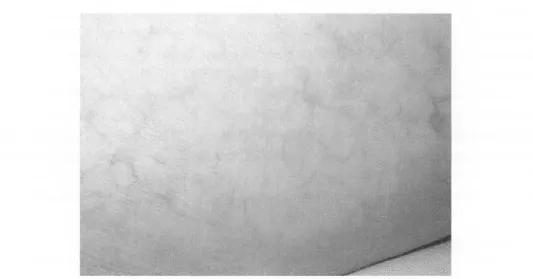
On admissio n, li vedo ret iculari s in the lowe r sections of both legs (Fig. 1) and bilate ral foot drop were noted. The patie nt's body temperature was 36.0°C, and no signs of Raynaud's phenomenon or arthritis were observed. Blood pressure was
Fig.1. Livedo reticularis in the lower portion of the right leg.
LIMITED-FORM PAN WITH MPO-ANCA AND IPF 143
150/82 mmHg. Heart sounds were clear with a regular sinus rhythm, and the pulse rate was 104 beats/min. Weak fine crepitations without any wheezing were audible in both lung fields. No bruit was audible in the neck or abdomen. Mild edema was observed in both feet, while both dorsal pedis arteries were easily palpable. The patient reported mild stinging pain in the lower sections of his legs, especially in the soles. Manual muscle tests revealed severe muscle weakness equivalent to grade 0 or 1 in both tibialis anterior muscles. Due to significant muscle weakness in the lower sections of the legs, the patient was unable to stand unaided. Deep tendon reflex in the upper extremities and patellar tendon reflex were normal. However, the Achilles tendon reflex was absent bilaterally. Superficial sensations, such as thermal and touch senses, were slightly disturbed, while deep sensory disturbance was not observed.
Laboratory data on admission were as follows: erythrocyte sedimentation rate, 45 mm/h (normal, less than 15 mm/h); CRP, 2.3 mg/dl; white blood cells, 17,500/
mm
3(normal, 3,000-10,000/mm
3 );Neutrophils, 78% (normal, (27-69%) ; Eosinophils, 2% (normal, less than 10%); Lymphocytes, 14% (normal, 18-59%); hemoglobin, 14.3 g/dl (normal, 13.4-17.5 g/dl); platelets, 50.1 x 10
4/mm
3(normal, 12.5-37.0 x 10
4 /mm
3);total protein, 7.6 g/dl (normal, 6.5-8.3 g/dl); albumin, 3.9 g/dl (normal, 4.0- 5.2 g/dl); aspartate aminotransferase, 38 lU/I (normal, 5-35 lU/l); alanine aminotransferase, 62 lU/I (normal, 5-40 lU/I); lactate dehydrogenase, 220 U/ml (normal, 110-220 U/ml); blood urea nitrogen, 14.2 mg/dl (normal, 8-20 mg/dl);
creatinine, 0.68 mg/dl; KL-6, 1,310 lU/ml (normal, less than 500 lU/ml); 24-h creatinine clearance, 185.81/day. ANA, anti-DNA, anti-RNP, anti-Sm, anti-Ro, anti-La and anti-Scl-70 antibodies were not detected using commercial ELISA kits.
Levels of C
3 ,C
4and hemolytic complement (CH
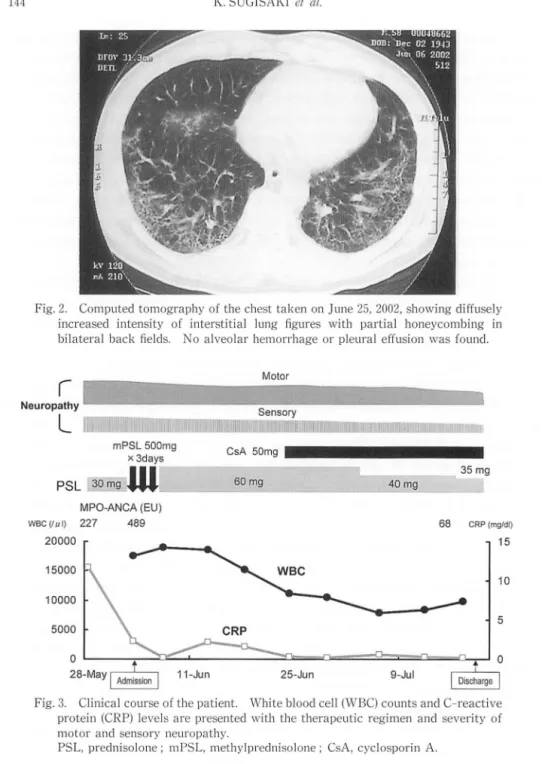
so )were normal. The immune complex level measured by the C1q binding method was 3.5 )lg/ml (normal, less than 2.9 )lg/ml). There was an exceedingly high titer of MPO-ANCA (489 EU), while PR3-ANCA was not detected. No evidence of chronic infection with hepatitis B or C virus was observed. Urinalysis revealed no abnormal sedimentation or urinary cast. Chest X -ray and computed tomography of the chest revealed diffuse inter- stitial fibrosis throughout both lung fields with no alveolar hemorrhage or pleural effusion (Fig. 2). Both pulmonary function test and arterial blood gas analysis showed no abnormality. An immunological fecal occult blood test was negative.
The clinical course of this case is shown in Fig. 3. Following the 1990 American
Collage of Rheumatology criteria, the patient's condition was diagnosed as classical
PAN. The diagnosis was based on livedo reticularis, weakness of muscles and
multiple mononeuropathies, although histological examination of arteries was not
performed. To prevent additional progression of motor and sensory nerve distur-
bances, methylprednisolone drip infusion therapy at a dosage of 500 mg/day for 3
days was started on June 3, 2002. The infusion therapy was followed by administra-
tion of prednisolone at a dosage of 60 mg/day. The patient's livedo reticularis was
subsequently ameliorated. However, no remarkable improvements in the sensory
144 K. SUGISAKI et (II.
Fig. 2. Computed tomography of the chest taken on June 25,2002, showing diffusely increased intensity of interstitial lung figures with partial honeycombing in bilateral back fields. 0 alveolar hemorrhage or pleural effusion was found.
r
MotorNeuropathy
L
1 _ _ _mPSL 500mg
x 3days CsA 50mg • • • • • • • • • • • • • •
30 mg
W .... ~ ___
6_0_m....;.g _ _ _ _ _ _ _ _....;..-...;;~~
40 mg 35 mgPSL
MPO-ANCA (EU)
wec (Itt I) 227 489 68 CRP (mg/dl)
20000 15
10
5
0 9-JuJ
I
DiSLrgeI
25-Jun
Fig. 3. Clinical course of the patient. White blood cell (WBC) counts and C-reactive protein (CRP) levels are presented with the therapeutic regimen and severity of motor and sensory neuropathy.
PSL, prednisolone; mPSL, methylprednisolone; CsA, cyclosporin A.
disturbance or foot drop were observed. Motor nerve conduction studies of bilat- eral peroneal and tibial nerves and sensory nerve conduction studies of bilateral sural nerves were performed on June 25. Action potentials were absent in all examined nerves (Fig. 4). These results suggested the existence of axonal degenera- tion that was probably caused by peri-neuronal vasculitides. No malignancy was
LIMITED-FORM PAN WITH MPO-ANCA AND IPF
5 ....
Lt. peroneal. . Rt. sural
Al~~ ________________ ~M~.~1mA~
1 1 nt.I
5,...
Rt. peroneal. : Lt. sural
A 48.5mA
1 1 nt.I
Fig.4 [a] Fig.4 [b]
145
29.0mA.
10
N: 5
30.4rrA OUV N: 10
Fig. 4. Nerve conduction studies. Absence of action potential was observed in the bilateral peroneal motor nerves [a] and the bilateral sural sensory nerves [b].
found by routine gastrointestinal endoscopy, chest computed tomography and abdominal ultrasonography.
Because of the complication of severe IPF and the prevention of the rapid progression of the interstitial pulmonary lesion, treatment with cyclosporin A (CsA) at a dosage of
50mg/day was commenced on July
5.Thereafter, the levels of CRP decreased to
0.2mg/dl, and the titer of MPO-ANCA decreased to 68 EU on July 18.
Blood CsA trough-level ranged between
45-213ng/ml.
DISCUSSION
MPO-ANCA is widely recognized as a specific serological marker for small vessel vasculitis such as MPN) and CSS2).
Ithas been reported that MPO-ANCA is found in
50-80%of patients with MP A and
20%of patients with classical P AN3), and some cases of classical PAN with low titers of MPO-ANCA have been recently reported
4 )-6).These reports indicate that the existence of MPO-ANCA does not always rule out the diagnosis of classical PAN.
Nephropathy, especially glomerulonephritis, is often found in patients with
MP A, but it is rarely seen in patients with classical PAN
1),7).Our patient had no
146 K. SUGISAKI et at.
renal dysfunction or abnormal urinary findings. Alveolar hemorrhage is the most common and fatal complication of MPAS)-IO), but alveolar hemorrhage rarely occurs in patients with classical PAN. Our patient did not develop alveolar hemorrhage.
Peripheral neuropathy, including multiple mononeuropathies, is a common complication of systemic vasculitis. Approximately
60%of classical PAN and MPA patients develop multiple mononeuropathies
7).Moreover, motor neuron disturbance is often seen in patients with classical PANll),12), while sensory distur- bance is more common in patients with MPAI3). Severe motor neuropathies, such as drop foot, are rarely seen in patients with MP
A.In our patient, motor neuron- dominant neuropathy, which was demonstrated by drop foot, was observed with mild sensory nerve disturbance. This strongly suggested the presence of PAN.
Despite a high titer of MPO-ANCA, the diagnosis of classical PAN was made.
The diagnosis was based on the lack of both nephritis and alveolar hemorrhage and the presence of motor neuron-dominant neuropathy, calf muscle weakness and livedo reticularis. We did not find any signs of vasculitis in other parts of the body.
It is plausible that the patient did not have high fever or weight loss, which are often found in cases of classical PAN, because this was a limited form of PAN that was quickly and intensively treated.
Pulmonary fibrosis is a rare complication of classical PAN and MP
A.Some cases of MPA accompanied by IPF have been recently reportedI4),15). Interestingly, in most of these cases, IPF preceded the vasculitis. These reports indicate that IPF may affect the pathogenesis of MP
A.Various kinds of autoantibodies, such as ANA, have been detected in patients with IPp6),l7). Moreover, a predominantly T- helper-2 cytokine profile, which is indispensable for autoantibody production, was observed in patients with IPPS),19). We speculate that the high titer of MPO-ANCA in our patient was produced because the patient had a 15-year history of IPF.
However, the IPF observed in this patient was considered to be unrelated to the formation of PAN.
MPO-ANCA has been reported to be related to various kinds of tissue damage.
The titer of MPO-ANCA is supposed to be correlated with the severity of vasculitis.
However, Geffriaud-Ricouard et at. reported that the titer of ANCA is not always correlated with the severity of disease20). Moreover, Fuji et al reported that MPO- ANCA obtained from patients with MPO-ANCA-associated glomerulonephritis recognized particular epitopes of MP021). According to their reports, MPO-ANCA that reacts with the upstream site near the N -terminus and the downstream site near the C-terminus of the MPO molecule is related to clinical outcomes and is more frequently pathogenic than MPO-ANCA that evenly reacts with all epitopes.
Suzuki et al also reported that most MPO-ANCA obtained from patients with PAN
or MPA reacted with only the N - or C-terminus of the heavy chain of the MPO
molecule22). These reports indicate that MPO-ANCA, like other autoantibodies, is
heterogeneous and not always harmful. Despite an exceedingly high titer of MPO-
ANCA in our patient, he did not develop progressive nephritis or fatal alveolar
LIMITED-FORM PAN WITH MPO-ANCA AND IPF 147
hemorrhage, indicating that MPO-ANCA did not cause major tissue damage.
REFERENCES
1. Bakkaloglu A, Ozen S, Baskin E, Besbas N, Gur-Guven A, Kasapcopur 0, Tinaztepe K.
The significance of antineutrophil cytoplasmic antibody in microscopic polyangitis and classic polyarteritis nodosa. Arch Dis Child, 85: 427-30, 2001.
2. Solans R, Bosch JA, Perez-Bocanegra C, Selva A, Huguet P, Alijotas J, Orriols R, Armadans L, Vilardell M. Churg-Strauss syndrome: outcome and long-term follow-up of 32 patients. Rheumatology (Oxford), 40: 763-71, 2001.
3. Guillevin L, Lhoto F. Polyarteritis nodosa and microscopic polyangitis. Clin Exp Im- munol, 101: 22-3, 1995.
4. Iwamasa K, Komori H, Niiya Y, Hasegawa H, Sakai I, Fujita S, Yoshida M, Nose M. A case of polyarteritis nodosa limited to both calves with a low titer of MPO-ANCA. (in Japanese) Ryumachi, 41: 875-9, 2001.
5. Tsunoda K, Akaogi J, Ohya N, Murofushi T. Sensorineural hearing loss as the initial manifestation of polyarteritis nodosa. (in Japanese) J Laryngol Otol, 115: 311-2, 2001.
6. Bohgaki T, Mukai M, Notoya A, Kohno M. Two cases of classical polyarteritis nodosa associated with a low titer of MPO-ANCA. (in Japanese) Ryumachi, 40: 9-15,2000.
7. Handa R, Wali JP, Gupta SD, Dinda AK. Aggarwal P, Wig N, Biswas A. Classical polyarteritis nodosa and microscopic polyangiitis-A clinicopathologic study. J Assoc Physicians India, 49: 314-9, 2001.
8. Lauque D, Cadranel J, Lazor R, Pourrat J, Ronco P, Guillevin L, Cordier JF. Microscopic polyangiitis with alveolar hemorrhage. A study of 29 cases and review of the literature.
Groupe d'Etudes et de Recherche sur les Maladies "Orphelines" Pulmonaires (GERM"O"P). Medicine (Baltimore), 79: 222-33, 2000.
9. Lee CK, Koh JH, Cha HS, Kim J, Huh W, Chung MP, Koh EM. Pulmonary alveolar hemorrhage in patients with rheumatic diseases in Korea. Scand J Rheumatol, 29: 288- 94,2000.
10. Guillevin L, Durand-Gasselin B, Cevallos R, Gayraud M, Lhote F, Callard P, Amouroux J, Casassus P, Jarrousse B. Microscopic polyangiitis: clinical and laboratory findings in eighty-five patients. Arthritis Rheum, 42: 421-30, 1999.
11. Bosch X, Navarro M, Lopez-Soto A, Grau JM, Martinez-Orozco F. Primary polyarter- itis nodosa presenting as acute symmetric quadriplegia. Clin Exp Rheumatol, 17: 232-4, 1999
12. Tsukaguchi M, Takeuchi H, Yamada A, Kazushi D, Nishioka M. Extensive mononeur- itis multiplex in polyarteritis nodosa. A case report. (in Japanese) Shinkei Naika, 44:
356-60, 1996.
13. Penas PF, Porras
n,
Fraga J, Bemis C, Sarria C, Dauden E. Microscopic polyangiitis. A systemic vasculitis with a positive P-ANCA. Br J Dermatol, 134: 542-7, 1996.14. Mansi lA, Opran A, Sondhi D, Ayinla R, Rosner F. Microscopic polyangiitis presenting as idiopathic pulmonary fibrosis: is anti-neutrophilic cytoplasmic antibody testing in- dicated? Am J Med Sci, 321: 201-2, 2001.
15. Becker-Merok A, Nossent JC, Ritland N. Fibrosing alveolitis predating microscopic polyangiitis. Scand J Rheumatol, 28: 254-6, 1999.
16. Chapman JR, Charles PJ, Venables PJ, Thompson PJ, Haslam PL, Maini RN, Turner Warwick ME. Definition and clinical relevance of antibodies to nuclear ribonucleo- protein and other nuclear antigens in patients with cryptogenic fibrosing alveoli tis. Am Rev Respir Dis, 130: 439-43, 1984.
17. Holgate ST, Haslam P, Turner-Warwick M. The significance of antinuclear and DNA antibodies in cryptogenic fibrosing alveolitis. Thorax, 38: 67-70, 1983.
148 K. SUGISAKI et al.
18. Pardo A, Selman M. Molecular mechanisms of pulmonary fibrosis. Front Biosci, 7:
01743-61, 2002.
19. Majumdar S, Li D, Ansari T, Pantelidis P, Black CM, Gizycki M, du Bois RM, Jeffery PK.
Different cytokine profiles in cryptogenic fibrosing alveolitis and fibrosing alveolitis associated with systemic sclerosis: a quantitative study of open lung biopsies. Eur Respir J, 14: 251-7, 1999.
20. Geffriaud-Ricouard C, Noel LH, Chauveau D, Houhou S, Grunfeld JP, Lesavre P.
Clinical spectrum associated with ANCA of defined antigen specificities in 98 selected patients. Clin Nephrol, 39: 125-36, 1993.
21. Fujii A, Tomizawa K, Arimura Y, Nagasawa T, Ohashi YY, Hiyama T, Mizuno S, Suzuki K. Epitope analysis of myeloperoxidase (MPO) specific anti-neutrophil cytoplasmic autoantibodies (ANCA) in MPO-ANCA-associated glomerulonephritis. Clin Nephrol, 53: 242-52, 2000.
22. Suzuki K. Auto-antibody in vasculitis: Antibody of neutrophilic cytoplasmic antibody ANCA. (in Japanese) Saishin Igaku, 55: 2636-46, 2000.
![Fig. 4. Nerve conduction studies. Absence of action potential was observed in the bilateral peroneal motor nerves [a] and the bilateral sural sensory nerves [b]](https://thumb-ap.123doks.com/thumbv2/123deta/6044793.2076034/6.748.111.622.105.544/conduction-studies-absence-potential-observed-bilateral-peroneal-bilateral.webp)
