• 検索結果がありません。

Resuscitation in the Fundamental Nursing Education 

N/A
N/A
Protected

Academic year: 2021

シェア "Resuscitation in the Fundamental Nursing Education "

Copied!
8
0
0

読み込み中.... (全文を見る)

全文

(1)

Resuscitation in the Fundamental Nursing Education 

with special reference to Basic Life Support 

Hideko URATA * , Yumiko FUKUYAMA * . Harumi MIYAHARA * , Jun OSHIMA ' ,  Hiromi KITAJIMA * , Keiko OKUMA * , Etsuko IMANAKA * , and Hiroko MIYASHITA * 

Abstract Nursing skill training for cardiopulmonary resuscitation as part of the basic life  support was conducted in the school using dummies for training emergency resuscitation. This  training was participated by 70 students of the Department of Nursing, the School of Allied  Medical Sciences, Nagasaki University. The effectiveness of learning and practicing by the students  and the problems were analyzed on the basis of their nursing practical test and objective tests  before and after the skill exercise. 

In nursing practical skill test, the instructors evaluated each item on the check list, and more  than 900/0 of the students passed the test for most of the items. In objective test, the average  marks after the nursing skill exercise was high. However, knowledge and skill were not integrated  in some items, Ieaving problems for the teaching procedure. In self‑evaluation, many students 

"could not" perform artificial respiration, indicating that keeping airway and mouth‑to‑mouth  ventilation were quite difficult. Basic life support is meaningless if one is unable to perform at an  emergency circumstance. Acquisition of the skill by repeated training is considered essential. 

Bull. Sch. Allied Med. Sci., Nagasaki Univ. 11: 41‑48, 1997 

Key Words  cardiopulmonary resuscitation, prehospital  artificial respiration, cardiac massage 

I . INTRODUCTION 

Emergency cases may arise in all areas of daily  life as well as in hospitals. As medical treatment  has been developing highly and widely, nurses are  required at various emergency sites to have the  ability of judgment to assess ntirsing problems  based on the degree, cause and factor of the injury. 

and the ability to promptly play their role in  emergency procedure. Thus, it is essential to de‑

velop basic ability such as skill and playing a role  to perform emergency nursing. 

Clinical nursing practice plays an important role  in fundamental nursing education. However, oppor‑

tunities for nursing students to experience the  method of emergency resuscitation in clinical nurs‑

ing practice are extremely scarce, and it is impos‑

sible for them to actually perform emergency resus‑

citation even if they encounter such an occasion. 

care, airway keepin , 

Emergency resuscitation is a skill which is essential  in a crisis of life. A variety of trials to provide  more practical learning have been undertaken at 

schools I ) lo) 

Ever since its inauguration, the Department of  Nursing, the School of Allied Medical Sciences,  Nagasaki University, has provided lessons of car‑

diopulmonary resuscitation (CPR) as part of basic  life support in nursing skill training of third‑year  class students using LAERPAL'S Recording Resusci  Anne (Resusci Anne), a dummy for training of  emergency resuscitation. Recently, a review was  made on the learning and practicing evaluation and  future problems on the basis of nursing practical  skill test, objective tests before and after nursing  skill exercise and self‑evaluation by students them‑

selves . 

2  3 

Department of Nursing, the School of Allied Medical  Former Department of Nursing, the School of Allied  Master's Course in Nursing, Kitasato University 

Sciences Nasagaki University 

Medical Sciences Nasagaki University 

(2)

II . OUTLlNE of NURSlNG SKILL EXERCISE  1. Purpose 

To understand cardiopulmonary resuscitation  (CPR) and to be able to perform emergency pro‑

cedure including basic life support. 

2. Subjects and Period of Exercise  1) Subjects 

The subjects were 70 nursing students among  those registered in the third‑year class of the De‑

partment of Nursing, the School of Allied Medical  Sciences, Nagasaki University, who participated in  the exercise and underwent both pretest and post‑

test in the academic year 1993. 

2 ) Period of exercise 

The nursing skill exercise was conducted in  January 1994 at the period of "Evaluation and  summarization of clinical nursing practice" after  the completion of clinical nursing practice. 

3. Content of Exercise 

1) Discovery of the injured person and observation  of the whole body 

2 ) Airway keeping and its maintenance 

3 ) Mouth‑to‑mouth ventilation ( artificial respira‑

4) External cardiac massage ( cardiac massage)  5) CPR by two operators 

4. Procedure of Exercise  l) Orientation 

A11 the students were given a 90‑minute lecture on  CPR including watching videotape, and then the  purpose and procedure of exercise were explained. 

2) Actual exercise 

The students were divided into 3 groups with 22  to 24 persons each, and they underwent the actual  exercise for 180 minutes under the direction of three  instructors . 

(1) Explanation of how to use Resusci Anne  ) Pulse sirnulator 

R Signal lights 

Artificial respiration: The signal light is turned 

on when the minimurn amount of ventilation 

required for the adult, or 800ml, is attained. 

Cardiac massage : The signal light is turned on  when the sternum is depressed by 3.8 cm at correct  hand position . If the hand position is not correct, 

"Wrong Hand Position" signal light is turned on. 

RRecorder 

The length of stroke and wrong hand position at  cardiac massage can be recorded, and the results of  CPR training in terms of time and sequence can be  judged (Fig. l). 

(2) Demonstration by instructors 

Following the flow chart of CPRu) , two instruc‑

tors playing the role of a finder and an assistant  demonstrated the procedure beginning with the dis‑

covery of an injured person, observation of whole  body, artificial respiration  nd cardiac massage. 

(3) Exercise by group 

Approximately 8 students each per Resusci Anne  practiced the followings under the direction of an  instructor. 

) Each student practiced fundamental skill of  airway keeping and its maintenance, artificial res‑

piration (mouth‑to‑mouth), and cardiac massage. 

R A pair of two students practiced artificial  respiration and cardiac massage ' alternating the  role, and combined these roles for "CPR by two 

Fig.  1 CPR records 

‑ 42 ‑

(3)

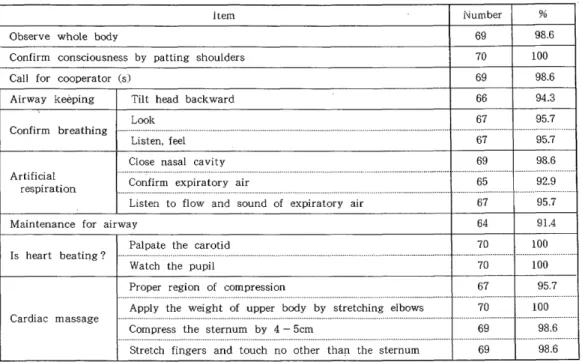
Table I Number of students who  passed test by item  in the check list 

persons" . Group exercise of the above items was  performed for 90 minutes each. 

5. Evaluation 

The practical skill and knowledge acquired by the  students were tested and the results of exercise were  evaluated. Self‑evaluation and impression of the  students were also taken into consideration. 

l) Practical skill test 

After the practice in each group, the practical  skill of CPR by two operators was performed 

alternating the role, and the instructor checked the  check list (Table 1) and the record sheet (Fig. l). 

The three instructors had discussed the standards of 

evaluation in advance. ' 

2) Pretest and posttest 

Before and after the exercise, objective tests on  20 items concerning general knowledge of CPR,  airway keeping, artificial respiration and cardiac  massage were performed. The full marks were 20 

points. 

3) Self‑evaluation and irnpression 

After the exercise, the students were asked to  make self‑evaluation of their fundamental skill and  to freely describe their impression of the exercise. 

l . RESULTS 

l. Practical Skill Test 

Each item of the check list was checked as either 

"could" or "could not", and the number and per‑

centage of "could" are shown in Table l. The items 

all the students answered "could" were to confirm  the consciousness by patting shoulders, to palpate  the carotid artery, to watch the pupil and to apply  the weight of upper body, amounting to four items. 

Almost all the students were evaluated as satis‑

factory in other items. 

l) Airway keeping 

Confirmation of breathing was achieved in 67  students, keeping airway by tilting head backward  in 66, and maintenance for airway in 64. There were  3 to 4 students who performed artificial respiration  without airway keeping or who failed to confirm 

breathing . 

2) Artificial respiration 

Confirmation of chest inflation was available in  65 students, and listening to the flow and sound of  expiratory air in 67. There were 3 to 5 students  who could not observe whether the inserted air  volume was appropriate or not. 

Resusci Anne turns the signal light on when 800  ml of air is inserted. There was a tendency among  the students in the exercise to depend on the signal  light rather than to watching the extension of the  chest of Resusci Anne. 

3) Cardiac massage 

"Apply the weight of upper body" was achieved  in all the students and "Proper region of corn‑

pression" in 67 students. Three students were unable  to perform cardiac massage m a pl oper regron  4) Number of items which students "could" 

The number of items which students "could" 

(4)

perform was all the 16 items by 54 students 

(77.10/0), 15 items by 7 students (10.00/0), 14 items  by 4 students (5.70/0), 13 items by 4 students  (5.70/0) and 11 items by I student (1.40/0). 

2. Pretest and Posttest 

The average mark of pretest was 15.3 1.9 (11‑

19), and that of posttest was 16.3 1.3 (12‑19),  Fig. 2 shows the distribution of marks by indi‑

vidual. The marks of less than 15 points before the  exercise were seen in 20 students (28.60/0 ) , but the  number was reduced to 7 (10.00/0 ) after t,he exercise. 

* ***' *'  u 3u *,er** =' 

20  l o 

***k* 

10  2u 

Fig. 2 Frequency distribution of test marks 

3. Self‑evaluation by Students after the Exercise  Concerning the fundarnental skills of airway  keeping, artificial respiration and cardiac massage,  students were asked to answer "could" , "so‑so or 

,' 

"could not" . The results are shown in Fig. 3. 

l) Airway keeping 

In holdmg head "could" and "so so" were an‑

swered by all the students. In supporting neck, the  first two answers were given by 68 students 

(97.1 o/o ) . 

2 ) Artificial respiration 

In closmg nasal cavrty "could" and "so‑so" were  answered by 69 students (98.60/0 ) . In covering  mouth, the first two answers were given by 64  students (91.40/0). In ventilation, the first two  answers were given by 60 students (85.70/0). In  confirmation of breathing, the first two answers  were given by 65 students (92.90/0). 

3) Cardiac massage 

In the region of compression and the strength  of pressure, all the students answered "could" or 

"so‑so" . In speed, such answers were given by 67  students (95.70/0). 

As described above, 3 items, i.e., holding head,  region of compression and the strength of pressure 

were self‑evaluated by all the students as "could" 

or "so‑so" . The items of relatively high rate of 

"could nat" were "method of ventilatlon" "cover  mg mouth" and "confirmation of breathing 

,, 

Airway keeping 

o 50 roo ( 6) 

Hold head 

Support neck 82.9 :::: zi. : ...:::: 2.9 

Artificial respiration 

Close nasat cavity 77.2  :::::::::::: 1.4 

Cover mouth  ventnate  Confirm inspiratorv air 

Cardiac massage  Compressed region 

Compressing force 

Speed qo,o ::::: 4, 3 

L] could 

E ] sc so 

 coutd not 

Fig. 3 Self‑evaluation after exercise 

4. Impression by Free Description 

The impression which was relatively numerous in  the free description after the exercise was as  follows. "It was nice to have the exercise of CPR  since it is an essential skill for nurses." (27  students). "The effect was indicated by signal light  in the exercise, but it is feared as to how the effect 

. (17 

can be determined in on srte performance " 

students) "I thmk I can make rt on srte." (16  students). "It was fairly difficult." ( 15 students). 

"I did not know that CPR is so tiresome " (14 

students ) . 

IV . DISSCUTION 

Concerning emergency medical care in Japan, it  has been pointed out that the prognosis of DOA  (Dead on Arrival) cases is considerably worse com‑

pared to Western nations, and the improvement of  prehospital care has become a social problem. For  substantiation of prehospital care, Emergency Life‑

saving Technicians Law was promulgated in April  1991 and its effects have been reportedl2). However,  appropriate measures by the family before the 

‑ 44 ‑

(5)

arrival of ambulance are the clue to life‑saving in and speed (number of times per minute) of com‑

case of sudden change of the aged or the patient pression. 

with ischemic heart disease under home treatment. In evaluation by the instructors, "proper regron  In order to spread bystander CPR by general of compression" was not achieved in 3 students. 

citizens, the course on the method of emergency Wrong position of hands deviating toward the  resuscitation became obligatory in high school abdominal region may oppress the xiphoid process  physical education and in driving school to obtain causing rupture of the liver. It is important to  learn the correct hand position. However, there was  driver's license in 1992. 

It is a matter of course for nursing students a tendency among the students to rely upon the  signal light to confirm the correct hand position. It  receiving a fundamental nursing education to thor‑

oughly understand and learn CPR in order to fulfill should be taken into consideration in actual teach‑

their social task of protecting human life as future ing to confirm the angle of elbow and the force of  professionals in nursing. They are also in a position compression. 

Students learn CPR by actually experiencing arti‑

to educate the general public in this respect. 

The content and method of nursing skill training ficial respiration and cardiac massage while alter‑

in the school were discussed and future problems nating the role, receiving advice from the instruc‑

tors and other students in the group concerning the  were reviewed. 

fundamental skill, and by repeatedly practicing the 

1. Situation of Nursing Skill Acquirement procedure. 

The objective of basic life support is to maintain In the present exercise by small group, the in‑

respiration and circulation. Measures within 3 to 5 structors knowing the individuality of each student  minutes after the cease of respiration and circula‑ devised the teaching method suitable for each  tion are important. Accurate and prompt nursing student, and conducted training towards skill acqui‑

skill is required. sition. The students being highly motivated could  1) Airway keeping positively participate in the exercise, as they de‑

It was likely that students had a difficulty in scribed their irnpression that they were glad to have  airway keeping and its maintenance, since those participated in the exercise since CPR is an essen‑

who "could not" in this item in the practical skill tial skill. The students after the test repeated self‑

test were more numerous than in other items. The training for their weak items and were rechecked by  fact that 4 students were regarded disqualified by the instructors, demonstrating their aggressive  the instructors indicates the necessity of education attitude. 

and training for definite skill acquisition. 

2 ) Artificial respiration. 2. Future Problems 

"Confirmation of breathing" was not achieved in l) Integration of knowledge and skill 

5 students. They paid attention only to air inser‑ The higher average marks of posttest compared  tion without confirming the effect. Students tended to pretest may indicate that the exercise provided  to rely upon the signal light. An important point integration of knowledge and skill. In some items,  of teaching is to confirm the movement of the however, what they learned in the practical skill  chest so that the students may estimate an was not integrated with their knowledge. In the  appropriate volume of air they insert. conduct of group practicing, it may be required to  Students had a difficulty in "how to cover the devlse the method of teachmg so as to promote  mouth" and "how to provlde ventilatron" . Some self‑practicing while confirming irnportant points. 

students could not cover the mouth of the dummy 2) Teaching materials 

as their mouth was small, and they had a difficulty Resusci Anne, equipped with signal lights and a  in ventilation. It was thought necessary to teach recorder, is effective not only for training of skill  students while taking their physique into considera‑ but also for evaluation of the effect of training. 

tion. However, it is for the sake of record and there is a 

3) Cardiac massage limit to confirm the possibility of resuscitation. 

In cardiac massage, an appropriate volume of out‑ Hence, a vital simulator KOKEN RESIM has been 

put can be maintained by proper region, strength developed for the training of resuscitation8). This 

(6)

simulator with an incorporated micro‑computer  makes an overall judgment of the performed basic  life support and shows vital responses such as open‑

ing the eyes in response to calling the name. The  students can confirm whether or not resuscitation  is made available by the basic life support they  performed, and directly evaluate the pertinence of  their skill in reference to the rate of successful  resuscitation. We have a KOKEN RESIM at school  since 1994. We are considering to plan for exercise  to be somehow conducted within a limited time by  means of combining KOKEN RESIM and Resusci 

Anne . 

3) Period of exercise 

The importance of CPR is being recognized by the  general public and education at an early period is  thought to be necessary. However, the nursing skill  exercise in our school is conducted at the final  stage of three‑year course. A national survey of  CPR education for medical studentsl3) indicates that  sorne universities start education of basic life  support only in advanced class. It may be consid‑

ered that the students acknowledge their role to  play as professionals and have a high motivation to  protect life, particularly because they are at the  stage to have completed the course of clinical  practice. It may be necessary to organize a curricu‑

lum to conduct skill exercise in the beginners' class  and the advanced class, expecting the effects of  learning and practicing by repeated training. 

The basic life support in the present exercise is a 

procedure which can be done "anywhere by any‑

body" . It is a skill required not only in the area of  medical care but also in daily life. It is also  important to note, before the acquisition of skill  and knowledge, whether one can help someone who  is in need. The willingness with courage will en‑

hance the aggressive attitude of students to learn  and elevate the quality of their skill. 

CPR is meaningful only when it is actually  performed. We would like to study further for the  device and improvement of teaching methods. 

Ref erences 

1 . Yukiko Tanaka, Mikiko Takahara: Understand‑

ing of basic life support. Jpn J Nursing Educa‑

tion 24(1):46‑49, 1983. (in Japanese) 

2 . Miyako Mizutani, Reiko Nagaura, Sachiko Nari‑

sawa, Fumiyo Kaneko and Sachiko Kurushima: 

Simultaneous use of a recording resusci anne 

4. 

6. 

10 

11 

12 

and computerized patient robot in technical  training for basic life support in cardiopulmon‑

ary resuscitation, and its resulting education  effects. Bull. Coll. Biomed. Technol. Niigata  Univ. 3(1):36‑49, 1987. (in Japanese) 

Hiromi Uchida, Takashi Inamoto: Exercise of  cardiopulmonary resuscitation in school and  learning evaluation. Jpn J Nursing Education  38(1):46‑50, 1997. (in Japanese) 

Tomoko Omine, Michiko Baba, Saori Senoguchi: 

Study on skill acquirement of cardiopulmonary  resuscitation. 40th J. A. S. H., 1993, p240. (in  Ja panese ) 

Kyoko Kikawada, Noriko Sakurai, Chiyoko  Nishimura : Effective development of emergency  nursing practice. Jpn J Nursing Education 

28(6):360‑363, 1978. (in Japanese) 

Kumiko Otsuka: Effects of emergency practice  on ambulance by nursing students. Jpn J Nursing  Education 33(7):530‑534, 1992. (in Japanese) 

Chiemi Kawanishi. Makie Kawabata et al :  Program of practice giving importance to  regional nursing. Jpn J Nursing Education 

28(13):782‑790, 1987. (in Japanese) 

Hiroyuki Miyamoto, Yasuhisa Sakurai, Chiyo  Chiba, Katsue Hirosawa: Effectiveness of Car‑

diopulmonary Resuscitation Training with a  Patient Simulator. Bulletin of Junior College of  Nursing, Tokyo Womens Medical College 9:57‑

66, 1987. (in Japanese) 

Yoshiko Nishizawa, Minoo Hayakawa: Reseach  of the Educational Method of Emergency Re‑

suscitation in students with different Cognitive  Styles‑An Examination of Cardiopulmonaly Re‑

suscitation Guidance for Students in the First  Stage of Practice‑. J of Jpn Society of Nursing  Research 19(1) :53‑60, 1996. (in Japanese) 

Teruyo lwamoto: Study of Nursing Technique  Education to Aim at Making Learners Fully  Understand What They Learned‑Effect of Learn‑

ing with CAI Teaching Materials "Resuscita‑

tions" ‑J of Jpn Society of Nursing Research  19(2):17‑24, 1996. (in Japanese) 

Toshifumi Otsuka, Keiji Kohama (eds): CPR  instructors guide. IGAKU‑SHOIN, 1994, pl4. 

(in Japanese) 

Gonbei Ueshima, Kuniharu Ono : Actual state  and problems of the system of emergency life‑

saving technicians. Health Care 38(3):171‑176,  1996. (in Japanese) 

‑ 46 ‑

(7)

13. Japan Anesthesia Society Emergency Medical  Care Measures Committee : Actual state survey  report on education of cardiopulmonary resusci‑

tation. Jpn J Anesthesiol 45(6):774‑781, 1996. 

(in Japanese) 

(8)

看護基礎教育における心肺蘇生法の習得状況     一一次救命処置を中心として一

浦田 秀子1・福山由美子1・宮原 北島 浩美3・大熊 恵子1・今中

春美1・大島  淳2 悦子1・宮下 弘子1

1 2 3

長崎大学医療技術短期大学部看護学科 前長崎大学医療技術短期大学部看護学科 北里大学大学院研究科看護学専攻

要 旨  長崎大学医療技術短期大学部看護学科学生70名を対象に,救急蘇生訓練用人形を用いて,一次救 命処置を中心とした心肺蘇生法の学内演習を行った.実技テスト,演習前後の客観テスト,学生の自己評価 などをもとに学習効果および今後の課題を検討した.

 実技テストでは,チェックリストにそって,各項目ごとに教官が評価した結果,ほとんどの項目で9割以 上の学生が合格できた.客観テストでは演習後の平均点は高かったが,知識と技術の統合がされていない項

目もあり,指導上の課題と考えられた.また,学生の自己評価では,人工呼吸法が「できなかった」とする 学生が多く,気道の確保および維持,また吹き込みもかなり難しい技術であった.一次救命処置は緊急の現 場で実践できなければ意昧のない技術であり,反復訓練による習得が必要であると考えられた.

      長崎大医療技短大紀 11:41−48,1997

一48一

Table I Number of students who  passed test by item  in the check list  persons" . Group exercise of the above items was  performed for 90 minutes each.  5. Evaluation  The practical skill and knowledge acquired by the  students were tested and the res
Fig. 2 Frequency distribution of test marks  3. Self‑evaluation by Students after the Exercise  Concerning the fundarnental skills of airway  keeping, artificial respiration and cardiac massage,  students were asked to answer "could" , "so‑so o

参照

関連したドキュメント

Rumiko Kimura* College of Nursing and

Orientations are described in terms of functors de- fined on equivariant fundamental groupoids of base G-spaces, and the essence of the theory is to construct an appropriate

Part V proves that the functor cat : glCW −→ Flow from the category of glob- ular CW-complexes to that of flows induces an equivalence of categories from the localization glCW[ SH −1

The SLE-revised (SLE-R) questionnaire despite simplicity is a high-performance screening tool for investigating the stress level of life events and its management in both community

administrative behaviors and the usefulness of knowledge and skills after completing the Japanese Nursing Association’s certified nursing administration course and 2) to clarify

Then it follows immediately from a suitable version of “Hensel’s Lemma” [cf., e.g., the argument of [4], Lemma 2.1] that S may be obtained, as the notation suggests, as the m A

Definition An embeddable tiled surface is a tiled surface which is actually achieved as the graph of singular leaves of some embedded orientable surface with closed braid

Development of an Ethical Dilemma Scale in Nursing Practice for End-of-Life Cancer Patients and an Examination of its Reliability and Validity.. 江 口   瞳 Hitomi