重症心疾患の胎児診断後に行ったピアカウンセリング
西畠 信,徳永 正朝
総合病院鹿児島生協病院小児科
Peer Counseling after Fetal Diagnosis of Critical Congenital Heart Disease
Makoto Nishibatake and Masatomo Tokunaga Department of Pediatrics, Kagoshima Seikyo Hospital, Kagoshima, Japan
Background: Providing psychological support to pregnant women and their families after fetal diagnosis of critical con- genital heart disease is essential. However, because of limited time and manpower it is sometimes hard to provide effective counseling that satisfies the patient’s needs.
Methods: We recently arranged opportunities for peer counseling between mothers who had experienced fetal diagnosis of their babies’ heart disease and mothers prior to maternal transport to a distant tertiary center. As the first project, two mothers of a child with hypoplastic left heart syndrome (HLHS) were paired with two mothers with fetuses diagnosed with HLHS. The second project was group counseling composed of three mothers with children with different kinds of heart disease and two pregnant women with different kinds of fetal heart disease. To evaluate the effects and the problems of peer counseling, each client underwent a post-counseling interview.
Results: Through both procedures the clients were able to obtain useful practical information about the hospital stay, perinatal management and financial support. They could also anticipate what their babies would look like after delivery. Although one-to- one counseling was emotionally heavier for the counselor mothers, group counseling reduced the counselors’ responsibility and provided more information and choices for the clients.
Conclusion: Peer counseling before maternal transport seemed to provide effective emotional support to pregnant women whose fetuses had heart disease. However, we should remember that the counselors have their own children who are under treatment and that there are many problems to be solved.
要 旨
背景:重症心疾患の胎児診断後の妊婦と家族への精神的援助は重要であるが,具体的な疑問や悩みに応えられる カウンセリングは時間や人の制約で難しいことも多い.
方法:同様な経験を持つ母子に依頼し,母体搬送予定の妊婦に対するピアカウンセリングを試みた.方法1は出 生後の左心低形成症候群(HLHS)の児の母親とHLHSの胎児診断で母体搬送前の妊婦の1:1の組み合わせ2組で,
方法2では異なる心疾患の胎児を持つ妊婦2例に対し,母体搬送か新生児搬送の経験を持つ3例の母子をカウン セラーとしてグループで面談してもらった.その効果と問題点の評価には,各クライアントから事後に感想を聴 取した.
結果:2方法とも搬送先の情報,出産前後の対処,公的医療補助等の具体的な情報が伝えられ,出生後のイメージ が得られるという評価であった.1対1カウンセリングではカウンセラー側の精神的負担が大きかったが,グルー プカウンセリングではより多くの情報と多様な対処の仕方を知り,負担を軽減できた.
結論:ピアカウンセリングは妊婦と家族に有効な精神的なサポートと思われたが,カウンセラー側患児も治療途 上で解決すべき課題は多い.
Key words:
critical congenital heart disease, fetal diagnosis, maternal transpor- tation, peer counseling
別刷請求先:〒891-0141 鹿児島市谷山中央 5-20-10 総合病院鹿児島生協病院小児科 西畠 信
ングの手法である.
このピアカウンセリングの方法を胎児診断後の胎児 の母親と家族に応用したので,その利点と今後の課題 を考察する.
方法と対象
対象はTable 1に示した心疾患児の母子もしくは妊
婦7組である.外来を受診している胎児診断もしくは 新生児診断のもとに遠隔地の三次施設に紹介された経 験を持つ先天性心疾患児の外来受診時に母親(以下,
カウンセラー側)に依頼し,胎児診断され母体搬送に なる予定の胎児の母親(一部ではその夫も一緒に参 加.以下,クライアント側)に外来で懇談できる場を 設定した.いずれの場合も医師と外来看護師がクライ アントを相談室に案内して,カウンセラー側に紹介 し,話のきっかけを作った.カウンセラー側の母子は 通常の血液検査結果や心エコー検査を待つ時間を利用 して話し合いに加わった.双方の紹介後には医療側は 退席して,その後の話には基本的に介入しなかった.
ピアカウンセリングは以下の2つの方法を試みた.
方法1では左心低形成症候群(HLHS)の3組で搬送 先の状況と治療の経験を,Fig. 1のように,上下大静 背 景
重症心疾患の胎児診断後に妊婦本人と家族をどうサ ポートするかは重要な課題である1,2).特に遠隔地に 母体搬送される際には出生前から新生児期まで慣れない 土地で滞在期間も長く不安も大きいが,時間や人的な 制約で十分なカウンセリングは難しい.またインター ネット等で患者が得られる情報の範囲は広がったが,
当事者が求める情報や具体的な悩みには応えきれず,
診断した医師が伝えたいことと胎児診断された妊婦と 家族が混乱の中で求める情報が異なっていることもあ る.医学や医療に素人である患者(胎児の家族)が知り たいことに医療側と異なった視点で応えられるのは,
同じ経験をしてきた患児の家族であることもある.
最近,ピアカウンセリングという方法が医療・介護 の分野,教育の分野,企業の研修等で広く用いられる ようになり,医療の分野では悪性腫瘍,HIV感染症,
精神疾患,障害者支援,母乳育児プログラム等,さま ざまな分野で活用されている.ピアカウンセリングの
「ピア(peer)」とは仲間とか同僚という意味で,ピアカ ウンセリングは同じ悩みや障害をもつ仲間同士で,悩 みや障害を自身で克服するように援助するカウンセリ
Age of the infant at PC Surgical status at PC (surgery after transport)
1 HLHS 8 years Fetal Dx ⇒ Neonat. Trans.
S/P TCPC Counselor of Project 1
2 HLHS, restrictive FO
GA 35 weeks Fetal Dx ⇒ Mat. Trans. Client of Project 1 (Norwood)
2 months S/P Norwood Counselor of Project 1
2 years 6 months S/P BDG Counselor of Project 2
3 HLHS, IUGR GA 35 weeks Fetal Dx ⇒ Mat. Trans. Client of Project 1 (death at 3
months after bilateral PAB) 4 TGA, VSD, AV block 1 year 8 months Fetal Dx ⇒ Neonat. Trans.
S/P BDG+PMI Counselor of Project 2
5 Heterotaxy (Left iso, TA) 7 months Fetal Dx ⇒ Mat. Trans.
S/P PAB Counselor of Project 2 6 Heterotaxy (Right iso, TA) GA 34 weeks Fetal Dx ⇒ Mat. Trans. Client of Project 2 (Ao arch
reconstruction+PAB)
7 ToF, absent P-v GA 33 weeks Fetal Dx ⇒ Delivered before
Mat. Trans. ⇒ Neonat. Trans. Client of Project 2 (ICR+PA plasty) Dx: diagnosis, GA: gestational age, HLHS: hypoplastic left heart syndrome, Neonat. Trans.: neonatal transport after birth, S/P: post-operative sta- tus, TCPC: total cavopulmonary connection, FO: foramen ovale, Mat. Trans.: maternal transport, BDG: bidirectional Glenn operation, IUGR: in- trauterine growth retardation, PAB: pulmonary artery banding, TGA: transposition of great arteries, VSD: ventricular septal defect, AV Block:
atrioventricular block, PMI: pacemaker implantation, Left iso: left isomerism, TA: tricuspid atresia, Right iso: right isomerism, Ao arch: aortic arch, ToF: tetralogy of Fallot, absent P-v: absent pulmonary valve, ICR: intracardiac repair, PA plasty: pulmonary artery plasty
脈肺動脈吻合術(TCPC)後遠隔期の症例1と妊娠35週 の症例2がまず面談し,次にその症例2に生後2カ月 の時に妊娠35週の症例3とそれぞれ1回ずつ面談を してもらった.この場合はカウンセラー側とクライア ント側の胎児の心疾患は同一疾患であり最終的な治療 方針は同じである.
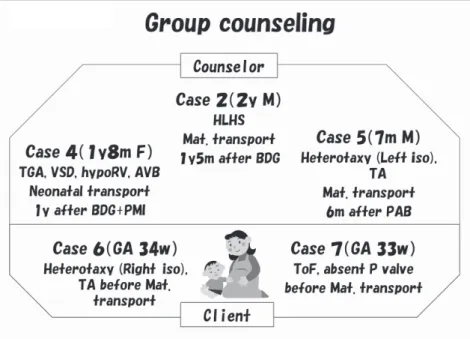
方法2ではFig. 2のように,小児循環器外来で観察
中の前記の症例2(生後2歳6カ月),症例4(生後1歳 8カ月),症例5(生後7カ月)のそれぞれ疾患が異なる 3組の母子に,胎児診断後で母体搬送が決定した症例 6,7の2例の妊婦とその夫と,集団での面談を依頼し た.この場合,カウンセラー側の児の診断も妊娠中の 2症例も診断や出生後の治療の基本方針は異なっている.
ピアカウンセリングの評価は,カウンセリングの後 しばらくしてから,カウンセラー側とクライアント側 の双方から外来受診時にピアカウンセリングに関する 感想を聴取した.亡くなった症例3の両親には弔問し たときに聴取した.
結 果 1.方法1
方法1は同じ疾患群であるHLHSの児を持つ家族同 士である.
症例1は妊娠末期に胎児診断され,出生後に遠隔地 の小児病院に新生児搬送され,2回の姑息手術を経て 数年前にTCPC手術を受けた10歳児で,その母子に 最初のピアカウンセリングのカウンセラーを依頼した.
症例2は妊娠35週で症例1の母子にピアカウンセ リングを受け,その後,母体搬送,周産期集中治療,
Norwood手術,両方向性Glenn手術を経て,TCPC手
術まで到達した.
症例2の母子には児が生後2カ月時(Norwood手術 後)に症例3に対するカウンセラーを,さらに2歳6 カ月時(両方向性Glenn手術後)に方法2のグループカ ウンセリングのカウンセラーを依頼した.
症例3は妊娠35週に症例2の母子にピアカウンセ リングを受け,母体搬送の後,子宮内胎児発育不全
(IUGR)で出生したため両側肺動脈絞扼術を受けた が,肺高血圧発作(PH crisis)のため術後3カ月で児は 死亡した.
2.方法2
方法1での経験を踏まえ,カウンセラー側の精神的な 負担感を軽減するため,グループでのカウンセリング を計画した.カウンセラー側は胎児診断を受けていない 症例4も加わり,いずれも重症複雑心奇形ではあるが 疾患の種類は異なり,外科治療の段階も異なってい る.クライアント側の2例(症例6,7)も胎児心疾患の 種類は異なっているが,ほぼ同時期に胎児診断され母 体搬送予定であった.症例6はカウンセリング後に母 体搬送となり,新生児期に大動脈再建と肺動脈絞扼術 を受けた.症例7は陣痛発来のため母体搬送できず,
分娩後に呼吸管理しつつ新生児搬送され,新生児期に 心内修復手術と肺動脈縫縮手術を受けたが乳児期は呼 吸管理に難渋している.
3.患者からの評価
それぞれの症例の母親からカウンセリング後に聴取 Fig. 1 Schema of Project 1 (one-to-one peer counseling).
The mother in Case 2 was the client in Pair 1 at 35 weeks gestation, and she was the counselor in Pair 2 after Case 2 underwent the Norwood procedure.
HLHS: hypoplastic left heart syndrome, S/P: post-opera- tive status, TCPC: total cavopulmonary connection, GA:
gestational age, FO: foramen ovale, Mat. transport: ma- ternal transport, IUGR: intrauterine growth retardation
Fig. 2 Schema of Project 2 (group peer counseling).
The mothers in Cases 2, 4, and 5 were the counselors, and the mothers in Cases 6 and 7 were the clients. The mother in Case 4 had a history of neonatal transport.
The mothers of Cases 2 and 5 had a history of maternal transport.
HLHS: hypoplastic left heart syndrome, TGA: transposition of great arteries, VSD: ventricular septal defect, hypo RV: hypoplastic right ventricle, AVB:
atrioventricular block, BDG: bidirec- tional Glenn operation, PMI: pace- maker implantation, Mat. transport:
maternal transport, Left iso: left isom- erism, PAB: pulmonary artery band- ing, GA: gestational age, Right iso:
right isomerism, TA: tricuspid atresia, ToF: tetralogy of Fallot, absent P valve: absent pulmonary valve
した評価の要点はTable 2のとおりである.それぞれ の胎児診断の疾患の説明は診断した医師が行ってそれ 以上の説明はされていないが,母体搬送後の遠隔地で の生活,新生児期に児がICUにいる間の過ごし方,そ の後の治療経過中の工夫等,家族としての情報が伝え られ,滞在先の宿泊施設や医療費の公的補助制度の知 識等も話され,医療者が伝えていない情報が伝えられ ていた.
またピアカウンセリングの際にカウンセラー側の育 ちつつある児の姿を目の当たりにして,クライアント 側の家族が我が子の出生後のイメージを構築できたこ とがうかがわれる.
考 察
筆者の所属施設がある地域では,新生児重症心疾患 の侵襲的治療の多くを遠隔地に紹介してきた.胎児期 の心大血管の形態異常の診断145例のうち45%が胎 児診断に基づいて県外への母体搬送が選択され,多く
の症例でductal shockをはじめとする新生児のリスク
を回避し得た.しかし胎児診断後の説明の際またはそ の後に望まれる臨床心理士,助産師,看護師らのコメ ディカルスタッフの同席によるカウンセリング体制は 整えられていない.多忙な外来診療体制の中ではコメ ディカルスタッフの協力は得難く,胎児診断を受けた 胎児の家族の悩み,心配,要望には十分応えることが できないのが現状である.
AllanらのTextbook of Fetal CardiologyにはParental
Counselingの1章1)を設けてあり,また日本小児循環器
学会の胎児心エコー検査ガイドライン3)でも診断前の インフォームド・コンセントの重要性とともに,診断 後のカウンセリングの重要性を強調している.Allan らは,胎児診断後の胎児の親への説明として,正確な 診断を伝えること,選び得る選択肢を示すこと,真摯 に予後を説明すること,両親自身が最良な選択ができ るように援助することの4点を挙げている.その中に はよい経過の可能性と同時に悪い経過の可能性も含ま れている1).健康な赤ちゃんをイメージして妊娠期間 を過ごしてきた両親にとって青天の霹靂のような赤 ちゃんの病気を伝えられたうえに,母体搬送で遠隔地 の紹介先施設での出産の準備までしなければならず,
混乱していることは想像に難くない.複数回の検査の 勧めはそうした不安に応える目的でもある.
しかし,クライアント側が混乱の中で実際に知りた いことは医療側の詳しい診断の説明や治療方法の選択 肢だけではないのかもしれない.たとえば,母体搬送 から新生児期の治療までどれくらいの経済的負担があ り,公的な補助を得るために必要な手続きはどうすれ ばよいのか,母体搬送された母親はどこでどうやって 食事をするのか,児がNICUや術後ICUに入院中には 両親はどこにいればよいのか等,母体搬送までの限ら れた時間で何をどう準備したらよいのかという現実的 なことは医療側がよく知らないことである.そのよう なことを実際に経験したカウンセラー側と話すうち に,クライアント側は告知された診断と選択肢につい
Table 2 Parents’ assessment and comments after peer counseling (PC) Project 1
Mother of Case 2 (client and PC counselor)
・As a client: Although I was shocked when I saw the large surgical wound, I was also very relieved by seeing Case 1’s grown-up child.
・As a counselor: I was able to pass on some practical information about the postoperative situation in the intensive care unit or hospital ward, how to live during the long stay at the children’s hospital, picture books for children, etc. We also exchanged addresses for further contact.
Parents of Case 3
(hearing at the grief care visit )
・The information we heard from the counselor mother about life at the children’s hospital, the public financial support system, etc., was useful after the transport.
・The mental and economic burdens due to the long-term stay at a distant children’s hos- pital and the frequent round-trips from home to the hospital were heavier than expected.
・Although our child died, we want to make time to talk to parents when the fetus will be transported in utero or after delivery.
Project 2 Mother of Case 2
(two times experience as a counselor)
・Direct contact with each other after one-to-one counseling is sometimes difficult be- cause our children are undergoing treatment. Group counseling may be easier to do.
・As a client, peer counseling is useful after cooling down following the doctor’s explanation of the prenatal diagnosis because we can accept the information calmly. It may be bet- ter after around 30 weeks of gestation.
Mothers of Cases 4 and 5 (first counselor experience)
・We will cooperate as counselors if there is a similar prenatal diagnosis of a critical heart lesion.
・I was not able to talk much because I did not have the experience of raising a healthy child, only my baby with heart disease.
Mothers of Cases 6 and 7 (clients of PC)
・Although we felt deeply uneasy after the prenatal diagnosis, we were grateful to hear stories of mother counselors who had a similar experience. Hearing that she was sad and cried throughout the pregnancy eased our minds a little.
・Practical information covering delivery to surgery, hospital life, the various procedures for public assistance, etc., as experienced several months before by counselor mothers was very helpful.
・It encouraged us to see a pregnant friend whose fetus has a heart lesion scheduled for maternal transport about the same time as we were.
・By exchanging cell-phone numbers and mailing addresses, we could consult with the counselor mothers or pregnant friends after delivery.
・A pamphlet explaining the approximate time flow of the delivery, the surgery on the infant, and the timing of various hospital and public support procedures would be useful at the counseling session.
が同席していることもクライアント側にとって良い効 果を上げていた.クライアント側は病児を妊娠してい るという告知で,かわいい我が子ではなくお腹の中で
「モンスター」のイメージを膨らませてしまうこともあ り,育児に前向きになれない不安を抱えてしまいがち とされる.実際に育ちつつあるカウンセラー側の児と 同席することで,生まれてくる我が子のイメージを構 築できたという感想もみられた.
一方で,ピアカウンセリングの限界と注意点も忘れ てはならない.ピアカウンセリングの本来の姿は,同 じ立場にいる者同士のカウンセリングで,お互いにカ ウンセリング効果があることである.今回のピアカウ ンセリングは経験者(カウンセラー側)とこれから経験 する者(クライアント側)で行った.最も重要なことは カウンセラー側も治療途上の我が子を抱えていること である.重症の複雑心奇形が多いだけに,彼らの経過 と予後も安定しているわけではなく,現に症例2の児
はGlenn手術後に重度の心不全を経験してTCPC手術
を受けるまでに不安定な時期を過ごしている.またク ライアント側も同様に予後が良好とは限らない.した がって,カウンセラー側に過度の精神的な負担がかか るのは避ける必要があり,同時にカウンセラー側に とってもカウンセリングに参加したことが良い結果を もたらすような工夫が必要である.今回のように医療 従事者が患者同士の紹介の後に退席せずにファシリ テーターとしてその場を見守り,適切なアドバイスを することも今後の課題である.
カウンセリング側がアドバイスできるのは,自分の こどもを中心とした経験に基づく知識と意見であり,
クライアント側の背景や疾患そのものに関しては応え られず,クライアント側がどのような経過をたどると 予測されているかは知らない.今回のピアカウンセリ
ある程度進めた後で行った.
カウンセラー側の母親の選定は,医師との間で信頼 関係が構築されている母親に依頼した.今後の方向と しては,特定の母親に度重なる負担をかけるのではな く,心臓病のこどもを守る会等のサポートグループに ピアカウンセリングの理解を深めてもらい,組織的な 協力を得ることも考える必要があるだろう.
結 論
重症先天性心疾患の胎児診断後に医療側が疾患,予 後,方針選択等の説明を行っただけでは精神的なサ ポートとして十分とはいえない.母体搬送の方針決定 後に,その経験を持つ母子に依頼して行ったピアカウ ンセリングは,妊婦とその家族の知りたい情報の提供 や精神的支援の一つの方法である.カウンセラー側も 治療途上の患児の家族であり,医療者ではないことを 考慮する必要がある.
本論文の要旨は,第44回日本小児循環器学会総会・学術 集会(2008年7月,福島県)のシンポジウムにおいて講演した.
【参 考 文 献】
1)Allan L, Hornberger LK: Parental counseling, in Allan L, Hornberger LK, Sharland G (eds): Textbook of Fetal Cardiology.
London, Greenwich Medical Media, 2000, pp399–406 2)Dallaire L, Lortie G, Des Rochers M, et al: Parental reaction
and adaptability to the prenatal diagnosis of fetal defect or genetic disease leading to pregnancy interruption. Prenat Diagn 1995; 15: 249–259
3)日本小児循環器学会胎児心エコー検査ガイドライン作成 委員会:胎児心エコー検査ガイドライン.日小循誌 2006;22:63–85