東京大学大学院農学生命科学研究科附属演習林
千葉演習林
試験地・研究紹介 2018
The Graduate School of Agricultural and Life Sciences, the University of Tokyo
Introduction to Experimental Sites and Research
of The University of Tokyo Chiba Forest (UTCBF) 2018
目次 Table of contents1.人工林 Planted forests …1
固定成長試験地 Permanent plots for growth measurement 牛蒡沢スギ人工林 Gobozawa Sugi forest
相ノ沢スギ品種展示林 Ainosawa Sugi cultivars exhibition forest
演習林創設以前の老齢人工林 Old-aged forests planted before Chiba Forest establishment 今澄スギ老齢人工林 Imasumi old-aged Sugi planted forest
清澄寺のスギ超高齢木 Extremely old Sugi trees in Seicho-ji temple 今澄混交化試験地 Imasumi mixidization experimental plot
2.天然林 Natural forests …7
堂沢風致林 Dozawa natural forest
荒樫沢モミ・ツガ天然林 Arakashizawa fir-hemlock natural forest 林業遺産 浅間山 “Forestry Legacy” Mt. Sengen
楢ノ木台長期生態系プロット Long-term ecological research plots in Naranokidai 二次林試験地 Secondary-forest experimental plots
3.生物 Wildlife and plants …13
外国産/日本産樹種見本林 Exhibition forests of exotic/domestic species
保護樹 Protected trees
モウソウチク開花年限試験地 Flowering cycle study site of Moso bamboo
4.育種 Breeding …16
郷台苗畑 Godai nursery
札郷苗畑 Fudago nursery
5.水文研究 Hydrological research …17
袋山沢試験地 Fukuroyamasawa experimental watershed 伐採後の流出水量の変動 Water runoff change after cutting
6.森林博物資料館 Forest museum …19 7.研究資料 Research materials …20
基盤データ Fundamental data
歴史的資料 Historical records
8.千葉演習林および周辺の地図 Map of Chiba Forest and surrounding area …21 研究利用を行うために In order to start your research
1.人工林
Planted forests
1894 年の創設からの数十年で、千葉演習林では林業経営を意図して活発な造林活動を行い、森林のうちの約 4 割はスギ、ヒノキを中心とする人工林となりました。その後も伐採再造林を続けて、波はありますが若齢林から 120 年生を超える高齢林まで多様な林齢の人工林を保有するに至っています。それらを研究教育のフィールドと して活用するだけでなく、多数の試験地を設置・維持しているほか、森林管理作業を行う中で様々な実験的試み を行ってきています。During the first decades since the establishment of Chiba Forest in 1894, we eagerly planted trees and have managed to establish planted forests of mainly Sugi (Cryptomeria japonica) and Hinoki (Chamaecyparis obtusa) which cover nearly 40% of the forest. Through continual harvesting and replanting, we now have forests of various stand ages, from young stands to some over 120 years old. They have served as resources for research and education, and in addition, many experimental plots have been established and various methods of management have been tested.
スギ Sugi, Japanese cedar ヒノキ Hinoki, Japanese cypress
固定成長試験地 Permanent plots for growth measurement
人工林の固定成長試験地の観測データは、人工林の経営や、現代では地球温暖化防止(炭素固定)機能などの
基礎情報となっています。特に通称「吉田試験地」と呼ばれる試験地群である『森林試験測定地(生長測定試験地)』
10 区は、主に 1916 年からおよそ 5 年に 1 回ごとの毎木調査を続けており、日本屈指の長期間の観測の歴史を持 っています。
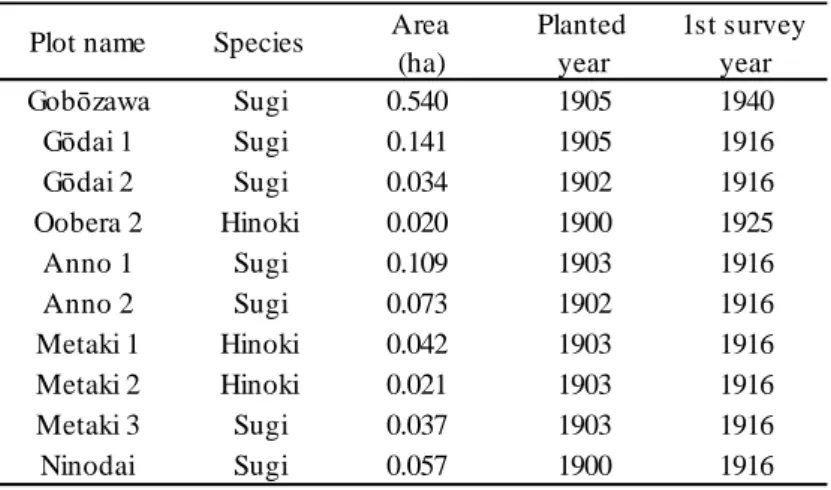
Measurements of permanent plots provide us with fundamental data for plantation management and current interests such as carbon sequestration. In particular, a group of growth measurement plots called the “Yoshida Plots,” currently including 10 plots, have been measured every 5 years mainly since 1916, and it is one of the historically longest forest measurement studies in Japan.
表 吉田試験地10 区の概要 Summary of Yoshida Plots
図 胸高直径と本数密度の推移 Shifts of DBH and standing tree density
Planted 1st survey year year Gobōzawa Sugi 0.540 1905 1940 Gōdai 1 Sugi 0.141 1905 1916 Gōdai 2 Sugi 0.034 1902 1916 Oobera 2 Hinoki 0.020 1900 1925 Anno 1 Sugi 0.109 1903 1916 Anno 2 Sugi 0.073 1902 1916 Metaki 1 Hinoki 0.042 1903 1916 Metaki 2 Hinoki 0.021 1903 1916 Metaki 3 Sugi 0.037 1903 1916 Ninodai Sugi 0.057 1900 1916 Area (ha) Species Plot name
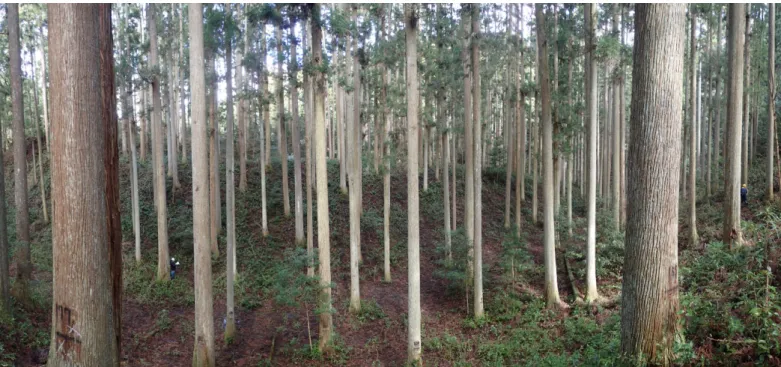
牛蒡沢スギ人工林 Gobozawa Sugi forest 1905 年植栽、試験地面積 0.54ha,
吉田試験地10 プロットのうち一つがある牛蒡沢は、演習林創設初期の造林地で、小班中央の凹部は千葉演習
林でも特に成長のすぐれたスギ林です。1940 年に吉田試験地に追加されました。1936 年の雨氷害や数度の雪害
を被ったほか、1942 年・1993 年に間伐が行われています。
The Gobozawa forest is an old Sugi (Cryptomeria japonica) stand planted in 1905. Growth measurements began in 1940, and tree growth here is some of the best in Chiba Forest. This stand has suffered from several heavy snowfalls, including a severe silver storm in 1936, and experienced thinning in 1942 and 1993.
ave. 26.5 32.9 36.7 39.7 42.1 46.4 53.4 56.5 57.6 max. 43.8 58.8 66.6 72.2 79.6 89.5 96.0 105.5 107.0 ave. 24.2 27.5 30.1 32.4 34.1 37.7 37.9 38.3 max. 32.6 39.2 41.7 43.1 45.5 46.8 48.8 48.6 845 600 592 559 544 530 362 359 357 627 868 1,038 1,223 1,524 1,465 1,643 1,706
注:2000年までの樹高平均は推定値である。 Averages of tree heights until 2000 are estimated values.
林分幹材積の推定値は要検証の暫定値である。 The accuracy of estimated volumes are dubious and should be examined more.
2016 111
表 吉田試験地 牛蒡沢プロットの成長推移 Growth data of Gobozawa plot, one of Yoshida Plots
2011 106 1981 76 1991 86 2000 96 1950 46 1960 56 1971 66 1940 ― ― ― 36 樹高 Height (m) 本数密度 Tree num.(本/ha) 林分幹材積 Stand Volume(m3/ha)
測定年 Measured yr 林齢 Stand yr 胸高直径 DBH
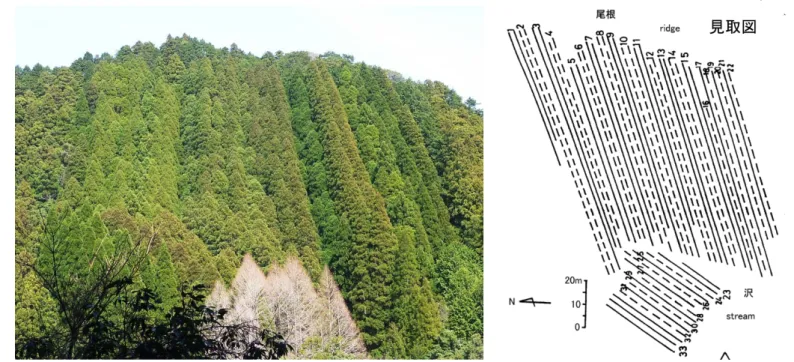
相ノ沢スギ品種展示林 Ainosawa Sugi cultivars exhibition forest 1931 年植栽,試験地面積 0.83ha 九州を主とするスギ在来挿木33 品種の生育比較を目的とした試験地です。各品種 1 または 2 列を斜面沿いに 植栽してあり、郷台作業所の裏から容易に観察できます。1959 年から定期的に毎木調査を行っており,1983 年に は弱度の間伐を実施しています。品種ごとの成長には有意な差があり、トサグロ、エダナガ、トサアカ、クロス ギといった飫肥スギ系の品種のほか、サンブスギ、インスギが比較的良好な成長を示しています。斜面上部に比 べて斜面下部では各品種とも成長が良いほか、冬期には、品種間で葉の変色に差が大きいことが観察できます。
The Ainosawa exhibition forest has a wonderful array of differences among Sugi (Cryptomeria japonica) cultivars. Each of the 33 cultivars was planted in one or two lines along the slope, and you can easily observe the whole sight of this plot from behind Godai lodge. Height and DBH of all trees has been measured since 1959, and we conducted light thinning in 1983. Differences in tree growth are significant among cultivars and within trees of each cultivar, as better growth is observed on the lower side of the slope. In the winter, color change of leaves quite differs among cultivars.
表 植栽されている挿し木品種と生存本数 Planted cultivars and their remaining induviduals
No. 品種名 産地 本数 No. 品種名 産地 本数 No. 品種名 産地 本数
1 ヤブクグリ 熊本県 小国 35 12 ナンゴウ 宮崎県 飫肥 43 23 エダナガ 宮崎県 飫肥 13 2 アオスギ 熊本県 小国 33 13 ミネヤマ 京都府 北山 30 24 クマモトアヤスギ 熊本県 小国 1 3 ホンスギ 大分県 日田 38 14 ホンジロ 京都府 北山 40 25 ハネカワ 熊本県 小国 6 4 ウラセバル 大分県 日田 27 15 サンブスギ 千葉県 山武 41 26 テナガ 熊本県 小国 7 5 インスギ 大分県 日田 40 16 コウラスギ 大分県 日田 8 27 トサグロ 宮崎県 飫肥 9 6 オオイタアヤスギ 大分県 日田 19 17 トヤマスギ 大分県 日田 19 28 カラツキ 宮崎県 飫肥 7 7 チリメントサ 宮崎県 飫肥 32 18 シラサヤ 大分県 日田 12 29 ガリン 宮崎県 飫肥 10 8 クロスギ 宮崎県 飫肥 33 19 シバハラ 京都府 北山 21 30 トサアカ 宮崎県 飫肥 11 9 アカスギ 宮崎県 飫肥 39 20 ホオズキ 京都府 北山 20 31 コウベアオバ 兵庫県 9 10 ヒダリマキスギ 宮崎県 飫肥 27 21 ヒキ 宮崎県 飫肥 11 32 コウベナンゴウ 兵庫県 7 11 アオバ 宮崎県 飫肥 24 22 アラカワ 宮崎県 飫肥 18 33 ナガノクマスギ 長野県 24 本数は2008年時点 お び
演習林創設以前の老齢人工林 Old-aged forests planted before Chiba Forest establishment
1835 年植栽の桜ヶ尾(43Cl6)のモミ・ツガとの混交林、1853 年植栽の神田上(16C2)の疎林、1859 年植栽の今
澄(40C5)の水源林は、いずれもスギ植栽木を中心とする学術的に貴重な高齢人工林として保護されています。
The Sakuragao mixed forest planted in 1835, Jindajo open forest planted in 1853, and Imasumi headwater forest planted in 1859 are protected as they have high scientific value.
今澄スギ老齢人工林 Imasumi old-aged Sugi planted forest 1859 年植栽 面積 0.81ha
清澄集落の水源涵養林として保護されてきた人工林で、被害木の除去程度の密度管理が行われてきました。 1927 年に雪害、1990 年に竜巻、1996 年に台風の被害を受けているほか、一部では 1986 年にスギの樹下植栽に よる二段林化が試みられました。
This is a protected headwater forest of Kiyosumi village which has suffered from heavy snowfall in 1927, a tornado in 1990, and a typhoon in 1996. In some locations, we tried to shift this single-storied forest to a double-storied forest by planting Sugi seedlings in 1986.
清澄寺のスギ超高齢木 Extremely old Sugi trees in Seicho-ji temple
千葉演習林に隣接する清澄寺は、江戸時代には清澄周辺を広く領有していました。現在も清澄寺が所有する妙
見山は社殿の背後に位置し、台風害によって疎林となっているものの、500 年生以上のスギ個体も生育する超高
齢林です。また、清澄寺境内には国の天然記念物に指定されているスギの個体(通称:千年杉)があり、樹高約
47m、幹の周囲長は 15m あまりで日本有数の巨木です。
Seicho-ji temple neighbors Chiba Forest and is located near our Kiyosumi lodge. It once ruled over a vast area in the Edo period, and the temple still owns Mt. Myoken situated behind the temple's main hall. It is covered by an open forest of gigantic Sugi with ages of more than 500 years. Additionally, Seicho-ji temple has one especially large Sugi tree called the "Thousand-year-old Sugi,” reaching 47 m in height and 15 m stem perimeter, and is registered as a National Natural Monument.
今澄混交化試験地 Imasumi mixidization experimental plot
日本では、林業経営上の条件が悪い場所などに設けた人工林に対して手を加えて針広混交林などに誘導する技
術が求められています。今澄混交化試験地は今澄スギ老齢人工林の近くにあり、2014 年に弱度の間伐を行った
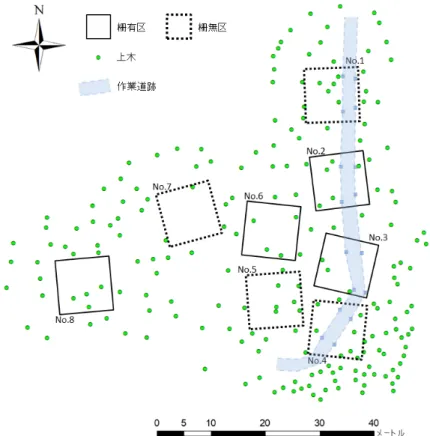
85 年生の高齢人工林(スギ主体、ヒノキ混交)に、防鹿柵の有無を比較する計 8 区の 10m 方形区を設け、植生 の推移などを観察しています。
In Japan, they are requirind techniques of how to introduce natural tree species into planted coniferous forests that have bad industrial conditions. Imasumi mixidization experimental plot is located next to Imasumi old-aged Sugi planted forest, where light thinning was conducted in 2014 in 85-year-old Sugi planted stand. We keep observing the shift of vegetation in eight 10m-square plots, half of which are enclosed by deer fences.
図 区画配置および植栽スギ・ヒノキ立木位置 Map of plots and standing Sugi and Hinoki trees
2015 年 6 月 4 日 June 4th, 2015 2017 年 6 月 26 日 June 26th, 2017 図 8 区の下層植生の変化 Shift of the understory vegetation of plot No.8
2.天然林
Natural forests
暖温帯常緑広葉樹林(照葉樹林)は、日本では沖縄付近から太平洋側では仙台付近まで分布しますが、まと まった林分が見られる地域は房総半島南部がおおよそ北限となっています。 演習林で見られる天然林は2 タイプがあります。針葉樹天然林は上層にモミ・ツガの常緑針葉樹が、その下 層を主にカシ・シイなどの常緑広葉樹が占めており、暖温帯~中間温帯における原生的なモミ・ツガ林となっ ています。この天然林がまとまった規模で見られる場所は房総丘陵では千葉演習林とその周辺にしか残ってお らず、大変貴重な森林です。もう一つは広葉樹天然林で、旧薪炭林や二次林とも呼ばれ、萌芽更新を伴う薪炭 材伐採の減少・消滅によって放置されて成長した広葉樹林です。スダジイ、カシ類、コナラ、ケヤキ、カエデ 類などで構成されます。In Japan, the warm-temperate evergreen broad-leaved forest (laurel forest) is distributed along the Pacific Ocean from the Okinawa islands to Sendai city. However, the southern Boso peninsula, where Chiba Forest is located, is near the northern boundary of the area where we can see larger areas of forests of this type.
Natural forests in the Chiba Forest are classified into two types. First are coniferous natural forests, consisting of Abies firma and Tsuga sieboldii in the upper story, and evergreen Quercus spp. and
Castanopsis cuspidata var. sieboldii in the lower story. This coniferous natural forest shows the characteristic close-to-primary vegetation of the warm-middle Temperate Zone. Second are broad-leaf natural forests, which are known as coppice forests or secondary forests. These forests were left to grow with the decline in the charcoal industry. This type of forest consists of Castanopsis, Quercus spp., Q. serrata, Zelkova, Acer, and others.
堂沢風致林 Dozawa natural forest 面積 8.98ha
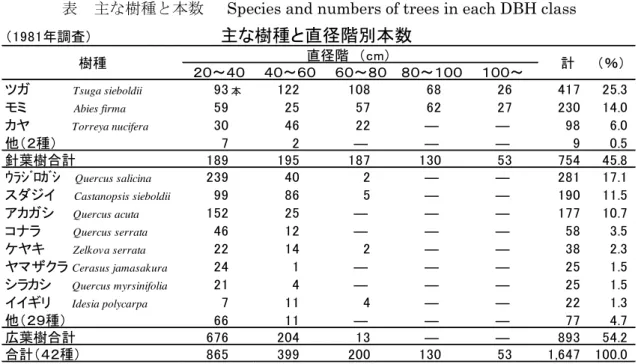
演習林に移管された1898 年以降は禁伐の天然林として保護されています。1981 年の調査では、胸高直径
20cm 以上の林木は 42 樹種で、本数の 46%をモミ・ツガを主とする針葉樹が、54%をシイ・カシ類を主とする 広葉樹が占めていました。外観は針葉樹林ですが、林内に入ると広葉樹が目に付きます。
After transfer to Chiba Forest in 1898, this stand has not experienced any cutting. This 8.98 ha stand has 42 tree species of ≧20 cm in DBH as of a 1981 survey. Among them, 46% are coniferous trees, mainly
Abies firma and Tsuga sieboldii, and 54% are broad-leaved trees, mainly evergreen Quercus spp. and
Castanopsis cuspidate var. sieboldii. Coniferous trees seem to be dominant from a distance; however, from inside the forest you may feel broadleaved trees are prevailing.
表 主な樹種と本数 Species and numbers of trees in each DBH class
ツガ Tsuga sieboldii 93 122 108 68 26 417 25.3 モミ Abies firma 59 25 57 62 27 230 14.0 カヤ Torreya nucifera 30 46 22 98 6.0 他(2種) 7 2 9 0.5 針葉樹合計 189 195 187 130 53 754 45.8 ウラジロガシ Quercus salicina 239 40 2 281 17.1 スダジイ Castanopsis sieboldii 99 86 5 190 11.5 アカガシ Quercus acuta 152 25 177 10.7 コナラ Quercus serrata 46 12 58 3.5 ケヤキ Zelkova serrata 22 14 2 38 2.3 ヤマザクラ Cerasus jamasakura 24 1 25 1.5 シラカシ Quercus myrsinifolia 21 4 25 1.5 イイギリ Idesia polycarpa 7 11 4 22 1.3 他(29種) 66 11 77 4.7 広葉樹合計 676 204 13 893 54.2 合計(42種) 865 399 200 130 53 1,647 100.0 ― ― ― ― ― ― ― ― ― ― ― ― ― ― ― ― ― ― ― ― ― ― ― ― ― ― ― (1981年調査)
主な樹種と直径階別本数
樹種 直径階 (cm) 計 (%) 20~40 40~60 60~80 80~100 100~ ― ― ― 本荒樫沢モミ・ツガ天然林 Arakashizawa fir-hemlock natural forest 荒樫沢24 林班は 1972 年以来、千葉県より鳥獣保 護区特別保護地区に指定されており,動植物の採取 を禁止して貴重な動植物の生息地として保護されてい ます。郷台林道からはこの荒樫沢の見事な針葉樹天 然林の外観を観察できます。最上層はモミ・ツガが 目立つ針葉樹林ですが、目を下に向けると、モミ・ ツガの下はカシ・シイなどの常緑広葉樹が占めてい ることが分かります。
The Arakashizawa forest was designated by Chiba Prefecture as a special wildlife conservation area in 1972, and since then hunting and plant harvesting has been prohibited. From the vantage point of Godai road, you can observe the typical appearance of a coniferous natural forest, which is dominated by fir and hemlock trees in the
upper story and oak trees in the lower story.
モミ (Abies firma) ツガ (Tsuga sieboldii)
アラカシ (Quercus glauca) スダジイ(Castanopsis cuspidata var. sieboldii) 郷台林道から見た荒樫沢モミ・ツガ林の林冠
林業遺産 浅間山 “Forestry Legacy” Mt. Sengen 面積 3.37ha 浅間山は清澄寺を取り囲む「清澄八名山」の一つで、信仰の対象として古くから伐採が禁じられていたと伝 えられています。このため、上層を針葉樹のモミ・ツガ、その下をシイ・カシを中心とする常緑広葉樹が占め るという暖温帯~中間温帯における原生的な林相(森林構造)が観察できます。 1892 年(明治 25 年)、留学先のドイツから帰国して当時助教授だった本多静六博士がこの浅間山を調査し、 当地が林学の教育・研究の場として適当であるとして演習林設置を提起したことが、千葉演習林ひいては日本 の大学演習林の端緒となりました。このことから浅間山は、『林業遺産』に第一回選定にて選ばれています。
Mt. Sengen is one of the “Kiyosumi Eight Mountains” around the Seicho-ji temple, and it is said that tree cutting on this sacred mount has been prohibited since ages past. Hence, you can observe the natural forest structure of a close-to-primary forest in a warm-middle temperate zone
In 1892, Dr. Seiroku Honda, an associate professor, examined Mt. Sengen after studying in Germany and thought that this area would be appropriate for the education and research of forest science. Soon he started insisting of the establishment of a university forest here, leading to Chiba Forest as the first
university forest in Japan. Later, Mt. Sengen was chosen as one of the firstly-registered “Forestry Legacies” in Japan.
Tree species and diameter distribution of upper and middle layer
樹種 計 (%) スギ Cryptomeria japonica 2 33 53 31 14 133 21.8 モミ Abies firma 1 9 21 21 22 74 12.1 ツガ Tsuga sieboldii 2 10 5 2 1 20 3.3 カヤ Torreya nucifera 1 5 2 1 9 1.5 アカガシ Quercus acuta 5 114 41 15 175 28.6 スダジイ Castanopsis sieboldii 31 38 11 5 85 13.9 ウラジロガシ Quercus salicina 5 36 2 43 7.0 イロハモミジ Acer palmatum 5 5 10 1.6 ヤブニッケイ Cinnamomum yabunikkei 7 3 10 1.6 その他 1 46 2 3 52 8.5 合計(26種) 17 296 172 84 42 611 100.0 上層木の主な樹種と直径階別本数 ― ― ― 5~20 ― ― ― ― ― ― ― ― ― 20~40 40~60 60~80 80~ 本 直径階(cm) (2004年調査) 樹種 計 (%) サカキ Cleyera japonica 342 232 22 1 597 28.9 ヒサカキ Eurya japonica 434 132 566 27.4 ヤブツバキ Camellia japonica 113 42 1 156 7.6 アカガシ Quercus acuta 9 62 33 5 109 5.3 ヤブニッケイ Cinnamomum yabunikkei 59 29 9 1 98 4.7 モチノキ Ilex integra 43 38 4 85 4.1 シキミ Illicium anisatum 35 29 1 65 3.1 スダジイ Castanopsis sieboldii 23 23 15 4 65 3.1 ウラジロガシ Quercus salicina 11 41 9 4 65 3.1 その他 その他 146 96 13 4 259 12.5 合計(39種) 1,215 724 106 20 2,065 100.0 ― ― ― 5~10 10~20 20~30 30~ 中層木の主な樹種と直径階別本数 ― ― 本 直径階(cm) 『林業遺産』認定証
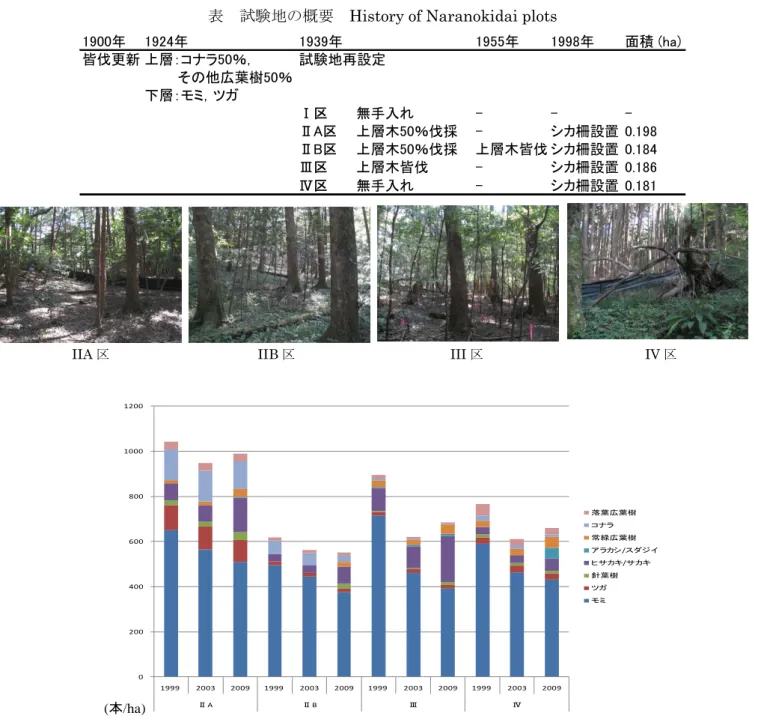
楢ノ木台長期生態系プロット Long-term ecological research plots in Naranokidai モミ・ツガ天然林における森林動態を調べるため、楢ノ木台8 林班 A1 小班に 1998 年に設置された長期生態 系プロットです。本試験地は1900 年に皆伐更新され、コナラと他の広葉樹が半数ずつ生育した森林でした。そ の後、1939 年にモミ・ツガ撫育試験地として設定され、その際、上層木に対し異なる伐採処理を実施した実験区 を5 区画設置しました。1998 年に防鹿柵が設置され、無手入れ区を除く 4 区について長期生態系プロットとし て再設定されました。
To analyze the dynamism of a natural forest dominated by Abies firma and Tsuga sieboldii, the
Naranokidai long-term ecological research plots were established in 1998. This site was clear-cut in 1900 when Quercus serrata and other deciduous trees were dominant. When plots were originally established to examine the growth of Abies firma and Tsuga sieboldii in 1939, they were divided into five blocks according to harvesting type of the upper broadleaved trees. In 1998, deer fences were constructed and four blocks, excluding a non-practice block, were again established as research plots.
表 試験地の概要 History of Naranokidai plots
1900年 1924年 1939年 1955年 1998年 面積 (ha) 皆伐更新 上層:コナラ50%, 試験地再設定 その他広葉樹50% 下層:モミ,ツガ Ⅰ区 無手入れ - - -ⅡA区 上層木50%伐採 - シカ柵設置 0.198 ⅡB区 上層木50%伐採 上層木皆伐 シカ柵設置 0.184 Ⅲ区 上層木皆伐 - シカ柵設置 0.186 Ⅳ区 無手入れ - シカ柵設置 0.181
IIA 区 IIB 区 III 区 IV 区
図 1999, 2003, 2009 年の各区画の樹種別の本数密度 Tree density in detail 0 200 400 600 800 1000 1200 1999 2003 2009 1999 2003 2009 1999 2003 2009 1999 2003 2009 ⅡA ⅡB Ⅲ Ⅳ 落葉広葉樹 コナラ 常緑広葉樹 アラカシ/スダジイ ヒサカキ/サカキ 針葉樹 ツガ モミ (本/ha)
ⅡA ⅡB Ⅲ Ⅳ 1999年 2003年 2009年 1999年 2003年 2009年 1999年 2003年 2009年 1999年 2003年 2009年 モ ミ A bie s fir m a 651 ( 6 2 ) 5 66 (60) 5 10 (52) 4 95 (80) 4 46 (79) 3 75 (68) 7 15 (80) 4 62 (74) 3 92 (57) 5 91 (78) 4 64 (76) 4 31 (64) ツ ガ T su ga s ie bo ld ii 1 11 (11) 1 01 ( 11) 9 6 (10) 1 6 ( 3 ) 1 6 ( 3 ) 1 6 ( 3 ) 1 6 ( 2 ) 1 6 ( 3 ) 1 6 ( 2 ) 2 8 ( 4 ) 2 8 ( 5 ) 2 8 ( 4 ) カヤ T o rr ey a nuci fer a 2 0 ( 2 ) 2 0 ( 2 ) 3 0 ( 3 ) -1 1 ( 2 ) 5 ( 1 ) 5 ( 1 ) 1 1 ( 2 ) 6 ( 1 ) 6 ( 1 ) 6 ( 1 ) イヌガ ヤ C ep ha lo ta xus ha rr ing to ni a -5 ( 1 ) -スギ C ryp to m e ri a jap o n ic a -5 ( 1 ) -6 ( 1 ) 6 ( 1 ) 6 ( 1 ) ヒ ノ キ C h am ae c yp ar is o bt u sa -5 ( 1 ) -ヒ サ カ キ E u rya jap o n ic a 4 0 ( 4 ) 4 0 ( 4 ) 7 1 ( 7 ) 2 2 ( 4 ) 2 2 ( 4 ) 4 9 ( 9 ) 4 3 ( 5 ) 3 8 ( 6 ) 9 7 (14) 1 7 ( 2 ) 1 7 ( 3 ) 3 9 ( 6 ) サ カキ C ley er a ja po ni ca 3 5 ( 3 ) 3 5 ( 4 ) 8 1 ( 8 ) 1 1 ( 2 ) 1 1 ( 2 ) 2 7 ( 5 ) 5 9 ( 7 ) 5 9 ( 9 ) 1 08 (16) 1 7 ( 2 ) 1 7 ( 3 ) 1 7 ( 2 ) ヤ ブニ ッ ケ イ C inna m o m um y ab uni kk ei 1 0 ( 1 ) 1 0 ( 1 ) 2 5 ( 3 ) -2 2 ( 4 ) 1 6 ( 2 ) 1 1 ( 2 ) 1 6 ( 2 ) 2 2 ( 3 ) 2 2 ( 4 ) 4 4 ( 7 ) クロ バ イ S ym plo c o s pr u n if o lia -5 ( 1 ) 5 ( 1 ) 1 1 ( 2 ) -シ キ ミ Illic iu m a n is at u m 5 ( 0 .5 ) 5 ( 1 ) 5 ( 1 ) -シ ロ ダ モ N eo lit sea s er icea -6 ( 1 ) 6 ( 1 ) 6 ( 1 ) ア ラ カ シ Q uer cus g la uca -5 ( 1 ) -5 ( 1 ) -4 4 ( 7 ) ス ダ ジ イ C as ta n o ps is s ie bo ld ii -5 ( 1 ) 5 ( 1 ) 5 ( 1 ) -タ ブノ キ M achi lus t hunb er gi i -5 ( 1 ) -5 ( 1 ) 5 ( 1 ) 5 ( 1 ) -バ リバ リノ キ A ct ino da phne acum ina ta -5 ( 1 ) -ヤ ブツ バ キ C am e llia j ap o n ic a -5 ( 1 ) -コ ナラ Q uer cus s er ra ta 1 36 (13) 1 36 (14) 1 21 (14) 6 0 (10) 5 4 (10) 2 7 ( 5 ) 1 1( 1) 5 ( 1 ) 5 ( 1 ) 2 2 ( 3 ) 1 7 ( 3 ) 1 1 ( 2 ) サ クラ C er as us s pp. -5 ( 1 ) 5 ( 1 ) 5 ( 1 ) 5 ( 1 ) 5 ( 1 ) 5 ( 1 ) 3 3 ( 4 ) 1 1 ( 2 ) 1 1 ( 2 ) ア オ ハダ Ile x m ac ro po da 5 ( 0 .5 ) 5 ( 1 ) 1 0 ( 1 ) -イヌシ デ C ar pi nus t scho no sk ii 5 ( 0 .5 ) 5 ( 1 ) 5 ( 1 ) -エゴ ノ キ S tyr ax j ap o n ic a -5 ( 1 ) -イ ロ ハ モ ミ ジ A cer p al m at um 5 ( 0 .5 ) 5 ( 1 ) 5 ( 1 ) -カゴノ キ L it sea co rea na -1 1 ( 2 ) ネ ム ノ キ A lb iz ia j u lib ris sin -5 ( 1 ) 5 ( 1 ) -フサ ザ クラ E u pt e le a po lyan dr a 5 ( 0 .5 ) 5 ( 1 ) -ホ オ ノ キ M ag n o lia o bo vat a -5 ( 1 ) 5 ( 1 ) 5 ( 1 ) -6 ( 1 ) 6 ( 1 ) 6 ( 1 ) ミ ズ キ C o rnus co nt ro ver sa 5 ( 0 .5 ) 5 ( 1 ) 5 ( 1 ) 5 ( 1 ) 5 ( 1 ) 5 ( 1 ) -1 1 ( 2 ) 1 1 ( 2 ) 1 1 ( 2 ) ヤマ ボ ウ シ C o rn u s ko u sa 1 0 ( 1 ) 1 0 ( 1 ) 1 0 ( 1 ) -合計 1051 949 990 620 565 554 898 624 688 762 608 669 種名 学名 表 各区 画の 10 年間 の樹種 構 成の 変化 Te n-ye ar shif t o f t re e sp ec ie s c om po sit io n o f e ac h plo t 注 : 久本ら( 201 1 )「 関東森 林研究 」 62 :1 91 -194 より抜粋
二次林試験地 Secondary-forest experimental plots シカの影響により衰退した広葉樹二次林(旧薪炭 林)の生態系機能を修復する長期野外実験を行って いる試験地で、小坪沢・平塚・檜尾の3 箇所があり ます。実験的に上木伐採(皆伐)と防鹿柵設置の有 無を組み合わせて,環境条件の観測と各種生物相の 追跡調査を行っています。2007 年度に初期状態の記 録と実験処理、2008-2009 年度に実験処理直後の記 録を行い、その後は5 年目、10 年目に定期調査を行 っています。
In the stands of Kotsubozawa, Hiratsuka, and Hinokio, a long-term field experiment has been conducted in order to examine tree regeneration and ecosystem restoration of secondary broad-leaved forests under overabundant deer. Clearcutting and deer fence establishment were experimentally conducted in 2007 and primary data were recorded in 2008-2009. Since then, we have investigated these plots every 5 years.
2007 年の伐採区 2007 年の非伐採区
2011 年の伐採区(シカ柵外) 2011 年の伐採区(シカ柵内) 2014 年の非伐採区
3.生物
Wildlife and plants
千葉演習林内では維管束植物が1,000 種以上生育しています。そのうち、樹木は約 280 種、シダ植物は 120 種以上とされ、非常に豊かな植物相です。また、コケ類も多様で『日本の貴重なコケの森』にも認定されてい ます。千葉演習林内に生息する動物相も植物相に対応して極めて豊かです。哺乳類は約20 種、鳥類は 100 種類 近く確認されているほか、昆虫相も多く、例えば2016 年現在で蝶類 45 種、蛾類約 1,700 種、甲虫類約 1,200 種が確認されています。他にも両生類、爬虫類、魚類、甲殻類など多種多様な動物がいます。詳しくは、「7. 研究資料」の基盤データの項もご参照ください。 貴重な樹種の一例としてヒメコマツを紹介します。ヒメコマツはゴヨウマツとも呼ばれるマツ科の樹木で、 一般には標高500m 以上の山地に生育しますが、千葉県房総丘陵のヒメコマツは最終氷期の生き残りとして低 山に生育する大変貴重な個体群です。しかし、その個体数はマツ材線虫病等により急激に減少しています。こ のヒメコマツを保護するため、千葉演習林は行政や研究機関と協力して様々な保全活動をおこなっています。More than 1,000 species of vascular plants grow in the Chiba Forest. Among them, ferns constitute more than 120 species, and approximately 280 are trees. In addition, the moss flora is various, and Chiba Forest is certificated as a "National Bryophyte Heritage Site” in Japan. The fauna of Chiba forest is also very rich following the flora. Approximately 20 mammal species and nearly 100 avian species are known. The insect fauna is also rich, including approximately 1,200 beetle, 1,700 moth, and 45 butterfly species identified by 2016. There are also diverse species of amphibians, reptiles, fish, and crustaceans. Please see “7 Research Materials” for detail.
Let us introduce one important tree species, Pinus parviflora. Its local population on Boso hills is very important as a relic of the glacial age, but the population is diminishing rapidly because of Pine Nematode Disease. We are actively working with local authorities and research institutes to preserve this species.
ジョウビタキ (Phoenicurus auroreus) マメヅタ (Lemmaphyllum microphyllum)
ヒメコマツ (Pinus parviflora) ギンリョウソウ(Monotropastrum humile)
外国産/日本産樹種見本林 Exhibition forests of exotic/domestic species
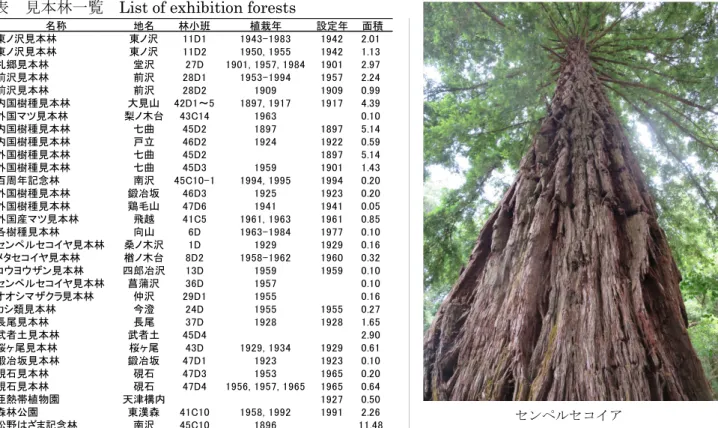
見本林として、研究教育用に多様な樹種が植栽されています。外国産樹種見本林では、北米原産で世界一樹 高が高くなるセンペルセコイアや、生きた化石と呼ばれるメタセコイアなど珍しい樹種も見られます。
You can observe various rare tree species in our exhibition forests, including the coast redwood (Sequoia sempervirens), the tallest tree species indigenous in North America, and the dawn redwood (Metasequoia glyptostroboides).
表 見本林一覧 List of exhibition forests
メタセコイア見本林(Metasequoia glyptostroboides) 桜ヶ尾見本林 Sakuragao forest
名称 地名 林小班 植栽年 設定年 面積 東ノ沢見本林 東ノ沢 11D1 1943-1983 1942 2.01 東ノ沢見本林 東ノ沢 11D2 1950, 1955 1942 1.13 札郷見本林 堂沢 27D 1901, 1957, 1984 1901 2.97 前沢見本林 前沢 28D1 1953-1994 1957 2.24 前沢見本林 前沢 28D2 1909 1909 0.99 内国樹種見本林 大見山 42D1~5 1897, 1917 1917 4.39 外国マツ見本林 梨ノ木台 43C14 1963 0.10 内国樹種見本林 七曲 45D2 1897 1897 5.14 内国樹種見本林 戸立 46D2 1924 1922 0.59 外国樹種見本林 七曲 45D2 1897 5.14 外国樹種見本林 七曲 45D3 1959 1901 1.43 百周年記念林 南沢 45C10-1 1994, 1995 1994 0.20 外国樹種見本林 鍛冶坂 46D3 1925 1923 0.20 外国樹種見本林 鶏毛山 47D6 1941 1941 0.05 外国産マツ見本林 飛越 41C5 1961, 1963 1961 0.85 各樹種見本林 向山 6D 1963-1984 1977 0.10 センペルセコイヤ見本林 桑ノ木沢 1D 1929 1929 0.16 メタセコイヤ見本林 楢ノ木台 8D2 1958-1962 1960 0.32 コウヨウザン見本林 四郎冶沢 13D 1959 1959 0.10 センペルセコイヤ見本林 菖蒲沢 36D 1957 0.10 オオシマザクラ見本林 仲沢 29D1 1955 0.16 カシ類見本林 今澄 24D 1955 1955 0.27 長尾見本林 長尾 37D 1928 1928 1.65 武者土見本林 武者土 45D4 2.90 桜ヶ尾見本林 桜ヶ尾 43D 1929, 1934 1929 0.61 鍛冶坂見本林 鍛冶坂 47D1 1923 1923 0.10 硯石見本林 硯石 47D3 1953 1965 0.20 硯石見本林 硯石 47D4 1956, 1957, 1965 1965 0.64 亜熱帯植物園 天津構内 1927 0.50 森林公園 東漢森 41C10 1958, 1992 1991 2.26 松野はざま記念林 南沢 45C10 1896 11.48 センペルセコイア (Sequoia sempervirens)
保護樹 Protected trees
天然樹種の保存のため、その樹種最大の成長を示す個体や生態学的・植物地理学的に重要な個体を1927 年に
保護樹として登録しました。当初の登録数は58 科 172 種 618 本でした。1970 年からは 10 年ごとに樹種名、 個体番号、胸高直径、樹高を記録しています。枯損や所在不明による減少、また追加設定による増加もあり、 2011 年現在の数は 38 科 81 種 317 本です。
618 individuals of 172 species and 58 families were registered as “protected trees” in 1927, which are important because of best growth or ecological and phytogeographical importance. Species, ID number, DBH, and tree height for each individual were recorded every 10 years since 1970. Through declines by death and missing or additional recruitment in each survey, currently 317 individuals of 81 species and 38 families are registered in the latest 2011 survey.
モウソウチク開花年限試験地 Flowering cycle study site of Moso bamboo (Phyllostachys pubescens)
タケ類は数十年に一度一斉に開花・枯死するという特異な生活史を持つことが知られています。しかし、その 開花周期については文献などからの推測にすぎず、実際に開花年限を実証した例はありませんでした。 郷台作業所構内には、開花年限試験のため、1930 年に横浜市で開花した竹林から得た実生 2 株を 1934 年に植 栽したモウソウチク林が設置されています。1997 年に、他地域に植栽されていた兄弟株とともに再び開花・枯 死したため、開花周期は 67 年周期であると考えられ、この周期が正しければ次回は 2064 年に開花するはずで す。この試験地は300 年計画で維持されることになっています。
Bamboo is known for its specific life cycle, as it flowers and dies simultaneously over the course of multiple decades. However, this flowering cycle was only predicted from literature, and there was no evidence that demonstrated the exact flowering cycle. Established in the Godai Branch in 1934, the flowering cycle study site of Moso bamboo (Phyllostachys pubescens) used two seedlings of Moso bamboo gathered in Yokohama city, east Japan, after flowering in 1930. This clump flowered and fruited in 1997, meaning that the flowering cycle is 67 years. The next flowering will come in 2064 if this cycle is correct, and this plot is planned to be maintained for 300 years.
1997 (flowering) 1998 (seedlings)
2013 2001
4.育種
Breeding
千葉演習林では林木の育種や増殖の研究・技術改良を続けてきました。たとえば、マツ材線虫病抵抗性苗の増 殖が挙げられます。千葉演習林を含む房総半島南部では、1955~1975 年の約 20 年間にマツノザイセンチュウに よってマツの大径木の大多数が枯死してしまいました。わずかに生き残ったアカマツ大径木から77 本を選び、 マツノザイセンチュウの人工接種を行った結果、抵抗性のある個体を選抜することができました。これらの接ぎ 木個体を母樹として1983 年に武者戸苗畑(45E)に採種園を造成し、苗木生産を行っています。また近年、採種園 産実生の再検定や新たな選抜を行うなどの再整備を行っています。クロマツについても、抵抗性個体の選抜を千 葉県との共同研究で実施中です。We researched techniques for the breeding and seedling raising of trees. One of our objectives is the propagation of pine seedlings resistant to Pine Wilt Disease. During 1955 to 1975, most of the larger and older pine trees in the Boso hills died by this disease. Among survived large-diameter Pinus densiflora, we chose 77 individuals and inoculated them with the pine wood nematode, showing that they had strong resistance against the disease. A seed orchard was established in the Mushado Nursery (45E) using grafted trees originated from resistant trees, and resistant seedlings have since been produced. Recently, retesting and reselection has started in the seed orchard. Selection of Pinus thunbergii trees resistant to the disease are also in progress, in collaboration with the Chiba Prefecture office.
郷台苗畑 Godai nursery
千葉演習林での伐採後の再造林において使用する造林用苗を生産してきた苗畑です。演習林内の精英樹等から 採取された種子を用いたスギ・ヒノキの実生苗を主に生産してきましたが、近年では主にマツ材線虫病抵抗性苗 木の生産や大規模な圃場実験に活用しています。
Godai nursery has mainly produced seedlings for replantation after harvesting in Chiba Forest. Produced seedlings were mainly Sugi and Hinoki whose seeds were collected from candidate trees, such as elite trees in Chiba Forest. However, recently we mainly utilize this nursery to produce pine seedlings resistant to Pine Nematode Disease and conducting large-scale nursing examinations.
札郷苗畑 Fudago nursery
札郷苗畑は主に研究目的で使用されており、温室やさし木床を用いた育種技術の開発や、マツやスギのコンテ ナ苗生産の試みを行っています。
Fudago nursery is utilized mainly for research, particularly for examining breeding techniques using greenhouse and cutting beds, and for trials of nursing containerized pine and Sugi seedlings.
郷台苗畑のアカマツ苗木 札郷苗畑のスギコンテナ苗
5.水文研究
Hydrological research
千葉演習林では1913 年から 1923 年に、大学演習林として日本初の量水試験の観測が実施されました。現在
は東京大学森林理水及び砂防工学研究室とともに、袋山沢対照流域法試験地の観測研究が続けられています。 In Chiba Forest, a water measurement was conducted from 1913 to 1923 for the first time in university forests in Japan. Currently, we keep measuring in Fukuroyamasawa experimental watershed, with the University of Tokyo Laboratory of Forest Hydrology and Erosion Control Engineering.
袋山沢試験地 Fukuroyamasawa experimental watershed
本試験地は、森林が降雨流出過程に及ぼす影響を、対照流域法を用いて総合的に解析することを目的として 1991(平成 3)年に開設されました。植生は 1929(昭和 4)年に植栽されたスギ・ヒノキ人工林で、1999(平成 12)年 3 月に試験地の約半分の森林を伐採し、水文観測を行っています。 試験地は図 1 に示すように、ひとつの集水域(C 流域、2.03ha)からなります。C 流域は北側の A 小流域 (0.80ha)、南側の B 小流域(1.09ha)および残留域に 3 分され、そのうち B 流域が 1999 年に伐採されました。 3 流域にはそれぞれ量水堰が設けられており、流出水量・水質・浮遊砂濃度などを観測しています。 各流域内では、降雨が樹冠に触れてから渓流へ流出するまでの経路に沿って、樹冠通過雨・樹幹流の水量・水 質、不飽和土壌水の深度分布と水質、地下水位の変動と地下水質などの観測が行われています。また、地中の熱・ 水移動や、土壌中二酸化炭素の濃度分布に対する森林伐採の影響も調べるため、地温や土壌中CO2濃度や土壌呼 吸量を観測しています。
Fukuroyamasawa experimental watershed was established in 1991 to study the influence of forest cutting on rainfall-runoff processes by the paired watershed approach. Vegetation of the Fukuroyamsawa is manmade Cryptomeria japonica and Chamaecyparis obtusa forest planted in 1929. About a half of the area in this watershed was cut in March 1999. The hydrological measurements to compare the clear-cut and control watersheds are being done.
As shown in the topographic map in the next page (Figure 1), the watershed (hereafter watershed C, 2.03ha) consists of three small watersheds; the sub-watershed A (0.80ha), the sub-watershed B (1.09ha) and the residual watershed. The sub-watershed B was clear-cut in 1999. Three stilling pools with V-notch weir are installed in the A, B and C watershed to measure water level, water quality and suspended solid concentration.
In the sub-watershed A and B, many hydrological processes are measured continuously such as spatial distribution of throughfall and stemflow, profiles of soil water suction, groundwater level distribution and evaporation from trees. Rainfall, throughfall, stemflow, soil water and groundwater are sampled for water quality analysis. The CO2 concentration profiles and soil respiration are also measured.
図 1 袋山沢水文試験地の地形図 Topographical map of Fukuroyamasawa watershed
袋山沢試験地の年平均気温は14°C (1994–2012)、年平 均降水量は2,320 mm(1994–2012)です。地質は新第三期層 堆積岩で、両流域の標高は126 ~ 230 m です。2000 年に
植林された樹木は毎年およそ1 m 程度成長し、2012 年の
平均樹高は約11m で樹冠は閉鎖しています。
The mean annual temperature is 14°C (1994–2012), and the mean annual precipitation is 2,320 mm (1994– 2012). Both watersheds are underlain by Tertiary sedimentary rock. The elevation in both watersheds ranges from 126 to 230 m above sea level. Trees planted in 2000 grow 1m/year and the mean tree height was about 11 m in 2012 and canopy closed.
伐採後の流出水量の変動 Water runoff change after cutting
1994 年から 2013 年の降水量・流出水量の観測により、1999 年の伐採後、B 流域 (伐採流域) の年流出水量
は伐採後およそ200~300mm 増加し、その後 13 年間高い流出水量が継続していることが分かりました(図
2)。現在は伐採後の長期的な流量変動の要因を調べるため、蒸発散量の観測を行っています。
By observing precipitation and stream runoff from 1994 to 2013, we found that after clear-cutting (1999), the annual runoff of the Watershed B (clear-cut) increased by approximately 200–300 mm, and the increase keep more than 13 years (Figure 2). We are investigating evapotranspiration in both watersheds, to clarify the controlling factor to make the difference of water runoff.
参照:小田ら(2017)「砂防学会誌」70(1): 68-71 袋山沢 B 流域の伐採後の写真
Picture of Fukuroyamasawa Watershed B after
clear- cutting
降水量観測(左)・流量観測(量水堰)(右)
Pictures of precipitation (left), stream runoff (Weir) (right) observations
図 2 1994 年から 2013 年における袋山沢 A 流域、B 流域の年流出水量の差の変動 Difference of annual discharge between Watershed A and B from 1994 to 2013
1994 1998 2002 2006 2010 2014 -200 -100 0 100 200 300 Year Clear-cut A n n u a l ru n o ff c h a n g e ( m m /y e a r)
6.森林博物資料館
Forest museum
清澄作業所構内にある森林博物資料館は、「標本館」として1929 年に設置されました。動植物・木材・木炭・
木工芸品などの標本、江戸時代の林業解説絵巻、かつて清澄寺や千葉演習林に生えていた巨木の輪切り円板、舶 来品を含む古い林業道具、各種トピックの解説などを常設展示しているほか、植物標本などの収蔵庫の役割も果 たしています。
The Forest Museum, located in the Kiyosumi Branch, was established in 1929. The contents of the permanent exhibition include samples and specimens of animals, plants, timber, charcoals and woodworks, a handscroll explaining forestry of the Edo era, sliced plates of giant trees from Seicho-ji temple and Chiba Forest, vintage forestry tools including foreign ones, and interpretive boards about our studies. This museum also serves as a warehouse of specimens.
7.研究資料
Research materials
基盤データ Fundamental data東京大学演習林では基盤デ-タ整備委員会を組織するなどして、教育研究の基礎となるデ-タの収集・整理に 組織的に取り組んでいます。
The University of Tokyo Forests have collected and filed fundamental data necessary for education and research, mainly by Fundamental Data Development Comittee.
歴史的資料 Historical records 1894 年(明治 27 年)に創設された日本初の大学 演習林である千葉演習林には、これまでに紹介して きた試験地や研究データの他にも、未公開資料や運 営上の資料が多く保管されています。学術上の価値 が高いと考えられるものとしては例えば、各時点の 森林の状態が記録されている「森林現況簿」や「林相 図」、10 年計画である「経営案」(現:第 13 期教育研 究計画)、運営上の通信・決済記録である「往復綴」 などが挙げられます。
Chiba Forest, established in 1894, has filed and possessed numerous unpublished materials and paperwork. For example, forest inventory and forest type map of each timing, every-ten-year “management plan” (the latest is the 13th version) and “files of return paperwork” seem to have academic value. 基盤データ 収集されているデータ 公開場所 / 主な文献 「東京大学千葉演習林昆虫相調査報告」. 千葉県昆虫談話会会誌 房総の昆虫 №47 (2011) 「東京大学千葉演習林(千葉県南部清澄山系)の昆虫相」. 千葉県立中央博物館 自然誌研究報告特別号 10 (2017) 収蔵標本 「千葉演習林森林博物資料館所蔵の1922-1990年に採集された維管束植物標本リスト」. 演習林 59号(2017) 現地調査による発見記録 「千葉演習林維管束植物目録」. 演習林 54号(2013) 「東京大学演習林鳥類目録第1版 2004/4~2008/7」. 演習林 48号 (2009) 「東京大学演習林鳥類目録第2版 2008/8~2014/3」. 演習林 57号 (2015) 「東京大学演習林気象報告(自2015年1月至2015年12月)」. 演習林 59号(2017) 気象年報、気象月報 http://www.uf.a.u-tokyo.ac.jp/data/ 「東京大学演習林水文観測・水質分析報告(自2014年1月至2014年12月)」. 演習林 59号(2017) 日降水量、日流出量、降水水質、渓流水質 http://www.uf.a.u-tokyo.ac.jp/data/ その他 「千葉演習林内の地質」「千葉演習林地質図」. 演習林 10号(1955) http://www.uf.a.u-tokyo.ac.jp/publish/science/nenpo/nenpo.html 「千葉演習林第13期教育研究計画」. 演習林 51号(2012) *2 資料集『演習林』は、紀要『演習林報告』とともに、東京大学学術機関リポジトリにてPDFファイルとして全号が公開されています。 *1 千葉県立中央博物館との共同研究。『千葉県立中央博物館 自然誌研究報告特別号 10(2017)』には、千葉演習林における昆虫、コケ植物、地衣類、大型菌類の記録が網 羅的に掲載されています。 昆虫 現地調査による発見記録(一部は標本収蔵) 現地調査による発見記録 林内5ヶ所の撮影画像データ 2カ所(札郷、清澄)の ロガーデータ 袋山堰堤の ロガーデータ 植物 動物 鳥類 気象 地質図 「演習林年報」:各年の活動記録 「教育研究計画」:約10年毎に策定する活動方針 水文水質 「千葉演習林自動撮影カメラ成果報告(2011年4月~2016年3月)」. 演習林 59号(2017) *2 *1 *2 *2 *2 *2 *2 *2 *1 *2 *2 歴代の「経営案」 明治 31(1898)年の林相図 Management plans Forest type map of 1898 表 収集・整理・公表されている主な千葉演習林関連データ Main data collected, filed and opened
8.千葉演習林および周辺の地図
Map of Chiba Forest and surrounding area
相ノ沢 Ainosawa 牛蒡沢 Gobozawa 今澄 Imasumi 堂沢 Dozawa 荒樫沢 Arakashizawa 浅間山 Mt. Sengen 楢ノ木台 Naranokidai 袋山沢 FukuroyamasawaMemo
研究利用を行うために
In order to start your research
千葉演習林のフィールドや未公開資料を対象として研究を行う場合は、利用申請の手続きが必要です。 千葉演習林HP(http://www.uf.a.u-tokyo.ac.jp/chiba/utilization/utilization.html)に掲載されている利用規則や デ-タ利用規則をご確認の上、利用申請書類を作成・提出していただきますが、まずはメ-ル等でご相談くださ い。
In order to start your research in Chiba Forest or in using unpublished data from Chiba Forest, you are required to submit an application accepting our rules on use. You can obtain this in our website. However, we recommend that you contact us first by e-mail.
東京大学大学院農学生命科学研究科附属演習林千葉演習林(天津事務所) 〒 299-5503 千葉県鴨川市天津 770
TEL:04-7094-0621 FAX:04-7094-2321 The University of Tokyo Chiba Forest (Amatsu Office) 770, Amatsu, Kamogawa city, Chiba prefecture, 299-5503 JAPAN
TEL. ++81-4-7094-0621 FAX:++81-4-7094-2321 E-mail [email protected]
Website http://www.uf.a.u-tokyo.ac.jp/chiba/