著者
段 杰一
内容記述
学位記番号:論経第88号, 指導教員:七條 達弘
The
effects of information transmission in
the coordination games: An experimental
study
by
Jieyi Duan
Doctor of Economics
Osaka Prefecture University
Japan
2019
1
A b s t r a c t
This thesis experimentally investigates how information transmission affect decision in two coordination games —a global game and an infinite intergenerational prisoner ’s dilemma game.
Specifically, chapter 1 introduces the research background and briefly discusses the Implications for experiments in Economics ,
In Chapter 2, we conducted a global game to investigate the role of two-sided cheap talk in decisions under asymmetric information. Unlike previous studies, we also consider endogenous investment timing. In the experiment, subjects play two -player global games with asymmetric information. Before making any decision, a subject sends the other player a free message that takes the form of continuous numerical value. The results show that both the cheap talk and the endogenous investment timing improve the efficiency of investments significantly, but the effect of the former is weaker than that of the latter. Moreover, data shows that when subjects ’ decision timing is endogenous, additional information from the cheap talk cannot further improve investment efficiency. Finally, the data report a high proportion of sub jects sending truth -telling messages, which is close to the value of the private signal. However, some subjects send exaggerated messages that are higher than their private signals, and the proportion of these subjects increases with time.
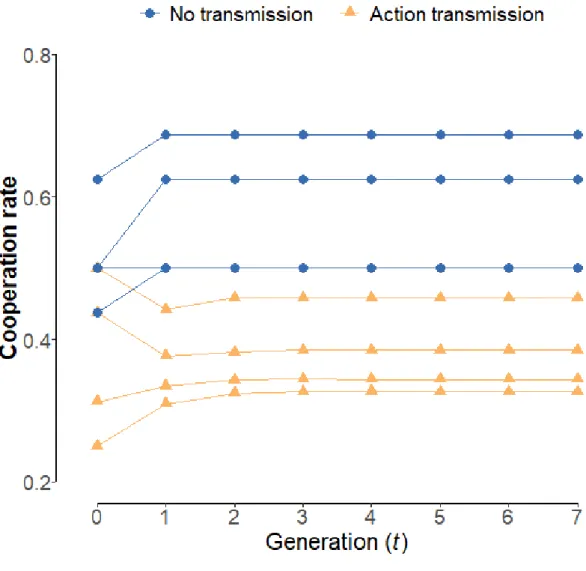
In Chapter 3, we conducted an infinite intergenerational prisoner ’s dilemma experiment to investigate whether the observable actions of previous generation’s players improve the cooperation of players in the current generation. The theoretical prediction shows that ther e exists some Cooperative equilibrium if players can observe the action of the immediately previous generations. The experimental data reports that subjects most likely to take a cooperative action when they observed both of two subjects cooperated in the previous generation rather than other action histories. However, against the
2
theoretical prediction, observing the action s of previous generation cannot improve cooperation of subjects compared with the situation that they cannot observe the actions.
Finally, In Chapter 4, we conclude the dissertation by summarizing the previous chapters, discusses the limitation, and clarify the future works of thi s thesis.
i
C o n t e n t s
CHAPTER 1 Introduction ... ... 1
1 . 1 B a c k g r o u n d a n d O b j e c t i v e . . . .. . . .1 1 . 2 I m p l ic a t i o n s fo r ex p e r im e n t s i n Ec o n om i c s . . . .. . 3 1 . 3 S t r u c tu r e o f t h e T h e s i s . . . .. . . .4 R e f e re n c e . . . .. . . .. . . .6CHAPTER 2 Does cheap tal k promote coordination under
as ymmetric information? An experimental s tudy on global games . 7
2 . 1 I n t r o d u c t i o n . . . .. . . .. . . .7 2 . 2 R e l a t e d L i t e r a tu r e . . . .. . . .. . . 9 2 . 3 M e th o d . . . .. . . .. . . 1 1 2 . 3 . 1 E x p e r i m e n t a l d e s ig n . . . .. . . 1 1 2 . 3 . 3 D a t a c ol l ec t i o n . . . .. . . .. . 1 4 2 . 4 T h e o r y . . . .. . . .. . . 1 5 2 . 5 R e s u l t s a n d D i s c u s s i on . . . .. . . 1 8 2 . 5 . 1 C o o r d i na t i o n r a t e s , m is c oo r d i n a t i o n r a t e s , a n d p a y o f f r a t i o s . 1 8 2 . 5 . 2 A n a l y s is o f c h e a p t a l k . . . .. . . 2 4 2 . 5 . 3 A n a l y s is o f in v e s tm e n t d ec i s i on . . . .. . . 3 2 2 . 6 C o n c l u s io n s . . . .. . . .. . . 3 5 F u n d i n g . . . .. . . .. . . 3 6 R e f e re n c e s . . . .. . . .. . . 3 6 Ap p e n d ix 2 . A . . . .. . . .. . . 3 9 Ap p e n d ix 2 . B . . . .. . . .. . . 4 1 Ap p e n d ix 2 . C . . . .. . . .. . . 4 2 Ap p e n d ix 2 . D I n s t r u c t i o n s i n s e q u e n t i a l g a m e w i t h c h e ap t a l k t r e a tm e n t ( O r ig i n a l l y w r i t t e n i n J a p a n e s e ) . . . .. . . 4 3 D e c i s i o n P r o b l e m . . . .. . . .. . . 4 4ii W h a t i s Q? . . . .. . . .. . . 4 5 E n t e r i n g M e s s a g e s . . . .. . . .. . . 4 6 S e l e c t i n g Y o u r Ac t i o n s . . . .. . . 4 7 P a y o f f s . . . .. . . .. . . 4 8 Ru l es . . . .. . . .. . . 4 9
CHAPTER 3 An experiment on intergenerational prisoner dilemma
game ... ... ... 52
3 . 1 I n t r o d u c t i o n . . . .. . . .. . . 5 2 3 . 2 R e l a t e d L i t e r a tu r e s . . . .. . . .. . 5 4 3 . 3 M o d el a n d Me t h o d s . . . .. . . .. . 5 5 3 . 3 . 1 M o d el . . . .. . . .. . . 5 5 3 . 3 . 2 G a m e T h e o r e t i c a l P r e d i c t i on . . . .. . . 5 5 3 . 3 . 3 E x p e r i m e n t a l D e s ig n s . . . .. . . 5 7 3 . 3 . 4 E x p e r i m e n t a l P r oc e du r e s . . . .. . . 6 3 3 . 3 . 5 A n a l y s is o f D a t a . . . .. . . 6 5 3 . 4 . R e s u l t s . . . .. . . .. . . 6 8 3 . 4 . 1 C o op e r a t i o n R a t e P a th s . . . .. . . 6 8 3 . 4 . 2 E a c h Su b j ec t ’ s Ch o i c e s . . . .. . . 7 0 3 . 5 D i s c u s s i o n a n d C o n c l u s io n . . . .. . . 7 5 F u n d i n g . . . .. . . .. . . 7 6 R e f e re n c e . . . .. . . .. . . 7 6 Ap p e n d ix 3 . A I n s t r u c t i o n s i n A c t i o n t r a ns m i s s i o n t r e a tm e n t ( O r i g i n a l l y w r i t t e n i n J a p a n e s e) . . . .. . . .. . . 8 0 P r e p a r i n g f o r t h e s t a r t o f t h e e x p e r i m e n t . . . .. . . 8 0 T h e t o t a l n u m b e r o f p o i n t s t o b e ob t a i n e d . . . .. . . 8 1 T h e n u m b er o f p o i n t s y ou w il l o b t a i n d i r e c tl y . . . 8 2 T h e n u m b e r o f p o i n t s o b t a i n e d i n d i r e c t l y . . . .. . . . 8 3 T h e m e th o d o f c h o o s i n g X o r Y . . . .. . . 8 3 T h e m e th o d t o de c i d e t o a c t u a l l y a d o p t a c h o ic e . . . 8 4 P r o c e du r e t o e n d th e e x p e r i m e n t . . . .. . . 8 6iii O t h e r p o in t s t o b e a w a r e o f . . . .. . . 8 7 Ap p e n d ix 3 . B E q u i l i b r i a wh e n p l a y e r s h a v e o t h e r - r e g a r d i n g p r e f e re n c e s . . . .. . . .. . . .. . . . 8 8 T h e o r e t i c a l e n v i r o n m e n t . . . .. . . 8 9 Al l - C s t r a t e g y . . . .. . . .. . . 8 9 P av l o v s t r a t e g y . . . .. . . .. . . 8 9 T r i g g e r s t r a t e g y a n d al l - D s t r a t e g y . . . .. . . 9 0 C on c l u s i o n . . . .. . . .. . . 9 1 R e f e r e n c e s . . . .. . . .. . . 9 1
Chapter 4 Concl usions ... ... 92
4 . 1 Su m m a r y . . . .. . . .. . . 9 2 4 . 2 L i m i t a t i o n a n d fu t u r e r e s e a r c h . . . .. . . 9 3 R e f e re n c e . . . .. . . .. . . 9 4
1
C H A P T E R 1 I n t r o d u c t i o n
1 . 1 B a c k g r o u n d a n d O b j e c t i v e
Since the interests of individuals and society are not always consistent, Pareto efficiency cannot be achieved automatically in some situations. An example is an economic environ ment where exist multiple Nash equilibria, but the Pareto efficient outcome is not easy to be achieved . For example, in the stag hunt game, both the action profile (stag, stag) and (hare, hare) are Nash equilibria. However, the profile (hare, hare), which is risk domination one but not a Pareto efficient one, is achieved easily.
Another example is an economic environment where the Pareto efficient is not consistent with the Nash equilibrium, such as Prisoner dilemma games. In the Prisoner dilemma games, the action profile (cooperate, cooperate) is Pareto efficient but the action profile (Defection, Defection) is the Nash equilibrium.
In such situations described above, to achieve Pareto efficiency is one of the goals of game theory. To get closer to this goal, a large amount of research focuses on the effects of information transmission such as pre-play communication or presenting the action history. However, there are few experimental researches considers those effects under the dynamic condition, although this condition cannot be ignored in the real world.
Therefore, this thesis studies the effects of information transmission in the dynamic games, and test our assumption by Laboratory economic e xperiments. More specifically, this thesis addresses the following two issues.
The first issue is whether the information transmission from two-sided cheap talk improves the coordination of agents in a dynamic environment characterized by symmetric information and strategic complementarity.
To deal with this issue, we conduct a l aboratory experiment. The stage game of the model is global games, in which exist multiple equilibria. In the game,
2
agents select their decision timing endogenously, and the agent lately invested can observe the decision of agent early invested. That is, the design of endogenous timing is also an information transmission by agents ’ past actions. The background of this issue applies to an investment environment such as foreign investment and technology adoption. In such environments, information asymmetry contributes to the failure of coordination among agents and results in loss of social efficien cy. In theory, such efficiency loss can be expected to be mitigated by performing information transmission by two-sided cheap talk or past actions between agents. The first part of the thesis experimentally tests the effects of two-side cheap talk and static condition separately and shows the difference of effects of cheap talk between Sta tics and dynamic condition.
To
our best knowledge, there is no experimental study comparing the effect
of cheap talk and that of endogenous timing under global games, so our
experiment is the first experiment that directly compare s these two
effects.
Since the condition of endogenous timing can be regarded as an information transmission by agents ’ past action, the results of the experiment also make a contribution that shed light on the problem of selecting information systems in the economic environment (Duan, Kobayashi, Shichijo, 2019).The second issue is how the information transmission from action history of the immediately previous generation affects the action of the next generation in an intergenerational prisoner dilemma game environment.
In the intergenerational prisoner dilemma game, there exists a unique equilibrium that is not a Pareto efficiency if players cannot obtain additional information. To decrease efficiency loss, we create an environment in the laboratory, where the agent can observe the action history of the immediately previous generation. In this case, new Pareto efficient equilibri a is created, which can be expected to be theoretically achieved. Our research verified theoretical predictions by laboratory experiments and clarified how the contents of the action history of the previous gen eration
affects the behaviors of the
next generation under an environment like the prisoner's dilemma game
.3
Finally, this experiment also compensated for the blank in inter
-generational experiments by prisoner dilemma games in experimental
economics
(Kusakawa, Duan, et al, 2019).1 . 2 I m p l i c a t i o n s f o r e x p e r i m e n t s i n E c o n o m i c s
The need for an economics experiment is somet imes suspected. Although theoretical predictions have been derived under the default assumptions for the two issues addressed in this thesis, empirical data analysis is considered still necessary to prove the robustness of the theory.
In some cases, an economic issue may be interpreted by multiple theories. In such a situation, it is necessary to verify wh ich theory is most appropriate. In addition, economic experiment and theoretical analysis can promote each other. From the divergence between experimental data and theoretical predictions, we can discover the lack of models and improve theoretical models by clarifying the reason. Then, we can conduct further experiments under the improved model.
The above-mentioned role of experimental economics also can be realized by the method of econometrics. However, the data of econometrics treated is not scientifically controlled. The validity of such data is often compromised by missing variables in which we are interested, measurement errors, or distorti ons in the collection range. Instead, the data collected in laboratory experiments has been greatly improved against the above problems. In the book of “Experimental Methods: A Primer for Economists ” (1994), Friedman and Sunder emphasis that experimental data are carefully generated data for scientific purposes under controlled conditions and are more reliable than uncontrolled contingencies. Similarly, Capra, et. al, (2009) also suggests that laboratory experimenters are able to fully observe and control t he environment and institutions, which can be changed exogenously so that their effects on an outcome variable can be clearly identified. Results from different institutional configurations can be compared
4
to optima and to equilibria, as well as to each other. Due to the above properties, the economic environments, which cannot be realized in the real world, can be realized in the laboratory. That is, multiple economies can be created under identical conditions. This allows the potential falsification of theoretical propositions at any desired level of significance and the investigation of the variability of possible outcomes under fixed conditions. Therefore, it can be said that experimental economics and econo metrics are complementary to each other. On the other hand, however, the issue of external validity of results from experimental data becomes more serious than econometrics. This issue will be discussed in Chapter 4.
1 . 3
S t r u c t u r e o f t h e T h e s i s
The thesis is organized as follows:
In chapter 2, we investigate the issue of whether two -sided cheap talk improves the coordination of agents in an environment characterized by asymmetric information and strategic complementarity under the dynamic condition. The stage game is asymmetric information global game, which has the following Features: firstly, agents do not know the fundamental of the investment target when making decisions; secondly, the more agents invest, the better the gain in investment and the lowe r the cost incurred. Under such a situation, it can be expected to promote coordination among agents by performing two-sided cheap talk.
In our experimental setting, the subjects are randomly grouped in pairs and play one-shot global games. To examining the effect of pre -play communication, there exist two treatments described as follows. In the first treatment, subjects in pair can send a message to each other before making any decision. In the first treatment, subjects in pair can send a message to eac h other before making any decision. Whereas in the second treatment, subjects cannot send any message. Besides, different from previous research, in the experiment, we also considered
5
the influence of the endogenous timing, which cannot be easily ignored in the real world. Thus, in our experiments, there are four treatments, depending on whether the subjects can send messages to each other and whether the subjects' investment timing is endogenous.
The experimental results, which is consistent with previ ous experimental research, show that pre -play communication can improve coordination between subjects in such a game. However, our results also report that this effect disappears if the subjects' decision timing is endogenous. The experimental results imply that the effect on promoting the coordination of two -sided cheap talk may be overestimated. In addition, our experimental data show that subjects tend to exaggerate their private information when they communicate, whereas this tendency becomes weak if th eir investment timing is endogenous.
In chapter 3, we investigate the issue of how the action history of the immediately previous generation affects the action of the next generation in the intergenerational prisoner dilemma games. In our experimental mode l, we divide the players into two groups. In each group, all players are divided into different generations. Players of each generation only play against players, who belong to the same generation in the other group. The players of each generation play only once, but the payoff is influenced not only by the results of their own generation but also by the results of the next generation. In this way, the gain relationship between the parents and children in the real world is reproduced to some extent.
The experiment is divided into two treatments roughly described as follows. In the first treatment, players can observe the actions of immediately previous generation players. In such a treatment, there exist some equilibria theoretically that subjects cooperate in all generations. Furthermore, in this treatment, it is possible to know under which action history the subject is more likely to choose “Defection” or “cooperation”. To control the effect of amount of information, in the second treatment, players cannot observe any action history of the previous generation.
6
Our experimental results show that the subject, who observed the "Defection" action history, tends to choose "Defection", regardless of whether the subject chosen "Defection" is his/her parent or not. The subject, who observed action profile (Cooperation, Cooperation), tend to cooperate. Furthermore, our experimental data presents the opposite result of Theoretical prediction that subjects' actions show more cooperation in the second treatment, where subjects cannot observe any action history of a previous generation, compared with the first treatment.
The conclusion and discussion will be summarized in chapter 4.
R e f e r e n c e
Copra, M., T. Tanaka, C. F. Camerer, L. Feiler, V. Sovero and C. N. Noussair, 2009. “The Impact of Simple Institutions in Experimental Economies with Poverty Traps.” The Economic Journal 119, 977 -1009
Duan, J., H. Kobayashi, T. Shichijo, 2019. “Does Cheap Talk Promote Coordination under Asymmetric Information? An Experimental Study o n Global Games.” Working paper.
Friedman, S., D. Friedman and S. Sunder, 1994 . “Experimental Methods: A Primer for Economists .” Cambridge University Press.
Kusakawa, T., J. Duan, H. Kobayashi, T. Shichijo, T. Saijo, 2019. “Cooperation in Prisoner’s Dilemma by Letting Bygones Be Bygones: An Intergenerational Experiment.” Working paper.
7
C H A P T E R 2 D o e s c h e a p t a l k p r o m o t e c o o r d i n a t i o n
u n d e r a s y m m e t r i c i n f o r m a t i o n ? A n e x p e r i m e n t a l
s t u d y o n g l o b a l g a m e s
2 . 1 I n t r o d u c t i o n
When individuals fear coordination failure, they address this issue, communicating ways to coordinate each other ’s actions. Thus, the role of pre -play communication is extensively studied in games with strategic complementarities and asymmetric information.1 A typical example is the
problem of currency attacks using a global game (see Morris and Shin, 2003). In this situation, pre -play communication, such as cheap talk, is expected to improve the efficiency of investments by facilitating coordination, as investo rs can obtain more information about other investors through such communication.
In practice, however, investors do not necessarily make decisions simultaneously. Importantly, they can obtain some information from other investors’ decisions to avoid coord ination failure. Brindisi, Celen, and Hyndman (2014) experimentally study such a dynamic game as a dynamic global game in which subjects can determine their decision timing endogenously. In their experiment, subjects can observe the decisions of the others by delaying the timing of their investments with a cost delayed investment. In this setting, if subjects with a good signal move first and others with a relatively bad signal move second, the first movers can transmit their private information committing to action and the second movers can infer their opponent ’s private information by the committed action. Because the first mover commits to an action refusing
1 Garratt an d Keister (2 00 9) and Go ld stein and P au zn er (20 05 ) co n sid er th e en viro n men t
o f b an k run s, Katz and S h apiro (1 98 5 , 1 98 6 ) con sid er th at o f tech no lo gy ad o ptio n , Mo rris and S h in (19 98 ) an d S hu rch ko v (20 16 ) co n sid er th at o f cu rren c y attacks, and Go ld b erg and Ko lstad (19 95 ) an d Rod rik (19 91 ) con sid er th a t o f fo reign d ire ct in vestmen t.
8
the learning opportunity represented by being the second to move and the second mover learns the first mover’s information by paying delay costs, this process can be seen as a special kind of costly communication, through committing to an action. The results of the experiment show that the coordination rate significantly increases when subjects determi ne their decision timing endogenously.
Given this background, we focused on the following issues: (i) what factor improves the investment efficiency of players more significantly, the information transmission by cheap talk, or the costly information trans mission by the endogenous timing? (ii) if both types of information are available, does the investment efficiency of players improve further?
We conducted a laboratory experiment to answer these questions. Our experiment used a between -subject design comprising four treatments. In all four treatments, the subject was part of a pair and participated in one shot incomplete information global game. The first treatment was a baseline treatment, where subjects acted simultaneously and could not send any messages . In the second treatment, before making any investment decision, subjects could send each other messages consisting of continuous numerical values. In the third treatment, subjects could determine their decision timing endogenously in three action periods without sending messages. In the last treatment, subjects could send messages before making a decision and determine their decision timing endogenously.
We found that both the costless information transmission through cheap talk and the costly information transmission through the endogenous timing improved the efficiency of investments significantly, but the effect of the cheap talk was weaker compared to endogenous timing. Moreover, the data showed that when subjects’ decision timing was endogenous, addit ional information from the cheap talk could not further improve investment efficiency. Finally, the data showed a high proportion of subjects sending truth -telling messages, which was close to the value of the private signal. However, some subjects sent
9
exaggerated messages, which were higher than their private signals, and the proportion of these messages increased over time.
The rest of this chapter is organized as follows. Section 2.2 describes the related literature. Section 2.3 describes the model and experimental design. Section 2.4 outlines the theoretical predictions and hypotheses. Section 2.5 provides an analysis of the data. Finally, Section 2.6 offers some conclusions.
2 . 2 R e l a t e d L i t e r a t u r e
Despite the substantial amount of research analyzing t he effects of cheap talk and endogenous timing separately, to the best of our knowledge, no experimental study has examined the two effects together and determined which one is more powerful. Therefore, the literature related to our study can be separated into two streams.
The first stream of literature includes the studies by Qu (2013) and Avoyan (2019) on the effect of cheap talk, in which players can send a costless message before making investment decisions. Qu (2013) experimentally examines how two communication mechanisms, market, and cheap talk, affect investment decisions and efficiency in the incomplete information global games. In the cheap talk setting, subjects are asked to invest or not. Then, before making investment decisions, the subjects ob serve how many subjects intend to invest. The results provide evidence that the subjects' average payoff improves through pre-play communication regarding their intended decisions.
Avoyan (2019) focuses on informative equilibria and analyzes the effects of different cheap talk protocols in global games. The study examines how subjects behave in the following three cases: (i) when the content of the message is a continuous number, (ii) when the content of the message is a tendency concerning whether to inves t or not and (iii) when the content of the message contains both. The results show that all cases of cheap talk reduce miscoordination.
10
The second stream of literature includes the studies by Duffy and Ochs (2012), Brindisi, Celen, and Hyndman (2014) and Heggedal, Helland, and Joslin (2018) on the effect of dynamic games, in which subjects can determine their decision timing endogenously.2 Duffy and Ochs (2012) and Brindisi, Celen,
and Hyndman (2014) investigate the role of endogenous decision timing in coordination under both asymmetric information and complete information. Subjects play a dynamic global game in which they can delay their investment timing. Compared with Duffy and Ochs (2012), Brindisi, Celen, and Hyndman (2014) examine the effect of endo genous timing under several degrees of the accuracy of private information. The data produced by Brindisi, Celen, and Hyndman (2014) show that subjects ’ coordination rate and performance improve significantly relative to the simultaneous game under endogen ous timing.3
Moreover, they find that the gap between the coordination rates of simultaneous and sequential games increases when private information becomes less informative.
Heggedal, Helland, and Joslin (2018) adopt the asymmetric information dynamic bandwagons game introduced by Farrell and Saloner (1985). In addition, they test the effect of cheap talk. Their results provide some evidence that cheap talk improves the subjects ’ average payoff, even given a dynamic structure.
Unlike these previous studies, we compared the effects of both endogenous timing and cheap talk and examined the interaction between them. Finally, our research is also related to recent studies on the relationship between information and human behavior co nducted by physics carried out by researchers in physics.
2 F or mo re th eo retical an al yses o f en do gen ou s timin g, see, fo r ex a mp le, F arrell and
S alo n er (19 85 , 19 88 ), F arrell (19 87 ), Bo lton and F a rrell (19 90 ), Ch amle y an d Gale (1 994 ), Xu e (20 03 ), an d Dasgu p ta (2 007 ). Ch a mle y an d Gal e (1 99 4 ) and Gu l and Lu n dho lm (1 99 5 ) an alyz e th e effect o f en do geno u s ti min g with p ure in fo rmatio n extern alities, wh erea s Bo lto n an d F arrell (199 0 ), F arrell (1 98 7 ), F arrell and S alo n er (19 85 , 1 98 8), Dasgu p ta (2 00 7 ), and Xu e (200 3 ) an al yze it with strategic co mp lemen taritie s.
3 Du ffy an d Och s (20 12 ) find no d ifferen ces in sub jects' b eh avio r acro ss static an d
d yn a mic ga mes, wh ereas th e results ob tain ed b y Gro ss man et al. (2 01 9 ) are con sisten t with th o se o f Brind isi, Celen, an d Hyn d man (2 01 4 ), wh ere th e y sh o w th at so cial wel f are is sign ifican tl y imp ro ved in co n flict ga mes, if su b jects' d ecisio n timin g is endo gen ou s.
11
Szolnoki and Perc (2013) and Xia, Li, and Perc (2018) analyze how information sharing between networks affects agents ’ decisions in the social dilemma. Szolnoki and Perc (2014) study the relationshi p between deceitful behavior and the cost of the information in the social dilemma.4
2 . 3 M e t h o d
2 . 3 . 1 E x p e r i m e n t a l d e s i g n
Our experimental design builds upon and complements the previous experiment of Brindisi, Celen, and Hyndman (2014). In all treatments, each player 𝑖 ∈ {1,2} makes a binary investment decision 𝑎𝑖∈ {𝐼, 𝑊}. The action I is
interpreted as Investing, and action W is interpreted as Waiting. Table 2.1
presents the payoff matrix, in which the payoffs are denoted in points (1 point=1 JPY=0.0093 USD). 𝜃 is a realization of Θ, which is a random variable distributed uniformly over [20, 50]. The payoff of I is determined by 𝜃. When both players take action 𝐼, the return is 𝜃 points. If only one player takes action
I, the return of the player choosing I is 𝜃 − 20 points. Thus, an action I exhibits
strategic complementarities. In contrast, W presents a riskless alternative, as its payoff is always 25 points. Neither player can observe the realization of 𝜃, but each receives a private signal before making any decision. Player i's signal is determined by a random variable defined as
𝑋𝑖= 𝛩 + 𝐸𝑖,
where 𝐸𝑖 is a random variable distributed uniformly over [-10, 10]. 𝐸1 and 𝐸2
are identically and independently distributed (i.i .d.), and 𝐸𝑖 and 𝛩 are
independent of 𝑖.
4 S zo lno ki an d P erc, (20 1 3) an d X ia, Li, and P erc (201 8 ) stu d ied h o w in fo r matio n sh arin g
b et ween n etwo rks a ffect s agen ts’ d ecision s in th e so cial d ilemma. S zo lno k i and P erc (2 01 4 ) stu d y th e relation ship b etween d eceit fu l b eh avio r an d th e co st o f th e in fo rmation in th e so cial d ile mma.
12 Ta b le 2. 1. P a y o f f m a t r i x . I W I 𝜃, 𝜃 𝜃 − 20, 25 W 25, 𝜃 − 20 25, 25
To examine the effect of cheap talk and endogenous timing, we use a 2 × 2 experimental design, in which we vary the communication method - cheap talk or no communication, and the game structure - simultaneous game (SIM) or sequential game (SEQ).
For the communication condition, players in the cheap talk treatment can send a message before making any decision. Specifically, in the cheap talk treatments, players within a pair can send messages 𝑚𝑖∈ [0,70]5 to each other
following the realization of 𝑋𝑖; then, they observe the received messages and
choose Investing or Waiting. On the other hand, the players in the
no-communication treatment, make decisions immediately following the realization
of 𝑋𝑖.6
5 Th at is, u nd er th is settin g, sub jects can send a message, wh ich is h igh er o r lo wer th an
th e p rivate sign al, regard less o f th e valu e o f th e p rivate sign al. Fo r in stan ce, su b jects can send a messa ge h igh er th an 6 0 if th e valu e o f t h e receiv ed p rivate sign al is 6 0, o r a messag e lo wer th an 10 if th e valu e o f th e received private sign al is 10 .
6 In th e exp eri men t, th e re alizatio n o f X o b served b y each su b ject is u p to two d igits after
th e d ecimal po in t, so th e me ssag e th at each sub ject sen t an d received is u p to t wo d igits after th e d eci mal po int.
13
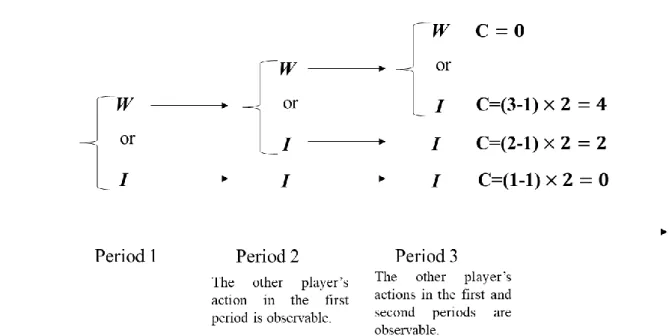
Figure 2.1. The experimental design for decision making in sequential games.
The delay costs determined as C=(t-1)×2 points. The t is the period number in which the player initially chose I. Otherwise if subjects chose W in all three periods, there are no delay costs to be paid.
For the game structure condition, players make an investment decision simultaneously in the setting of the simultaneous game, whereas in the setting of the sequential game, each game consists of three decision periods. In each period, players choose I or W simultaneously. If a player chooses W in the first period (or second period), then the player again chooses between W or I in the second period (or third period). However, if a player chooses I in the first stage (or second stage), the decision I is irreversible. The actions of player i in the subsequent periods are fixed to I. If the players choose I initially after the first period, they must pay delay costs determined as C=( t-1)×2 points, where t is the period number in which the player initially chose I. Otherwise, if they chose W in all three periods, there are no delay costs born and subjects earn the fixed payoff for W. Figure 2.1 shows the game process for each round and the
calculation method of delay costs of the sequential game settings.
Table 2.2 offers a visual illustration of these four experimental conditions.
In our experiment, the SEQ and SIM settings replicate those of Brindisi, Celen, and Hyndman (2014), and the SEQ -C and SIM-C settings are original to our
14 study.
Table 2.2.
Classification of treatments.
Sequential Simultaneous
Cheap talk SEQ-C SIM-C
No communication SEQ SIM
Each treatment consists of 40 identical rounds. The SEQ -C treatment proceeds as follows. At the beginning of each round, each subject is randomly matched with another subject. Then, the realizations of 𝛩 and 𝑋𝑖 are decided
by computers. After all subjects receive a private signal, they send a message to the other player in the same pair. Each player then reads the message from the other player before choosing an action. In this treatment, each subject makes three decisions in three periods after receivin g the message from the other player. Note, however, that the subjects that choose I cannot change their actions in the remaining period(s). All subjects can observe other subjects ’ decision(s) in the previous period(s). The value of 𝛩 and the profits in that round are displayed on the screens after all subjects make their choices.
The other treatments differ from the SEQ -C treatment as follows. The SEQ treatment differs from SEQ -C at the point where subjects make decisions immediately after observing their private signals, and no communication occurs. In the SIM and SIM -C treatments, the subjects make one -time investment decisions simultaneously in each round. Although subjects make decisions immediately after observing private signals, and no communication occurs in the SIM treatment, players in the SIM C treatment can communicate, as in SEQ -C.
2 . 3 . 3 D a t a c o l l e c t i o n
15
run at the experimental laboratory of the Center for Experimental Econom ics Laboratory at Kansai University from January to February 2018. All subjects were students enrolled in the school. The recruiting methods included sending emails and putting up flyers on campus. In total, 174 subjects participated in the experiment across eight sessions. In all sessions, instructions7 were read
aloud before the experiment began. Then, the subjects were tested to confirm that they understood the rules and knew how to calculate their payoffs. To ensure that most subjects understood the rules, we did not start the experiment until all participants had answered all the questions correctly. Each treatment comprised two sessions, and each session lasted from one and a half to two hours. After 40 rounds, subjects took a short survey, and they received their final payment that included the show-up fee and the amount earned in each of the 40 rounds.8
Table 2.3 provides descriptive statistics for the sessions.
Table 2.3.
Descriptive data for sessions.
2 . 4 T h e o r y
As Brindisi, Celen, and Hyndman (2014) reported, a unique symmetric equilibrium exists in the SIM and SEQ treatments. In particular, the equilibrium
7 In stru ction s are b ased o n Brin d isi, Celen, and Hyn d man (2 01 4 ). Th e y are availab le in
th e sup ple men tal material.
8 Th is p aymen t rule is c on sisten t with Brind isi, Celen, an d Hyn d man (20 14 ), wh ereas
Avo yan (20 19 ) ado pted a n altern ative ru le acco rd in g to wh ich th e fin al p a ymen t in clud ed th e sh o w-u p fee an d th e averag e o f fi ve ro un d s o f th e p a yo ffs r an do ml y ch o sen fro m all 50 rou nd s. Date 2/16/2018 2/19/2018 2/9/2018 2/19/2018 1/15/2018 1/29/2018 1/29/2018 2/16/2018 Participants 20 22 24 20 20 22 24 22 Total rounds 40 40 40 40 40 40 40 40 Earnings (USD): Average [Min, Max] 26.2 [24.4, 27.9] [23.9, 29.0]26.4 [24.9, 29.8]27.2 [22.4, 29.6]26.4 [23.8, 28.9]27.1 [24.8, 30.0]27.9 [23.7, 30.3]27.8 [24.9, 29.3]27.2
16
in the SIM treatment is characterized by a threshold k at which players choose
I if their private signal 𝑥𝑖 ≥ 𝑘 = 35 and W otherwise. The equilibrium of the SEQ
game is characterized by two thresholds, 𝑘1 and 𝑘2. Players choose I in the first
period when their private signals 𝑥𝑖≥ 𝑘1= 30.74, or choose I in the second period
when 𝑥𝑖≥ 𝑘2= 20.13 and they observe the other player choose I in the previous
period.
In contrast, in our experiment, the SIM -C and SEQ-C treatments have multiple equilibria, that is, babbling and informative equilibria. In babbling equilibria, messages are ignored, and the actions are the same as in the game without communication. Informative equilibria, on the other hand, can be classified into two types.
The first type is partially informative equilibria, which is identical to binary message equilibria when there is a possibility for bo th players to invest or when both players are waiting for sure (Avoyan, 2019). Here, the message is interpreted as an intention to invest or wait. However, few subjects adopt this message strategy in our experiment, so we do not include an argument about t his type of equilibria in this thesis.
The second type is fully revealing equilibria. Under fully revealing equilibria, each player learns the other ’s signal from cheap talk. The second type is fully revealing equilibria. Under fully revealing equilibria, each player learns the other’s signal from cheap talk. For example, if all subjects send a message that is exactly the same as their private signals (𝑚𝑖= 𝑥𝑖) and know that
others send messages according to the same strategy, then each player can accurately estimate the other’s signal. We define the type of fully revealing equilibrium described by this example as a truth -telling equilibrium. Our study focuses on the truth -telling equilibrium among fully revealing equilibria because the other types of full y revealing equilibria are considered difficult to be achieved. In truth -telling equilibria, each player can obtain the expected value of 𝜃 conditional on the private signal and the other player ’s signal, as follows (see Appendix 2.A):
17 𝐸(𝜃|𝑥1, 𝑥2) =
𝑚𝑖𝑛[𝑥1+ 10, 𝑥2+ 10,50] + 𝑚𝑎𝑥[𝑥1− 10, 𝑥2− 10,20]
2 .
That is, according to 𝐸(𝜃|𝑥1, 𝑥2), players adopt a threshold strategy in which
they choose I when 𝐸(𝜃|𝑥1, 𝑥2) > 𝑘 = 25 and W otherwise. Intuitively, 𝑚𝑖𝑛[𝑥1+
10, 𝑥2+ 10,50] is the maximum possible value of 𝜃 given 𝑥1 and 𝑥2 , whereas
𝑚𝑎𝑥[𝑥1− 10, 𝑥2− 10,20] is the minimum possible value of 𝜃 given 𝑥1 and 𝑥2 .
That is, players, find possible maximum and minimum values of 𝜃 given 𝑥1
and 𝑥2 , and set the mean value of the two as the threshold. Note that the
prediction of the truth-telling equilibrium in the SIM-C treatment is exactly the same as that in the SEQ -C treatment. That is, nobody invests in the second or third period in this equilibrium. We summarize the equilibria in each treatment in Table 2.4.
Table 2.4.
The theoretical equilibria present in each treatment.
SIM Unique equilibrium
SIM-C
Fully revealing equilibria, partially informative equilibria, Babbling equilibria
SEQ Unique equilibrium
SEQ-C
Fully revealing equilibria, partially informative equilibria, Babbling equilibria
If the truth-telling equilibrium is realized, the subjects ’ actions should be more coordinated, and the coordination failure of the treatment should decrease. Based on the assumption that truth-telling equilibria are realized in SEQ -C and SIM-C, the expected payoff of each treatment per round calculated by computer is reported as following: SEQ -C and SIM-C are 35.00, SEQ is 34.48, and SIM is 30.97. Therefore, we can predict that the relation between the payoff ratios of each treatment is SEQ -C=SIM-C>SEQ>SIM.
18
2 . 5 R e s u l t s a n d D i s c u s s i o n
2.5.1 Coordination rates, miscoordination rates, and payoff ratios
In this subsection, we investigate the effect of cheap talk on coordination, coordination failure, and efficiency. Similar to Brindisi, Celen, and Hyndman (2014), we can either use coordination rates or miscoordination rates to measure the action profile. The coordination rate is defined by the ratio of the occurrences of profile (I, I) to the total number of profiles, and the miscoordination rate is defined by the ratio of the total occurrences of the final profiles (I, W) and (W, I) to the total number of profiles. Note that since the 𝜃 is randomly generated, the average values differ among treatments. Such differences are not due to endogenous timing or cheap talk. Therefore, when we examine the effects of cheap talk and endogenous timing, to control the effect, we use the payoff ratio
𝜋𝑎
𝑚𝑎𝑥 {25, 𝜃}
as a statistic, where 𝜋𝑎 is the subject’s actual payoff and 𝑚𝑎𝑥 {25, 𝜃} is the
theoretical maximum gain. Such a statistic can reduce the impact of differences due to the random realization of 𝛩.
19
Figure 2.2. The average coordination rate, miscoordination rate and payoff
ratio of each treatment in the last 20 rounds.
Figure 2.2 reports the coordination rate, miscoordination rate, and payoff
ratio for each treatment, where the x -axis shows treatments, and the y -axis shows the proportion of coordination rate , miscoordination rate, and payoff ratio.9 Table 2.5 reports the results of the multiple comparisons using pairwise
t-tests for three statistics between treatments. The p-values are adjusted using
Bonferroni correction for multiple hypotheses testing. In t he first row of Table 2.5, we see that SEQ has a high coordination rate and payoff ratio and a low
miscoordination rate compared with SIM. The experimental data of Brindisi, Celen, and Hyndman (2014) show that the coordination rate and payoff ratio of
9 Co mp ared with tho se in th e first 2 0 rou nd s, th e sub jects' action s in th e last 20 ro un d s
are stab le an d reliab le. T h erefo re, si milarly to Brind isi, Celen , and Hyn d ma n (2 014 ), th e an alysis is p erfo r med u sin g on l y th e d ata o f th e last 20 roun d s.
20
SEQ are higher than those of SIM, and the miscoordination rate of SEQ is lower than that of SIM. Thus, our result is consistent with that of Brindisi, Celen, and Hyndman (2014). The second row of Table 2.5 shows that SIM-C has a higher
coordination rate, a lower miscoordination rate, and more efficiency than SIM has. However, in the third row of Table 2.5, we observe no statistical difference
between SEQ-C and SEQ in terms of the coordination rate and payoff ratio.1 0
Result 1
(a) Compared with SIM, the miscoordination rate of SIM -C is significantly lower, and the coordination rate and payoff ratio are significantly higher. (b) We find no significant difference in these three statistics for SEQ and SEQ -C.
Finally, the last row of Table 2.5 shows that, compared with SIM -C, SEQ
has a higher coordination rate and a lower miscoordination rate. Thi s result may show that more efficient investment can be made by gathering information at low cost than by gathering costless information through cheap talk.
1 0 Th e exp erimen tal resu lts o f H egg ed al, Hellan d an d Jo slin (2 01 8 ) sho w th at ch eap talk
imp ro ves th e p a yo ffs o f su b jects in d yn amic a s ymmetric ga mes. Ho we v er, th ey u se a differen t p a yo ff matrix fr o m th at in o u r exp erimen tal settin g. In p articu lar, in th eir settin g, sub jects h ave in cen tives tell th e tru th .
Table 2.5.
Pairwise t-tests for coordination rate, miscoordination rate, and payoff ratio between treatments (last 20 rounds).
Coordination rate Miscoordination rate Payoff ratio
SIM VS. SEQ <0.001 <0.001 <0.001
SIM VS. SIM-C <0.001 <0.001 <0.001
SEQ VS. SEQ-C 1.000 1.000 1.000
SIM-C VS. SEQ 0.081 <0.001 0.001
Notes:
Th is table rep orts p -valu es o f statistic tests. Bo n ferro n i co rrection was u sed o n th e p-valu es.
21 Result 2
Compared with SIM -C, SEQ has a lower miscoordination rate and a higher coordination rate and payoff ratio.
22
Table 2.6.
Regressions of coordination, miscoordination, and payoff ratio on treatments (last 20 rounds).
Logistic Logistic Linear regression
Model (1) Model (2) Model (3)
Dependent variable Coordination dummy
Miscoordination dummy
Group payoff ratio per round marginal effects marginal effects coefficients
Intercept 0.703***
(9.51) signal+
the other player’s signal
0.015*** (28.41) -0.002 (-1.23) 0.002*** (4.92) | signal-
the other player’s signal |
0.000 (0.27) 0.006** (2.25) -0.001 (-0.74) Θ -0.001 (-0.79) D1 0.244*** (6.35) -0.076*** (-4.59) 0.080*** (8.39) D2 0.113*** (5.54) -0.156*** (-6.69) 0.038*** (6.04) D3 0.033 (0.75) 0.049 (1.54) 0.007 (0.46) Round 0.000 (0.08) -0.002 (-1.14) 0.000 (0.11) Observations 1740 1740 1740 Notes:
Z val u es o f M od el s (1 ) a nd (2 ), an d t valu es o f M od el ( 3 ) ar e r ep o r t ed in p ar en th eses; Rob u st stand ard erro rs clu stered fo r session s were u sed o n p -valu es; *** S ign ifica nt at th e 1 % level, ** S ign i fican t at th e 5 % level, * S ign ifican t at th e 10 % level.
23
Table 2.6 reports the results of regressions of the coordination rate,
miscoordination rate, and payoff ratio on treatments. To show clearly the differences between treatments in the regression models, we define three special dummy variables as follows. The dummy variable D1 is equal to one when the subject belongs to SIM -C, SEQ, or SEQ-C and zero otherwise, D2 is equal to one when the subject belongs to SEQ or SEQ -C and zero otherwise, and D3 is equal to one when the subject belongs to SEQ-C and zero otherwise.
Combining these dummy variables, we can identify each treatment effect. For example, consider the case in which D1=1,D2=0," and" D3=0. This means that neither SEQ nor SEQ -C is the case, but SIM -C is the case. Since the case where D1=0,D2=0," and" D3=0 corresponds to SIM, the marginal effect of D1 captures the treatment effect of SIM -C comparing with SIM. Similarly, the marginal effect of D2 captures the treatment effect of SEQ comparing with SIM -C, and the marginal effe ct of D3 captures the treatment effect of SEQ -C comparing with SEQ. The proof of the meaning of these dummy variables is relegated to Appendix 2.B.
We can now turn to the estimation results in Table 2.6. Model (1) is a logistic
regression, whose dependent variable is a coordination dummy for each pair in each round that equals to one, if the action profile is (I, I) and zero otherwise. Also, the sum of the signals and the absolute value of the difference in signals for each pair in each round are used to control for the effect of the signal size, and the round number is used to control for the effect of the time seri es. According to Table 2.6, the marginal effects of the variables D1 and D2 in
Model (1) are significantly positive. Thus, the coordination rate of SIM -C is higher than that of SIM. Similarly, the coordination rate of SEQ is higher than that of SIM-C. In contrast, D3 is insignificant in this model so that there is no significant difference between SEQ and SEQ -C.
Similarly, the dependent variable in Model (2) is a logistic regression, whose dependent variable is a miscoordination dummy for each pair in each round that equals to one, if the action profile is (I, W) or (W, I) and equals to zero otherwise.
24
In Model (2), the marginal effects of the variables D1 and D2 are significantly negative. Thus, the miscoordination rate of SIM -C is lower than that of SIM, and that of SEQ is lower than that of SIM -C. As well as in Model (1), D3 has insignificant effects in Model (2), which means that there is no significant difference between SEQ and SEQ -C.
Finally, Model (3) is a linear regression model whose dependent varia ble is the pair payoff ratio in each round, which is defined as the payoff ratio of each pair in each round. Here, note that since the payoff ratio is also affected by the 𝜃, we control for it in Model (3). In Model (3), the marginal effects of the variables D1 and D2 are significantly positive. Thus, the payoff ratio of SIM -C is higher than that of SIM, and, similarly, the payoff ratio of SEQ is higher than that of SIM-C. The results of these regressions are consistent with those of pairwise t-tests reported in Table 2.5.
2.5.2 Analysis of cheap talk
In this subsection, we focus on the data for SIM -C and SEQ-C to investigate the subjects' message -sending behavior. As noted earlier, the contents of the messages are continuous numbers. Therefore, we can clas sify each message as one of three categories, truth -telling, belittled, or exaggerated, depending on the relationship between the values of the sent message 𝑚𝑖 and the subject’s
own signal 𝑥𝑖 . We call 𝑚𝑖 an exaggerated message if 𝑚𝑖 > 𝑥𝑖+ 2 ; call 𝑚𝑖 a truth-telling message if 𝑥𝑖+ 2 ≥ 𝑚𝑖 ≥ 𝑥𝑖− 2; call 𝑚𝑖 a belittled message if 𝑚𝑖 <
𝑥𝑖− 2.
Avoyan (2019), using a similar treatment to SIM -C, shows that the proportion of subjects that adopt a truth -telling message strategy is almost twice the proportion of subjects adopting a two -partition strategy. Thus, in our experiment, we predict that a la rge fraction of subjects tends to tell the truth. We are interested in how these subjects act after communication, and we expect that these subjects will play strategies consisting of the truth -telling equilibrium. The proportion of each category of the me ssage is presented in
25
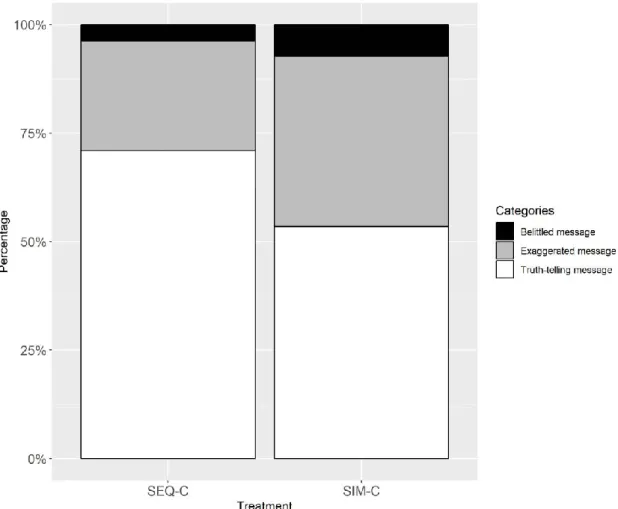
Figure 2.3, which focuses on the last 20 rounds of each session.
Figure 2.3. The proportion of each category of message for each treatment in
the last 20 rounds.
We observe that the proportion of truth -telling messages is the hi ghest among the three categories in both treatments.1 1
Result 3
For both cheap talk treatments, the proportion of the truth -telling message is
1 1 Th is resu lt is con sistent with th at o f Avo yan (20 19 ) an d o th er stud ies on in fo rmatio n
tran s mission in ch eap talk ga mes. E xa mp les in clud e th e exp erimen t o f Cai an d Wan g (2 00 6 ), wh o s e mo d el is in tro du ced b y Cra wfo rd an d S ob el (1 982 ), an d th e se nd er -receiver ga me exp eri men ts o f E van s et al. (2 00 1), Gn eez y ( 200 5 ), and S án ch es -P agés an d V o rsatz (2 00 7 ). Th e exp erimen tal resu lts o f th ese stud ies sho w th at su bjects tend to tell th e truth even if l yin g ma y b rin g a larger p a yo ff. S án ch es -P agés an d Vo rsatz (20 07 ) su gg est th at th is o verco mmu n icatio n p h en o men on resu lts fro m t h e fact th at so me ind ivid u als co n sid er so cial no rms, su ch as tru th -tellin g.
26 the highest among the three categories.
A possible interpretation is that subjects show lying aversion. Many experimental and theoretical studies investigated the reason why people tell the truth. For example, Kartik, Ottaviani, and Squintani (2007) and Kartik (2009) suggest that people who tell a lie pay a cost of lying. This cost may stem from various sources such as technological, legal, or psychological constraints. Gneezy (2005), Charness and Dufwenberg (2006), Vanberg (2008) and Hurkens and Kartik (2009) suggest that people do not tell a lie because of guilt aversion. Further, Figure 2.3 clearly shows that the proportion of truth-telling
messages is greater for the SEQ -C treatment (653/920) than for the SIM -C treatment (470/880) (χ2= 59.167, 𝑝 < 0.001).
Result 4
Subjects tend to send truth -telling messages more in SEQ -C than in SIM -C.
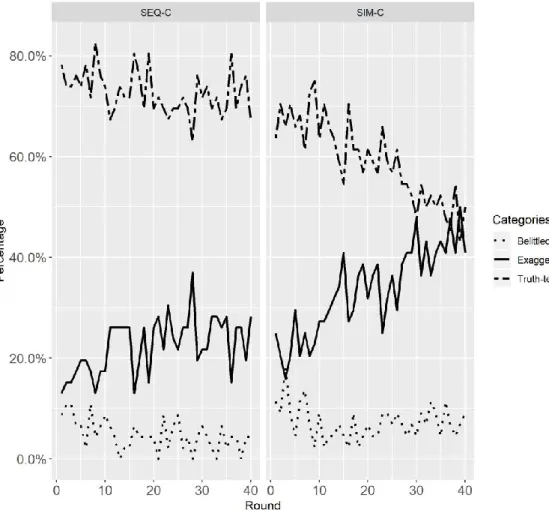
Figure 2.4 presents the proportion of each category of sent messages in each
round, and clearly shows that the proportion of exaggerated messages increases with the round under both cheap talk treatments. We run a logistic regression to investigate this trend statis tically. The dependent variable is a dummy that takes the value of one if the subject sends an exaggerated message or take the value of zero otherwise.
27
Figure 2.4. The proportion of each category of the message in each round.
Table 2.7 provides the results of logistic regressions. The independent
variable SIM-Dummy takes the value of one if the subject belongs to SIM -C and take the value of zero otherwise. We observe that the round and the interaction between round and SIM-Dummy have positive coefficient s. The coefficient of the round is significant at the 1% level, and the coefficient of the interaction between round and SIM-Dummy is weak significant at the 5% level.
28
Table 2.7.
Logistic regressions on exaggerated messages.
marginal effects Private signal -0.001* (-1.75) Round 0.003*** (2.97) SIM-Dummy 0.047 (1.50) SIM-Dummy×Round 0.003** (2.30) Observations 3600 Notes:
Th e d ep en d en t variab le is a du mmy th at takes o n e if th e sub ject send s an ex aggerated me ssag e or takes zero o th er wise. Z valu es are repo rted in p arenth eses; Rob u st stand ard erro rs were u sed on th e p -valu es; *** S ig nifican t at th e 1 % level, ** S ign ifican t at th e 5 % level, * S ign ifican t at th e 1 0 % level.
Result 5
In both cheap talk treatments, the proportion of exaggerated messages increases with time.
Result 6
The rate of increase in the proportion of exaggerated messages is higher in SIM -C than in SEQ--C.
In order to explain why the proportion of the exaggerated message increases over time, we consider a situation in which a subject E (Exaggerated) sends an exaggerated message, and a subject T (Truth-telling) sends a truth-telling message (here, we suppo se that the difference between the sent message of E and the private signal of T is not too high, specifically, |𝑚𝐸− 𝑥𝑇| < 20).
29
sending a truth-telling message, or (ii) E predicts T sending an exaggerated message, and T predicts E sending a truth-telling message. For the case (i), E predicts the private signal of T correctly, whereas T overestimates the private signal of E. Here, the possible action profile can be (Action of E, Action of T) = (I, I), (W, W) or (W, I), but never (I, W). That is, E can always make the best investment decision, whereas T sometimes invests when T should wait. For the case (ii), E underestimates the private signal of T, whereas T overestimates the private signal of E. Under such a case, the possible action profile can also be (Action of E, Action of T) = (I, I), (W, W) or (W, I), but never (I, W). That is, E sometimes waits when E should invest, whereas T sometimes invests when T should wait. For both cases, the payoff of E is higher than that of T (we will show that the payoff of E is higher than T in Appendix 2.C). Therefore, subjects
who notice this pattern, at some time point may switch the message they send from a truth-telling to an exaggerated one.
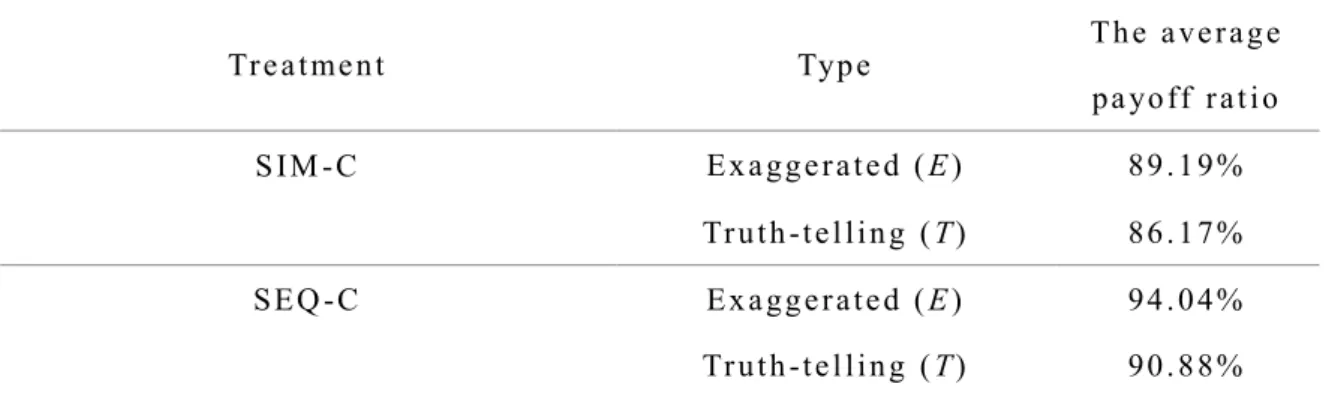
To confirm the above interpretation, we compared the payoff ratio between subjects E and subjects T when they are assigned to the same pair. The mean values of the payoff ratios of each type of subject in each treatment are presented in Table 2.8. The average payoff of E is significantly higher than that
of T in both cheap talk treatments (Wilcoxon rank -sum test: one-tailed, p = 0.068 in SIM-C; p = 0.047 in SEQ-C). This result supports the above interpretation.
30
Table 2.8.
The average payoff ratios of each type of subject in each treatment.
Treatment Type The average
payoff ratio
SIM-C Exaggerated (E) 89.19%
Truth-telling (T) 86.17%
SEQ-C Exaggerated (E) 94.04%
Truth-telling (T) 90.88% Notes:
Th ese a verag e p a yo ff rat io s are c alcu lated fro m i nd ivid u al d ata satis fyin g th e co nd itio n th at E and T are in th e same p air.
Moreover, the data show that subjects in the SEQ -C treatment are more likely to send a truth-telling message. We believe that subjects in SEQ-C can utilize the second period to avoid risks from misreading the other ’s true information when the difference between the received message and their own signal is high. For example, under SEQ -C, if subjects sending the truth -telling message receive a message that is much higher than the signal, they can confirm whether the other player’s action in the first period is consistent with the received message by delaying the decision timing. That is, subjects in SEQ -C are less likely to be deceived than those in SIM -C. As a result, subjects in SIM -C are more likely to send exaggerated messages than those in SEQ -C.
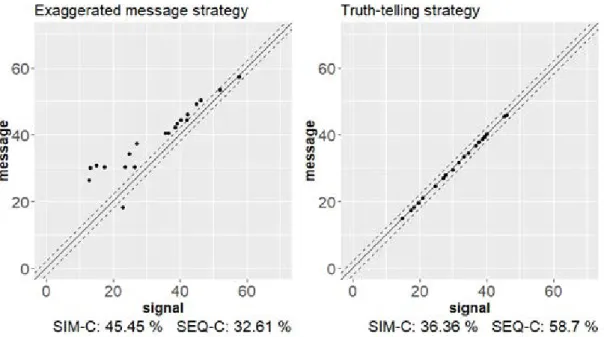
To confirm this hypothesis, we will investigate individual message strategies. Using data from the last 20 rounds, we focus on the two message strategies: (i) the truth-telling message strategy and (ii) the exaggerated message strategy.
We call a strategy truth-telling if a subject sends truth -telling messages in 18 out of 20 rounds. Also, we call a strategy exaggerated if the messages sent by the subject are not belittled messages in 18 of 20 rounds and if the strategy is not the truth-telling messages strategy.
Figure 2.5 depicts the examples of strategy types on a graph for which the
x-axis is received private signals, and the y -axis is the value of messages. The solid black line is the 45 -degree line. The points reflecting truth -telling
31
messages fall in the area between the two dotted lines. Since we define 𝑚𝑖 as
a truth-telling message if 𝑥𝑖+ 2 ≥ 𝑚𝑖≥ 𝑥𝑖− 2, dotted lines are paralle l lines of
the solid black line and are ±2 (points) away from the solid black line. The lower part of Figure 2.5 presents the proportions of the message strategies for
the two treatments. In total, the proportion of subjects adopting a truth -telling or exaggerated message strategy in the SIM -C treatment is 78.06%, and the same proportion in the SEQ -C treatment is 91.31%. Moreover, the proportion of subjects adopting a truth -telling strategy in the SEQ -C treatment is 58.70%, which is significantly higher than the 36.36% of subjects doing so under the SIM-C treatment (χ2= 4.495, 𝑝 = 0.034).
Figure 2.5. The examples of the two strategy types. The x-axis is the value of
received private signals, and the y -axis is the value of messages. All 20 black points of each part of the figure show the relationship between private signals and sent messages in the last 20 rounds of th e same subject. The solid black line is the 45-degree line. The points reflecting truth -telling messages fall in the area between the two dotted lines. The lower part of the figure presents the proportions of the message strategies for the two treatments.
Result 7
Compared with the SIM-C treatment, more subjects in the SEQ -C treatment tend to adopt truth-telling strategies.
32
2.5.3 Analysis of investment decision
In this subsection, we investigate subjects ’ decision making after receiving m e s s a g e s . W e p r e d i c t t h a t s u b j e c t s , w h o a d o p t a t r u t h - t e l l i n g strategy or an exaggerated strategy, will adopt threshold strategies when they make investment decisions. When we calculate the threshold, we treat the sent message as a function of the private signal. H owever, it is difficult to accurately determine the functions underlying the exaggerated message strategies adopted by subjects in our experiment. Therefore, we only investigate the decision making of players who adopt the truth -telling message strategy. The results indicate that 43 out of 90 subjects (16 out of 44 subjects in SIM -C; 27 out of 46 subjects in SEQ -C) adopted a truth-telling message strategy in the last 20 rounds in our experiment1 2.
As discussed in Section 2.4, we assume that payer i who adopt a truth-telling strategy also believe that player j send a truth-telling message. That is, player
i regards the received message as the player j's signal and calculates the
conditional expected value of 𝜃 as follows. 𝐸(𝜃|𝑥𝑖, 𝑥̂𝑗∗) =
[𝑚𝑖𝑛(𝑥𝑖+ 10, 𝑥̂𝑗∗+ 10, 50) + 𝑚𝑎𝑥(𝑥𝑖− 10, 𝑥̂𝑗∗− 10, 20)]
2 where 𝑥𝑖 is player i’s own signal and 𝑥̂𝑗∗= 𝑚𝑗.
Then, player i treats 𝐸(𝜃|𝑥𝑖, 𝑥̂𝑗∗) as a combined signal 𝑥̂∗ , where 𝑥̂∗ =
𝐸(𝜃|𝑥𝑖, 𝑥̂𝑗∗). Finally, he/she plays a threshold strategy in which he/she invests if
𝑥̂∗≥ 𝑘
𝑐 and waits otherwise. Note that 𝑘𝑐 is the threshold on 𝑥̂∗ , and the
theoretical value is 25.
To test this assumption, we compute the best-fitting threshold, which minimizes a subject’s number of mistakes, for each subject, following Brindisi , C e l e n , a n d H y n d m a n ( 2 0 1 4 ) . S p e c i f i c a l l y, f o r a n a r b i t r a r y t h r e s h o l d
1 2 As in Brin disi, Celen, an d H yn d man (20 14 ), th e n u mb er o f fu nd a men tal erro rs d eclin es
sub stantially a fter th e fir st 2 0 rou nd s. If we fo cu s o n th e en tire 4 0 rou nd s, th e averag e th resho ld s are ver y si milar, bu t th e fraction o f su bjects u sin g p erfect or almo st p erfect th resho ld s is sign ifican tly lo wer.
33
𝑘𝑐 of subject i, we say that subject i makes a mistake: either (i) if his/her
combined signal is 𝑥̂∗≥ 𝑘
𝑐 but he/she does not invest or (ii) if his/her combined
signal is 𝑥̂∗ < 𝑘
𝑐 but he/she does invest. Then we look for the threshold k̂c𝑖, that
minimizes subject i's number of mistakes.1 3 To determine whether a subject
adopts the threshold strategy, Brindisi , Celen, and Hyndman (2014) and Avoyan (2019) adopt different standards. Brindisi , Celen, and Hyndman (2014) define a subject as adopting a threshold strategy if he/she has a perfect threshold, that is, if he/she does not make mistakes. Avoyan (2019), however, defines a subject as adopting a threshold strategy if he/she has an almost per fect threshold, that is, if he/she makes no more than three mistakes out of 50 rounds. Considering the complexity of the experiment, we adopt the latter definition. That is, if a subject makes no more than 2 mistakes in the last 20 rounds for a given threshold, we call this threshold an almost perfect threshold and say that the subject adopts a threshold strategy.
Table 2.9 reports the theoretical thresholds in the second column, the
average estimated thresholds in the third column, and perfect and almost p erfect threshold rates in the fourth and fifth column for each treatment. Theoretically, the thresholds for the cheap talk treatments should not differ. The estimated values presented in the third column of Table 2.9 are consistent with the
theoretical prediction, as we observe no statistical difference between SEQ -C and SIM-C (Wilcoxon rank sum test, W=242, p>0.52). Moreover, the fifth column of Table 2.9 shows that high proportion of subjects have almost perfect
thresholds in SIM C and SEQC. Specifically, all the subjects adopting truth -telling strategies in SIM -C have almost perfect thresholds, and 96.30% of subjects adopting truth -telling strategies in SEQ -C have almost perfect thresholds. Thus, we obtain Result 8.
1 3 In ou r exp erimen t, man y su b jects h ave mu ltiple th resho ld s th at min imize th e nu mb er
o f mistakes. F o llo win g B rin disi, Celen, an d Hyn d man (2 01 4 ), in th e even t o f a tie, we take th e aver age o ver all th resh old s th at min imize th e n u mb er o f mista kes and treat th is averag e valu e as each sub ject’s b est fittin g th resho ld .