薬理学総論と情報伝達機構
著者 柳澤 輝行
薬理学I
20130917、0920
総論 と
情報伝達機構
p1-76 と
p77-139
新薬理学入門
, 第3版, 2008
Katzung, 12
thEd., 2011
Examination & Board Review
, 10
th, 2012
医学部分子薬理学分野 柳澤輝行 附属図書館副館長
薬理学I 総論
新薬理学入門
, 第3版, 2008
Katzung, 12
thEd., 2011
Examination & Board Review
, 10
th, 2012
Golan: Principles of Pharmacology, 3
rd, 2011
Goodman & Gilman, 12
thEd.,
2010
Color Atlas of Pharmacology, 3
rd,
2005参考資料「医学専門教育シラバス」 東北大学機関リポジトリTOUR
医学部分子薬理学分野 柳澤輝行 20130917
医学教育モデルコアカリキュラムの概要
■著しい医学の進歩、医療を取り巻く社会的変化に応じ た医学教育の抜本的改善を目的 ■わが国の医学・医療の担い手となる医学生が身に付け るべきコアとなる基本的学習内容を提示 ■医学部が医学教育改革を進める上でのモデル ■新しい医学教育の内容を、教員だけでなく医学生や社
会一般にも
わかりやすい形で表示⇒
EASTより閲覧可能 医学部生/医学科
モデル・コア・カリキュラム (平成22年度改定版)薬理学: 薬についての正しい
知識を与える学問
pharmaco + -logy
(薬drug) + (論theory, logic)
・基礎医学から臨床医学へ
薬力学 pharmacodynamics:
薬の生体に対する作用
薬
→
生体
薬物動態学 pharmacokinetics:
生体の薬に対する作用
生体
→
薬
「どうするか、何を起こすか」
「どうなるか、何になるか」
作用
反作用
薬物療法学、薬物治療学
pharmacotherapeutics
臨床薬理学
clinical pharmacology
中毒学、毒科学 toxicology
有効性・安全性評価
:
治療効果 therapeutic effect
と
有害
作用 toxic effect
とを考慮して、
薬効
-
副作用
のバランス
(
利益
/
危険
比)
を考慮。
薬物治療には
薬効
と
副作用
に関す
る薬理学の知識が必須である。
「薬はリスク!」
a. 促進 と 抑制
stimulation & inhibition
b. 直接効果 と 間接効果
direct effect & indirect effect
c. 特異性 と 選択性
分子
→細胞
(生命の最小単位)
molecule
cell
平滑筋細胞
タンパク質・
核酸などの
巨大分子
種々の
分子
薬物:
分子
をターゲット,
細胞機能に影響
作用機序
mechanism
of action
有機的構築;小器官
平滑筋組織 平滑筋細胞 循環(器)系 (心臓血管系) 上皮組織(内皮) 筋肉組織(平滑筋) 結合組織(外膜) 一部、神経組織も混入 血管(器官)
奏効機序
治療効果 therapeutic effect
薬物
細胞
→組織→器官(系)→個体
循環系
(心臓血管系)
個体レベル
個体は多数の器官系の統合よりなる
個体
+他の器官系
統合
, Physiome
治療効果と副作用
心理・社会・経済学的な面
薬物
(分子)
↓
(作用部位)
分子
→
細胞小器官
→
細胞
→
組織
→
器官
→
器官系
→
個体
ー
環境、社会ー
生体
Physiome の概念
作用機序 奏効機序 (治療効果)作用機序、
治療機序
;
ズームできる力
サイズ:宇宙からクオークまで
• 宇宙は
10
26m
•銀河系は
10
21m
•太陽系は
10
13m
• 地球は
10
7m
• 原子は
10
-10
m
• クオークは
10
-18
m
• 人体は
10
0
m=1m
• 細胞は
10
-5
m
• 分子は
10
-8
m
宇宙は極大の方向にも(137億光年)、極小 の方向にも(プランク単 位)有限であると物理 学者たちは主張。80
Drug Groups :
prototype drugs
Almost all of the several thousand drugs can be arranged in
about
80
groups
.Many of the drugs within each group are very similar
in pharmacodynamic actions and often in their pharmacokinetic properties as well.
For most groups, one or more
prototype drugs
can be identified that typify the most important characteristics of the group.This permits classification of other important drugs in the group as variants of the prototype, so that only the prototype must be learned in detail and, for the remaining drugs, only the differences from the
Types of Binding Forces
Noncovalent bond
A. Electrostatic attraction
Ionic interaction Dipole-ion interaction Dipole-dipole interactionB.
Van der Waals’ bond
C. Hydrophobic interaction
Covalent bond
(firm, irreversible)alkylating cytostatics, organophosphates,
Hydrophobic interaction
van der Waals’
bond
Cytostatics: alkylating agents & cytostatic antibiotics
(G) (G)Covalent bond
nitrogen mustard (1)(2) Direct and indirect parasympathomimetics
AChE vs. ACh, neositigmine, paraoxon &
sarin
.
sarin
Irreversible enzyme inhibition
(3) Conjugation reactions
Example of an enantiomeric pair with
different affinity for a stereoselective receptor
anticholinergic
Asymmetric center
酒石酸Na(光学的に右旋性) (R,R)-酒石酸;ぶどう酒の中から発見(1769) パラ酒石酸Na; 工業的に生産 ミッチェルリヒ(光学的に不活性, 1844)
異性体とパスツール
COOH C-OH C-H COOH H- HO- (R,R)-酒石酸 (右旋性) COOH C-H C-OH COOH HO- H- (S,S)-酒石酸 (左旋性) COOH C-OH C-OH COOH H- H- (R,S)-酒石酸 光学活性なしCOOH C-H C-OH COOH HO- H- (S,S)-酒石酸 (左旋性) COOH C-OH C-H COOH H- HO- (R,R)-酒石酸 (右旋性) 結晶形の細部を研究;ラセミ体であることを証明、 パスツール(1848.5.15); ビオ(74歳)のその後の援助
In studying the
affinity
and number of drug
binding sites, receptors, use is made of
Measurement of binding (B) as a function of
concentration (c)
Concentration-binding relationship
KD K
Measurement of effect as a function of concentration
Vasoconstrictor agents can be examined in isolated
Measurement of effect as a function of concentration Basal
Concentration-Effect Relationship Concentration-Response Curve
Receptor Theory
receptive substances (Langley, 1904)
Corpora non agunt nisi fixata. (Ehrlich, 1914) (Agents do not act unless bound.)
リガンド(L), 薬物が
受容体
(R)と結合し
て
複合体
(LR)が生じて、反応
response (効果 effect、E)が起こる。
L + R ⇔ LR → 反応
E/E
max
= f(S) = f(α [LR]) =
αX [L]
n
/(EC
50
n
+ [L]
n
)
E/E
max=
αX [L]
n/(EC
50n+ [L]
n)
α: efficacy(固有[内因]活性)
薬物濃度
[L]
E/Emax = f(S) = f(α [LR]) SMolecular mechanisms of drug-receptor interaction
E/E
max
=
αX [L]
n
/(EC
50
n
+ [L]
n
)
α: efficacy(固有[内因]活性)
完全アゴニスト
full agonist (α = 1)
部分アゴニスト
partial agonist (0< α < 1)
拮抗薬
(neutral)
antagonist (α = 0)
インバースアゴニスト
inverse agonist (α< 0)
log[アゴニスト(M)]
0 0.1 0.2 0.3 0.4 0.5 0.6 0.7 0.8 0.9 1 -8 -7 -6 -4 -3A
B
C
D
EC
50 =1 =1 =0.8 =0.4 10 M 10 M-7 -6 -5 10 M -5 -5 10 M反
応
ポテンシーの順番
A>B>C=D
エフィカシーの順番 A=C>B>D
Full agonist, partial agonist, inverse agonist -60 -40 -20 0 20 40 60 80 100 -10 -9 -8 -7 -6 -5 -4 log[Drug (M)] Respon se (% ) Neutral antagonist
=$D$4*$B5/($B5+E$4); <Excel file> Emax X [Drug] /(EC50 + [Drug] ; n=1)
A A
Constitutive
active
receptors
恒常的
構成的
活性
受容体
A A
Constitutive
active
receptors
恒常的
構成的
活性
受容体
Inverse
agonists
X余剰受容体
Spare receptorsincrease the sensitivity to drug.
0 0.1 0.2 0.3 0.4 0.5 0.6 0.7 0.8 0.9 1 0 0.1 0.2 0.3 0.4 0.5 0.6 0.7 0.8 0.9 1 -8 -7 -6 -5 -4 受容体占有率と効果(反応) 0 0.2 0.4 0.6 0.8 1 効果 受容体占有率 受容体占有率 log[薬物 (M)] 効 果 割 合 f([DR]) KD EC50 k+1 [D] + [R] ⇔ [DR] k-1 [D] [R] [DR] = = KD k-1 k+1 余剰受容体 (-)
Analysis: Schild plot
(Schild, 1947)
Schild plot; Schild regression; Schild analysis
equal fractional occupation=equal response
{Control} {
in the presence ofantagonist
(Inhibitor, Blocker)}
[L]
[L']
--- = ---
K
D+ [L] K
D(1+
[I]
/K
I) + [L']
[L']/[L] - 1 =
[I]
/K
Ilog([L']/[L] - 1) = log
[I]
- logK
Idose ratio: [L']/[L] = x
log(x-1) = -logK
I- pA
x; -log:p0.00 0.10 0.20 0.30 0.40 0.50 0.60 0.70 0.80 0.90 1.00 -8 -7 -6 -5 -4 -3 [B] = KI [B] = 10KI [B] = 100KI コントロール log[アゴニスト(M)] 反 応
競合的拮抗
competitive antagonism
の様式
B + KD A + R ←-→ AR → 反応 ↓↑KI BR E [L] ---- = f --- Emax KD(1+ [B]/KI) + [L]log[Agonist (M)]
0 0.1 0.2 0.3 0.4 0.5 0.6 0.7 0.8 0.9 1.0反
応
コントロール 余剰 受容体 (-)余剰 受容体 (+)
EC
50非競合的拮抗薬
-8 -7 -6 -5 -4 -9 -3非競合的拮抗の様式
Noncompetitive antagonismアヘンopiumは、ケシの果実から採集した乳液を乾燥さ せたもの。モルヒネmorphineやコデインは、アヘンから 精製してつくる。
癌性疼痛(がんの痛み)の特
効薬、患者は依存性(中毒)になりにくい。
ケシの未熟な果実
CH3O:コデインアヘンアルカロイドの生合成と関連薬物
テバイン
コデイン
モルヒネ
Dose-Response Relationship 用量反応関係
Abnormal posture in mouse given morphine
「マウス挙尾反応」
Luellmann, Heinz et al:
Dose (mg/kg)
Linear
Logarithmic
Quantal (all or none) dose-effect plots. Shaded boxes (and the accompanying curves) indicate the requency distribution of doses of drug required to produce a specified effect; ie, the percentage of
animals that required a particular dose to exhibit the effect.
100 50 1.25 2.5 5 10 20 40 80 160 320 640 ED50 LD50 Cumulative percent Exhibiting Therapeutic effect Cumulative percent Dead at each dose
Perc
en
t ind
ivid
uals
re
sp
on
ding
Percent requiring dose for a lethal effect Dose(mg) Percent requiring dose to achieve desired effect 0薬理作用 有害(中毒)作用 致死作用 小量 大量 用量 治療量 (極量) 無効量 有効量 中毒量 致死量 最小有効量 最小中毒量 最小致死量
薬物の通過障害となる生 体膜、酵素類
図1-7
薬物の投与方法と体内動態
消化管 肝臓 血液 腎臓 組織 糞中排泄 尿中排泄 排泄 (皮膚、 肺、乳汁) 代謝 胆汁中 排泄 蛋白結合型 遊離型 経口投与 直腸内投与 口腔内投与 吸入 静注 筋注、皮下注 経皮投与 腸肝循環 動注、吸入 吸収 作用部位 (代謝) 酸化、還元、加水分解 抱合zonula occludens
Lipid bilayer脂質二重層
zonula occludens密着帯
頂部と基底側壁部細胞膜を 仕切るフェンス機能と,内皮 細胞や上皮細胞間をシール するバリアーないしは細胞間 を通る輸送調節の機能を有 する。親油性物質 親水性物質 輸送系 親和性(+) 親和性(-) 拡散 細胞膜
拡散と輸送
脂質二重層
小胞性輸送
受容体( )の 仲介する取り込 み細胞活動 小胞性輸送 リソソーム ファゴリソソーム 内部 外部 外部Two-compartment model
C
entral,
P
eripheral
t
1/2βt
1/2αC
P
AUC: area under the curve
t
1/2β単位時間内に薬物が完全に排出される血漿量を仮定的に考え ることができ,これをクリアランスclearanceという。(p13)
Oral
administration:
drug release
and absorption
剤型drug form 錠剤tablet カプセル剤capsule Matrix tablet Enteric-coated Drops, mixtureCoated tablet with Delayed release
Propellant gas Drug solution
吸入inhalation
直腸内投与
rectal administration
座薬
Blood-tissue barrier
内皮細胞 基底膜 毛細血管膜 Heart Pancreatic islet Astrocyte CNS Liver薬物 薬物 薬物 吸収 代謝 排泄 第一相 第二相 薬物 抱合 抱合 抱合 不活性薬物 代謝産物 薬物代謝産物 (活性化、 他の薬理作用) プロドラッグ
親油性
親水性
(酸化、還元、加水分解) (グルクロン酸、 アセチル化、 グルタチオン)図1-9 薬物の生体内変化
中毒域 単独 併用3 単独 併用2 併用1 毒性発現濃度 薬 物 濃 度 時 間 時 間 薬物動態学的相互作用 薬力学的相互作用 毒性発現濃度 中毒域 治療域 治療域 無効域 効果発現濃度 (効果の減弱) (効果の増強) (効果の増強)
Drug interaction 薬物相互作用
薬物依存症の種類とその関係
覚醒剤 麻薬 睡眠薬 抗不安薬アルコール依存
鎮痛薬 その他併用
禁忌
メタアンフェタミン コカイン モルヒネ ヘロイン LSD-25 メスカリン 大麻 バルビツール酸系 (アモバルビタール等) ベンゾジアゼピン系 (トリアゾラム等) ベンゾジアゼピン系 (ニトラゼパム等) 精神に影響する薬物はどれも何らかの依存性を持つ。①GLP; ②GCP; ③GMP; ④GQP, GVP; ⑤GPSP
①
②
第4相⑤
Synthesis
Drug Development
新薬開発力のある国はわずか!
新薬の開発においては、医学や薬学だけでなく理学、工学など幅広い分野の技 術が必要で、しかもゲノムやITなど最先端で高度な知識・技術が求められる。こうし た技術力を備えている国は世界でも10カ国にも満たない。日本はそれらの国々の 中でもトップクラスの技術を持つ国として、世界中で認められるような新薬を開発し ている。日本で開発されたくすりは、欧米をはじめ多くの国々でも発売され、世界中 の患者さんの治療に使われている。医薬品の適正使用法
薬物開発シーズの可能性・ニーズの掘起し
まとめ:薬を飲むとは:薬の運命
• 薬物は吸収されて体内に入り
• 血流にのって分布し
•
作用機序・治療機序ではたらき
*
• 何らかの代謝を受けて
• 体外に排泄される
*生体での7階層と環境や社会が薬効に影
響する
薬理学によって解明された
情報伝達機構
A.生体内情報伝達機構 1.生体内情報伝達機構の概念 2.情報伝達の過程と場 B.薬理学的受容体 の構造と分類 pharmacological receptor C.細胞内情報伝達系 D.イオンチャネル;Ca2+・K+チャネル 教科書:新薬理学入門(3版)南山堂(2008)
参考文献:Katzung, 2011; Goodman & Gilman, 2010; Science, 2001; Hille, 2001; Encyclopedic Ref Mol Pharmacol, 2003
生体内情報伝達機構 signal transduction mechanism
情報伝達の基本課程(図2
−2)
(構造→機能)変化 リン酸化反応 転写 trascription 翻訳 translation cAMP cGMP IP3/Ca ProteinsNetwork
Distribution of the molecular functions of 26,383 human genes. Science (2001) Fig. 15.
Unknown 10% Predicted 18% (Oct. 2004)
要素還元的解析法から統合的解析法へ
• ポストゲノム科学の中で、遺伝子発現制御機構からゲノ ム産物を計測可能な包括的生物情報(Ome)として系統 的に解析する手法(Omics)が生じた。 • これにより産出されるデータやクローン資源を大規模な 基盤として個別の学術研究が推進されている。 • データ集積の目的は、生命の網羅的理解・各種疾患の 病態・病因の解明や効率的な治療薬開発などです。 • 爆発的に増加した各レベルでの知識を整理し、人体生理 および病理の定量的・統合的理解に役立てる方法を確 立することは、今後の生命科学の統合的研究や創薬、 疾患遺伝子の役割の解明にとって最も重要なプロジェク トの一つである。Receptor proteins
cell-surface receptors
• intrinsic effector function (+)
– Ligand-gated (receptor-operated) ion channels
– receptors with intrinsic enzymatic activity (receptor tyrosine kinases, receptor serine/threonine kinases or receptor guanylyl cyclases)
• intrinsic effector function (-)
– G-protein coupled receptors (GPCRs)
– cytokine receptors → cytosolic protein kinases (Jak/STAT-coupled)
– TNF-receptor superfamily
– IL-1/Toll-like receptors → adaptor proteins (e.g. TRADD, MyD88)
intracellular receptors “nuclear receptors”
Enzymes
Organellae
Cytoplasm
At binding to and activation of
nicotinic ACh receptor
At binding to and activation of
muscarinic ACh receptor
Mechanism of
glucocorticoid
action
Nucleus
heat-shock protein, hsp90 ジンクフィンガー構造 Nuclear pore核内受容体の構造(図2-9)
転写調節因子受容体
Mechanism of activation of the EGF receptor, a
representative receptor tyrosine kinase.
Insulin, PDGF, ANP*, TGFβ, many other trophic homones
*ANP: Guanylyl cyclase↑ cGMP↑
Cytokine receptors
STAT dimers then travel to the
nucleus, where they regulate transcription of specific genes.
growth hormones, erythropoietin, interferons, and other regulators of growth & differentiation
細胞膜貫通パターンによるイオンチャネルの型 イオンチャネル内蔵型 M1 M2 P 内向き整流K+ チャネル 電位依存性K+チャネル 4量体→イオンチャネル 4/5量体→イオンチャネル COOH H N 2 膜貫通構造 M1 M2 M3 M4 細胞膜 細胞外 細胞内 M1 M2 M3 M4 COOH M1 M2 P (ポア) H N2 2回の遺伝子重複 Ca2+, Na+ チャネル S1 S4 S5 S6 P S2 S3 COOH + + + + S1 S2 S3 S5 S6 P S4 H N 2 Inward rectification 内向き整流性(後述) TRP channel
脱分極depolarization 電位依存性筋細胞膜全体興奮Naチャネル:開 →収縮
The nicotinic ACh receptor (N
M, N
N),
イオンチャネル内蔵型受容体
channel-containing receptor,
ligand-gated ion channel, ionotropic receptor
受容体タンパク質は原則として4回細胞膜を貫通する構造(ただし NMDA受容体は3回+ポア構造)をしており、それが4〜5量体で一 つのチャネルを形成する。作動薬は細胞膜の外側で受容体に結合し、 受容体の構造変化を生じる。例えば内蔵するイオンチャネルが開口 して、主にNa+の透過性が亢進すれば、脱分極を生ずる。 この情報伝達の形式は、グルタミン酸受容体(特に NMDA受容体) でも同様である。また、興奮抑制をきたす神経伝達物質であるGABA (γ-aminobutyric acid)のGABAA受容体やグリシンglycine受容体 (ともにCl- チャネルを内蔵)でも見られる。作動薬とは別の部位に結
合 し て 、 イ オ ン チ ャ ネ ル の 活 性 を 変 化 さ せ る 薬 物 (Benzodiazepines) もある(アロステリック効果)。
Gタンパク質共役型受容体
G-protein coupled receptor =
GPCR, metabotropic receptor
作動薬の受容体との結合を引き金として、受
容体が膜の中で酵素の活性化を調節するもの
がある。作動薬
−受容体複合体はGTP結合タ
ンパク質(Gタンパク質)に結合する。これによ
り活性化されたGタンパク質が情報伝達signal
transduction を担う種々の酵素やイオンチャ
ネルと結合してそれらの活性の調節をする。
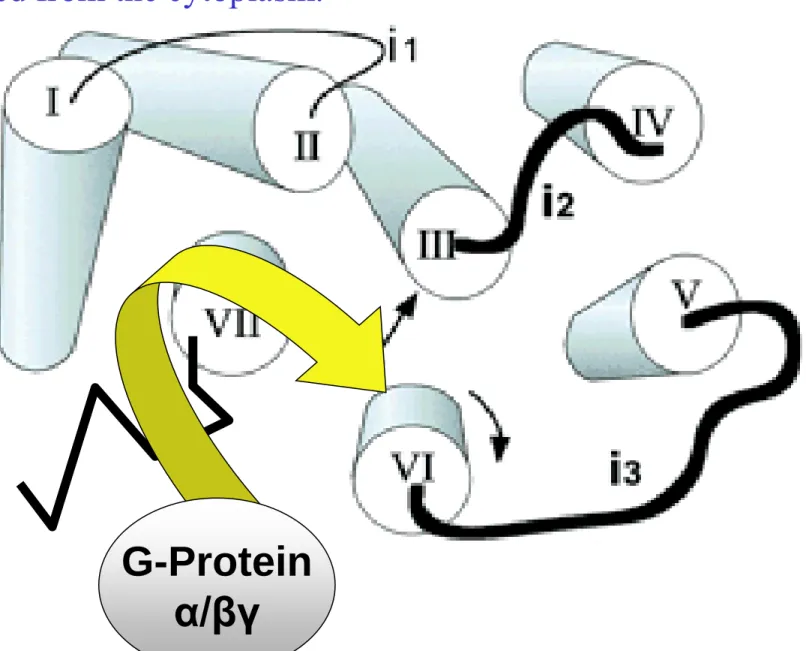
Transmembrane topology of a typical serpentine receptor (GPCR)
Illustration of the central core of rhodopsin. The core is viewed from the cytoplasm.
G-Protein α/βγ
Gタンパク質=変換器(transducer)(図2-6)
小分子G-Protein (Rho) MAP kinase (by βγ)
細胞内情報伝達系 Gタンパク質
細菌の毒素を用いてGタンパク質の研究は進展し
てきた。
コレラ毒素はGsと呼ばれるGタンパク質をADPリ
ボシル化して、アデニル酸シクラーゼ活性を高め、
腸管上皮細胞中にcAMPを過度に蓄積させる。
このcAMPの作用で、コレラ特有の下痢症状が
出現する。
百日咳毒素は、抑制性タンパク質GiをADPリボシ
ル化して受容体から情報を受け取れないように
してしまう。
カテコールアミン受容体の系統樹 M3 M4 祖先アミン受容体 M2 M1M5 3 T 1 2 1A 1B 1D 2C 2B 2A 3 D D2 D4 1 D D5 Gq Gi/o Gs Gq Gi/o
Scaffolding -arrestin Caveolins AKAPs GKAPs SNARFs Components effector substrates protein kinases phosphoprotein phosphatases phosphodiesterases Receptors for biogenic peptides, amines, acetylcholine (M), eicosanoids, Wnt proteins, adhesion protein, odorants, and photons Kin GTP GDP Agonist Effector GPCR βγ α α Sub
‘Evolution is molecular tinkering.’ (F. Jacob)
Effectors
Regulated by Gα ↑adenylyl cyclase ↓adenylyl cyclase ↑phospholipase Cβ Regulated by Gβγ KIRcurrents (KGIR) Ca2+ channels Pl-3 kinase G Proteins Classified by α-Subunit αs αi αq αo αtαolf α12/13Desensitization of the
-adrenoceptor.
The response to a -adrenoceptor agonist (ordinate) versus time (abscissa). The break in the time axis
indicates passage of time in the absence of agonist.
Desensitization & Down-regulation
The Nobel Prize in Chemistry 2012
Robert J. Lefkowitz and Brian K. Kobilka "for studies of G-protein-coupled receptors" Rapid desensitization, resensitization, and down-regulation of
Katzung B: Basic and Clinical Pharmacology 12/E
(LANGE Basic Science) (2011/12/13)
The Nobel Prize in Chemistry 2012
Ca
2+-phosphoinositide
signaling pathway
ER, SR Ca store
Enzyme
Regulation
NO synthases MLCK CaMKⅡ calucineurin PDEs smooth muscle contraction↑[Ca
2+]
i Ca2+ for Contraction striated musclesCalcium Release Channels
IP3R MLCK RyR nNOS eNOS Calcium storage organelle CaM CaM CaM: calmodulin
MLCK: myosin light-chain kinase NO: nitric oxyde
PDE: phosphodiesterase CaM
4) 設問
アンケート用紙の裏面に
骨格筋、心室筋、平滑筋の光学
顕微鏡像(
500倍, 2㎛:1
mm
)をス
薬理学によって解明された
情報伝達機構
A.生体内情報伝達機構 1.生体内情報伝達機構の概念 2.情報伝達の過程と場 B.薬理学的受容体 の構造と分類 pharmacological receptor C.細胞内情報伝達系 D.イオンチャネル;Ca2+・K+チャネル 教科書:新薬理学入門(3版)南山堂(2008)
参考文献:Katzung, 2011; Goodman & Gilman, 2010; Golan, 2011; Science, 2001; Hille, 2001; Encyclopedic Ref Mol Pharmacol, 2003
20130920 (金) 1講時
薬理学
によって
解明
された
情報伝達機構
D. イオンチャネル ionic channels
•はじめに
<心筋活動電位、イオンチャネル> •イオンチャネルの進化
Nothing in biology makes sense except in light of evolution. (Dobzhansky) •Ca2 + channels 構造と機能 Ca2 + channelを介する調節 •K+ channels 構造と機能(多種多彩) •K+ channel openersの血管拡張機序 20130920 (金) 1講時
膜輸送タンパク質の分類
イオンチャネル
膜
チャネル
輸
水チャネル
送
受動輸送
タ
ユニポーター
ン
トランス
シンポーター
パ
ポーター
アンチポーター
ク
ポンプ
能動輸送
質
イオンIn CNS~120 ~-80mV GABAA
K
+Cl
-
Ca
2+
Na
+
イオン濃度とイオンチャネル
個体を構成する様々なレベル
を理解するために
進化
evolution の観点(生命の歴史)
Nothing in biology makes sense except in
light of evolution. (Dobzhansky)
Hille, 2001
電位依存性Ca
2+チャネルの分子進化系統樹
α1サブユニット相同性 (%) (CLUSTAL W) 100 80 60 40 20 0 高閾値活性型 低閾値活性型 L型(C) L型(D) L型(F) L型(S) P/Q型(A) N型(B) R型(E) T型(G) T型(H) T型(I) C. eleglans C54 電位依存性Na +チャネル DHP感受性 DHP非感受性 非選択性陽イオンチャネル 電位依存性K +チャネル (遺伝子重複 2回) 電位依存性 Ca2+チャネルL型Caチャネル
の分子模型
2
outside inside H 2N S-S II III I COOH COOH NH 2 HOOC NH 2 NH 2 COOH
IV1
Varadi (1999) 受容体刺激によるCa チャネル機能の修飾 Ca2+ Caチャネル病L型Ca2+チャネルはリン酸化を受けて、その電
流量が著明に増加します。
C1 ⇆ C2 ⇆ O 交感神経 β受容体 Gs, cAMP リン酸化興奮分泌連関 Ca2+ channel
神経のN型Ca2+チャネルはGiタンパク質による抑制を受け ると活性化の速度が遅くなることが特徴です。
神経終末
抑制性神経伝達物質
(
α
2, M
2, μ
受容体)
GABA
B 脱抑制I II III IV Extracellular Intracellular G +NH 3 subunit COO -+NH 3 COO -G RIM1 Ca2+流入 1 シナプス小胞 α1サブユニットの機能調節タンパク質
Current Opinion in Neurobiology, 1998;8:351-356
歯学部若森教授 RIM1 (Rab3-Interacting Molecule l)
α1subunit
‘Willing’
Closed Inactivated Extracellular Intracellular G‘Reluctant’
Closed Closed Closed Closed Closed Open G ‘Willing’ ‘Reluctant’State dependence of G modulation of presynaptic Ca2+ channels
Prepulse deinhibition of
N-type Ca
2+channel
Gβ1 PP:prepulse I(+PP)/I(-PP) 3 2 1 0 τ(-PP)/ τ(+PP) 3 2 1 0 4 電流値 時定数-
NE, noradrenaline; Ado, adenosine; 5-HT, serotonin; SS, somatostatin; ATII, angiotensin II; BK, bradykinin.
7.11 Synaptic Sensitization and Depression Hille 3rd p221 Receptors
Channels
GIRK, Kir3.x 一種のIPSP
Ezogabine
Ezogabine (Retigabine ): KCNQ/Kv7 opener, anticonvulsant. Flupirtine: the same mechanism , non-opioid analgesic.
1)K
+チャネルは種々の細胞機能に影響する。
2)K
+チャネルチャネル開口薬の作用は過分極が
その機序にある。
3)K
+チャネル開口薬は間接的なCa拮抗薬ではない。
4)弛緩機序を総合して過分極弛緩連関と呼ぶ。
Potassium (K
+
) channels
1) K
+チャネルは種々の細胞機能に
影響する。
どのような機能を君は思いつくか?
そして、
担う機能が多彩であるとすれば、..
興奮性細胞の再分極、静止膜電位レベル
The historical view. Potassium channels, key controllers of resting and action potentials. Armstrong C: Science 1998;280: 56-57.
deactivation
0 1 0 0 2 0 0 3 0 0 4 0 0 0 m V 膜 電 位 オ ー バ ー シ ュ ー ト プ ラ ト ー - 8 5 m V 静止膜電 位 再分極 膜 電 流 イ オ ン 濃 度 、 平 衡 電 位 、 電 流 の 方 向 と 膜 電 位 効 果 細 胞 外 細 胞 内 平 衡 電 位 方 向 効 果 N a + 2 0 n A 1 4 5 m M 1 0 m M 7 0 m V 内 向 き 脱 分 極 外 向 き 電 流 4 m M 1 5 0 m M - 9 4 m V 外 向 き 再 分 極 過 分 極 K + a b c 0 . 5 n A 心 筋 の 膜 電 位 ・ 膜 電 流 ・ イ オ ン チ ャ ネ ル の 概 観 向 内 き 電 流 2 m M 1 0 0 n M 1 2 9 m V 内 向 き 脱 分 極 C a 2 + 2 n A 時間(msec)
チ ャ ネ ル K + 内 向 き 整 流 ( a ) K + チ ャ ネ ル 一 過 性 外 向 き ( b ) K + 遅 延 整 流 チ ャ ネ ル ( c ) N a + チ ャ ネ ル 電 位 依 存 性 局 所 麻 酔 薬 、 テ ト ロ ド ト キ シ ン ( T T X ) C a 2 + チ ャ ネ ル 電 位 依 存 性 C a 拮 抗 薬 K + チ ャ ネ ル 電 位 依 存 性 I I I 群 抗 不 整 脈 薬 、 テ ト ラ エ チ ル ア ン モ ニ ウ ム ( T E A ) 遮 断 薬 ; K A C h ; K A T P 心 筋 の 膜 電 位 ・ 膜 電 流 ・ イ オ ン チ ャ ネ ル の 概 観 (Kir3.x, Kir6.x)
Kir3.x regulated by Gi/o βγ
受容体刺激
Gi/o
βγ
Kir3.x 開口
過分極
・徐拍
・伝導抑制
・鎮痛
・鎮静
M1 M2 M1 M2 P 4量体→イオンチャネルβ 細胞におけるインスリン分泌機序とその調節因子 図9-13 グルコース Ca 2+ Gi Aキナーゼ インス リン インス リン Gs AC PLC Gq IP3 Ca 2+ cAMP ATP グリベン クラミド + -+ P 脱分極 + KATP -ATP ACh [K ] + 0 ↑ + + Ca ストア SU 受容体 + K チャネル活性↓+ + -L型Ca チャネル 2+ (M 3 受容体) (2 受容体) (2 受容体) GLP-1 ソマトスタチン アドレナリン [小腸L細胞] [D細胞] ジアゾキシド +
Closure of the pancreatic β-cell type KATP channel by ATP and sulfonylurea.Increased ATP caused by glucose metabolism closes the KATP channel by binding to the Kir6.2 subunit (A). Sulfonylureas close the channel by binding to the SUR1 subunit (B). The SUR2 subunit has binding sites for benzamide-derivatives in addition to sulfonylureas (SU). Although there are four binding sites for the ATP molecule and four binding sites for the sulfonylurea molecule in each channel complex, occupation of only one of these sites by ATP or sulfonylurea is
sufficient to close the channel.
Encyclopedic Reference of Molecular Pharmacology, p153
4Kir + 4SUR hetromultimer
血糖値
と
インスリン分泌
の連関機構
K
ATPchannel, p.225 (図9-13)
他にも、
K
ATPchannelが関与する系は?
K
ATPchannelは虚血時の心筋保護効果
を持つ。
p.28; p.136 (
preconditioning
)
K
ATPchannel opener,
minoxidil
は発毛
輸送系、
K
+を再循環
させる系として
胃の壁細胞
,HCl分泌
K
+channel, p.181 (COLUMN7)
尿細管細胞
, Na-K-2Cl再吸収
K
+channel, p.165 (図5-6)
他の
K
+channelが関与する系は?
Bartter’s syndrome
2 2 2 O O O 神 経 末 梢 頚 動 脈 洞 神 経 Kチャネル I 型 細 胞 Ca電流 毛 細 血 管 受容体 ドパミン*
頚動脈小体での
P
O2の受容
生理学テキスト 図16-26 PO2 正常 PO2 低下 Na電流 *Transmitter:ACh, Glu 舌咽神経,延髄の孤束核Oxygen Sensing: It’s a Gas!
SCIENCE VOL 306 17 DECEMBER 2004 p2050
ヘム分解系の調節・シグナリング
遊離ヘムはラジカル発生(毒性) HO-1 (誘導型): HO-2(構成型) K+チャネル開口 cGMP 血管拡張 イオン輸送 ビリベルジンヘム
F e Fe CO F e ビリベルジン還元酵素 ビリルビン(抗酸化作用)HO: Heme oxigenase
ヘム、NO、重金属、酸化ストレスで誘導
:過分極、再分極 b 肺細動脈 肺胞内低酸素 低酸素性肺血管収縮 BKCa (電位依存性) Kv and/or BKCa の抑制 抑制 a 全身循環の細動脈 K ATP Kv 低酸素、虚血、アデノシン K + チャネル開口薬 血管内圧上昇 脱分極 細胞内Ca2+濃度上昇 筋原性張力(収縮) (電位依存性) 電位依存性Ca2+ チャネルを通して のCa2+流入 血流自己調節 (伸展受容チャネル開口) イオンチャネルによる筋原性張力調節 p52 BKCa (電位依存性) 電位依存性Ca2+ チャネルを通して のCa2+流入 脱分極 細胞内Ca2+濃度上昇 TRPなど
脳血流の自己調節
autoregulation
0
100
200
潅流圧(動静脈圧差 (mmHg)
血流量
(ml/min)
0
500
1000
1500
膜電位 (mV) -55 -90 収縮刺激・ 高血圧 細胞外 細胞内 K + チャネル Ca 2+ チャネル 血管平滑筋 の緊張 血管径 K+チャネルオープナー 過分極 閉 K+ 平衡電位 -75 -40 静止時 Ca 2+ 細胞膜 脱分極 K + 開 過分極弛緩連関 K + K + K + K+ K+ Ca 2+ Ca 2+ Ca 2+ Ca 2+ Ca 2+ 細胞膜 閉 開