札幌大学総合論叢 第 50 号(2020 年 10 月)
〈論文〉
Motivating English Second Language
Learners to Succeed in Business Writing
Andrew Ryan ・ Michael Mielke
Abstract
For English second language learners, business English correspondence can appear to be extremely difficult and daunting. It is, however, very important in our ever-shrinking world. This paper outlines an approach to increase the motivation and confidence of the students using the triad of authenticity, teaching approach, and technology. The authenticity is supplied by the students writing to real people and doing real research. This involves researching celebrity charitable interests and writing to them to ask for advice. The teaching style mixes the Project and Process Approaches to writing to create a system which gives the student not only support, but also the freedom to be creative. Also, at every stage, technology is used in the form of Google Drive and Google Docs to deliver materials to the students and to write and edit in real time. The approach was trialed with twenty, first-grade university students in Japan with a lower intermediate English level. It was found that they enjoyed the course much more than they had expected and that business English correspondence was not as difficult as they had feared.
Key words: English as a second language, English business writing, motivation for studying English, university English language teaching
Introduction
For college-age learners of English as a second language, writing can be one of the most daunting aspects of learning the language (Craig, 2013). In particular, writing formal or business English writing can prove to be extremely off-putting (Majchrzak, 2018). Often this involves writing business style correspondence, letters and emails and it involves a new set of vocabulary
and expressions which they do not generally use in their English communication classes. This can lead to the student putting up an unscalable wall generated by their low confidence where they feel they do not want to study it or they cannot study it because it seems too challenging. The key to climbing this wall of doubt is motivation, and motivation is a vital component to effective language acquisition (Dörnyei, 2001).
This paper puts forward a three-pronged approach, a motivational trident, to help students acquire the motivation they need and to maintain their motivation to allow them to find formal written English correspondence not only less intimidating, but interesting and enjoyable. The three prongs of this trident are authenticity, teaching style, and technology.
The Motivational Trident
Authenticity
The first prong of this trident is authenticity. Many ESL teachers use real life materials in the classroom and they have been shown to have significant value. Kilickaya (2004) states the benefits of using authentic materials as:
・A positive effect on learner motivation ・Providing authentic cultural information ・Giving exposure to real language ・Relating closely to learners’ needs ・Supporting a creative approach to teaching
Tamo (2009) adds to the list of advantages of using authentic materials believing they keep the students informed about world events, have inherent educational worth, and produce a sense of accomplishment.
In a formal English writing class, a sense of authenticity can be provided in two ways. Firstly, the recipient of the letter or email needs to be a real individual. This has been shown to increase motivation and performance of the students (Vincent, 1990). Secondly, authenticity can be provided through the content of the correspondence. The student needs to write about a topic that requires research. This can be done using books, journals, and most easily, the internet. The student needs to look at real websites and collect real information which can lead to meaningful and authentic correspondence.
Teaching Style – The Product vs. Process Approach.
The central prong of the motivational trident is the style of teaching. For many years there have been two main theories for the teaching of ESL writing. The Product Approach and the Process Approach. Broadly speaking, the Product Approach is one where students are encouraged to copy a model text and use it as a structure (Gabrielatos, 2002). There are four main stages to this approach (Steele, 2004):
1. Students study example texts and the main aspects of those texts are highlighted 2. Pattern practice of the main features of the text
3. Organization of ideas, this is not related to the actual content, but the general style in which ideas should be arranged
4. Students write a similar piece to that they have been studying, demonstrating what they have learnt during the whole process
The Process Approach is a less controlled style which encourages more creativity. The general structure is as follows (Steele, 2004):
1. Brainstorming with fellow students on a particular subject 2. In writing, students share ideas and assess their peers’ thoughts
3. Mind mapping – Students organize their thoughts to help plan their writing 4. Students write a first draft – Often done in groups
5. Peer review and feedback
6. The students consider the peer review and how to improve their work 7. The final draft is written
8. The student’s work is evaluated and feedback is given by the teacher
Both of these approaches have merits and demerits in terms of motivation. The Project Approach is very structured, giving students a sense of security. However, the lack of freedom it allows could prove demotivating and boring for students. The Process Approach gives the students the space to be creative and this can motivate them but if they do not have the safety blanket provided by the structure of the Project Approach, it may seem daunting and overwhelming to them. This paper promotes a middle way which draws from both approaches. The writing process
presented later in this piece combines both approaches but the basis of it is as follows: 1. i. Students receive a business letter writing phrase handbook
ii. Models of formal English letters/emails are provided to the students which are then analyzed and stock phrases are identified
iii. Practice rewriting informal language into a more formal register iv. Examining the format of business letters
2. i. Students brainstorm their topic and do research in pairs or groups ii. In pairs or groups, students start to write a first draft.
iii. Peer/teacher review and feedback.
iv. In pairs or groups, the students consider the review and how to improve their work.
v. In pairs or groups, further drafts are written until the final one is complete. vi. The students' work is evaluated and feedback is given by the teacher.
This system gives the comfort offered by the Project Approach in the initial stages and the freedom offered by the Process Approach in the later stages. This gives the students a foundation and therefore confidence in the early part of the process but allows them the chance to be more creative in the second.
Technology
The final prong of the trident are the tools used during the writing process. At every stage, modern technology is used. During the last 20 years, technology has played a bigger and bigger role in our lives. The current generation of young adults use the internet almost constantly (Sefton-Green 2004). They are almost always online, and therefore it would be foolish not to employ this as a motivational tool. They enjoy working with computers, so teachers should teach using this technology.
In this case, the internet is used in three different ways. Firstly, all course materials are supplied to the students via Google Docs on Google Drive. This gives the students the ability to access them at their choosing anywhere. Secondly, students are encouraged to use the internet to generate the content of their correspondence. This is the research they need to do to complete their
letter/email. Thirdly, during the writing and drafting process, the students use Google Docs and share their document with the teacher and their peers, thus allowing peer editing in real time. Peer editing drives motivation (Tribble, 1996), but possibly even more so if it is done in real time.
The three prongs of this writing trident -- authenticity, teaching approach and tools used -- each supply motivation from different sources, and together they can assist students not only to scale their wall of doubt, but to knock it down.
The Procedure
The Procedure 1 – The Goal
Before the procedure is explained it is useful to outline what the student's end product should be. By the end of the process, the students should have written, in pairs, to a celebrity. These celebrities need to have some kind of charitable interest and the letter should express the student's interest in the celebrity's cause and ask for advice in the context of their home country. The letters are then sent and hopefully, the celebrity or somebody from their organization will reply. The final letter will have at least four main paragraphs and the basic structure is as follows:
1. In paragraph one, the student briefly introduces themselves.
2. The second paragraph shows the student’s interest in the celebrity’s work and expresses admiration for it.
3. In paragraph three, the student outlines why the celebrity’s interest is relevant to their home country.
4. In the fourth paragraph, the student asks the celebrity for advice concerning the issue. 5. In the final paragraph, the student closes the letter.
The Procedure 2 – Setting the Stage
Before the students start to produce their final letter, they need to understand the formality of business communication and the format of a business letter. This is done in four relatively short stages:
1. Students Receive a Business Letter Writing Phrase Handbook.
This will be used by the student throughout this course, it contains a large number of stock phrases, see Appendix 1.
2. Formal Letter Analysis
Models of formal English letters/emails are provided to the students. The students in groups examine these to identify key features and stock phrases. (These type of stock letters/emails are readily available on the internet)
3. Rewriting Informal Language into a More Formal Register
Students are presented with a short informal letter to a celebrity asking for advice. Following this, there is a group discussion about what problems there may be in this message. The teacher should try and elicit ways to make the letter more formal. The students may suggest, amongst other points, using different vocabulary and expressions, changing the sentence structure or revising the punctuation. In pairs, the students then rewrite the message in a more appropriate style. (See Appendix 2) They are then given a model letter and asked to compare their draft with the model. At this point, students should notice that although their message is written in a formal style, they may be missing some English business writing expressions.
The students are then given another informal letter to rewrite. This time they write with the help of a business English phrase list shared with them on Google Docs. There are two letters, letter A and letter B. In pairs, half the class tackles letter A and half letter B. Once the writing is complete they share their letter with another pair and the teacher for comments and correction.
4. Business Letter Format
Students are given an example of a business letter and identify and label the key features of it. Some of these, like the location of addresses and the date, will be obvious to the students, but the teacher may need to point out some features which the students will miss, for example, spacing, font and font size, and punctuation.
The Procedure 2 – Creating Meaningful Content
Brainstorming and Research
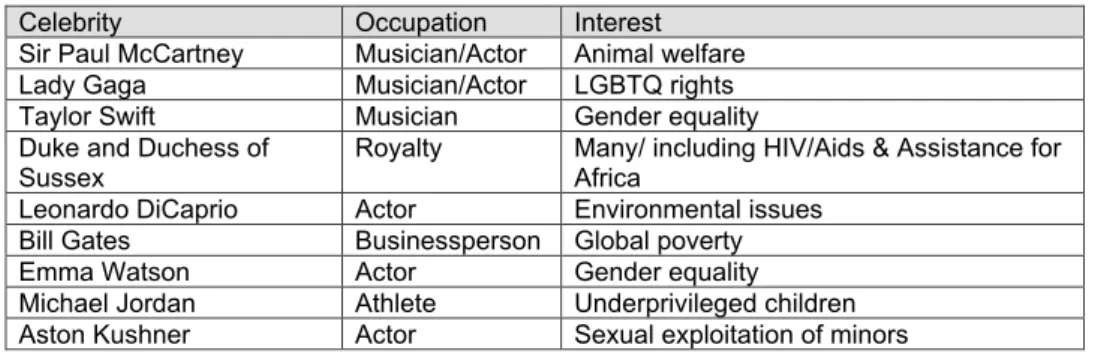
By this stage, the students should have a solid idea about the structure of the letter they need to write. It is at this stage that they start to gain more freedom over the content of the letter. Students are asked to find a celebrity they are interested in who has a charitable interest. Before they start to research this, it is useful to give them examples.
Table 1. Examples of Celebrities and their Charitable Interests
Students are instructed to find two or three pieces of evidence of the celebrity’s involvement in their chosen cause. This information is generally easily available on the internet. If the students have real information, for example, quotations from speeches, percentages of people helped, or amount of money donated to a particular cause, rather than vague statements, it shows they are genuinely interested in the celebrity’s work and therefore more likely to get a reply.
For example, one student who had decided to write to the actor Emma Watson learnt that she had donated $1.4 million to the Justice and Equality Fund, an organization that is involved in the fight against workplace harassment and discrimination in 2018. They also found a speech she had given to the United Nations on September 20th in 2014 where she spoke about gender equality at the launch of the HeForShe campaign. As mentioned earlier, this information, as well as expressing admiration for the celebrity’s work, is included in the second paragraph of the letter.
The second set of research the students complete is about their home country and its record in terms of the celebrity’s interest. The student mentioned previously is from Japan, so they looked into the Japanese record on gender equality. Again the students need to find two or three facts, quotations, or events to include in the third paragraph. The student who was writing to Ms. Watson decided to mention the admission’s scandal which broke out in 2018 at Tokyo Medical University, where female applicant's entrance scores were manipulated to reduce the number of women entering the university, and the lyrics in a hit pop song from 2016. This song, entitled Einstein yori Dianna Agron, was sung by the all-female teenage pop group HKT48. The song written by a middle-aged male music producer stated that young women did not have the ability to think about complex issues.
Writing and Editing
Students, in pairs, begin to compose their first draft. They do this in class and on Google Docs. As soon as they start to write, they share their document with the teacher. The teacher can then view in real time what the students are doing. The teacher identifies common errors, such as misuse of articles and prepositions, incorrect capitalization, inaccurate tense choice and problems with punctuation. After the students have completed the first two paragraphs the teacher should pause the class and explain the common errors to the students. Each pair of students then shares their document with another pair of students and they peer edit. The students should not only be looking for the common mistakes outlined by the teacher, but anything else they think is incorrect. They highlight the potential mistake and can write comments on the document explaining what they believe is wrong. The teacher should also be looking for errors in the students’ work, but trying to focus on mistakes the students might not spot. They should then highlight those errors, make comments, and see if the students can self-correct. The students then review the feedback and decide what changes to make. This process is repeated until the final draft is produced. It is useful for the students and the teacher to use different colors when highlighting errors so the author of the document knows who made the suggestion. Also, for each cycle of peer editing, the students should be grouped with a different pair. The more students that see a particular piece of work the greater the chance of finding any errors.
After the final draft is produced it is then sent to the celebrity with the hope of receiving a reply.
Assessment of the Students’ Attitudes towards Business Writing
To try and assess the impact this course had on the students’ attitudes towards business writing, three statements were presented to the class at the beginning of the course, and once again after the course had finished. Each class member was asked if they agreed or disagreed with the statement and by what degree. To avoid any undue influence of the teacher, this was done anonymously. This was done in one class of twenty students.
The statements were as follows:
Statement 1: Studying business English is enjoyable Statement 2: Studying business English is difficult Statement 3: Studying business English is useful
Students were asked if they strongly disagreed, disagreed, agreed or strongly agreed with the statements.
Results of Assessment of the Students’ Attitudes towards Business Writing
Table 2. Survey Results Pre and Post-course - Studying Business English is EnjoyableTable 3. Survey Results Pre and Post-course - Studying Business English is Difficult
Table 4. Survey Results Pre and Post-course - Studying Business English is Useful
Discussion
There are two main areas to focus on in this discussion. Firstly, the process and the work produced by the students, and how to improve this and avoid possible pitfalls. Secondly, a discussion on how the students' attitudes toward business writing was altered by doing this course.
Discussion – The process
The high standard of formal letters the students produced is without doubt. Examples of their finished work can be seen in Appendix 3. The class that completed this course were first-year university students with lower intermediate English skills. Although all of them had written short essays and paragraphs prior to taking this course none of them had ever written a formal letter before. As such, this process can be deemed to be a success. However, there are some areas of the process which need to be reviewed.
This first matter that needs to be addressed is the question of whether this process is truly authentic. As authenticity was one of the three motivating factors for the students, this issue is vitally important. If the students do not believe that their letter will reach the celebrity they have written to, then surely this is not a real life experience and they may as well be writing to a fictional character. It would have been useful to survey the students at the start of the process to gauge their opinions on the possibility of them receiving a response, or the celebrity actually reading their letter.
In the future, if some of the current students’ letters receive responses, then this will not be an issue as examples will be available to show the students who take this course in years to come. However, as this group were the first to undertake this process, no such examples were available.
A second point to consider is the student’s choice of celebrity. Some celebrities have one main interest. For example, Sir Paul McCartney and his concern for animal welfare or Lady Gaga and her support for LGBTQ rights. However, other famous people have a myriad of interests. An example of this is the Canadian singer Justin Bieber who supports interests as varied as child poverty, Alzheimer’s research, animal rights and education in the developing world. Although, there is no evidence to the contrary, an assumption can be made that students are more likely to receive a reply from those celebrities who have a strong interest in one area rather than a fleeting concern in many. This assumption is based on the idea that those celebrities with one strong interest care more deeply about that particular concern compared to those celebrities who support many varied causes. This assumption, although logical, may not always hold true.
A further issue concerning the students’ choice of celebrity is that each letter should be written to a different celebrity. This may seem obvious but many students are fans of the same actors or singers and want to write to their idols. However, the idea of authenticity works on both sides, from the sender and the receiver. If the celebrity’s office receives a multitude of letters from the one group of students, it can be assumed they are less likely to take the letters seriously and therefore less likely to send a reply.
On the whole, the process ran very smoothly. However, the one area the students found difficult was the peer editing section. At first, they were uncomfortable finding fault with their classmates' work. The more times they did it the better they became, but still there seemed to be a reluctance to point out mistakes they had found. It is possible that this was due to a lack of confidence about whether their correction would be right, or the idea that if they did identify an error they might be perceived as attacking or criticizing the author. One possible adjustment to this process to make it less stressful for the students could be to peer edit anonymously. This may work in a large class who only peer edit once, but in a tight-knit group of twenty students who do multiple edits, anonymity is unlikely to last very long.
Discussion – Students’ Attitudes towards Business Writing
Before discussing the results of the pre/post-course statements it must be acknowledged that this survey was only done with one class of twenty students and so provides a very small sample
size. However, even while acknowledging this limitation, some conclusions can be drawn from the survey.
Statement 1: Studying Business English is Enjoyable
Statement 1 showed the greatest change in the students' opinions pre and post-course. As can be seen in Figure 1, before the course the vast majority believed they would not enjoy studying business English, with 17 out of the 20 students disagreeing with the statement that business English was enjoyable. After the course, this had completely reversed with 17 students agreeing with the statement, 6 of which strongly agreed.
Figure 1. Survey Results Pre and Post-course - Studying Business English is Enjoyable
Statement 2: Studying Business English is Difficult
Statement 2 showed a change in opinion but to a lesser degree than in Statement 1. As shown in Figure 2, before the course all of the students thought that studying business English was difficult with 12 students strongly agreeing with the statement. After the course had finished the majority still felt it was difficult although the number who strongly agreed with the statement had fallen from 12 to 2 students and a small minority, 5 students, had changed their minds and no longer believed it to be difficult.
Figure 2. Survey Results Pre and Post-course - Studying Business English is Difficult
Statement 3: Studying Business English is Useful
This statement showed the smallest amount of change among the three statements as seen in Figure 3. Before and after the course most students agreed with this statement. However, after the course, the number who strongly agreed rose slightly, from 3 to 4, and the number who agreed, from 12 to 13.
Figure 3. Survey Results Pre and Post-course - Studying Business English is Useful
When looking at the three statements and the students' opinions as a whole it is clear that the process was more enjoyable than they expected and generally less difficult. Once again the small sample size should not be forgotten and more data is needed before drawing firm conclusions. Also,
the whole process is not yet complete. If a student receives a response from their chosen celebrity that may alter their opinions concerning Statement 1 and 3.
Conclusion
Business correspondence is often viewed as daunting and difficult by English second language learners. This paper has set out a process to try and harness a motivational trident consisting of authenticity, teaching style and technology, which is hoped will make learning this type of formal language easier and more enjoyable. From the survey results, it would appear that this approach has been successful. Students enjoyed the process more than they believed they would and found it less challenging than they supposed before the start of the course, while maintaining their belief that it was useful.
There are still unanswered questions and points to improve. Key among these is whether the students will receive responses from the celebrities they have written to, and how that will impact their motivation to continue to study English in the future. Also, if they do receive a reply and it used as an example for future students, will that enhance their motivation to study? In the process, there are still areas which need to be perfected, chiefly, the peer editing process. A system needs to be developed where students do not hold back from offering advice to their classmates. Peer editing has the potential to help the author and editor of a piece learn from each other, but until students are prepared to be forthright about their opinions, its value is limited.
The planet is getting smaller. More and more students will go abroad to study or work, and even if they remain in their home country, they will have ever-increasing contact with people from overseas. English is the Lingua franca, so to be successful having a decent grasp of the language is essential -- especially in work and employment. For many students business English is extremely intimidating, but the process laid out in this paper may assist students to find the confidence and the motivation to start to tackle their trepidation. This, however, is only the first step, but once the walls erected by this anxiety are scaled then hopefully students will find the self-assurance to continue to learn.
References
Craig, J.L. (2013). Integrating Writing Strategies in EFL/ESL University Contexts: A Writing-across-the-curriculum approach. New York, NY: Routledge.
Pearson Education ESL.
Gabrielatos, C. (2002). EFL writing: product and process. Retrieved from
https://www.academia.edu/13907872/Gabrielatos_C._2002_._EFL_writing_Product_and_ process._ERIC_ED476839
Kilickaya, F. (2004). Authentic Materials and Cultural Content in EFL Classrooms. Retrieved from http://iteslj.org/Techniques/Kilickaya-AutenticMaterial.html
Majchrzak, O. (2018) Learner Identity and Learner Beliefs in EFL Writing. Cham, Switzerland: Springer International Publishing AG.
Sefton-Green, J. (2004). Literature Review in Informal Learning with Technology Outside School. Retrieved from https://www.nfer.ac.uk/publications/FUTL72/FUTL72.pdf
Steele, V. (2004). Product and process writing: A comparison. Retrieved from
https://www.teachingenglish.org.uk/article/product-process-writing-a-comparison Tamo. D. 2009. The use of Authentic Materials in EFL Classroom. Retrieved from https://www.lcpj.pro/skedaret/127754768574_pdfsam_LCPJ,%20Per%20shtyp.pdf
Tribble C. (1997). Writing: Language Teaching: A Scheme for Teacher Education. Oxford, UK: Oxford University Press
Vincent, S. (1990). Motivating the advanced learner in developing writing skills: a project. ELF Journal, 44(4), 272-278. http://dx.doi.org/10.1093/elt/44.4.272