原 著
別刷請求先:〒640-8558 和歌山市小松原通 4-20 日本赤十字社和歌山医療センター心臓小児科 豊原 啓子 平成19年 9 月19日受付 平成20年 5 月27日受理 緒 言 TCPC手術症例は長期生存例が増加している1).しか し周術期および術後遠隔期に上室頻拍を認める例も多 い2–5).術後の頻拍は抗不整脈薬に抵抗性で5),血行動 態の悪化を来しやすい6).またTCPC手術後はカテーテTotal cavo-pulmonary connection前に電気生理検査および
高周波カテーテルアブレーションを施行した先天性心疾患の検討
豊原 啓子,梶山 葉,芳本 潤,福原 仁雄,中村 好秀
日本赤十字社和歌山医療センター心臓小児科
Electrophysiological Studies and Radiofrequency Catheter Ablation before Total
Cavo-pulmonary Connection in Patients with Complex Congenital Heart Disease
Keiko Toyohara, Yo Kajiyama, Jun Yoshimoto, Hitoo Fukuhara, and Yoshihide Nakamura Department of Pediatric Cardiology, Japanese Red Cross Society, Wakayama Medical Center, Wakayama, Japan
Objectives: We characterized the mechanism of supraventricular tachycardia (SVT) in patients scheduled for total
cavo-pul-monary connection (TCPC) and evaluated the outcome of preoperative electrophysiological studies (EPS) and radiofrequency catheter ablation (RFCA).
Patients and methods: We performed EPS in 16 patients who had a history of SVT and were suspected of having an anatomic
arrhythmogenic substrate (i.e., an anatomical anomaly causing tachycardia).
Results: We were unable to induce supraventricular tachycardia in four patients. In 11 of 12 other patients ablation was
suc-cessful; five patients had reciprocating tachycardia and twin atrioventricular nodes (twin AVNs), four had WPW syndrome, two had atrial tachycardia (AT), and atrial flutter (AFL) developed in one. Junctional tachycardia (JT) was documented clini-cally or during surgery in three cases with right isomerism. In 11 patients with RFCA, five patients underwent TCPC. In five patients, four did not have SVT during or after TCPC.
Conclusion: EPS are essential for complete arrhythmic evaluation before TCPC. After successful RFCA, patients, especially
those with right isomerism, may still develop JT during and after the TCPC procedure.
要 旨
目的:Total cavo-pulmonary connection(TCPC)手術前症例において,上室頻拍の性質を明確にし,電気生理検査 (EPS)および高周波カテーテルアブレーション(RFCA)の有用性を検討する.
対象:TCPC前に上室頻拍の既往を有する例および不整脈基質(すなわち頻拍を起こす原因となる場所)の存在を疑 われた例の計16例を対象とした.
結果:4 例は頻拍が誘発されなかったためEPSのみ施行した.EPS時に頻拍を認めた12例は,2 つの房室結節を有 する回帰性頻拍(twin AVNs)5 例,WPW症候群(房室副伝導路を介する房室回帰性頻拍)4 例,心房頻拍(AT)2 例, 心房粗動 1 例であった.ATの 1 例を除いて11例にRFCAを施行し頻拍の除去に成功した.頻拍を認めた12例中 3 例(25%)に,手術中または臨床的に結節頻拍(JT)を認めた.この 3 例は無脾症候群であった.RFCAを施行した11 例中TCPC到達例は 5 例で,4 例は周術期および術後に頻拍を認めなかった. 結論:TCPC手術前の上室頻拍を認めた症例に対してEPSおよびRFCAを行うことは,血行動態の悪化を来す周術期 の頻拍を防ぐのに有用である.ただし,無脾症候群ではJTに留意する必要がある. Key words:
total cavo-pulmonary connection, supraventricular tachycardia, radio-frequency catheter ablation
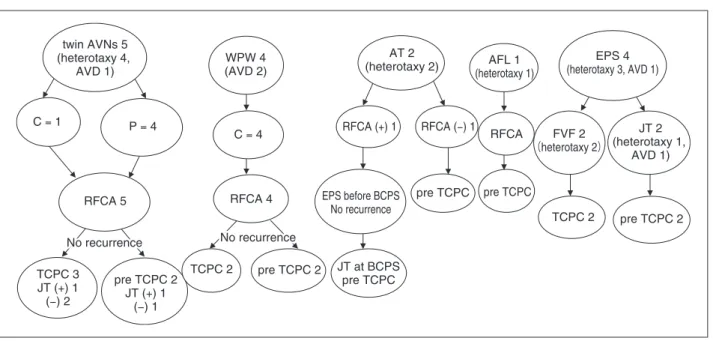
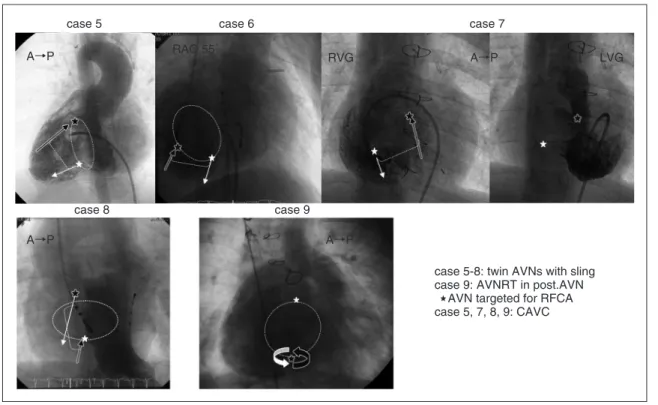
ルによる心房へのアプローチが極めて難しい.今回わ れわれは2004年 1 月∼2007年 5 月の間に,TCPC前に 上室頻拍の既往を有する14例および不整脈基質(すな わち頻拍を起こす原因となる場所)を疑われた 2 例の 計16例にEPSを施行したので,その結果について検討 する. 対 象 Table 1 に症例の詳細を示す.年齢,体重はそれぞれ 9 カ月∼17歳(中央値36カ月),6.0∼46.8kg(中央値12kg) であった.このうち心房臓器錯位症候群(heterotaxy syndrome:以下heterotaxy)は10例,房室錯位(atrioven-tricular discordance:AVD)は 4 例であった.臨床的に 頻拍を認めた症例が 7 例,心臓カテーテル検査時また は姑息術周術期に頻拍を認めた症例が 7 例,頻拍の既 往はないが,心電図上デルタ波が存在し基質の存在が 疑われた症例が 2 例であった.なおatrio-pulmonary connection(APC)からのTCPC conversion前の症例は, 頻拍の基質は心房切開操作や負荷による心房筋障害に 基づき7),APC術後から存在すると考え対象に含めな かった. 結 果 TCPC前にEPSを行った16例を頻拍別にフローチャー トに示す(Fig. 1). 4 例(heterotaxy 3,AVD 1)は頻拍が誘発されなかっ たためEPSのみで終了した.2 例(case 1,2)はデルタ 波を認めWPW症候群が疑われたが,頻拍の既往はな く心房高頻度刺激や期外刺激でもデルタ波の大きさは 変化せず(Fig. 2:case 1),室房伝導も認めなかった. 以上からHis束以下の副伝導路であるfasciculo-ventricu-lar-fiber(FVF)と判断した.2 例(case 3,4)は心臓カ テーテル検査時または姑息術周術期に頻拍を認めた. case 3 は心臓カテーテル検査時,心室内のカテーテル 操作での心室期外刺激で再現性をもって頻拍を認めた ため,不整脈基質の存在が疑われた.case 4 は姑息術 時頻拍を認め,心房overdriveで頻拍が停止したため, リエントリー頻拍が疑われた.両症例ともEPSを施行 したが,頻拍は誘発されずRFCAは行わなかった. 2 つの房室結節が頻拍に関与した例は 5 例(hetero-taxy 4,AVD 1)であった.房室弁輪の異なる部位で 2 つのHis束電位が記録された.一方の房室結節を順行 し,もう一方の房室結節を上行する頻拍を認めれば, 2 つの房室結節間にslingが存在すると判断した.2 つ の房室結節間のslingを介した回帰性頻拍 4 例(case 5∼ 8)において頻拍中 3 例が前方結節を上行し(case 5∼ 7),1 例が後方結節を上行した(case 8).順伝導の不応 期が長いほう,または頻拍中の上行するほうの房室結 節にRFCAを行う方針とした3).3 例(case 5∼7)におい て,2 つの房室結節は250msec以下と良好な伝導で順 伝導の不応期に差がなく,頻拍中は前方結節を上行し た.1 例(case 8)は 前 方 結 節 の 順 伝 導 の 不 応 期 は 340msec,後方結節は200msec未満であった.頻拍中は 後 方 結 節 を 上 行 し た が, 不 応 期 の 長 い 前 方 結 節 に RFCAを行った.4 例とも前方結節にRFCAを行い前方 結節の離断に成功した.slingを有さない 1 例(case 9) は後方結節内での遅伝導路と速伝導路を旋回する房室 結節回帰性頻拍であった.heterotaxyにおいて,速伝導 路および遅伝導路の走行については明らかでないた め,後方結節自体にRFCAを行った.頻拍は認めなく なった.Fig. 3 にそれぞれの症例のシェーマを示す. heterotaxyは 4 例すべてが共通房室弁口であった. AVD症例は三尖弁輪後方と僧帽弁輪前方にそれぞれ房 室結節が存在した.Fig. 1 の 5 例の経過が示すとおり 全例頻拍の再発は認めていない.TCPC到達例は 3 例 中heterotaxy 1 例とAVD 1 例ではTCPC周術期には頻拍 の再発はなかった.一方,heterotaxyの 1 例(case 5)は TCPC術中にJTを認め頻拍の管理に難渋した.JTの波 形 は 残 存 す る 後 方 結 節 か ら の 調 律 と 同 一 波 形 で, RFCAを行った前方結節は再発していなかった.術後 はJTを認めていない.TCPC待機中の 2 例のうちhet-erotaxy症例の 1 例(case 6)は臨床的に心拍数100∼120/ 分のJTを認めた.明らかな室房解離を認め,残存する 後方結節からの調律と同一波形であった(Fig. 4). WPW症候群 4 例のうち 2 例はAVD 症例で,全例に 頻拍の既往を認めた.副伝導路は三尖弁輪 3 例,僧帽 弁輪 1 例に存在し全例離断に成功した.全例再発なく 2 例でTCPCを施行し,2 例が待機中である. AT 2 例のうちの 1 例(heterotaxy:case 14)では,プ ログラム刺激で再現性をもって誘発され,少量のATP (0.1mg/kg)で頻拍は停止した(Fig. 5).共通房室弁輪の 2 カ所でHis束電位が記録されたが,室房伝導はなく房 室結節が関与した回帰性頻拍は起こらないと判断し た.最早期興奮部位は共通房室弁輪 4 時でHis束電位 が記録された場所に近かったが,房室ブロックを起こ す こ と な くRFCAを 行 い 頻 拍 は 認 め な く な った. bidirectional cavo-pulmonary shunt(BCPS)前にEPSを 行ったがATは誘発されなかった.しかし,BCPS時に 心拍数140台のJTを認め心房ペーシング治療を必要と した.もう 1 例のATは,EPS前後で明らかなATを頻 回 に 認 め た が,EPS時 に 持 続 せ ずRFCAは 不 成 功 で あった.
Table 1 Patient characteristics case tachycardia age (months) weight (kg) morphology RFCA target of RFCA palliation condition JT 1 - none (FVF) 15 8.9
RI, {A,L,D}, MA, DORV
- - - TCPC -2 - none (FVF) 24 7.7
RI, {A,X,X}, SV, SA, CAVC, PA
- - bil.BTs + UF TCPC -3 P none 58 17.1 {S,X,A}, DILV, PS - - PAB pre BCPS -4 P none 17 11.8 {S,L,L}, DORV, PS - - BCPS pre TCPC -5 P
AVRT (twin AVNs)
42
12.3
RI, {A,L,L},CAVC, DORV, PS, TAPVC
+ ant.AVN BCPS TCPC + 6 C
AVRT (twin AVNs)
71
16.7
RI, {A,L,L}, CAVC, PA
+ ant.AVN BCPS pre TCPC + 7 P
AVRT (twin AVNs)
35 13.4 {I,D,D}, VSD, PS + ant.AVN BCPS TCPC -8 P
AVRT (twin AVNs)
52
16.2
LI, {I,D,D}, CAVC, PA
+ ant.AVN BCPS TCPC -9 P
AVNRT (twin AVNs)
22
9.9
RI, {A,L,L}, CAVC
+ post.AVN BCPS pre TCPC 10 C WPW 17 8.8 {S,L,L}, DORV, PS + AP (LL) lt.BT TCPC 11 C WPW 26 10.3 {S,L,X}, DORV, PS + AP (LP) bil.BTs TCPC 12 C WPW 9 6.0 {S,D,D}, DIRV, PS + AP (LP) CS pre TCPC 13 C WPW 17y * 46.8 {S,D,D}, DORV, straddling TV + AP (LA) BCPS, TVP pre TCPC 14 P AT 38 13.9
RI, {A,L,L}, CAVC, PA, TAPVC
+
CAVC LL
bil.BTs + TAPVC repair
pre TCPC + 15 C AT 47 12.4
RI, {A,X,X}, SV, SA, CAVC, PA
+ ** - bil.BTs pre BCPS 16 C AFL 70 10.8
RI, {A,X,D}, SV, SA, CAVC, PS
+
IVC-TV isthmus
BCPS
pre TCPC
-JT: junctional tachycardia, FVF: fasciculo-ventricular-fi
ber, AVRT: atrioventricular reentrant tachycardia, AVNRT: atrioventricular nodal reentrant tachycardia, AT: atrial tachycardia
, AFL: atrial fl
utter,
P: tachycardia in early post-palliative operation and/or during catheter examination, C: clinical tachycardia, y*: years,
+
**: failure
RI: right isomerism, MA: mitral atresia, DORV: double-outlet right ventricle, SV: single ventricle, SA: single atrium, CAVC: co
mmon atrio-ventricular canal, PA: pulmonary atresia, DILV: double-inlet
left ventricle, PS: pulmonary stenosis, LI: left isomerism, TAPVC: total anomalous pulmonary venous connection, TV: tricuspid v
alve, ant.AVN: anterior atrioventricular node, post.AVN: posterior
atrio-ventricular node, AP: accessory pathway, LL: left lateral, LP: left posterior, LA: left anterior, IVC: inferior vena cava, BT:
Blalock-Taussig shunt, UF: unifocalization, PAB: pulmonary artery banding,
twin AVNs 5 (heterotaxy 4, AVD 1) C = 1 P = 4 RFCA 5 No recurrence No recurrence TCPC 3 JT (+) 1 (−) 2 pre TCPC 2 JT (+) 1 (−) 1 WPW 4 (AVD 2) C = 4 RFCA 4 No recurrence No recurrence No recurrence No recurrence TCPC 2 pre TCPC 2 AT 2 (heterotaxy 2) RFCA (+) 1 RFCA (−) 1 EPS before BCPS No recurrence pre TCPC JT at BCPS pre TCPC AFL 1 (heterotaxy 1) RFCA pre TCPC EPS 4 (heterotaxy 3, AVD 1) FVF 2 (heterotaxy 2) JT 2 (heterotaxy 1, AVD 1) TCPC 2 pre TCPC 2
Fig. 1 Clinical course in each case.
P: tachycardia in early post-palliative operation and/or during catheter examination, C: clinical tachycardia
共通房室弁輪を時計方向に旋回する心房粗動の 1 例 (heterotaxy)には,弁輪から下大静脈への線状RFCAを 行い,頻拍を認めなくなった. RFCAを施行した11例中TCPC到達例は 5 例で,4 例 は周術期および術後に頻拍を認めなかった.2 つの房 室結節を有した 1 例(case 5)は術中にJTを認めたが, 術後はJTを認めていない. 考 察 TCPCの適応拡大により,以前はTCPCまで到達でき Fig. 2 Two ECGs in case 1. A: sinus rhythm, B: H R A o v e r d r i v e : delta waves were unchanged. ECG: electrocardio-gram
なかったheterotaxy症例にも施行されるようになった1). それに伴って周術期および術後遠隔期の多様な上室頻 拍を認めるようになった2–5).特にheterotaxyやAVDに 共 通 房 室 弁 口 を 伴 う 一 部 の 先 天 性 心 疾 患 で はtwin AVNsが存在し,他の先天性心疾患にはみられない不 整脈基質を有している2–5).頻拍は血行動態の悪化を来 しやすく6),抗不整脈薬に抵抗性である.TCPC手術後 はカテーテルによる心房へのアプローチが極めて難し いため,われわれはTCPC前に頻拍を認めた症例には 積極的にEPSを行う方針としている. 4 例(heterotaxy 3,AVD 1)は頻拍となる基質を認め なかった.FVFと診断したheterotaxy 2 例は周術期に頻 拍を認めずTCPCを施行できた.EPS時に頻拍が誘発さ れなかった 2 例はTCPC待機中である. WPW症候群では半数がAVDであったがheterotaxyの 症例はなかった.従来の報告でも先天性心疾患におい てWPW症候群はEbstein奇形やAVDに多く,heterotaxy にはまれである8).またWPW症例は全例が臨床的に頻 拍を認めていた.RFCA後は全例再発なく,TCPCを 行った 2 例は周術期にも頻拍を認めなかった. 一方,heterotaxyの比率が多かったtwin AVNsでは, 検査前に臨床的に頻拍を認めた症例は 5 例中 1 例で, 残りの 4 例は心カテ時または姑息術術中に頻拍を認め た.すなわち,twin AVNs症例において臨床的には頻 拍を認めない症例でも,TCPC術後には頻拍を認め血 行動態が悪化するリスクを有する.heterotaxyやAVD に共通房室弁口を伴う一部の先天性心疾患ではtwin AVNsの存在する確率も高い2–5).これらの疾患で心電 図上 2 種類のQRS波形が存在する症例ではTCPC術前 にEPSを行うことが望ましいと考える.heterotaxyにお いて,slingの有無に関わらず無脾症候群には全例twin AVNsが存在し,多脾症候群では房室関係がl-loopの症 例のみにtwin AVNsが存在するという報告がある9). twin AVNsを有する症例が全例頻拍を認めるわけでは ないが,臨床での経過やEPSを行うことによって,ど れくらいの割合で頻拍が起こるのか今後の経過観察が 必要である. BaeらはFontan術後52例のEPSを報告している4).52 case 5 case 8 case 9 case 6 case 7 A→P A→P A→P RAO 55˚ RVG A→P LVG
Fig. 3 Schema of re-entrant pathway of tachycardia in each case with twin AVNs.
Asterisks represent AVNs, i.e., His potential recording sites. Dotted circles show common atrioventricular annu-lus. Dotted lines represent slings between two AVNs. White arrows act as anterograde limbs, black arrows act as retrograde limbs in AVRT. The curved arrows and black asterisk in case 9 show AVNRT. We targeted the AVNs shown with black asterisks. In patients with heterotaxy and a common AV valve, anterior and posterior AVNs ex-ist either on the anterior and posterior sides or on the lateral and posterior sides of the common AV valve. In a patient with AV discordance (I,D,D), an anterior AVN existed on the anterior side by the mitral valve, and a poste-rior AVN existed on the posteposte-rior side by the tricuspid valve.
case 5-8: twin AVNs with sling case 9: AVNRT in post.AVN AVN targeted for RFCA case 5, 7, 8, 9: CAVC
例中10例に 2 つの房室結節が存在し(QRS波形が 2 種 類),10例中 6 例にslingを有する 2 つの房室結節間で の回帰性頻拍が誘発された.一方,52例中 9 例にペー シング中またはイソプロテレノール負荷でJTが誘発さ れ,このうちの 7 例は 2 つの房室結節を有する症例で あ った. ま た,Baeら はFontan術 後 遠 隔 期 に 認 め る Fig. 4 A-C: Three ECGs in case 6. E-G: Schema of conduction from AVN (asterisk) to ventricle in relation to each ECG.
A, B: Baseline ECGs showing two different QRS complexes, QS pattern (A), RS pattern (B). C: ECG during induced supraventricular tachycardia with the same QRS complex as demonstrated in panel A. We targeted the anterior AVN (the black asterisk) as the retrograde limb in the tachycardia. D: ECG during clinical JT with VA dissociation (arrows represent P waves) after RFCA with the same QRS complex as demonstrated in panel A, and C.
A B
C
D
atypical JTを報告している10).機序は,① 自動能亢進 もしくは撃発活動と,② リエントリーが半々で,いず れもアデノシンで停止している.III群抗不整脈薬の内 服が有効であった.heterotaxy,twin AVNs,共通房室 弁口の症例が多数であった.なぜJTがこれらの疾患群 に多いのかは,His束以下の刺激伝導系の長い複雑な 走行11)と関係があるのではないかと推測される. 今回われわれがアブレーションを行ったtwin AVNs 症例のうち,5 例中 2 例にJTを認めた.RFCAを行っ たほうの房室結節は再発を認めず,RFCA時に誘発さ れ た 回 帰 性 頻 拍 も 認 め な か った.1 例 はTCPC周 術 期,1 例は臨床的に,残存するほうの房室結節からの JTを認めた.JTの波形は残存している後方結節からの 順行性の波形と一致した.slingを有する 2 つの房室結 節間のAVRTがアブレーションによって誘発されなく な って も, 術 後 のJTに 留 意 す る 必 要 が あ る.JTの RFCA治療において房室結節に対するmodificationが報 告されている12).しかし,先天性心疾患,特に無脾症 候群において刺激伝導系の解剖は複雑で,残存する房 室結節へのRFCAは房室ブロックの危険性もあり, RFCAは行わなかった.たとえ,最初から残存するほ う の 後 方 結 節 にRFCAを 行 いAVRTが 誘 発 さ れ な く なっても,残存する前方結節からJTが新たに出現する 可能性も考えられ,twin AVNsにおいてどちらの房室 結節にRFCAを行うべきかは今後の課題である. また,プログラム刺激で誘発された共通房室弁輪を 最早期とするATを無脾症候群の 1 例に認めた.少量 のアデノシン三リン酸で停止する興味深い症例であっ た.RFCA後の評価のためBCPS前にEPSを行ったが再 発 は 認 め な か った. し か し,BCPS時 にJTを 認 め, slingのないtwin AVNs症例でも周術期のJTには注意が 必要と思われる.
Fig. 5 A: ECG during induced atrial tachycardia in case 14. B: Activation map during AT and successful ablation. C: Intracardiac electrogram. Dotted circle shows successful ablation site with the earliest fragmentation potential.
His His RFCA A B C
結 語
TCPC手術前の頻脈性不整脈に対するRFCAの成績は 良好であった.頻拍の既往を有する症例では,術前に EPSを積極的に施行するべきであると考える.
【参 考 文 献】
1)Stamm C, Friehs I, Duebener LF, et al: Improving results of the modified Fontan operation in patients with heterotaxy syndrome. Ann Thorac Surg 2002; 74: 1967–1978
2)Wu MH, Lin JL, Wang JK, et al: Electrophysiological proper-ties of dual atrioventricular nodes in patients with right atrial isomerism. Br Heart J 1995; 74: 553–555
3)Epstein MR, Saul JP, Weindling SN, et al: Atrioventricular reciprocating tachycardia involving twin atrioventricular nodes in patients with complex congenital heart disease. J Cardiovasc Electrophysiol 2001; 12: 671–679
4) Bae EJ, Noh CI, Choi JY, et al: Twin AV node and induced supraventricular tachycardia in Fontan palliation patients. Pacing Clin Electrophysiol 2005; 28: 126–134
5)Walsh EP: Arrhythmias in patients with congenital heart disease. Card Electrophysiol Rev 2002; 6: 422–430
6)Ohuchi H, Miyazaki A, Watanabe T, et al: Hemodynamic deterioration during simulated supraventricular tachycardia in patients after the Fontan operation. Int J Cardiol 2007; 117:
381–387
7)Nakagawa H, Shah N, Matsudaira K, et al: Characterization of reentrant circuit in macroreentrant right atrial tachycardia after surgical repair of congenital heart disease: Isolated channels between scar allow “focal” ablation. Circulation 2001; 103: 699–709
8)Chetaille P, Walsh EP, Triedman JK: Outcomes of radiofre-quency catheter ablation of atrioventricular reciprocating tachycardia in patients with congenital heart disease. Heart Rhythm 2004; 1: 168–173
9)Dickinson DF, Wilkinson JL, Anderson KR, et al: The cardiac conduction system in situs ambiguus. Circulation 1979; 59: 879–885
10)Bae EJ, Noh CI, Choi JY, et al: Late occurrence of adenosine-sensitive focal junctional tachycardia in complex congenital heart disease. J Interv Card Electrophysiol 2005; 12: 115–122 11)Ih S, Fukuda K, Okada R, et al: The location and course of the
atrioventricular conduction system in common atrioventricular orifi ce and in its related anomalies with transposition of the great arteries─A histopathological study of six cases. Jpn Circ J 1983; 47: 1262–1273
12)Fishberger SB, Rossi AF, Messina JJ, et al: Successful radio-frequency catheter ablation of congenital junctional ectopic tachycardia with preservation of atrioventricular conduction in a 9-month-old infant. Pacing Clin Electrophysiol 1998; 21: 2132–2135