(2016年 8 月30日受付;2016年12月 ₇ 日受理)
〔原著〕
松本歯学 42:91~103,2016Summary
To clarify risk factors for periodontal disease from the viewpoints of physiology, blood biochemistry, and nutrition, a survey involving 364 persons (224 males, 140 females) who consulted the Medical Examination Center of Matsumoto Dental University Hospital was conducted.
The pathogenesis of periodontal disease was investigated using the maximum Commu-nity Periodontal Index (CPI) and Attachment Loss (AL) values, and their distributions
key words:CPI,AL,マンガン,ビタミン C,脂肪酸,果実類摂取量
歯周疾患の病態に関する栄養学的視点を含めた総合的分析
牧 茂
1,荒 敏昭
2,竹内 由里
3,岩井 由紀子
4,
吉成 伸夫
4,佐藤 晶
5,前島 信也
5 1松本歯科大学 大学院 歯学独立研究科 健康増進口腔科学講座 2松本歯科大学 歯科薬理学講座 3松本歯科大学病院 管理栄養士 4松本歯科大学 歯科保存学講座 5松本歯科大学病院 内科学Comprehensive analysis including the nutritional point of view on the pathogenesis of periodontal disease
S
HIGERUMAKI
1, T
OSHIAKIARA
2, Y
URITAKEUCHI
3, Y
UKIKOIWAI
4,
N
OBUOYOSHINARI
4, A
KIRASATOH
5and S
HINYAMAEJIMA
51Department of Oral Health Promotion, Graduate School of Oral Medicine,
Matsumoto Dental University
2Department of Dental Pharmacology, School of Dentistry,
Matsumoto Dental University
3National Registered Dietitian, Matsumoto Dental University Hospital 4Department of Operative Dentistry, Endodontology and Periodontology,
School of Dentistry, Matsumoto Dental University
緒 言 歯の喪失の直接的な原因の 1 つである歯周疾患 は,口腔内の細菌バイオフィルムによる感染症1) であり,病巣部においては細菌に対して炎症が惹 起され宿主の免疫応答が発生する.さらに,持続 的な慢性炎症が歯根膜組織を破壊し,歯槽骨吸収 へと進行する. 歯周疾患のリスク因子については,微生物(バ イオフィルム内の細菌),宿主因子,環境因子そ れぞれについて明らかにされつつある2,3).さらに は,心臓血管疾患,早産・低出生体重児,糖尿病 などの全身疾患と歯周病の関連性も報告されてい る4).このように,全身にも重大な影響を及ぼす 歯周病のリスクをできるだけ少なくすることは非 常に重要であり,歯周疾患の病態と全身の健康状 態の関連性を探求するにあたって,栄養学的視点 も含めた複合的なアプローチが必要である.現在 まで全身の健康状態を示す生理学的所見や血液生 化学的所見と歯周疾患に関する分析は数多くなさ れているが,栄養学的視点に関連した歯周疾患の 分析は見当たらない. 本研究の目的は,歯周疾患の病態を特に生理学 的,血液生化学的,栄養学的視点から総合的に明 らかにすることである. 材料及び方法 1 .対象者 2013年 2 月 1 日 か ら2015年 3 月31日 ま で の 間 に,松本歯科大学病院健診センターを受診し,一 般的な全身健康診査と歯科健康診査および簡易自 記式食事歴質問票(brief–type self–administered diet history questionnaire,以下 BDHQ)調査が 実施された364名(男性224名,女性140名)を対 象者とした.本研究は,松本歯科大学倫理委員会 の承認(許可番号第01₇6号)を受けた上で実施 し,あらかじめ研究内容について説明し,検査値 等を研究に使用することについて被験者から文書 で同意を得た. 2 .調査方法 1 )歯科健康診査 1 名の健康診査専任の歯科医師により,充分な 照明下にて行われた.診査項目は現在歯数,欠損 歯数,欠損補綴歯数ならびに歯周組織検査とし た.現在歯数には第三大臼歯を含む健全歯,処置 歯,未処置歯(C1~3)が含まれ,残根(C4)は含 まれない.また,歯周組織の状態については, CPI(Community Periodontal Index: 以下 CPI) および WHO の Attachment loss code(At tach-ment loss: 以下 AL)を用いて,代表歯法により
診査した5).
with respect to the sex were analyzed using Wilcoxonʼs rank sum test. Based on the CPI and AL values, the subjects were divided into 3 groups: healthy (0), mild (1–2), and severe (3–4). The mean values obtained from the physiological, dental, blood biochemical, and nu-tritional findings in the 3 groups were analyzed using the multiple comparison test. Fur-thermore, their distributions with respect to sex and smoking in the 3 groups were ana-lyzed using Fisherʼs direct probability test. A p–value of 0.05 was regarded as significant. Factors influencing the CPI included the sex (male), body mass index (BMI), abdominal circumference, diastolic blood pressure, AL, alanine aminotransferase (ALT), fasting blood glucose, neutral fat, HDL cholesterol, and smoking. Factors influencing the AL included the sex (male), age, current number of teeth, CPI, lipid intake, manganese intake, vitamin C intake, monounsaturated fatty acid intake, polyunsaturated fatty acid intake, n–6 fatty acid intake, fruit intake, and smoking.
The results suggest that the physiological, blood biochemical, and nutritional states are involved in the pathogenesis of periodontal disease. The CPI was associated with metabol-ic error in the presence of metabolmetabol-ic syndrome. There was an association between the AL and diet as an environmental factor.
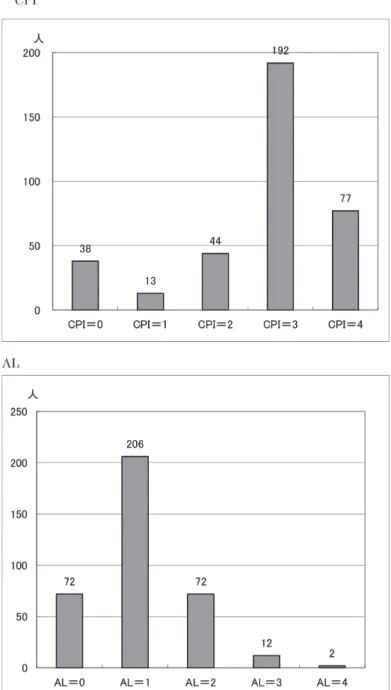
2 )全身健康診査 生理学的な指標として身長,体重,Body mass index(BMI),腹囲,さらに血圧を測定した. 血液生化学検査は AST(GOT),ALT(GPT), γ–GTP,空腹時血糖,HbA1c(NGSP),中性脂 肪,高密度リポ蛋白質コレステロール(HDL コ レステロール,以下 HDL),低密度リポ蛋白質 コレステロール(LDL コレステロール,以下 LDL)を測定した.喫煙状況は,質問紙(「現在 タバコを吸いますか.」「タバコを吸った経験があ りますか.」)により調査した. 3 )食品群および栄養素等の摂取量の推定 食品および栄養素等の摂取量の推定には,簡易 自記式食事歴質問票(BDHQ)6)を用いた.測定 項目は食品群15項目(穀類,いも類,砂糖・甘味 料類,豆類,緑黄色野菜,その他の野菜,果実 類,魚介類,肉類,卵類,乳類,油脂類,菓子 類,嗜好飲料類,調味料・香辛料類),および栄 養素等36項目[総たんぱく質(%E),脂質(%E), 炭水化物(%E),ナトリウム,カリウム,カル シウム,マグネシウム,リン,鉄,亜鉛,銅,マ ンガン,レチノール(βカロテン当量,レチノー ル当量),ビタミン D,αトコフェロール,ビタ ミン K,ビタミン B1,ビタミン B2,ナイアシ ン,ビタミン B6,ビタミン B12,葉酸,パント テン酸,ビタミン C,飽和脂肪酸,一価不飽和脂 肪酸,多価不飽和脂肪酸,コレステロール,水溶 性食物繊維,不溶性食物繊維,総食物繊維,食塩 相当量,n–3系脂肪酸,n–6系脂肪酸など]である. 3 .分析方法 基本統計量として,対象者の年齢分布,CPI お よび AL の平均,標準偏差,男女別の値を求め た.以下,数値は平均値±標準偏差で記載した. 2 群間の平均値の検定には Welch 検定を用いた. 次に,対象者を CPI および AL の値により 3 群 ( 0 :健常, 1・2 :軽度, 3・4 :重度)に分け て,生理学的所見(性別,年齢,BMI,腹囲, 収縮期血圧,拡張期血圧),歯科的所見(CPI に おいては AL の値,AL においては CPI の値), 喫 煙( 有 無 ), 血 液 生 化 学 的 所 見(ALT, γ– GTP,空腹時血糖,HbA1c,中性脂肪,HDL, LDL),栄養素等の摂取量[総たんぱく質(%E), 脂質(%E),炭水化物(%E),ミネラル,ビタ ミン,脂肪酸,コレステロール,食物繊維]およ び食品群別摂取量(穀類,いも類,砂糖・甘味料 類,豆類,緑黄色野菜,その他の野菜,果実類, 魚介類,肉類,卵類,乳類,油脂類,菓子類,嗜 好飲料類,調味料・香辛料類)の項目について比 較し,Games–Howell の方法(等分散を仮定し ない多群間の平均値の比較)を用いて検定を行っ た. 統計計算には統計解析ソフト R–3.2.3(https:// cran.r–project.org)を用いた.Games–Howell 検 定は,群馬大学社会情報学部青木繁伸教授が公開 し て い る プ ロ グ ラ ム(http://aoki2.si.gunma– u.ac.jp/R/)を使用した.すべての統計解析にお いて有意水準を0.05とした. 結 果 1 .男女別の CPI と AL の分布 全対象者の CPI および AL 分布のヒストグラ ムを Fig. 1 に,Tab. 1 に対象者の年齢分布を示 す.対象者364名で,男性224名,女性140名の平 均年齢に有意差はみられなかった(Welch 検定, p=0.9₇1).また,Tab. 2 に男女別の CPI と AL の分布を示す.男性と女性の分布を比較したとこ ろ,性差に統計学的な有意差がみられ,CPI, AL ともに Wilcoxon t–test で p=0.004であった. 2 .CPI に影響を及ぼす項目 Tab. 3 に結果を示す.CPI 値をもとに 3 群に 分類したところ,健常群38名,軽度群5₇名,重度 群269名であった.生理学的所見から,BMI では 健常群(20.8±2.4)と比較して軽度群(23.3± 3.9),重度群(23.0±3.5)は有意に数値が大きく なった(p<0.001).腹囲(cm)も同様に健常群 (₇4.6±₇.0)と比較して軽度群(81.₇±9.5),重 度群は(81.0±10.3),有意に数値が増した(p< 0.001).拡張期血圧(mmHg)は,健常群(₇0.1 ±11.3) と 比 較 し て 軽 度 群(₇6.4±12.1) が 高 かった(p<0.05). 次に,歯科的所見として,AL においては健常 群(0.26±0.50),軽度群(0.26±0.48)と比較し て重度群(1.3₇±0.61)は値が大きくなった(p <0.001). さらに血液生化学的所見では,ALT(log)(U/ L)は,健常群(2.88±0.35)と重度群(3.04±0.52)
間で有意差が認められた(p<0.05).空腹時血糖 (mg/dl)においても,健常群(95.0±8.4)と重 度 群(100.3±21.6) 間 で 同 様 で あ っ た(p< 0.05),HbA1c(%)も健常群(5.41±0.29)と重 度群(5.56±0.₇0)間で同様の傾向があった(p =0.0509). 中 性 脂 肪(mg/dl) で は, 健 常 群 (69.₇±29.2)と比較して軽度群(115.4±63.4), 重 度 群(108.9±62.6) は 有 意 に 数 値 が 大 き く なった(p<0.001).一方,HDL(mg/dl)は,健 常 群(₇₇.0±13.5) と 比 較 し て 軽 度 群(63.6± 12.5),重度群(65.0±1₇.0)では有意に数値が小 さくなった(p<0.001). 栄養学的な項目からの分析では,特記すべき事 項はなかった. Tab. 4 に示すように,男女別では男性に重度 が多い傾向があり(Fisher 直接確率検定,p= 0.051),喫煙についても喫煙者に重度が多かった (p<0.05). 以上より,CPI に影響を及ぼす因子として,統 計学的に有意差を認めたものは,性(男性), BMI,腹囲,拡張期血圧,AL,ALT,空腹時血 糖,中性脂肪,HDL,喫煙であった.
3 .AL に影響を及ぼす項目 結果を Tab. 5 に示す。AL 値による 3 群の分類 では,健常群₇2名,軽度群2₇8名,重度群14名で あった.生理学的所見から,年齢は,健常群 (4₇.6±10.0) と 比 較 し て 軽 度 群(51.0±11.0), 重度群(53.1±6.5)は有意に数値が大きかった (p<0.05).歯科的所見では,現在歯数(本)は, 健常群(26.6±3.2)と比較して軽度群(26.4± 2.₇),重度群(22.4±5.2)は有意に数値が小さ かった(p<0.05).CPI は,健常群(1.1±1.0), 軽度群(3.1±0.8),重度群(3.₇±0.5)いずれも 有意に数値が大きかった(p<0.001). 血液生化学的な項目からの分析では,特記すべ き事項はなかった. 次に,栄養素等の摂取量では,脂質(%エネル ギー比)が,健常群(26.6±4.8)と比較して軽 度群(24.8±5.0)で有意に数値は減少していた (p<0.05).ミネラルであるマンガン摂取量(mg /日)は,健常群(1.68±0.48)と比較して軽度 群(1.84±0.48) で 有 意 に 増 加 し て い た(p< 0.05).ビタミン類では,ビタミン C 摂取量(mg /日)で,軽度群(₇0.8±32.1)と比較して重度
Table 1 :Subject of age distribution
Number of people Mean±SD(years) Minimum(years) Median(years) Maximum(years)
All 364 50.4±10.8 21 51 81
Male 224 50.4±10.4 29 51 81
Female 140 50.4±11.4 21 51 ₇9
There is no gender difference in age(Welch test, p=0.9₇1).
Table 2 :Distribution of the CPI and the AL by gender CPI 0 1 2 3 4 Male 1₇( ₇.6%) 5( 2.2%) 28(12.5%) 119(53.1%) 55(24.6%) Female 21(15.0%) 8( 5.₇%) 16(11.4%) ₇3(52.0%) 22(15.₇%) AL 0 1 2 3 4 Male 39(1₇.4%) 122(54.5%) 51(22.8%) 10( 4.5%) 2( 0.9%) Female 33(23.6%) 84(60.0%) 21(15.0%) 2( 1.4%) 0 Severeʼs CPI and AL is seen significantly more in men(Wilcoxon t–test, p=0.004). Numerical value in the table : number of people(%)
Table 3 :Factors affecting in CPI( 1 ) healthy group
(n=38) mild group(n=5₇) severe group(n=269) p–value
BMI 20.8±2.4 23.3±3.9 23.0±3.5 Healthy : mild**, Healthy : Severe**
Waist(cm) ₇4.6±₇.0 81.₇±9.5 81.0±10.3 Healthy : mild**, Healthy : Severe**
Diastolic blood
pressure(mmHg) ₇0.1±11.3 ₇6.4±12.1 ₇4.4±13.1 Healthy : mild*
AL 0.26±0.50 0.26±0.48 1.3₇±0.61 Healthy : Severe**, Mild : Severe**
ALT(log)(U/L) 2.88±0.35 3.08±0.53 3.04±0.52 Healthy : Severe**
Fasting blood
glucose (mg/dl) 95.0±.4 9₇.9±10.5 100.3±21.6 Healthy : Severe*
Neutral fat(mg/dl) 69.₇±29.2 115.4±63.4 108.9±62.6 Healthy : mild**, Healthy : Severe**
HDL(mg/dl) ₇₇.0±13.5 63.6±12.5 65.0±1₇.0 Healthy : mild**, Healthy : Severe**
Numerical value in the table : Mean±SD
群(5₇.2±1₇.8) は 有 意 に 減 少 し て い た(p< 0.05).脂肪酸では,一価不飽和脂肪酸摂取量(g /日)が,健常群(10.6±2.0)と比較して,軽 度 群(9.8±2.2) で 有 意 に 減 少 し て い た(p< 0.05).また,多価不飽和脂肪酸摂取量(g /日) が,健常群(₇.2±1.5)と比較して,軽度群(6.₇ ±1.5)で有意に減少していた(p<0.05).n–6系 脂肪酸摂取量(g /日)は,健常群(5.8±1.2) と比較して軽度群(5.3±1.2)で有意に減少して いた(p<0.01). 食品群別では果実類摂取量(g /日)が,健常 群(64.8±48.9)と比較して重度群(35.₇±29.2) で有意に数値が小さく(p<0.05),さらに軽度群 (62.1±50.5)と比較して,重度群では有意に減 少した(p<0.05). Tab. 6 に示す喫煙については,喫煙者に健常
Table 5 :Factors affecting in AL( 1 ) healthy group
(n=₇2) mild group(n=2₇8) severe group(n=14) p–value
Age(years) 4₇.6±10.0 51.0±11.0 53.1±6.5 Healthy : mild*, Healthy : Severe*
number of present teeth 26.6±3.2 26.4±2.₇ 22.4±5.2 Healthy : Severe*, Mild : Severe*
CPI 1.1±1.0 3.1±0.8 3.₇±0.5 Healthy : mildMild : Severe****, Healthy : Severe**,
Lipid intake
(% Energy ratio) 26.6±4.8 24.8±5.0 24.6±5.4 Healthy : mild
**, Healthy: Severe**,
Mild : Severe**
Manganese intake
(mg/1,000kcal) 1.₇±0.5 1.8±0.5 1.₇±0.3 Healthy : mild* Vitamin C intake
(mg/1,000kcal) ₇0.2±32.4 ₇0.8±32.1 5₇.2±1₇.8 Mild : Severe* Monounsaturated fatty 10.1±2.0 9.8±2.2 9.₇±2.2 Healthy : mild*
acid intake (g/1,000kcal)
Polyunsaturated fatty ₇.2±1.5 6.₇±1.5 6.₇±1.5 Healthy : mild*
acid intake (g/1,000kcal) (n–3 fatty acids intake)
(g/1,000kcal) 1.4±0.4 1.4±0.4 1.4±0.4
n–6 fatty acids intake
(g/1,000kcal) 5.8±1.2 5.3±1.2 5.2±1.2 Healthy : mild* Fruits intake
(g/1,000kcal) 64.8±48.9 62.1±50.5 35.₇±29.2 Healthy : Severe*, Mild : Severe* Numerical value in the table : Mean±SD
**p<0.001, *p<0.05(Games–Howell test)
Table 4 :Factors affecting in CPI ( 2 ) Gender
healthy group mild group severe group Male 1₇( ₇.6%) 33(14.₇%) 1₇4(₇₇.₇%) Female 21(15.0%) 24(1₇.1%) 95(6₇.9%) There is a trend seen many severeʼs men ( p=0.051, Fisherʼs exact test). Numerical value in the table : number of people (%)
Smoking habit
healthy group mild group severe group non–smoking 36(11.8%) 53(1₇.3%) 21₇(₇0.9%) smoking 2( 3.4%) 4( 6.9%) 52(89.₇%) There are significantly many severe cases in smokers(p<0.01, Fisherʼs exact test) Numerical value in the table : number of people(%)
者が少なく,軽度や重度の者が多かった(Fisher 直接確率検定,p<0.01). 以上から,AL に影響を及ぼす因子として,統 計学的に有意差を認めたものは,性(男性),年 齢,現在歯数,CPI,脂質摂取量,マンガン摂取 量,ビタミン C 摂取量,一価不飽和脂肪酸摂取 量,多価不飽和脂肪酸摂取量,n–6系脂肪酸摂取 量,果実類摂取量,喫煙であった. 考 察 歯周疾患に影響を及ぼす因子の中で,変えられ ない因子(non–modifiable risk factors)と可変 あ る い は 修 正 で き る 因 子(modifiable risk factors)がある2)が,ここでは,可変あるいは修 正できる因子について焦点をあてることとする。 変えられない因子の年齢,性については省略す る。 1 .CPI と BMI,腹囲 CPI においては,BMI と腹囲は健常群と比較 して軽度群,重度群は有意に数値が大きくなると いう結果を得た(Tab. 3 ).健常な日本人を対象 とし,BMI と CPI を用いて,BMI が大きくなる と歯周疾患のリスクが高まることが示されてお り₇,8),本結果もそれを支持するものであった.さ らに,歯周疾患と肥満などの生活習慣病との関連 に世界の注目が集まり多くの疫学的報告がなされ ており9–13),肥満は歯周疾患のリスク因子とされ ている.すなわち,現存の炎症を主に状態評価す る CPI では,中心性肥満を含めたメタボリック 症候群に同時併存する代謝障害にみられる諸因子 との関連性が認められた. 2 .CPI と血圧 拡張期血圧が健常群より有意に CPI の軽度群 で高値を示し(Tab. 3 ),健常群と重度群の比較 では血圧値が高くなる傾向(p=0.08)を認めた. 収縮期血圧と CPI との関連は見られなかった. 日本人において,CPI 値と拡張期血圧が有意に 関連していたという報告14)や,また外国である が,拡張期血圧が90mmHg より高いと 5 mm 以 上の深い歯周ポケットが有意に多くなるという報 告15)がある. 高田16)は40歳以下の勤労者を対象として男女別 に肥満の有無で分け,その後 CPI 値 2 以下を歯 周病無し群,CPI 値 3 あるいは 4 を歯周病有り 群とし,血圧の値を比較した.その結果,観察開 始時には歯周病の有無で有意な差を認めなかった が, 3 年後の血圧値では,非肥満群男性の歯周病 を認めた群で,認めなかった群に比べ,拡張期血 圧が有意に高値を示したと報告している.このよ うに,追跡調査により歯周病有り群に拡張期血圧 の上昇を認めていること,また,我々の結果から 横断研究ではあるが軽度群・重度群に拡張期血圧 の上昇があることから,歯周病の発症・進行に血 圧は関連していると考えられる.高感度 C 反応 性タンパク(CRP)やインターロイキン 6(IL–6) の血中濃度が歯周病患者で高く,歯周病による炎 症が引き金となって血管内皮機能障害などにより 血圧を上昇させる1₇–19)可能性が考えられている. 3 .CPI と ALT,血糖,中性脂肪,LDL,HDL Tab. 3 に示すように血液生化学検査で,健常 群との比較で重度群に ALT の有意の上昇が認め られた.肥満による非アルコール性脂肪性肝疾患 の発症が考えられる.また,空腹時血糖も同様に 重度群で有意に高値であった.日本人において高 血糖は歯周炎のリスクを高め20),歯周ポケットの 深さを増加させる21)という報告がある.重度群に 見られることは歯周病の進行に関与している可能 性を示している. 中性脂肪は健常群との比較で軽度群と重度群と
Table 6 :Factors affecting in AL ( 2 ) Smoking habit
healthy group mild group severe group non–smoking 68(22.2%) 229(₇4.8%) 9 (2.9%) smoking 4( 6.9%) 49(84.5%) 5 (8.6%) There are significantly many mild and severe cases in smokers (p<0.01, Fisherʼs exact test) Numerical value in the table : number of people (%)
が有意に高値であり,HDL は逆に軽度群と重度 群が有意に低値であった(Tab. 3 ).トリグリセ ライド(中性脂肪)値が CPI 値 3 あるいは 4 の 罹患者で有意に高かったという報告22,23),また, HDL 低値群が高値群に比べて歯周疾患罹患に対 するオッズ比が高くなること24)や歯周ポケットの 深さを増す12)こと,などの報告がある.その他, 健常者と比較して歯周疾患患者で総コレステロー ルや LDL の有意な増加の報告など25–28)がある. 中性脂肪やコレステロールは動脈硬化と関係して おり,歯周疾患はリポタンパク質の側面をより動 脈硬化を起こしやすく変化させている.すなわ ち,LDL 値は歯周炎で上昇し,ほとんどの研究 が中性脂肪の同様の増加を示しており,それとは 対照的に抗動脈硬化性である HDL は歯周炎で低 くなる傾向となる.本研究の結果もこれらを支持 するものである. 歯周病などの慢性炎症の存在が菌血症や内毒素 血 症 と な り 炎 症 促 進 性 サ イ ト カ イ ン で あ る IL–1β,TNF–αの血清濃度を上昇させ,これら が脂質生成あるいは脂肪分解を増加させたり,脂 肪排泄を減じたりして,LDL や中性脂肪の高脂 質血症を起こすと考えられている29).また,歯周 治療後に,無治療群に比べて標準及び集約治療群 で血清 CRP が有意に低下し,集約治療群では 2 か月後に総コレステロールと LDL が減少したと いう30).HDL については,HDL がより高値であ れば炎症マーカーである CRP 値が有意に減少す る31)ことや,歯周治療前に比べて治療後に HDL は有意に増加し32–34),動脈硬化症予防に好影響を 与える.疫学的及び臨床的にも,歯周疾患は脂質 代謝に関係があることを示している. 4 .AL とマンガン,ビタミン C Tab. 5 に示すように,AL に影響する因子の中 で栄養素については,マンガン摂取量が健常者と 比べて軽度者で有意に増加していた.マンガンの 働きは骨の形成,インスリンの合成,抗酸化作用 のある酵素の構成成分となるなど,必須微量元素 とされている.植物性の食品が主な供給源で,穀 類,豆類,茶葉に多く含まれ,通常の食生活では 過不足は起こらないと考えられている35).重度群 と健常群との比較で同様の値であり,軽度群と重 度群との比較ではマンガンの摂取は減少してお り,十分に説明できない.マンガンについては著 者らが初めて言及するものであり,今後の症例数 を増やしての検討やマンガンの栄養の働きに関す る研究の進展に期待したい. 注目すべきは,ビタミン C であり,健常群お よび軽度群と比較して,重度群では有意に減少し ていた(Tab. 5 ).ビタミン C は,水溶性で強い 還元能力で抗酸化作用を有し,コラーゲン線維の 合成促進作用もあり,歯周組織の健康を保つため には欠かせない.実験的に,ラット歯周病モデル で抗酸化作用のあるαリポ酸とアスコルビン酸の 胃内への投与によって歯槽骨の吸収と歯周組織の 破壊が抑制されている36).疫学的には,日本人に おいて血清中のビタミン C 低値群は AL の値が 有意に大きくなること3₇),アメリカ国民健康栄養 調査で血清中のビタミン C の濃度が高くなると 中等度や重度の歯周炎が有意に減少すること38)が 報告されている.本研究の結果からも,ビタミン C の摂取量が少ないことは歯周炎の進行に関連す る因子であるといえる.特に喫煙者において食事 でのビタミン C 摂取量が少ないとアタッチメン トロスが有意に大きくなること39)が報告されてい る. 本 研 究 で は, 非 喫 煙 者₇2.1±32.4(mg / 1,000kcal),喫煙者59.₇±56.1(mg /1,000kcal) と有意に喫煙者がビタミン C の摂取量は少な かった(p=0.002)が,Tab. ₇ に示すように,重 症度別の摂取量については症例数も少なく,それ ぞれの群のバラツキも大きく有意な分布を示さな かった.今後,症例数を増やして検討を重ねた い.さらに,歯周炎患者は健常者に比べ,ビタミ ン C に加えて,葉酸,マグネシウム,および食 物繊維の摂取が少ないことが指摘されており40),
Table 7 :Effects of smoking and vitamin C intake on the attachment loss healthy group mild group severe group non–smoking ₇2.6±31.6 ₇2.5±33.1 60.2±15.8 smoking 30.5±18.9 62.8±25.₇ 51.9±21.8 Numerical value in the table : Mean±SD
バランスのとれた栄養摂取が重要である. 5 .AL と脂質,n–6系脂肪酸 脂質(%エネルギー比)の摂取量は,軽度群が 健常群と比較して有意に減少していた(Tab. 5 ). 脂質には飽和脂肪酸と不飽和脂肪酸,コレステ ロールなどが含まれている.本研究においては, 飽和脂肪酸の摂取量も健常群より軽度群において 減少してはいるが有意差はなかった.一価不飽和 脂肪酸,多価不飽和脂肪酸において健常群に比べ 軽度群で有意に減少していた(Tab. 5 ).安藤ら 41)の歯科疾患実態調査とリンケージした国民健 康・栄養調査データによる解析で,CPI 値 0 ~ 2 群に比べ 3 ~ 4 群では有意に脂肪エネルギー比 率(%)が減少し,総脂質も同様であったと報告 しており,概ね本研究の結果と一致している. 歯周病群では非歯周病群に比べて血清中の総脂 肪酸が有意に高く,PD(ポケットの深さ)や AL と密接な関係があるという報告42)や,日本人 の老人非喫煙者の追跡調査43)では,飽和脂肪酸の 摂取量が多いと AL が増加し,歯周疾患の進行に 関与しているという.これらの報告と本研究は全 く逆で,歯周疾患罹患者で脂肪酸摂取量は減少し ていた.理由は不明であり,脂質全体で考える必 要がある.食餌によっての高脂血症は酸化ストレ スや炎症誘導性メデイエーターの産生への一連の 流れを引き起こすと考えられている44,45). 多価不飽和脂肪酸では,n–6系脂肪酸について, 本研究では健常群と軽度群とに有意差が認めら れ,軽度群では摂取量が減少していた(Tab. 5 ). n–6系脂肪酸はアラキドン酸カスケードにより炎 症・アレルギー反応と関連した強い生理活性物質 であるプロスタグランジン,ロイコトリエンを生 成する.血清中の n–6系脂肪酸レベルが,対照群 に比して歯周組織の骨喪失を伴う患者に高く, n–3系脂肪酸はその逆であったことから,骨喪失 は n–6と n–3系脂肪酸の不均衡に関係していると いう報告46)や,日本人老人において n–6対 n–3脂 肪酸摂取量の比が高い群は,低い群と比べて AL が増加し歯周疾患が進行していたという報告4₇)も ある.Tab. 5 に参考として n–3系脂肪酸摂取量を 示したが,本研究ではその比は健常群で4.02,軽 度群で3.₇3,重度群3.₇₇であり,健常群の方が比 は高く,これらの報告と一致していない.今後症 例数を増やすなど検討したい. 6 .AL と食品群 食品群別では,果実類において健常群と重度 群,軽度群と重度群で有意差を認め,重度群では 明らかに摂取量が減少していた(Tab. 5 ).果実 類には,ビタミン C,B 群,A,E などのビタミ ンやカリウムなどのミネラル,食物繊維,有機 酸,ポリフェノールなどが含まれている.日本人 男性49~59歳を対象とし,ポリフェノールの一つ であるカテキンやビタミン C の供給源である緑 茶を多く飲む人は,ポケットの深さや AL が減少 するという48),また,日本人妊婦で,緑黄色野菜 や不溶性食物繊維の摂取量と喪失歯数は量─反応 関係であった49)ことが示されている.果実類の摂 取量の少ないことは歯周病の進行因子と考えられ る. その他,緑黄色野菜摂取量が多い人は AL の増 加が有意に少ない50)という追跡研究,乳製品を多 く摂る人は歯周病罹患率が低い51)あるいはポケッ トの深さや AL の平均値が低い52),食餌からのカ ルシウム摂取量が多い日本人妊婦は歯周疾患の罹 患率は低い53),さらに摂取量や血清中のカルシウ ム量の少ない人は AL が大きくなる54,55)という研 究もある.本研究では,緑黄色野菜や乳製品,カ ルシウムは健常群に比して軽度群及び重度群では 摂取量が少ない傾向であるが有意ではなかった. ₇ .CPI および AL と喫煙 生活習慣である喫煙については,CPI および AL いずれにおいても喫煙あり群はなし群に比し て有意に健常群が少なく,軽度群・重度群が多い (Tabs. 4 , 6 ).タバコは環境因子として歯周病 のリスクの半分を占めるといわれている4),また, アタッチメントロスに中心的な役割を果たしてい る56).大阪府や米国をはじめとするさまざまな地 域の疫学研究により,歯周疾患と喫煙曝露のオッ ズ比は2.5~8.6の高い値を示している5₇).また, 喫煙が歯周組織に与える影響については,P. gingivalis などの歯周病原細菌の増加,多形核白 血球などの免疫担当細胞の機能の障害,末梢血管 の収縮や血流の低下による微小循環機能障害58,59) などが考えられている.
結 語 歯周疾患のリスク因子を特に生理学的,血液生 化学的,栄養学的視点から総合的に明らかにする ことを目的とし,松本歯科大学病院健診センター の受診者364名(男性224名,女性140名)を対象 として調査した. 歯周疾患の病態を CPI と AL の最大値を用い て代表させ,男女別の分布を Wilcoxon 順位和検 定した。次に,CPI と AL のそれぞれの値により, 健常( 0 ),軽度( 1 ~ 2 ),重度( 3 ~ 4 )と 3 群に分類し,生理学的所見,歯科的所見,血液生 化学的所見,栄養素等の所見をから得られた 3 群 の平均値を多重比較検定した.また,性及び喫煙 と 3 群の分布を Fisher 直接確率検定した.いず れの検定も有意水準を0.05とした. CPI に影響を与える因子として,統計学的に 有意差を認めたものは,性(男性),BMI,腹囲, 拡張期血圧,CAL,ALT,空腹時血糖,中性脂肪, HDL,喫煙であった.AL に影響を与える因子と して,統計学的に有意差を認めたものは,性(男 性),年齢,現在歯数,CPI,脂質摂取量,マン ガン摂取量,ビタミン C 摂取量,一価不飽和脂 肪酸摂取量,多価不飽和脂肪酸摂取量,n–6系脂 肪酸摂取量,果実類摂取量,喫煙であった. 歯周疾患の病態は生理学的,血液生化学的,栄 養学的状態に影響されることが示唆された.CPI では,メタボリック症候群に併存して認める代謝 障害と関連性を認め,AL では,環境因子として の食習慣との関連性を認めた. 参 考 文 献
1 )Maddi A and Scannapieco FA(2013)Oral bio-films, oral and periodontal infections, and sys-temic disease. Am J Dent 26:249–54.
2 )Van Dyke TE and Dave S(2005)Risk factors for periodontitis. J Int Acad Periodontol 7: 3–₇.
3 )Cronin AJ, Claffey N and Stassen LF(2008) Who is at risk? Periodontal disease risk analy-sis made accessible for the general dental practitioner. British Dental Journal 205:131– ₇.
4 )Pihlstrom BL, Michalowicz BS and Johnson NW(2005)Periodontal diseases. Lancet 366:1809–20. 5 )WHO(花田信弘,他訳,1998):口腔診査法♶ ─ WHO によるグローバルスタンダード─,34– 8. 6 )牧 茂,荒 敏 昭,竹 内 由 里,岩 井 由 紀 子, 吉成伸夫,佐藤 晶,前島信也(2016)現在歯 数に関連する因子─特に生理学的,血液生化学 的,栄養学的視点から─.松本歯学 42:16–24. ₇ )Saito T, Shimazaki Y and Sakamoto M(2001) Obesity and periodontitis. N Engl J Med 399: 482–3.
8 )Saito T. Shimazaki Y, Koga T, Tsuzuki M and Ohshima A(2001)Relationship between up-per body obesity and up-periodontitis. J Dent Res 80:1631–6.
9 )Al–Zahrani MS. Bissada NF and Borawski EA (2003)Obesity and periodontal disease in young, middle–aged, and older adults. J Peri-odontol 74:610–5.
10)Wood N, Johnson RB and Streckfus CF(2003) Comparison of body composition and periodon-tal disease using nutritional assessment tech-niques: Third National Health and Nutrition Examination Survey (NHANES III). J Clin Periodontol 30:321–₇.
11)Hujoel PP, Drangsholt M, Spiekerman C and DeRouen TA(2000)Periodontal Disease and Coronary Heart Disease Risk. JAMA 284: 1406–10.
12)DʼAluto F, Sabbah W, Netuveil G, Donos N, Hingoran AD, Deanfield J and Tsakoa G(2008) Asociation of the metabolic syndrome with se-vere periodontitis in large U.S. population– based survey. J Clin Endocrinol Metab 93: 3989–94.
13)Chaffee BW and Weston SJ(2010)Associa-tion between chronic periodontal disease and obesity: a systemic review and meta–analysis. J Periodontol 81:1₇08–24.
14)Furuichi Y, Shimotsu A, Ito H, Namariyama Y, Yotsumoto Y, Hino Y, Mishige Y, Inoue M and Izumi Y(2003)Associations of periodontal status with general health conditions and se-rum antibody titers for Porphyromonas
gingi-valis and Actinobacillus actinomycetemcomi-tans. J Periodontol 74:1491–₇.
15)Engström S, Gahnberg L, Högberg H and Svärdsudd K(200₇)Association between high blood pressure and deep periodontal pockets: a nested case–referent study. Ups J Med Sci 112:95–103.
16)高田康光(200₇)歯周病の血圧への影響.松仁 会医学誌 46:129–34.
1₇)Saito M, Ishimitsu T, Minami J, Ono H, Ohrui M and Matsuoka H(2003)Relations of plas-ma high–sensitivity C–reactive protein to tra-ditional cardiovascular risk factors. Athero-sclerosis 167:₇3–9.
18)Higashi Y, Goto C, Hidaka T, Soga J, Naka-mura S, Fujii Y, Hata T, Idei N, FujiNaka-mura N, Chayama K, Kihara Y and Taguchi A(2009) Oral infection–inflammatory pathway, peri-odontitis, is a risk factor for endothelial dys-function in patients with coronary artery dis-ease. Atherosclerosis 206:604–10.
19)Leong XF, Ng CY, Badiah B and Das S(2014) Association between hypertension and peri-odontitis: possible mechanisms. The Scientific World Journal 2014, Article ID₇6823₇, 11 pages (http://dx.doi.org/10.1155/2014/₇6823₇) 20)Yamamoto T, Tsuneishi M, Furuta M, Koyama
R, Ekuni D, Morita M and Hirata Y(2010) Relationship between periodotitis and meta-bolic syndrome in rural Japanese. The Bulletin of Kanagawa Dental College 38:98–100. 21)Shimazaki Y, Saito T, Yonemoto K, Kiyohara
Y, Iida M and Yamashita Y(200₇)Relation-ship of metabolic syndrome to periodontal dis-ease in Japanese women: the Hisayama study. J Dent Res 86:2₇1–5.
22)Morita M, Horiuchi M, Kinoshita Y, Yama-moto T and Watanabe T(2004)Relationship between blood triglyceride level and periodon-tal status. Community Dent Health 21:32–6. 23)Moeintaghavi A, Haerian–Ardakani A, Talebi–
Ardakani M and Tabayabaie I(2005)Hyper-lipidemia in patients with periodontitis. J Con-temp Dent Pract 6:₇8–85.
24)小川由紀子,髙橋節子,吉田幸恵,今本雅英, 棚田成紀(2000)事業所の男性従業員における 歯周疾患と生活習慣要因および医学的検査値に 関する横断的研究.日生理人類会誌 5:41–6. 25)Craig RG, Yip JK, So MK, Boylan RJ,
Socran-sky SS and Haffajee AD(2003)Relationship of destructive periodontal disease to the acute– phase response. J Periodontol 74:100₇–16. 26)Katz J, Flugelman MY, Goldberg A and Heft
M(2002)Association between periodontal pockets and elevated cholesterol and low den-sity lipoprotein cholesterol levels. J Periodon-tol 73:494–500.
2₇)Palle AR, Reddy CM, Shankar BS, Gelli V and Sudhakar J(2013)Association between obe-sity and chronic periodontitis: a cross–section-al study. J Contemp Dent Pract 14:168–₇3.
28)Sandi RM, Pol KG, Basavaraj P, Khuller N and Singh S(2014)Association of serum cho-lesterol, triglyceride, high and low density li-poprotein (HDL and LDL) levels in chronic periodontitis subjects with risk for cardiovas-cular disease (CVD): a cross sectional study. J Clin Diagn Res 8:214–6.
29)Iacopino AM and Culter CW(2000)Patho-physiological relationships between periodon-titis and systemic disease: recent concepts in-volving serum lipids. J Periodontol 71: 13₇5–84.
30)DʼAiuto F, Nibali L, Parkar M, Suvan J and Tonetti MS(2005)Short–term effects of in-tensive periodontal therapy on serum inflam-matory markers and cholesterol. J Dent Res 84:269–₇3.
31)Izumi A, Yoshihara A, Hirotomi T and Miya-zaki H(2009)The relationship between se-rum lipids and periodontitis in elderly non– smokers. J Periodontol 80:₇40–8.
32)Pussinen PJ. Jauhiainen M, Vilkuna–Rauti-ainen T, Sundvall J, Vesanen M, Mattila K, Palosuo T, Alfthan G and Asikainen S(2004) Periodontitis decreases the antiatherogenic potency of high density lipoprotein. J Lipid Res 45:139–4₇.
33)Tüter G, Kurtiş B, Serdar M, Aykan T, Okyay K, Yücel A, Toyman U, Pınar S, Cemri M, Çengl A, Walker SG and Golub LM(200₇)Ef-fects of scaling and root planing and sub–anti-microbial dose doxycycline on oral and system-ic biomarkers of disease in patients with both chronic periodontitis and coronary artery dis-ease. J Clin Periodontol 34:6₇3–81.
34)Buhlin K, Hultin M, Norderyd O, Persson L, Pockley AG, Pussinen PJ, Rabe P, Klinge B and Gustafsson A(2009)Periodontal treat-ment influences risk markers for atherosclero-sis in patients with severe periodontitis. Ath-erosclerosis 206:518–22. 35)厚生労働省(2014)(2)微量ミネラル④マンガン, 日本人の食事摂取基準(2015年版)策定検討会 報 告 書,p303–5.(http://www.mhlw.go.jp/ file/05–Shingikai–10901000–Kenkoukyoku– Soumuka/0000042638.pdf 2016 年11 月30 日 ア クセス可能)
36)Akman S, Canakci V, Kara A, Tozoglu U, Ara-baci T and Dagsuyu İM(2013)Therapeutic effects of alpha lipoic acid and vitamin C on al-veolar bone resorption after experimental peri-odontitis in rats: a biochemical, histochemical,
and stereologic study. J Periodontol 84:666– ₇4.
3₇)Amarasena N, Ogawa H, Yoshihara A, Hana-da N and Miyazaki H(2005)Serum vitamin C–periodontal relationship in community– dwelling elderly Japanese. J Clin Periodontol 32:93–₇.
38)Chapple ILC, Milward MR and Dietrich T (200₇) The prevalence of inflammatory peri-odontitis is negatively associated with serum antioxidant concentrations. J Nutr 137:65₇– 64.
39)Nishida M, Grossi SG, Dunford RG, Ho AW, Trevisan M and Genco RJ(2000)Dietary vi-tamin C and the risk for periodontal disease. J Periodontol 71:1215–23.
40)Staudte H, Kranz S, Völpel A, Schütze J and Sigusch BW(2012)Comparison of nutrient intake between patients with periodontitis and healthy subjects. Quintessence Int 43:90₇–16.
41)安藤雄一(研究代表者)(2012)歯周病と食品群・ 栄養素の摂取量との関連.厚生労働科学研究費 補助金(循環器疾患・糖尿病等生活習慣病対策 総合研究事業)分担研究報告書,p205–13.(https:// www.niph.go.jp/soshiki/koku/kk/sosyaku/report11/ report2011_23.pdf 2016年11月30日 アクセス 可 能)
42)Ramirez–Tortosa MC, Quiles JL, Battino M, Granados S, Morillo JM, Bompadre S, New-man HN and Bullon P(2010)Periodontitis is associated with altered plasma fatty acids and cardiovascular risk markers. Nutrition, Me-tabolism & Cardiovascular Diseases 20:133– 9.
43)Iwasaki M, Manz MC, Moynihan P, Yoshihara A, Muramatsu K, Watanabe R and Miyazaki H(2011)Relationship between saturated fat-ty acids and periodontal disease. J Dent Res 90:861–₇.
44)Ceriello A, Assaloni R, Ros RD, Maier A, Pico-ni L, Quagliaro L, Esposito K and Giugliano D (2005)Effect of atorvastatin and Irbesartin, alone and in combination, on postprndial endo-thelial dysfunction, oxidative stress, and in-flammation in type 2 diabetic patients. Circu-lation 111:2518–24.
45)Chapple IL(2009)Potential mechanisms un-derpinning the nutritional modulation of peri-odontal inflammation. J Am Dent Assoc 140: 1₇8–84.
46)Requirand P, Gibert P, Tramini P, Cristol JP and Decomps B(2000)Serum fatty acid
im-balance in bone loss: example with periodontal disease. Clinical Nutrition 19:2₇1–6.
4₇)Iwasaki M, Taylor GW, Moynihan P, Yoshi-hara A, Muramatsu K, Watanabe R and Miya-zaki H(2011)Dietary ratio of n–6 to n–3 polyunsaturated fatty acids and periodontal disease in community–based older Japanese: a 3–year follow–up study. Prostaglandins, Leu-kotrienes and Essential Fatty Acids 85:10₇– 12.
48)Kushiyama M, Shimazaki Y, Murakami M and Yamashita Y(2009)Relationship between in-take of green tea and periodontal disease. J Periodontol 80:3₇2–₇.
49)Tanaka K, Miyake Y, Sasaki S, Ohya Y, Matsu naga I, Yoshida T, Hirota Y, Oda H and the Osaka maternal and child health study group (200₇) Relationship between intake of vegetables, fruit, and grains and the preva-lence of tooth loss in Japanese women. J Nutr Sci Vitaminol 53:522–8.
50)Yoshihara A, Watanabe R, Hanada N and Miya zaki H (2009) A longitudinal study of the relationship between diet intake and dental caries and periodontal disease in elderly Japa-nese subjects. Gerodontology 26:130–6. 51)Al–Zahrani MS (2006) Increased intake dairy
products is related to lower periodontitis prev-alence. J Periodontol 77:289–94.
52)Shimazaki Y, Shirota T, Uchida K, Yonemoto K, Kiyohara Y, Iida M, Saito T and Yamashita Y (2008) Intake of dairy products and peri-odontal Disease: the Hisayama study. J Peri-odontol 79:131–₇.
53)Tanaka K, Miyake Y, Okubo H, Hanioka T, Sasaki S, Miyatake N and Arakawa M (2014) Calcium intake is associated with decreased prevalence of periodontal disease in young Japanese women. Nutrition Journal 13:109 (DOI: 10.1186/14₇5–2891–13–109)(https://nutritionj.
biomedcentral.com/articles/10.1186/14₇5–2891– 13–109 2016年11月30日アクセス可能)
54)Nishida M, Grossi SG, Dunford RG, Ho AW, Trevisan M and Genco RJ(2000)Calcium and the risk for periodontal Disease. J Peri-odontol 71:105₇–66.
55)Amarasena N, Yoshihara A, Hirotomi T, Takano N and Miyazaki H(2008)Association between serum calcium and periodontal dis-ease progression in non–institutionalized el-derly. Gerodontology 25:245–50.
risk factors for periodontal attachment loss among adults in the United States. J Clin Periodontol 30:230–₇.
5₇)小関健由,雫石 聡 (2014)歯周疾患とその予 防,第 4 版新予防歯科学補訂,125–31,医歯薬 出版,東京.
58)Palmer RM, Wilson RF, Hasan AS and Scott DA(2005)Mechanisms of action of environ-mental factors – tobacco smoking. J Clin Peri-odontol 32:180–95.
59)前 野 正 夫(200₇)喫 煙 と 歯 周 病,Preventive Periodontology,142–6,医歯薬出版,東京.