[Record
of
Symposium]
Matsumoto
Shigaku,
19
:
129-134,
1993
Dental
Education
in
Japan
TAKEHIRO CHINO
Department
of Oral
and Maxillofacial
Surgery I, Matsumoto
Dental
College
(Chief
: Prof.
T. Chino)
The Japanese
Education
Curriculum
requires
that
Japanese
children
enter elementary
school
at
age 6. The elementary
school
curriculum
is six years
long,
after
which
elementary
school
graduates
enter
a three-year
junior
high
or middle
school.
Upon completion
of junior
high
school,
Japanese
schoolchildren
enter
a three-year
senior
high
school.
This
three-step
progression
composes
the
so-called
6-3-3
system
of general
education
in Japan.
The
Liberal
Arts
College
or University
curriculum
is four-years
long
while
Medical
or Dental
School
is six.
History
of the
Dental
Education
System
in Japan
Japan's
first
dental
school,
the predecessor
to the
first
Japanese
dental
college
(also
the
predecessor
to Tokyo
Dental
College),
was founded
in 1890.
In 1929,
with
the foundation
of the
Tokyo
Medical
and Dental
School
(also
the predecessor
to Tokyo
Medical
and Dental
University),
the
total
prewar
number
of
schools
teaching
dentistry
reached
nine.
During
this
period,
labelled
Dental/Medical
Schools,
these
schools
offered
a four-year
program
which included
instruction
in
various
liberal
arts
courses
as
well
as
specialized
dental
ones
(Figure
1).
Dental
School
Predental liberal arts &dental course 4yrs.
yi&. ^y&iciu
Junior
College
Dental
College
Predental
l
iberal
arts
course
2yrs.
Dental
course
4yrs.
2+4yrs.
system
Dental
College,
Dental
School
of Univ.
Predental
course
2yrs.
Dental
course
4yrs.
2-4yrs. system Dental College, Dental School of Univ.
Predental liberal arts & dental course 6yrs.
6yrs. system Figure 1 : History of Educational System of Dentistry in Japan
130 =fn:ts\taEe=ee-t-6eX]V-JY.71,."-J;9A HJasVLib-efr6ts\#fi
After World War II in i945, the Japanese Education SYstem was completely revised according to Ameriean guidelines. Following the 6-3-3 secondary education system, completiori of a two-year liberal artS junior college program followed by a four-year specialized dental school became the standatd dental education system in Japan. The liberal arts education system of this time was identical to America's. That is, this system no longer guaranteed automatic progression into the Specialized dental curriculum uPon a student's initial entrance into the previous six-year program as before. Instead, it stipulated that entrance to dental school could only occur upon eompletion of the two-year liberal arts junior college, after which the student wOuld agaih fotmally take an entranCe exam to enter the dental ptogr'am. This became the so-called 2+4 dental educatiOn system (Figure l).
Moreover, between 1946-49 the so-called Dental School came to be known as Dental College.
Higashi Nippon Gakven Univ'ersity. School df Dentistry
School of Dentistry Hokkaldo University
Kitakyusyu Fukuoka Okeyamn Hiroshime Shiejiri Yekohema Gifu yokosuka Tobetsu Sapporo
Aichi gakuin University Schoo1 of Dentistry
Tokushima University School of Dentistry
Nagasaki University. School of Dentistry
Tsurumi
Fticuity ef Dentistry. Kegoshima University
Figure 2: Location of Dental School in
Morieka
Sendei
University. Scheol
Japan
zaJztsitw"t]'!L` 19(2) 1993 131
Subsequently, as domestic demand for medical care increased, dentists became highly concentrated in urban areas, leaving many rural areas with no dental care whatsoever. In order to eliminate this problem, derital colleges were testructured into the present situation (Figure 2).
This revised system, however, caused an increase in the number of students who could not enter the dental program upon completion of the Iiberal arts curriculum. Be6ause of this, private schools began to face financial difficulties. As a result, in 1954 the Iaw regarding the dental education
system was amended. Students who intended to enter medical or dental schools were separated from general Iibetal atts curriculum students. In addtiton, both a premedical and predental course were established. All students who completed these courses aut6matiCally centinued on to the specialized dental arid medical courses. This is the present 2:4 dental education System (Figure 1).
The drawback to this system was, however, that even though students entered a dental college for the sole purpose of becoming dentists, for the firSt two years they were taught subjects which had no relation to dentistry by teachers who knew nothing Of dentistry. Also, with general Iiberal arts courses being electives, students were given the impression that they were courses which really didn't have to be mastered. For this reason, the students at a large number of colleges began to feel that their dentistry-related courses were also dull and uninspiring like the liberal arts ones. Even though they entered dental schQol having passed the rigorous entrance exam and full of a burning desire to become dentists, students soon lost both the ability to manage time effectively as well as the desire to learn.
In order to eliminate this problem, a 1973 amendment was introduced. This amendment led to a switch from the 2-4 program to a continuous six-year dental education program ; this involved a discontinuation of the division between liberal arts and specialized dental courses (Figure 1). The 1973 amendment enabled students to be taught a small ameunt of dentistry-rela,ted material immedi-ately following entrance into dental college. While at the same time, students were forced to be conscious of their societal mission to devoting a lifetime of service to offering medical care. The main goal of this amendment was to make students recognize that not only the dentistry-related courses but also the liberal arts ones were important to their futures' as dentists. This amended system is something that a 'few colleges have been practicing since quite a while back. It is also the current six-year dental education system.
Matsumoto Dental College's Education System
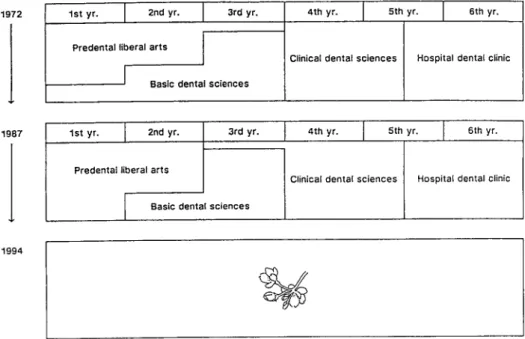
Matsumoto Dental College was founded in 1972. The contents of Matsumoto Dental College's education system at the time of its foundation are clearly illustrated by Table 1. However, in 1976 these contents were modified and it became possible, more or less, for each college to establish its own individual education system (Table 2). Since MDC offers instruction in dentistry only, its education system has followed this continuous six-year program from the beginning. In order to give first and second year students the impression of truly having entered a dental college, MDC adopted a system which, by means of presentations using Figure 3, incorporated an element of dentistry-related study into the liberal arts courses and, conversely, incorporated an element of liberal arts study into the dentistry-related courses.
After a number of years with this system, however, students really concentrated on their dentistry-related courses but began to neglect their liberal arts ones. Therefore, we discontinued the inclusion of dentistry-related study into the first-year curriculm. We have utilized this revised curriculum up to the present.
132 =Fff : ts.E]i,.#E ecma-g-M Jk a 7 -) Y .,t".e -JÅr 9 A
Table 1:
H Jde Vt fo- rr 6 ts e.i`.
XE
Requirements for Dental School Graduation (Stipulated by Japan Ministry of Education)
Predental liberal arts course
1. More than 36 units 2. 1 unit (lecture): 1 1 unit (laboratory) Cultural science Natural science Social science Foreign languages s,ag:•Y.Py.gil•:",fi, }
Predental basic subjects Dental course
L
2. 3. 4. Up to a hourÅ~15 times 1 hourX30 times 12 units 12 units 12 units 16 units (English, 4 units 8 units German etc.)More than 30 weeks per year. More than 35 hours per week.
More than 4200 hours in a four-year span.
dditional 600 hours is permitted per four-year span. Oral Anatomy Oral Biochemistry Oral Bacteriology Dental Technology Operative Dentistry Oral Surgery Dental Radiology Internal Medicine Correlated Medicine Dental CIinic
9%
30/o 30/o 30/o6%
4%
2%
2.5% 20/o 28.50/. Oral Physiology Oral Pathology Dental Pharmacology Oral Hygiene Prothodontics Orthodontics Pedodontics Surgery Special Subject4%
50/o 30/o3%
12%
2.5% 1.5o% 2.5% 3.5%Since about 10 years ago, similar to the dental students' case mentioned above, not only the medical and dental schools' but also the four-year liberal arts colleges' curriculum has been strongly criticized for its superficial treatment of liberal arts courses. As a result, it became apparent that
a fundamental change was necessary. In 1988 a Review Committee responsible for evaluating college education was formed and in July of 1991, college education was reformed as described below :
1 . The "liberal arts course" distinction was to be abolished.
2 . Curriculum formation was to be left to each college to perform individually. 3 . Syllabus-making was required.
4 . Self-evaluation and self-judgement were to be left to the instructor.
Therefore, according to these guidelines, we at MDC are now in the process of examining how to restructure our own education system. So far we have discussed the merits of dividing the six-year term into 1.5 years of liberal arts education and 4.5 years of specialized dentistry. Within this 4.5 year period, 28 30% of the class time would be spent on the basic dental sciences and 70 -72% would be spent on clinical dentistry. We're also giving careful consideration to the idea of incorporation dentistry into the liberal arts courses as well as incorporating clinical dentistry into the basic dental sciences.
To accompany future medical progress and social developments, we feel that it will be necessary to consider whether or not to abolish or combine currently exisiting courses, whether to introduce new courses or whether other appropriate measures should be taken with regards to the
tE}Jztsits+"" 19(2) 1993
Table 2 : Requirements for Dental School Graduation (1976) (Stipulated by Japan Ministry of Education)
133
Predental liberal arts course C.t.i,t.U,'.a,ig.Cl',e."8,e 136units
Social science i
Possible to substitute foreign language
or predental basic subject up to 12 units.
Foreign languages 16 units
s,igh,.2r{rz",.e,., } 4 units
Predentalbasicsubjects 8units
-Dental course
1. More than 4200 hours in a four-year span.
2. Up to additional 600 hours is permitted per four-year span. IigXIC.,dg,"g,aAst/rE:ce }2s--3,%
Oral anatomy, Oral pathology, Oral bacteriology, Oral physiology, Dental pharmacology, Oral biochemistry, Dental .technology etc.
gg.E.Lcei,g.eeisi,s,2iheg,ce}63--73o/.
(Including 25'-400/o of dental clinical practice and clinical lectures)
Oral surgery, Periodontology, Dental anesthesiology, Endodontics, Operative dentistry, Prothodontics, Dental radiology, Oral diagnosis, Orthodontics, Pedodontics, Oral Hygiene (Preventive dentistry) Dental sociology, History of Dentistry etc.
Additional subjects as required : 2--50%
1972
1987
19g4
lstyr. 2ndyr. 3rdyr. 4thyr. 5thyr. 6thyr.
Predentalliberalarts
Clinicaldentalsciences Hospitaldenta{clinic
Basicdentalsciences
tstyr. 2ndyr. 3rdyr. 4thyr. 5thyr. 6thyr.
Predentalliberalarts
Clinicatdentalsciences Hospita[dentalciinic
Basicdentalsciences
N'
S
134 千野:歯学教育に関するモスクワシソポジウム 日本における歯学教育
humanities
and social
sciences
(philosophy,
ethics,
literature,
law,
economics,
social
thought,
psychology).
At the present
we are considering
either
a course election
system or seminar program
in hopes
of raising
students'
academic
ability,
nurturing
them into
well-rounded
individuals
and
helping
them to develop
composite-oriented
powers of judgement.
We would also like
to structure
the natural
science
courses such that
the students
can make a smooth transition
into
the follwing
dental
courses.
For this
reason,
we will
introduce
special
seminar-style
lectures
which
best match
and accomodate
the students'
academic
abilities.
As for foreign
language
courses-in
addition
to
English
Conversation,
we would also like
to add a Dental
English
Course in order to enable
students
to improve their
English
speaking
ability.
We are also considering
the appropriate
time distribution
for German and would like
to introduce
French,
Chinese
and Russian
as elective
courses
in the
future.
We intend
to provide
a system of education
which
improves
the students'
levels
of ability
by
recognizing
and accomodating
the need for a close
relationship
between
the basic
dental
sciences,
liberal
arts
and clinical
dental
courses.
We must also be concerned
with
creating
an education
system which
allows
students
to acquire
enough
knowledge
to effectively
treat
oral
hygiene
and
disease
problems
in the future.
In order
to ensure that the academic
courses share a close association
with
the clinical
ones, we hope to include
immunology
and applied
basic
dental
sciences
into
our
present
curriculum.
We would also
like
to offer
a clinical
dental
course
which
teaches
both
the
basics
of clinical
work as well as practical
skills,
and fosters
in the students
a high
level
of ability
which corresponds
to this
high
level
course. Presently
we feel that
clinical
practice
should
empha-size the entire
human body.
Looking
down the road
at future
social
conditions,
we believe
that
elderly
patient
dental
care (Geriatric
Dentistry)
should
also become a major focus.
(IwishtoexpressmythankstoMissM.A.Waitsforherkindassistance.) FormatforFig・lobtainedfromFusayama,T・(1975)DentistryintheHumanSociety(Japanese) P.71,IshiyakuPublishers,Inc. GeneralinfomationobtainedfromFusayama,T.(1975)DentistryintheHumansociety(Japanese) pp・71∼73,andImada,K・,Masaki,T・(1977)Nipponno Shikaigaku−Shoshi(Japanese)pp.3−34, IshiyakuPublishers,Inc.