From Defense to Advance: Protecting Businesses
from Risk and Crisis -Business Resilience in
the Selected Cases of China and Japan
著者
WENG XUANBIN
学位授与機関
Tohoku University
学位授与番号
11301
Doctoral Dissertation
From Defense to Advance: Protecting
Businesses from Risk and Crisis - Business
Resilience in the Selected Cases of China
and Japan
Student ID:
Name: Weng Xuanbin
Takaura Lab.
Graduate School of Economics and Management
Submitted on: 30th June 2020
CONTENTS
Chapter 1 Introduction ... 1
Chapter 2 Research Interests and Research Questions ... 2
2.1 Research Background ... 2
2.2 Research Interests and Research Motivations ... 4
2.3 Research Questions ... 5
Chapter 3 Literature Review ... 6
3.1 On Resilience ... 6
3.1.1 Originality ... 6
3.1.2 Evolution ... 7
3.1.3 Researches at New Stages ... 9
3.1.4 New Challenges ... 15
3.2 On Business Strategy ... 17
3.2.1 Views from the West on Timeline before 2000 ... 17
3.2.2 Business Strategy After 2000 ... 19
3.2.3 Views from the East before 2000 ... 23
3.3 On Corporate Social Responsibility ... 25
3.3.1 CSR Before 1990s ... 25
3.3.2 Carroll and Theories on CSR ... 27
3.3.3 CSR in the 21st Century: A Time of Prevalence of Crisis ... 30
3.4 Relationship Between CSR and Resilience ... 32
3.5 Relationship Between Business Strategy and Resilience ... 34
Chapter 4 Methodology ... 35
4.1 Suitable Approaches for Answering Research Questions ... 35
4.2 Reviewing on Qualitative Methodology ... 36
4.2.1 Reviewing on the Grounded Theory ... 36
4.2.2 Reviewing on the Coding Approaches of Qualitative Researches ... 37
4.2.3 Reviewing on the Current Debates while Applying the Grounded Theory ... 38
4.2.4 Methodology of This Research ... 39
4.2.5 Computer Assisted Qualitative Data Analysis Program ... 43
Chapter 5 Case Studies of the Chinese Businesses ... 44
5.1 Data Collection ... 44
5.2 Zhongda Construction Engineering Firm ... 44
5.3 State Owned Company A ... 56
5.4 LUTEC ... 60
5.5 Palcent Group ... 74
Chapter 6 Case Studies of the Japanese Businesses ... 87
6.1 Data Collection ... 87
6.2 FANCL ... 87
6.3 Olympus Corporation ... 93
6.5 Sysmex ... 103
Chapter 7 Comparison ... 108
7.1 Overall Statistics of the Chinese Businesses ... 108
7.2 Overall statistics of the Japanese Businesses ... 112
7.3 Comparisons of the Cases on the Dimension of Nationality ... 116
7.4 Comparisons of the Cases on the Dimension of Industry ... 118
Chapter 8 Implications ... 119
8.1 Academic Implications ... 119
8.1.1 the Grounded Theory for Management Studies in China and Japan ... 120
8.1.2 Relationships Consist of Resiliency under Business Emergencies ... 120
8.2 Practical Implications ... 124
8.2.1 Over the Outbreak of the COVID-19 ... 124
8.2.2 Providing An Analytical Business Resiliency Structure ... 124
8.2.3 Challenging Common Sense ... 125
8.2.4 Chinese Businesses May Become More Resilient under Uncertainties ... 125
8.3 Acknowledgement ... 126
Chapter 9 Conclusion ... 127 Reference
Chapter 1 Introduction
The current world is full of uncertainties, and under such an environment, many individuals and organizations are far more vulnerable than ever before. In the business world, companies experience tough times due to product faulty, customer complaint in large scale, inappropriate business structures, and old fashioned business conceptions. However, all the listed threats to business organizations could be concentrate on one single topic-business resiliency. In general, business resiliency refers to the ability obtained by business organizations that could enable companies to mitigate and eliminate the adversity of unexpected emergencies and crises, then recover and grow from such fatal events.
However, bring in all sorts of business crises on a global scale is a project too massive for individual research. Hence, this research focuses on the topic of business resiliency under the circumstance of business risks and business crises due to the failed performance of products and services provided by various firms in different industries. Moreover, this research chooses Chinese businesses and Japanese businesses as the research targets because in both countries had occurred business crises and even scandals that hurt not only the business revenue but also industrial reputation in both nations.
Thus, in the next chapter, research motivations and detailed research questions that this dissertation designed to discover are provided. Illustration of research background, reasons for choosing businesses from China and Japan as research targets, the definition of business resiliency of this study are offered as well.
As the sequent impact factors that contribute to determining the performance of business resiliency under business crises and emergencies, Chapter 3 reviews typical academic literature of business strategy, business resilience, and corporate social responsibility (CSR).
Chapter 4 describes the research methodology deployed in the researches of this dissertation. In particular, sophisticated arguments that support the statements of choosing qualitative research methodology with grounded theory are given. Further, research tools practiced in this research, such as the research questionnaire and computer-assisted qualitative data analysis software, are introduced.
Chapter 5 and Chapter 6 include the contents of four case studies in each nation by processing data regulated in Chapter 4 and structuring individual analytical frameworks that respond to research questions. A broader picture of the research topic in businesses of both countries can be grasped.
Chapter 7, as the most meaningful chapter, contains the data related to the research result, is portrayed via comparing companies categorized in different groups of industries and opponent groups of nationalities. Consequently, several mind-changing insights were brought in.
Chapter 8 introduces several academic enlightenment and practical implications concluded from this systematic qualitative research, which contributes to analyzing the research topic of this study. Meanwhile, limitations of this research are confirmed as well due to the restrictions of the research environment. Moreover, ultimately, Chapter 9 helps readers to quickly review all of the structure and content of each chapter to facilitate the integrated understanding of this research.
Chapter 2 Research Interests and Research Questions
2.1 Research Background
Globalization is a popular trend for most countries and regions. China and Japan are seeking a framework of economic integration with another relevant country, South Korea, to increase the efficacy of economic performance. On the one hand, in terms of GDP, China and Japan are not only the two giants of economic entities in East Asia but also take the second and the third place in the globe up to date, respectively (World Bank, 2019).
Figure 2.1 Top 10 of the World GDP Ranking in 2018 World Bank,2019
On the other hand, given the reality of geo-politics, long-shared culture, and the increasing economic dependence, regional integration on various aspects between the two nations has had revealed its validity (Taylor, 2013). Japan shows its economic importance after China practiced Reform and Open policy, Japanese businesses entered the Chinese market and played an active role by introducing investment of capital, technologies, and management. Recently, China is having a significant economic impact on Japan by exporting tourists and initiating new regional organizations and policies like The Asian Infrastructure Investment Bank (AIIB) and the Silk Road Economic Belt and the 21st-Century Maritime Silk Road (B&R). Consequently, maintaining sound economics is critical for the two nations themselves as well as for each other.
The performance and development of an economy entity significantly rely on the sustainability of the business in both countries, as shown in Figure 2.2 and Figure 2.3 (NBS of China, 2019;
Statistics Bureau Ministry of Internal Affairs and Communications Japan, 2018). Regarding China, the primary industry, the secondary industry, and the tertiary industry shape the boost engine of its national economy in terms of GDP, which reflects the overwhelming impact of its businesses. While for Japanese industries, especially of its manufacturing industry and service industry, lies as the heart of the economic entity. As a result, helping companies to immune from avoidable and processible business risks and crises while they confront uncertainties could mainly contributing to the goal of the positive economic performance of the two states.
Figure 2.2 The Ratio of Value added of Industries in GDP of China NBS of China, 2019
Figure 2.3 Changes in Industrial Structure,
Uncertainties that fulfill the current business world originated from the issues of black swan and gray rhino, which further evolved into disruption changes of politics, technology advancement, and the industrial revolution (Taleb,2011; Wucker, 2017). Businesses can be obsoleted by experiencing business failures and breakdowns due to these reasons. Hence it becomes more urgent and necessary for companies to prepare themselves to defend risks and crises, thus leading to the conception of business resilience.
Derived from material science, resilience, as a terminology, describes the restoring ability of objects after interacted with outside forces. In essence, it is about robustness and elasticity (Laprie, 2008). Later, it was practiced into organizational research (Rodin, 2014) but the business management field in an integrated manner up to date. Hence, it is valuable to research on resilience on business as a possible contributing factor towards a better economic performance for both countries under the circumstances of increasing uncertainties.
2.2 Research Interests and Research Motivations
When facing issues, risks, and crises, the numbers of companies had failed to handle them properly with huge losses. For instance, of Chinese business, Lu and Tao (2009) manifest the storyline of the breakdown of Sanlu, a failed leading player in the Chinese dairy market. Auto recalling on the global scale due to the affirmed several death reporting is still affecting various auto brands, and typically on Japanese brands of Toyoda, Nissan, and Honda. Segal (2019) states that the major Japanese auto manufacturers, including the mentioned three, had to abort the usage of airbags supplied by Takata. Hence, analyzing and answering why businesses from both countries could suffer dysfunction in risks and crises in different timing, even in distinctive industries, becomes the core motivation of this research.
Business resilience is not an independent sector for businesses; rather, it could interrelate with other business fractions like business strategy and corporate social responsibility (CSR) (Warhurst, 2005). However, how business strategy and CSR interact with business resilience is yet to be systematically analyzed. Therefore, research and explicit the interaction mechanism of the three forms the essential research interest of this dissertation. Nevertheless, tackling a single research task shall be difficult as a way to understand the overall picture of the research. Instead, breaking down the research motivation into several research questions in detail from diversified perspectives are needed. However, hypothesizing the concept of the 'business resilience' of this paper is a prerequisite for further discussion.
In the sea of current research on business resilience, the approaches of the research concept of the term can be categorized as follows:
1. Focusing on resilient strategies for businesses to achieve to detect uncertainties of the external environment (Winnard, Adcroft, Lee & Skipp, 2014). Researches in the type emphasized the connection between resilience and sustainability via study on the external unpredictability. Another purpose of the researches in this category is to zoom in the relations of bad-performed resilience and unexpected consequences.
2. Paying great attention to operational resilience by offering an integrated model, which is designed for coping with the risk-dynamic environment (Caralli, Allen & White 2010). Priorities of the type are to secure the survival of human lives, then assets of intelligence, equipment, and technology in a practical way for reaching the goal of business continuity ultimately.
3. Looking into the changeability as the essence of achieving business resilience by offering models. Researchers advocate this statement believe that a large number of businesses have not established a changeable business plant because of the 'absence of suitable systems to evaluate the economic sustainability of changeability in companies' (Bauernhansl, Mandel & Diermann, 2012, p. 364).
However, researches on business resilience that concentrate on business organizations of China and Japan are still necessary to develop. Moreover, current academic statements on business resilience prefer to study the term based on segmented fractions rather than to analyze the mechanism and variables that could positively or negatively contribute to the topic holistically. Thus, the research of business resilience is still on its way of forming a universal definition. By briefly refer to the current researches, a hypothetical definition of business resilience for the current situation has shaped.
Hypothetical definition of business resilience for China and Japan: The ability enables business organizations to prevent, mitigate, recover, and rebound from business risks and crises, or even improve the overall business performance in new circumstances under the framework of business strategy, resilience structure, and CSR.
Given the hypothetical definition of business resilience, detailed questions can thus be broken down.
2.3 Research Questions
Directly originated from the hypothetical definition, the first part of the research questions come to the surface. Since this paper hypothesize that business strategy, resilience structure, and CSR could effect on the overall performance of business resilience, hence reveals the first research question:
1. How to testify that business strategy, resilience structure, and CSR can contribute to the performance of business resilience?
As the further breakdown of the first research question, here raise an additional four research questions:
2. How could business strategy impact on business resilience? 3. How could resilience structure impact on business resilience? 4. How could CSR influence on business resilience?
5. What is the interaction mechanism of business strategy, resilience structure, and CSR mutually impact on business resilience and each other?
The above five research questions lay as the research guidelines of the following sub-research questions, as the second part, from the views of business strategy, resilience structure, and CSR. Under the category of business strategy, the following specific questions are worthy of consideration in this research.
1. What type of business strategy could decide the existence or efficacy of business resilience? 2. What variables consist of the contributing factors that judge the functionality of business strategy on business resilience?
3. What are business strategies practiced by the current businesses in China and Japan? In consideration of resilience structure, research concerns are listed as below:
1. Do the current Chinese and Japanese businesses incept a resilient business structure? 2. In what way, the current Chinese and Japanese businesses secure the ability to be resilient? 3. With more details, what variables can influence the operation of business resilience? Within the concept of CSR, several points are worth discussing:
1. What factors consist of the current CSR concerns for Chinese and Japanese businesses? 2. What variables shape the of factors of CSR that can ultimately impact on business resilience? 3. What are the current CSR structures in Chinese and Japanese firms?
The remaining part of the research questions design to analyze Chinese and Japanese businesses as different groups for comparison. A comparison in this category would conclude the similarities and distinctions of the two nations. Furthermore, the research targets of this study are all attributed in the secondary industry and the tertiary; hence questions based on conducting comparisons of businesses in various industries take place as well. Sparing research questions refer as follow:
1. What are the similarities and differences of business resilience between Chinese companies and Japanese companies, under the framework of comparing business strategy, resilience structure, and CSR?
2. What are the similarities and differences of business resilience among businesses attributed to various industries?
3. Is it possible to form a universal conception or framework of business resilience regardless of nationality and industry?
Chapter 3 Literature Review
3.1On Resilience
3.1.1 Originality
Resilience, as a terminology, is a popular conception that originated from the field of material science more than a century ago. Resilience is a vocabulary to generally describe the ability to bounce back into the normality of materials utilized in a various way, not only in the engineering
and construction industry as the function of resisting shock of iron materials (Johnson, 1890; 1898), but also medical science (Hulsen, 1896). Soon after the initial concept forming of the term, material patents partially referring to it started to show up continuously in large numbers in the following years. In short, during the early stage since the existence of the word in academia and industry, resilience is a prevalent jargon for manifesting the adversity-proof functions of materials. However, social scientists who lived in the same period borrowed the core explanation of resilience firstly for civil management and organizational study a few decades later. Until then, the definition of resilience commenced to spinoff into social science; the idea of the term started its journey of evolution.
Figure 3.1.1 Early Mindset Structure of Resilience 3.1.2 Evolution
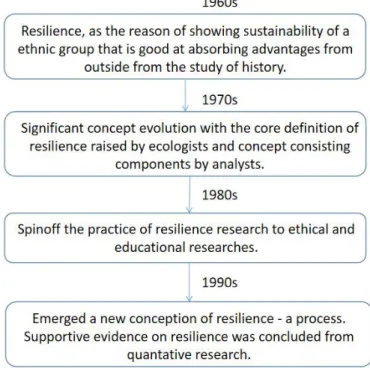
In the following seven decades, resilience was rarely discussed outside of material sciences. However, in 1965, the concept of resilience began to evolve beyond the board of general material science. Historians used the term, as a new one, to explain the research in his field. Anthony (1965) practiced the term to illustrate resilience as an attribution of Japanese culture since the late 19th century when the country encountered the western world. In detail, he argues that Japanese culture maintains its unity while being able to accept advantages from other societies, which shows the resilience of the culture.
Soon after the initial reference in the non-natural science study of history, ecologists began to describe their studies with the term within ten years. Among many researchers, Hollin (1973) gives a prerequisite while defining resilience on ecology, which is highly close to the current version, as the prototype. He states (1973, p. 1), 'But if we are dealing with a system profoundly affected by changes external to it, and continually confronted by the unexpected, the constancy of its behavior becomes less important than the persistence of the relationships.' Until then, the definition of resilience evolved from focusing on material, the item, itself, expanded on focusing the external environment that is going to affect on unities. In other words, scholars start to move their attention from focusing on whether their research targets are resilient or not while
confronting external adversity into considering what the mechanisms of interactions between external adversity and the research targets are.
Two years later, Holling, with another two researchers, as analysts, further integrated the questions of how to judge a resilient organization and how people can do to achieve organizational resilience more or less (Clark, Holling, & Jones, 1975). Moreover, they offer their definition of resilience as 'persistence-promoting (or "resilient") mechanisms and relationships in a variety of natural and human-made systems' (Clark, Holling, & Jones 1975, p. 1). Meanwhile, three components of resilience were proposed in this research as follows:
1. Boundary component, as the mechanism which enables the compromised part of the system to recover without any contribution from being non-affected parts.
2. Restorative component, which represents not only the existence of the uncompromised parts of the system but also the ability that the uncompromised parts could contribute to becoming the dysfunction parts.
3. Contingency component concerns the dependence extent of elastic properties of systems regards on the environment beyond its immediate impact.
Figure 3.1.2 Evolution Flow on the Conception of Resilience
In the late 1970s and early 1980s, the concept of resilience was further developed into the field such as educational research that compares the good and evil between the higher education system of US and UK (Shattock, 1979), philosophical science of discussing the way of preventing adversity accompanied by the appearance of computer (Branscomb & Gazis 1977), and ethnic study aims to analyze the immigration policy of a nation (Baureiss 1982).
Since the 1990s, researches on resilience not only limited to the topics related to the conception of the term but also integrate the term as processes from various perspectives. Psychologists argue that resilience, as an ability, is not given. Instead, it is a process learned by people during interactions (Egeland, Carlson & Sroufe, 1993). As a consequence, they find that caregiving, as the resilience process, contributed to mediating the accumulated adverse influence on children. Sociologists who study the pressure of economy based on family units propose marital support, as the resilience component in this topic, to erase the stress caused by marital problems and economic distress (Conger, Rueter & Elder 1999).
As the evolution of the concept of resilience from the late 19th-century until the end of the 20th century, the term itself had been first practiced from material science, then into various disciplines. Nonetheless, resilience is not discussed in the field of management science until the 21st century.
3.1.3 Research at New Stage
High Reliability Organizations
From the year of 2000, researches on resilience had gradually focused on various organizations, including business organizations, directly. The idea of resilience no longer stays in vagueness; rather, it had been further inserted into business operations as detailed guidelines and mindsets. Weick and Sutcliffe (2007) proposed five principles regarding organizational resilience, portrayed with a more explicit definition of the term. The two scholars first illustrate the underlying awareness, or 'mindful infrastructure' in their words, which obtains the following functions that shape the ground of the principles of resilience (Weick & Sutcliff 2007, p.2):
1. Track small failures. 2. Resists oversimplification. 3. Remains sensitive to operations. 4. Maintains capabilities for resilience.
5. Takes advantages of shifting locations of expertise.
After discussing several cases that have caused terrible results, the two scholars consequently came up with five principles by the framework with the title of 'High-Reliability Organizations' (HROs).
Principle 1. Preoccupation with failure. Principle 2. Reluctance to simplify. Principle 3. Sensitivity to operations. Principle 4. Commitment to resilience. Principle 5. Deference to expertise.
The principle of preoccupation with failure particularly emphasizes that any minor errors within the organization or system could be treated as the signals of unfortunate consequence. It is the most fundamental principle to forward to the next ones.
To improve operational efficiency, business organizations advocate simplifying their structures. Nevertheless, the two scholars argue that oversimplification could lead to overlooking information, sometimes a critical one, which could contribute to better judgment according to external dynamics. Thus, the principle of reluctance to simplify was concluded. By referring to the stage of sensitivity on operations, the two scholars emphasize that anomalies for the front line staff are required since they are the merging point.of business operations and environment. They believe business personnel can make better decisions with well-formed 'situational awareness' (Weick & Sutcliffe 2007, p.12).
Moreover, regarding the principle of commitment to resilience, the two experts deny the existence of a perfect system, followed by an illustration of the importance of keeping resilient. Then retrieved from the description of previous work about resilience, Weick and Sutcliffe (2007, p. 14) assert 'Resilience is a combination of keeping errors small and of improvising workarounds that allow the system to keep functioning.' as the base of the term. Ultimately, the final principle highlights the weakness of business structure with flat hierarchies beforehand, therefore propose the necessity to support the decision making authorities of the front line staff with expertise without concerning their ranking positions inside of business organizations. On the other hand, it fits another attribution of HROs, which is encouraging diversity within organizations.
To conclude, the concept and framework of HROs kicked off the study of business resilience in an integrated manner; however, the validity of testifying on HROs was not sufficient by then. Nevertheless, other scholars prove the efficacy of HROs as time went by.
The Resilience Dividend
To gain the good, the dividend, from being resilient, Rodin (2014, p.3 ) suggests 'Resilience is the capacity of any entity-an individual, a community, an organization, or a natural system-to prepare for disruption, to recover from shocks and stresses, and to adapt and grow from a disruptive experience.' as clarification on the term. Specifically, she advocates five characteristics-aware, diverse, integrated, self-regulating, and adaptive-consist of the framework of resilience.
According to the framework, for entities, being aware becomes the most valuable part of the process of being resilient. Realizing the resources and weakness, as a strategic analysis of situations, form the core guideline of the awareness. Furthermore, under the category of 'aware,' Rodin (2014, p. 15) mentions 'ability and willingness to constantly assess, take in new information, reassess and adjust our understanding of the most critical and relevant strengths and weaknesses and other factors as they change and develop.'. Meanwhile, the perception of 'situational awareness' is another essential term, which is a mindset of leading to the actions for entities to being aware. With some new considerations, Rodin complements the principle of preoccupation with failure from HROs.
Diverse, as the next element of the framework, Rodin essential agree with the idea of hesitate to simplify the organizational structure from HROs by making a further effort on stating resource that organizations could rely on, such as various capabilities, thoughts, intelligence channel, technical elements, and personnel. Moreover, she believes that entities should do more than
simply refuse to simplify their structures; they should prepare some spare or redundant parts that could replace the malfunction elements while confronting abnormities.
Equipped with awareness and diversity while facing unknown challenges, the ability to integrate available sources of entities plays a vital role while defining resilience. During the process of tackling the unexpected, entities are able to keep 'self-regulating' without taking fatal consequences. Last but not least, Rodin asserts that entities of adaptation are required as the last characteristic of resilience, which highlights the ability enables entities to make a timely adjustment based on the evolution of environments and situations.
Figure 3.1.3 Five Characteristics of Resilience from Rodin
Scholars quoted above proposed their understanding and frameworks on resilience from the experience of cases in various industries and communities by academic approach. Nevertheless, designing and analyzing resilient systems for business organizations in a practice-based manner were discussed as well by a different group of people.
CERT® Resilience Management Model
The CERT® Resilience Management Model, or known as CERT-RMM, is a managing process that individually pays attention to operational resilience. In particular, Caralli, Allen, Curtis, White, and Young (2010) manifest the model is originated based on the view of management study by emphasizing how systems, in the environment, fulfilled with uncertainty, to execute acutely and directly while reaching the goal of operational resilience. The initial version of overall CERT-RMM contains more than twenty processes on four categories of operational resilience management-'enterprise management, engineering, operations, and process management' (Caralli, Allen, Curtis, White & Young 2010, p.3)-for organizations varying industries.
Although with diversity for different processes, CERT-RMM mainly prints the definitions on six key components, which are services, business processes, assets, resilience requirements, strategies for protecting and sustaining assets and services, and life-cycle coverage. Independent processes
are practiced according to the category of the component. However, three distinctive characteristics can be concluded, as the advantages of CERT-RMM.
First, it devotes to integrate the tasks of security management, business continuity, and IT operations management that aims to increase the performance of risk and resilience management. Secondly, the model puts the operational tasks into a process, which improves the process of innovation by not only practice but also spinoff these innovations to other fields. Finally, it plants vital concepts for process internalization inside of organizations.
Nevertheless, even with the current available framework and model for dealing with uncertainties and risks, organizations, as still, are overwhelmed continuously on the road of being resilient, especially in an era of black swan and gray rhino.
Review on Journal Papers since about 2000
Besides the detail-fulfilled theories regarding resilience, journal papers, as well, had launched the discussion of the topic simultaneously. However, researchers present their findings on resilience from various perspectives by the given circumstances.
As an ability, organizational resilience is initially investigated for the mission of researching the characteristics or attributions that help organizations recover and rebound from the crisis; hence, researchers focus on the original input of organizations being resilient, which is an organizational crisis. For instance, Pearson and Clair (1998) argue that the corporate crisis, an event of high-impact with low-possibility, is not systematically integrated because the previous researches were grounded from distinctive standing-points while focusing on the topic. Therefore, she purposed the definitions of organizational crisis and crisis management throughout reframing the issue based on the views of psychology, social-politics, and technological-structure. Then ultimately 'develop a comprehensive model of the crisis management process' (Pearson & Clair 1998, p. 59), as shown below with some propositions.
Figure 3.1.4. The Crisis Management Process By Pearson and Clair 1998, p. 66
Moreover, regarding the propositions proposed by this work, the relationship between organizational crisis and CSR starts to be uncovered since a particular interest group of organizational-crisis-affected have been brought in.
Later, in 2009, additional scholars illustrate organizational resilience from different methods based on the case analysis and discussion derived from types of organizations. Powley (2009) highlights the importance of resilience activation that concentrates on the movement or response organizations will practice during the unexpected shocks in light of human relations. He articulates that during external crisis events, the relationship among the personnel inside of an organization could significantly boost the resilient reaction that can resolve or mitigate the adversities. By launching qualitative research equipped with the grounded theory approach, Powley (2009) initiated an organizational resilience study in a US university and then concludes a mechanism of resilience activation, as shown below.
Figure 3.1.5. Mechanisms of Resilience Activation Powley 2009, p. 1298.
Although the research from Powley provided a part of the mechanism that could implement the analysis of organizational resilience, the study tries to diffuse the practicability of such mechanism into organizations by conducting research in an academic organization and reviewing previous relevant works. Nevertheless, as a generalized one, the validity and credibility of the mechanism for organizations are yet to be testified.
Similarly, Burnard and Bhamra (2011) research on organizational resilience focused on an organizational response, particularly on uncovering the characteristics of resilient organizations while responding to crises. In other words, this research concentrates on responding, which is logically followed by the step of resilient system activation extended from previous works. Nevertheless, the authors of the research portray a more holistic framework in speaking of resilient response as expressed below.
Unlike previous works, Burnard and Bhamra (2011) framed the conception of resilient organizational response with more process details. First, researchers highlight the significance of a
stage called 'critical period' that contains the movement of threat detection, resilient activation, and enhanced monitoring of the crisis. These three movements consist of the organizations' responsive activities under threat that will cause organizational adjustment with different consequences. Both positive and negative adjustments will evolve to the organizational learning process, aiming to improve the monitoring actions on a threat. Meanwhile, those organizational adjustments lead to positive consequences that would be identified as a resilient response that could handle threats.
Figure 3.1.6. Resilient Response Framework Burnard and Bhamra 2011, p.5589.
Later, researchers started to review research works on the topic of resilience in business and management. By deploying quantitative research methodology, Linnenluecke (2015) retrieves 339 influential publications from 1977 to 2014 regarding organizational resilience. By analyzing the previous works, Linnenluecke (2015, p. 2) concludes that resilience had been researched from five significant directions sequentially as:
1. Organizational responses to external threats; 2. Organizational reliability;
3. Employee strengths;
4. The adaptability of business models or;
5. Design principles that reduce supply chain vulnerabilities and disruptions.
Grounded by hundreds of existed papers, Linnenluecke articulates a question for future research of "whether these are complementary or competing, or simply context-dependent 'approaches' to build resilience” (Linnenluecke (2015, p. 13).
Moreover, researchers try to put a more clarified framework that integrates the topic of crisis management and resilience. Williams et al. (2017) manifest a holistic process flow that illustrates the integration of crisis management and resilience, as depicted below.
Gathering the types of adversities, Williams et al. (2017) categorize the crisis events into two dimensions: a crisis with moderate urgency and crisis with profound impact. Under the structure
of a moderate urgency crisis, the researchers develop a loop of organizing and adjusting, which is further broken down into the elements of capabilities for durability consist of four endowments, as well as reliability organizing and adjusting, as another one. Meanwhile, reaction to a critical crisis, cognitive responding, behavioral response, and contextual reinforcement to adversity become the significant movements of organizations. Inside of this stage, Williams et al. (2017) discuss the reactions from organizations from the backgrounds of psychology, sociology, and organizational resilience.
Further, both types of resilience development and enactment would lead to positive outcomes and ultimately flow to the resilience feedback loop. Nevertheless, the authors highlight the disadvantages, or "the dark side of resilience" in their language, of both structures by arguing that resilience could trigger the phenomenon like reluctant to change in organizations, failed to learn and adapt from a crisis, and being vulnerable in scenarios of new normal.
Figure 3.1.7. Process View of the Fusion of Crisis Management and Resilience Williams et al. 2017, p. 751.
3.1.4 New Challenges Black Swan
Before Europeans witnessed black swan in Australia, they believed all swans were in white. For a long time, 'swans are white' was an unbreakable creed in their minds, which, as a consequence, shocked and surprised themselves. Taleb (2011) concluded that the most distinctive characteristic of a black swan event is the experience gained through many verifications in the array of human knowledge would cause upheaval as long as another phenomenon takes place only once. As the complement statement, Taleb (2011) discusses a black swan event that tells us the revelation of the severe limitation and vulnerabilities of the knowledge accumulated by experience and
observation.
Further, by taking examples of the Great East Japan earthquake hit the country on March 11 of 2011 that had caused a tragic loss, the and '9.11' event, the terrorist attack murdered thousands of lives, Taleb (2011) continues to supplement the remaining attributions of black swan event: high unpredictability and fatality on causing consequence. Meanwhile, he highlights the background of a high possibility of the occurrence of black swan event-a society of extremist, a society distributes inequality. These statements on reality of inequality, on diverse aspects, proved by other scholars as well (Atkinson, 2015; Western & Pettit, 2010; Murdock & Golding, 1989; Glied & Lleras-Muney, 2008).
At the same time, Taleb (2011) illustrates several critical mindsets on facing a black swan event: 1. Evolution takes place disruptively rather than smoothly.
2. Making judgments solely based on experience does not work. 3. Avoiding group thinking, in a manner of behaving, not concerning.
In essence, Taleb (2011) believes that even with the unpredictability of black swan events, individuals and organizations can improve the performance on risk and crisis defense with an awareness of being highly alert.
Gray Rhino
While Taleb came up with the phenomenon of a black swan event and created a corresponding explanation, Wucker (2017) proposes the type of crises that obtain opposite characteristics, known as 'gray rhino.'. Wucker (2017) takes a metaphor, as a scenario and the originality of the term, to describe the perception of gray rhino by manifesting three persons observing rhinos in Africa. Although told by local guidance not to annoy rhinos for the concerns of safety, tourists who occasionally spotted the appearance of rhinos were so excited to take a look at the rare creature within a close distance for the film some pictures. One of the tourists blew the whistle and attracted the attention of a baby rhino, but the matured rhino was alerted as well and recognized the tourists were about to hurt the baby rhino-it was annoyed-and rushed to the people. While facing a fatal threat, the tourists were frozen to take action even they clearly remember the advice from the guide of "do not freeze.". The metaphor shows three distinctive attributions of gray rhino crises as below:
1. Individuals and organizations were told with some information for avoiding the dangerous. 2. Individuals and organizations choose to overlook the dangerous.
3. Individuals and organizations were reluctant to take actions to avoid and/or mitigate the consequences by the dangerous beforehand or during the process.
Wucker (2017) analyzes the mindset of those business organizations and other entities which overvalue the optimism when predicting possible issues. In other words, the over-optimistic organizations prefer to persist and deny the probable problem, as bias, that had been studied by another scholar (Sharot, 2011). As the reason for persists and deny risks, Mitroff (2000) states,
many organizations are in the absence of risk and crisis detecting mechanism. Even by the time of facing crises, Wucker (2017) suggests the way to dissolve is to, first, diagnose the applicability of crises responding and keep clam. With rationale, members of an organization can act according to situations. Further, for those who go-through crises successfully, the opportunities, such as revise and adjust internal structures, should be discovered as the learned experience. Last, Wucker (2017) highlights that having a long-term plan while issues, risks, and crises are far from showing up as the most fundamental method to keep safe.
For Further Research
Referred to the originality, evolution, and upcoming challenges on resilience, some questions are remained to consider based on the interest of this research.
1. The studied researches on resilience mainly focus on western organizations. Can the same conclusions on resilience reproduce in business organizations in China and Japan with practical evidence?
2. Do there exist universal resilient business structures for firms in China and Japan?
3. Do there exist universal resilient business structures for firms in the same industry or even different industries?
4. What are the factors that influence the performance of business resilience for Chinese and Japanese companies, if there are any?
3.2 On Business Strategy
The strategy is a term used to be utilized in the field of the military other than politics. As the world economy developing, the strategy began to emerge with the discipline of the business study of management. However, the cognition on the originality of business strategy is divided by the sides of the east and of the west.
3.2.1 Views from the West on Timeline before 2000
The concept of business strategy did not shape until the formation of the management discipline by Drucker decades later (Freedman, 2013). Drucker (1955), in his famous book of The Practice of Management, notices the linkage of distributing capital and labor forces. In detail, Drucker associates the management to the economic performance of firms. Further, he criticized the Taylorism management, scientific management, that strips the execution from planning with the neglect of dynamics of the environment.
With the background of management discipline, however, Kiechel Ⅲ (2010) states that before the early start of the revolution of corporate strategy in the 1960s, there was no business strategy. He proposed before the establishment of the concept of business strategy, costs, customers, and competitors, or known as "three Cs", were the core components that refer to the destiny of business organizations. Nevertheless, as a matter of fact, Drucker (1955) describes the term "business strategy" as one stage in the loop of practical business judgment while illustrating the design of corporate performance. The book of Drucker made the term strategy prevalent since the
1960s (Freedman, 2013). The founder of strategic management, Igor Ansoff (1965) states his version on the purpose of strategic management, which links the concept of strategy with the discipline of management, as developing series of theories and processes with practical value to help a manager to operate the business so that the business firms could utilize these methods for strategic decision making.
The evolution process of the term went on continuously. Andrews (1971) describes the term based on a long-term view since he considers the development sustainability of businesses in the long-run. Later, with his colleagues, Andrews conducted a famous framework of SWOT (Strength, Weakness, Opportunities, and Threats) analysis as well as highlighted a substantial view of case-specific under according circumstances (Freedman 2013). Meanwhile, he emphasized it is critical that ensuring strategy formation is followed by execution and implementation, or otherwise, the gap between practice and planning would appear, which is advocated by Mintzberg, Ahlstrand, and Lample (2005).
Although by given the purpose of strategic planning, as the essence of business strategy, at the time, problems of over-redundancy were raised. Freedman (2013) reviews that because of the overwhelmed tasks and expenses on strategic planning, implementation was completely separated because of the bureaucracy and over-dependence on skeptical data, as Mintzberg criticized as the fatal shortcoming of theory on strategic planning defended by Ansoff (1991).
Nevertheless, Porter (1996) pulls back the discussion on business strategy by publishing his paper What Is Strategy with providing his answers to the title as a concern in late 20th century from five dimensions as the following:
1. Operational effectiveness is not strategy. 2. Strategy rests on unique activities.
3. A sustainable strategic position requires trade-offs. 4. Fit drives both competitive advantage and sustainability. 5. Rediscovering strategy.
Porter (1996) discusses that businesses must obtain operation effectiveness; however, not sufficient. Operational effectiveness refers to a company that performs better than its competitors on similar tasks, while strategic implies either performing distinct with others or performing similarly in a distinctive way. Hence, he steps to the second dimension. Later, he argues that businesses need to choose to maintain their strategic position sustainability, followed by an illustration of three types of fit. Lastly, he emphasized that the confusion within companies and the external changes, as a combination, could mislead the business strategies as the reason for refining and analyzing current strategies.
Though as the concept and practices of business strategy upgrade by time, the term itself have been combined with a new mindset and scenario-specific trade-offs since the 21st century.
Figure 3.2.1 Evolution and Argument on Business Strategy Before 2000 3.2.2 Business Strategy After 2000
The tasks of business strategy, embody the value of the long-term interest of business from previous academic work, have been revised to not only ensure the survival and expanding, but also to achieve sustainability by implementations. However, scholars who concentrate on the study of business strategy analysis have proposed the mindset and methods of practice from various perspectives.
Porter and the Five-Force Model
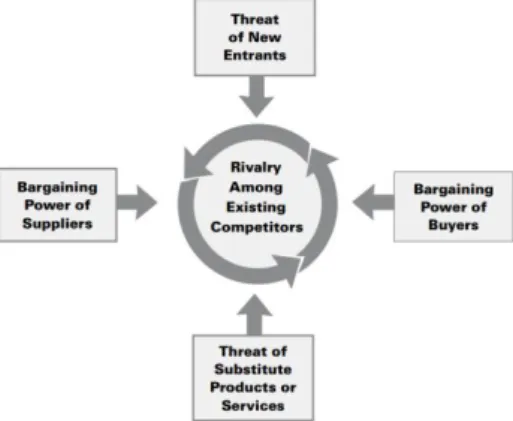
At the very beginning of the paper that proposed the five-force model, Porter (2008, p. 25) highlights 'the job of the strategist is to understand and cope with competitions' as the background of his mindset. In brief, he focuses on competitions among business organizations to practice the five-force model as being strategic by given his academic specialty on market competition.
Figure 3.2.2 The Five Forces That Shape Industry Competition By Porter, 2008, p. 27
Porter (2008) believes that while referring to business strategy, companies shall consider five aspects. Businesses are expected to evaluate the replaceability not only on the products or services but also other new players who begin to join. Meanwhile, in the chain of value delivery, analyzing the dynamics of the bargaining power of their suppliers and buyers is critical as well. Last, taking account of the current competitions among existing players as the overall picture.
Nevertheless, the mindset and framework on business strategy from scholars like Porter concentrate on how to help businesses to compete in the red sea market. A theory based on the opposite mindset of focusing the competition in the red sea market emerges.
Blue Ocean Strategy from Kim and Mauborgne
Kim and Mauborgne are known for their researches on blue ocean strategy. The two scholars revolved the way of thinking on business strategy as they look beyond the full market competition. Their early work, a paper published in 2004, initially illustrates their mindset on business strategy, which put innovation as the cornerstone of the concept. Kim and Mauborgne (2004) state the case of Cirque du Soleil, a company which has had been trapped in a business paradox of increasing cost on their performance while decreasing the number of buyers but later achieved a large number of revenues from the market, as an example to start to engage with the analysis of blue ocean strategy.
With intensified market competition, such as price war among rivals or full market saturation, Kim & Mauborgne (2004) describes the distinctive characteristics of red ocean strategy and blue ocean strategy as below:
Red ocean strategy Blue ocean strategy
Compete in existing market space. Create Uncontested market space. Beat the competition. Make the competition irrelevant. Exploit existing demand. Create and capture new demand. Make the value/cost trade-off. Break the value/cost trade-off.
Align the whole system of a company’s Align the whole system of a company’s activities with its strategic choice of activities in pursuit if differentiation and differentiation or low cost. low cost.
Table 3.2.1 Red Ocean Versus Blue Ocean Strategy By Kim and Mauborgne, 2004, p. 136.
Moreover, the two scholars (2004) state that the fundamental method towards the blue ocean, the uncovered market, is to overlap the targets that the strategies of differentiation and low-cost design to achieve.
Thirteen years later, the theory on blue ocean strategy was upgraded. Kim and Mauborgne (2017) expand the theory from identifying blue ocean to setting practical steps by several case studies. In brief, they proposed five steps as the guideline for realizing practice:
Step One: Get started.
Step Two: Understand where you are now. Step Three: Imagine where you could be. Step Four: Find how you get there. Step Five: Make your move.
Unlike Porter's view on the competition with rivals, Kim and Mauborgne (2017) suggest that emerging businesses shall concern on the products or services that directly lead to the blue ocean while recommending conglomerates, or large organizations, to have a product or service portfolio by providing an analytical tool (p. 86) 'called the pioneer-migrator-settler map.' That is to say, blue ocean strategy values innovative products or services rather than intensified competition in the existing market. While prepared with designated blue ocean market, setting up a group of people who could make explicit the uncontested market demand into products or services, tangible or intangible, jumps into consideration.
The second step is somewhat similar to the view of strategic planning proposed by other strategic researchers; however, Kim and Mauborgne mix the dynamics inside and outside of businesses with putting another analytical tool titled (p.120) 'strategy canvas' to portray the situation in a current market and the relationship between the demand and the supply. Distinctive characteristics of the mindset of blue ocean strategy reveal themselves in the following step. When the task of identifying utilities of the products or services, blue ocean strategy emphasizes reaching the segment that the current products or services, in the market, yet to function but highly expected by the market. Also, referring to identify the receivers, blue ocean strategy encourages to highlight the noncustomers - the potential customers who are blocked out due to various reasons - and unleash them to the businesses.
When it comes to the fourth step, Kim and Mauborgne (2017) state that businesses could spot away to blue ocean market by proposing a new value-cost frontier by practicing a six-path framework, an analyzing framework that helps businesses to look over all the nodes and chains systematically relate to their products. Then design the action plan based on The Four Actions Framework, which is consisted of the ideas to create, raise, reduce, and eliminate. Ultimately, choose the blue ocean movement by selecting opinions inside while producing market tests. By enlarge the good things achieved, the blue ocean strategy is achieved.
No matter it comes to the discussion on business strategy from the views of the red sea market competition or blue ocean market expanding, proper strategic portfolio according to cope with different business situations is somewhat less mentioned. Thus, strategic business experts, as scholars as well, transfer their sights to look into the study business strategy portfolio that guides businesses through a long period with different strategies.
Optimizing Competition Strategy from Boston Consulting Group (BCG)
In the introduction of the book, Your Strategy Needs a Strategy, Reeves, Haanæs, and Sinha (2016) assert that businesses could only find the most optimized solution based on analyzing specific tasks. They introduce a framework called 'Strategy Palette,' which translates five business environments and according to business strategies that fit them, respectively.
The framework, as shown in Figure 3.2.3, concludes five strategies that vary to five different market environments from three dimensions: unpredictability, malleability, and harshness. In brief, the framework believes that businesses could play classical strategy while the environment is comfortable to foresee and malleable. Adaptive strategies are appropriate for firms while things are in high-uncertainty but still changeable. In the time of high malleability with easy-foresee circumstances, visionary strategies can jump into the management, while if unpredictability and malleability are high simultaneously, then it is the time for companies to practice shaping strategies. Last, if the businesses were extremely constrained, that is to say, in high harshness, there is no alternation but utilize renewal strategies.
Figure 3.2.3 The Right Approach to Strategy Depends on the Environment, From Reeves, Legrand, and Fuller, 2018.
Also seen from Reeves, Haanæs, and Sinha, simplified Chinese translation, 2016. Moreover, Reeves, Haanæs, and Sinha (2016) illustrate the core concepts of each strategy are distinctive. Classical strategies require businesses to enlarge its size by first analyzing, followed by planning, and ultimately implementing when everything is easy to predict but change. Being fast lies as the center of adaptive strategies in the situation of high-uncertainty with stability. Threatened by changes, picking up the most appropriate strategy and spread it out into business practices becomes the logic of the adaptive ones.
Within low stability but high predictability, it will be possible for enterprises to propose practical assumptions with value, then concrete the ideas and achieve perseverance to realize the visionary strategy. While the future becomes difficult to foresee, but the industry is easy to change, then it is
the right time to deploy shaping strategies by getting attraction from the market, coordinate with business partners, and develop. In the worst case for businesses, in other words, if firms were strand in the ocean of business competition, it is necessary to pick up renewal strategies from their tool knits. When uncertainties hit firms, they need to respond in the first place, then reshape their businesses scales and structures to save cost for future business growing after everything becomes stabilized.
Nevertheless, Reeves, Haanæs, and Sinha (2016) mention an implementation skill, which is not included in the 'Strategy Palette' but composed by elements of the 'Strategy Palette' to merge. They call it ambidexterity. The background of the emergence of the skill is that experts had aware and noticed that businesses need to take several strategies in one shot, notwithstanding the conflict that may occur. They (2016, p. 232) define it as 'the capability of businesses to apply multiple methods of strategies in a period of time or in a consistent period of time'. That is to say, experts and scholars are contributing to tackling the difficulties derived from the complexity and paradox of the environment.
Western scholars had and are still researching business strategy originated from various mindsets and technical tools; however, scholars from east, especially China, had formed the fundamental principles on the strategy which are enlightened by political and military activities for more than two thousand years before.
3.2.3 Views from the East before 2000
It is well-known that the theory on strategy in the east are mainly originated from ancient China, especially in the periods of Spring and Autumn and the Warring States. Despite the concept and practice of strategy had been practiced in China throughout history; however, due to the political policy of 'favor agriculture and disfavor commerce' that put ancient Chinese business personnel in the lowest social status, codes and records concentrate on the topic of business with known authors is rare up to date. Business wisdom has remained in forms of oral inheritance. As the Chinese proverb says, 'Business circles are like battlefields.'.
Though some Chinese business strategists have been significantly influenced by western views to come up with specific technical tools and frameworks, in practice, Chinese experts like Wang (2018) proposes a strategic framework in the western style which pays more attention to specific issues. Nevertheless, strategies are the method of reaching the goal from macroscopic views rather than microscopic; otherwise, strategies become tactics. In short, the strategy is not a part of a business but a business itself. Business, withhold a centralized target, could synchronize and deploy its available resources thoroughly. If not so, a business loses or at least blur, the mission of its strategy. Sun Tzu, by his profound work of the Art of War, discusses and concludes the mindset of strategy about the time of 515 B.C. - 512 B.C. (Sima, 104 B.C.- 91 B.C.).
Sun Tzu: the Art of War
As Griffith (1963) translates the original text of the book, Sun Tzu declares five significant dimensions-moral influence, weather, terrain, command, and doctrine-before considering a war.
The same logic is applicable in a business context. Moral influence refers to the harmony of a leader with staff that can bond the two sides even in adversities. In short, it is togetherness. The weather could be translated as the macroscopic environment, which shapes the constrain of business movements. The terrain is equivalent to the landscapes of business. Command states the characteristics of the person who implement business activities. In modern language, command equals leadership. Doctrine is a combination conception of human resource management, organizational regulations, and audition. In brief, the doctrine can be interpreted as a holistic management system. Thus, it forms the base of philosophy enlightened by Sun Tzu in business strategy, as Figure 3.2.4.
By put the five fundamental elements as the blueprint, seven branches are broke down as Griffith (1963, p. 65) translates from Sun Tzu 'If you say which ruler possesses moral influence, which commander is the more able, which army obtains the advantages of nature and the terrain, in which regulations and instructions are better carried out, which troops are the stronger; Which has the better trained officers and men; And which administers rewards and punishments in a more enlightened manner; I will be able to forecast which side will be victorious and which defeated.'. Interpreting to the business context, a person in top place shall inspire and unite the rest of the people; executors, senior or junior, shall obtain various abilities in different places; businesses shall aware of the macroscopic environment and industry landscape; regulations and instructions shall be practiced as best as it can; business organizations shall devote to remain in an advantageous position with well-trained staff as well as the training system; companies shall have clear reward and punishment policy with transparent implementation.
Figure 3.2.4 Philosophy of the Art of War to Business Strategy
With the mindset on strategy, Sun Tzu describes several principles of strategy in his later writing. Sun Tzu highlights the war shall not be prolonged; otherwise, it becomes a disaster. Same for the strategy, if the strategy implementation takes a long time, people would exhausted, the resource would run out, and most importantly, the strategic goal would reveal as time goes by. Considering the cost of the resource, Sun Tzu asserts that it is more economical to take the resource of competitors or rivals to supplement. Moreover, he states that the best practice of war is to make the enemy's strategy unable. If not, break up the enemy's appliance; then attack the enemy; the worst is to attack cities. In business, different companies share various strategies with distinct
法 道
天 地
partners; hence it is meaningful to apply the idea.
Principle 1. Do not prolong the time to implement a strategy. Principle 2. Take rivals' resources to supplement.
Principle 3. Compete with business rivals by disabling their strategic goal and not to directly offense them.
Further, Sun Tzu portrays five crucial elements that decide the result of the offensive strategy: 1. Knowing the timing of the attack and not so.
2. Knowing the force of large or small.
3. Sharing a consistent goal from up to the bottom. 4. Waiting for enemies' movement with caution. 5. Having a capable commander who has not interfered.
In a business context, a capable commander refers to the executor of business strategy implementation. Thus forms the guideline of how to implement offensive business strategy. In conclusion, the mindset of strategy from Sun Tzu highly values the unity of each element that form strategy supported by according tactics design to create relentless energy.
3.3 On Corporate Social Responsibility
Corporate social responsibility (CSR), a term evolved from social responsibility and corporate performance (Kuisma, 2017), describes the functions - basic and advanced - of businesses. Though as early as 1950, scholars had begun to research on corporate responsibilities from the various perspectives such as entrepreneurs and management, as a prototype of corporate social responsibility (Brown, 1950; Drucker 1954), and directly on the subject (Bowen, 1953), the term did not become valid in modern time until Carroll proposed his famous The Pyramid of Corporate Social Responsibility. However, his work can be traced back to the 1970s and expand to the 2010s.
3.3.1 CSR Before 1990s
Bowen initially published his definitive book on CSR in 1953, titled Social Responsibilities of the Businessman, which is considered as the foundation of the discipline (Carroll, 1979). In essence, Bowen (1953) believes that business decisions and the business activities derived from them are somehow shaping the future of society. Some business stakeholders, for instance, customers, employees, and the government will be inevitably affected. Hence, the responsibilities of the consequences of the business decisions are put on the shoulders of businesses. That becomes the reason to study and analyze related questions regarding CSR.
Bowen (1953) based his research and observation of the given time scale specified in the US; he declared to breakdown the term of CSR into several sub-categories with questions and assumptions accordingly. He put the economic goals of corporations as the first aspect to discuss. Then he analyzes the social responsibilities of businessman under the system of laissez-faire, which is similar to the absolutely free exchange market nearly without any intervention from the government. Further, he looks into the views of the social responsibilities of businessmen from different sides: protestant and businessman. Moreover, he portrays the concept of social
responsibilities of businessmen and roots out the reason that explains why businessmen put specific concerns into the topic. Finally, he brings in business ethics as an explanation of the law of social responsibilities.
Economic goals
Several goals form the list of economic goals of the corporation were concluded as follows: 1) high standard living; 2) economic progress; 3) economic stability; 4) personal security; 5) order; 6) justice; 7) freedom; 8) development of the individual person; 9) community improvement; 10) national security; 11) personal integrity. In brief, few dimensions could be extracted from the above list: 1. economic growth, for individuals, groups, communities, and nation; 2. social stability; 3. social equality, the concept not purely concentrate on the economy but individual opportunities and rights as well; 4. social and national welfare.
Reviewing CSR under the Laissez-Faire System in the 19th Century
By reviewing business practices in the 19th century in some countries that were once in the system of laissez-faire, Bowen (1953) argues that businessmen excellently followed the principle of being efficient on the economy to maximize the return of interests. Nevertheless, in the progress of the upgrade of the economy, of the market, and technology, businessmen practiced poorly on the protecting employees' legal rights while limited legal regulation legislated accordingly, not mention the implementation. The social responsibilities of businessmen were highly dependent on the moral standards of businessmen. Hence, he starts to look deep into the religious perspective-from the view of protestant.
Defining Social Responsibilities: Protestants and Businessmen
Regardless of the discussion on religious-related issues, protestant viewpoints on social responsibilities of businessmen, which later formed as The Amsterdam Statement, could be generally summarized into the following dimensions based on Bowen (1953) conclusion:
1. Being economic based on the value of serving the society. It refers to businessmen should put the consideration of the needs and interests of the public in the first place rather than overwhelmed by maximizing the economic profit. Stick to the above prerequisite; businessmen shoulder the responsibility to push forward social progress by improving the efficiency and productivity of business production. Meanwhile, eliminating poverty and economic inequality by business production shall be achieved. However, business productions must not overdraft the resources which are for the future human generations.
2. Being respectful to the stakeholders. Customers, employees, suppliers, business partners, and rivals, and other personnel who associate with the business, businessmen must confess and respect various rights, or in Bowen's word 'dignity.' Specifically, businessmen must not prejudice others because of (Bowen 1953, E-book) 'race, religion, political views, national origin, social status, physical appearance, or sex (expect as these characteristics affect actual work performance).' Furthermore, providing opportunities with equality represents a manner from the businessmen of valuing human dignity.
3. Being considerable to the labor force. Bowen (1953) concludes that it is the responsibility of businessmen to offer moral and secure working space for the workers; however, it is far from enough. Working security indicates covers for employees via some welfare methods such as
social insurance to clear the economic concern of the labor force. Also, compensation is desired to be deployed originated from the needs of the household of employees and their performance. To the next stage, businessmen shall take care of the workers' families. Lastly, businessmen should guide workers to fulfill a sense of achievement by practicing day-to-day business operations.
4. Being decentralized and transparent as soon as possible when it is applicable. Institutions of politics and commerce shall be decentralized. Meanwhile, honesty dealings shall be witnessed all the way through.
On the other hand, businessmen thought similar social responsibilities with some differences to the views of Protestants with a different mindset. There is no doubt that businessmen regard being profitable of businesses lies as the footstone of the social responsibilities while with additional thoughts. Businessmen agree on their social responsibilities of realizing economic stability, progress, and improvement while not deplete the natural resources for future generations. However, by collecting and analyzing various materials on the statement and opinions of businessmen, Bowen (1953) asserts the social responsibilities of businessmen within the following categories:
1. Educating the modern business systems to the public. American businessmen believe that it is their responsibility to cultivate the concept of business and the bright side of businesses by showing their goodwill in communicating with society.
2. Human relations. The statement on human relations articulates the relationship between businessmen and workers via providing good working conditions without unhealthy conditions while with backups and opportunities. Nevertheless, the motivation of establishing good relations with workers is originated from the pragmatism viewpoint, which is to best practice the production efficiency rather than from the viewpoint of humanity.
3. Public relations. The term refers to the relationship between businessmen and the local community and government. For local communities, businessmen mainly put themselves as fund providers to participate in community activities for their business interests. As for the government, businessmen propose that they shoulder the responsibility of shaping public policies. Moreover, due to the economic contribution to society, businessmen regard themselves as having an obligation to offer leadership to society and contributing to national security.
Bowen (1953) mainly discusses the corporate social responsibilities from the views of US society in the given time, but the conception of the term CSR was kept renewing.
3.3.2 Carroll and Theories on CSR
Before the Pyramid of Corporate Social Responsibility
Before the year when Carroll came up with his famous description of CSR as the most prevalent theory of the discipline, he researched on corporate performance as the originality of his theory on CSR. Carroll (1979) proposed a three-dimensional model while analyzing corporate performance, as shown in Figure 3.3.1.
Carroll (1979) highlights his version of the concept of corporate social responsibilities after reviewed previous work on the subject. At the time, he suggests that the overall social responsibilities of businesses can be divided into four sections-economic responsibilities, legal