比例代表制選挙におけるブロック別ドント式についての
非確率論的及び確率論的考察
(Non-probabilistic
and
probabilistic approaches to
the d’Hondt
system
of proportional
representationwith
blocs)
筑波大・数学 佐藤道–
(Michikazu Sato)*
Abstract
It is usually
believed
in Japan that the
d’Hondt
system
with
blocs
gives
an
advantage
to large
parties.
If
we
regard the number of votes that each party
gets
as a
constant
(a
non-probabilistic
approach),
not
a
random
variable,
this is
not generally correct. I
give
an
easy
counter-example,
also another by falsihing the actual
data,
giving
more
votes to
the largest
party,
and fewer votes
to
other
parties.
In
a
non-probabilistic approach,
I show
some
inequalities
on
the
number of seats that each
party
wins.
I give
a
rigorous
statement
and
a
proof
that,
under
the d’Hondt
system:
a merger
does not decrease seats
unless
losing
support.
If
the
proportions
of
the
votes that
a
party gets
are
approximately
independent
of
blocs,
then
the blocs give
a
disadvantage
as
long
as
it is
a
question
whether
the
party
wins
a
seat
or
not. If
we
regard
the number of votes that each
party gets
as a
random
variable
(a probabilistic
approach),
then
the
d’Hondt
system with
blocs
gives
an
advantage
to large
parties
in
the
sense
of
the
expectation
under
some
assumptions.
1. Introduction
On October 20, 1996, the election of theLower House of the Japanese Diet
was
held for the first timeunder a
new
system, whichwas
introduced in1994. Thenew
electoralsystemcomprises 300single-seatcon-stituencies and200proportionalrepresentation$(\mathrm{P}\mathrm{R})$ seats bythe d’Hondt
system1
with 11blocs2
(districts).The old
one
is the single nontransferable vote systeminmedium-sizeddistricts, which isdiscussed by, e.g.,Taagepera and Shugart (1989, p. 28) and Cox (1996). It iswell known that the single-seat system gives a
great advantage to the largest party, and the election result also proves this. In the following discussion,
I consider mathematically whether the d’Hondt systemofPRwith blocsgivesan advantagetolargeparties
ornot.
*This researchwassupported in part by$\mathrm{c}_{\mathrm{r}\mathrm{a}\mathrm{n}\mathrm{t}-}\mathrm{i}\mathrm{n}$
-Aid forScienceResearch, Ministry of Education, Science, Sports and Culture, Japan.
1 D’Hondt $(1878, 1882)$ proposed his system in Belgium, and it was introduced in France in 1899.
Hagenbach-Bischoff et al. (1884, pp. 26-27) gave a method of using $f$
.
in Section 2. Hagenbach-Bischoff (1888) proposed aneasierwayof calculationtoreach thesameeffect in Switzerland, which is called the Hagenbach-Bischoffsystemtoday. According to Fujita (1978, pp. 101-104), this was proposed in 1892. His contribution is importanttoday, however,
in theoretical sense, which Ishallstate below Theorem 1, rather than to have proposed an easier way of calculation.
Using Mathematica for Macintosh, I calculated the numbers of seats by the method of d’Hondt in few seconds even if the magnitude is 200. See also Hagenbach-Bischoff (1908), Moriguchi (1925), Birke (1961), Mizuki (1967), and Rokkan (1968).
Yamamoto et al. (1996) and anonymous authors (1996b) considerwhether each party would win more
seatsifthe PRwere carriedout under aconstituency coveringthe whole nation (i.e., not divided intoblocs,
“Nation” in tables). Their result is given in Table 1.
TABLE 1. PR seats
$\frac{\mathrm{L}\mathrm{D}\mathrm{P}\mathrm{N}\mathrm{F}\mathrm{p}\mathrm{M}\mathrm{I}\mathrm{N}\mathrm{J}\mathrm{C}\mathrm{P}\mathrm{S}\mathrm{D}\mathrm{P}\mathrm{N}\mathrm{s}\mathrm{P}\mathrm{N}\mathrm{P}\mathrm{S}\mathrm{J}\mathrm{R}\mathrm{D}\mathrm{R}\mathrm{L}\mathrm{T}\mathrm{o}\mathrm{t}\mathrm{a}1}{\mathrm{A}\mathrm{c}\mathrm{t}\mathrm{u}\mathrm{a}1\mathit{7}0603524110000200}$
Nation 66 57 32 26 13 3 2 1 $0$ 200
Increment $-4$ $-3$ $-3$ $+2$ $+2$ $+3$ $+2$ $+1$ $0$ $0$
LDP Liberal Democratic Party
NFP Shinshinto (NewFrontier Party)
MIN Minshuto (Democratic Party ofJapan)
JCP Japanese Communist Party
SDP Social Democratic
Par..ty
.NSP New Socialist Party
NPS New Party Sakigake
JR Liberal League (Jiyu Rengo)
DRL Democratic Reform League
English names and their abbreviations are used according to annonymous authors (1996a).
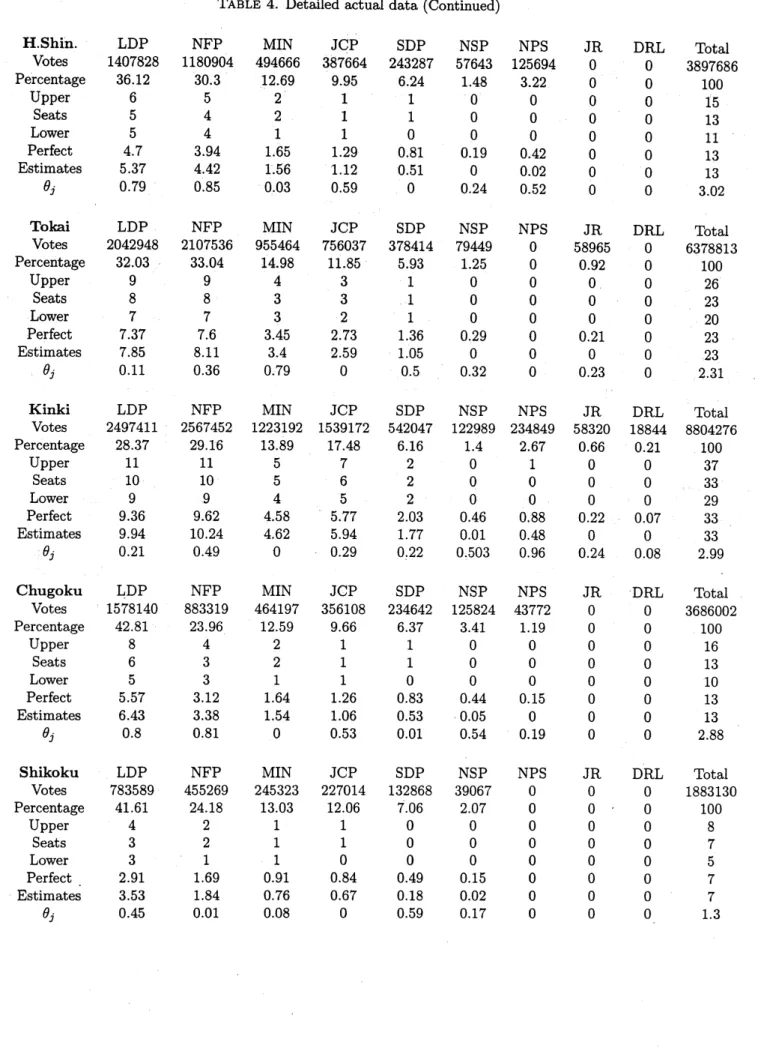
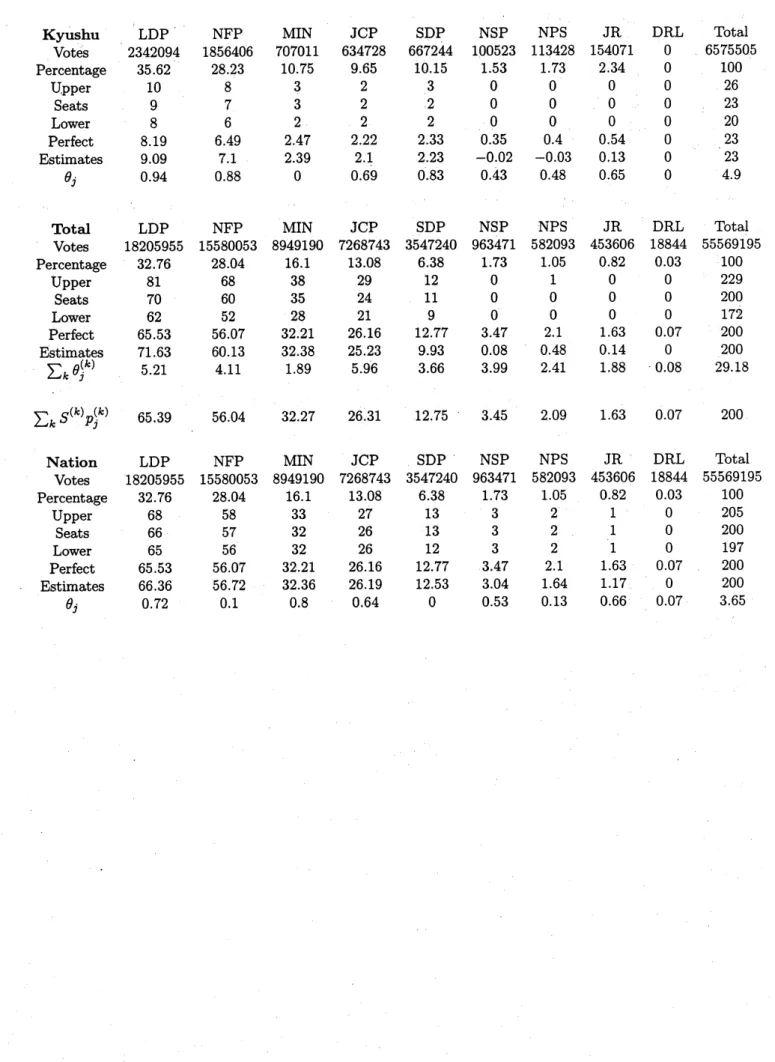
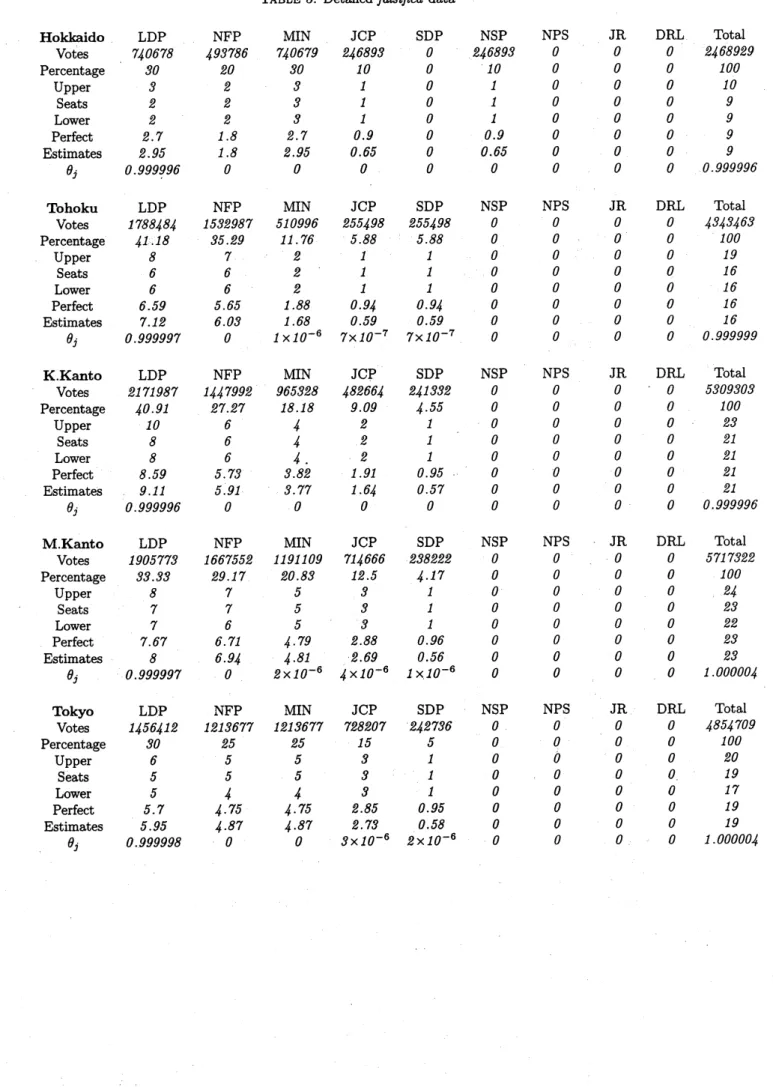
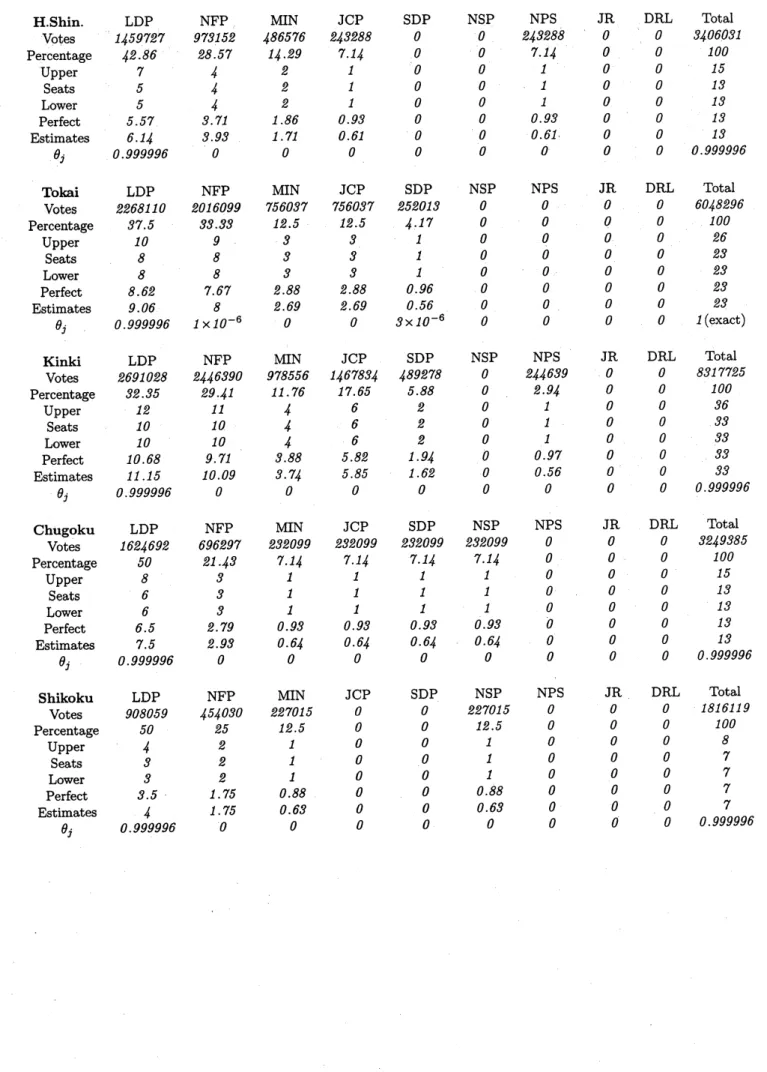
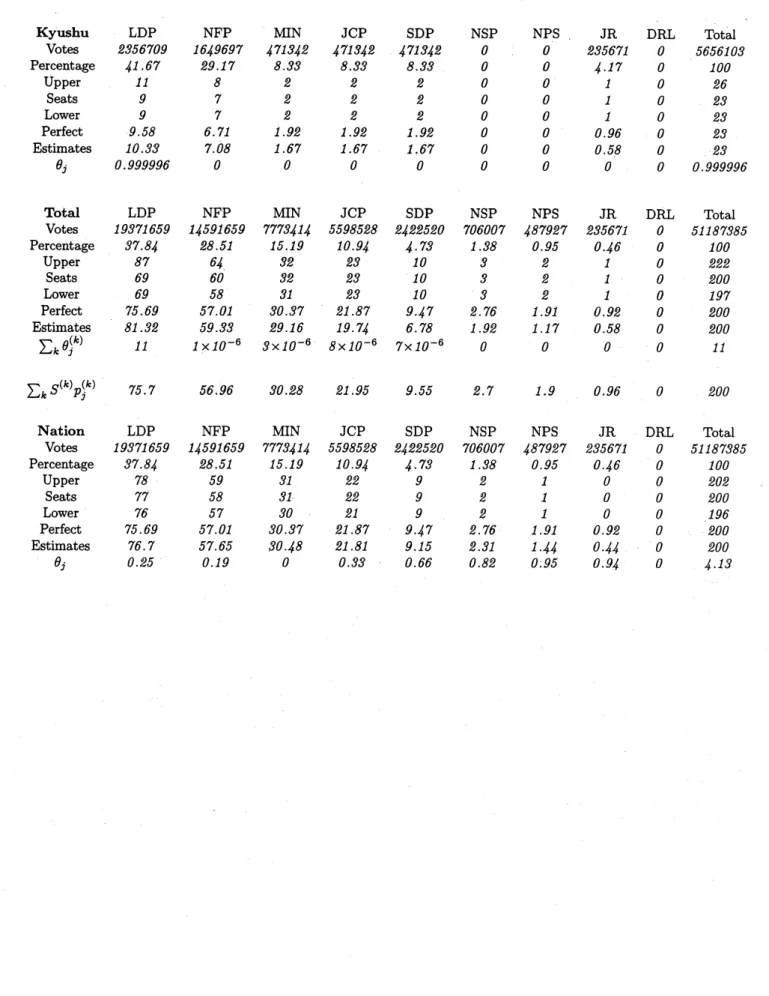
For the detailed data, see Table 4 in Appendix C.
Weseethat theblocs gaveanadvantage to large parties anda disadvantageto smallonesinthis election.
Yamamoto et al. (1996) point out, “Generally, the largerthe magnitude, the smaller the percentage ofvotes
it becomesto win aseat. To win a seatwithout fail, in the Kinki bloc, where the magnitude is 33, aparty
needs 2.9% ofthevotes; in the Shikoku bloc, where the magnitude is 7, it needs 12.5% ofthe votes; ifthe
magnitude is 200, to get 0.5% ofthe votes isenough.”3 This iscorrect aswill be seen later.
The anonymous authors (1996b) conclude, (
$‘ \mathrm{T}\mathrm{h}\mathrm{e}$smallertheconstituencies, themoreadvantageous it is
to largeparties. The larger theconstituencies,themoreadvantageous itisto smallpartiesand medium-sized
ones.”3
Usingdata of otherelections, Nisihira (1990, pp. 73-77) concludes, “Obviously the d’Hondt systemofPR withblocsgives agreat advantage to large parties.”3 A similarstatement isfoundin Nisihira (1981,
pp. 147-153), too. However, this doesnot generally hold. An easycounter-example is as follows:
Assumethat thereare 2 blocs $\mathrm{B}^{(1)}$
and $\mathrm{B}^{(2)}$
, and4 parties$\mathrm{P}_{1},$ $\mathrm{P}_{2}$, P3, and $\mathrm{P}_{4}$ run. Weselect 4 seats in
each bloc. Then acounter-example is given in Table 2.
TABLE 2. Counter-example
lotalseats 2 2 ‘2 2 8
Total votes 18 16 14 10 58
Seats under Nation 3 2 2 1 8
Increment of seats +1 $0$ : $0$ $-1$ $0$
The reader might say, “This isan artificialcounter-example since the numbers ofvotes aretoo small.” However, we may multiply them by a positive constant, so this criticism does not makesense. It is $e$asy to
3 English translation$\dot{\mathrm{b}}\mathrm{y}$ me.
make theoretic explanation ofa disadvantagetothe NSP, the NPS, and the $\mathrm{J}\mathrm{R}\’$
.but it is not
eas.y
to do soto the JCP orthe SDP.
Furthermore, we can make a counter-example by “falsifying” the actual data under the following
re-striction on the number of votes that each partygets:
LDP (Actual)$<(pal_{Sified})$ in all blocs. NFP, MIN, JCP, SDP (Actual)$\geq(FalSified)$ in all blocs.
NSP, NPS, JR (Actual)$>(FalSified)$ forthetotal numbersofvotes
with respectto the blocs.
DRL It does not run for the
falsified
data. The result is given in Table 3. HereI useitalic numerals forthefalsified
data.TABLE 3. PR seats based on
falsified
dataLDP NFP $\mathrm{M}\mathrm{I}\mathrm{N}\mathrm{J}\mathrm{C}\mathrm{P}$ SDP NSP NPS JR DRL Total
With Blocs 69 60 32 23 10 321 $\mathit{0}$ 200
Nation 77 58 31 22 9 2 1 $\mathit{0}$ $\mathit{0}$ 200
Increment $+\mathit{8}$ $-\mathit{2}$ $-\mathit{1}$ $-\mathit{1}$ $-\mathit{1}$ $-\mathit{1}$ $-\mathit{1}$ $-\mathit{1}$ $\mathit{0}$ $\mathit{0}$
Forthe detailed data, seeTable 5 in AppendixC.
Of course, I have made the
falsified
data artificially. At present, it isdifficult to know how Ihave doneso becausethe reader does not know the meaningof$\theta_{j}$ nor “Estimates” yet.
2. A non-probabilistic approach: Part 1
First, I shall consider non-probabilistically in a fixed constituency that we select $S$ seats, that is, $S$
is a bloc (district) magnitude, where $S$ is a given positive integer. I shall also apply the result and make
numericalcomparisonsbetween the d’Hondt system with the blocs andthecase of theconstituency covering
thewhole nation. I shallusethe followingnotation: $n$ parties $\mathrm{P}_{1},$ $\mathrm{P}_{2},$
$\ldots,$
$\mathrm{P}_{j},$
$\ldots,$ $\mathrm{P}_{n}$ run and theparty $\mathrm{P}_{j}$
gets $v_{j}$ votes for$j=1,$$\ldots,$$n$, where$v_{j}$ isa
nonnegative4 integer.5
In thissection, I regard $v_{j}$ asa constant,not a random variable. Denote $V:= \sum_{j=1}^{n}v_{j}$, which isthe total number ofvalid ballots, and assume that
$V\neq 0$. Here I use acapital letter for a variableexpressedas a totalwith respect to$j=1,2,$ $\ldots,$$n$. Denote
$p_{j}:=v_{j}/V$, which is the relative proportion of the votes that the party $\mathrm{P}_{j}$ gets. Clearly $0\leq p_{j}\leq 1$ and
$\sum_{j=1}^{n}p_{j}=1$ hold. The number ofperfect PRseats of the party $\mathrm{P}_{j}$ is $Sp_{j}$, which is impossible tocarry out
except very special cases because it is not an integer. I shall consider the d’Hondt system of$\mathrm{P}\mathrm{R}$. Denote
the number of seats that the party $\mathrm{P}_{j}$ wins by $s_{j}$, whichis a nonnegative integer $\mathrm{s}\mathrm{a}\mathrm{t}\mathrm{i}\mathrm{S}6^{\Gamma}\mathrm{i}\mathrm{n}\mathrm{g}\sum_{j=1}^{n}s_{j}=S$.
(Remark: This is not a
definition of
$S$, but $S$ is an originally given constant. ) Adefinition6
of $\{s_{j}\}_{j=1}^{n}$ isgiven by$v_{j}/s_{j}\geq v_{i}/(s_{i}+1)$ for all $i$ and$j$, wherewe define $v_{j}/0=\infty$ including the case$v_{j}=0$.
When $\{s_{j}\}$ isnot unique, aversion is chosen by lot inpractice. The definition above maylook different
fiiom a usual one, but if we consider the meaning of taking the $S$ largestvalues of $\{v_{j/}l\}_{j=1,2}l=1,2,,...,n$
’ then we
can easilyunderstand thatthis is just thesame. This definitionis equivalent to maximize$r:= \min_{j}(v_{j}/s_{j})$
with respect to $\{s_{j}\}$. Denoting $\epsilon_{j}:=s_{j}-Sp_{j}$, this is equivalent to
minimize7
$\max_{j}(\epsilon_{j}/Sp_{j})$, where4 It seemsbetter to assume that $v_{j}>0$ because at least thecandidates ofthe party $\mathrm{P}_{j}$ vote for their own party.
Mathematically, however, it is better to allow$v_{j}=0$. Otherwise,theinequalitiesinTheorems 1 and 2arenot generally
.the best.
5 Mathematically, it isnonessential that$v_{j}$ is an integer. When$v_{j}’ \mathrm{s}$$(j=1, \ldots , n)$ arerationalnumbers, multiplying
themby an adequate constant,we may regard themasintegers. In Appendix$\mathrm{B}$,formathematicalconvenience, I take $v_{j}’ \mathrm{s}$that are not integers.
6 Strictlyspeaking, thisdefinitionmakessenseonly if there is not$j$ suchthat the number ofindividualcandidates oftheparty$\mathrm{P}_{j}$ isless than $s_{j}$ definedabove. Here I assumethis. The actual datasatisfy this.
7 Lijphartand Gibberd (1977,p. 235)saythatthed’Hondt systemminimizes$L:= \sum_{j=1}^{n}pj/(s_{j}+1)$, but this is not
correct. For example, let $S=5,$ $n=2,$ $v_{1}=100$, and $v_{2}=19$. Then, in thed’Hondt system, $s_{1}=5$ and$s_{2}=0$, but $L$
$\epsilon_{j}/0=0(\epsilon_{j}=0),$ $=\infty(\epsilon_{j}\neq 0)$. Here, $\epsilon_{j}$ is the absolute error (the seat bonus) of the seats of the
party$\mathrm{P}_{j}$ comparedwith those of theperfect
$\mathrm{P}\mathrm{R}$, and$\epsilon_{j}/Sp_{j}$ istherelativeerror. I thinkthat this is a good
method, but the reader might object to it. On this point, see Appendix A. HereI use a Greek letter for a
variable that signifiesa measure of a differencein a sense from theperfect $\mathrm{P}\mathrm{R}$. Clearly
$\sum_{j=1j}^{n}\epsilon=0$ holds.
By the definition of $r$, we have $v_{j}/s_{j}\geq r\geq v_{j}/(s_{j}+1)$, so there exists a unique $\theta_{j}$ (for a fixed
version $\{s_{j}\})$ satisfying
$v_{j}=r(S_{j}+\theta j)$. (1)
Then $0\leq\theta_{j}\leq 1$ for all$j$, and $\theta_{j_{0}}=0\neq s_{j_{0}}$ for some$j_{0}$.
Conversely,assumethat$v_{j}’ \mathrm{s}$areexpressedas$v_{j}=r_{*}(s_{j}+\eta_{j})(j=1,2, \ldots, n)$,where$s_{j}$isanonnegative
integer, $r_{*}$ is a constant, $\sum_{j=1}^{n}s_{j}=S$, and $0\leq\eta_{j}\leq 1$. Note that $j_{0}$ satisfying $\eta_{j_{0}}=0\neq s_{j_{0}}$ does not
necessarily exist. Then $\{s_{j}\}$ isa sequence of the numbers of seats (see footnote 1) because
$\frac{v_{j}}{s_{j}}=\frac{r_{*}(s_{j}+\eta j)}{s_{j}}\geq r_{*}\geq\frac{r_{*}(s_{i}+\eta_{i})}{s_{i}+1}-rightarrow\frac{v_{i}}{s_{i}+1}$ for all $i$ and$j$.
We can derive $r_{*}\leq r$, since for $j_{0}\mathrm{S}\mathrm{a}\mathrm{t}\mathrm{i}\mathrm{S}\mathfrak{h}^{\gamma \mathrm{i}\mathrm{n}\mathrm{g}j}\theta 0=0\neq s_{j_{0}}$, we have $v_{j_{0}}=rs_{j\mathrm{o}}=r_{*}(s_{j\mathrm{o}}+\eta_{j_{0}})$. Another
version of$\{s_{j}\}$ exists if and only if$\eta_{j\mathrm{o}}=0\neq s_{j_{0}}$ and$\eta_{j_{1}}=1$ for some$j_{0}$ and$j_{1}$. Then, fixing$j_{0}$ and$j_{1}$, and
letting $\dot{s}_{j}=s_{j}-1(j=j_{0}),$ $=s_{j}+1(j=j_{1}),$ $=s_{j}$ (otherwise), we get another version of seats $\{\dot{s}_{j}\}$. Here
I usea dot to signify anotherversion. Any other version canbe expressed as this form or by repeatingthis
process. Denoting $\ominus:=\sum_{j=1}^{n}\theta_{j}$, we have $0\leq\ominus\leq n-1$. Note that $r$ is uniquelydetermined and so is $\ominus$
even if$\{s_{j}\}$ is not uniquelydetermined.
There is an important meaningof$r$ concerned with theessenceofthe representation system. Consider
that when onevotesfor theparty $\mathrm{P}_{j}$, it means that one expresses one’swill to have itsmember attend the
Diet instead ofone. Then a member selected in the PR system attends the Diet instead of$r$ voters, and
we can regard $r\theta_{j}$ asthe number ofwasted votesto the party$\mathrm{P}_{j}$, and$r\ominus$ is the total ofthem. Those who
vote for the party $\mathrm{P}_{j}$ can regard $\theta_{j}$ as a measureof regret for not winning another seat. In the following
discussion, $\theta_{j}$ plays an important role. There is no influence iftheparty $\mathrm{P}_{j}$ loses less than $r\theta_{j}$ votes. Note $\mathrm{t}\mathrm{h}\mathrm{a}\mathrm{t}\mathrm{V}\circ \mathrm{t}\mathrm{i}\mathrm{n}$
“
there is no influence even if the party $\mathrm{P}_{j}$ loses $r\theta_{j}$ votes. There is no influence ifthe party $\mathrm{P}_{j}$ increases
less than$r(1-\theta_{j})$ votes. If it increases exactly$r(1-\theta_{j})$ votes and $\theta_{j}\neq 0$, thenin one version there is no
influence, whileinanotherversion, it increases exactlyone seat. If it increases more than$r(1-\theta_{j})$ votesand
$\theta_{j_{0}}=0\neq s_{j\mathrm{o}}$ for some$j_{0}\neq j$, then it increases more than one seat. For the actual data, maximum value
of $\theta_{j}$ is 0.99501, which is of the JCP in the Kita-Kanto bloc (K.Kanto in Table 4). In fact, anonymous
authors $(1996_{\mathrm{C}})$ inthe JCP point out that if it got 1,205 morevotes, itwouldwin one moreseatand defeat
onecandidate in the MIN. The second largest value of$\theta_{j}$ is 0.95998,whichis of the NPS inthe Kinki bloc.
At present, seeing$\theta_{j}’ \mathrm{s}$of the
falsified
data,the readercan$\mathrm{e}\mathrm{a}s$ilyimaginehow Ihave made thefalsified
data.The reader might not agree to regard $\theta_{j}$ as a measure of a difference in a sense from the perfect
$\mathrm{P}\mathrm{R}$.
Then regard$\theta_{j}$ as a mathematicaltool and do not considerameaningof it. Still, it playsanimportant role.
Summing up the equality (1) with respect to$j$, we have
$V=r(S+\ominus)$
.
(2)Therefore,
$\frac{V}{S+n-1}\leq r=\frac{V}{S+\ominus}\leq\frac{V}{S}$ (3)
holds. It is ideal that $r=V/S$ by considering themeaning of$r$. If$n\ll S$, then $r\approx V/S$. Otherwise, there
is a possibility that$r\ll V/S$. Dividing aconstituency into blocs makes $S$small and causes this possibility.
For the actual data, $r$for the constituency covering the wholenation (say
$r^{(\mathrm{N})}$
) is largerthan $r$in any bloc
(say$r^{(k)}$ forthe bloc$\mathrm{B}^{(k)}$
for$k=1,2,$$\ldots,$
$b$), that is, $r^{(k)}<r^{(\mathrm{N})}$ for all $k=1,2,$
$\ldots,$
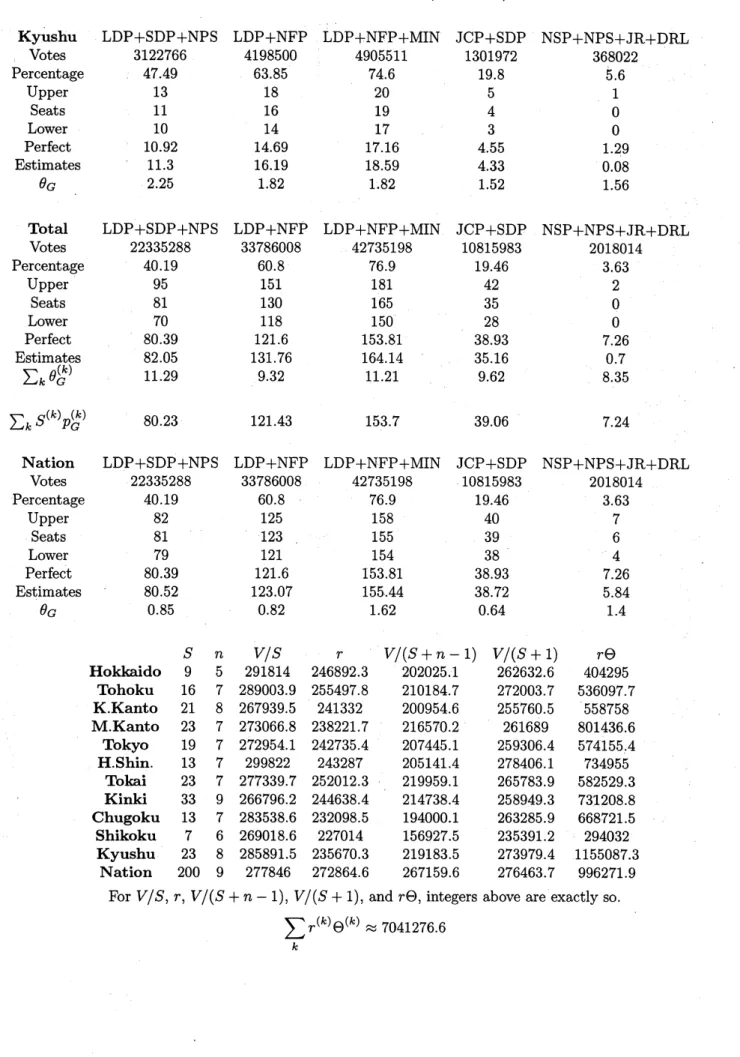
$b$. The value $r^{(k)}$ where
$\mathrm{B}^{(k)}$
isthe Shikokubloc,is thesmallest. Infact, $r^{(\mathrm{N})}\approx 272,865$, and in thisbloc$\mathrm{B}^{(k)}$
, wesee$r^{(k)}=227,014$.
Indeed, $V^{(k)}/(S^{(k)}+n^{(k)}-1)\approx 156,928$, so $r^{(k)}$ can take a much smaller value than the actual
one. For
the detailed data, see the last part of Table 4 in Appendix C. Note that $r^{(k)}<r^{(\mathrm{N})}$ does not
gen.erally.
hold for the
falsified
data. Next, Ishall check the numbers of wasted votes for the actual data. Wesee$\mathrm{t}\dot{\mathrm{h}}\mathrm{a}\mathrm{t}$$\sum_{k=1}^{b}r^{(}\ominus k)(k)$ ismorethan 7timesas largeas$r^{(\mathrm{N})}\Theta^{(\mathrm{N})}$
, so the blocs made agreat numberof wasted votes.
For the
falsified
data, $\sum_{k=1}br(k)_{\Theta}(k)$ is much smaller than the actual one, because I have artificially made$\theta_{j}^{(k)}\approx \mathit{0}$ for all parties except the LDP.
Dividing the equality (1) by (2), we get$p_{j}=(s_{j}+\theta_{j})/(S+\ominus)$. Solving this with respect to $s_{j}$, and
subtracting $Sp_{j}$, wegetthe followingformulae:
Lemma 1. The following equalities hold:
$s_{j}=(S+\ominus)p_{j}-\theta_{j}$, $\epsilon_{j}=\Theta p_{j}-\theta_{j}$.
Besides, $\epsilon_{j}=0$
for
all$j$if
and only $if\ominus=0$.
They are important formulae for the following discussion. For a fixed$j$, if$\theta_{j}=0\neq\ominus p_{j}$, then $\epsilon_{j}>0$.
However, we cannot conclude that there isa casethat $\epsilon_{j}>0$even if$p_{j}$ isvery small, because$p_{j}$ and$\theta_{j}$ are
not independentvariables. In fact, if$0<p_{j}<1/(S+n-1)$, then $s_{j}=0$bythe following theorem so $\epsilon_{j}<0$
holds.
Let $\underline{s_{j}}$ be the smallest value of $s_{j}$ of all versions of $\{s_{j}\}$, and $\overline{s_{j}}$ the largest one. Note that $\overline{s_{j}}=\underline{s_{j}}$
or $\overline{S_{j}}=\underline{s_{j}}+1$ holds. For any $a$, define integers $[a]$ and $[a]_{*}$ by $[a]\leq a<[a]+1$ and $[a]_{*}<a\leq[a]_{*}+1$,
respectively. Here I use$a$ for avariable that we need not considera meaning of it.
Theorem 1.
If
$0<p_{j}<1$, then the following$inequalitie\mathit{8}$ hold:$[(S+1)p_{j}] \leq\overline{s_{j}}\leq\min\{[(S+n-1)p_{j}], s\}$,
$[(S+1)p_{j}]_{*} \leq\underline{s_{j}}\leq\min\{[(S+n-1)p_{j}]_{*}, s\}$.
If
$p_{j}=0$, then $s_{j}=0$.If
$p_{j}=1$, then $s_{j}=1$. These bounds cannot be improved (seefootnote
4)if
weconsider bounds that are
functions of
$S,$ $n$, and$p_{j}$ ($ji\mathit{8}$fixed), and are independentof
$p_{i}(i\neq j)$.Ishallgeneralizethis inTheorem2, andwecaneasilyderiveTheorem 1 as aspecialcase ofTheorem2.
Since the lower bounds cannot be improved, we see that the minimum$p_{j}$ that the party $\mathrm{P}_{j}$ could possibly
win $s$ or more seats is $s/(S+n-1)$. For $s=1$, Rokkan (1968, p. 13) essentially pointed this out, and
Rae (1971, p. 193) generalizes
this.8
Since the upper bounds cannot beimproved, we seethat themaximum$p_{j}$ that the party $\mathrm{P}_{j}$ could fail to win at least $s$ seats is $s/(S+1)$. Historically, see Hagenbach-Bischoff
etal. (1884, pp. 28-29), Hagenbach-Bischoff$(1888, 1908)$, Rae et al. (1971), Rae(1971, p. 193), andLijphart
and Gibberd (1977), who correct errors in Rae et al. (1971) and Rae (1971). For $s=1$, this is numerically
stated by Yamamoto et al. (1996) as I quoted below Table 1. By Theorem 1, if $n<<S$, then $s_{j}$ is a good
approximation of $Sp_{j}$ by considering the relative error, but otherwise, there is a possibility that $s_{j}>>Sp_{j}$.
To avoid this, it is betterto adopt theconstituency coveringthe wholenation.
Fortheactualandthe
falsified
data inAppendix$\mathrm{C}$, if$p_{j}^{(k)}\neq 0$,then$(S+(k))p_{j}(1k)$ and$(S^{(k)}+n-1(k))p^{(}jk)$are non-integers. Similar statements to this are satisfied in the following discussion for the actual and the
falsified
data. Note that$p_{j}^{(k)}=0$ meansthat the party $\mathrm{P}_{j}$ has no candidatesin thebloc$\mathrm{B}^{(k)_{9}}$
. So
$[(S^{(k)}+1)p_{j}^{(k)}] \leq s_{j}^{(k)}\leq\min\{[(S^{(k)}+n^{(k)}-1)pj](k),$ $S^{(}k)\}$
8 In Rokkan (1968), $V-1$ should read $V$
9 Strictly speaking, “
$n$parties $\mathrm{P}_{1},$ $\mathrm{P}_{2},$
$\ldots,$ $\mathrm{P}_{j},$ $\ldots$, $\mathrm{P}_{n}$ run” should read “ $n^{(\mathrm{N})}$
parties $\mathrm{P}_{1},$ $\mathrm{P}_{2},$
$\ldots,$ $\mathrm{P}_{\mathrm{j}},$
$\ldots,$ $\mathrm{P}n^{(\mathrm{N}\rangle}$ run
and $n^{(k)}$ ofthem have candidates inthe bloc $\mathrm{B}^{(k)}$,,
holds ineach bloc. The upper and the lower bounds, and $s_{j}^{(k)}$ arewritten in Tables4 and 5 inAppendix C.
For example, for the actual datain the Hokkaido bloc, the upper bound fortheLDP is 3 and the lower one
is 2, and the actual number of seats that the LDP won is 3, which is equal to the upper bound. This is due
to$p_{j}’ \mathrm{s}$for the other parties. The MIN in this blocisthe contrary case.
Summing up the inequality with respect to $k$ and denoting $s_{j}^{(+)}$ $:= \sum_{k=1}^{b}s^{()}jk$, we have
$\sum_{k=1}^{b}[(S^{(k)}+1)p_{j}^{(k)}]\leq s_{j}^{(+)}\leq\sum_{k=1}^{b}\min\{[(S^{(k)}+n^{(k)}-1)p_{j}^{(}]k),$$S^{(k)}\}$
.
The upper and the lower bounds, and $s_{j}^{(+)}$ are written at the place Total (in boldface) inTables 4 and 5.
We see that the differences between the upper and the lower bounds are large here. For the constituency
covering the whole nation, we have
$[(S^{(\mathrm{N})}+1)p_{j}^{(\mathrm{N})}] \leq s_{j}^{(\mathrm{N})}\leq\min\{[(S^{(\mathrm{N})}+n^{(\mathrm{N})}-1)p_{j}^{(}]\mathrm{N}),$$S^{(\mathrm{N})}\}$.
The upperand the lowerbounds, and$s_{j}^{(\mathrm{N})}$ arewritten at the place Nationin Tables 4 and 5.
For the actual data,the LDP, the NFS, the MIN, and the JCP satisfy
(Lower bound for Total) $<$ ($\mathrm{L}_{\mathrm{o}\mathrm{W}}\mathrm{e}\mathrm{r}$ bound for Nation)
$<$ (Upper bound for Nation) $<$ (Upper bound for Total).
So the bounds do not explain whether theblocsgive an advantageto them or not. The SDP satisfies
(Lower bound for Total) $<$ ($\mathrm{U}_{\mathrm{P}\mathrm{P}^{\mathrm{e}\mathrm{r}}}$
.bound for Total)
$=$ (Lower bound for Nation) $<$ ($\mathrm{U}_{\mathrm{P}\mathrm{P}^{\mathrm{e}\mathrm{r}}}$bound for Nation).
Sothe bounds explain that the blocs do not give an advantage to it, but they do not explainthat theblocs
give a disadvantage to it. The NSP, the NPS, and the JR satisfy
(Upperbound for Total) $<$ ($\mathrm{L}\mathrm{o}\mathrm{w}\mathrm{e}\mathrm{r}$bound for Nation).
So the bounds explain that the blocsgive a disadvantage to them. The DRL satisfies
(Upperbound for Total) $=$ ($\mathrm{U}\mathrm{p}\mathrm{p}\mathrm{e}\mathrm{r}$ bound for Nation)$=0$.
So it wins no seat anyway. For the
falsified
data, the bounds explain that the blocs give an advantage to the JCP, the SDP, the NSP, the NPS, and the $\mathrm{J}\mathrm{R}$.
I shall consider this problem theoretically in the nextsection.
Next, let $G\subset\{1,2, \ldots, n\}$. $\mathrm{M}\mathrm{a}\mathrm{t}\mathrm{h}\dot{\mathrm{e}}\mathrm{m}\mathrm{a}\mathrm{t}\mathrm{i}\mathrm{C}\mathrm{a}\mathrm{l}\mathrm{l}\mathrm{y}G$ is an arbitrary subset, but in practice it is important
when the parties $\mathrm{P}_{j}’ \mathrm{s}(j\in G)$ try to form a coalition government. Let $g$ be the number of elements in $G$,
and denote $v_{G}:= \sum_{j\in c^{v_{j,p_{G}}}}:=\sum_{j\in}cp_{j},$ $s_{G}:= \sum_{j\in G}s_{j}$, and $\theta_{G}:=\sum_{j\in c^{\theta_{j}}}.$ Let $\underline{s_{G}}$ be the smallest
valueof$s_{G}$ ofallversionsof $\{s_{j}\},$ and$\overline{sc}$the largest one.10
Theorem 2.
If
$0<p_{G}<1$, then the following inequalities hold:$\max\{[(S+g)pc]+1-g, 0\}\leq\overline{s_{G}}\leq\min\{[(S+n-g)pc], s\}$,
$\max\{[(S+g)pc]*+1-g, 0\}\leq\underline{s_{G}}\leq\min\{[(S+n-g)p_{G}]_{*}, S\}$.
If
$p_{G}=0$, then $s_{G}=0$.
If
$p_{G}=1$, then $sc=1$. These bound8 cannot be improved (seefootnote
4)if
we consider bounds that are
functions of
$S,$ $n,$ $g$, and$p_{G}$, and are independentof
$p_{j}$ except the dependencethrough$p_{G}$.
For aproof, see AppendixB. The upper bounds show that the d’Hondtsystemcan prevent acoalition
government of parties that are too small.
$1$ Not necessarily$\underline{s_{G}}=\sum_{j\in G}\underline{S_{j}}$ nor $\overline{sc}=\sum_{j\in c^{\overline{S_{j}}}}$. If $G=\{1,2, \ldots , n\}$, then $\underline{s_{G}}=\overline{s_{G}}=S$, while $\sum_{j=1}^{n}\underline{s_{j}}<S<$
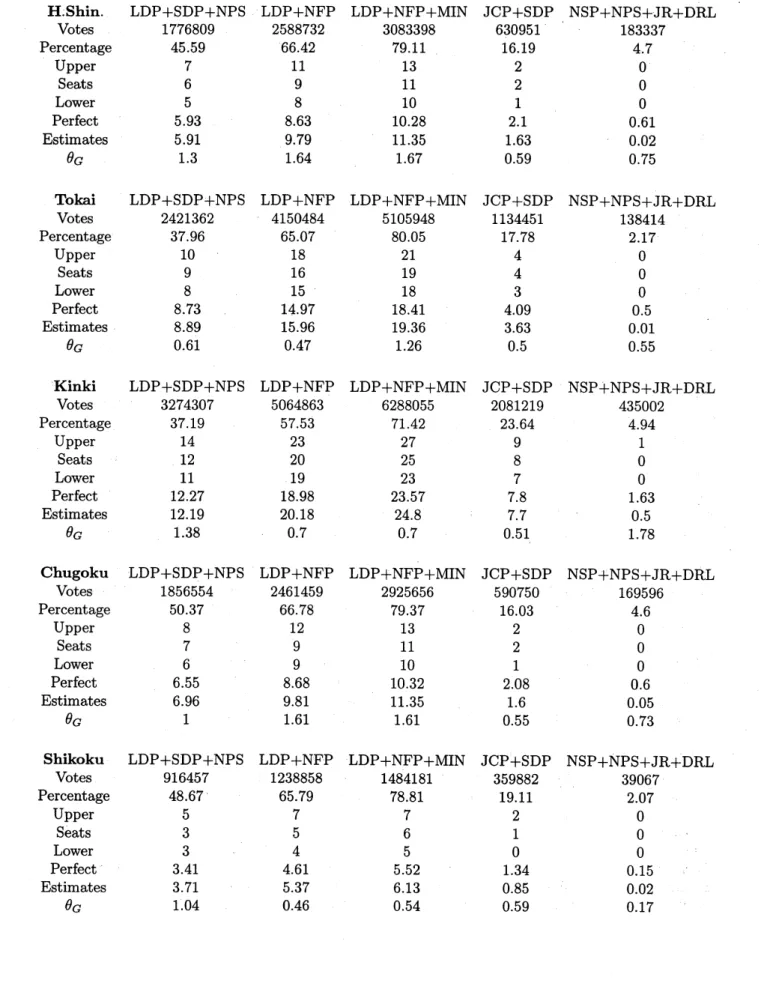
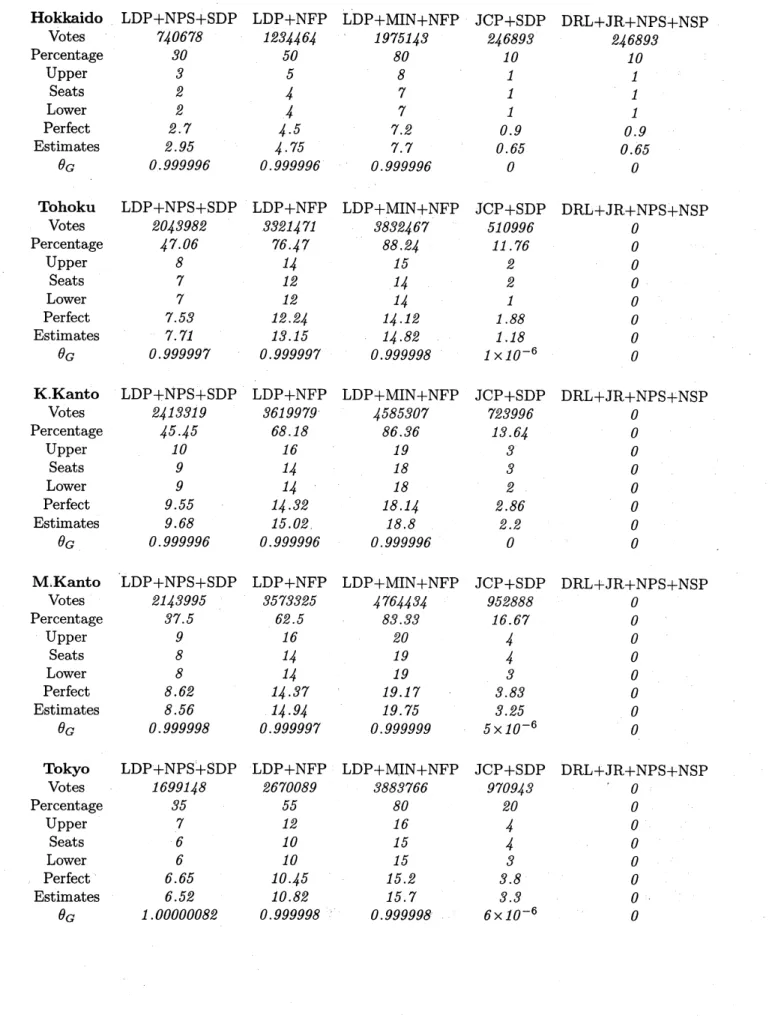
Numericalresultsaregiven inTables 4and5. First,Iconsider the combinationoftheLDP, the SDP, and
the NPS, because theyforma coalition
now.11
For the actualdata, the number of their seats is equally81,both inTotal and Nation,but the upper and the lower bounds do notexplainthis. Second, to seewhether
the blocs giveanadvantage to combined large parties, Iconsider thecombination of theLDP and theNFS,
and that of the LDP, the NFS, and the MIN. The bounds, however, do not explain that the blocs gavean
advantage to the combination. Third, to see whether the blocs give a disadvantage to combined
medium-sized parties that are actually given a disadvantage but won seats, I considerthe combination of the JCP
and the SDP. The bounds, however, do notexplain that the blocs give adisadvantage tothe combination.
Fourth, I consider the combination of the parties that could not win a seat, that is, the combination of the NSP, the NPS, the $\mathrm{J}\mathrm{R}$, and the DRL. This time the bounds show that the blocs give a disadvantage
to the $\mathrm{c}\mathrm{o}\mathrm{m}\mathrm{b}\mathrm{i}\mathrm{n}\mathrm{a}\mathrm{t}\mathrm{i}\mathrm{o}\dot{\mathrm{n}}$. For the
falsified
data, the bounds show that the blocs give an advantage to the lastcombination.
Next, regarding$p_{G}$ as a constant and$g$ as avariable, we see that theupper bounds (weakly) decrease
withrespectto$g$. Since the lower bounds for$\overline{s_{G}}$and
$\underline{sG}$canbeexpressedas $\max\{[(SpG+1)-(1-p_{G})g], 0\}$
and $\max\{[(Spc+1)-(1-p_{G})g]_{*}, 0\}$, respectively, we seethat theyalso decrease with respect to$g$.
We can consider the case that the parties $\mathrm{P}_{j}’ \mathrm{s}(j\in G)$ are merged into a party $\mathrm{P}_{G}$. It is considered
that the d’Hondt system favors mergers of parties. However, I have not found its mathematical rigorous
proof in literature. Sainte-Lagu\"e (1910) points this out, but he does not give a rigorous proof. He says,
“to show this we considerthe calculus of the mostprobable values of the numbers ofseats obtained bythe
differentparties.” Rae etal. (1971) essentiallyuse this factnot only forthed’Hondtsystembut unjustifiably
also for other systems, and Rae (1971, p. 193) generalizes their result without proofs, though Lijphart and
Gibberd (1977) pointout their mistake. Lijphart and Gibberd (1977) accept this fact for thed’Hondtsystem,
$\mathrm{b}\mathrm{u}.\mathrm{t}$ aproofis not given.
Letting $G=\{1,2, \ldots, g\}$, consider that the parties$\mathrm{P}_{1},$ $\mathrm{P}_{2},$
$\ldots,$ $\mathrm{p}_{g}$ aremerged into aparty
$\dot{\mathrm{P}}_{G}$. In the
casethat the parties$\mathrm{P}G,$ $\mathrm{P}1,$$\mathrm{P}g+\mathit{9}+2,$ $\ldots,$ $\mathrm{P}_{n}$ run, assume thatthe party $\mathrm{P}_{G}$ gets $v_{G}= \sum_{j=1}^{g}v_{j}$ votes and
that the party $\mathrm{P}_{j}$ still gets $v_{j}$ votes for $j=g+1,$ $g+2,$ $\ldots,$ $n$. (Remark: This is not mere convention
of
notation but Ireally assume this. $)^{12}$ Then we have the following:
Theorem 3. By denoting the number
of
seats that the party$P_{j}$ wins by $s_{j}’$for
$j=G,$ $g+1,$ $g+2,$$\ldots,$ $n$,
the following inequalitieshold:
$s_{G}\leq s_{G}’\leq sG+g-1$, $s_{j}-g+1\leq s_{j}’\leq s_{j}(j=g+1, g+2, \ldots , n)$, (4)
if
either$s_{j}(s_{G})$ or$s_{j}’(s_{G}’)$ is uniquely determined.Note that even if neither isuniquely determined, we can consider that theinequalities (4) hold. For a
rigorous statement of this and a proof, see Appendix B. This shows that a merger does not decrease seats
unless losingsupport. Iftheparties$\mathrm{P}_{1},$ $\mathrm{P}_{2},$
$\ldots,$ $\mathrm{P}_{g}$ tryto forma coalition government, then theyare under
ahandicap. For the constituencycoveringthe whole nation, if$g\ll S$,then this handicap is small.
We can also interpretTheorem 3 as follows: First therewere parties$\mathrm{P}_{G},$ $\mathrm{P}_{g+1},$ $\mathrm{P}_{g+2},$
$\ldots,$
$\mathrm{P}_{n}$, but the
party $\mathrm{P}_{G}$ split into
$g$ parties $\mathrm{P}_{1},$ $\mathrm{P}_{2},$
$\ldots,$ $\mathrm{P}_{g}$. Instead ofthe inequalities (4), if$s_{G}’\leq s_{G}$ holds, then the
party $\mathrm{P}_{G}$ can winmore seats by nominal splitting, unless losing support. The nominal splitting should be
donebydistricts because thenit iseasy for votersto understand, and thesplit partiescanspare money and
labor in a campaign. Thanks to Theorem 3, however, the nominal splitting does not bring more seats. I
thinkthatthis is a meritof the d’Hondtsystem.
3. A non-probabilistic approach: Part 2
In this section, I shall consider non-probabilistically the total seats compared with the case of the
constituency covering the whole nation theoretically. For the notation, we should not omit an index $(k)$
,
11 However, it isnotatruecoalition because only the LDP forms the Cabinet after the election. Before the election,
it was atrue coalition since the LDP, theSDP, and theNPS formed the Cabinet.
12 Thisdoes not hold even approximately if, for example$g=2$, the supportersof the party $\mathrm{P}_{1}$ become angry at its
which signifies the bloc$\mathrm{B}^{(k)}$
,anindex $(+)$
,which signifies the total with respect to theblocs, nor anindex
(N),
which signifies the constituency covering the whole nation. Remember that $s_{j}^{(+)}:= \sum_{k=1}^{b}s^{()}jk$. Note that
$S^{(\mathrm{N})}:= \sum_{k=1}^{b(k)}s,$ $v_{j}^{(\mathrm{N})}:= \sum_{k=1j}^{b(k)}v,$ $V^{(\mathrm{N})}:= \sum_{j1}^{n^{(\mathrm{N})}}=v_{j}^{(\mathrm{N})}=\sum_{k=1}^{b(k)}V$, and $p_{j}^{(\mathrm{N})}:=v_{j}^{(\mathrm{N})}/V^{(}\mathrm{N}$). It may
look natural to write $S^{(+)}$ instead of $S^{(\mathrm{N})}$
, but we need it to calculate seats for the constituency covering
the wholenation, soI write $S^{(\mathrm{N})}$.
It is similar for $v_{j}^{(\mathrm{N})},$ $V^{(\mathrm{N})}$
, and$p_{j}^{(\mathrm{N})}$. Denote$\epsilon_{j}^{(+)}:=s_{jj}^{(+)}-S(\mathrm{N})_{p}(\mathrm{N})$.
Fix $j$ and assume that $p_{j}^{(k)}$ is approximately independent of $k$, that $\mathrm{i}\mathrm{s}\backslash ’ p_{j}^{(k)}\approx p_{j}$ (say). Then
$v_{j}^{(k)}\approx V^{(k)}p_{j}$ holds, and summing this up withrespectto$k$,wehave$v_{j}^{(\mathrm{N})}\approx V^{(\mathrm{N})}p_{j}$, so$p_{j}^{(\mathrm{N})}\approx p_{j}$. Therefore,
we get
$\sum_{k=1}^{b}S^{(k})pj\approx(k)(\sum_{k=1}^{b}S(k))pj=^{s^{(}s^{(}}p_{j}\approx \mathrm{N})\mathrm{N})pj(\mathrm{N})$.
Numerically, $S^{(\mathrm{N})}p_{j}^{(\mathrm{N}}$) isgivenat the place “Perfect” ofTotal and Nation, and$\sum_{k=1}^{b(k}sp^{(k)}$
)
$j$ is givenunder
the placeTotal.
Instead of the assumption above, assume that $V^{(k)}/s^{(k)}$ is approximately independent of $k$, that is,
$V^{(k)}/s^{(k)}\approx c$ (say). Thisholdsif malapportionment does not ariseandtheabsolute proportionsofthevalid
ballots are approximately independent of the blocs. Then $V^{(k)}\approx cS^{(k)}$ holds, and summing this up with
respectto $k$, we have $V^{(\mathrm{N})}\approx cS^{(\mathrm{N})}$, so $V^{(\mathrm{N})}/s^{(\mathrm{N})}\approx c$. Therefore, weget
$\sum_{k=1}^{b}S^{(}pj)k)(k=\sum_{k=1}^{b}\frac{sv_{j}(k)(k)}{V^{(k)}}\approx\frac{\sum_{k=1j}^{b(k)}v}{c}=\frac{v_{j}^{(\mathrm{N})}}{c}\approx\frac{S^{(\mathrm{N})(\mathrm{N})}v_{j}}{V^{(\mathrm{N})}}=S^{(\mathrm{N})_{p^{(\mathrm{N})}}}j$.
Numerically, $V^{(k)}/s^{(k)}$ is givenat the last partofTables 4 and 5. Note that the actual data areof the first
electionunderthe new system, so it$\mathrm{i}(k)\mathrm{s}$natural that malapportionment
doesnot arise.
Hence altogether, if either $p_{j}$
or
$V^{(k)}/s^{(k)}$ is approximately independent of$k$, then we have $\sum_{k=1}^{b(k}sp^{(k)})j\approx S^{(\mathrm{N})}p_{j}^{(}\mathrm{N})$, sowe get
$\epsilon_{j}^{(+)}=s_{j}^{(+}-)s^{(}\mathrm{N})p^{(\mathrm{N})}j\approx\sum_{k=1}^{b}s_{j}^{(}k)-\sum_{=k1}S^{(}pj)bk)(k=\sum_{k=1}^{b}(s-jpS^{(k})j(k)(k))=\sum_{k\simeq 1}^{b}\mathcal{E}_{j})(k$.
This approximationis, however, importantforaprobabilistic approach. For the question whether the d’Hont
system with blocs gives an advantage or not, a non-probabilistic approach is useful when it is a question
whether the partywins aseat, or when aparty is supported in onlyone bloc. AsI noted below Theorem 1,
to win a seat, $p_{j}^{(\mathrm{N})}\geq 1/(S^{(\mathrm{N})}+n^{(\mathrm{N})}-1)$ is necessary and $p_{j}^{(\mathrm{N})}>1/(S^{(\mathrm{N})}+1)$ is sufficient. We can $\mathrm{e}\mathrm{a}s$ily
seeit by Theorem 1. Under blocs,$p_{j}^{(k)}\geq 1/(S^{(k)}+n^{(k)}-1)$for some $k$ isnecessary and$p_{j}^{(k)}>1/(S^{(k)}+1)$
for some $k$ is sufficient. If$p_{j}^{(k)}$ isapproximately independent of$k$, then the blocs do not give an advantage
aslongas it isaquestion whether the partywins a seat ornot. The explanation by Yamamoto et al. (1996)
quoted below Table 1 makes sense then. Otherwise, blocs maygive an advantage. To see this, we may let
$j=1$. Consider that the party $\mathrm{P}_{1}$ is supported in only one bloc (say $\mathrm{B}^{(1)}$
) and it gets no votes in other
blocs. For the constituency covering the whole nation, to win a seat, $v_{1}^{(1)}\geq V^{(\mathrm{N})}/(S^{(\mathrm{N})}+n^{(\mathrm{N})}-1)$ is
necessary and $v_{1}^{(1)}\succ V^{(\mathrm{N})}/(S^{(\mathrm{N})}+1)$ is sufficient. Under blocs, $v_{1}^{(1)}\geq V^{(1)}/(S^{(1)}+n^{(1)}-1)$ is necessary
and $v_{1}^{(1)}>V^{(1)}/(S^{(1)}+1)$issufficient. In addition,assumethat $V^{(k)}/s^{(k)}\approx c,$$n^{(\mathrm{N})}\ll S^{(\mathrm{N})}$and $S^{(1)}$ isnot
so large. Then, to win a seat inthe constituency covering the whole nation is approximately equivalent to
$v_{1}^{(1)}>c$, while the condition towin a seat under the blocsismuch weaker than$v_{1}^{(1)}>c$
.
For furtherdetails,under the assumptions above,
$c\approx>\overline{s^{(\mathrm{N})(\mathrm{N}}+n-)1}\overline{s^{(1)}+1}$’ $\mathrm{i}.\mathrm{e}.$, $V^{(\mathrm{N})}$ $V^{(1)}$ $\frac{1}{c}\approx\frac{S^{(\mathrm{N})}+n^{(\mathrm{N})}-1}{V^{(\mathrm{N})}}<$ . $\frac{S^{(1)}+1}{V^{(1)}}$
holds. Numerically, see the last part ofTables 4 and 5. For the actualdata, 8 blocs satisfy this inequality,
while 3 blocs do not. Under this inequality,we have
$s_{1}^{(\mathrm{N})} \leq[\frac{s^{(\mathrm{N})}+n^{(\mathrm{N})}-1}{V^{(\mathrm{N})}}v_{1}^{(\mathrm{N})}]=[\frac{S^{(\mathrm{N})}+n^{()}-1\mathrm{N}}{V^{(\mathrm{N})}}v_{1}^{(1)]}\leq[\frac{S^{(1)}+1}{V^{(1)}}v_{1]}^{(1)}*\leq s_{1}^{(1)}=s_{1}^{(+)}$ ,
so $s_{1}^{(\mathrm{N})}\leq s_{1}^{(+)}$. Hence the blocs do not give a disadvantage for a party supported in only one bloc.
I have
made the
falsified
dataofthe NPS,the NPS, and the JRconsidering this. Therefore, for a very smallpartyto win aseat in the d’Hont system withblocs,it isbetter to besupported in itsownterritory. Sothissystem
is a hotbed of bribery.
4. A probabilistic approach to seats in a fixed constituency
In this section, I shall consider probabilistically in a fixed constituency that we select $S$ seats. I regard
$v_{j}$ as the realization ofa random variable $\tilde{v}_{j}$. Here I use a tildeto $\mathrm{s}\mathrm{i}\mathrm{g}\mathrm{n}\mathrm{i}\Psi$a random
variable.13
Note thatthe following discussion is not mere application ofa usual statistical method. The reader might object to
a probabilistic approach. In fact, this problem is concerned with a philosophical problem ofmathematical
statistics. Extremenon-Bayesians object toitbecauseanelection is not carried out underarandomsampling.
They do not consider the probability of, for example, the event that the DRL gets (orwill get) more votes
thanthe LDP. They donot say thatthe probability that $\{s_{j}\}$is not uniquelydeterminedisverysmall. On
theother hand, extreme Bayesians, beforean election, consider as follows:
“I do not know what others vote for. So the number of votes that each party gets isa randomvariable,
andits distributionis determinedbymy subjectivity. It does not matter evenifthe distribution for another
person is different from mine. Ofcourse I can consider the probabilityofthe event that the DRL will get
more votes than the LDP. For me, for example, it is 0.03. For one who has no knowledge of Japanese politics, it is 0.5. AfterI see the electionreturns, $v_{j}$ will be aconstant for me because I shall know it.”
Another standpoint is as follows: Regarding human beings as products made by a machine, we can
consider that each elector independently votes for the party $\mathrm{P}_{j}$ with probability $u_{j}^{*}(j=1,2, \ldots, n)$, and
abstains fromvotingor makes invalidvotingwith probability$u_{0}^{*}$,where$u_{j}^{*}$ isanunknown constant$\mathrm{S}\mathrm{a}\mathrm{t}\mathrm{i}\mathrm{S}\mathfrak{h}r\mathrm{i}\mathrm{n}\mathrm{g}$
$u_{j}^{*}\geq 0(j=0,1,2, \ldots, n)$ and $\sum_{j=0}^{n}u^{*}j=1$.
I adopt neither standpoint in the following discussion. Consider the following imaginary experiments.
We carry out an election. After carrying it out, we carry an election again. Assume that, between the
two elections, no information is added. Then, one who votes with belief, votes for the same party in the
two elections. One who votes without belief, might vote for different parties. Consider continuing elections
repeatedlywithout addedinformation,andregard the actualelectionasoneoftheelections inthe imaginary experiments, then non-Bayesians can regard $v_{j}$ as therealizationof arandom variable $\tilde{v}_{j}$. I shall similarly
use$\tilde{p}_{j},\tilde{s}_{j},\tilde{\epsilon}_{j},\tilde{\theta}_{j}$, and $\ominus\sim$. By the equality
of$\epsilon_{j}$ in Lemma 1, we have $E(\overline{\epsilon}_{j})=E(\tilde{\ominus}\overline{p}_{j})-E(\tilde{\theta}_{j})$. I assume
the following:
Assumption 1. The random variable $\tilde{p}_{j}$ can change only a little, that is, $\overline{p}_{j}\approx p_{j}^{*}:=E(\overline{p}_{j})$, but not
too little.
Note that$p_{j}^{*}$ is anunknownconstant, notarandom
variable.14
Iuse asuperscript asteriskfora constantthat wecannot observe. In mathematical statistics, this is called aparameter (or a function of parameters)
and usually denoted bya Greek letter. Then we have $E(\tilde{\epsilon}_{j})\approx E(\ominus)p_{j}^{*}\sim-E(\tilde{\theta}_{j})$. I denote $\theta_{j}^{*}:=E(\tilde{\theta}_{j})$, and
similarlyuse $\Theta^{*},$ $\epsilon_{j}^{*}$, and $s_{j}^{*}$. In this notation, weget $\epsilon_{j}^{*}\approx\Theta^{*}p_{j}^{*}-\theta_{j}^{*}$. The reader might considerthat
$\theta_{j}^{*}$ is
independentof$j$, or approximatelyso. However, this isinadequate. I further assumethe followings:
13 Conventionally, we usea capital letter, but I avoid this herebecauseIuse acapital letter foravariable expressed
as a totalwith respect to$i=1,2,$$\ldots$,$n$.
14 This time, Bayesians object. They consider that an unknown thing is a random variable. Here,
there is no
problem even if$p_{j}^{*}$ is known, but there isa problem when we apply the following results to the actual data. In their
Assumption 2. $S+n<<\tilde{V}\not\simeq\overline{V},$ where$\overline{V}$
isthe number of members of the electorate.
Assumption 3. The magnitude $S$is not too small.
Assumption 4. We can approximately consider that $\{s_{j}\}$ isuniquely determined and that so is$j_{0}$
satis-fying $\theta_{j}0=0$. That is, the probability of the exceptional event is very small. Define a random variable
$\tilde{J}0$
by$\tilde{\theta}_{\overline{J}0}=0$.
Assumption 5. As a mathematicaltool, consider that $S$ is also the realization of a random variable $\tilde{S}$.
Assume that $P[\tilde{S}=S]=1/(\overline{S}-\underline{S}+1)$ for $S=\underline{S},$ $\underline{S}+1,$
$\ldots$,
$\overline{S},$ where$\underline{S}<<\overline{S},$ though$\underline{s}$ is not so small,
and $\overline{S}$is not too large. Then the random variables
$\tilde{J}0$ and $S$ are approximately independent. That is, we
can approximately use Fisher’s fiducialargument to get $P[\tilde{\theta}_{j}=0]$ by regarding $S$ as arandom variable.
Assumption 6. Fix$v_{j}$ that $\tilde{v}_{j}$ cantake. (Then $V$ and $r$ aredetermined correspondingly.) For any fixed
$i=1,2,$$\ldots,$$n$, the conditional distribution of$\tilde{v}_{i}$ under the conditions $v_{i}-a<\tilde{v}_{i}<v_{i}+r-a(0<a\leq r)$
and$\tilde{v}_{j}=v_{j}(j\neq i)$ is
approximately15
the uniform distributiononthe interval (vi-a,$v_{i}+r-a$) $\mathrm{i}\mathrm{f}v_{i}-$isnot
too small.
Thenwe have the following lemma:
Lemma 2. Under Assumptions 1 to 6, by letting
$M^{*}:=\{j:p_{j}^{*}\geq t^{*}\}$
for
some small$t^{*}>0$, $p_{j}^{**}:= \frac{p_{j}^{*}}{p_{M^{*}}^{*}}$for
$j\in M^{*}$,the following approrimation $i_{\mathit{8}}$
satisfied:
$\theta_{j}^{*}\approx\frac{1-p_{j}^{**}}{2}$
for
$j\in M^{*}$.For a proof, see Appendix B. There is a problem how to determine $t^{*}$. Roughly speaking,
$\tilde{p}_{j}<t^{*}$
means that the party $\mathrm{P}_{j}$ can win no seat anyway. Let $m^{*}$ be the number of elements in $M^{*}$. Denote
$w^{*}:= \sum_{j\not\in M^{\mathrm{e}}}\theta_{j}*\mathrm{a}\mathrm{n}\mathrm{d}m^{**}:=m^{*}+2w^{*}$. Then we have
$\ominus*=\sum_{j=1}^{n}\theta_{j}^{*}\approx\sum_{j\in M^{*}}\frac{1-p_{j}^{**}}{2}+j\not\in\sum_{M^{*}}\theta_{j}*=\frac{m^{*}-1}{2}+w^{*}=\frac{m^{**}-1}{2}$,
therefore,we havethe following theorem:
Theorem 4. Under Assumptions 1 to 6 and the notation above, the following approximationholds:
$\epsilon_{j}^{*}\approx\frac{m^{**}-1}{2}p_{j}-*\frac{1-p_{j}^{**}}{2}$
for
$j\in M^{*}$.In particular,
if
$w^{*}\approx \mathrm{O}$, then$\epsilon_{j}^{*}\approx\frac{m^{*}p_{j}^{*}-1}{2}$
for
$j\in M^{*}$.These formulae show that the d’Hont system gives an advantage to large parties in the sense
of
theexpectation. However, the right-hand sides inthe two formulae abovedepend on $S$ only through$t^{*.16}$ This
15 As often happens whenwe use acontinuous distribution as an approximation, this is never exactlythe uniform
distribution because$\tilde{v}_{i}$cantake only integers. However, the length of the intervalis$r$,which satisfies the inequality (3).
ByAssumption 2$(S+n<<\tilde{V})$, weseethat$r$is sufficiently large. ,Soit is natural touse acontinuousdistributionas an
approximation.
16 Strictly speaking, this is under the assumption that candidates and voting are independent of $S$. This is not
satisfiedif one considers, for example, “To tellthe truth, I support the partyPl, but Ithink that it can win no seat anyway because $S$ is toosmall. So Ivotefor alarger party.”
has an importantmeaning. First, if$S$islarge, the tendency to giveanadvantage to large parties is small by
consideringthe relativeerror. Second, remember that$t^{*}$ is a measureof excluding small parties. Regarding
it as afunction of$S$, itdecreases withrespectto$S$. So alarge party canmake “magnitude gerrymander” by
letting $S=10$ instead of$S=100$, but it cannot make magnitude gerrymander by letting $S=101$ instead
of$S=100$.
The standpoint based on $u_{j}^{*}$ seems to justify the argument above, but this is not correct. A reason
is not philosophical but mathematical (see Appendix B). I shall apply the results above to the actual
data. Remember that the values expressed with an asterisk are unknown. So I have to estimate them.
I have assumed that $\tilde{p}_{j}\approx p_{j}^{*}$, and I regard the actual data $p_{j}$ as the realization of$\tilde{p}_{j}$
.
So I shall use$p_{j}$
as an
estimate17
of$p_{j}^{*}$. I write $p_{j}^{*}\wedge:=p_{j}$ to express this, where $p_{j}^{*}\wedge$ signifies an estimate of$p_{j}^{*}$. Next, let
$\overline{M^{*}}:=\{j : s_{j}+\theta_{j}\geq 1/2\}$. I do so for convenience’ sake, but for a reason, see Appendix B. I estimate $m^{*}$
and $p_{j}^{**}\mathrm{a}\mathrm{c}\mathrm{C}\mathrm{o}\mathrm{r}\mathrm{d}\mathrm{i}\mathrm{n}\mathrm{g}\mathrm{l}\mathrm{y},18$ that is, let
$m^{*}-$
be the number of elements in $\overline{M^{*}}$
, and $p_{j}^{**}-:=p_{j}^{*}/ \sum_{i\overline{M^{\wedge}}}p_{i}^{*}\wedge\wedge\in$
.
NextI shall estimate $\theta_{j}^{*}$. For
$j\in\overline{M^{*}}$, according to Lemma 2, I let $\theta_{j}^{*}\wedge:=(1-p_{j}^{*})-*/2$. For $j\not\in\overline{M^{*}}$, the
non-probabilistic approach is useful so estimating $\theta_{j}^{*}$ is not important in itself, but the formulae in Theorem 4
depend on $m^{*}$, whichdepends on $\theta_{i}^{*}’ \mathrm{s}(i\not\in M^{*})$ for any fixed$j$. So we have to estimate$\theta_{j}^{*}$ even if
$j\not\in\overline{M^{*}}$.
Though this is also for convenience’ sake, I let $\theta_{j}^{*}\wedge:=\theta_{j}$ then. Hence altogether,
$\theta_{j}^{*}\wedge$ $:=( \frac{1-p_{j}^{**}-}{\theta_{j}2}$
$\mathrm{f}\mathrm{o}\mathrm{r}j\not\in^{\frac{M^{*}\overline}{M^{*}’}}\mathrm{f}_{0}\mathrm{r}j\in$
.
I estimate $w^{*}$ and $m^{**}$, accordingly, that is, $w^{*}-:= \sum_{j\not\in\overline{M^{\mathrm{s}P_{j}}}}\wedge*\mathrm{a}\mathrm{n}\mathrm{d}\overline{m^{**}}:=m^{*}-+2w^{*}-$. Next, I estimate $\epsilon_{j}^{*}$
accordingto the first formula inTheorem 4, that is,
$\epsilon_{j}^{*}\wedge:=\frac{\overline{m^{**}}-1}{2}p_{j}^{*}-\frac{1-p_{j}^{**}-}{2}\wedge$
for$j\in\overline{M^{*}}$
.
Theassumptionfor thesecond formulainTheorem 4issostrongthat I do notuseit. For$j\not\in\overline{M^{*}}$, it is not
im-portant to estimate$\epsilon_{j}^{*}$becausethenon-probabilisticapproach isuseful. To getestimates$\epsilon_{j}^{*}’ \mathrm{s}\wedge(j=1,2, \ldots, n)$ $\mathrm{s}\mathrm{a}\mathrm{t}\mathrm{i}\mathrm{S}\mathfrak{g}r\mathrm{i}\mathrm{n}\mathrm{g}\sum_{j1}^{n}=\epsilon_{j}^{*}\wedge=0$ , however, we shouldlet
$\overline{m^{**}}-1_{\wedge}$
$\epsilon_{j}^{*}\wedge:=\overline{2}p_{j}^{*}-\theta_{j}^{*}\wedge$ for$j\not\in\overline{M^{*}}$.
Next, according to $s_{j}^{*}=Sp_{j}^{*}+\epsilon_{j}^{*}$, I estimate $s_{j}^{*}$, that is, $s_{j}^{*}\wedge:=Sp_{j}^{*}\wedge+\epsilon_{j}^{*}\wedge$.
17 Inconvention of mathematicalstatistics, therandom variable$\tilde{p}_{j}$ iscalled an estimatorof$p_{j}^{*}$, andthe realization$p_{j}$
of the estimator$\tilde{p}_{j}$ iscalledan estimate.
18 The argument where I say “according(ly)” is not generally justified inmathematical statistics. Estimating $h(a^{*})$
is differentfrom estimating$a^{*}$,where$a^{*}$ is aparameter (conventionally$\theta$, but different from
$\theta_{j}$ here) inageneralcase.
In fact, if$a^{*}\wedge$ isan unbiased estimator of$a^{*}$, then $(a^{*})^{2}\wedge$is not anunbiasedestimatorof$(a^{*})^{\mathit{2}}$ except trivialcases. Here,
however, because$\tilde{p}_{j}\approx p_{j}^{*}$ isassumed, $h(\tilde{p}_{1}, \ldots,\tilde{p}n)\approx h(p_{1}^{*}, \ldots , p_{n}^{*})$ follows fora continuous function $h$ whose value does
not move violently. The problem is$\overline{M^{*}}$
and$\theta_{j}^{*}\wedge(j\not\in\overline{M^{*}})$, buttheydonot affect so muchunless there aremany parties
In Tables 4, the values of$s_{j}^{*}\wedge$,which are called “Estimates”,aregiven inall
blocs.19
Forexample, in theKyushu blocfor the MIN,$s_{j}(\mathrm{S}\mathrm{e}\mathrm{a}\mathrm{t}\mathrm{s})=3$ while$s_{j}^{*}(\mathrm{E}\mathrm{s}\wedge \mathrm{t}\mathrm{i}\mathrm{m}\mathrm{a}\mathrm{t}\mathrm{e})\approx 2.39$. Wecan consider that this is goodluckfor
the MINthere. Inthe K.Kanto (Kita-Kanto) bloc for theJCP, $s_{j}(\mathrm{S}\mathrm{e}\mathrm{a}\mathrm{t}_{\mathrm{S}})=2$ while $s_{j}^{*}(\mathrm{E}\mathrm{S}\mathrm{t}\mathrm{i}\mathrm{m}\mathrm{a}\mathrm{t}\mathrm{e}\wedge)\approx 2.62$. We
canconsider that this is bad luckforthe JCP there. In almost (but not all) casesin abloc, $s_{j}$ istheinteger
given by rounding off$s_{j}^{*}\wedge$. I have “unjustifiably” calculated $s_{j}^{*}\wedge$ for the
falsified
data. We seethat$s_{j}<s_{j}^{*}\wedge$ for
the LDP in all blocs, but it is natural because I have artificiallygiven a disadvantage to the largest party.
For the actual data, $s_{j}^{*}\wedge$ can be negative though its absolute value is small. This is due to the convenience’
sake to define $s_{j}^{*}\wedge$ for$j\not\in\overline{M^{*}}$. Such asmall contradiction naturallyariseswhen we considerapproximations.
In the Tokyo bloc, for the SDP, both the upper and the lower bounds equal 1, but $s_{j}^{*}\wedge\approx 0.68\not\simeq 1$. This
seems a contradiction, but it is notso. To get the bounds,we regard $p_{j}$ for the SDP as a constant, that is,
we do not consider that the SDP could
ge’t
higher or lower proportion of votes. In contrast, to obtain $s_{j}^{*}\wedge$,we regard$p_{j}$ as the realization of a randomvariable, that is, weconsider that the SDP couldget higher or
lower proportionofvotes. For aset $G$, I defined $S^{*}:=-_{G} \sum_{j\in G}S_{j}^{\wedge}*$ in any bloc.
5. A probabilistic approach to the total seats compared with the case of the constituency
covering the whole nation
In thissection,I shallconsider probabilistically the totalseats comparedwith thecase of theconstituency
coveringthe whole nation.
We have seen that $\epsilon_{j}^{(+)}\approx\sum_{k=1j}^{b(k)}\epsilon$ holds if either $p_{j}^{(k)}$ or $V^{(k)}/s^{(k)}$ is approximately independent
of $k$. I have also announced that this approximation is important for
a
probabilistic approach. I define$\epsilon_{j,(+)}^{(+)}*,$
$m^{(k)**}$ etc. corresponding to the non-probabilistic approach. For example, corresponding to define
$\epsilon_{j}$
$:=s_{j}^{(+)}-Sp_{j}^{(}(\mathrm{N})\mathrm{N})$, I define$\epsilon_{j}^{(+)*}:=s_{jj}^{(+)(}*-s\mathrm{N})_{p}(\mathrm{N})*$. Assume that either$p_{j}^{(k)}$ or $V^{(k)}/s^{(k)}$ is
approxi-mately independent of$k$. Then$\epsilon_{j}^{(+)}\approx\sum_{k=1j}^{b}\epsilon(k)$ holds, so we get
$\epsilon_{j}^{(+)*}\approx\sum_{k=1}^{b}(\frac{m^{(k)*}-*1}{2}p_{j}^{(k)}*-\frac{1-p_{j}^{(k)*}*}{2}\mathrm{I}$ for$j \in\bigcap_{k=1}^{b}M(k)*$.
In particular, if$w^{(k)*}\approx 0$, then
$\epsilon_{j}^{(+)*}\approx\sum_{k=1}^{b}\frac{mp_{j}(k)*(k)*-1}{2}$ for$j \in\bigcap_{k=1}^{b}M(k)*$.
Moreover, if $M^{(k)*}$ is independent of $k$, and $p_{j}^{(k)*}$ and $m^{(k)*}$ are approximately independent of $k$, that is,
$M^{(k)*}=M^{*},$$p_{j}^{(k)}*\approx p_{j}^{*}$, and $m^{(k)*}\approx m^{*}$ (say), then
$\epsilon_{j}^{(+)*}\approx b\frac{m^{*}p_{j}^{*}-1}{2}$ for$j\in M^{*}$.
This formula has animportant meaning, though theassumptionsaremadeinordertosimplifythe discussion
and are too strong to apply to the actual data. We have already seen that the d’Hondt system gives
an advantage to large parties in the sense of the expectation. And this formula shows that dividing a
constituency into blocs exaggerates this. Even for the constituencycovering the wholenation, the d’Hondt
system gives an advantage to large parties in the sense above, but I think that this is unavoidable. Ifwe
19 Strictly speaking, I must admit that it is not reasonable enough to apply the probabilistic approach in a bloc where $S^{(k)}$ is not solarge, especially in the Shikoku bloc $(S^{(k)}=7)$.
try to avoid this, we should give aseat foreven a very small party. However, I object to exaggeratethis by
dividing a constituency into blocs.
Ishall consider numerically. Here, I do not use$\epsilon_{j}^{(+)}\approx\sum_{k=1j}^{b(k)}\epsilon$. Irewrite $s_{j}^{*}\wedge$ in the bloc
$\mathrm{B}^{(k)}$
by $s^{\overline{(}}jk$)$*$.
I estimate $s_{j}^{(+)*}$ by $s_{j}^{\overline{(+)}*}:= \sum_{k=1^{S}j}^{b}\overline{(k)}*$, which is “Estimate” in Total. I write $s_{j}^{(\mathrm{N})*}$ for the constituency
covering thewhole nation, which is “Estimate” inNation.
I shall consider the LDP. We see $Sp_{j}^{(\mathrm{N})}=65.53$ (“Perfect”, written in both Total and Nation). For
$j$
the constituency covering the whole nation, $s_{j}^{\overline{(\mathrm{N})}*}$
(Estimate) $\approx$ 66.36, so it is advantageous a little in the
senseof theexpectation, andsince$s_{j}^{(\mathrm{N})}$(Seats) $=66$, it is somewhat badluck, but alittle advantageous. For
the total number of seats, $s_{j}^{(+)}$(Seats) $=\mathit{7}0$ and $Sp_{j}^{(\mathrm{N})}\approx 65.53$, so the LDP isvery advantageous, but the
$\overline{(\mathrm{N})}*$
upper and the lower bounds do not explain this. However, $s_{j}$
$\approx$ 71.63, so this system could give more
advantage to theLDP, but it was bad luck fortheLDP that this systemgave a smaller advantage.
We can explain for other parties, too. So we can see the d’Hondt systemgives an advantage to large parties in thesenseof the expectation a little, and that the blocs exaggerate this.
Appendix A
Here, I shall rejoin thefollowing to some presumableobjections to the d’Hontsystem.
Objection 1: In the d’Hont system, minimizing $\max_{j}(\epsilon_{j}/Sp_{j})$, we can prevent $s_{j}\gg Sp_{j}$, but it is
irrational not to prevent $s_{j}\ll Sp_{j}$.
Rejoinder 1: Because $\sum_{j=1}^{n}s_{j}=S$, where $S$ is a given constant, preventing $s_{j}\gg Sp_{j}$, we can also
prevent $s_{j}<<Sp_{j}$. In fact, Theorem 1 holds.
Objection 2: Even so, it is better to minimize $\max_{j}(|\epsilon_{j}|/Sp_{j})$.
Rejoinder 2: In this method, however, it becomes oversensitive to seats of small parties because
$|\epsilon_{j}|/Sp_{j}=1$ if $s_{j}=0\neq p_{j}$. For example, let $S=n=v_{1}\geq 3$ and $v_{2}=v_{3}=$ .,
.
$=v_{n}=1$.Then
$V=2n-1,$
$p_{1}=n/(2n-1)>1/2,$ $p_{2}=p_{3}=\cdots=p_{n}=1/(2n-1),$ $Sp_{1}>n/2$, and$Sp_{2}=Sp_{3}=\cdots=Sp_{n}=n/(2n-1)>1/2$. We have $|\epsilon_{j}|/Sp_{j}<1$ if $s_{1}=s_{\mathit{2}}=\cdots=s_{n}=1$, and
$|\epsilon_{j}|/Sp_{j}\geq 1$ otherwise. Therefore, to minimize $\max_{j}(|\epsilon_{j}|/Sp_{j})$, each parties have 1 seat even more than
half the votes areto the party$\mathrm{P}_{1}$. In particular, ifall the membersintheLower Housewere selectedinthis
way in the constituency covering the whole nation, it is possible for the parties P2, P3,
...
, $\mathrm{P}_{n}$ to form acoalition government.
Objection 3: Since dividing by $Sp_{j}$ gives an advantage to large parties, we should not do so but
minimize$\max_{j}|\epsilon_{j}|$.
Rejoinder 3: Such a system also exists. This is $\mathrm{e}\mathrm{s}\mathrm{s}\mathrm{e}\mathrm{n}\mathrm{t}\mathrm{i}\mathrm{a}\mathrm{l}\mathrm{l}\mathrm{y}^{2}$ the simple (Hare) quota and largest
remainders, which is known by the paradox ofAlabama. See,e.g.,Nisihira (1981, p.86, and 1990, pp. 51-60). In this method, it is easy to calculate, though it is not essential today because there are computers. In
addition, consider the casethat the parties $\mathrm{P}_{1},$
$\ldots$, $\mathrm{p}_{g}$ tryto form acoalitiongovernment. Then $\epsilon_{1},$
$\ldots,$$\epsilon_{g}$
are not important but $\max\{|\sum_{j}^{g}=16j|, |\epsilon_{g+1}|, \ldots, |\epsilon_{n}|\}$ is important. Ifwe minimize $\max_{j}|\epsilon_{j}|$, however,
then $| \sum_{j=1}^{g}\epsilon_{j}|$ is not always small.
Objection
4:
The fact that the upper bounds in the inequalities in Theorem 1 cannot be improvedshows that the d’Hondt system isbad.
Rejoinder
4:
Since the d’Hondt system minimizes $\max_{j}(\epsilon_{j}/Sp_{j})$, it minimizes $\max_{j}\alpha_{j}$, where $s_{j}=$$(S+\alpha_{j})p_{j}(p_{j}\neq 0),$ $\alpha_{j}=\infty(p_{j}=0\neq s_{j})$, and $\alpha_{j}=0(p_{j}=s_{j}=0)$. Since, for any different system,
ifwe consider an upper bound of the form $\overline{s_{j}}\leq(S+\beta)p_{j}$ for all choices of $\{p_{j}\}_{j=1}^{n}$ such that $p_{j}>0$
and $\sum_{j=1}^{n}p_{j}=1$, the constant $\beta$ does not become smaller than $n-1$. Surely the d’Hondt system can be
a bad one unless $n\ll S$, so it is better to adopt the constituency covering the whole nation as I noted
belowTheorem 1.
Objection 5 (Mizuki, 1967, pp. 326-327): Consider the case that $S=11,$$n=3,$ $v_{1}=1,900,$ $v_{2}=4,800$,
and $v_{3}=6,000$. Then $s_{1}=1,$ $s_{2}=4$, and $s_{3}=6$. Though the party$\mathrm{P}_{3}$ wins 6 seats by getting 6,000 votes,
the parties$\mathrm{P}_{1}$ and
P2
together win only5 seats by getting 6,700 votes.Rejoinder 5: I think that it is rather a merit that the parties $\mathrm{P}_{1}$ and
P2
together win only one lessseats than the party $\mathrm{P}_{3}$ wins. If the parties $\mathrm{P}_{1}$ and
P2
aremerged into aparty $\mathrm{P}_{\{1,2\}}$, thenit wins 6 seatswhile the party$\mathrm{P}_{3}$ wins5 seats. If theydo not merge, theparties$\mathrm{P}_{1}$ and
P2
together win onlyoneless seatsthan the merged case. Bythe Theorem 3, if$S$ is anygiven, then the number of seats theparties $\mathrm{P}_{1}$ and$\mathrm{P}_{2}$
together win isone lessthan,orequalto, the mergedcase. The trueproblemofthisexampleisthat $S$istoo
small. In fact, for anygiven $S$, we have $s_{\{1,\mathit{2}\}}\geq[(S+2)p_{\{2\}}1,]_{*}-1=[Sp\{1,2\}+(2p_{\{1,\mathit{2}\}}1)]*\geq[Sp\{1,2\}]_{*}$by
the latterinequality in Theorem 2. So $\mathrm{i}\overline{\mathrm{f}S}$isnot small, then
$s_{\{1,2\}}>s_{3}$, and this problem doesnot arise.
Objection 6: Then we should adopt a method that such a problem does not ariseeven if $S$is small.
Rejoinder 6: To avoid this, the problem is Theorem 3. We should avoid $s_{G}’=s_{G}+1$ even if$g=2$.
Consider thataparty$\mathrm{P}_{G}$splits intotwo parties,each of them splits into two parties, each ofthemsplits into
two parties, and so on. Thentheparty $\mathrm{P}_{G}$ has becomeparties $\mathrm{P}_{1},$ $\mathrm{P}_{\mathit{2}},$
$\ldots,$ $\mathrm{P}_{g}$, andeach$p_{j}(j=1,2, \ldots, g)$
is very small. To avoid $s_{G}’=sc+1$ even if$g=2$, then we shouldgive a seat even if$p_{j}(j=1,2, \ldots, g)$ is
very small. This is rather irrational.
Appendix $\mathrm{B}$
Proof of
Theorem 2. Assumethat $0<p_{G}<1$. We may let $G=\{1,2, \ldots,g\}(1\leq g\leq n-1)$. Fixaversionof$\{s_{j}\}$. Summing upthe equalityof$s_{j}$ in (2.1) with respect to$j\in G$, we have
$s_{G}=(S+\ominus)pc-\theta c=(S+\theta G+\theta H)p_{G}-\theta_{G}=(S+\theta_{H})pc-\theta G(1-pG)$,
where$H:=\{g+1, g+2, \ldots , n\}$. Using $0\leq\theta\leq 1$, we get
$s_{G}\geq s_{pc-}g(1-p_{G})=(s+g)pG-g$. (5)
Since $s_{G}$ is an integer, $sc\geq[(S+g)pc]_{*}+1-g$ follows. This holds for all versions of $\{s_{j}\}$, so we have
$\underline{s_{G}}\geq[(S+g)pc]_{*}+1-g$. Since $0<p_{G}<1$, the sign of equality holds in the inequality (5) ifand only if$\theta_{1}=\theta_{\mathit{2}}=\cdots=\theta_{g}=1(g\geq 1)$ and $\theta_{g+1}=\theta_{g+2}=\cdots=\theta_{n}=0$ so $\overline{s_{G}}>sc$ in this case. Therefore, $\overline{s_{G}}>(S+g)p_{G}-g$ generally holds $\mathrm{a}\mathrm{n}\mathrm{d}_{\overline{\mathit{8}}}c\geq[(S+g)p_{G}]+1-g$ follows. Clearly$\overline{S_{G}}\geq\underline{\mathit{8}_{G}}\geq 0$holds. Hence
we have obtainedthe lowerbounds. To get theupper bounds, applyingthe lower bounds to $s_{H},\mathit{2}1$ we have
$\overline{sc}=S-\underline{sH}$ $\leq S-\max\{[(s+n-g)p_{H}]_{*}+1-(n-g), 0\}$ $= \min\{S-[(S+n-g)p_{H}]_{*}-1+n-g, S\}$ $= \min\{[S-(S+n-g)p_{H}+n-g], S\}$ $= \min\{[S-(S+n-g)(1-pc)+n-g], S\}$ $= \min\{[(S+n-g)p_{G}], s\}$,
and we can similarly derive$\underline{\mathit{8}_{G}}\leq\min\{[(S+n-g)pG]_{*}, s\}$.
Next, we shall show that the bounds cannot be improved. We may assume that $G=\{1,2, \ldots , g\}(1\leq$
$g\leq n-1)$. Let $0<p<1$. Ifwe show that the lower boundscannot be improved, then
we
seeby the proofof the upper bounds that theycannot be improved, either.
(i) Assumethat $(S+g)p+1-g$isanonnegative integer. Let$v_{1}=(S+g)p+1-g,$$v\mathit{2}=v_{3}=\cdots=v_{g}=1$,
$v_{g+1}=(S+g)(1-p)$, and$v_{g+2}=v_{g+3}=\cdots=v_{n}=0$, then theyare nonnegative integers, $v_{G}=(S+g)p$,
$V=S+g$, and $p_{G}=p$. Let $r_{*}=1,$ $s_{1}=(S+g)p-g,$ $s_{2}=s_{3}=\cdots=s_{g}=0,$ $s_{g+1}=(S+g)(1-p)$,
$s_{g+2}=s_{g+3}=\cdots=s_{n}=0,$ $\eta_{1}=\eta_{2}=\cdots=\eta_{g}=1$, and $\eta_{g+1}=\eta_{g+\mathit{2}}=\cdots=\eta_{n}=0$. Then $\sum_{j=1j}^{n}s=S$,
$0\leq\eta_{j}\leq 1$ for all $j$, and $s_{j_{0}}\neq 0$ and $\eta_{j_{0}}=0$ for some $j_{0}$ hold. Hence $\{s_{j}\}$ is a version of seats and
21 It is easier to derive the upper bounds directly. However, I use this method because it is useful when we show
$s_{G}= \max\{[(S+g)pc]*+1-g, 0\}$issatisfied. So$\underline{s_{G}}=\max\{[(S+g)pc]*+1-g, 0\}$ issatisfied. (Notethat
$\overline{s_{G}}=\max\{[(S+g)p_{G}]+1-g, \mathrm{O}\}+(g-1)$. ) Therefore,$\underline{s_{G}}=\max\{[(S+g)pc]*+1-g, 0\}$ isthe best bound
for $s_{G}$ if$(S+g)p_{G}+1-g$ is a nonnegativeinteger.
$\overline{(\mathrm{i}}\mathrm{i})$ Assume that $(S+g)p+1-g$ is nonnegative. Then we can take a positive number $a$ satisfying
$(S+g)p+(g-1)a<[(S+g)p]+1$
. Let $v_{1}=(S+g)p+(g-1)a+1-g,$ $v_{2}=v_{3}=\cdots=v_{g}=1-a$,$v_{g+1}=(S+g)(1-p)$, and $v_{g+2}=v_{g+3}=\cdots=v_{n}=0$, then they are nonnegative (see footnote 5),
$vc=(S+g)p,$ $V=S+g$ , and$p_{G}=p$. Let $r_{*}=1,$ $s_{1}=[(S+g)p+(g-1)a]+1-g,$ $s_{2}=S_{3}=\cdots=s_{g}=0$,
$s_{g+1}=[(S+g)(1-p)],$ $s_{g+\mathit{2}^{-}}-s_{g+3}=\cdots=s_{n}=0,$ $\eta_{1}=\{(S+g)p+(g-1)a\}-[(S+g)p+(g-1)a]$,
$\eta_{2}=\eta_{3}=\cdots=\eta_{g}=1-a$, and $\eta_{g+1}=(S+g)(1-p)-[(S+g)(1-p)],$ $\eta_{g+2}=\cdots=\eta_{n}=0$, then $s_{j}$ and $\eta_{j}$ satisfy the similar conditions to the case (i). Hence $\{s_{j}\}$ is a version of seats and
$s_{G}= \max\{[(S+g)pc]+1-g, 0\}$ is satisfied. Because $\eta_{j}<1$ here, $\{s_{j}\}$ is uniquely determined. So
$\underline{s_{G}}=\overline{s_{G}}=\max\{[(S+g)pc]+1-g, 0\}$issatisfied. Therefore,this is the best bound for$\overline{sc}$
.
If$(S+g)\mathrm{p}c+1-g$is not an integer, then $\max\{[(S+g)pc]+1-g, 0\}=\max\{[(S+g)_{PG}]_{*}+1-g, 0\}$, so this is also the best
bound $\mathrm{f}_{\mathrm{o}\mathrm{r}S}\underline{c}$.
(iii) Assume that
$(S+g)p+1-g<0$
. Let $v_{1}=v_{\mathit{2}}=\cdots=v_{g}--(S+g)p/g,$ $v_{g+1}=(S+g)(1-p)$,and$v_{g+2}=v_{g+3}=\cdots=v_{n}=0$, thenthey are nonnegative, $v_{G}=(S+g)p,$ $V=S+g$, and$p_{G}=p$. From
the assumption, $(S+g)p<g-1$ so $v_{j}=(S+g)p/g<(g-1)/g<1(j=1,2, \ldots , g)$. On the other hand,
$v_{g+1}=(S+g)(1-p)=(S+g)-(S+g)p>(S+g)-(g-1)=S+1$
, so $v_{g+1}/S>1$. Hence $\{s_{j}\}$ isuniquely determined and $s_{1}=s_{\mathit{2}}=\cdots=s_{g}=0,$ $s_{g+1}=S$, and $s_{g+2}’=s_{g+3}=\cdots=s_{n}=0$. So we see $\underline{s_{G}}=\overline{s_{G}}=\max\{[(S+g)pc]*+.1-g, 0\}=\max\{[(S+g)pc]+1-g, 0\}$ . Therefore, they
ar.e
the best boundsif $(S+g)pG+1-g<0$. $\square$
Rigorousstatement
of
Theorem 3 in generalcases. Generally, versions of$\{s_{j}\}$and$\{s_{j}’\}$ are randomly chosen.So wecan regard $s_{j}$ and $s_{j}’$ as the realizations of random variables $\tilde{s}_{j}$ and $\tilde{s}_{j}’$ (say), respectively. HereI use
a tildeto signifya random variable (seefootnote 13). For any versions $\{s_{j}\}$ and $\{s_{j}’\}$,
$P[\{\tilde{S}j\}=\{s_{j}\}]=1/$(thenumber of versions of$\{s_{j}\}$), (6)
$P[\{\tilde{S}’\}j=\{s_{j}’\}]=1/$(thenumber ofversions of$\{s_{j}’\}$) (7)
hold, but thejointprobability distribution of$\tilde{s}_{j}$ and$\tilde{s}_{j}’$ is not assigned. A rigorous statementofTheorem 3
ingeneral casesis as follows: By assigningan adequate joint probability distribution of $\tilde{s}_{j}(j=1,2, \ldots , n)$
and$\tilde{s}_{j}’$ $(j=G, g+1, g+2, \ldots , n)$togetherthat does not contradict (6) nor (7),the following assertion holds:
$P[\tilde{s}c\leq\tilde{s}_{G}’\leq\tilde{s}_{G}+g-1\mathrm{a}\mathrm{n}\dot{\mathrm{d}}\tilde{S}_{j}-g+1\leq\tilde{s}_{j}’\leq\tilde{s}_{j} (j=g+1, g+2, \ldots , n)]=1$. (8)
Ishall explain this bygiving an example. Assumethat $S=2,$ $n=5,$ $v_{1}=v_{\mathit{2}}=1,$ $v_{3}=4$, and $v_{4}=v_{5}=3$.
Before the merger, 2 versions of seats exist. One is given by $s_{3}=s_{4}=1$ and $s_{1}=s_{\mathit{2}}=s_{5}=0$, while
the other is given by $\dot{s}_{3}=\dot{s}_{5}=1$ and $\dot{s}_{1}=\dot{s}_{\mathit{2}}=\dot{s}_{4}=0$. Let $G=\{1,2\}$, then after the merger, also
2 versions of seats exist. One is given by $s_{3}’=s_{4}’=1$ and $s_{G}’=s_{5}’=0$, while the other is given by
$\dot{s}_{3}’=\dot{s}_{5}’=1$ and $\dot{s}_{G}’=\dot{s}_{4}’=0$. Ifwe carry out randomization to choose aversion ofseats before and after
the merger independently, then $\{s_{j}\}$ and $\{\dot{s}_{j}’\}$ are chosen with probability 1/4. Here, an inequality in (4) is
not satisfied for$j=5$. So the assertion (8) does not hold for this randomization. However, after we carry
out randomization to choose a version of seats before the merger (or ‘carry out $\{\tilde{s}_{j}\}$’ for short), we define
$\{\tilde{s}_{j}’\}$ by $\tilde{s}_{j}’:=\tilde{s}_{j}(j=G, 3,4, \ldots, n)$. That is, ifwe take aversion $\{s_{j}\}$ before the merger, then we take a
version $\{s_{j}’\}$ after themerger, while ifwe take aversion $\{\dot{s}_{j}\}$ before the merger, thenwetakeaversion $\{\dot{s}_{j}’\}$
after themerger. Thenwe need only consider the combination of$\{\mathit{8}_{j}\}$with $\{S_{j}^{J}\}$, and $\{\dot{s}_{j}\}$ with $\{\dot{s}_{j}’\}$. Then,
the inequalities (4) are satisfied and the assertion (8) follows.
On choosing a version
of
$\{s_{j}\}$. Let $n_{0}$ be the number of$j’ \mathrm{s}\mathrm{s}\mathrm{a}\mathrm{t}\mathrm{i}\mathrm{s}\theta \mathrm{i}\mathrm{n}\mathrm{g}\overline{s_{j}}=\underline{s_{j}}+1(j=1,2, \ldots, n)$ , and$n_{1}:= \sum_{j=1^{\overline{S}}j}^{n}-S$. If$n_{1}\neq 0$, then $\{s_{j}\}$ is not uniquely determined, so werandomly choose a version. To
carry this out, we prepare $n_{0}$ cards. Each of them is written $\mathrm{P}_{j}$ where$j$ satisfies $\overline{s_{j}}=s_{j}+1$. We choose
$n_{1}$ cards from them. The parties chosenwin only$\overline{s_{j}}-1$ seats, while otherswin$\overline{s_{j}}\mathrm{s}\mathrm{e}\mathrm{a}\mathrm{t}\mathrm{S}^{\overline{22}}$. I use aprime to
signifythe caseafter the merger. Forexample, $n_{1}’:= \overline{s_{G}’}+\sum_{j=3}^{n}\overline{s_{j}’}-s$.
22 It is more naturalto choose parties that win$\underline{s_{j}}+1$seats, whileothers win$\underline{s_{j}}$seats. However, I do the contrary