原 著
地球環境問題と英語(2)
-ハイリゲンダム・サミット議長総括の分析から
時事英語学習のための語彙を中心に-
西岡 和子
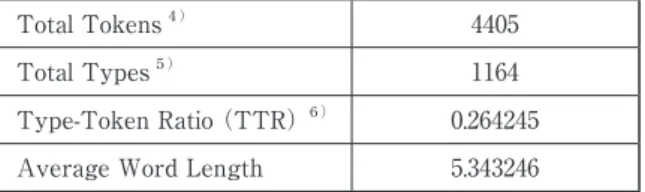
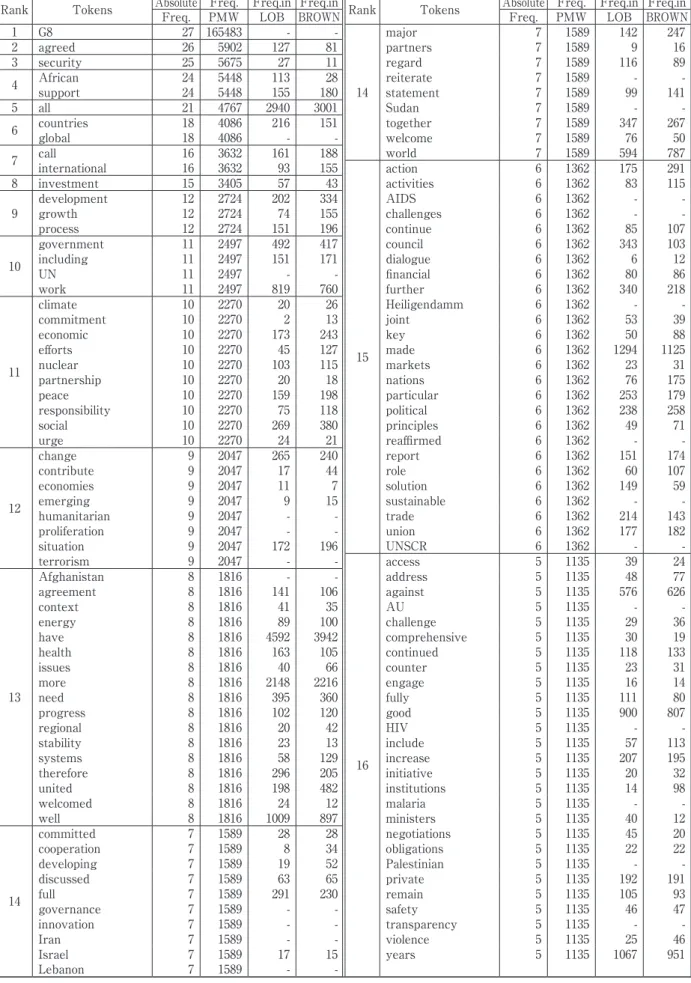
︿要 旨﹀ 本研究の目的は、現代世界における喫急の課題について英語で議論する場合に用いられる語句、コロケーション などの使用法をコンピュータを用いた分析によって明らかにすることである。分析の対象となるコーパスは2007年 に開催されたG8ハイリゲンダム会議の議長総括のテクストより作成した。様々な特長的な語彙の使用頻度、コロ ケーションなどがLOBコーパスやBROWNコーパスとの比較において抽出された。また、カタカナ英語や日本 の学校英語で教えられる語彙との関連において質的な分析も行なった。 キーワード:G8サミット、コーパス、頻度、コロケーション、時事英語学習、カタカナ英語 Ⅰ.序 本論では、今日の世界が直面する最も重要かつ緊急 性のある問題を議論するためにどのような英語が用い られているか、その語彙の範囲と語法を把握し、効率 的な時事英語学習の一助とするために、2007年にドイ ツのメルケル首相を議長として開催されたG8ハイリ ゲンダム会議1)の議長総括のテクストをコーパスと して、量的分析を中心に考察を試みる。特徴的語彙の 抽出にあたっては、同テクストに出現する内容語中の 高頻度語をLOB、BROWNコーパスにおける当該語 の頻度と比較した。また、日本の外務省による同総 括の日本語(仮訳)2)テキストとの比較分析を行い、 それに関連して日本の中学校から大学までの英語語彙 学習に関して留意すべき諸問題について質的考察も試 みる。 まず、第Ⅱ章では研究方法を述べ、第Ⅲ章におい て.語彙・語法の特徴について量的分析を行い考察す る。第Ⅳ章では、同テクストの日本語訳との関連にお いて語彙・語法の特徴について述べ、さらに、第Ⅴ章 では同テスクトの文体全般についての考察を行う。第 Ⅵ章のまとめでは、本研究を総括し、その結果を今後 の大学における時事英語教育にどのように活用するこ とが可能かを展望する。 Ⅱ.研究方法 1.分析対象テクスト 英文で発表されたハイリゲンダム・サミット議長総 括のテクストを主な分析対象として、その分析結果を 日本人の英語学習に資するため、同テクストの現時点 での公式日本語訳といえる外務省発表の和訳(仮訳) テクストを参照し、比較分析を行う。両者ともに全文 がインターネット上に公開されている。 議長総括は今回のサミット議長国がドイツであった ことから、テクストがメルケル首相自身の手になるも のか否かは別としても、英語を母国語としない英語使 用者によって作成されたものと考えられ、凝った修辞 テクニックを用いていない簡潔明瞭な英文である。し かしながら、今回の研究は語彙とコロケーションに主 眼を置くものであり、テクストの文体が英語のnative speakerものであるかどうかを立証することを目的と はしていないため、そのような観点からの分析は行わない。 一方、外務省発表による日本語訳は、その表題に(仮 訳)とことわっているとおり、議長総括発表直後に出 されたものであり、時間をかけてこなれた日本語に移 されたものではない。そのことは、多くの英単語がま だ一般には流布していないカタカナ語としてそのまま 用いられていることでも明らかであり、まさにその点 に原語の用法との比較考察の意義を見いだすものであ るが、詳しくは後章で考察する。 2.分析方法 上記の議長総括の原文テクストをG8ハイリゲン ダム・サミット公式サイトからダウンロードした PDFファイルをテキストファイルに変換し、コン コーダンサー3)2)3)で処理して、コーパス(以下、 Heiligendamm Corpus/HCという)を作成した。この 段階では、LOB, BROWNコーパスのデータとの整合 性を保つために派生語のlematizationは行っていない。 HCのデータ概要はFig.1のとおりである。 Fig. 1 Data of Heiligendamm Corpus Total Tokens4) 4405 Total Types5) 1164 Type-Token Ratio(TTR)6) 0.264245 Average Word Length 5.343246 コ ー パ ス の 総 語 数 は4405語、 そ の う ち lemmatization後の異語数は1164語、総語数に対する 異語の比率は約0.26、一語の平均字数は約5,34文字で ある。graphologicalには目立った差異は認められない 平均的な英文テクストであると言える。また、コーパ スとしては小規模ではあるが、本論の目的は同コーパ ス内の語彙・語法の特徴の分析と考察にあるため、コー パスサイズは特に問題とならない。 日 本 語 訳( 仮 訳 ) の テ ク ス ト( 以 下、Japanese Translation/JTという)はPDFファイルとして外務 省のホームページからダウンロードし、そのまま分析 資料として使用した。 Ⅲ.語彙・語法の特徴 1.高頻度語 1)データの範囲 まず、Heiligendamm Corpusの語彙・語法の特徴を 概観するために出現頻度の高い語を抽出した。その結 果はFig. 2に示す通りである。Fig. 2に限らず本論中の 全てのfrequency listでは、全語彙から機能語function wordsと数詞を除外し、内容語content words(名詞、 動詞、形容詞、副詞)のみをその対象としている。そ の理由は、本研究の主な目的は時事英語のSPE的興味 にもとづいた特徴的な語彙・語法の抽出にあり、機能 語はその限りではないからである。 Fig. 2では、HCの高頻度語の出現状況とその頻度 frequencyの有意性を確認するためにLOB、BROWN 両コーパス内の頻度を併記した高頻度語リストを作 成した。HCのデータとLOB、BROWN両コーパスの データの比較に整合性を与えるために、この段階で はHC内の単語のlemmatizationは行っていない。ま た、HCではLOB, BROWNと母数が異なるため、比較 のために百万語あたりの換算頻度PMW(Per Million Words)も併記した。データの範囲は、紙幅の関係か ら出現数5回以上の単語、125語とした。 2)特徴的語彙・語法の概観 ① LOB, BROWNコーパスに出現しないHCの高頻度 語 Fig. 2において、HCでは100万語あたり1000語以上 出現する語、すなわちPMWが1000以上の語でありな がら、LOB、 BROWNコーパスのFrequency Listには 掲出されていないものは以下の14語であった。( ) 内の数字は頻度の順位とPMWである。 G8(1-165483),global(6 -4086),humanitarian(12-2047),proliferation(12-2047),terrorism(12-2047), Afghanistan(13-1816),governance(14-1589), innovation(14-1589),Iran(14-1589),Lebanon (4-1589 ),reiterate(14-1589),Sudan(14-1589), AIDS(15-1362),challenges(15-1362),reaffirmed (15-1362),sustainable(15-1362),UNSCR (15-1362),challenge(16-1135),HIV(16-1135),malaria (16-1135),Palestinian(16-1135),transparency(16-1135) G8(1-165483),AIDS(15-1362),HIV(16-1135) などの概念はLOB、BROWNコーパス構築当時は存在 しなかったか、あるいは一般的でなかったと考えられ るので、これらの差異は当然であろう。 g l o b a l ( 6 - 4 0 8 6 ), t e r r o r i s m ( 1 2 - 2 0 4 7 ), proliferation(12-2047),governance(14-1589),
Fig. 2 High-frequency Word List from HC
Rank Tokens Absolute Freq. Freq.in Freq.in RankFreq. PMW LOB BROWN Tokens Absolute Freq. Freq.in Freq.inFreq. PMW LOB BROWN
1 G8 27 165483 -
-14
major 7 1589 142 247
2 agreed 26 5902 127 81 partners 7 1589 9 16
3 security 25 5675 27 11 regard 7 1589 116 89
4 Africansupport 2424 54485448 113155 18028 reiteratestatement 77 15891589 99- 141
-5 all 21 4767 2940 3001 Sudan 7 1589 -
-6 countriesglobal 1818 40864086 216- 151- togetherwelcome 77 15891589 34776 26750 7 callinternational 1616 36323632 16193 188155 world 7 1589 594 787
15
action 6 1362 175 291
8 investment 15 3405 57 43 activities 6 1362 83 115
9 developmentgrowth 1212 27242724 20274 155334 AIDSchallenges 66 13621362 -- -
-process 12 2724 151 196 continue 6 1362 85 107 10 government 11 2497 492 417 council 6 1362 343 103 including 11 2497 151 171 dialogue 6 1362 6 12 UN 11 2497 - - financial 6 1362 80 86 work 11 2497 819 760 further 6 1362 340 218 11 climate 10 2270 20 26 Heiligendamm 6 1362 - -commitment 10 2270 2 13 joint 6 1362 53 39 economic 10 2270 173 243 key 6 1362 50 88 efforts 10 2270 45 127 made 6 1362 1294 1125 nuclear 10 2270 103 115 markets 6 1362 23 31 partnership 10 2270 20 18 nations 6 1362 76 175 peace 10 2270 159 198 particular 6 1362 253 179 responsibility 10 2270 75 118 political 6 1362 238 258 social 10 2270 269 380 principles 6 1362 49 71 urge 10 2270 24 21 reaffirmed 6 1362 - -12 change 9 2047 265 240 report 6 1362 151 174 contribute 9 2047 17 44 role 6 1362 60 107 economies 9 2047 11 7 solution 6 1362 149 59 emerging 9 2047 9 15 sustainable 6 1362 - -humanitarian 9 2047 - - trade 6 1362 214 143 proliferation 9 2047 - - union 6 1362 177 182 situation 9 2047 172 196 UNSCR 6 1362 - -terrorism 9 2047 - -16 access 5 1135 39 24 13 Afghanistan 8 1816 - - address 5 1135 48 77 agreement 8 1816 141 106 against 5 1135 576 626 context 8 1816 41 35 AU 5 1135 - -energy 8 1816 89 100 challenge 5 1135 29 36 have 8 1816 4592 3942 comprehensive 5 1135 30 19 health 8 1816 163 105 continued 5 1135 118 133 issues 8 1816 40 66 counter 5 1135 23 31 more 8 1816 2148 2216 engage 5 1135 16 14 need 8 1816 395 360 fully 5 1135 111 80 progress 8 1816 102 120 good 5 1135 900 807 regional 8 1816 20 42 HIV 5 1135 - -stability 8 1816 23 13 include 5 1135 57 113 systems 8 1816 58 129 increase 5 1135 207 195 therefore 8 1816 296 205 initiative 5 1135 20 32 united 8 1816 198 482 institutions 5 1135 14 98 welcomed 8 1816 24 12 malaria 5 1135 - -well 8 1816 1009 897 ministers 5 1135 40 12 14 committed 7 1589 28 28 negotiations 5 1135 45 20 cooperation 7 1589 8 34 obligations 5 1135 22 22 developing 7 1589 19 52 Palestinian 5 1135 - -discussed 7 1589 63 65 private 5 1135 192 191 full 7 1589 291 230 remain 5 1135 105 93 governance 7 1589 - - safety 5 1135 46 47 innovation 7 1589 - - transparency 5 1135 - -Iran 7 1589 - - violence 5 1135 25 46 Israel 7 1589 17 15 years 5 1135 1067 951 Lebanon 7 1589 -
-innovation(14-1589),Afghanistan(13-1816),Iran (14-1589),Lebanon(4-1589),Sudan(14-1589), UNSCR(15-1362),Palestinian(16-1135) な ど の 語 群は、LOB、BROWNコーパス構築当時も存在してお り、意味も大きくは変化していないが、現代社会の要 請によって、またはHCの文脈上多用されていると考 えられるものである。 h u m a n i t a r i a n ( 1 2 - 2 0 4 7 ) , s u s t a i n a b l e (15-1362),sustainable(15-1362),challenges(15-1362), challenge(16-1135),transparency(16-1135) な ど の語もLOB、BROWNコーパス構築当時、当然存在し ていたはずであるが、時代の要請によってその意味や 含意が少しずつ変化しながら用いられるようになっ た語群と考えられるが、HCの語法の特徴として多用 されているとも言える。特に、challengesとchallenge は両方合わせるとHC中の頻度が11となり、PMWは 2497、順位も10位となる。この語の用法については後 段で詳述したい。 ② HCの内容を表す特徴的な語 高頻度リストからは、G8サミットの議長総括とい うテクストの目的からいって、国名や地名、その他議 長総括でとり上げられている課題を端的に表している 語群も抽出される。 African(4-5448),AU(the African Union)(16-1135),は合わせるとHC中の頻度29,PMW6583となり、 頻度順1位の突出したトピックとなる。このことから だけでも、ハイリゲンでのG8サミットにおける最重 要課題のひとつがアフリカ問題であることが明らかと なる。 その他総括で取り上げられた課題を表すと考えられ る語には次のようなものが挙げられよう。 security(3-5675),climate(11-2270),economic (11-2270),nuclear(11-2270),economies(12-2047), energy(13-1816),financial(15-1362),trade(15-1362), violence(16-1135) 以上、高頻度語リストに見られる語彙について概観 した。これらは、外務省発表の「G8ハイリゲンダム・ サミット(概要)」(平成19年6月8日)にG8の主な論 点として掲げられている 議長国ドイツは、「成長と責任」をテーマと して、「世界経済」、「アフリカ」を主要議題 として提示。世界経済の分野では、気候変動 が大きなテーマとなった。政治・安保分野で は、北朝鮮、イランの核問題を含む不拡散、 コソボ、アフガニスタン、中東等について議 論。 という骨子の文脈を十分に表していると言えよう。そ の他の特徴的な語・語法については、以下の品詞別高 頻度語リストとの関連においてさらに詳しく考察す る。 2.品詞別高頻度語 1)データについて 品詞別の高頻度語リストを作成するに当たっては、 その主な目的がHCのコンテクスト上特徴的な語や 語法を抽出することにあるので、トピック毎に分類 する方がその目的にかなうという観点から出現語の lemmatizaitionを行った。データの範囲は、どの品詞 もHC中の頻度5以上の語とした。 2)名詞 名詞は、最もテクストの内容が端的に反映される語 である。Fig. 3に抽出されている高頻度語を総覧する だけで、テクストの文脈の概要がつかめるといっても 良いであろう。1- 2)でも述べたようにハイリゲンダム 会議の議論の内容やそこにおける価値などが反映され ている。1- 2)では現代世界が対応を迫られている課題 を示唆する語彙を挙げたが、その他、主要国会議が目 指す価値を表していると考えられる語としては次のよ うなものが挙げられる。 investment 投資 development 発展、開発 growth 成長 responsibility 責任 agreement 合意 progress 発達、進展 stability 安定 cooperation 協力 governance 統治 innovation 革新、新基軸 safety 安全 transparency 透明性 また、HCコーパスの特徴のひとつとして、“challege” という語がすべて「(対応すべき)課題」という意味 の名詞として頻出している。この点については、次章 で日本語訳テクストとの関連において考察したい。
Fig. 3 List of High-frequency Nouns Rank Type Freq. inHC PMWFreq.
1 G8 27 165483 2 security 25 5675 3 support 24 5448 4 country 21 4767 5 investmentdevelopment 1515 34053405 6 commitment 14 3178 7 economy 13 2951 8 effort 12 2724 growth 12 2724 issue 12 2724 process 12 2724 responsibility 12 2724 9 governmentUN 1111 24972497 10 agreement 10 2270 climate 10 2270 market 10 2270 peace 10 2270 system 10 2270 11 change 9 2047 proliferation 9 2047 situation 9 2047 solution 9 2047 terrorism 9 2047 12 Afghanistan 8 1816 context 8 1816 energy 8 1816 health 8 1816 partner 8 1816 progress 8 1816 stability 8 1816 14 activities 6 1362 AIDS 6 1362 challenge 6 1362 council 6 1362 dialogue 6 1362 Heiligendamm 6 1362 nation 6 1362 negotiation 6 1362 obligation 6 1362 report 6 1362 role 6 1362 trade 6 1362 union 6 1362 UNSCR 6 1362 year 6 1362 15 access 5 1135 AU 5 1135 HIV 5 1135 initiative 5 1135 institution 5 1135 malaria 5 1135 minister 5 1135 Palestinian 5 1135 safety 5 1135 transparency 5 1135 violence 5 1135 work 5 1135 2)動詞 動詞の高頻度語はFig. 4のとおりである。サミッ ト会議の開催目的を反映する動詞として、“agree” の頻度が突出していることが注目される。名詞の “agreement”の頻度が10であるから、派生語として 両者あわせると頻度37回となり、PMWは8399にもの ぼる。 頻度2位の 動詞“call”は全て“call on”「要請す る、求める」という群動詞の中に現れている。また、 順位6位の“address”は、一般的な時事英語として よく出てくる「演説する」という意味ではなく、「(課 題などに)取り組む」という意味で用いられている。 “address”という語の概念がスポーツ用語の「アドレ ス」に表れているように「ある方向に向かって差し出 す、力を向ける」というものであってみれば、これは 日本語訳レベルの問題と考えてもよいであろう。HC 中の用例は次のとおりである。文頭の( )内の数 字はテクストの行数を表している。 (5) i n t h e W o r l d E c o n o m y W e m e t a t Heiligendamm to address key challenges of the (52) with the leaders from emerging economies, to address these issues as a part (72) that should include all major emitters. To address the urgent challenge of
(76) engage major emitting economies on how best to address the challenge of climate
(179) G8 and their African partners also agreed to address the different causes
(7) G8 Presidency “Growth and Responsibility” we addressed economic, social and
( 8 ) shaping of globalization. In particular, we addressed the role of major emerging
(243) regard to Chernobyl were reaffirmed. Kosovo: We addressed the issue of the
(295) and legislature by Israel. Lebanon: We addressed the situation in Lebanon
(221) role of the United Nations Security Council in addressing the challenge of
Fig. 4 List of High-frequency Verbs in HC Rank Types Freq. inHC PMWFreq.
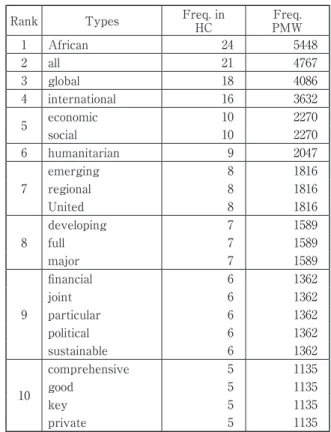
1 agree 27 165483 2 call 16 3632 3 include 15 3405 weicome 15 3405 4 have 12 2724 5 continue 11 2497 support 11 2497 6 urge 10 2270 address 10 2270 7 change 9 2047 contribute 9 2047 8 made 8 1816 progress 8 1816 reaffirm 8 1816 9 commit 7 1589 discuss 7 1589 increase 7 1589 reiterate 7 1589 10 fight 6 1362 need 6 1362 work 6 1362 11 condemn 5 1135 engage 5 1135 improve 5 1135 note 5 1135 remain 5 1135 3)形容詞 形容詞の高頻度語はFig. 5のとおりである。ここ でも、会議の議論の内容やそこにおける価値など が、次のような語によく反映されているといえる。 “international”より“global”のほうが頻度が高いこ とは近年の傾向をよく表しているといえる。 global 世界的な、国際的な international 国際的な economic 経済の social 社会的な humanitarian 人道的な sustainable 持続可能な comprehensive 包括的な、総合的な 形容詞について特筆するべきは、その数の少なさで はないだろうか。文体論にふれることになるが、HC では主観的な価値を表す飾りとしての形容詞の使用は 控えられており、簡明で客観的な印象を与える文体が 主流と言えよう。 Fig. 5 List of High-frequency Adjectives in HC Rank Types Freq. inHC PMWFreq.
1 African 24 5448 2 all 21 4767 3 global 18 4086 4 international 16 3632 5 economic 10 2270 social 10 2270 6 humanitarian 9 2047 7 emerging 8 1816 regional 8 1816 United 8 1816 8 developing 7 1589 full 7 1589 major 7 1589 9 financial 6 1362 joint 6 1362 particular 6 1362 political 6 1362 sustainable 6 1362 10 comprehensive 5 1135 good 5 1135 key 5 1135 private 5 1135 4)組織・団体名 出現する固有名詞中の組織や団体の名称はFig. 6の ようなものである。これらは時事英語学習者にとって の基礎的な知識として、まず注目されるべき語彙とい える。 Fig.6 Names of Organizations/Institutions Freq. in HC Types 27 G8 17 UN(the United Nations) 10 AU(the African Union) 6 UNSCR 3 APRM(the African Peer Review Mechanism) 2 DDA EITI FARC G11 GFATM IPRs MDGs NEPAD OSCE UNFCCC 1 the European Union AMIS CIS EUPOL FSF IAEA
1 IPCC ISAF NPT NSSG OECD UNAIDS UNSC WHO WTO 5)国・地域・都市・国民名 議長総括において言及されている国、地域、都市、 国民の名称はFig. 7のとおりであるが、前段でも述べ たように、世界が直面する緊急課題を反映してアフリ カ関連の地名が突出している。欧米諸国に滞在中は、 毎日のようにメディアで報道されるアフリカ諸国の ニュースに遭遇するが、日本では地理的ならびに外交 的な理由もありこれらアフリカ関連の名称は時事英語 学習者にとってさえ最も馴染みが薄い分野のひとつと 言えよう。そのような意味でも、本コーパスのような 包括的な時事分野のコーパスを活用して背景知識とと もに語彙を習得することは有意義である。Fig. 7に挙 げられている名称のうち、特に日本人に馴染みがない と思われるものや複数の読み方があるものには議長総 括の日本語訳(仮訳)テクストからカタカナ読みを引 いて付記した。 Fig. 7 Names of Nations, Regions & Cities Freq. in HC Types 14 Africa 8 Afghanistan 7 Iran Israel Lebanon 6 Heiligendamm 5 Palestinian 4 Darfur ダルフール Iraq Afghan 3 Armenia China Colombia Iranian Korea St.Petersburg サンクト・ペテルブルグ 2 Arab Azerbaijan Brazil Canada German India 2 Japan Jordan Kosovo Mexico Minsk Nagorno Karabakh ナゴルノ・カラバク Pakistan the United Kingdom US(the United States of America) 1 Algeria America Chernobyl Colombian Doha France French Germany Ghana Indonesia Israeli Italian Italy Jordanian Kananaskis カナナキス Kyoto Lebanese Nahr el Bared ナフル・エル・バーリド Nigeria Rome Russia Senegal Sharm El Sheikh シャルム・エル・シェイク Spanish Swiss Ukraine 6)病名等 議長総括で緊急対策が必要な病気として挙げられて いるものは、Fig. 8のとおりである。 Fig. 8 Names of Diseases, Syndromes, etc. Freq. in HC Types 5 AIDS HIV malaria 4 TB
Ⅲ. 特徴的な語法 1.“challenge” 前 述 し た よ う に、HCコ ー パ ス 中 の“challege”、 “challenges”は全て「(対応すべき)課題」という意 味の名詞として用いられている。HC中の用例は次の とおりである。文頭の( )内の数字はテクストの 行数を表している。 (72) all major emitters. To address the urgent challenge of climate change, it is vital that the (76) emitting economies on how best to address the challenge of climate change. We stress that (172) to quality health services remains a critical challenge in many African countries. (217) c o m m i t m e n t t o c o u n t e r t h e g l o b a l proliferation challenge. In this regard, we reaffirm our
(221) Nations Security Council in addressing the challenge of proliferation. We also stress the
( 5 ) Economy We met at Heiligendamm to address key challenges of the world economy, climate change (10) Heiligendamm Process: We discussed global challenges with the Leaders of Brazil, China, (59) Combating climate change is one of the major challenges for mankind and it has the potential (124) the African Leaders that we can only meet these challenges in a spirit of partnership, mutual (225) committed to resolving regional proliferation challenges by diplomatic means. Global (324) We support a comprehensive approach to the challenges that still lie ahead and we reiterated 以上の用例からわかるように、本議長総括では、地 球的規模で協働して取りくまなければならない課題を 意味する語として“challenge”を使用している。 Oxford Advanced Learner’s Dictionaryの語義にも、 1番目に“a new or difficult task that tests sb’s ability and skill”とあり、最初の文例も“Distruction of the environment is one of the most serious challenges we face.”となっている。また、次の英国のリベラル な高級紙の記事の例からもわかるように“challenge” のこの用法は一般的なものと言ってよい。 Campbell meets the challenge While the Lib Dem leader is not a natural tub-thumper, his speech today was good enough to satisfy most of his audience in Brighton, writes Michael White.
It's never easy making a party leader's conference speech and Ming Campbell's address to a darkened, less-than-packed Brighton Centre today was a special challenge at the end of a week of muttering about his fitness to lead his troops. Did he meet it?
(Thursday September 20, 2007 Guardian Unlimited) Ⅳ.日本語訳との関連において 1.“challenge”と「チャレンジ」 翻って、日本語訳(仮訳)テクストのおける “challenge”の扱いを見てみると、その訳はすべて「挑 戦」となっている。日本語訳を英文の文脈にそって「課 題、難問、問題」としなかった背景にどのような考慮 があったのかは伺いしれないが、日本の英語学習者用 辞書の語義の記載の仕方と無縁ではないと思われる。 たとえば、見出し語数17万3千語の「研究社新英和 中辞典」では 次のように記載されている。 ⑴ a 挑戦,決闘[試合(など)]の申し込み,チャレン ジ;挑戦状 〔to〕 b +to do 〈…しようという〉挑戦. ⑵ a [また a 〜] 努力[意欲,感興(など)]を呼び 起こすこと,手ごたえ,やりがい b 手ごたえのある事(柄)[仕事,問題(など)]. ⑶ a 説明[証拠]の要求;(説明・証拠を求めての) 抗議,難詰; 〔権威・正当性などへの〕異議 〔to〕. b 《米》(投票(者)の有効性・資格などへの) 異議申し立て. ⑷ a 誰 何( す い か )《 番 兵 が“Halt! Who goes there?”「止まれ!だれだ」 と呼び止めるこ と》.b+to do 〈…せよとの〉誰何. ⑸ 【法】(任命前の陪審員に対する)忌避. 上記のような語義からは、日本の英語学習者は「対 処すべき難問」という意味はすぐには引き出せないで あろう。また、見出し語数12万語の「エクシード英和
辞典」(三省堂)および「プログレッシヴ英和辞典」では、 次のように同じ記載がある。 ━ n.挑戦(状); 決闘[試合,競技など]の申込;(番 兵の)誰何(すいか);難問;やりがい;【法】忌避; 説明の要求;異議(の申し入れ),抗議. ここからも「難問」という語義が現代のごく一般的 で主流の用法であるとは、すぐには見てとれない。 このように日本人英語学習者にとって“challenge” という語はすぐに「難問」とは結びつかないという背 景があるため、一般的な訳として「挑戦」を用いたの であろうが、日本語における挑戦は「大辞林第二版」 にもあるように、 (名)スル 戦いをいどむこと。 「チャンピオンに−する」「−的な態度」 と動詞として用いるのが一般的である。ここには「対 処すべき難問」という概念はまったくない。したがっ て、次のような外務省による日本語訳(仮訳)は、日 本語としては非常にぎこちないものと言えよう。 「我々は、ハイリゲンダムにおいて、世界経済、 気候変動及びアフリカの主要な挑戦に取り組む ため一堂に会した。」 「我々は、ブラジル、中国、インド、メキシコ 及び南アフリカの首脳とともに、地球規模の挑 戦について議論した。」 「気候変動との闘いは人類の主要な挑戦の1つ であり、我々の自然環境と世界経済に深刻な悪 影響を与える潜在性がある。」 「気候変動の緊急な挑戦に取り組むためには、 主要排出国が2008年末までに、新しい地球規模 の枠組みに対する詳細な貢献について合意し、 気候変動の挑戦に対する最良の取組のあり方に ついて、主要排出国を関与させる必要性を繰り 返し述べる。」 「我々は我々は、世界的な拡散上の挑戦に対抗 するという我々の共通のコミットメントに引き 続き決意を有する。」 「地域的な拡散上の挑戦を解決することに、引 き続きコミットする。」 日本語におけるチャレンジは「挑戦(する)」とい う意味でもっぱら用いられるが、仮訳にあるように主 語が無生物である場合、「挑戦」と訳したのでは一般 的な日本語としては文脈になじまない。かといって、 カタカナ語の「チャレンジ」そのままでは、英語の意 味が伝わらないというジレンマがありながらの窮余の 策であったに違いない。 ここでの筆者の目的は、外務省の仮訳を批判するこ とにはない。この事例によって筆者が強調したいの は、学校の英語教育で従来おこなわれてきた英和辞典 にたよる和訳中心の学習では、このような時事的な英 文には今後ますます対応できなくなるであろうことか ら、学校英語教育においてもこの議長総括のような authenticでup-to-dateな資料を教材として文脈の中で の語法学習の大切さである。現代のように次々と新し い概念と言葉が生まれる状況にあっては、それが唯一 有効な学習方法と言えよう。特に、中学・高等学校時 代の言葉の概念を形成する段階での英語学習にはその ような指導の態度がきわめて重要と思われる。 2.仮訳でカタカナ語で処理されている語について 外務省による仮訳では、多くの語が和訳されること なくカタカナ語として表記されているが、そのうち国 立国語研究所による『「外来語」言い換え提案』7)で 日本語への言い換えが推奨されている語には次のよう なものがある。 アクセスaccess→⑴接続 ⑵交通手段 ⑶参入 アジェンダagenda→検討課題 コミットcommit→⑴かかわる ⑵確約する コミットメントcommitment→⑴関与 ⑵確約 ミッションmission→使節団 使命 ただし、本テキストにおいて「アクセスaccess」と いう語で意味するところは、上記の日本語代替案であ る⑴接続 ⑵交通手段 ⑶参入のいずれでもなく、「入 手(利用)の権利(できること)」というものであるため、 カタカナ語のまま表記したとも考えられる。外来語と しての「アクセス」には、まだ「入手(利用)の権利(で きること)」という語義はないと考えられているとい
うことである。それにもかかわらず、仮訳ではカタカ ナ表記することを選んだ理由としては、本会議のよう な国際的な問題を議論する場では、accessという語が 第一義的に「入手(利用)の権利(できること)」と いう意味で用いられるという現実があるためだと推測 される。このことは、日本の英語教育あるいは外来語 の分野さえ、現代世界の英語使用の現実とタイムラグ が生じていることを表している。 また、仮訳には「ハイリゲンダム・プロセス」、「国 連の気候プロセス」など、従来の外来語の「プロセス」 の意味の範疇にはない、いわば現代の外交用語として の「プロセス」もカタカナ語として残されている。 Ⅴ.まとめ 本論では、今日の世界が直面する最も重要かつ緊急 性のある問題を議論する場面ではどのような英語が用 いられているか、その語彙の範囲と語法を把握してよ り効率的な時事英語学習の一助とすることを目的とし て、2007年にドイツのメルケル首相を議長として開催 されたG8ハイリゲンダム会議の議長総括のテクスト について量的分析を中心に行い考察した。また、日本 の外務省による同総括の日本語(仮訳)テキストとの 比較分析を行い、それに関連して日本の中学校から大 学までの英語語彙学習に関して留意すべき諸問題につ いての質的考察も試みた。 まず、第Ⅱ章では分析対象テクストとその背景、 分析方法、コーパス全体についてのデータ等を述べ た。第Ⅲ章においては.語彙・語法の特徴を抽出する ために量的分析を行い、まず、HCではPMWが1000 以上の語でありながら、LOB、 BROWNコーパスの Frequency Listには掲出されていない14語を特定し た。 そ の 中 に は、global、 innovation、 sustainableな ど現在では毎日のように眼にする語群が含まれてい ることも時代の特徴を表している。語法の特徴とし て特に多用されているchallengesとchallengeは、全て 「(対応すべき)課題」という意味の名詞として用い られており、これについては別項をたてて考察した。 また、総括で取り上げられた課題を表すと考えられ る語として、security、 climate、 economic、 nuclear、 economies、 energy、financial、trade、violenceな ど が高頻度語として抽出された。その他、議長総括にお いて言及されている国、地域、都市、国民の名称の中 では、世界が直面する緊急課題を反映してアフリカ関 連の地名が突出していた。日本では地理的ならびに外 交的な理由から時事英語学習者にとっても馴染みが薄 い地域であることから、学習上の課題のひとつとなる であろう。 第Ⅳ章の第1項では、同テクストの外務省による 日本語訳(仮訳)との関連において、カタカナ語の 使用とそれにまつわる課題について考察した。ここ でも日本語訳(仮訳)テクストにおけるchallengesと challengeのあつかいがカタカナ語の「チャレンジ」 ではなく、すべて「挑戦」と訳されていることを、主 な英和辞典と国語辞典における語義などとの関連にお いて考察した。第2項では、外務省による日本語訳(仮 訳)では、多くの語が和訳されることなくカタカナ語 として表記されていることを取り上げ、国立国語研究 所による『「外来語」言い換え提案』との関連におい て考察した。日本語訳(仮訳)には「ハイリゲンダム・ プロセス」、「国連の気候プロセス」など、従来の外来 語の「プロセス」の意味の範疇にはない、いわば現代 の外交用語としての「プロセス」もカタカナ語として 残されていることも明らかになった。日本語訳におい て、ある用語をカタカナ語として表記するか、日本語 訳を用いるかという問題を観察することによって、そ の語に対する日本社会における一般的通念、外交関係 者間での通念、日本の学校英語教育で一般的に与えら れている知識という3者間に存在する齟齬が浮彫りと なった。 以上、本研究を概観し明らかになったことは、今日 的な問題を地球規模の視野で議論するには、日本の英 語教育あるいは外来語の分野においてさえ、現代世界 の英語使用の現実と明らかにタイムラグが生じている ということである。現代のように次々と新しい概念と 言葉が生まれる状況にあっては、従来の学校英語教育 でおこなわれてきた英和辞典にたよる和訳中心の学習 では、時事的な分野の英文には今後ますます対応でき なくなるであろう。 地球規模の課題解決にむけて他国の人々と協働する ためのコミュニケーション能力を獲得させることが現 代の学校英語教育の目的のひとつであることは論をま たない。そのためには、これからの英語教育では、教 室での教材としても本コーパスのようなauthenticで 包括的な時事分野のコーパスを活用して背景知識とと もに文脈の中で語彙を習得することがもっとも有効な 学習方法と言えよう。 <注> 1)2007年6月6日〜 8日にドイツのハイリゲンダム
にて開催された第33回目主要国首脳会議。議長国 ドイツは、「成長と責任」をテーマとして、「世界 経済」、「アフリカ」を主要議題として提示。世界 経済の分野では、気候変動が大きなテーマとなっ た。政治・安保分野では、北朝鮮、イランの核問 題を含む不拡散、コソボ、アフガニスタン、中東 等について議論。 2)2007年6月8日に下記外務省ホームページに発表 され、2009年9月現在も仮訳として掲載されてい る。 http://www.mofa.go.jp/Mofaj/Gaiko/summit/ heiligendamm07/g8_s_gs.html 3)フリーソフトウエアのKWIC Concordance for Windows Version 4.7 Copyright (C) 2004 塚本 聡 4) テクスト中の延べ語数 5) テクスト中の異なる語の総数 6)延べ語数中の異なり語数の比率 7)平成18年3月発表 http://www.kokken.go.jp/gairaigo/ 参考文献・資料
Buttler, C.S. :Computers and Written Texts, Blackwell(1992)
Garsid, R., Leech, G. and Sampson, G.:The Computational Analysis of English, Longman (1987)
Hofland, K., Jphansson, St.:Word Frequencies in British and American English,NAVF(1986) Sinclair, J. :Corpus, Concordance, Collocation,
Describing English Language Series, Oxford University Press(1991) 青葉ことばの会 :日本語研究法 古代語編. おうふう, 1998 赤瀬川史朗他 :コーパス言語学の技法 Ⅱ. 言語データ の収集とコーパスの構築, 夏目書房., 2004 石川慎一郎 :英語コーパスと言語教育, 大修館書店, 2008 伊藤雅光:計量言語学入門, 大修館書店, 2002 稲木昭子・沖田知子:コンピュータの向こうのアリス の世界, 英宝社, 2002 上田博人:パソコンによる外国語研究への招待, くろ しお出版, 1998 :パソコンによる外国語研究Ⅰ数値データの処理, くろしお出版, 998 :パソコンによる外国語研究Ⅱ文字データの処理, くろしお出版, 1998 小稲義男他:新英和中辞典第5版、研究社 1985 齊藤俊雄他:改訂新版 英語コーパス言語学, 研究社 出版, 2005 Stubbs, M. :Words and Phrases:Corpus Studies of Lexical Semantics. Oxford:Blackwell. 2001、ス タッブズ, マイケル 南出康世・石川慎一郎訳 :コー パス語彙意味論から句へ, 研究社, 2006 三省堂編修所:エクシード英和辞典第2版、三省堂 2004 国広哲弥他:プログレッシヴ英和辞典第4版、小学館 2002 http://www.mofa.go.jp/Mofaj/Gaiko/summit/ heiligendamm07/g8_s_gs.html 外務省HP(2009 年8月25日閲覧) http://www.kokken.go.jp/gairaigo/Teian1_4/tebiki. html 国立国語研究所HP(2009年8月25日閲 覧)
附録1
CHAIR'S SUMMARY Heiligendamm, 8 June 2007 Ⅰ.
Growth and Responsibility in the World Economy
We met at Heiligendamm to address key challenges of the world economy, climate change and Africa. Under the core theme of the German G8 Presidency “Growth and Responsibility” we addressed economic, social and environmental aspects of the political shaping of globalization. In particular, we addressed the role of major emerging economies in the world today. We agreed on the benefits of a closer cooperation. Heiligendamm Process: We discussed global challenges with the Leaders of Brazil, China, India, Mexico, and South Africa. We acknowledged our respective responsibilities and the need to develop common solutions. We therefore agreed to launch a new topic-driven dialogue on key world economic issues with the aim of reaching concrete results until the G8 Summit in Italy 2009. The topics of this dialogue include issues relating to the freedom of investment and investment conditions, including corporate social responsibility; the promotion and protection of innovation; energy efficiency and technology cooperation; and development policy. The road map of this process is described by a joint declaration of the G8 Presidency and Brazil, China, India, Mexico and South Africa. G8 Agenda for Global Growth and Stability: We noted that the world economy is in good condition and growth is more evenly distributed across regions. In this context, we committed ourselves to a G8 Agenda for Global Growth and Stability with the aim of pursuing our strategies to promote a smooth adjustment of global imbalances which should take place in the context of sustained and robust global economic growth. These strategies include sound macroeconomic policies in our countries and structural reforms. They also include a clear signal to emerging economies concerning their necessary contribution.
Systemic Stability and Transparency of Financial Markets/Hedge Funds: We also discussed the situation on financial markets and, in particular, issues related to hedge funds. While noting the positive contribution of hedge funds to financial-market stability We also want to minimize systemic risks by increasing transparency and market discipline on the part of all parties involved. We welcomed the Financial Stability Forum£s (FSF) work, support its recommendations and look forward to its report to finance ministers as from October this year.
Freedom of Investment, Investment Environment, and Social Responsibility: We concluded our discussion on investment with a strong commitment to the freedom of open and transparent investment. The G8 benefit considerably from cross-border investment, as do emerging economies. We agreed to work together in the Heiligendamm Process to foster open and more favorable investment conditions in our respective countries. We will increase our efforts toward helping investment be more beneficial and sustainable. In the context of investment we also discussed social responsibility issues. Open markets need social inclusion. We therefore agreed on the active promotion of social standards, of corporate social responsibility, and on the need to strengthen social security systems in emerging economies and developing countries.
Promoting Innovation : Protecting Innovation: Innovation is one of the crucial drivers of economic growth in our countries. We therefore agreed to take action to promote innovation as well as research and development. At the same time, innovation needs to be protected worldwide. Intellectual Property Rights (IPRs) are a critical precondition for innovation. The protection of IPRs is of core interest for consumers in all countries, particularly in developing countries. We therefore agreed, together with the leaders from emerging economies, to address these issues as a part of the Heiligendamm Process. As G8, we decided to increase our cooperation in the field of intellectual property protection especially regarding our customs and law enforcement administrations. We will further engage our respective private sectors on effective solutions with regard to both the supply and the demand side of piracy and counterfeiting. Climate Change, Energy Efficiency and Energy Security: Combating climate change is one of the major challenges for mankind and it has the potential to seriously damage our natural environment and the global economy. We noted with concern the recent IPCC report and its findings. We are convinced that urgent and concerted action is needed and accept our responsibility to show leadership in tackling climate change. In setting a global goal for emissions reductions in the process we have agreed in Heiligendamm involving all major emitters, we will consider seriously the decisions made by the European Union, Canada and Japan which include at least a halving of global emissions by 2050. We have agreed that the UN climate process is the appropriate forum for negotiating future global action on climate change. We are committed to moving forward in that forum and call on all parties to actively and constructively participate in the UN Climate Change Conference in Indonesia in December 2007 with a view to achieving a comprehensive post 2012-agreement (post Kyoto-agreement) that should include all major emitters. To address the urgent challenge of climate change, it is vital that the major emitting countries agree on a detailed contribution for a new global framework by the end of 2008 which would contribute to a global agreement under the UNFCCC by 2009. We reiterate the need to engage major emitting economies on how best to address the challenge of climate change. We stress that further action should be based on the UNFCCC principle of common but differentiated responsibilities and capabilities.
Technology, energy efficiency and market mechanisms, including emission trading systems or tax incentives, are key to mastering climate change as well as enhancing energy security. We reaffirmed the energy security principles we agreed at St. Petersburg. In our discussion with the emerging economies we agreed that energy efficiency and technology cooperation will be crucial elements of our follow-up dialogue. Responsibility for Raw Materials - Transparency and Sustainable Growth: We discussed the situation on world commodity markets and recent price increases and reaffirmed our commitment to free, transparent and open markets. We will support increased transparency and build good governance in developing countries with social and environmental standards. We therefore express our continuous support for EITI and we will launch a certification pilot project. We acknowledge that promoting a consolidated set of principles and guidelines that apply to the international mining sectors in the developing countries would help ensure that the sector contributes to development. Fight against Corruption: We are committed to full implementation of our obligations under existing international agreements created to combat corruption, particularly those of the United Nations and the Organisation for Economic Cooperation and Development
(OECD) and will intensify our common efforts to effectively combat corruption worldwide. Trade: We stressed the need for achieving an ambitious, balanced and comprehensive agreement on the Doha Development Agenda (DDA), which will enhance worldwide trade among and between developed and developing countries and reinforce multilateral trade rules. We took note of the Ministerial Communique of the G-6 Trade Ministers of 12 April 2007 underlining their belief that by intensifying their work convergence can be reached and thus contribute to concluding the Round by the end of 2007. In this spirit, we pledged to work with a high level of ambition in all areas of the DDA and call on all WTO members to demonstrate constructive flexibility to bring these negotiations to a prompt successful conclusion. The time has come to translate the continued commitment on political level into tangible results. Therefore we urge Ministers in charge of trade, in particular from leading developed countries and major emerging economies, to provide in the coming weeks a solid platform for a multilateral negotiation leading to an agreement on modalities. Ⅱ. Growth and Responsibility in Africa On 8 June 2007, we met with the Leaders of Algeria, Nigeria, Senegal, and South Africa as well as with the Chairs of the African Union (the President of Ghana), the President of the AU Commission, the Chair of the NEPAD Executive Committee, the Prime Minister of Ethiopia, and the Secretary General of the United Nations to discuss key elements of “Growth and Responsibility in Africa. ” Together with our African partners, we agreed on the aims and core principles of our partnership to achieve our common goal of promoting African development. Our discussions focused how the G8 could effectively contribute toward the achievement of the Millennium Development Goals in Africa. In the context of the G8 Partnership with Africa we dealt in greater detail with the issues of “Peace and Security”, “Sustainable Investment”, “Good Governance”, and “Improving Health Systems and Fighting HIV/Aids, TB, and Malaria”. We confirmed together with the African Leaders that we can only meet these challenges in a spirit of partnership, mutual accountability and trust, and through enhanced international dialogue and cooperation, including with emerging economies. We agreed to a core set of development principles. We stressed the importance of private sector growth, including deepening financial markets, improving governance, and enabling trade. We jointly confirmed the commitments made in Gleneagles, in particular with regard to development financing. Debt relief, innovative finance initiatives as well as private sector engagements will contribute to fulfill these commitments.
Peace and Security: We discussed with our African partners questions relating to long- termpeace-building and the prevention of violent conflicts. We commended the progress achieved so far and the efforts of the African Union and African sub-regional organizations to develop an African Peace and Security Architecture and to establish the African Standby Force to settle violent intra-African conflicts and secure stability. We concurred that strengthening the civilian component of the African Standby Force, including police capabilities, would be an important step in this regard. We agreed that continued G8 support of these efforts will be required. We affirmed that military solutions alone can not secure peace in the long term. Instead, the political, economic and social conditions needed for promoting human security and stability would have to be
aimed for. We also agreed to assist the AU and sub-regional organizations to combat the unauthorized proliferation and the misuse of illicit small arms and light weapons, and to halt the illegal exploitation of natural resources. We will continue and intensify our ongoing dialogue with the African Union and, together with other development partners, will foster the coordination and coherence of our endeavors. Economic growth and investment: We welcomed significant and stable economic growth rates for the past years in many African countries as the outcome of courageous reforms and improved governance. The G8 want to enhance these positive developments and contribute to sustainable growth by encouraging and mobilizing domestic and international entrepreneurship and investment. In order to reach the MDGs, we need ODA as an important catalyst for reaching the MDGs and also more and more sustainable private investment. To support African partners in facilitating investment, the G8 welcomed on a variety of measures, including establishing a partnership for making finance work for Africa. We also decided to further promote market integration and cross-border infrastructure, inter alia through more coherent and coordinated support for capacity building for regional economic communities. We reiterated our commitment to accelerate the delivery of universal primary education as key instrument for sustainable development in Africa.
Good Governance and the Reform-Partnership with Africa: We paid tribute to the Regional and Pan-African institutions, especially the African Union (AU), and underlined our strong intention to further support African institutions at the pan-African and regional level. The G8 welcomed progress in the African Peer Review Mechanism (APRM) which aims at fostering governance reforms in Africa on a voluntary basis. The G8 have given assistance to NEPAD and the APRM process from its beginning while recognizing and supporting complete ownership by participating countries. The G8 agreed to provide additional support to countries during their peer reviews and for implementing reforms emerging from the APRM recommendations. The G8, together with their African partners, also welcomed the Extractive Industries Transparency Initiative (EITI) and agreed to implement an Action Plan for Good Financial Governance. Improving health systems, fighting HIV/AIDS, TB, and Malaria: We recognized that the access to quality health services remains a critical challenge in many African countries. We therefore agreed to assist our partner countries in developing and strengthening health systems to help them work toward the availability of appropriate health services for all, including poor and vulnerable groups such as women and children. Enhancing this process, the G8 will elaborate on sustainable and equitable financing of health systems through linking national financing strategies with coordinated international support. The G8 and their African partners also agreed to address the different causes of the lack of human resource capacity within the health sector. The G8 reaffirmed their commitment to continue to scale up their efforts towards the goal of universal access, the Millennium Development Goals for fighting HIV/AIDS, malaria and tuberculosis as well as strengthening of health systems by providing at least a projected US$ 60 billion over the coming years. We noted the substantially increasing demand projected by the board of the Global Fund to Fight AIDS, TB and Malaria and we agreed that the Global Fund continues to enjoy our full support. We will provide predictable, long-term additional funding in the ongoing replenishment round. The G8 acknowledged the increasing feminization of the HIV/AIDS pandemic and agreed
to specifically focus activities on the needs of women and girls. We will concretely work with all the relevant stakeholders including UNAIDS, WHO, the World Bank and the GFATM, the African Union and African States, innovative and generic pharmaceutical industry, private donors and civil society in order to deliver practical steps towards “universal access”.
In St. Petersburg we agreed to regularly review our work on tackling the three pandemics HIV/AIDS, TB and malaria. We undertake this monitoring exercise for the first time and will publish a report to provide information on our activities in September at the GFATM replenishment conference. Our Joint Progress Report on Africa is a sign of the mutual accountability of our relations with Africa and showed where we had already made progress, but also outlined areas where we still need to make immediate progress. Ⅲ. Foreign Policy and Security Issues Counter Terrorism: We adopted a Statement on Counter-Terrorism. We condemned all acts of terrorism, whatever their alleged motivation, in the strongest terms and reaffirmed that there could be no justification for such acts. We pledged to work closely together to react efficiently to new and continuing threats stemming from terrorist activities. We defined specific areas of further joint work to counter terrorism including, among others, responding to the terrorist and criminal abuse of modern communication and information technology, protecting critical energy infrastructures, improving transportation security, countering terrorist recruitment and preventing nuclear terrorism. We reaffirmed our support for the central role of the United Nations in the international fight against terrorism; in this context, we are providing a Report on G8 Support to the United Nations・Counter-Terrorism Efforts. Non-Proliferation: We adopted a statement on this issue. Preventing the proliferation of weapons of mass destruction and their means of delivery are critical to international peace and security. We remain resolute in our shared commitment to counter the global proliferation challenge. In this regard, we reaffirm our commitment to the multilateral treaty system which provides the normative basis for all non-proliferation efforts. To be successful, we need to work jointly with other partners and through relevant international institutions, in particular those of the United Nations system, and reiterate the key role of the United Nations Security Council in addressing the challenge of proliferation. We also stress the importance of developing and implementing mechanisms of multilateral approaches to the nuclear fuel cycle. In this regard, we appreciate suggested initiatives listed in the statement. We remain committed to resolving regional proliferation challenges by diplomatic means. Global Partnership: At the midpoint of its lifespan we have reviewed the progress made so far in the Global Partnership against the Proliferation of Weapons and Materials of Mass Destruction and assessed the state of the cooperative projects undertaken. We consider the Global Partnership, launched five years ago at Kananaskis as a unique and successful joint effort. We acknowledge the progress made since the launch of the Partnership in 2002. We will do more to increase the effectiveness of our cooperation. On the occasion of the midterm-review we reaffirm our commitments made in Kananaskis
and will discuss in the years to come the geographical scope of the Global Partnership and whether it should be extended beyond 2012. Nuclear Safety and Security: The Nuclear Safety and Security Group (NSSG) provided technically informed, strategic policy advice on selected nuclear safety and radiation protection issues, discussed nuclear safety improvement programs for operating Nuclear Power Plants (e.g. in Armenia, Ukraine), and furthered international activities on the safety and security of radioactive sources. The G8 commitments with regard to Chernobyl were reaffirmed. Kosovo: We addressed the issue of the future status of Kosovo and UN Special Envoy Martti Ahtisaariʼs comprehensive proposal submitted to the UN Security Council by the UN Secretary General on 26 March 2007. While there continue to be different views on substance and on the way forward, we will remain engaged on the issue. Sudan/Darfur: We adopted a statement on the situation in Sudan/Darfur which reflects our deep concern that the situation in Sudan continues to be marked by conflict and strife. We are particularly concerned over the tragic security and humanitarian situation in Darfur. We urge all sides to abide by the ceasefire agreements and by their obligations under UN Security Council Resolution (UNSCR) 1591 as well as international humanitarian law. We also appeal to the Government of Sudan and the rebel movements to ensure safe and unhindered humanitarian access. We underline that there is no military solution to the conflict in Darfur and fully support the efforts of the Special Envoys of the UN and the AU to restart negotiations with a view to reaching a political agreement. We call on the Government of Sudan and rebel movements to engage fully in this process. In order to create an enabling environment for negotiations and humanitarian access, the security situation must improve. Therefore, while we welcome the acceptance by the Government of Sudan of the UN heavy support package for AMIS, we urge Khartoum to also express its full acceptance of the AU/UN Hybrid force. Finally, we agreed that, if the Government of Sudan and the rebel movements continue to fail to meet their obligations, we will support appropriate action in the Security Council.
Iran: We reiterate our profound concerns over the proliferation implications of the Iranian nuclear program. We urge Iran to comply with its international obligations and UNSCR 1696, 1737 and 1747, in particular its obligation to suspend all enrichment related activities. We deeply deplore the fact that, as evidenced by the IAEA Director Generalʼs latest report to the Security Council, Iran has expanded its enrichment programme. We urge Iran to engage on the proposals put forward in June 2006 on behalf of China, France, Germany, Russia, the United Kingdom and the United States of America and reiterate that we remain committed to a negotiated solution. We call on Iran to meet the requirements for the resumption of negotiations. Should Iran continue not to heed the call of the Security Council, we shall support further appropriate measures as agreed in UNSCR 1747. We also call on Iran to play a more responsible and constructive role in the Middle East region and condemn the threats towards Israel by the Iranian government and the repeated denial of the Holocaust by representatives of the Iranian government. Middle East Peace Process: We reiterate our firm commitment to a comprehensive just and lasting peace solution in the Middle East. The Middle East Quartet which plays a central role in this respect enjoys our full support. We hope that the continued talks between Prime Minister Olmert and President Abbas will lay the foundation for negotiations on the establishment of a Palestinian state, consistent with the Roadmap
and based on the UNSCR 242, 338, 1397, and 1515. In this context, we welcome the re-affirmation of the Arab Peace Initiative and the intention of the Arab League to engage with Israel on this initiative. We call for an immediate end to violence against Israel, especially the continued firing of Qassam rockets into Southern Israel, and for the immediate release of the abducted Israeli soldier and urge all Palestinian factions to end internal violence and to respect the ceasefire. We call on Israel to show restraint in responding to these attacks and to refrain from all activities which are not in accordance with international law. We reiterate our concern over the severe economic and humanitarian situation in the Palestinian Territories and call on Israel to resume the transfer of the withheld Palestinian tax and customs revenues. We also call for the release of elected members of the Palestinian government and legislature by Israel. Lebanon: We addressed the situation in Lebanon and remain committed to Lebanon's sovereignty, independence and territorial integrity. We fully support the legitimate and democratic government of Lebanon. Noting the decision by UNSCR 1757 regarding the timely establishment of the Special Tribunal for Lebanon, we urge all states to fully cooperate with the Special Tribunal for Lebanon in accordance with UNSCR 1757 (2007). We strongly condemn the terrorist attacks that led to the recent outbreak of violence. We urgently call on all sides to respect the authority of the Lebanese Government and of the Armed Forces and thereby to prevent the situation in Nahr el Bared from escalating. We deplore the human suffering and loss of life caused by the violence. We reiterate our call on all political forces in Lebanon to search for a solution to the current political crisis through dialogue and with full respect for the democratic institutions of the country. Iraq: We exchanged views on the developments in Iraq and reiterated our commitment to Iraqʼs independence, sovereignty and territorial integrity. We once again condemn in the strongest terms all acts of terrorism and politically motivated or sectarian violence. We welcome the launching of the International Compact with Iraq and the meeting of neighbouring countries on 3/4 May 2007 in Sharm El Sheikh as important steps towards the goal of national reconciliation and a long-term process of regional confidence-building. Afghanistan: We welcomed the progress achieved by Afghans with the support of the International Community in the past years. We are deeply concerned over the increase of suicide attacks, deeply regret the losses sustained by the Afghan national security forces and ISAF members, and strongly condemn attacks on civilians, Afghan and international security forces. We expressed our support for the UNʼs central role in Afghanistan and encourage its ongoing leadership and engagement. We agreed that strong and reliable Afghan institutions, especially its courts, police and correctional systems, are vital to that countryʼs future and committed to continued support in these areas. We welcome the launch of the European Police Mission EUPOL Afghanistan as an important contribution to the strengthening of the Afghan National Police and the decision by Canada to contribute significant resources to this initiative. We support a comprehensive approach to the challenges that still lie ahead and we reiterated our commitment to stay engaged in Afghanistan and contribute to building a safe and prosperous country, free from narcotics and terrorism, on the basis of the Afghanistan Compact. In this context we underline the importance of the Rule of Law and the importance of the conference that will be held in Rome, hosted by the Italian government and co-chaired with the UN and the government of Afghanistan on 3 July. We call on countries in the region to contribute constructively to this effort. In this
context, we welcomed the meeting of G8 Foreign Ministers with the Foreign Ministers of Afghanistan and Pakistan in Potsdam on 30 May and endorsed their #Joint Statement on the G8 Afghanistan-Pakistan Initiative.・ Nagorno-Karabakh: We agreed that a settlement of the dispute between Armenia and Azerbaijan over Nagorno-Karabakh is vital for regional peace and stability. The G8 support the efforts undertaken by the Co-Chairs of the OSCE Minsk Group and call on the Presidents of Armenia and Azerbaijan to increase efforts to reach agreement on the basic principles proposed by the Co-Chairs of the OSCE Minsk Group. In this connection, we welcome the intention of both Presidents to meet at the margins of the CIS-meeting in St. Petersburg on 9 June, 2007, and call on them to reach early agreement on the basic principles in order to pave the way for a peaceful resolution of the conflict. North Korea: We urge North Korea to return to full compliance with its obligations under the NPT and, in accordance with the Joint Statement of 19 September 2005 and UNSC-Resolutions 1695 and 1718, to abandon all nuclear weapons and existing nuclear programs as well as ballistic missile programs. We fully support the Six Party Talks and swift implementation of the initial actions agreed on 13 February 2007 as a first step towards full implementation of the Joint Statement of 19 September 2005 in good faith. We also urge North Korea to respond to other security and humanitarian concerns of the international community, including the early resolution of the issue of abductions. Colombia: We have discussed the recent developments that have occurred in Colombia in the last few days. We acknowledged and welcomed the bold and courageous decision by President Uribe of Colombia to release a significant number of prisoners, including Mr. Rodrigo Granda, as a positive humanitarian step. Against this background, we call on the FARC to consider urgent steps that would contribute to a humanitarian solution leading to the liberation of hostages detained by the FARC, as well as guerilla fighters that have not yet been released. We urge all those concerned to continue to make the best use of French, Spanish and Swiss facilitation in this regard. We expressed our hope that such a humanitarian solution might pave the way to the resumption of a peace process to the benefit of the entire Colombian people. G11: We welcome the meeting of the German G8 Presidency with the Jordanian Chair of the G11 in the second half of 2007. Ⅳ. G8 Summit 2008: We welcome the offer of the Prime Minister of Japan to host our next Summit in Hokkaido Tokyo, Japan in July 2008.
English for Global Environmental Issues(2)
A Philological Study on the Chair’s Summary of
G8 Summit 2007 in Heiligendamm with a view of
Media English Learning in Japanese Class Rooms
Kazuko NIshioka ︿Abstract﹀ The purpose of this study is to investigate the usage of English words, phrases and collocations used to discuss the most comprehensive and pressing global issues today through the use of computational language analysis. The corpus examined for this study is taken from the Chair’s Summary of the G8 Summit 2007 in Heiligendamm. Various distinctive features of the text are found in terms of word frequency and collocation compared to those in LOB and BROWN corpora. Some qualitative analysis is also made in relation to the vocabulary taught in Japanese English education and to the use of some of the Japanized English words in Japan.
Keywords:G8 Summit, corpus, frequency, collocation, media English study, Japanized English