The co-evolution of bron/e-cuckoos (Chalcites spp.) and their hosts
テ リ カ ツ コ ウ 属 と そ の 宿 主 の 托 卵 を め ぐ る 攻 防
D o c to r a l th e sis
博士論文
2013
立 教 大 学 大 学 院 理 学 研 究 科 生 命 理 学 専 攻
N o z o m u J. S a t o
佐藤望
|查終了 .1 3. 6,1 8
主 _ '■?
参 考 論 文
1.Sato NJ, T o k u e K, N o s k e R A , M i k a m i O K , U e d a K. 2010. Evicting cuckoo nestlings from the nest: a n e w anti-parasite behaviour. Biology Letters. 6:67 - 69.
2. Sato NJ, M i k a m i O K , U e d a K. 2010. E g g dilution effect hypothesis: a condition
under which parasitic nestling ejection behaviour will evolve. Ornithological
Science. 9:115-121.
Contents
参 考 論 文 ... 2
C o n t e n t s ... 3
General introduction... 5
Chap t e r I Evicting cuckoo nestlings f r o m the nest: a n e w anti-parasitism behaviour...8
Introduction... 8
Methods...9
Results... 11
Discussion... 12
Chapter II D o hosts of bronze-cuckoos recognize foreign nestlings through learning? Effects of small clutch size a n d delays in host chick eviction (idea) 1 8 introduction... 18
H o w might hosts recognize alien nestlings?...19
(1)Recognition by discordancy of eggs vs. chicks... 20
(2) Template-based recogniuon of eggs vs. chicks... 20
Effect of small clutch size in recognition by discordancy... 22
Importance of hatching patterns for the evolution of nestling distinction by template-based recognition... 23
Possibility of template-based recognition in Gerygone spp... 24
Conclusion... 25
C hapter III Discrimination by learning against parasite chicks drives the cuckoo-host co-evolutionary a r m s r a c e ... 2 8 Introduction... 28
T he M o d e l ... 30
Discussion...32
Cha p t e r IV E g g dilution effect hypothesis: a condition under which parasitic nestling ejection behaviour will evolve... 4 1
匿
n to r o d u c t i o n ... 41
T h e egg d ilu tio n effect h y p o th e s is ...43
D is c u ss io n ...48
C ha p t e r V Evolution of nestling ejection in G erygone spp. driven by the egg dilution effect... 5 7 I n t r o d u c t i o n ... 57
M e t h o d s ... 59
R e s u l t s ...60
D is c u ss io n ...63
G e n e r a 丨 discussion... 6 9
A c k n o w l e d g e m e n t s ... 7 2
Refer e n c e ... 7 3
General introduction
T h e image of a small bird feeding a huge c o m m o n cuckoo Cuculus canorus
young has been attracted scientists and other people for thousands of years. M o r e than
2000 years ago, Aristotle (384-322 B C ) wrote about the wonder behaviour of the
cuckoo (Peck 1993; Hett 1936). H e already k n e w that female cuckoos lay eggs in nests
of small birds, and that the cuckoo nestling evicts all other nest mates from the nest
(Davies 2011).The small birds (hereafter “host”)raise the cuckoo nestling even though
the nestling kills their offspring (Payne 2005), and grows up to 10 times the size of the
adult host (Wyllie 1981). Avian brood parasitism is not u n c o m m o n , at least 100 species
from 5 families (Cuculidae, Icteridae, Indicatoridae, Viduidae and Anatidae) parasite
their hosts, which represents one percent of all bird species in the world (Davies 2000).
Scientists and naturalists, however, principally focus on only one species, the c o m m o n
cuckoo, as model for this co-evolutionary arms race (Rothstein and Robinson 1998;
Davies 2000; Payne 2005).
Since parasitism by the c o m m o n cuckoo reduces the breeding success of its
hosts, m a n y hosts have evolved anti-parasite behaviour such as parasite egg rejection,
5
and the behaviour promotes parasites to evolve counter-adaptations such as laying
mimetic eggs. This is a good example of a co-evolutionary arms race (Dawkins & Krebs
1979; Rothstein 1990).
T h e arms race between the c o m m o n cuckoo and its hosts occurs in various
stages of the hosts’ breeding. W h e n a female cuckoo approaches a host nest to lay her
egg, m a n y hosts attack the cuckoo (Reskaft et al. 2002; Welbergen & Davies 2009).
This behaviour promotes counter-adaptation in female cuckoos: swift and secretive
parasitism at times w h e n their hosts are absent from the nest (Chance 1940; Davies &
Brooke 1988). Although female cuckoos sometimes lay successfully their eggs in the
nest of their hosts, s o m e hosts have developed advanced defense behaviour, such as egg
ejection (Ban et al. 2013) or nest desertion (Moskat et al.2011),and this behaviour
promoted that cuckoos evolved laying mimetic eggs (Brooke & Davies 1988).
However, hosts of the c o m m o n cuckoo have never evolved anti-parasite
behaviour against cuckoo nestlings, even though they are not similar to host young and
m u c h larger (Davies 2000). This paradox of “lack of nestling rejection in hosts of
c o m m o n cuckoo” (Davies 2000) has been a long-standing question in evolution.
However, recent discoveries of alien nestling recognition and ejection in two Australian
warbler species {Gerygone spp.) that are hosts of bronze-cuckoos (Chapter I; T o k u e &
U e d a 2010) provide an opportunity to disentangle the paradox. In the first chapter, I
s h o w that large-billed gerygones G. magnirostris can eject alien nestling from the nest.
In the second chapter, I specifically address the question h o w the two species of
Australian warblers are able to recognize and reject parasitic nestlings. In chapter III, I
s h o w that nestling ejection by Gerygone species is adaptive even though they recognize
parasites by learning. I s h o w in chapter IV that nestling ejection is more adaptive than
egg ejection w h e n clutch size is small and double parasitism occurs. In chapter V, I
compare behaviour a m o n g Gerygone species. Their behaviour supports m y hypothesis.
Finally, I discuss all these aspects in the general discussion.
Chapter I Evicting cuckoo nestlings from the nest: a new anti-parasitism behaviour.
I n t r o d u c t i o n
Since brood-parasitic cuckoos usually reduce their host’ s reproductive
success, hosts exhibit strong defence behaviour against parasitism (Wyllie 1981). T h e
ejection of cuckoo eggs from host nests is one of effective defence mechanism, but it
depends on hosts having the ability to discriminate cuckoo egg (Davies 2000). If cuckoo
eggs slip through the hosts’ detection system, and hatch, hosts accept the cuckoo
nestlings and take care of them until w h e n they b e c o m e independent (Payne 2005).
W h y do hosts accept cuckoo nestlings? O n e hypothesis is that learning to
recognize parasitic nestlings is costly (recognition error overweighing benefit) and thus
maladaptive for hosts (Lotem 1993). However, two recent studies have s h o w n that two
host species; reed warbler Acrocephalus scirpaceus and superb Fairy-wren Malurus
cyaneus have defence mechanisms against parasitism at the nestling stage (Grim et al.
2003,L a n g m o r e et al. 2003). These hosts recognize that their brood has been
parasitized by using cues such as the begging call by cuckoo nestling (Langmore et al
8
2003) or unusually prolonged parental care (urim et ai 2003) and then abandon the
nests. It has been suggested that this defense mechanism at the nestling stage should
evolve w h e n host defense at the egg stage had been breached by the parasite and is
beneficial for hosts because they avoid a future parental investment (Langmore et al.
2003). However, the hosts cannot salvage their progeny. Thus, in theory hosts should
rescue their progeny by selectively ejecting cuckoo nestlings from their nest before the
cuckoo young ejects the hosts’ brood, but the behaviour has never been reported until
now.
In this chapter, I report this previously u n k n o w n behaviour in a host species
of an Australian bronze-cuckoo, and discuss whether it represents an anti-parasitic
strategy. Using video cameras, I successfully recorded the m o m e n t w h e n host birds
ejected live cuckoo chicks from their nests.
M e t h o d s
T h e little bronze-cuckoo Chalcites minutillus is c o m m o n in mangroves and
rainforests of tropical Australia and Southeast Asia, and specializes in parasitizing
warblers of the genus Gerygone (Higgins 1999; N o s k e 2001). The study w a s conducted
in mangroves in Darwin, Northern Territory, Australia, where I focused on the main
Australian host species, the large-billed Gerygone Gerygone magnirostris (Brooker &
Brooker 1989a). T h e frequency of parasitism w a s recorded during 2000-2002. T h e
cuckoos parasitized 4 1 % of the nests of the species (Mulyani 2004),and during
2007-2009, 3 6 % (Tokue unpublished data). Immediately after the cuckoo chick hatches
it physically ejects any host eggs and chicks from the nest (Friedmann 1968). T h e
appearance of cuckoo eggs is very different from those of their hosts (Figure 1).In the
contrast the cuckoo chicks have blackish skin and white d o w n on the dorsal surface. It
is closely resemble to the nestlings of its hosts (Figure 1).Nestling mimicry in the
Vidua and its host systems is based on being accepted by the foster parents (Payne
2005) and facilitate in parasite y o u n g competing for foods (Schuetz 2005, but see also
Hauber & Kilner 2007). These conditions cannot explain the nestling similarity of the
present system because the cuckoo evicts the host’ s eggs and young soon after hatching.
I looked for host nests during four years (2006-2009) and recorded the nests
and behaviour during the nestling stage at 22 nests (523 hours);11 parasitized (254
hours) and 11 unparasitized (268 hours) with video cameras (Canon m i n i - D V F V 3 0 &
10
F V M 200). T h e recording period w a s from the expected hatching date to the day of
nestling ejection event or to the fifth day since hatching of parasitic young. T h e average
recording time for each nest w a s about 7 hours per day.
R e s u l t s
O f 22 nests I succeeded in capturing live nestling(s) being ejected by an adult
host at 5 different host nests (one case w a s unparasitized nest, four cases were
parasitized ones, Table 1).In two cases, only a cuckoo nestling w a s removed. In other
t wo cases, only a host nestling w a s evicted. In the fifth case, both cuckoo and host
nestlings and a host egg were ejected. In all cases, the host dragged the resisting
nestling(s) from the nest, and dropped it under the nest, presumably resulting in its
death (Figure 2). Although only two of the adult hosts from the five nests were marked
with colour rings, I concluded that the five adults were different individuals judging
from their nest position and breeding year. These two marked individuals were k n o w n
to be the owners of the nests from which they ejected nestlings because they incubated
the eggs in those nests.
A n y other different types of rejection were not taken on the video in other 17
11
nests. Host young fledged in 4 out of 10 unparasitized nests. In two nests, outcomes are
not known, while the rest of unparasitized nests failed to produce any young. In contrast,
cuckoo young fledged from two nests, host young fledged from two nests (cuckoo
egg/young disappeared from nest), and from three nests young disappeared before the
day that they were expected to fledge.
Discussion
This is the first report of cuckoo hosts physically ejecting cuckoo nestlings
from their nests, although nestling rejection (i.e. nest abandonment by hosts containing
parasite young) has been reported previously (Langmore et al. 2003; Grim et al. 2003).
I speculate that this ejection behaviour is an anti-parasitism strategy, for the following
reasons. First, at least two confirmed nest-owners ejected live nestlings from their nest,
suggesting that this behaviour was not infanticide by intruders. Secondly, the similarity
between the nestling of the cuckoo and that of its host (Figure 1 ) suggests that this
similarity is a consequence of the host’ s ability to discriminate odd looking cuckoo
nestlings, similar to the outcome seen in cuckoos mimicking hosts’ eggs to avoid
detection (Brooke & Davies 1988).
12
A lt h o u g h m a n g r o v e g e r y g o n e
G. levigaster
s a v e o w n n e s t lin g b y e je c t io nbehaviour (Tokue & Ueda 2010), this study did not provide sufficient evidence to show
that the host adults rescued progeny from host-evicting cuckoo young. Rather some of
them killed their o w n offspring, but this is to be expected since similar recognition
errors are k n o w n in egg ejecting host species (e.g. Davies & Brooke 1988). Therefore, I
need to examine whether the hosts are able to achieve higher fitness by ejecting cuckoo
nestlings even with the cost of ejecting their o w n young.
The evolutionary trajectory of this probable anti-parasitism strategy at the
nestling stage m a y be quite different from that of abandonment of parasitized nests at
the same stage. Langmore et al. (2003) suggested that defence mechanisms at the
nestling stage would evolve only after host defense at the egg stage had been breached
by the parasite. Interestingly, the hosts seem to lack any anti-parasitism strategy at the
egg stage (cuckoo egg does not mimic host eggs, Figure 1).In fact, I observed only one
case of o w n egg ejection in four years of research and this happened w h e n the egg did
not hatch after the full incubation period (Table 1,no. 5).
These factors suggest that the host m a y have by passed the egg rejection, and
1 3
went straight to the evolution of nestling ejection. The lack of egg rejection, and the
evolution of nestling ejection, m a y be due to a coincidence, or constraints such as small
bill size (Rohwer & S p a w 1988), physical structure of the nest, e.g. d o m e d nest
(Langmore et al. 2009b; Brooker et al. 1990). Future research on this apparently unique
system m a y give us n e w insights into the co-evolution of avian brood parasitism.
14
T a b le 1 . D e t a ils a n d o u tc o m e s o f nests f r o m w h ic h n e s tlin g s w e re e je c te d .
No. Nest contents when Is1 nestling was ejected Which was ejected
Outcome
C egg C young H egg H young C H
1 1
2 -
1 0depredated
2*
3
-
1•
3
1
1
depredated
two host young fledged
4*
2 - -
1 0 1one cuckoo fledged
5 -
12 -
12** failure, entire brood ejected
C = cuckoo, H = host
*both adults at the nest were colour-banded for individual recognition,
" o n e young and one host egg ejected.
1 5
(a)
Figure 1.A n Australian brood parasite and its host, (a) little bronze-cuckoo nestling
(left) and egg (right); (b)large-billed gerygone nestling (left) and egg (right).
16
Figure 2. Nestling ejection behaviour. The nestling of little bronze-cuckoo Chalcites
minutillus was ejected from the nest by the nest owner; large-billed gerygone Gerygone
magnirostris that has colour band.
17
Chapter II Do hosts of bronze-cuckoos recognize foreign nestlings through learning? Effects of small clutch size and delays in host chick eviction (idea)
Introduction
A s avian brood parasites reduce the breeding success of their hosts, m a n y
hosts have evolved anti-parasite behaviours such as parasite egg rejection, and these
behaviours promote parasites to evolve adaptations such as mimetic eggs (Winfree
1999). These interactions are a good example of a co-evolutionary arms race (Kilner
2013). For rejection of foreign eggs by hosts, there are two main possible cognitive
mechanisms of egg discrimination: recognition by discordance and template-based
recognition (Moskat et al. 2010). Although both mechanisms are valuable for egg
recognition, they do not seem to be suitable for nestling recognition by hosts of the
C o m m o n Cuckoo Cuculus canorus, because the cuckoo nestling evicts all eggs from the
nest before they hatch (Wyllie 1981). Therefore hosts cannot recognize parasites by
discordancy. It is also risky for these hosts to learn a template for recognition, because it
is possible that hosts treat the cuckoo nestling as the template for their o w n progeny if
1 8
they are parasitized in their first breeding attempt (Lotem et al. 1992; Lotem 1993).
However, two Gerygone species do eject foreign nestlings even though the cuckoo
nestlings mimic the host nestlings (Chapter I; Tokue & Ueda 2010). This raises the
question of h o w hosts distinguish o w n nestlings from cuckoo nestlings. In the chapter, I
argue that hosts reject cuckoo nestlings by using template-based recognition because the
small clutch size in Gerygone hosts makes it difficult to recognize by discordancy and
because host and parasite chicks coexist in the nest.
H o w might hosts recognize alien nestlings?
The lack of nestling recognition by m a n y hosts of avian brood parasites has
been a long-standing mystery. However, recent discoveries of nestling recognition in
some hosts (Chapter I; Langmore et al. 2003; Shizuka and Lyon 2010; Tokue and Ue d a
2010) provide an opportunity to begin disentangling the cognitive mechanisms involved
in such anti-parasitism behaviours. Here, I discuss w h y two species of Australian
warblers, Gerygone magnirostris and G. levigaster, are able to recognize and reject
parasitic nestlings.
M a n y hosts of avian brood parasites have evolved anti-parasitism behaviour
19
such as foreign egg rejection (Davies 2011).T w o main cognitive mechanisms of egg
discrimination have previously been proposed: recognition by discordancy and
template-based recognition (Rothstein 1974; Lahti & Lahti 2002; Moskat et al. 2010).
These two mechanisms do not seem to be mutually exclusive and it has been shown that
some hosts use both mechanisms (Moskat et al. 2010).
(1) Recognition by discordancy of eggs vs. chicks
In recognition by discordancy, hosts reject the minority egg type in a clutch
(Moskat et al. 2010). In this case, hosts can recognize an alien egg if o w n eggs are
representing the majority of eggs in the nest. During the chick stage, in contrast, chicks
of some brood parasites, such as those of the C o m m o n Cuckoo Cuculus canorus, evict
all other eggs in the nest before they hatch (Willie 1981),thus making it impossible for
hosts to reject parasite chicks by discordancy.
(2) Template-based recognition of eggs vs. chicks
In template-based recognition, hosts compare the characteristics of eggs with
a template that is inherited and/or learned. For example, Great Reed-warblers
Acrocephalus arundinaceus use an imprinting-like mechanism to recognize their o w n
eggs during the first breeding attempt (Lotem et al. 1992). Template-based recognition
20
that relies on learning in this w a y is limited however by the host’ s opportunity to use its
o w n chicks as templates for recognition. If the parasite nestling evicts all host eggs,
naive hosts that are parasitized at the first breeding would only learn to recognize the
cuckoo nestling and reject their o w n chicks for the rest of their lives (Lotem 1993).
Both discordancy and template-based recognition mechanisms are therefore
influenced by the behaviour of cuckoo nestling, and makes hosts difficult to recognize
foreign nestlings. However, recent discoveries suggest that at least two Australian
warbler species Gerygone spp., hosts of the little bronze-cuckoo Chalcites minutillus,
reject parasite nestlings (Chapter I; Tokue & U ed a 2010). Host parents of both species
eject parasite nestling even though host and parasite nestlings coexist in the nest (Tokue
& Ueda 2010), presumably by discriminating between them despite parasite nestlings
visually mimicking host nestlings (Langmore et al.2011).This requires an explanation
for h o w the hosts distinguish their o w n nestlings from cuckoo chicks. In this chapter, I
suggest that the hosts reject cuckoo nestlings by using template-based recognition and
that small clutch size of the hosts plays an important role in the evolution of nestling
discrimination.
21
Effect of small clutch size in recognition by discordancy
Recognition by discordancy can only lead to parasite egg/nestling rejection if
host offspring represent the majority in the clutch, unless hosts have a prior knowledge
about the appearance of their eggs (Lahti & Lahti 2002). Given that female brood
parasites remove a host egg while they lay their egg (e.g. m a n y species of cuckoos
including Chalcites),discordancy requires that the clutch size of hosts is at least three.
In the two Gerygone species, however, the clutch size consists mostly of two or three
eggs ( Y o m - T o v 1987; Noske 2001; Tokue 2011).This suggests that these two host
species would not always be able to use discordancy as a reliable cue for egg/nestling
rejection. Moreover, females of Chalcites cuckoos occasionally lay egg in already
parasitized nests by another female (multiple parasitism) (Brooker & Brooker 1989),
which increases the chances that the host offspring would become the minority in the
clutch if the clutch size is small (see Moskat et al. 2010). Therefore, as long as such a
life history trait is invariable, the small clutch size of hosts will sometimes prevent the
recognition of parasite eggs and nestlings by discordancy, which should affect the
evolution of their defense strategy against cuckoo parasitism.
22
Importance of hatching patterns for the evolution of nestling distinction by template-based recognition
In template-based recognition, the host uses learned and/or innate information
regarding its o w n eggs to discriminate against alien eggs. Lotem (1993) hypothesized
that template-based recognition using a learning mechanism has risk for hosts that reject
alien nestlings (also see discussion above). A key component of this hypothesis is the
hatching pattern. D u e to special adaptations such as a short incubation period, Cuculus
eggs can typically hatch earlier than those of hosts and the cuckoo nestling evicts host
eggs before they hatch (Davies 2000). Therefore, these hosts do not have the
opportunity to learn to recognize their o w n chicks w h e n they are parasitized. In contrast,
eggs of American Coots Fulica americana,typically hatch ahead of conspecific brood
parasite eggs, thus these hosts are able to imprint correctly on their o w n chicks and
reject parasitic eggs (Shizuka & Lyon 2010). In light of these patterns, it is worth
examining the relative timing of egg-laying and incubation periods of the hosts of
Chalcites bronze-cuckoos. The little bronze-cuckoos and shining bronze-cuckoos (C.
lucidus) sometimes lay their eggs during the incubation period of hosts (Gill 1983;
2 3
Tokue 2011).In addition, the incubation period of the little bronze-cuckoo (ca. 16±1
days) is equal to that of their host, the mangrove Gerygone, G. levigaster (Tokue 2011).
A s a result, the host nestlings sometimes hatch before the cuckoo chick is able to evict
them (Gill 1998; Tokue 2011).1 hypothesize that, despite the efforts by the cuckoo
chick to eliminate its nest mates, the relative hatching pattern and the delay in eviction
could provide host parents the opportunity to learn recognizing their o w n chicks. Even
if the host imprints on both the cuckoo and their o w n chicks, the cost of misimprinting
would be significantly reduced, it would be no worse than that of a host that accepts all
chicks (Lotem 1993; Shizuka & Lyon 2010).
Possibility of template-based recognition in Gerygone spp.
The two gerygones mostly lay only 2-3 eggs in one breeding attempt, which
makes it difficult to recognize their o w n eggs and nestlings by discordancy. They can
eject alien chicks that do not represent the minority in the nest (Chapter I; Tokue &
Ueda 2010). Therefore, they might recognize alien chicks by template-based
recognition. In this case, the hosts could have evolved ejection behaviour against alien
eggs and nestlings. W h y the hosts would eject only nestlings? I proposed one possible
answer in the chapter IV of this thesis: the chick ejection strategy is more adaptive than
egg ejection w h e n hosts have small clutch size and their nests are often several times
parasitized by cuckoos (egg dilution effect hypothesis). This is because a cuckoo egg in
a host nest reduces the risk of a remaining host egg being replaced by another cuckoo
female that parasitizes the same nest subsequently, thus hosts can achieve greater
success w h e n they accept cuckoo eggs and only eject cuckoo chicks. The egg dilution
effect should increase with smaller clutch size (Chapter IV) and under the conditions
that cuckoos selectively remove the rival cuckoo eggs to prevent their o w n chick from
being evicted by the rival cuckoo chick. Nevertheless, there are only few previous
studies reporting removal of a cuckoo egg by another cuckoo (Davies & Brooke 1988;
Brooker et al. 1990; also see Langmore et al. 2009), so this requires further
investigation.
Conclusion
The clutch size of hosts is not only important for the “egg dilution effect” but
also for the mechanism of recognition of alien offspring. Small clutch size of 1-2 makes
recognition by discordancy impossible. In contrast, small clutch size does not affect
25
against template-based recognition as long as the template is correctly acquired.
Therefore, hosts with small clutch size such as the two Gerygone species m a y use
template-based recognition for the rejection of alien nestlings. Nevertheless, since the
hosts have to learn recognizing their o w n offspring, or to evolve an innate template,
template-based recognition m a y have an evolutional disadvantage over recognition by
discordancy, which does not require learning or another prerequisite mechanism. If so,
it would m a k e anti-parasitic defense strategies difficult to evolve per se. In fact, m a n y
hosts of Chalcites cuckoos, which usually lay a clutches of 2-4 eggs in Australia
(Langmore et al. 2005), have not evolved any rejection behaviour (Davies 2000). Also
temporal coexistence of both nestlings of cuckoo and its host can affect the recognition
mechanisms (Lotem 1993). W h e n the cuckoo nestlings expel host eggs before they
hatch, hosts lose the reference required for a template-based recognition mechanism of
nestlings, particularly if parasitism occurs during the first breeding attempt (Lotem
1993). This risk of misrecognition, however, is m u c h lower for hosts those nestlings
coexist with parasite nestlings in the same nests (Lotem 1993). Therefore, I argue that
these factors, namely small clutch size of the hosts and coexistence of parasite and host
26
nestlings m a y have promoted the evolution of nestling ejection behaviour through
template-based recognition.
27
C h a p t e r I I I D i s c r i m i n a t i o n b y l e a r n i n g a g a i n s t p a r a s i t e c h i c k s d r i v e s
the cuckoo-host co-evolutionary arms race
Introduction
In the previous chapter, I suggested that discrimination for nestling ejection
by two Gerygone spp. uses template-based recognition even though this mechanism is
not adaptive for hosts of c o m m o n cuckoo Cuculus canorus (Lotem 1993). In this
chapter, I provide theoretical reconciliation to this controversy by evaluating the
conditions in which cuckoo chick rejection through learning is more adaptive than chick
acceptation.
O n e mystery in nature is w h y cuckoo hosts indifferently raise alien-looking
parasite chicks despite their fine discrimination against parasite eggs (Davies 2000).
Lotem (1993) provided a theoretical solution to this question by postulating that
monopolization of host nests by c o m m o n cuckoo Cuculus canorus chicks deprives host
parents of the opportunity to learn which is their o w n offspring, thereby preventing the
evolution of host discrimination ability. However, recent discoveries contradict this
theory: host parents of some bronze-cuckoos (Chalcites spp.) actually discriminate
2 8
against parasite chicks though the parasites eventually monopolize host nests (see
chapter I), and even further, parasite chicks evolved visual mimicry as resistance
(Langmore et al.2011).Here, I propose a theoretical reconciliation to this controversy
by showing h o w the hosts’ ability to learn to recognize nestlings can be adaptive.
In the case of the c o m m o n cuckoo, parasite chicks evict host eggs from the
nest before they hatch (Davies 2000; Lotem 1993; Figure 1 A). Under this condition,
naive parents that are parasitized during their first breeding attempt would encounter
only a cuckoo chick, thereby imprint on the parasite and kill all future progeny of their
o w n as alien. This deficit critically damages the advantage of a chick rejecter, thus its
fitness can never surpass even that of an acceptor w h o indiscriminately accepts cuckoo
parasitism (Lotem 1993). However, if eviction by parasite chicks occurs well after host
chicks hatch, this will give naive hosts time to imprint on their o w n offspring. Such a
delayed host chick eviction typically occurs in Chalcites cuckoo-host systems, resulting
in temporal coexistence of host and parasite chicks generally lasting several days
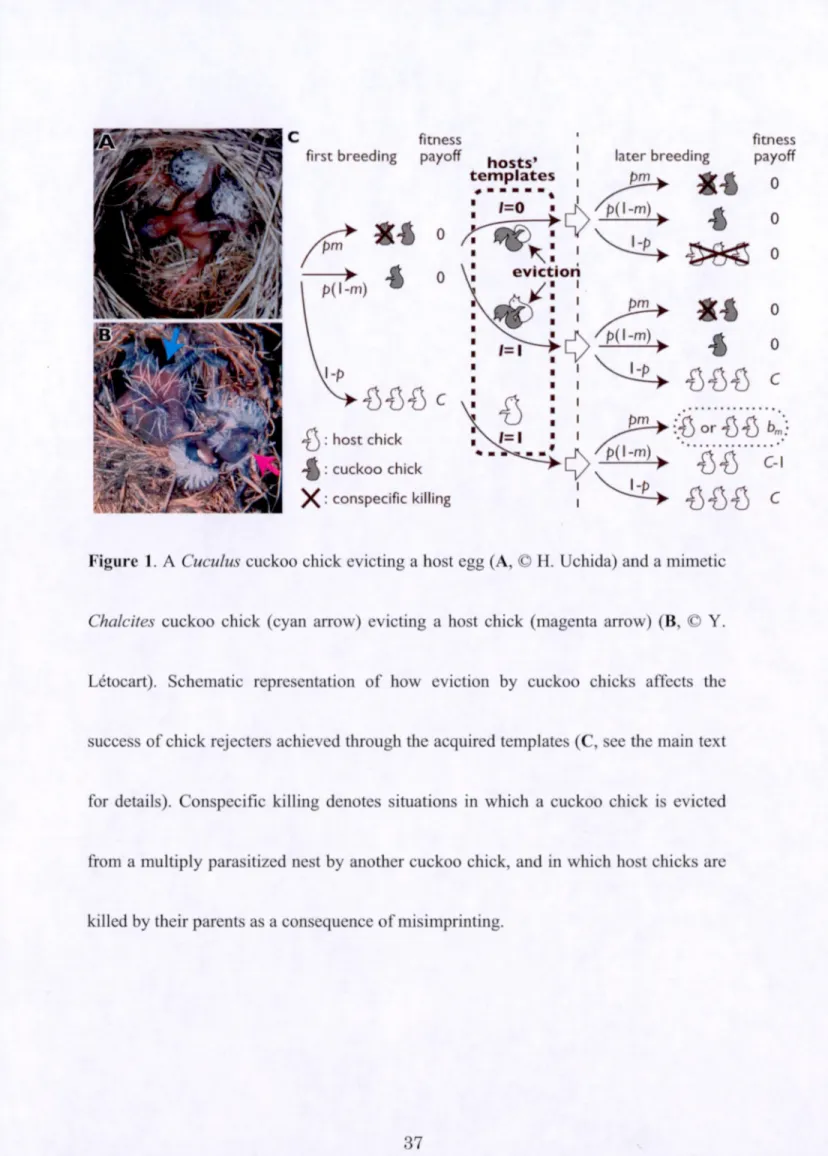
(Tokue 2 0 1 1 ; Gill 1998; Figure IB). I included this aspect into the model (i.e., I) to
consider whether a naive parasitized host correctly imprints on its o w n offspring, hence
29
acquiring a tolerable template by which hosts would not mistake their o w n chicks as
alien (Figure 1C).
T h e Model
The model subtracts the fitness of two respective confronting strategies,
acceptor and egg rejecter, from that of chick rejecter to determine its fitness advantages
over the opponents. I assumed that both egg and chick rejecters learn the characteristics
either of the eggs or chicks in the nest during their first breeding attempt in life (i.e.,
imprinting), and reject or accept parasites based on this template in the all subsequent
breeding attempts (Lotem et al. 1992). Acceptors never learn, hence always raise
cuckoo chicks w h e n parasitized in any stage of life (Lotem 1993). Rejecters during the
first breeding respond to parasitism in the same w a y as the acceptor because they have
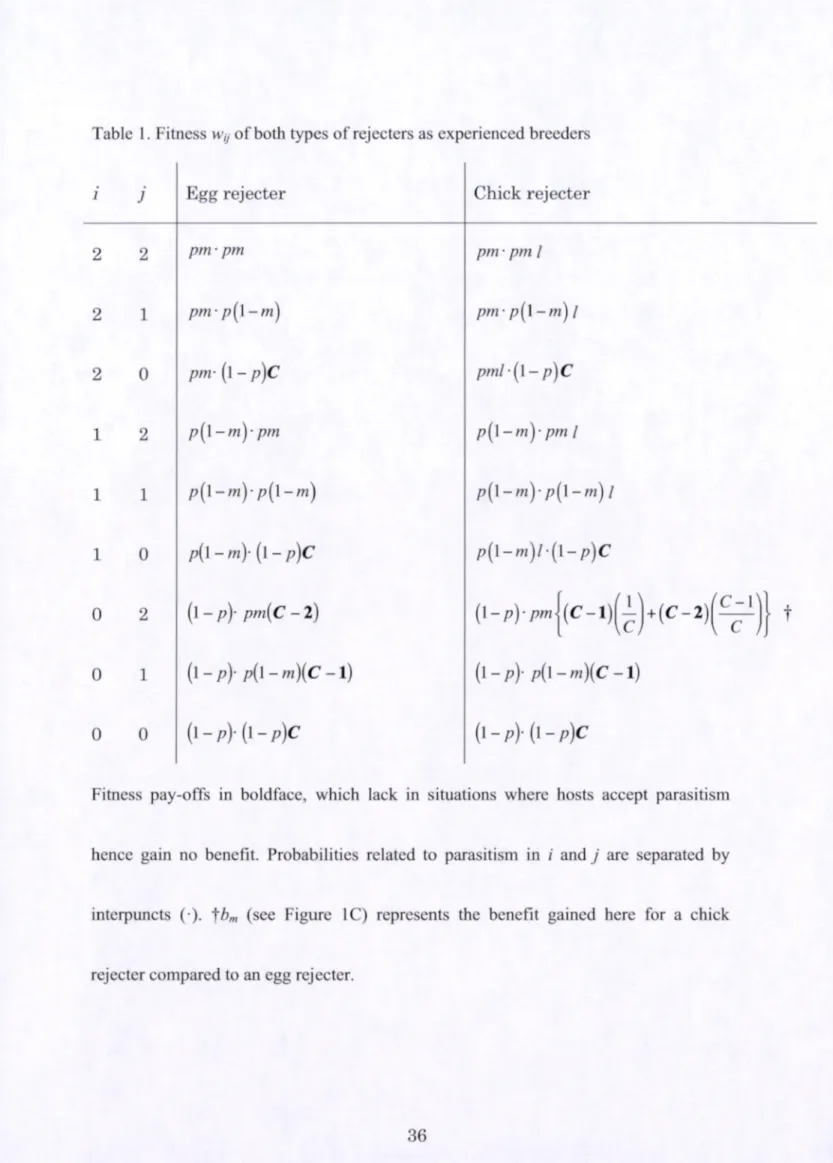
no prior template to detect parasitism.
I defined the fitness of rejecters as vvむ ,consisting of the s u m of reproductive
successes gained in all possible situations times the probabilities of being parasitized
(Tabic 1).Symbols i and j denote the number of parasitism events a host nest suffers in
the first breeding attempt in life (/) during which the hosts acquired the template, and
3 0
those in later life (/) w h e n they actually exert their template to deal with parasitism.
Occurrence probability of parasitism events is represented by the product of
probabilities p and m as follows: 1 一/? for
0 (no parasitism),p{\ - m) for 1 (singular
parasitism), and p m for 2 (multiple parasitism), as I do not assume more than two
cuckoo females parasitizing the same host nest. I assume that p is constant for all years.
The fitness of acceptor is thus defined as ( 1 - p ) C times the number of breeding
attempts through life (C = clutch size of host).
D u e to the lack of templates in naive rejecters, the difference in fitness
between a chick rejecter and an acceptor is the fitness benefit gained during breeding
attempts in later years. The formula for the predicted advantage of chick rejecter over
acceptor reduces to
爪(士 - 丨 ) “ C -
1>
0, [1]
given that / is 1 (i.e., chick rejecter surely learn o w n nestling), and the C, clutch size of
host is greater than 2. The left side of this inequation yields the surfaces in figure 2 A &
3. Graphs were drawn using R (R Core T e a m 2013) with the wireframe function of the
lattice package (Sarkar D 2008).
3 1
A p a r t fr o m /,the d iffe r e n c e b e tw e e n c h ic k a n d e g g rejec ters is re p re s e n te d b y
the benefit of the chick rejecter, described as bm (chick rejecter of W
02一 egg rejecter of
W
02) in figure 1C (see Table 1;Chapter IV): bm depends on whether the subsequently
parasitizing cuckoo female removes a rival cuckoo egg or a host egg in replacement of
its own. The resulting pay-offs are as follows: removing a host egg results in host’ s
pay-off C - 1 at probability ; replacing a cuckoo egg results in host’ s pay-off C - 2
at probability ,as 1 cuckoo egg out of C eggs had been in the nest. The assumed intolerance of egg rejecters toward parasite eggs is consistent with empirical
evidence (Lawes & Marthews 2003),w m c h eventually reduces the fitness benefit of
hosts by the number of parasitism events their nest suffers (Chapter IV). The inequation
for the difference in fitness reduces to
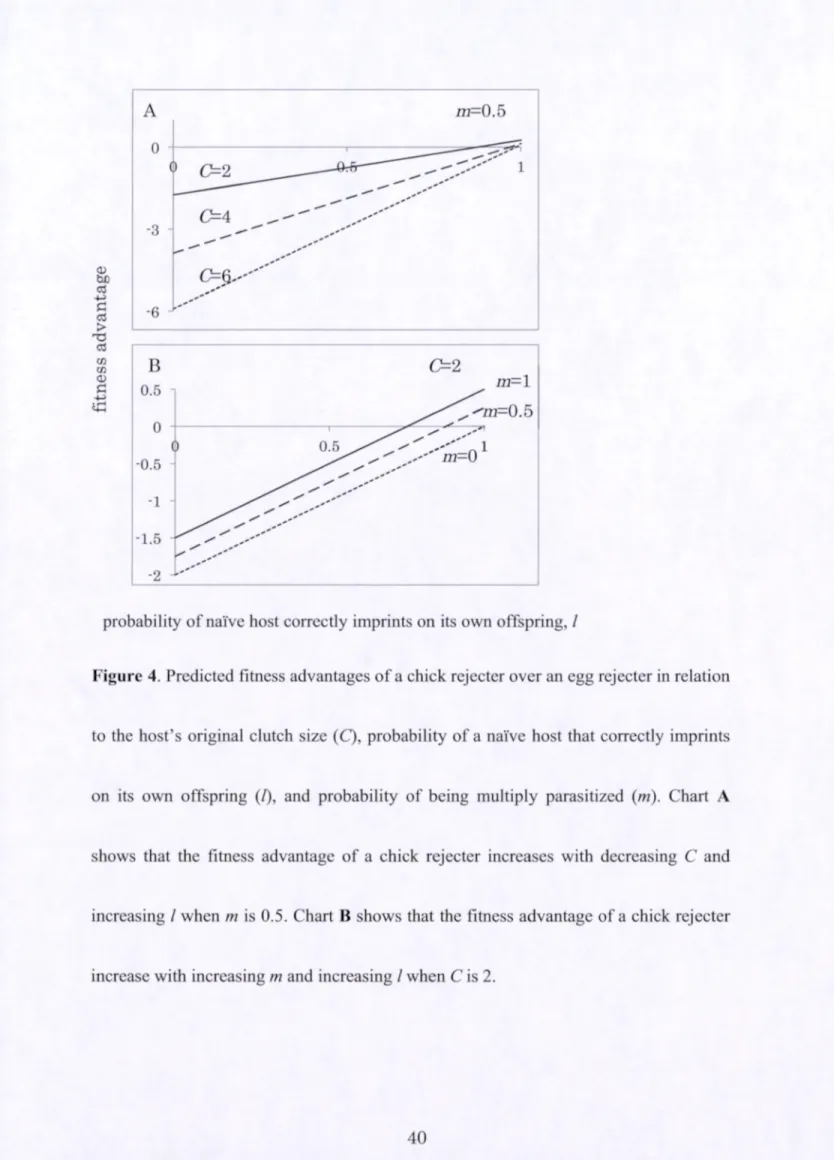
under the same condition as [1], described graphically as well in figure 2 B & 4.
Discussion
The predicted advantages of chick rejecters differ depending on the opponent
strategies (Figure 2); compared to acceptors, chick rejecters are favored as chick rejecter [
2]
3 2
hosts gain greater fitness benefits w h e n at least half of naive host parents in a
population could achieve imprinting o w n nestling, i.e., / = 0.5 and m = 0 (Figure 2A, 3).
In contrast, to outstrip egg rejecters, perfect learning (/ = 1 ) is not sufficient for chick
rejecters because egg rejecters always correctly imprint on their o w n eggs (Lotem 1993),
and both rejecters thus gain equal benefits (when w = 0 in Figure 2B). Therefore, chick
rejecters need additional benefits to be favored. I introduced m (frequency of multiple
parasitism) to the model, representing h o w likely a single host nest is parasitized by
multiple cuckoo females (Figure 1C; Chapter IV). Under multiple parasitism, chick
rejecters that accept cuckoo eggs laid in replacement of their own, give subsequently
parasitizing cuckoo females the possibility to remove the rival cuckoo egg. Therefore,
chick rejecters can have one more surviving offspring than egg rejecters (bm in Figure
1C) that reject every parasite egg (Pozgazova 2011).This benefit decreases marginally
with increasing clutch size, C (Chapter IV). Acceptance of cuckoo eggs, small clutch
sizes and multiple parasitism are indeed c o m m o n in host-parasite systems of
bronze-cuckoos (Davies 2000).
The model predicts that chick rejection per se is difficult to evolve as it
3 3
depends not only on stationary coexistence of host and parasite chicks but also on
additional benefits. This is consistent with the rarity of chick rejection in cuckoo-host
systems, hitherto found only in some bronze-cuckoos (Chapter I, IV; L a m g m o r e et al
2008; Davies 2 0 1 1 ;Colombelli-Negrel 2012). If multiple parasitism has actually an
effect on the evolution of observed chick rejection (Pozgazova et al 2011),this implies
that hosts even need to exploit the competition a m o n g parasites. Moreover,
bronze-cuckoo chicks mimic not only the appearance of host chicks (Langmore et al.
2011),but even their vocalization to secure host care (Shizuka & Lyon 2010). It is
unclear whether host parents’ learning is the major evolutionary drive of these
mimicries (but see Jetz et al 2008); however, it is probable because innate responses can
easily lead to misidentification of nestlings where traits serving as cues for host parents
could be phenotypically variable (Lotem 1993; Jetz et al 2008; Langmore 2011).
The model also provides insights into h o w most parasitic cuckoos and their
hosts have fought fierce battles to disguise and to detect the identity of parasite chicks in
their co-evolutionary arms races. The original clutch size of hosts might play a major
role here, as larger clutch size gives advantage to chick rejecters w h e n confronting
3 4
a c c e p to rs , w h ile it d is fa v o r s c h ic k rejecters a g a in s t e g g reje cte rs ( F ig u r e 2 ) , w h ic h
previous models failed to detect (Brooker & Brooker 1996; Lawes & Marthews 2003).
In the light of the prevalence of egg mimicry by brood parasites (Davies 2000;
Colombelli-Negrel et al. 2010),these predictions indicate that egg rejecters would
outcompete chick rejecters in most cases, which would be the case in Cuculus hosts as
they have relatively larger clutches. Thus in Cuculus cuckoos, females strive to help
their non-mimetic chicks evict all host eggs before they hatch (e.g., finely tuned timing
of egg-laying) (Davies 2000; Colombelli-Negrel et al. 2010) to avoid coexistence with
host chicks. B y contrast, controlling the timing of hatching seems difficult for Chalcites
cuckoos because of the relatively small clutch sizes of hosts (Chapter V ) ,which provide
cuckoo females a small margin to lay their eggs at a proper timing. This should favor
mimetic parasite chicks a m o n g already hatched host brood mates to avoid
discrimination (Figure IB).
3 5
Table 1.Fitness vvむ of both types of rejecters as experienced breeders
i j Egg rejecter Chick rejecter
2 2 pm • pm pm • pm I
2 1 pm -p(\-rn) pm- p ( \- m ) I
2 0 p m - (l- p)C pml -{I- p)C
1 2 p(l - m) . pm p(l - m). pm I
1 1 p ( \ - m y p ( \- m ) p [ \- m ) - p [ \- m ) I
1 0 (l- p)C p { \ - m ) l { \ - p ) C
0 2 ( 1 - p \ pm{C — 2) (l-p).pw{(C7-l)(
去) +(C -2)
0 1 (l-p). p ( l - m ) { C - l ) (i- p \ p (l-w )(C -l)
0 0 ( 1 - p } ( 1 - p)C ( 1 - p } ( 1 - p)C
Fitness pay-offs in boldface, which lack in situations where hosts accept parasitism
hence gain no benefit. Probabilities related to parasitism in i and j are separated by
interpuncts (•)• ^bm (see Figure 1C) represents the benefit gained here for a chick
rejecter compared to an egg rejecter.
3 6
C fitness
first breeding payoff h o s t s
,"pm p(i-m)
t e m p l a t e s , p m y J
/= 0■人 , D( I -m)
fitness later breeding payoff
X 通 o
必
: host chick : cuckoo chick X : conspecific killing
eviction
C
°r 4 3 * 6 b' .袖 … ._C:I
Figure 1.A Cuculus cuckoo chick evicting a host egg (A, © H. Uchida) and a mimetic
Chalcites cuckoo chick (cyan arrow) evicting a host chick (magenta arrow) (B, © Y.
Letocart). Schematic representation of h o w eviction by cuckoo chicks affects the
success of chick rejecters achieved through the acquired templates (C, see the main text
for details). Conspecific killing denotes situations in which a cuckoo cnick is evicted
from a multiply parasitized nest by another cuckoo chick, and in which host cnicks are
killed by their parents as a consequence of misimprinting.
3 7
clutch size
(Q
multiple parasitism 0.5
2 0.0M -
2.0•0.4 clutch size
(Q
multiple parasitism 0.5
2 0.0 (m)
Figure 2. Predicted fitness advantages of chick rejecter over acceptor (A) and over egg
rejecter (B) in relation to host’ s original clutch size, C, and probability of being multiply
parasitized, m. Levels of I were altered to illustrate transitional states. Gradation of
while colours represents the advantageousness of chick rejecter (magenta) and of
respective opponent strategies (cyan; increasing negatively), antagonizing each other
around
0 where advantages of both sides are in equilibrium (whitish zones) as scaled inthe centred bar.
3 8
probability of naive host correctly imprints on its o w n offspring, /
Figure 3. Predicted fitness advantages of a chick rejecter over an acceptor in relation to
the host’ s original clutch size (C), probability of a naive host that correctly imprints on
its o w n offspring (/), and probability of being multiply parasitized (m). Chart A shows
that the fitness advantage of a chick rejecter increases with increasing C and increasing I
whe n m is 0. Chart B shows that the fitness advantage of a chick rejecter increases with
decreasing m and increasing I w h e n C is 2.
probability of naive host correctly imprints on its o w n offspring, I
Figure 4. Predicted fitness advantages of a chick rejecter over an egg rejecter in relation
to the host’ s original clutch size (C), probability of a naive host that correctly imprints
on its o w n offspring (/), and probability of being multiply parasitized (m). Chart A
shows that the fitness advantage of a chick rejecter increases with decreasing C and
increasing I w h e n m is 0.5. Chart B shows that the fitness advantage of a chick rejecter
increase with increasing m and increasing I w h e n C is 2.
a bcB +JU B TSB A
g g QJ cl 'sJ
4 0
C h a p t e r I V E g g d i l u t i o n e f f e c t h y p o t h e s i s : a c o n d i t i o n u n d e r w h i c h
parasitic nestling ejection behaviour will evolve
Intoroduction
Avian brood parasitism drives a co-evolutionary arms race between brood
parasites and their hosts (Davies 2000). For example, m a n y hosts have evolved an
ability to recognize and reject unlike foreign eggs. O n the contrary parasites have
evolved better egg mimicry to counter host defences. However, once a foreign egg
escapes the detection system by the host, it is accepted, the host rear the parasite
nestlings until it has fledged despite the fact that the parasitic nestling often looks very
unlike the host nestling (Wyllie 1981). W h y does the host accept alien nestlings? O n e
possibility is that learning to recognize parasitic nestlings is costly, with the risk of
misimprinting outweighing the benefit of recognition, and thus the evolution of
nestling-ejection behaviour is maladaptive for hosts (Lotem 1993).
However, I have reported that the large-billed gerygone Gerygone
magnirostris,one of the major hosts of the little bronze-cuckoo Chalcites minutillus, in
northern Australia, physically ejects cuckoo young from the nest (Chapter I). Given that
4 1
the little bronze-cuckoo nestlings closely resemble the large-billed gerygone nestlings,
the host’ s ability to eject foreign nestlings seems to have selected for the
bronze-cuckoos which morphologically resemble the host in order to avoid detection
(Chapter I). However, the host seems to never reject foreign eggs even though the little
bronze-cuckoo’ s eggs appear very different from their o w n (Mulyani 2004; Sato et al.
2010b; see also Brooker & Brooker 1998).
This behaviour raises two important questions: w h y has parasitic nestling
ejection evolved only in s o m e gerygone species (Tokue & Ueda 2010; Chapter I, V),
and w h y have the large-billed gerygone evolved this strategy without having first
evolved egg rejection behaviour often observed in other hosts, even though egg
rejection seems to be a superior strategy given that success results in no risk of the
host’ s o w n eggs being ejected by the little bronze-cuckoo young?
These puzzles m a y be explained by the following four previously proposed
hypotheses. First, the evolutionary lag hypothesis (Winfree 1999) states that cuckoo
eggs are accepted because the hosts have had insufficient time for the selection of the
necessary genetic variants for the ability to reject foreign eggs. Second, the bill-size
4 2
constraint hypothesis (Ro h w e r & S p a w 1988) argues that small bill-sizes of hosts m a k e
the evolution of egg ejection behaviour physically impossible. Third, the mafia
hypothesis (Soler et al. 1995; Briskie 2007) proposes that parasitic birds enforce
acceptance by destroying eggs or nestlings of hosts that eject a parasitic egg. Finally,
the cryptic egg hypothesis (Langmore et al. 2009b; Brooker et al. 1990) states that
cuckoo eggs have evolved to be cryptic inside the dark interiors of the enclosed host
nests, and therefore they are not rejected because they are difficult to detect.
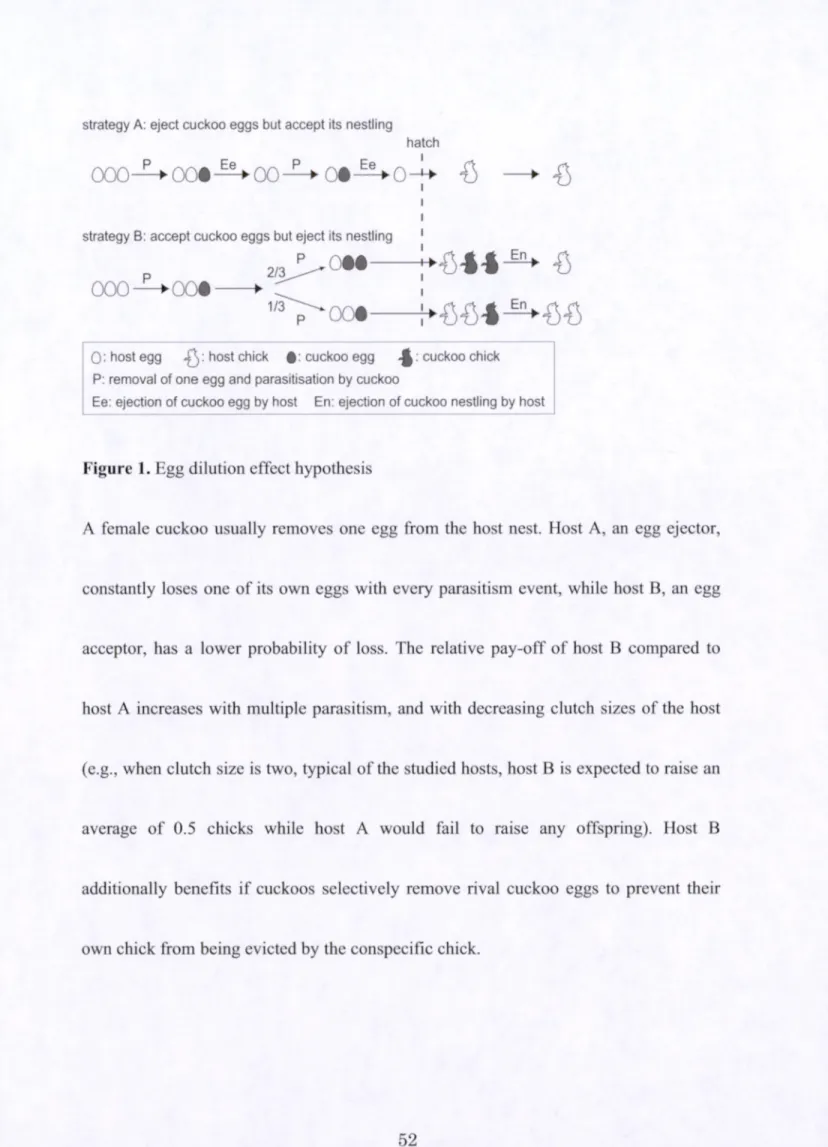
Here I propose a novel, but not mutually exclusive hypothesis termed the egg
dilution effect ( E D E ) hypothesis that well explains the benefit of accepting parasitic
eggs and the evolution of rejecting parasitic nestlings in host. T h e details of the E D E
hypothesis are presented, followed by an evaluation of the different hypotheses to
determine which is m o r e suitable to explain the observed p h e n o m e n a in the large-billed
gerygone.
T h e egg dilution effect hypothesis
In the E D E hypothesis, cuckoo eggs act as insurance of host egg survival
through a dilution effect that serves to protect against parasitism by multiple female
cuckoos. This hypothesis requires two conditions to be met which are found in certain
host species including the large-billed gerygone: multiple parasitism of the same nest
during a single breeding season, and the removal of one egg from host nests by the
parasitizing species (Davies 2000).
T o examine this hypothesis, I assume two strategies. In strategy A, a host
ejects cuckoo eggs but not cuckoo nestlings, while in strategy B, a host ejects cuckoo
nestlings but not the eggs. I also assume that 1)nests are parasitized twice and only after
the host clutch is completed, 2) hosts, using strategy A, regularly eject the first cuckoo
egg before the second cuckoo lays her egg, 3) hosts eject cuckoo eggs and nestlings
without mistakes, 4) eggs and nestlings do not die other than by ejection of the host and
cuckoo and 5) hosts adopted strategy B, eject cuckoo nestlings before killing of host
brood.
W h e n the first female cuckoo lays an egg in the nest of a host using strategy
A, the clutch size (C) of the host reduces to C-l because a cuckoo removes one host
egg from the nest. Subsequently, the host ejects the cuckoo egg, and C-l host eggs still
remain in the nest. After a second female cuckoo lays in the same nest, the number of
4 4
host eggs becomes C-2. The C - 2 eggs then hatch and fledge which represents the
pay-off of strategy A. In contrast, the pay-off of strategy B is more complex. After the
first cuckoo lays an egg into the nest, the nest has C-l host eggs and one cuckoo egg.
W h e n another female cuckoo parasitizes the nest, she removes one egg from the clutch
at random, with the probability of a host egg being removed is (C-l)/C and that of a
cuckoo egg being removed is 1/C. If both host and cuckoo eggs are remained in the nest
after the second parasitism hatch, the cuckoo young hatched is ejected by the host and
then host young successfully fledge. The expected pay-off of strategy B is represented
by C-2+1/C, which is always greater than the pay-off of strategy A by 1/C. Figure 1
illustrates this argument for clutch size 0=3.
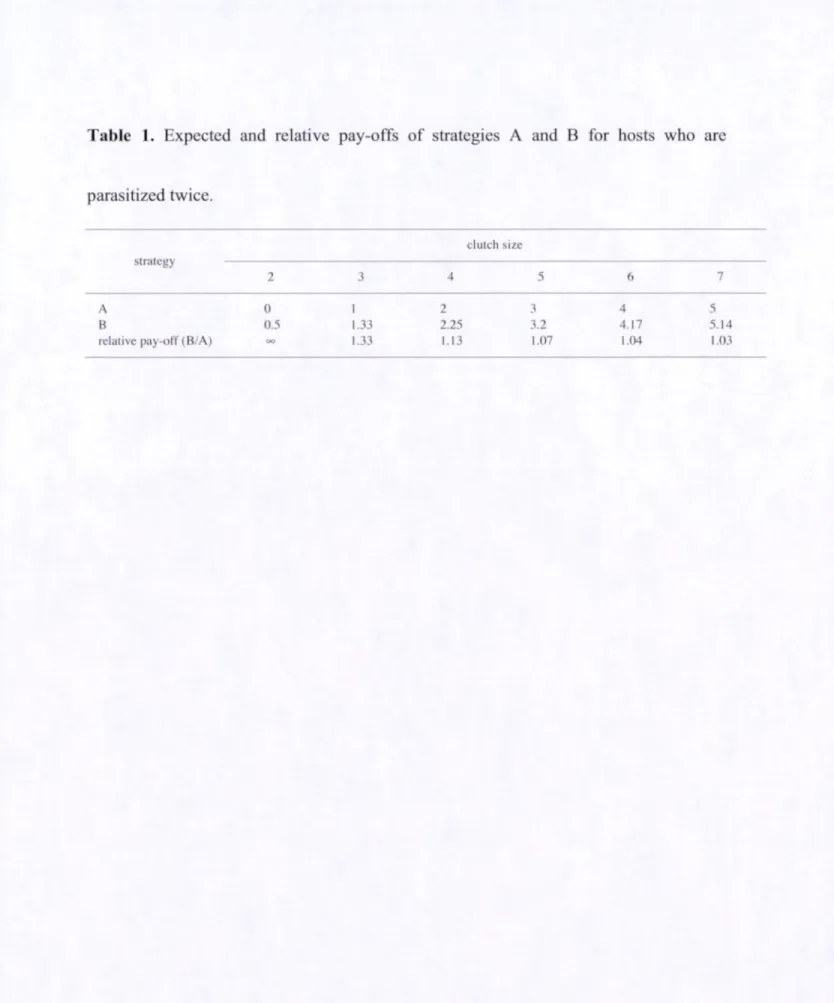
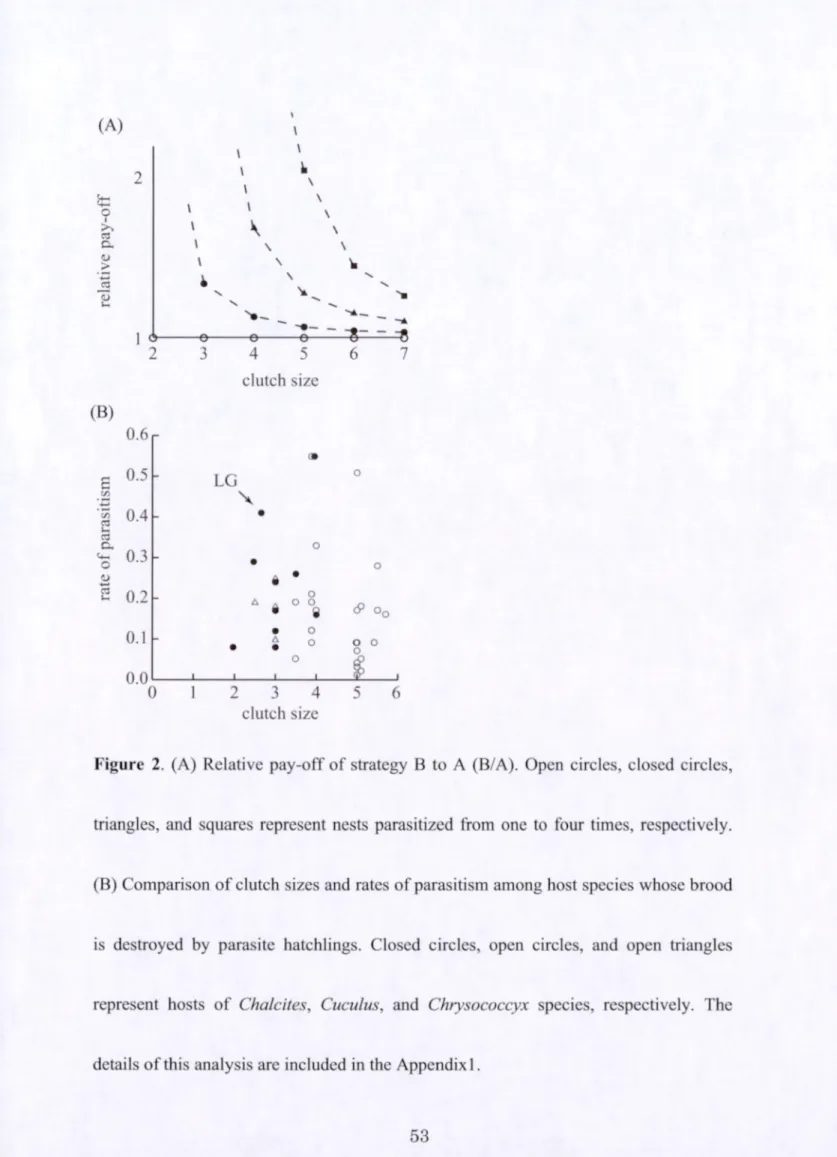
The relative pay-off of strategy B compared to A (strategy B/ strategy A)
increases as the host clutch size decreases (Table 1).For example, w h e n the clutch size
is six, the relative pay-off is nearly one, however, w h e n the cultch size decreases to two,
the theoretical relative pay-off increases to infinity. O f particular note, w h e n the clutch
size is equal to the number of parasitism events, the pay-off of strategy A is zero. T he
advantage of strategy B is also greater with increasing numbers of parasitism events
45
(Figure 2A).
In the E D E hypothesis, I assume that a female cuckoo removes an egg
randomly at one parasitizing event. However, if the cuckoo selectively removes rival
cuckoos’ eggs to save their o w n chick from being evicted by the rival cuckoo chick,
strategy B becomes more beneficial as the probability of the first-laid cuckoo egg being
removed by the second cuckoo is greater than I/C. Indeed, females of the C o m m o n
cuckoo tend to remove cuckoo eggs more frequently than host eggs (Davies and Brooke
1988). In addition, Brooker et al. (1990) proposed that the horsfield’ s bronze-cuckoo
Chalcites basalis evolved egg mimicry to avoid being ejected by competing female
cuckoos (but see Langmore et al. 2009a). It is worth noting that the egg dilution effect
also operates in an identical manner against predators that do not destroy all host eggs
during a single predation event.
Under the conditions described above, the E D E hypothesis demonstrates that
strategy B always wins against strategy A. However, this outcome becomes more
complicated w h e n I consider one risk which threatens strategy B, namely, wh e n a
parasitic nestling ejects the hosts’ brood before the host ejects the parasitic young.
Clearly, strategy B is superior only when cuckoo nestlings are ejected before the
occurrence of such an event. Another factor affecting the outcome of strategy B is that
for simplicity, I assumed that hosts eject parasitic eggs and young without mistakes.
The success of this strategy varies if I consider the error rate of discrimination, for
example, w h e n the error rate in discriminating parasite eggs is equal to that of
discriminating parasite young, the relative pay-off (strategy B/ strategy A) is identical to
those shown in table 1 and figure 2A. If the error rate in discriminating parasite eggs is
larger than that for parasite young, the advantage of strategy B is greater. In contrast,
whe n the error rate is higher for the discrimination of parasite young, the superior
strategy depends on the difference between the benefit of the dilution effect and the risk
of ejecting one’ s o w n young. However, even if the host cannot distinguish between its
o w n and parasite young and regardless of the error rate for the discrimination of parasite
eggs, w h e n the clutch size is equal to the number of parasitism events strategy B will
always be superior to strategy A (Figure 2A). Under conditions of small clutch sizes
and multiple parasitism, strategy B is more likely to evolve.
Based on our observations and published findings, the large-billed gerygone
47
appears subject to these conditions. The predominant clutch sizes of large-billed
gerygones are two (36.8%) and three (54.2%) (2.65±0.66 SD, N=190) (Mulyani 2004),
while the parasitism rate of large-billed gerygone nests is high (41%, N=1 5 5 ) (Mulyani
2004), and 13.5% of parasitized nests (N=148) contain more than one cuckoo egg
(Brooker & Brooker 1989). Brooker & Brooker (1989) also described that the incidence
of multiple parasite eggs per the large-billed gerygone nest seems to be particularly high
compared to other Chalcites species. With the assumption that parasitism rates correlate
with the frequency of multiple parasitism, w h e n compared with other hosts of
host-evicting brood parasites, the large-billed gerygone has a unique combination of
small clutch size and high parasitism rates (Figure 2B).
Discussion
The previously proposed hypotheses seem insufficient to explain the observed
nestling ejection behaviour in the absence of egg rejection in the large-billed gerygone.
The evolutionary lag hypothesis is implausible, as it appears sufficient evolutionary
time for the occurrence and selection of the necessary mutation(s) for nestling ejection
behaviour has passed. The bill-size constraint hypothesis also seems to be inadequate
48
given that hosts w h o suffer from this constraint have evolved other anti-parasitic
strategies, such as abandoning parasitized nests at the egg stage (Davies 2000) and
burying cuckoo eggs in the bottom of nests (Sealy 1995). Although the mafia
hypothesis cannot be refuted, our research team did not observe the little
bronze-cuckoos revisiting parasitized the large-billed gergyone nests in more than ten
large-billed gerygone nests that were monitored for a long period. Although the cryptic
egg hypothesis proposes a reasonable explanation, it cannot explain w h y nestling
ejection has been observed in only some gerygone species.
The E D E hypothesis can explain this behaviour as follows: nestling ejection
is likely to evolve in those hosts with small clutch sizes and high parasitism rates as the
relative fitness of this strategy versus egg ejection is higher. The required conditions of
the E D E hypothesis are consistent with the ecology of large-billed gerygone (Figure 2A,
B). Still, E D E and cryptic egg hypotheses are not mutually exclusive. For example,
cryptic eggs which more difficult for the host and probably rival cuckoo to distinguish
their o w n eggs from parasite eggs, increases the benefit of accepting parasitic eggs with
EDE. Although I cannot dismiss the possibility that nestling ejection exists in other
49
species but has yet to be detected, in such cases, the E D E represents an additional effect
for increasing the host benefit of accepting parasitic eggs and assisting in the evolution
of rejecting parasitic nestlings.
50
Table 1 . Expected and relative pay-offs of strategies A and B for hosts who are
parasitized twice.
c l u t c h s i z e
2 3 4 5 6 7
A 0 1 2 3 4 5
B 0 . 5 1 . 3 3 2 . 2 5 3 . 2 4 . 1 7 5 . 1 4
r e l a t i v e p a y - o f f ( B / A ) oo 1 . 3 3 1 . 1 3 1 . 0 7 1 . 0 4 1 . 0 3
51
strategy A: eject cuckoo eggs but accept its nestling
o o o - ^ o o t - ^ o o - ^ o t - ^ o
strategy B: accept cuckoo eggs but eject its nestling
^
o m—
0 0 0 0 0 # —— ► て1
/% ^
0 0# —
hatch
i
— fi
0: host egg
必: host chick •: cuckoo egg % cuckoo chick P: removal of one egg and parasitisation by cuckoo
Ee: ejection of cuckoo egg by host En: ejection of cuckoo nestling by host
Figure 1. Egg dilution effect hypothesis
A female cuckoo usually removes one egg from the host nest. Host A, an egg ejector,
constantly loses one of its o w n eggs with every parasitism event, while host B, an egg
acceptor, has a lower probability of loss. The relative pay-off of host B compared to
host A increases with multiple parasitism, and with decreasing clutch sizes of the host
(e.g., w h e n clutch size is two, typical of the studied hosts, host B is expected to raise an
average of 0.5 chicks while host A would fail to raise any offspring). Host B
additionally benefits if cuckoos selectively remove rival cuckoo eggs to prevent their
o w n chick from being evicted by the conspecific chick.
52
Figure 2. (A) Relative pay-off of strategy B to A (B/A). O p e n circles, closed circles,
triangles, and squares represent nests parasitized from one to four times, respectively.
(B) Comparison of clutch sizes and rates of parasitism a m o n g host species whose brood
is destroyed by parasite hatchlings. Closed circles, open circles, and open triangles
represent hosts of Chalcites, Cuculus, and Chrysococcyx species, respectively. The
details of this analysis are included in the Appendix 1.
Appendix
1.Frequency of parasitism and clutch size of hostsP a r a s i t e H o s t P a r a s i t i s m C l u t c h S o u r c e
r a t e s i z e
C o m m o n
C u c k o o
L i t t l e C u c k o o
C uculus T r e e P i p i t
M e a d o w P i p i t
P i e d W a g t a i l
D u n n o c k
R e e d W a r b l e r
G r e a t R e e d W a r b l e r
S e d g e W a r b l e r
R o b i n
C uculus B u s h w a r b l e r
p o lio c e p h a lus
A nthus trivia l is A nthus p ra te n sis
M o ta cilla alba
P runella m o d u la ris
A cro cep h a lu s scirp a ceu s
A cro cep h a lu s a ru n d in a ceu s A cro cep h a lu s sc h o en o b a en u s E rith a cu s ru b ecu la
C ettia d ip h o n e
0 . 0 7
0 . 0 3
0 . 0 9
0.02
0.02
0 . 1 8
0 . 0 5
0 . 1 9
0 . 5 5
0 . 0 9
0.21 0.12
0 . 5 1
0 . 0 4
0 . 1 7
0 . 3 3
W y l l i e 1 9 8 1,H a n d b o o k * v o l . 1 3
0 . 0 9 5 . 4 2 W y l l i e 1 9 8 1 ,L a n g m o r e e t al. 2 0 0 5
5
5
5 . 1
5 . 1
5 . 1
5 . 1
3 . 8 9
3 . 8 9
3 . 8 9
3 . 8 9
3 . 8 9
W y l l i e 1 9 8 1,H a n d b o o k * v o l . 9
W y l l i e 1 9 8 1 ,L a n g m o r e e t al. 2 0 0 5
W y l l i e 1 9 8 1 , L a n g m o r e e t al. 2 0 0 5
W y l l i e 1 9 8 1 , H a n d b o o k * v o l . l 1
0 . 0 9 4 . 9 8 W y l l i e 1 9 8 1 , L a n g m o r e e t a i 2 0 0 5
0 . 0 1 5 W y l l i e 1 9 8 1 ,L a n g m o r e e t al. 2 0 0 5
H i g u c h i 1 9 9 8 , H a n d b o o k * v o l . 1 1
54