Text Simplification without Simplified Corpora
Tomoyuki Kajiwara
Department of Information and Communication Systems Graduate School of System Design
Tokyo Metropolitan University
A Doctoral Dissertation
submitted to Graduate School of System Design, Tokyo Metropolitan University
in partial fulfillment of the requirements for the degree of Doctor of Philosophy
Tomoyuki Kajiwara
Thesis Committee:
Mamoru Komachi Associate Professor Toru Yamaguchi Professor
Text Simplification without Simplified Corpora
∗Tomoyuki Kajiwara
Abstract
Text simplification is the task of rewriting complex text into a simpler form while preserving its meaning. Systems that automatically pursue this task can potentially be used for assisting reading comprehension of less language-competent people, such as learners and children. Such systems would also improve the performance of other Natural Language Processing applications. As with machine translation and abstrac-tive summarization, this task is positioned as a Text-to-Text Generation task in natural language processing.
Current work has two approaches: lexical substitution and monolingual translation. In the former, a simpler synonymous sentence is generated by the pipeline of complex word identification, substitution generation, and substitution ranking. In the latter, a simpler synonymous sentence is generated using machine translation tools. In both ap-proaches, mainstream methods acquire simplification rules from a large-scale parallel corpus. Therefore, text simplification was studied mainly in English for where rich re-sources are available. However, a large-scale simplified corpus for text simplification cannot be used in many language other than English.
In this research, we propose text simplification methods by lexical substitution ap-proach and monolingual translation apap-proach for languages that cannot use large-scale simplified corpora, especially Japanese. As a lexical substitution approach without simplified corpora, we propose novel paraphrase acquisition, meaning preservation filtering, simplicity filtering, and grammaticality ranking methods for Japanese. In ad-dition, as a monolingual translation approach without simplified corpora, we construct a pseudo-parallel corpus for text simplification from a raw corpus using readability as-sessment and sentence alignment, and enable text simplification using machine trans-lation tools in any language.
∗Doctoral Dissertation, Department of Information and Communication Systems, Graduate School
Experimental results show that our lexical substitution approach outperforms the previous language-independent unsupervised method. Moreover, in the monolingual translation approach, the experimental results show that our pseudo-parallel corpus succeeds in training machine translation tools as well as existing parallel corpora for text simplification.
Keywords:
平易なコーパスを用いないテキスト平易化
∗梶原 智之
内容梗概
テキスト平易化は、難解なテキストの意味を保持したまま平易に書き換えるタ スクである。システムは、言語学習者や子どもをはじめとする人々の文章読解を 支援し、他の自然言語処理応用タスクの性能改善にも寄与する。このタスクは、 機械翻訳や文書要約などと同じく、自然言語処理におけるテキストからのテキス ト生成タスクとして位置づけられる。
先行研究には語彙的換言と単言語翻訳の2つのアプローチがある。語彙的換言 アプローチでは「難解語検出・換言生成・ランキング」のパイプラインで平易な 同義文を生成する。単言語翻訳アプローチでは機械翻訳器を用いて平易な同義文 を生成する。どちらのアプローチでも大規模なパラレルコーパスから平易化規則 を獲得する手法が主流であるため、これまでは言語資源の豊富な英語を中心に研 究されてきた。しかし、英語以外の多くの言語では平易に書かれた大規模コーパ スを利用できない問題がある。
本研究では、平易な大規模コーパスを利用できない言語、特に日本語を対象と して、語彙的換言アプローチと単言語翻訳アプローチによるテキスト平易化を実 現する。まず、平易なコーパスを用いない語彙的換言アプローチとして、本研究 では日本語のための新しい言い換え知識獲得、意味的等価性フィルタリング、平 易性フィルタリング、文法性ランキングの各手法を提案する。また、平易なコー パスを用いない単言語翻訳アプローチとして、本研究では文の難易度推定と文間 類似度推定を組合せて生コーパスからテキスト平易化のための疑似パラレルコー パスを構築し、任意の言語での機械翻訳器を用いたテキスト平易化を可能にする。
実験結果によって、我々の語彙的換言アプローチが既存の言語非依存な教師な し手法を上回ることを示す。また、単言語翻訳アプローチにおいては、我々の疑 似パラレルコーパスが既存のテキスト平易化のためのパラレルコーパスと同等に 機械翻訳器の訓練を成功させることを示す。
キーワード
v
Acknowledgements
博士課程の3年間ご指導いただきました小町守先生に深く感謝いたします。直 接の研究指導はもちろんのこと、インターンシップや共同研究として多くの研究 者に学ぶ機会を与えていただき、研究者としての幅を広げることができました。
博士論文の審査を引き受けてくださいました山口亨先生、高間康史先生、岡崎 直観先生に感謝いたします。副査の先生方には、お忙しい中、丁寧に博士論文を 見ていただき、様々な観点からご指導をいただきました。
長岡技術科学大学の山本和英先生には、研究室配属から修士課程までの3年間 ご指導いただきました。研究の基本とプレゼンテーションについて丁寧にご指導 いただき、初めての学会発表であったNLP若手の会で奨励賞を受賞することが できました。6年間の研究生活は順調なことばかりではありませんでしたが、こ の最初の成功体験のおかげでここまで頑張って来られたと思います。
富士通研究所の潮田明さん、大倉清司さんには、学士課程4年次に初めてのイ ンターンシップを経験させていただきました。また、富士秀さん、岩倉友哉さん にはインターンシップ後も様々な機会にアドバイスをいただきました。
ブレインパッドの太田満久さんには、修士課程1年次にインターンシップでお 世話になりました。就職活動をするか博士課程に進学するか迷っていた時期でし たが、博士号取得後にエンジニアとして活躍されている太田さんの姿を見て博士 課程への進学を決心しました。
博士課程1年次には、リバプール大学の客員研究員としてDanushka Bollegala 先生にご指導いただきました。一緒にご指導いただいた国立情報学研究所の河原 林健一先生、吉田悠一先生にも感謝いたします。博士課程での以降の研究も、多 くはこのとき学んだことからヒントを得て着想しました。論文の書き方について も、自分が書いた初稿と先生に直してもらった原稿とを何度も見比べ、多くのこ とを学びました。博士課程の早い時期に、研究の進め方や論文の書き方をトップ レベルの研究者からご指導いただくことができ、本当にありがたい機会でした。
博士課程3年次には、情報通信研究機構の協力研究員として藤田篤さんにご指 導いただきました。藤田さんには毎日ミーティングの時間を取っていただき、多 くのことを学ぶことができました。研究以外の話題にも親身になって相談に乗っ ていただきました。心より感謝いたします。「足場を固めながら進む」と繰り返 しご指導いただき、研究が進むということとタスクの性能が上がるということが 必ずしも同義ではないということを理解しました。何を明らかにしたいのか、何 が明らかになったのか、ということを意識し、藤田さんのように自分に厳しく真 摯に研究に取り組んでいきたいと思います。温かく受け入れてくださり、多くの ご助言をいただきました先進的翻訳技術研究室の皆様にも感謝いたします。
指導教員や共著者の皆様以外にも、多くの研究者の方々にお世話になりました。 トークに招待いただきご助言をいただきました東北大学の乾健太郎先生、愛媛大 学の二宮崇先生、LINEの佐藤敏紀さん、明石高専の奥村紀之先生、大阪大学の 荒瀬由紀先生、奈良先端科学技術大学院大学の能地宏先生に感謝いたします。ま た、Aim4ACLにて国際会議に投稿予定の研究や原稿に対してご助言をいただき ました先生方に感謝いたします。そして、NLP東京Dの会を一緒に立ち上げ、議 論してくださった同年代の博士課程の皆様に感謝いたします。NLP東京Dの会の 皆様のおかげで、博士課程の3年間を楽しく過ごすことができました。
首都大学東京の小町研究室および長岡技術科学大学の山本研究室で一緒に過ご した学生の皆様にも感謝いたします。皆様との日々の議論のおかげで、研究を進 めてくることができました。特に、自然言語処理の研究を始めるきっかけを与え てくださった真嘉比愛さん、一緒に研究を進めてくださった鈴木由衣さん、Aizhan
Imankulovaさん、金子正弘さん、小平知範さん、関沢祐樹さん、塩田健人さん、
野口真人さん、大森光さん、嶋中宏希さん、どうもありがとうございました。 また、宇摩剣道連盟の先生方および四国中央剣道会の後輩たちにも学生生活を 支えていただきました。研究が上手くいかないときもありましたが、後輩剣士の 皆さんが成長している姿を見せてくれたり、試合での活躍を聞かせてくれたおか げで、私はいつも幸せに過ごすことができました。
vii
Contents
Acknowledgements v
1 Introduction 1
1.1. Main Contributions. . . 2
1.2. Structure of the Thesis . . . 3
2 Lexical Simplification without Simplified Corpora 5 2.1. Candidate Acquisition . . . 6
2.1.1 Simplification Rules from Definition Statements . . . 6
2.1.2 Manually Acquired Paraphrase Lexicon . . . 7
2.1.3 Automatically Acquired Paraphrase Lexicon. . . 8
2.2. Meaning Preservation Filtering. . . 8
2.2.1 Path Distance Similarity . . . 9
2.2.2 Context Similarity . . . 9
2.2.3 Alignment Probability . . . 9
2.2.4 MIPA Score . . . 10
2.3. Simplicity Filtering . . . 12
2.3.1 Word Frequency . . . 12
2.3.2 Word Familiarity . . . 12
2.3.3 JLPT Simplicity . . . 12
2.3.4 JEV Difficulty . . . 12
2.4. Grammaticality Ranking . . . 13
2.4.1 Language Model Probability . . . 13
2.4.2 Context Embedding Similarity . . . 13
2.5. Evaluation for Japanese Lexical Simplification. . . 13
2.5.1 Previous Works . . . 14
2.5.2 Target Selection . . . 17
2.5.4 Simplicity Reranking . . . 18
2.5.5 Integrating Annotations . . . 18
2.5.6 Metrics. . . 19
2.6. Experiments . . . 19
2.6.1 Settings . . . 20
2.6.2 Baseline: LIGHT-LS . . . 21
2.6.3 Results . . . 22
3 Sentence Simplification without Simplified Corpora 23 3.1. Pseudo-Parallel Corpus from a Raw Corpus . . . 23
3.2. Sentence Alignment Based on Alignment between Word Embeddings . 26 3.2.1 AAS: Average Alignment Similarity . . . 27
3.2.2 MAS: Maximum Alignment Similarity . . . 27
3.2.3 HAS: Hungarian Alignment Similarity. . . 28
3.2.4 WMD: Word Mover’s Distance . . . 28
3.3. Experiment: Alignment within Complex and Simple Sentences . . . . 29
3.3.1 Settings . . . 29
3.3.2 Results . . . 30
3.4. Experiment: English Sentence Simplification . . . 31
3.4.1 English Pseudo-Parallel Corpus for Text Simplification . . . . 32
3.4.2 Settings . . . 34
3.4.3 Results . . . 36
3.5. Experiment: Japanese Sentence Simplification . . . 37
3.5.1 Japanese Pseudo-Parallel Corpus for Text Simplification . . . 39
3.5.2 Settings . . . 39
3.5.3 Results . . . 39
4 Further Improvement 41 4.1. Improving Paraphrase Lexicon . . . 41
4.1.1 Bilingual Pivoting and MIPA . . . 42
4.1.2 Settings . . . 43
4.1.3 Evaluation Datasets and Metrics . . . 43
4.1.4 Results . . . 44
4.1.5 Extrinsic Evaluation . . . 46
4.1.6 Examples . . . 47
4.2.1 Iterative Similarity Computation . . . 51
4.2.2 Settings . . . 54
4.2.3 Results . . . 55
4.2.4 Parameter Sensitivity . . . 58
4.2.5 Sentence Similarity Complement . . . 61
4.3. Improving Evaluation Metrics for Simplification . . . 62
4.3.1 Semantic Features Based on Word Alignments . . . 63
4.3.2 Settings . . . 65
4.3.3 Results . . . 67
4.3.4 Relationship between Word Embeddings and Word Difficulty . 69 5 Final Remarks 71 5.1. Conclusion . . . 71
5.2. Future Work . . . 72
Bibliography 75
xi
List of Figures
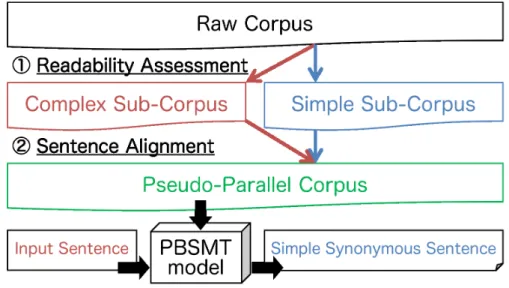
3.1 Text simplification using PBSMT from only a raw corpus by
readabil-ity assessment and sentence alignment. . . 24
3.2 Pseudo-parallel corpus from a raw corpus. . . 25
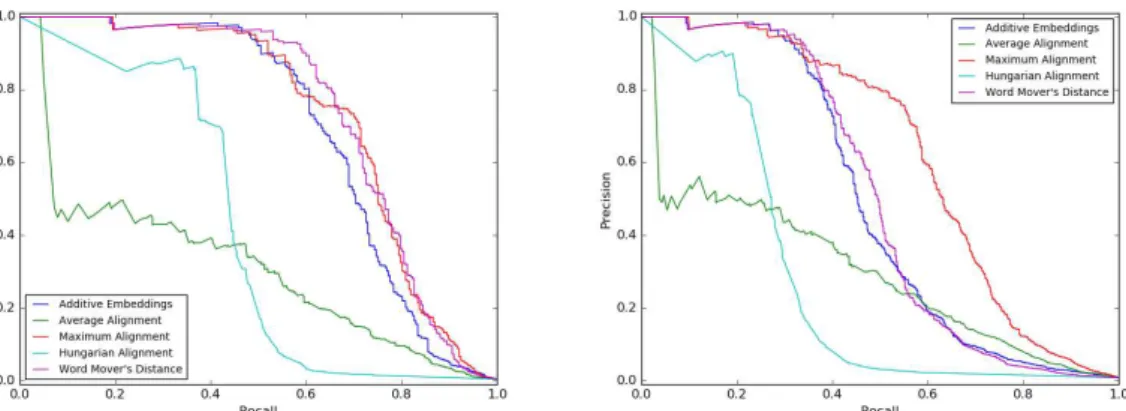
3.3 PR curves in binary classification of G vs. O. . . 31
3.4 PR curves in binary classification of G+GP vs. O. . . 31
3.5 Readability score distribution of English Wikipedia and Simple En-glish Wikipedia. A higher score in Flesch Reading Ease indicates sim-pler sentences. . . 33
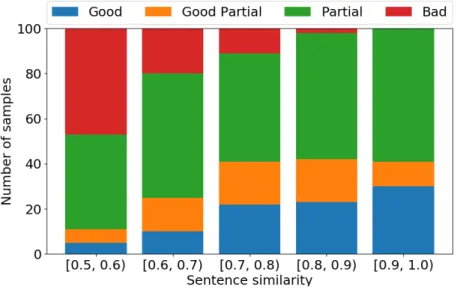
3.6 Quality of the pseudo-parallel corpus. . . 34
4.1 Paraphrase ranking in MRR. . . 44
4.2 Paraphrase ranking in MAP. . . 44
4.3 Coverage of the top-k paraphrase pairs. . . 45
4.4 ρ: logp(e2|e1) . . . 45
4.5 ρ: MIPA(e1,e2) . . . 45
4.6 Effect of the different update rate scheduling methods on the perfor-mance of the proposed method is shown. The dashed horizontal line shows p< 0.05 significance level (Fisher z-transformation) for out-performing the SGNSMAS method. Peak correlation value and the required number of iterations (t) are shown within brackets. . . 57
4.8 Effect of the number of top-ksimilar sentences selected using SimHash on the performance of the proposed method is shown. The dashed hori-zontal line showsp<0.05 significance level (Fisher z-transformation) for outperforming theSGNSMAS method. Peak correlation value and the required number of iterations (t) are shown within brackets. . . 59 4.9 Effect of the different initial word embeddings on the performance of
the proposed method is shown. The dashed horizontal line showsp< 0.05 significance level (Fisher z-transformation) for outperforming the
xiii
List of Tables
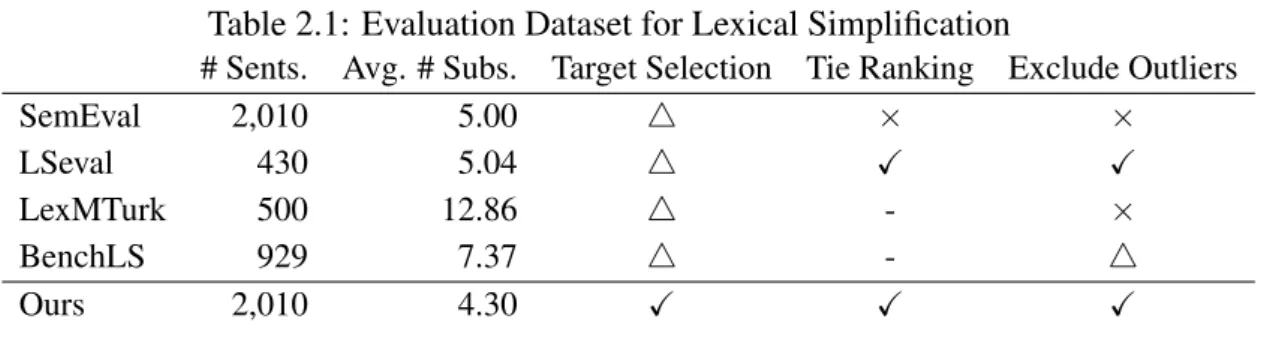
2.1 Evaluation Dataset for Lexical Simplification . . . 16
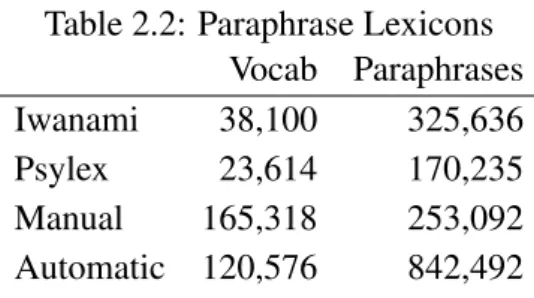
2.2 Paraphrase Lexicons . . . 20
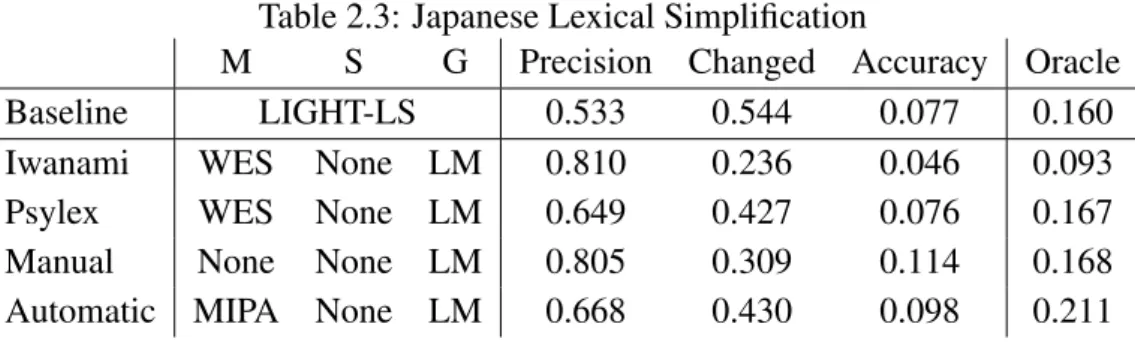
2.3 Japanese Lexical Simplification . . . 22
3.1 Binary classification accuracy of parallel and nonparallel sentences. . . 30
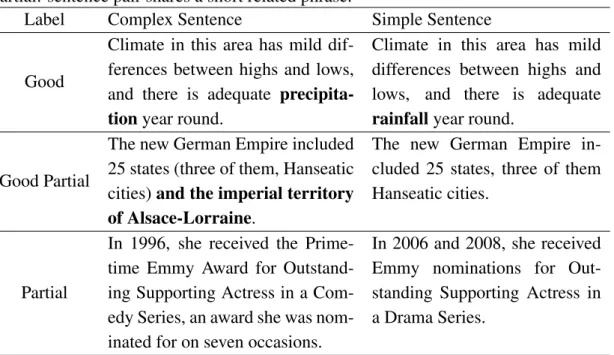
3.2 Examples of each label from our pseudo-parallel corpus. Good: syn-onymous sentence pair, Good Partial: a sentence completely covers the other sentence, Partial: sentence pair shares a short related phrase. . . . 35
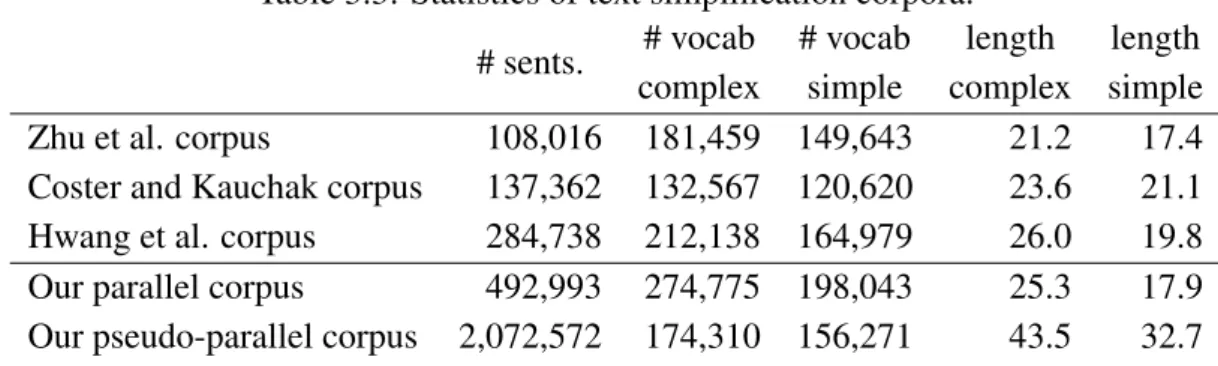
3.3 Statistics of text simplification corpora. . . 36
3.4 Results of English text simplification. . . 37
3.5 Performance on each our pseudo-parallel corpus size. . . 37
3.6 Examples of English text simplification. . . 38
3.7 Results of Japanese text simplification. . . 39
4.1 Evaluation by Pearson’s correlation coefficient in STS task. . . 47
4.2 Paraphrase examples ofcultural. Italicized words are the correct words. 48 4.3 Correct paraphrase examples oflabourers. . . 48
4.4 Sentence similarity measurement results on the SemEval-2015 Task 2 dataset. The bold scores means the highest performance. The scores with a star statistically significantly outperform the SGNS (MAS) base-line. . . 56
4.5 Sentence similarity results using Word Mover’s Distance on the SemEval-2015 Task 2 dataset. . . 61
4.7 Results on QATS classification task. The best scores of each metric are highlighted in bold. Scores other than ours are excerpted from ˇStajner
et al. [117]. . . 67
4.8 Ablation analysis on accuracy. Features are in descending order of overall accuracy. . . 68
4.9 An example of word alignment. Differences between the original and simplified versions are presented in bold. This is a sentence pair from goodclass on overall quality. HAS using word-level similarity reaches 0.85, while BLEU is 0.54. . . 68
4.10 Correlation between each feature and the difference of sentence length and the manually-labeled quality. Note that DWE cannot be included, as it is not a scalar value but the differential vector between original and simplified sentences. . . 69
4.11 CBOW . . . 70
4.12 SGNS . . . 70
1
Chapter 1
Introduction
Text simplification is the task of rewriting complex text into a simpler form while preserving its meaning. Systems that automatically pursue this task can potentially be used for assisting reading comprehension of less language-competent people, such as learners [88] and children [11]. Such systems would also improve the performance of other natural language processing tasks, such as information extraction [30] and machine translation [115].
Text simplification is one on the Text-to-Text Generation tasks with machine transla-tion, paraphrase generatransla-tion, abstractive summarizatransla-tion, and error correction. Machine translation transforms input sentence into different language sentence, while text sim-plification transforms it into same language sentence. The degree of meaning preser-vation differs between paraphrase generation and this task. Unlike paraphrase gener-ation, this task often deletes unnecessary expressions. Although it is common with abstractive summarization in terms of deleting unnecessary expressions, text simpli-fication often adds detailed explanation to assist the reader’s reading comprehension. Moreover, while error correction improves grammaticality of input sentence, text sim-plification improves its simplicity.
text simplification was studied mainly in English for where rich resources are available such as a manually constructed text simplification corpus [121], a large-scale simpli-fied corpus (Simple English Wikipedia1), and a paraphrase database [85]. However, improving the English model with abundant resources cannot benefit from text simpli-fication in other languages with poor resources. In this thesis, we simplify sentences without simplified corpora for Japanese.
1.1. Main Contributions
1. We propose novel, state-of-the-art strategies for Japanese lexical simplification. For three types of candidate acquisition, four types of meaning preservation fil-tering, four types of simplicity filfil-tering, and three types of grammaticality rank-ing, we comprehensively experiment and build a state-of-the-art Japanese lexical simplification system.
2. We build a first evaluation dataset for Japanese lexical simplification. This dataset enables a step-by-step automatic evaluation and an overall automatic evaluation of the simplification pipeline.
3. We propose to use sentence similarity based on alignment between word embed-dings for text simplification. In both lexical substitution approach and monolin-gual translation approach, a monolinmonolin-gual parallel corpus is indispensable for simplification rule acquisition. Our sentence similarity measure outperforms previous works in alignment task of complex and simple sentences.
4. By improving sentence alignment, we achieve the best performance of English text simplification model using PBSMT. This experimental result makes us re-confirm the fact that better data help to develop a better model.
5. For text simplification in languages that cannot use large-scale simplified cor-pora, we build a pseudo-parallel corpus from a raw corpus using readability assessment and sentence alignment. Experimental results show that our pseudo-parallel corpus can simplify as good as using large-scale simplified corpora.
6. We combine the paraphrasability score from monolingual corpora and from bilin-gual corpora to propose a novel paraphrasability score. Levy and Goldberg [65]
explained a well-known representation learning method for word embeddings, the skip-gram with negative sampling [73], as a matrix factorization of a word-context co-occurrence matrix with shifted positive PMI. In this work, we ex-plained a well-known method for paraphrase acquisition, bilingual pivoting [10], as an unsmoothed version of PMI.
7. In order to further improve sentence alignment, we propose a domain adapta-tion method for sentence similarity. Experimental results show that updating the general word similarity with the word similarity specialised for a given corpus improves the sentence similarity based on word alignment.
8. We propose a novel quality estimation method for text simplification using our proposed sentence similarity measures based on word alignment. In text sim-plification, since automatic evaluation metrics using single reference have low correlation with manual evaluation [122], quality estimation, i.e., automatic eval-uation without reference, has been drawing much attention [117]. As a result of experiments, we confirm that our alignment-based features computed on the ba-sis of word embeddings and paraphrase lexicons can achieve the state-of-the-art performance.
1.2. Structure of the Thesis
Chapter 2 presents our approach to Japanese lexical simplification. We build Japanese lexical simplification system (Contribution 1) and evaluation dataset (Contribution 2).
Chapter 3 presents our approach to English and Japanese sentence simplification. We investigate the best sentence alignment method for text simplification tion 3) and build the state-of-the-art simplification model based on PBSMT (Contribu-tion 4). In addi(Contribu-tion, it shows that pseudo-parallel corpus obtained from a raw corpus by readability assessment and the sentence alignment is as effective as parallel corpus, and it opens the door to multilingualization of text simplification (Contribution 5).
similarity based on word alignment for more accurate automatic evaluation (Contribu-tion 8).
5
Chapter 2
Lexical Simplification without
Simplified Corpora
In this section, we perform text simplification using lexical substitution approach in Japanese. Similar to previous works [94, 80], we paraphrase complex word in context into simpler version according to the following procedure.
1. Candidate Acquisition
2. Meaning Preservation Filtering
3. Simplicity Filtering
4. Grammaticality Ranking
In Japanese, parallel corpora to acquire simplification rules cannot be used. Moreover, automatic evaluation is difficult becaus there is no evaluation dataset for Japanese lex-ical simplification.
First, in Section 2.1, we acquire paraphrases as simplification candidates. Next, in Section 2.2, we remove pairs with low likelihood among the paraphrase pairs. More-over, in Section 2.3, we extract only paraphrase pairs from complex to simple words. Finally, in Section 2.4, we select the paraphrase suitable for the context of the input sentence.
2.1. Candidate Acquisition
In Japanese that cannot use large-scale simplified corpora, simplification rule ac-quisition from parallel corpus [44] cannot be used. Moreover, paraphrase acac-quisition from monolingual corpora [13, 69] using distributional similarity [38] is difficult to discriminate between synonym and antonym [77].
In Section 2.1.1, we forcus on the definition statements as a paraphrase acquisition source in place of a monolingual corpus and a parallel corpus. In Section 2.1.2, we integrate multiple synonym dictionaries constructed manually for high-quality para-phrasing. In Section 2.1.3, we acquire paraphrases using word alignment on bilingual corpus for large-scale paraphrasing.
2.1.1 Simplification Rules from Definition Statements
The Japanese dictionary is a resource that explains headwords by definition state-ments. Therefore, the following two characteristics can be assumed.
1. Corresponding headword and definition statement are semantically equivalent.
2. Definition statements are written in easier words than headwords for users to read easily.
We use these characteristics to acquire simplification rules through extracting synony-mous expressions of headwords from definition statements.
Since Japanese is a head-final language, Kaji et al. [51] proposed a method to acquire paraphrase of headwords from the end of definition statements. However, paraphrase of the headwords does not appear only at the end of definition statements.
Therefore, we widely collect paraphrase candidates of headwords from the whole definition statements. In order to reduce noise, we use constraints of part of speech [83] and target only words having the same part of speech as the headword. We acquire paraphrase candidates of headwords from definition statements in the following proce-dure.
1. Morphologically analyze definition statements.
2.1.2 Manually Acquired Paraphrase Lexicon
In the previous section, we proposed a method to acquire simplification rules by con-sidering pairs of headwords and definition statements as pairs of complex and simple texts. As with simplification rule acquisition method from parallel corpus for text sim-plification [44], this method has the advantage that difficulty estimation of paraphrase pair is not required but its performance is affected by alignment accuracy.
In this section, we integrate five types of Japanese synonym dictionaries constructed manually for high-quality paraphrasing.
Lexical Paraphrase Dictionary of Japanese Content Words1[123]
In this dictionary, paraphrases are given manually by nouns, sahen-nouns, verbs, adjectives, adverbs among headwords of morpheme dictionaries in morpholog-ical analyzeer JUMAN (Ver.7.0) [59]. This dictionary allows for missing in-formation and include irreversible transin-formations such as “canary” →“bird”. There are 25,503 paraphrases based on phrases of up to three words.
Japanese WordNet Synonyms Database2(Ver.1.0)
This is a collection of 11,753 synonym pairs, which were collected using synsets in Japanese WordNet [49]. Word pairs were created using words in a synset, which is a cluster of words that share the same sense, and were manually an-notated. The word pairs that were manually annotated as synonym pairs were included in the database.
Verb Entailment Database3(Ver.1.3.1)
This is a collection of automatically acquired [66, 119, 108, 39, 40] verb pairs. Eight types of labels such as entailment, presupposition, and action-reaction are manually given to these verb pairs. We use 94,025 verb pairs classified as entail-ment.
Database of Japanese Orthographic Variant Pairs4(Ver.1.1)
This is a collection of noun phrase pairs with edit distance of 1. Ten types of labels such as synonym, allograph, and erratum are manually given to these noun phrase pairs. We use 50,825 noun phrase pairs classified as synonym or erratum.
1http://www.jnlp.org/SNOW/D2
2http://compling.hss.ntu.edu.sg/wnja/jpn/downloads.html
Case Base for Basic Semantic Relations5(Ver.1.4)
This is a collection of word pairs with high contextual similarity included in the database of similar context terms6. Eight types of labels such as variant, abbreviation, and synonym are manually given to these word pairs. We use 78,260 word pairs classified as variant, abbreviation, or synonym.
2.1.3 Automatically Acquired Paraphrase Lexicon
In the previous section, we used synonym dictionaries constructed manually to ac-quire simplification rules. However, building a large-scale and high-quality synonym dictionary requires a large cost. Therefore, it is difficult to keep up with new words or new meaings. Moreover, it is also difficult to expand from word to phrase.
In this section, we acquire paraphrases using word alignment on bilingual corpus for large-scale paraphrasing. By applying phrase tabel acquire [79] in phrase-based statistical machine translation, Bannard and Callison-Burch [10] proposed a method (Bilingual Pivoting) to acquire large-scale paraphrases from a bilingual corpus using foreign language phrase as a pivot. In other words, using two phrase tables of j1→e
ande→ j2, acquire two Japanese phrases< j1,j2>as a paraphrase pair via an English
phrasee.
2.2. Meaning Preservation Filtering
In this section, we remove pairs with low likelihood among the paraphrase pairs acquired in Section 2.1.
To estimate semantic equivalence between words, there are methods based on se-mantic similarity and paraphrase probability. In Section 2.2.1, we use the distance of the path on WordNet [14, 37] which is a classic method for estimating semantic sim-ilarity between words. In Section 2.2.2, we use the cosine simsim-ilarity between word embeddings which is the de facto standard method for estimating semantic similar-ity between words. In Section 2.2.3, we estimate the paraphrase probabilsimilar-ity between words using word alignment probability on bilingual corpus which is the de facto stan-dard method for paraphrase acquisition. In Section 2.2.4, we estimate the equivalence
of meaning between words using pointwise mutual information which smoothes the paraphrase probability of Section 2.2.3 with word probability.
2.2.1 Path Distance Similarity
Thesauri such as WordNet [75, 49] are resources classifying words from the view-point of semantic hypernym-hyponym relations. The closer the distance between words on the thesaurus, the higher the semantic similarity between words. Path dis-tance similarity has been used in many previous works [14, 37] as a semantic similarity estimation method between words based on knowledge base. The semantic similarity PDS(j1,j2)between words j1 and j2is calculated as follows using the depth of each
word on the thesaurusdwand the depth of the hypernym common to both wordsdc.
PDS(j1,j2) =
2dc(j1,j2)
dw(j1) +dw(j2)
(2.1)
2.2.2 Context Similarity
Based on the distributional hypothesis [38], semantic similarity between words can be estimated using the similarity of the distribution of words co-occurring as context. Context similarity has been used in many previous works [25, 34] as a semantic sim-ilarity estimation method between words based on corpus. Especially, methods using word embeddings [73, 87, 64] which can be constructed from monolingual corpora by unsupervised learning are the de facto standard method for estimating semantic simi-larity between words. The semantic simisimi-larity WES(j1,j2)between words j1and j2is
calculated as follows using the cosine similarity between word embeddings⃗j1and⃗j2.
WES(j1,j2) =cos(⃗j1,⃗j2) (2.2)
2.2.3 Alignment Probability
Bilingual pivoting [10], described in Section 2.1.3, employs a conditional paraphrase probability p(j2| j1)as a paraphrasability measure, when there are word alignments
e and another Japanese phrase j2 on a bilingual corpus. It calculates the
probabil-ity from an Japanese phrase j1 to another Japanese phrase j2 using word alignment
probabilities p(e| j1)and p(j2|e); here, the English phraseeis used as the pivot.
p(j2| j1) =
∑
e p(j2|e,j1)p(e| j1)≈
∑
e p(j2|e)p(e| j1)(2.3)
It assumes conditional independence of j1and j2giveneso that the last equation can be
estimated easily using phrase-based statistical machine translation models. One of the advantages is that it requires only two translation models to estimate paraphrasability. However, since the conditional probability is asymmetric, it may introduce irrelevant paraphrases that do not hold the same meaning as the original one.
To mitigate this, PPDB7 [33] defined the symmetric paraphrase score BP(j1,j2)
using bi-directional bilingual pivoting.
BP(j1,j2) =−λ1logp(j2| j1)−λ2logp(j1| j2) (2.4)
In this study, without loss of generality, we set8λ1=λ2=−1.
BP(j1,j2) =logp(j2| j1) +logp(j1| j2) (2.5)
2.2.4 MIPA Score
The bi-directional bilingual pivoting of PPDB [33] constrains paraphrasability to be strictly symmetric. However, though it is extremely good at extracting synonymous ex-pressions, it tends to give high scores to frequent but irrelevant phrases since bilingual pivoting itself contains noisy phrase pairs due to word alignment errors.
To address the problem of frequent phrases, we smooth paraphrasability by bilingual pivoting in Equation (2.5) using word probabilitiesp(j1)andp(j2)from a monolingual
corpus that is sufficiently larger than the bilingual corpus.
BPMI(j1,j2) =logp(j2| j1) +logp(j1| j2)−logp(j1)−logp(j2) (2.6)
By doing so, we can interpret the bi-directional bilingual pivoting as an unsmoothed version of PMI. Since the difference of the logarithms of the numerator and denom-inator is equal to the logarithm of the quotient, we can transform Equation (2.6) as
7http://www.cis.upenn.edu/˜ccb/ppdb/ 8Similar to PPDB (λ
follows.
BPMI(j1,j2) =log
p(j2| j1)
p(j2)
+logp(j1| j2)
p(j1) =2PMI(j1,j2)
(2.7)
since we can transform PMI into the following forms using Bayes’ theorem.
PMI(x,y) =log p(x,y)
p(x)p(y)
=logp(y|x)p(x)
p(x)p(y) =log
p(y|x)
p(y)
=logp(x|y)p(y)
p(x)p(y) =log
p(x|y)
p(x)
(2.8)
In low-frequency word pairs, it is well-known that PMI becomes unreasonably large because of coincidental co-occurrence. In order to avoid this problem, Evert [31] pro-posed Local PMI that assigns weights to PMI depending on the co-occurrence fre-quency of word pairs.
LPMI(x,y) =n(x,y)·PMI(x,y) (2.9)
In this study, however, it is difficult to directly calculate the weight corresponding to
n(x,y)in Equation (2.9) on the bilingual corpus. Furthermore, what we want to calcu-late is not the strength of co-occurrence (relation) between words, but paraphrasability between words. Therefore, it is not appropriate to count the co-occurrence frequency on a monolingual corpus like Local PMI.
Alternatively, we use as a weight the distributional similarity, which is often used as a paraphrase acquisition from a monolingual corpus [25, 34].
MIPA(j1,j2) =cos(⃗j1,⃗j2)·BPMI(j1,j2) (2.10)
Equation (2.10) simultaneously considers paraphrasability based on the monolingual corpus (distributional similarity) and paraphrasability based on the bilingual corpus (bilingual pivoting). Distributional similarity is robust against noise associated with unrelated word pairs as opposed to bilingual pivoting. Bilingual pivoting is robust to noise arising from antonym pairs unlike distributional similarity. Therefore, MIPA(j1,j2)
2.3. Simplicity Filtering
In this section, we assign difficulty to each word in paraphrase pairs with high like-lihood acquired in Section 2.2, and extract paraphrase pairs from complex to simple words.
2.3.1 Word Frequency
In SemEval-2012 English Lexical Simplification Task [99] of reordering word lists form the viewpoint of simplicity, word frequency as baseline achieved the second place on the 12 system and showed the effectiveness of paraphrasing to the high frequency word in the lexical simplification task. We also define more frequent words as simpler words.
2.3.2 Word Familiarity
Word Familiarity [7] is a score that expresses how well a word is known as a real number from 1 (unknown) to 7 (well known). According to previous work [48], we define words with higher familiarity score as simpler words.
2.3.3 JLPT Simplicity
JLPT is a Japanese language proficiency test for non-native Japanese speakers. The criterion for that question is to classify each word in Japanese into four levels from 1st grade (complex) to 4th grade (simple). We define words with higher JLPT grade as simpler words.
2.3.4 JEV Difficulty
Japanese educational vocabulary9 (Ver.1.0) [105] is a word list based on vocabu-lary analysis of balanced corpus of contemporary written Japanese [67] and Japanese textbook corpus (100 Japanese textbooks on the market). Japanese teachers gave each Japanese word six levels of difficulty. We define words with lower JEV level as simpler words.
2.4. Grammaticality Ranking
In this section, we select the paraphrase suitable for the context of the input sentence using simplification rules acquired in Section 2.3.
2.4.1 Language Model Probability
We calculate the N-gram language model probability LMNof the input sentence and the paraphrased sentence, and select the sentence with the highest likelihood. In this way, the most fluent simplification rule can be applied considering the context of N
words before and after the target word.
LMN(w1,w2, ...,wn) = n
∏
k=1p(wk|wkk−1−N+1)
=p(w1)p(w2|w1)p(w3|w1,w2)...p(wn|wn−N+1, ...,wn−1)
(2.11)
2.4.2 Context Embedding Similarity
In lexical substitution task, candidate ranking methods [72, 8] based on cosine simi-larity between context words and paraphrase candidate are proposed. We select a para-phrase that fits the context as follows using the cosine similarity cos between context wordc∈Cand paraphrase candidates.
AddCos(s,C) = 1
|C|c
∑
∈Ccos(⃗s,⃗c) (2.12)AvgCos(s,C) =cos(⃗s, 1
|C|c
∑
∈C⃗c) (2.13)2.5. Evaluation for Japanese Lexical Simplification
In this section, we construct an evaluation dataset for Japanese lexical simplification. According to the previous works in English [99, 12], we also use crowdsourcing to construct the evaluation dataset for lexical simplification by the following procedure.2. Annotators generate paraphrases of complex word in consideration of context.
3. Annotators rank complex word and its paraphrases in terms of simplicity.
4. We integrate rankings obtained from annotators.
In Section 2.5.1, we explain existing evaluation datasets for lexical simplification and summarize the improvements to build a better evaluation dataset. In Sections 2.5.2 to 2.5.5, we build an evaluation dataset for Japanese lexical simplification according to the above procedure using crowdsourcing10. In Section 2.5.6 introduce the evaluation metrics in lexical simplification task. For crowdsourcing, we requested the annotators to complete at least 95% of their previous assignments correctly. They were native Japanese speakers.
2.5.1 Previous Works
Four datasets have been constructed for English lexical simplification.
SemEval11
Specia et al. [99] reranked the dataset for English lexical substitution [71] to build the dataset for English lexical simplification. The data was selected from the English Internet Corpus12 [95]. This is a balanced corpus similar in flavour to the BNC, though with less bias to British English, obtained by sampling data from the web. This dataset comprises 2,010 sentences, 201 target words each with 10 sentences. In paraphrase step, each target word was paraphrased by five native English speakers in consideration of context. In reranking step, each sentence was reranked by four or five non-native English speakers in terms of simplicity. In integration step, a gold-standard ranking was created based on the average rank of each word.
LSeval13
In common with Specia et al. [99], De Belder and Moens [12] reranked the dataset for English lexical substitution [71] to build the dataset for English lex-ical simplification. There are four major differences from Specia’s work. (1)
10http://www.lancers.jp/
11https://www.cs.york.ac.uk/semeval-2012/task1/
12http://corpus.leeds.ac.uk/internet.html
They excluded simple target words14 from their dataset. (2) In their rerank-ing step, they recruited five annotators for each sentence usrerank-ing crowdsourcrerank-ing15. (3) In their reranking step, they allowed annotators to include tie ranks in the rankings. (4) In their integration step, they created a gold-standard ranking in consideration of reliability of each annotator using noisy channel model. This dataset comprises 430 sentences, 43 target words each with 10 sentences.
LexMTurk16
Horn et al. [44] directly acquired simple paraphrases using crowdsourcing15. Each 500 sentences from English Wikipedia have a target word, and 50 annota-tors for each sentence gave a simple paraphrase. Target words for simplification were selected from the words in English Wikipedia that changed in the paral-lel corpus of English Wikipedia and Simple English Wikipedia [27]. In their integration step, they created a gold-standard ranking by simply counting word frequency on annotations. That is, they defined that the paraphrase suggested by more annotators is a better simplification. This dataset comprises 500 sentences, 500 target words each with only one sentence.
BenchLS17
Paetzold and Specia [80] used a dataset consisting of 929 sentences that inte-grated LSeval [12] and LexMTurk [44] for benchmarking lexical simplification.
Based on the previous works above, we construct an evaluation dataset considering follows.
Target Selection
In order to build a better evaluation dataset, we carefully choose the target sen-tence and the target word. First, in order not to limit the diversity of expres-sions, the target sentence is selected from the balanced corpus. Next, we select complex words to be simplified for the target word. As pointed out by Specia et al. [99], it is natural for each word in the sentence to have consistent difficulty. In other words, we do not simplify only the target word in the complex context, but simplify the complex word that appear in the simple context. SemEval dataset selects target sentences from a balanced corpus, but includes simple words in
14http://simple.wikipedia.org/wiki/Wikipedia:Basic English combined wordlist 15https://www.mturk.com/
Table 2.1: Evaluation Dataset for Lexical Simplification
# Sents. Avg. # Subs. Target Selection Tie Ranking Exclude Outliers
SemEval 2,010 5.00 △ × ×
LSeval 430 5.04 △ ✓ ✓
LexMTurk 500 12.86 △ - ×
BenchLS 929 7.37 △ - △
Ours 2,010 4.30 ✓ ✓ ✓
target words. LSeval dataset selects target sentences from a balanced corpus and removes simple words from target words, but the context of the target word may be complex. In LexMTurk dataset, only target words are complex, but the source of the target sentence is limited to English Wikipedia. We select sentences with only one complex word from a balanced corpus as target sentences and choose the complex word as the target word for simplification.
Tie Ranking
In the reranking step, a tie cannot be assigned in SemEval dataset. This deteri-orates ranking consistency if some substitutes have a similar simplicity. LSeval dataset allows ties in simplification ranking and De Belder and Moens report considerably higher agreement among annotators than SemEval dataset. We also allow tie to annotators in our reranking step. In LexMTurk dataset, since anno-tators only give simple paraphrases, there is no reranking step. However, we want to deal with the phenomenon “cannot be paraphrased into simple words”, so we follow SemEval or LSeval datasets. There are at least one type of simple paraphrase because the parallel corpus is used as the source in the LexMTurk dataset. However, such a situation cannot be generally assumed.
Exclude Outliers
2.5.2 Target Selection
We define complex words as “High Level” words in the JEV lexicon [105]. There were 7,939 complex words out of 17,920 words in the JEV lexicon. In addition, tar-get words of this work comprised content words (nouns, verbs, adjectives, adverbs, adjectival nouns, sahen nouns18, and sahen verbs19).
Sentences that include only one complex word were randomly extracted from the Balanced Corpus of Contemporary Written Japanese [67]. Sentences shorter than seven words or longer than 35 words were excluded. Replacing a word in a compound word can not hold the meaning of the compound word in many cases, so the target word appearing as a part of the compound word is excluded. Conjugation was allowed to cover variations of both verbs and adjectives. Following previous work [71, 99, 12], 10 contexts of occurrence were collected for each complex word. We assigned 30 complex words for each part of speech. The total number of sentences was 2,100 (30 words × 10 sentences × 7 parts of speech). We used a crowdsourcing to annotate 1,800 sentences, and we asked university students majoring in computer science to annotate 300 sentences.
2.5.3 Paraphrase Acquisition and Selection
For each complex word, five annotators gave as much paraphrase as possible without changing the meaning of sentence. Substitutions could include particles in context. An average of 4.59 paraphrases were given for 2,100 target words.
According to McCarthy and Navigli [71], we calculated pairwise agreement be-tween each pair of sets(a1,a2∈A)from all the possible pairingsPas inter-annotator
agreement.
IAA(A) = 1
|A|a1,
∑
a2∈Aa1∩a2
a1∪a2
(2.14)
The IAA for our paraphrase acquisition step was 0.194, which was a low score. This is because each annotator gave as much paraphrase as possible to acquire various para-phrases, because there were mixed annotators that give many paraphrases and annota-tors that give only a few paraphrases.
18Sahen noun is a kind of noun that can form a verb by adding a generic verb “する(do)” to the noun.
(e.g. “修理(repair)”)
To improve the quality of the lexical substitution, inappropriate substitutes were deleted for later use. Another five annotators selected an appropriate word to include as a substitution that did not change the sense of the sentence. The IAA for our para-phrases selection step was 0.669, which was greatly improved.
Substitutes that won a majority were defined as correct. Nine complex words that were evaluated as not having substitutes were excluded at this point. As a result, an average of 4.30 paraphrases were given for 2,010 target words.
2.5.4 Simplicity Reranking
Another five annotators arranged substitutes and complex words according to the simplification ranking. Annotators were permitted to assign a tie, but they could select up to four items20 to be in a tie because we intended to prohibit an insincere person from selecting a tie for all items.
According to De Belder and Moens [12], we calculated Spearman rank correlation coefficient as inter-annotator agreement.
ρ(i,j) =√ ∑k(ranki(wk)−ranki)(rankj(wk)−rankj)
∑k(ranki(wk)−ranki)2∑k(rankj(wk)−rankj)2
(2.15)
Here, let me define wk the k-th word in the list of substitutions, ranki(wk) the rank given by annotator i to word wk, and ranki the average rank of the words given by annotator i. Often words are ranked at the same position by the annotators, and ties here are solved by assigning them the average of their rank. The Spearman’sρ for our simplicity reranking step was 0.552, which was moderate correlation.
2.5.5 Integrating Annotations
Annotators’ rankings were integrated into one ranking, using a maximum likelihood estimation [70] to penalize deceptive annotators.
Pr[π˜ |π,λ(i)] = 1
Z(λ(i))exp
(
−λ(i)d(π˜,π))
Z(λ(i)) =
∑
˜π
exp(−λ(i)d(π˜,π))
(2.16)
This model gives the probability of a rank vector ˜π, given a modal order π and a i -th annotator’s concentration parameter λ(i). Here, d(·,·) denotes a distance between two rank vectors, and Z(λ(i)) is a normalizing constant. We employ the Spearman rank correlation coefficient as a distance. In this model, the annotation of an annotator who has a high concentration parameter λ(i) is likely to be an accurate order whose distance from the true order is small. Therefore, this method estimates the reliability of annotators in addition to determining the true order of rankings. We applied the reliability score to exclude extraordinary annotators.
We excluded annotators with low reliability score under the constraint of excluding only up to two annotators out of five for each target sentence. As a result, nine annota-tors out of 140 were excluded and the Spearman’sρ between gold-standard and each annotator was improved from 0.541 to 0.580. After excluding annotators with low reliability, annotations were integrated into gold-standard ranking using the average ranking according to the SemEval dataset.
2.5.6 Metrics
Lexical simplification methods are automatically evaluated by following three met-rics using gold-standard ranking.
Precision: The proportion of instances in which the highest ranking substituion is either the target complex word itself or is in the gold-standard.
Accuracy: The proportion of instances in which the highest ranking substituion is not the target complex word itself and is in the gold-standard.
Changed Proportion: The proportion of instances in which the highest ranking sub-stituion is not the target complex word itself.
The most important metric is Accuracy. Because Precision gives a high score to a safe system that rarely rewrites. Moreover, Changed Proportion gives a high score to a harmful system that frequently rewrites.
2.6. Experiments
Table 2.2: Paraphrase Lexicons Vocab Paraphrases
Iwanami 38,100 325,636
Psylex 23,614 170,235
Manual 165,318 253,092
Automatic 120,576 842,492
2.6.1 Settings
In our proposed methods, simplification candidates are extracted from three sources: pairs of headword and definition statement, synonym dictionaries constructed manu-ally, and synonym dictionaries automatically constructed from bilingual parallel cor-pora. Annotated Corpus of Iwanami Japanese Dictionary Fifth Edition 200421(Iwanami) and Basic Word Database22(Psylex) are used as pairs of headword and definition state-ment. Moreover, we combine the five synonym dictionaries (Lexical Paraphrase Dic-tionary of Japanese Content Words, Japanese WordNet Synonyms Database, Verb En-tailment Database, Database of Japanese Orthographic Variant Pairs, and Case Base for Basic Semantic Relations) described in Section 2.1.2 as a synonym dictionary con-structed manually (Manual). As the automatically concon-structed synonym dictionary (Automatic), we use the largest version (“10best”) of PPDB: Japanese23 [76]. PPDB: Japanese consists of a paraphrase pair of up to 7-gram acquired from 1.9 million pairs of Japanese-English parallel semtemces using bilingual pivoting [10] described in Sec-tions 2.1.3 and 2.2.3. In the lexicon, phrases with top 10 paraphrase probabilities for each phrase are included. We use only 1-gram pairs. Table 2.2 shows the vocabulary size and the number of paraphrase rules for each Paraphrase lexicon.
For meaning preservation filtering, we use Japanese WordNet2 (Ver.1.1) for PDS. We use CBOW model [73] of the 200-dimensional word2vec embeddings24 for WES. The word embeddings were trained on 12 million sentences of Japanese Wikipedia25 split into words using MeCab [57] (Ver. 0.996) with IPADIC (Ver. 2.7.0).
For simplicity filtering, we use Basic Word Database22 for calculating word famil-iarity. The word frequency was calculated on Japanese Wikipedia25.
21http://www.gsk.or.jp/catalog/gsk2010-a/ 22http://hon.gakken.jp/book/1530238600 23http://ahclab.naist.jp/resource/jppdb/
For grammaticality ranking, we trained a 5-gram language model from Japanese Wikipedia25 using KenLM [42] for LM.
2.6.2 Baseline: LIGHT-LS
We compare the proposed method with LIGHT-LS [34] as a Baseline which is a lexical simplification method without simplified corpora. Glavaˇs and ˇStajner performs lexical simplification based on a monolingual corpus using following two steps.
1. Candidate Selection:The 10 most similar candidate words are selected for each difficult word using cosine similarity between word embeddings.
2. Reranking: The best candidate is selected using the average ranking based on the following four features.
Semantic Similarity They select candidates with high cosine similarity cos be-tween the word embeddings⃗t of the target word t and the word embed-dings⃗s of the simplification candidate s. This feature corresponds to the our meaning preservation filtering.
f1(t,s) =cos(⃗t,⃗s) (2.17)
Context Similarity They select candidates with high averaged cosine similarity cos between the word embeddings⃗s of the simplification candidates and the word embeddings⃗c of each context word c∈C. Here,C is a set of content words (nouns, verbs, adjectives, and adverbs) in the target sentence. This feature corresponds to the our grammaticality ranking.
f2(C,s) =
1
|C|c
∑
∈Ccos(⃗c,⃗s) (2.18)Information Contents Under the hypothesis that the word’s informativeness correlates with its complexity [29], they select less informative candidates. Here,W is a vocabulary, and freq is a word frequency. This feature corre-sponds to our simplicity filtering.
f3(W,s) =−log
freq(s) +1
∑w∈Wfreq(w) +1
Table 2.3: Japanese Lexical Simplification
M S G Precision Changed Accuracy Oracle
Baseline LIGHT-LS 0.533 0.544 0.077 0.160
Iwanami WES None LM 0.810 0.236 0.046 0.093
Psylex WES None LM 0.649 0.427 0.076 0.167
Manual None None LM 0.805 0.309 0.114 0.168
Automatic MIPA None LM 0.668 0.430 0.098 0.211
Language Model They select candidates with high probability of N-gram lan-guage model (N=5). This feature corresponds to our grammaticality rank-ing.
f4(w1,w2, ...,wn) = n
∏
k=1p(wk|wkk−1−N+1) (2.20)
2.6.3 Results
Table 2.3 shows the experimental results on Japanese lexical simplification. In the method using definition statements (Psylex), using WES as the meaning preservation filtering and LM as grammaticality ranking without simplicity filtering, we achieved the same performance as LIGHT-LS which is a state-of-the-art lexical simplification method without simplified corpora. In the method using synonym dictionaries con-structed manually, we achieved the best performance on Japanese lexical simplification task using LM as a grammaticality ranking without filtering methods. In the method us-ing synonym dictionary constructed automatically, we outperformed LIGHT-LS base-line using MIPA as meaning preservation filtering and LM as grammaticality ranking without simplicity filtering.
23
Chapter 3
Sentence Simplification without
Simplified Corpora
In this chapter, we assume a language that cannot use a large-scale simplified cor-pora, construct a pseudo-parallel corpus for text simplification from a raw corpus, and perform text simplification using a statistical machine translation. We use readability assessment method and sentence alignment method to search simplified synonymous sentences for each complex sentence in a given monolingual corpus. Using the sen-tence pairs, the PBSMT model acquires phrase pairs to translate complex expressions into simpler synonymous expressions.
First, Section 3.1 outlines the proposed method of constructing a pseudo-parallel corpus from a raw corpus. Next, Section 3.2 proposes an sentence similarity estima-tion method based on alignment between word embeddings as sentence alignment for text simplification. Moreover, experiments are presented in Sections 3.3 to 3.5. First, Section 3.3 evaluates the proposed method from Section 3.2 and determines the best sentence alignment method for text simplification. Section 3.4 constructs an English pseudo-parallel corpus based on Sections 3.1 to 3.3, and performs English text simpli-fication. Section 3.5 similarly builds a Japanese pseudo-parallel corpus and performs Japanese text simplification.
3.1. Pseudo-Parallel Corpus from a Raw Corpus
Figure 3.1: Text simplification using PBSMT from only a raw corpus by readability assessment and sentence alignment.
statistical machine translation (PBSMT) [98, 27, 26, 120, 111, 118, 113, 112, 35]. However, building a monolingual parallel corpus for text simplification is costly be-cause a large-scale corpus written in simple expressions is not publicly available in many languages other than English. Hence, text simplification was studied mainly in English for where rich resources are available such as a manually constructed text sim-plification corpus [121], a large-scale simplified corpus (Simple English Wikipedia1), and a paraphrase database [33, 86, 85].
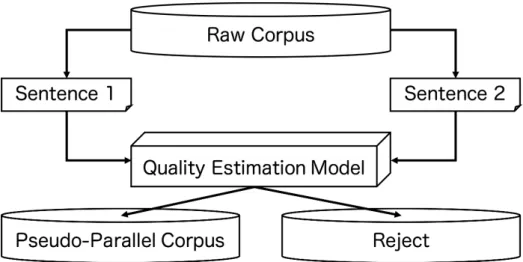
Therefore, we propose a language-independent unsupervised method that automat-ically builds a pseudo-parallel corpus to train a text simplification model from only a raw corpus. Synonymous or similar sentence pairs, such as multiple mentions or ex-planations of similar events or items, could be obtained from a large-scale monolingual corpus. We carefully create a parallel corpus containing complex form on one part and simple form on the other part. We automatically acquire such sentence pairs from the raw corpus. Our novel framework comprises two steps: 1) readability assessment and 2) sentence alignment. An overview of the proposed method is shown in Figure 3.1.
In this research, we propose a framework for automatically constructing a pseudo-parallel corpus for text simplification from a raw corpus. This can be explained more generally as in Figure 3.2. In other words, for randomly extract two sentences from
Figure 3.2: Pseudo-parallel corpus from a raw corpus.
the raw corpus, we perform a quality estimation according to the task, and extract sentence pairs with likelihood above the threshold as a pseudo-parallel corpus. Quality estimation [102] is a generic term for technologies to evaluate output sentences without reference by comparing input and output sentences, and is studied mainly in Text-to-Text generation tasks, especially in machine translation [23, 17, 18, 21, 20, 19].
We would like to build a pseudo-parallel corpus for text simplification. Since text simplification is a task that rewrites from complex sentence into simpler version while preserving its meaning, the quality estimation step in the Figure 3.2 evaluates the dif-ficulty of each sentence and the synonymity between two sentences. In order to eval-uate difficulty of sentence, we use the readability metrics developed in each language. After estimating readability for each sentence, we next evaluate the synonymity of complex sentences with low readability and simple sentences with high readability. In general, it is easier to read short sentences than long sentences, so in addition to para-phrasing from complex expressions into simple ones, text simplification often deletes expressions that are not important [121]. Hence, synonymy in text simplification is not limited to mutually replaceable “synonymity” as in paraphrase tasks. Therefore, we evaluate the synonymity between two sentences using the sentence similarity de-scribed in Section 3.2. Finally, only pairs of complex and simple sentences which have high similarity are used as a pseudo-parallel corpus for text simplification.
sentence extracted from the raw corpus using two kinds of machine translation sys-tems, generated two types of translated sentences, A and B, and estimated the quality of the translated pair (A, B). Sennrich et al. and Imankulova et al. extracted sentence A from the raw corpus and translated it into sentence B and constructed a pseudo-parallel corpus from a translated pair (A, B). Here, Imankulova et al. used quality estimation, but Sennrich et al. did not use them. In these previous works, since sentences gen-erated by machine translation systems are used as pseudo-parallel corpus, erroneous sentences may be included due to translation errors. On the other hand, in this work, since sentences extracted from the raw corpus are used, erroneous sentences are not in-cluded. The pseudo-parallel corpus constructed using our approach was also reported usefulness in domain adaptation of machine translation [68].
3.2. Sentence Alignment Based on Alignment between
Word Embeddings
Three monolingual parallel corpora for English text simplification have been built from English Wikipedia and Simple English Wikipedia. First, Zhu et al.2 [128] pio-neered automatic construction of a text simplification corpus using the cosine similarity between sentences represented as TF-IDF vectors. Second, Coster and Kauchak3[27] extended Zhu et al.’s work by considering the order of the sentences. However, these methods did not compute similarities between different words. In text simplification, it would be useful to consider similarities between synonymous expressions when com-puting the similarity between sentences, since concepts are frequently rewritten from a complex to a simpler form. Third, Hwang et al.4[46] computed the similarity between sentences taking account of wordlevel similarity using the co-occurrence of a head-word in a dictionary and its definition sentence. We also consider head-word-level similarity to compute similarity between sentences but using word embeddings to build a text simplification corpus at low cost without requiring access to external resources.
To address the challenge of computing the similarity between sentences containing different words with similar meanings, many methods have been proposed. In seman-tic textual similarity task [5, 6, 3, 2, 4, 24], sentence similarity is computed on the basis
2https://www.ukp.tu-darmstadt.de/data/sentence-simplification/simple-complex-sentence-pairs/
of word similarity following the success of word embeddings [73]. For example, a su-pervised approach using word embeddings when obtaining a word alignment achieved the best performance in SemEval-2015 Task 2 [104]. Word embeddings have also been used in unsupervised sentence similarity metrics [74, 97, 60]. These unsupervised sen-tence similarity metrics can be applied to the automatic construction of a monolingual parallel corpus for text simplification, without requiring the data to be labeled.
We propose four types of sentence similarity measures for building a monolingual parallel corpus for text simplification, based on alignments between word embeddings that have achieved outstanding performance on different NLP tasks. AAS,MAS,HAS are the sentence similarity measures proposed by Song and Roth [97] for a short text similarity task. The Word Mover’s Distance (WMD) [60] is another sentence similarity measure based on alignment between word embeddings that is known to achieve good performance on a document classification task.
3.2.1 AAS: Average Alignment Similarity
AAS [97] averages the cosine similarities between all pairs of words within given two sentences,xandy, calculated over their embeddings.
AAS(x,y) = 1 |x||y|
|x|
∑
i=1|y|
∑
j=1cos(⃗xi,⃗yj) (3.1)
3.2.2 MAS: Maximum Alignment Similarity
AAS inevitably involves noise, as many word pairs are semantically irrelevant to each other. MAS [97] reduces this kind of noise by considering only the best word alignment for each word in one sentence as follows.
MASasym(x,y) =
1
|x| |x|
∑
i=1max
j cos(⃗xi,⃗yj) (3.2)
Here, MAS is an inherently asymmetric score. Therefore, we obtain the symmetric sentence similarity by averaging each direction as follows.
MAS(x,y) =1
2MASasym(x,y) + 1
3.2.3 HAS: Hungarian Alignment Similarity
AAS and MAS deal with many-to-many and one-to-many word alignments, respec-tively. On the other hand, HAS [97] is based on one-to-one word alignments.
The task of identifying the best one-to-one word alignments H is regarded as a problem of bipartite graph matching, where the two sets of vertices respectively com-prise words within each sentencexandy, and the weight of a edge betweenxiandyjis given by the cosine similarity calculated over their word embeddings. GivenH iden-tified using the Hungarian algorithm [58], HAS is computed by averaging the cosine similarities between embeddings of the aligned pairs of words.
HAS(x,y) = 1
|H|
∑
(i,j)∈H
cos(⃗xi,⃗yj) (3.4)
where|H|=min(|x|,|y|), asH contains only one-to-one word alignments.
3.2.4 WMD: Word Mover’s Distance
WMD [60] is a special case of the Earth Mover’s Distance [92], which solves the transportation problem of words between two sentences represented by a bipartite graph.5Letnbe the vocabulary size of the language, WMD is computed as follows.
WMD(x,y) =min n
∑
u=1n
∑
v=1Auveud(⃗xu,⃗yv) (3.5)
subject to : n
∑
v=1Auv= 1
|x|freq(xu,x)
n
∑
u=1Auv= 1
|y|freq(yv,y)
where Auv is a nonnegative weight matrix representing the flow from a wordxu in x to a wordyv iny, eud(·,·)the Euclidean distance between two word embeddings, and
freq(·,·)the frequency of a word in a sentence.
3.3. Experiment: Alignment within Complex and
Sim-ple Sentences
In this section, we perform parallel and nonparallel binary classification on pairs of complex and simple sentences, and evaluate the effectiveness of sentence similarity based on the alignment between word embeddings.
3.3.1 Settings
Hwang et al. [46] built a benchmark dataset4 for text simplification extracted from the English Wikipedia and Simple English Wikipedia. They annotated one of the fol-lowing four labels to 67,853 sentence pairs:
Good (G): The semantics of the sentences completely match, possibly with small omissions. 277 sentence pairs.
Good Partial (GP): A sentence completely covers the other sentence, but contains an additional clause or phrase that has information which is not contained within the other sentence. 281 sentence pairs.
Partial (P): The sentences discuss unrelated concepts, but share a short related phrase that does not match considerably. 117 sentence pairs.
Bad (B): The sentences discuss unrelated concepts. 67,178 sentence pairs.
We classified a sentence pair as parallel or nonparallel using this dataset to evaluate the sentence similarity measures. We conducted experiments in two settings:
G vs. O: Only sentence pairs labeled G were defined as parallel, and others (O) were defined as nonparallel.
G+GP vs. O: Sentence pairs labeled either G or GP were defined as parallel.
We evaluated the performance of the binary classification using following two mea-sures in accordance with Hwang et al. [46]:
MaxF1: The maximum F1 score.