<はじめに>
日本ベトナム経済連携協定(以下「JVEPA」)に基づ くベトナム人看護師の受入れは,2008年12月に日本政府 とベトナム政府との間で締結された同協定における付帯 事項として位置づけられている(受入れ枠組みについて は図 1 を参照のこと).ベトナム人看護師・介護福祉士 の受入れについては,協定締結後,改めて受入れ枠組み に関する調整がなされたために,第一陣の看護師・介護 福祉士候補者が来日したのは,2014年 6 月になった.二 国間経済連携協定に基づくアジアから日本への看護師の 送出しについては,既にインドネシア(2008年~),
フィリピン(2009年~)からの送出しが先行しており,
ベトナムは先発二国に対して大きく遅れをとった形に なった.
ところでベトナムは,1990年代に民間レベルでの看護 師の送出しを行った経緯があり,これまでに56名の日本 語による看護師試験の合格者を輩出している.このこと からベトナム政府は,民間レベルでの看護師の送出しの 経験と,先発二国におけるEPA制度での外国人看護師 の送出しの問題点とを注意深く吟味して,JVEPA制度 下での看護師・介護福祉士送出しのための枠組みに組み 込むことが可能になった.具体的には,来日前に日本語 能力試験N3に合格することが入国要件となっているこ とである.このために,来日前日本語研修は12カ月,来 日後も 3 カ月の追加研修が行われている1).ベトナム政 府の自国の看護師送出し政策の検討は,候補者の日本語 能力の向上のみならず,日本の看護師国家試験に効率よ く合格させるための,日本ベトナム両国における看護カ
日本ベトナム経済連携協定に基づくベトナム人看護師の 受入れに関する国際共同研究
-ベトナムにおける看護制度・看護教育に関する報告-
平野 裕子1・
Pham Duc Muc
2・藤崎 郁1・川口 貞親3・大野 俊41 長崎大学大学院医歯薬学総合研究科 2 ベトナム看護協会
3 産業医科大学産業保健学部 4 清泉女子大学
Key Words : Japan, Vietnam, EPA, Nurse
(
2014年 7 月31日受付 2014年9月24日受理)
保健学研究 27 : 61-70,2015
図 1.二国間経済連携協定下における外国人看護師の受入れ制度の比較
リキュラムの比較にも及んでいる.このため,著者らは,
ベトナム看護協会2)と国際共同研究体制をとり,日本と ベトナムにおけるそれぞれの看護カリキュラムの比較を 行うこととした.今回,ベトナム看護協会側が来日し,
日本における医療機関・介護施設の視察を行うととも に,長崎大学大学院医歯薬学総合研究科保健学専攻にお いて,ベトナムの看護教育に関する貴重な講演を行った ので,その活動の内容を報告する.
<講演の概要>
来日したのは,Pham Duc Muc ベトナム看護協会長 である.Muc氏は,2014年 3 月まで医療省(Ministry of
Health)の官僚として,JVEPA制度下でのベトナム人
看護師・介護福祉士送出し側の交渉官として日本政府と の交渉を行ってきた.このためにJVEPA締結の経緯に ついて精通している.また,ベトナム看護協会の設立に も大きく貢献し,ベトナム看護協会第 1 回大会開催時(1990年10月26日)より秘書,副会長,副書記等の要職 を務め,ベトナムにおける看護界の要となった3).2014 年 4 月より同協会会長職を得ている.
講演内容は,Nursing Education in Vietnam(ベトナ ムにおける看護教育)というテーマで英語で行われ,第 一執筆者が逐次通訳を行った.その概要は以下のようで ある.
講演は第一部「ベトナム社会の基礎的健康指標」第二 部「ベトナムにおける看護関連組織」第三部「ベトナム における看護教育制度」に分けて行われた.
第一部「ベトナム社会の基礎的健康指標」として,医 療省(全国レベル),各県レベル,各地区レベルで運営 される病院数と病床数が紹介された.また,健康指標と して,人口,平均寿命,妊婦死亡率,乳児死亡率,5 歳 児未満死亡率,HIV陽性者率等の指標の変化が上げられ た.次に,1986年以降の原因別死亡率の推移が示され,
感染性疾患が減少する一方で,非感染性疾患(高血圧,
糖尿病等)や交通事故等不慮の事故による死亡が増加し つつあることが指摘された.また妊婦死亡率,乳児死亡 率,5歳児未満死亡率が1990年から10年間のうちに劇的 に低下していることが図示された4).
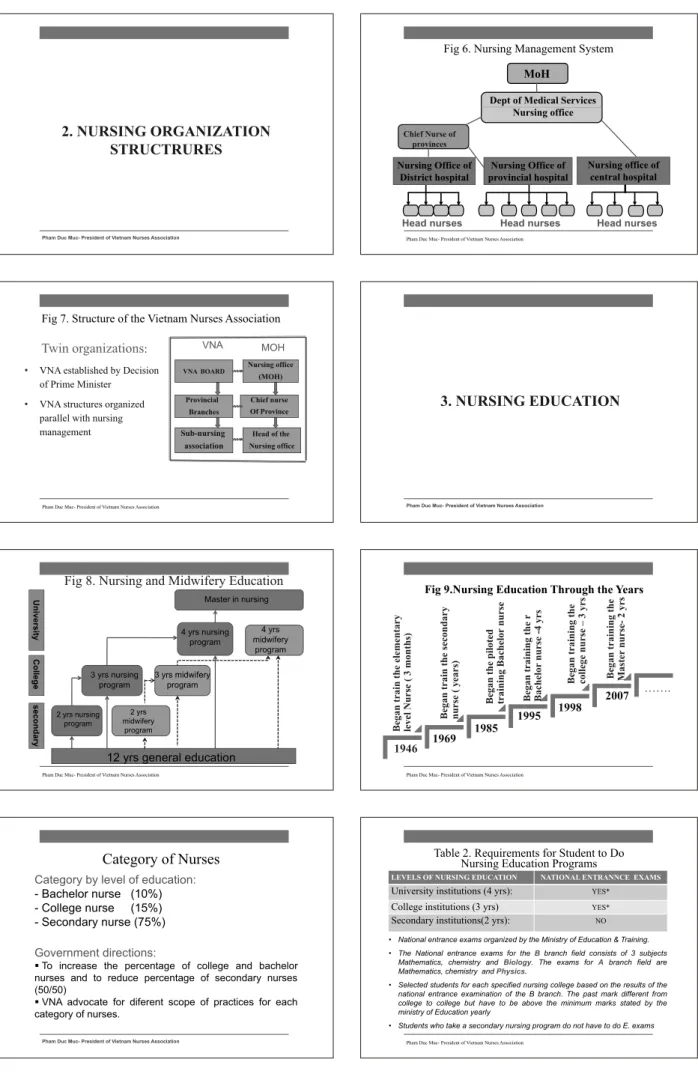
第二部「ベトナムにおける看護関連組織」として,医 療省医療サービス局看護課5)から各地区レベルの病院の
看護部の看護師長に至る,トップダウンの官僚的組織が 示された.また,ベトナムにおける医療省医療サービス 局看護課とベトナム看護協会の関連性についても,「双 子」のように二つの組織が相互補完的に活動することが 説明された.
第三部「ベトナムにおける看護教育」として,12年制 教育(日本でいう小学校・中学校・高校)を終えたのち に進学するルートとしては,2 年制,3 年制,4 年制(看 護学士)の養成課程があること,また看護専門教育の期 間が1946年以来徐々に長くなるとともに,高学歴化して いった過程が説明された.現在,ベトナムにおける看護 教育のうち,4 年制課程は全教育機関の10%,3 年制は 15%に過ぎず,75%が 2 年制課程を卒業した者によって 占められている現状が示されたが,同時にベトナム政府 の方針として,今後は 2 年制課程を修了したものと 3 年
制・
4 年制課程を修了した者の割合を50対50にする政策
がとられる予定であることが説明された.
次に看護師になるための入学試験制度について説明が なされた.3 年制,4 年制の看護師養成課程に進学する ためには,ベトナムの全国入学試験を受ける必要がある.
看護師養成課程の入学試験には,数学,化学,生物学が 含まれている.
次に看護師養成課程毎に,課程修了までに取得すべき 最低単位数が示された.2 年制課程は98単位,3 年制課 程は160単位,4 年制課程は202単位となる6).また 4 年 制課程における卒業までの最低取得単位が,一般教育
(45単位),専門科目(計157単位)以上であることが示 された.また,日本と顕著に違う授業内容として,一般 教育において「マルクス・レーニン主義の基礎」「ホー チミン思想」「ベトナム共産党革命理論」等の項目が 入っていることが示された.
なお発表に使われた英文のパワーポイントと発表原稿
(原文:英語)については資料 1 ,資料 2 を参照されたい.
<おわりに>
講演において示されたベトナムの看護カリキュラムの 単位数は,一単位を45分と換算する.日本は,一単位90 分と換算する.ただし,社会制度や文化的背景の異なる 複数の国の看護カリキュラムの比較は,その国における 看護の社会的地位やニーズを反映しているため,単に授 1 )インドネシアおよびフィリピンからの看護師・介護福祉士候補者は,来日前に 6 か月,来日後 6 か月の日本語研
修を行う枠組になっている(図 1 ).
2 )JVEPAは二国間政府の事業ということもあり,ベトナム側の研究カウンターパートについては,ベトナム政府側 の推薦を必要とする.今回はベトナム看護協会が研究カウンターパートとなっている.
3 )ベトナム医療省発行の基礎看護学テキストより.
4 )人口 1 万人あたりの看護師及び助産師数は 9.35(Ministry of Health, 2012)であり,その数は全国で2012年推計 で約13万人とされる(General Statistics Office).
5 )日本の厚生労働省医政局看護課に相当.
6 )日本の看護師養成機関(大学等)の指定規則(保健師助産師看護師学校養成所指定規則)では97単位.実際には 日本の看護系大学では,120 ~ 130単位で運用しているところが多い.
業単位数のみならず,どの科目を,誰がどのように教え るかというように,多面的複層的に検討する余地がある と思われた.今回のベトナム看護協会長の受入れをきっ
かけとして,今後より日本とベトナム側の研究が進展す るように努め,両国にとってWin-winとなるJVEPAの 運営に資する基礎的なデータを提供していきたい.
資料1
NURSING EDUCATION IN VIETNAM
Presented by Mr. Pham Duc Muc, President of The Vietnam Nurses Association
February 19, 2014 at Nagasaki University
My name is Pham Duc Muc, the president of Vietnam Nurses Association (VNA). I am very pleased to have
an opportunity to visit your very beautiful City of Nagasaki and your Medical College one of the oldest college in Japan.
As you know, the relationship between Vietnam and Japan has developed in various fields including medical and
nursing field. In December 2008, the Government of Vietnam and Japan signed Economic Partnership Agreement (EPA). This is a comprehensive bilateral agreement that will boost economic cooperation and investment between the two countries. As part of the agreement, Vietnam started to send nurses to Japan to learn nursing and to work in health care facilities in Japan for certain years before coming back to Vietnam.
The VNA is very happy to collaborate with Prof. Yuko Ohara-Hirano and Nagasaki University to do research
that facilitate the selection, preparation and sending Vietnamese outstanding nurses to learn and to work in Japan.
I would like to take this opportunity to express my sincerely thanks to Nagasaki University for the opportunity
to present to you the basic information about nursing and nursing education in Vietnam.
In my presentation today, I would like to share with you the following contents:
1. Basic health information in Vietnam 2. Nursing organization Structures in Vietnam 3. Nursing education in Vietnam
1. Basic health information in Vietnam
< Fig 1 >
Fig 1 shows the hospital system in Vietnam managed by 3 hierarchy level of management (Ministry of Health
(MOH), Provincial Health Bureau and District Health Bureau) with
3 referral level hospitals. There are 610district hospitals with number of beds accounts for
34.9% of total national beds; 414 provincial hospitals withnumber of beds accounts for 50.1% and 39 central hospitals with number of beds accounts for 11.3%.
The country has 1063 hospitals, among those, there are 132 private hospitals accounts for 12.4% of all hospitals and private hospital beds accounts for only 4.1% of total national beds.
< Table 1 >
Compared to countries with the same GDP(Gross Domestic Product) per capita, Vietnam is considered to
have fairly good health outcomes. Currently, the size of population was 89.5 million (2012), life expectancy at birth
has increased dramatically. It was 73.6 years in 2012. Health care insurance coverage national wide was 63% and
expected to be 100% of coverage by 2020. HIV/AIDS prevalence rate (general population) was <0.3%
< Fig 2 >
Vietnam is burden by both communicable and none communicable diseases. The non-communicable diseases
are on rise with diseases such as hypertension, and diabetics. The communicable diseases have been reducing through the years but still threaten the health of people. Death caused by accidents and poisoning is still the concern of the health of the people.
< Fig 3 >
The maternal mortality rate has reduced from 233.0 per 100,000 live birth in 1990 to 68.0(2010).
< Fig 4 >
The under 5 mortality rate has fallen from 42.0 per 1,000 live births in 2000 to 23.8 in 2010.
< Fig 5 >
The infant mortality rate has reduced from 30.0 per 1,000 live births in 2001 to 15.8 (2010) and expected to
reduce to 14 by 2015.
Key reasons for achievements include: economic growth; a stable socio-political environment; strong commitments by the government to achieve development and socioeconomic goals, including health goals, and the strategy on poverty reduction and hunger eradication.
2. Nursing Organization Structures
< Fig 6 >
At the MOH, the nursing office is under the Medical Service Department which is responsible for hospital
services throughout Vietnam.
In each of the province, there is a chief nurse position that is responsible to coordinate the nursing care activities in the province and report to Nursing Office of MOH.
In each hospital, there is a nursing office led by a senior nurses. The nursing office is responsible to organize
patient care and staff development. Under the nursing office of the hospital, there is a head nurse in each patient unit. The head nurse of the ward is responsible to organize patient care and unit resources
< Fig 7 >
VNA and MOHʼs nursing management system is considered twin brothers which supplements each other.
VNA has parallel structures with nursing management system in Vietnam. VNA has very important role in advocating for nursing policies, nursing education & practices.
3. Nursing Education
< Fig 8 >
The compulsory education in Vietnam is 12 years. There are 3 level of nursing education (secondary nursing
education is 2 years, college nursing education is 3 years and university nursing education is 4 years).
There is a bridging program to link secondary to college and from college to University nursing program. The
highest level of nursing education in Vietnam is at the master level. Nursing education separate from midwifery education
< Fig 9 >
In 1946, the first nursing course stated at primary level, the length of training was 3 months. In 1969, the
secondary nursing program stated. The length of education was 2 and half years. In 1985, the bridging nursing
program link from secondary to university nursing training stated as a pilot program and 10 years later, the regular
nursing education at university level has started in 1995. In 1998, the first regular college nursing education has
started. Currently, most of nursing training program are at college level.
< Category of Nurses >
There are 3 categories of nurses (secondary, college and university). The secondary level nurse forms the
majority group which accounts for 75%. The college and bachelor levels take only 25%. The Governmentʼs direction is to increase number of nurses at college and university levels, up to 50% of the portion of nurses. Currently, the scope of practices between each level nurses are not clearly defined. VNA is acting to advocate for VNA advocate for different scope of practices for each category of nurses.
< Table 2 >
Students who want do nursing education at the college and university levels have to seat for national exams
to be selected to nursing education field. National entrance exams organized by the Ministry of Education &
Training. The National entrance exams for the B branch field consists of
3 subjects Mathematics, Chemistryand Biology. The exams for A branch field are Mathematics, Chemistry and Physics.Selected students for each specified nursing college based on the results of the national entrance examination of the B branch. The cut-off- point of the entrance exams differ from college to college but have to be above the minimum scores stated by the ministry of Education every year.
< Length of Nursing Education >
The length of nursing education differs by level of education.
Bachelor of nursing program –
4 years: 202 credits, excluding 5 credits for Physical training and 11 credit forMilitary training. College nursing program – 3 years: 160 credits, excluding 5 credits for Physical training and
11 credit for Military training. Secondary nursing program – 2 years: 98 credits, excluding 5 credits for Physicaltraining and 11 credit for Military training.
< Table 3 >
The frame curriculum is a national standardized program which was approved by the Ministry of Education.
The curriculum is divided by two parts: first, General Education, and second, Professional Education.
General education is completed with 45 credits; Professional nursing education is completed with 157 credits. The professional nursing education is divided into basic medical sciences and professional nursing education.
< Table 4 >
The subjects of general parts are fixed and compulsory for all fields of education in Vietnam. The General
Education subjects includes: Politics, Physical education, Foreign language, Informatics, and Military training.
< Table 5-6 >
For the professional education, a total of 19 subjects are included: Medical statistics, Chemistry, Biology-
genetics, Physical-biology, Research, Medical psychology-Medical ethics, Anatomy, Physiology, Biochemistry, Bacteriology, Parasitology, Pathology-Immunology, Pharmacology, Health education and behavior, Nutrition- dietetics, Environmental health, Epidemiology, Law and medical organization, and Traditional medicine.
< Table 7-8 >
For professional nursing education, a total of 19 subjects are included: Communication skills, Health education,
Fundamental nursing (1), Fundamental nursing (2), Infection control, Adult nursing care I, Adult nursing care II, Emergency & ICU nursing care, Elderly nursing care, Surgical nursing care I, Surgical nursing care II, Maternal health-family health and nursing care, Child health care, Nursing care of patient with infectious diseases, Mental nursing care, Rehabilitation, Community nursing, Nursing administration, and Field practice
< Fig 10 >
After completing the nursing education program and obtaining diploma or degree, newly graduated nurses
have to do a 9 month practical training prior the service. After having a 9 month practical training, nurses can apply for license through MOH or provincial health bureau. The license is a lifelong but nurse have to provide evidence of CME (Continuing Medical Education) /CPD (Continuing Professional Development) equally to
24hours per year. Those nurses who do not meet CME requirements, their licenses be withdrawn.
Thank you for your listening!
資料 2
NURSING EDUCATION IN VIETNAM
Pham Duc Muc RN, MPH President of Vietnam Nurses Association
1.BASIC HEALTH INFORMATION
Pham Duc Muc- President of Vietnam Nurses Association
44.4
30.0 24.8
21.0
18.0 17.8 16.0 16.0 15.0 16.0 15.8 14.0
0 5 10 15 20 25 30 35 40 45 50
1990 2001 2002 2003 2004 2005 2006 2007 2008 2009 2010 2015 goal
Infant deaths per 1000 live births
Infant mortality rate
Pham Duc Muc- President of Vietnam Nurses Association
Fig 5. Basic Health Information
Pham Duc Muc- President of Vietnam Nurses Association
Vietnam Hospital System
Ministry Of Health
Provincial Health Bureau
District health Bureau
39 hospitals, 20,924 beds (11.3%) 414 hospitals, 92,857
beds (50.1%)
610 hospitals;
64,620 beds (34.9%) 10834 stations, 4903 beds (3.7%) Level 3: Centre
Level 2: Provinces
Level 1: District & Branches
Communal Health Station
Fig 1.Basic Health Information Table 1. Basic Health Information
INDICATORS 2010 2012
Population size (million people) 86.9 89.5
Average life expectancy (yrs.) 72.9 73.6
Maternal mortality ratio (p 100.000 live births) 68.0 62.0 Infant mortality rate (p 1000 live birth) 15.8 14.6 Under five mortality rate ( per 1000 live births) 23.8 21.1 Under five child malnutrition rate (under weight) % 18.0 16.0 HIV/AIDS prevalence rate (general population) % <0.3 <0.3
Pham Duc Muc- President of Vietnam Nurses Association
Diseases pattern - Yearly health statistic, 2009
Communicable
diseases None
communicable diseases
Accidents and poison
Fig 2. Basic Health Information
233.0
130.0
91.0 85.0 85.0 80.075.1 75.0 75.0 69.0 68.0 58.3
0 50 100 150 200 250
1990 2001 2002 2003 2004 2005 2006 2007 2008 2009 2010 goal2015
MDG Maternal mortality per 100,000 live births
Maternal mortality rate
Pham Duc Muc- President of Vietnam Nurses Association
Fig 3. Basic Health Information
Pham Duc Muc- President of Vietnam Nurses Association
Vietnam Hospital System
Ministry Of Health
Provincial Health Bureau
District health Bureau
39 hospitals, 20,924 beds (11.3%) 414 hospitals, 92,857
beds (50.1%)
610 hospitals;
64,620 beds (34.9%) 10834 stations, 4903 beds (3.7%) Level 3: Centre
Level 2: Provinces
Level 1: District & Branches
Communal Health Station
Fig 1.Basic Health Information
58.0
42.0 35.0 32.8
28.5 27.5 26.0 25.9 25.5 25.0 23.8
19.3
0 10 20 30 40 50 60 70
1990 2001 2002 2003 2004 2005 2006 2007 2008 2009 2010 2015 goal
Under 5 mortality rate per 1000 live births
Pham Duc Muc- President of Vietnam Nurses Association
Under 5 mortality rate
Fig 4. Basic Health Information
2. NURSING ORGANIZATION STRUCTRURES
Pham Duc Muc- President of Vietnam Nurses Association
Nursing office Dept of Medical Services
MoH
Nursing Office of District hospital
Head nurses Chief Nurse of
provinces
Nursing Office of
provincial hospital Nursing office of central hospital
Head nurses Head nurses
Pham Duc Muc- President of Vietnam Nurses Association
Fig 6. Nursing Management System
Pham Duc Muc- President of Vietnam Nurses Association
Category of Nurses
Category by level of education:
- Bachelor nurse (10%) - College nurse (15%) - Secondary nurse (75%) Government directions:
To increase the percentage of college and bachelor nurses and to reduce percentage of secondary nurses (50/50)
VNA advocate for diferent scope of practices for each category of nurses.
Table 2. Requirements for Student to Do Nursing Education Programs
Pham Duc Muc- President of Vietnam Nurses Association
LEVELS OF NURSING EDUCATION NATIONAL ENTRANNCE EXAMS
University institutions (4 yrs): YES*
College institutions (3 yrs) YES*
Secondary institutions(2 yrs): NO
• National entrance exams organized by the Ministry of Education & Training.
• The National entrance exams for theBbranch field consists of 3 subjects Mathematics, chemistry andBiology. The exams forA branch field are Mathematics, chemistry andPhysics.
• Selected students for each specified nursing college based on the results of the national entrance examination of the B branch. The past mark different from college to college but have to be above the minimum marks stated by the ministry of Education yearly
• Students who take a secondary nursing program do not have to do E. exams Nursing office
(MOH) Chief nurse Of Province Head of the Nursing office VNA BOARD
Provincial Branches Sub-nursing
association VNA MOH
Twin organizations
:• VNA established by Decision of Prime Minister
• VNA structures organized parallel with nursing management
Fig 7. Structure of the Vietnam Nurses Association
Pham Duc Muc- President of Vietnam Nurses Association
3. NURSING EDUCATION
Pham Duc Muc- President of Vietnam Nurses Association
Fig 8. Nursing and Midwifery Education
Pham Duc Muc- President of Vietnam Nurses Association
secondary
12 yrs general education
2 yrs nursing program
2 yrs midwifery
program
College University
3 yrs nursing
program 3 yrs midwifery program
4 yrs nursing program
4 yrs midwifery
program
Master in nursing Fig 9.Nursing Education Through the Years
Pham Duc Muc- President of Vietnam Nurses Association
1969 1985
1998 1946
1995
2007 …….
Began train the elementary level
Nurse ( 3 months)
Began train the secondary nurse ( years) Began the piloted training Bachelor
nurse
Began training the r Bachelor nurse -4 yrs Began training the college
nurse –3 yrs
Began training the Master nurse-2 yrs
Length of Nursing Education
1. Bachelor nursing program – 4 yrs: 202 credits, excluding 5 credit for Physical training and 11 credit for military training.
2. College nursing program – 3 yrs:160 credits, excluding 5 credit for Physical training and 11 credit for military training.
3. Secondary nursing program – 2 yrs:98 credits, excluding 5 credit for Physical training and 11 credit for military training.
Pham Duc Muc- President of Vietnam Nurses Association
Table 3.Frame Curriculum of Bachelor of Nursing(1)
Structures of the curriculum Credit
1. General education (��教育) 45
2. Professional education(専門教育) 157 Basic medical sciences (基礎専門科目) (44)
Professional education (専門科目) (75)
Additional education(option)(自由選択科目) (22)
Field practices(臨床実習) (06)
Final exams (卒業検定試験及び卒業論文) (10)
Total 202
Table 8.Frame Curriculum of Bachelor of Nursing(6)
Subjects CREDITS
∑ T P
12. Maternal health, family health and nursing care
(母性看護・家族計画) 6 3 3
13. Child health care(小児看護) 6 3 3
14. Nursing care of patient with infectious diseases
(感染症看護) 4 2 2
15. Mental nursing care(精神看護) 4 2 2
16. Rehabilitation(リハビリテーション看護) 3 2 1
17. Community nursing(公衆衛生) 4 2 2
18. Nursing administration(看護管理) 3 2 1
19. Field practice(卒業前実習) 8 0 8
Total 83 40 43
2. PROFESSIONAL EDUCATION (2) Fig 10. Licensing System for Nurses and Midwives in Vietnam
Pham Duc Muc- President of Vietnam Nurses Association
A nine month clinical training program in
hospitals Bachelor Nurse -4 yrs College Nurse – 3 yrs Secondary Nurse- 2yrs
Employment Hospitals
Nursing schools Community
health stations
Application of License for practice to MoH or Provincial H.
Bureau
Education Table 4.Frame Curriculum of Bachelor of Nursing(2)
Subjects ∑
Credit
Theory &
Practices
Theory Practices
Politics 1(マルクス・レーニン主義基礎) 8 8 0
Politics 2 (ホーチミン思想) 3 3 0
Politics 3 (ベトナム共産党革命理論) 4 4 0
Foreign language(外国語) 10 10 0
General informatics(基礎情報科学) 2 1 1
Physical education*(体育) 5
Military–security education*(防衛・公安教育) 11
Total 43 26 1
1. GENERAL EDUCATION(一般教育)
Table 5.Frame Curriculum of Bachelor of Nursing(3)
Subjects ∑ Credit Theory & Practices Theory Practices
1. Medical statistics (医療統計学)
2. Chemistry(化学)
3. Biology and genetics(生物・遺伝学)
4. Physical and Biology(物理・生物物理学)
5. Research (看護科学研究)
6. Medical psychology– Medical Ethics
(医療心理学・医療倫理)
2 2 0
2 2 0
3 2 1
2 2 0
2 2 0
3 3 0
2. PROFESSIONAL EDUCATION 2.1. Basic medical education (19 subjects)
Table 6.Frame Curriculum of Bachelor of Nursing(4)
2. PROFESSIONAL EDUCATION
Subjects Credit
∑ T P
7. Anatomy(解剖学・組織学) 5 3 2
8. Physiology(生理学) 4 3 1
9. Biochemistry(生化学) 4 3 1
10. Bacteriology(微生物学) 3 2 1
11. Parasitology(寄生虫学) 2 1 1
12. Pathology – immmunology(病理学・免疫学) 4 3 1
13. Pharmacology(薬理学) 4 3 1
14. Health education and behavior(健康教育・
健康行動) 2 1 1
15. Nutrition – Dietics(栄養管理) 4 3 1
16. Environment health(環境衛生) 3 2 1
17. Epidemiology(疫学) 3 2 1
18. Law and medical organization(法律・医療機関組織) 3 2 1
19. Traditional medicines(伝統医学) 3 2 1
2.1 Basic medical education (19 subjects)
Table 7.Frame Curriculum of Bachelor of Nursing(5)
Subject CREDITS
∑ T P
1. Communication skills(看護実践におけるコミュニケーションスキル) 4 3 1
2. Health Education(看護実践における健康教育) 3 2 1
3. Fandamental nursing (1)(基礎看護1) 6 3 3
4. Fandamental nursing (2)(基礎看護2) 5 2 3
5. Infection Control(看護実践における感染症対策) 3 2 1
6. Adult nursing care I(成人看護1) 6 3 3
7. Adult nursing care II(成人看護2) 4 2 2
8. Emergency & ICU nursing care(救急看護・集中治療看護) 2 1 1
9. Elderly nursing care(老年看護) 2 1 1
10. Surgical nursing care I(外科看護) 6 3 3
11. Surgical nursing care II(外科看護) 4 2 2
2. PROFESSIONAL EDUCATION(専門共通教育-19科目)
2.2. Professional nursing education (19 subjects)
Thank you for your attention!
Pham Duc Muc- President of Vietnam Nurses Association
International Collaboration Research on Vietnamese Nurses Migration under the JVEPA: Report on the Nursing Organization
and Education System in Vietnam
Yuko Ohara-HIRANO
1, Pham Duc Muc
2, Kaoru FUJISAKI
1Yoshichika KAWAGUCHI
3, Shun OHNO
41 Graduate School of Biomedical Sciences, Nagasaki University 2 Vietnam Nurses Association
3 University of Occupational and Environmental Health 4 Seisen University
Received 31 July 2014 Accepted 24 September 2014