Degradation mechanism of commercial ceramic primer
(市販セラミックプライマーの劣化機構)
日本大学松戸歯学部クラウンブリッジ補綴学講座 青木 直子
(指導:會田 雅啓 教授)
Abstract
The aim of this study was to investigate the bond durability and degradation mechanism of various commercial ceramic primers that are based on γ-methacryloxypropyl trimethoxysilane (γ-MPS) and contain various organic additives. Initially, the bond durability of two bottle-type commercial ceramic primer was evaluated. Secondly, to understand the activation potentials of the carboxyl group in 4-methacryloyloxyethyl trimellitic acid (4-MET) and the phosphate group in 10-methacryloyloxydecyl dihydrogen phosphate (MDP) in inducing the hydrolysis of methoxy group in γ -MPS, effects of the degree of dissociation of acids on the hydrolysis rate of methoxy group in γ-MPS and the adsorption characteristics of γ-MPS on ceramic surfaces were studied using acetic, phosphoric, and hydrochloric acids. Hydrolytic stability of γ-MPS adsorption layer at the resin-ceramic interface was thus examined.
The adherent was a silica-based ceramic block used for computer-aided design/computer-aided manufacturing (CAD-CAM). Two bottle-type four commercial ceramic primers, Clearfil Mega Bond Porcelain Bonding kit (CM), Tokuso ceramic primer (TC), GC ceramic primer (CP), and Porcelain Liner M (PL), were compared with a simplified experimental ceramic primer (TP) that comprised γ-MPS and an inorganic acid (0.05-mol/L hydrochloric acid) but no other organic additives. The specimens for the adhesion test were prepared after a dual-curing type resin cement (Link Max) had adhered to the ceramic surfaces treated with each ceramic primer. The bonded specimens were then stored in water at 37°C for 1 day. Then, the bonded specimens were thermocycled between 5°C and 55°C in water baths for 5000 or 10,000 cycles. The dwell time in each water bath and the transfer time were 60 and 7 seconds, respectively.
The shear bond strength of resin to the ceramic surface was measured under a crosshead speed of 1.0 mm/minute by a conventional testing machine. Thereafter, the fracture mode for each specimen was determined. In addition, the water contact angle on the treated ceramic surfaces was measured before and after tetrahydrofuran (THF) rinsing using a cotton pellet. As a control, the contact angle on the ground ceramic surface was measured without any ceramic primer.
29Si NMR
1
observations of acid-activated γ-MPS and contact angle measurements following ceramic surface silanization were performed. Bond strengths of resin to the silanized ceramic surfaces were measured. Statistical analyses of shear bond strength and contact angle data were performed.
For all samples, thermocycling led to an increase in the frequency of interfacial failure, reflecting reduced mean bond strength of the resin to the treated ceramic surfaces. However, the bond degradation behavior differed among commercial ceramic primers; in particular, PL exhibited different ceramic bond durability from the others. However, the mean bond strength of PL was only 11.8 MPa and over half the specimens exhibited interfacial failure. In contrast, TP provided significantly higher mean bond strength of 17.2 MPa and most specimens exhibited cohesive failure of the ceramic. Furthermore, the contact angle measurements clearly demonstrated that the commercial ceramic primers created a multilayer consisting of γ-MPS species and the organic additives on the ceramic surface.
To investigate the activation potentials of the carboxyl group in 4-MET and the phosphate group in MDP in inducing the hydrolysis of methoxy group in γ-MPS, acetic, phosphoric, and hydrochloric acids were used, because the degree of dissociation of the acidic group of 4-MET or MDP, which has been employed in commercial ceramic primers as an acid component, ranges among the three types of acids selected. Increase in the degree of dissociation of the acid used increased the hydrolysis rate of methoxy group in γ-MPS, but lowered the contact angle to the silanized ceramic surface. Decrease in the contact angle increased the hydrolytic stability of γ-MPS adsorption layer.
29Si NMR spectra showed that the hydrolysis rate of methoxy group in γ-MPS species strongly depended on the degree of dissociation of the acid used. The magnitudes of bond strength before and after thermocycling strongly depended on the acid type. Hydrochloric acid created a more hydrolytically stable γ-MPS bilayer than acetic and phosphoric acids.
2
Introduction
Ceramic is a useful restorative material to meet the increased demand for esthetics and biocompatibility. For a successful restoration and, consequently, greater patient satisfaction
1-3), ceramic prostheses are attached to the abutting tooth using a ceramic primer system and resin cement. Commercial ceramic primer systems typically comprise a silane coupling agent, usually γ-methacryloxypropyl trimethoxysilane (γ-MPS), and an acidic monomer or unpolymerizable organic acid component. The silane coupling agent forms a multilayer on the substrate surface, which consists of a chemisorbed silane layer and a physisorbed silane layer, as reported by Miller et al
4)and Ishida et al
5-7). The former is covalently bonded to the surface, and the latter attaches via hydrogen bond interactions and weaker Van der Waals attractions. Nishiyama et al
8)determined the amount of silane that is chemisorbed onto a colloidal silica surface as a function of the concentration of γ-MPS by quantifying the amount of physisorbed silane that was extracted from the treated silica surface by tetrahydrofuran (THF). The physisorbed silane causes drastic enhancement of the bonding between the resin and silica surface
9).
Thus, commercial ceramic primers generally contain an acidic monomer or unpolymerizable organic acid and methacrylate monomer in addition to γ-MPS to accelerate hydrolysis of the methoxy moiety of the silicone functional group of γ-MPS and to promote bonding with the resin cement, respectively. However, these organic additives could introduce steric hindrance and thus decrease adsorption of the γ-MPS to the ceramic surface and, as a result, compromise the ceramic bond durability. Therefore, we designed a simplified experimental ceramic primer that comprised only γ-MPS and an inorganic acid (hydrochloric acid)
10)without any additives.
Initially, we evaluated the bond durability of a range of commercial ceramic primers and experimental primer (TP) consisting of γ -MPS and 0.05-mol/L hydrochloric acid by measuring the shear bond strength of the resin to the ceramic surface after a different number of thermal cycles.
Further, in order to investigate the adsorption characteristics of the ceramic primers onto the ceramic surface, the water contact angle on the treated ceramic surface were measured before and
3
after THF rinsing. The degradation mechanism of these commercial ceramic primers is discussed by comparing the results obtained with those for TP.
To investigate the activation potential of the acidic group in 4-methacryloyloxyethyl trimellitic acid (4-MET) or 10-methacryloyloxydecyl dihydrogen phosphate (MDP) in inducing the hydrolysis of methoxy group in γ -MPS, two-bottle type of experimental ceramic primers were designed in this study. These primers contained a γ -MPS solution and an activator solution, using three types of acids with different degrees of dissociation — namely, acetic acid, phosphoric acid, and hydrochloric acid. The degree of dissociation of carboxyl group in 4-MET or the phosphate group in MDP is close to that in acetic acid or phosphoric acid. The effect of the degree of dissociation of the acid used on the hydrolysis rate of methoxy group in γ -MPS and the adsorption characteristics of γ -MPS on ceramic surface were examined. Effect of the degree of hydrolysis of methoxy group in γ -MPS on the hydrolytic stability of γ -MPS adsorption layer was examined by measuring the bond strengths of resin to the silanized ceramic surface, before and after thermocycling.
Materials and Methods 1. Materials
1-1. Ceramic adherent
To produce the ceramic plates, silica-based ceramic blocks (GN-1, GC Corporation, Tokyo, Japan, Components by weight: SiO2, 60%; Al2O3, 14%; B2O3, 2%; K2O, 17%; Na2O, 6%; CaO, 1%; and trace amounts of stain, etc.) were used with a computer-aided design/computer-aided manufacturing (CAD-CAM). Samples were cross-sectioned using a diamond saw under a stream of water. The ceramic plates (length, 6 mm; width, 6 mm; thickness, 2 mm) were then embedded in a self-curing resin (Pour Resin, Shofu Inc., Kyoto, Japan). The embedded ceramic plates, with surfaces polished with a sequence of 100-, 600-, and 1000-grit silicone-carbide papers under running water, were used as the adherent.
4
1-2. Commercial ceramic primer
Two-bottle-type commercial ceramic primers, Clearfil Mega Bond Porcelain Bonding kit (CM, Kuraray Medical Inc., Okayama, Japan), Tokuso ceramic primer (TC, Tokuyama Dental Corporation, Osaka, Japan), GC ceramic primer (CP, GC Corporation), and Porcelain Liner M (PL, Sun Medical Co., Ltd., Shiga, Japan), were used. The components of each commercial ceramic primer are summarized in Table 1.
2. Methods
2-1. Preparation of experimental ceramic primers
Experimental two-bottle type ceramic primers contained a γ -MPS (Shin-Etsu Chemical, Tokyo, Japan) solution and an activator solution of different acid concentrations. The γ -MPS solution was prepared by dissolving 50 mg of γ -MPS in 1 mL of ethanol (Wako Pure Chemical Industries, Osaka, Japan). Activator solutions were prepared by dissolving 0.005, 0.01, 0.05, or 0.1 mol/L of acetic, phosphoric, or hydrochloric acid solution in ethanol (50% by volume). The 0.005-, 0.01-, 0.05-, and 0.1-mol/L acetic, phosphoric, and hydrochloric acid solutions were prepared by diluting 0.1 mol/L of acetic acid (Wako Pure Chemical Industries), 0.5 mol/L of phosphoric acid (Kanto Chemical, Tokyo, Japan), or 0.1 mol/L of hydrochloric acid solution (Wako Pure Chemical Industries), respectively, with distilled and deionized water of pH 5.73. Degrees of dissociation of 0.1-mol/L acetic, phosphoric, and hydrochloric acid solutions were 0.016, 0.27, and 1.0 respectively. There, we used the experimental ceramic primer consisting of γ -MPS and 0.05-mol hydrochloric acid as a comparison purpose with four two-bottle type commercial ceramic primers and expressed as TP.
2-2. Silane treatment of ceramic surface
For each commercial primer and designed experimental primer, a single drop of each liquid was collected in a mixing dish and then mixed for 30 seconds. Thereafter, 0.3 mg of the mixed primer was applied onto the ceramic surface. The treated ceramic surface was then left at room temperature for 3 minutes and then air-blown for 60 seconds.
5
2.3. Specimen preparation for adhesion test
A silicone ring mold with a circular hole (internal diameter, 3.2 mm; thickness, 1 mm) was placed on the treated ceramic surfaces. Immediately thereafter, the mold was filled with dual-curing-type resin cement (Link Max). It was irradiated with visible light (Curing Light XL 3000h, 3M-ESPE, Grafenau, Germany) for 20 seconds and the mold was then removed. The bonded specimens were then immersed in water at 37°C. As a control, the resin cement was directly applied to the ceramic surface without any primer treatment (NT).
2-4. Shear bond strength measurement
After 1 day, the bonded specimens were thermocycled between 5°C and 55°C in water baths for 5000 or 10000 cycles to test their durability. The dwell time in each water bath and the transfer time were 60 and 7 seconds, respectively
11). The shear bond strength of the resin to the ceramic surface was measured under a crosshead speed of 1.0 mm/minute using a universal testing machine (TG-5KNi, Minebea Co., Ltd., Nagano, Japan).
2-5. Fracture mode determination
All the failure surfaces were observed under an optical microscope (Eclipse E800M, Nikon Corporation, Tokyo, Japan) under ×10 magnification. The fracture mode for each specimen was classified into one of three fracture types: (1) interfacial failure at the resin–ceramic interface, (2) mixed failure consisting of interfacial failure and cohesive failure of the ceramic, and (3) cohesive failure of the ceramic.
2-6. Measurement of water contact angle
The water contact angle on the treated ceramic surfaces was measured using a Dropmaster Contact Angler (MD100, Kyowa Electronic Instrument Co., Ltd., Tokyo, Japan) before and after rinsing with THF (Wako Pure Chemical Industries, Ltd., Osaka, Japan). Briefly, the treated ceramic plates were immersed in THF and ultrasonicated for 10 minutes. Thereafter, the ceramic surfaces were wiped with a cotton pellet soaked in THF. This procedure was repeated until the water contact angle reached a constant value, indicating complete removal of γ-MPTS and other
6
organics (Table 1) that had been deposited and/or physisorbed on the ceramic surface
6,8). As a control, the water contact angle on a ground ceramic surface without primer treatment was also measured.
2-7. NMR observation
Liquid-state
29Si NMR spectrum of γ -MPS in each mixture of γ -MPS and activator solution (0.05-mol/L acetic, phosphoric, or hydrochloric acid solution) was observed using an EX-270 spectrometer (Jeol, Tokyo, Japan) under these operating conditions: 30° pulse, accumulation time of 240, and repetition time of 21 s. Therefore, hydrolysis time of γ -MPS was approximately 85 min (240 [accumulation time] × 21 s [repetition time]). For the control, it was the NMR spectrum of γ -MPS dissolved in ethanol.
2-8. Statistical analysis
2-8-1 Ceramic bond durability and degradation mechanism of commercial γ -methacryloxypropyl trimethoxysilane-based ceramic primers
The initial bonding strength before thermal cycling was analyzed by one-way ANOVA and Scheffé’s multiple comparison tests. Two-way factorial ANOVA tested if the type of ceramic primer and thermocycling affected the bond strength before and after thermocycling. In addition, the initial contact angle before THF rinsing was also analyzed by ANOVA and Scheffé’s multiple comparison tests. Two-way factorial ANOVA tested if the type of ceramic primer and THF rinsing affected the contact angle. In all analyses, a P< 0.05 was considered statistically significant.
2-8-2. Effect of acid type on the contact angle of a waterdrop to silanized ceramic surfaces
On the next topic, since both shear bond strength and contact angle data did not show normal distribution, the non-parametric statistical method was used for statistical analysis.
All statistical analyses were performed using the statistical package, IBM
SPSS
®Statistics 21 (SPSS-IBM Inc., IL, USA). In both cases, level of statistical significance was set at 0.05.
Contact angle analysis
Kruskal-Wallis test followed by Mann-Whitney U test with Bonferroni correction was used to
7
analyze the following before and after THF rinsing: (1) Effect of acid concentration on contact angle; and (2) Effect of acid type on contact angle. Finally, Mann-Whitney U test was used to analyze the effect of THF rinsing on contact angles in each acid group.
Shear bond strength analysis
Kruskal-Wallis test followed by Mann-Whitney U test with Bonferroni correction was used to analyze the following before and after thermocycling: (1) Effect of acid concentration on shear bond strength; and (2) Effect of acid type on shear bond strength. Finally, Mann-Whitney U test was used to analyze the effect of thermocycling on shear bond strength in each acid group.
3. Results
3-1 Ceramic bond durability and degradation mechanism of commercial γ -methacryloxypropyl trimethoxysilane-based ceramic primers
3-1-1. Bond durability and fracture mode
For the initial bond strength, the statistical analyses showed significant difference between TP consisting of γ -MPS and 0.05-mol/L hydrochloric acid) and the commercial primers, between NT and the other commercial primers, between CP and CM groups, and between TC and CP (P<
0.019). The initial mean bond strengths of the samples treated with the commercial primers ranged from 10.3 to 15.8 MPa. However, notably, the TP samples exhibited the highest initial mean bond strength of 23.3 MPa.
After thermocycling, the PL and TP samples showed only a small change in bond strength, whereas the others showed a considerable reduction (Fig. 1). Two-way ANOVA showed that the type of primer and thermocycling had statistically significant effects (P< 0.0001). Furthermore, the interaction effect between the two factors was also statistically significant (P< 0.0001).
After 5,000 cycles, all CM, TC, and CP samples exhibited interfacial failure (Table 2), whereas all PL specimens exhibited mixed failure even after 10,000 cycles. However, most of the TP specimens exhibited cohesive failure of the ceramic even after 10,000 cycles.
8
3-1-2. Effect of THF rinsing on water contact angle
The mean initial contact angles (before THF rinsing) ranged from 15.1° to 57.0° and differed between the type of ceramic primer applied (Fig. 2). CP samples exhibited the highest initial mean contact angle of 57.0°. Scheffé’s multiple comparison tests after one-way ANOVA showed significant differences in the initial contact angle between TP and all the commercial primers, between NT and the other commercial primers, between PL and the other commercial primers, and between CP and CM and TC (P< 0.024).
After THF rinsing, CP showed a decrease in contact angle, whereas the others showed an increase (Fig. 2). Two-way ANOVA showed that the type of primer and THF rinsing were statistically significant factors (P< 0.0001). The mean contact angles after THF rinsing ranged from 36.0° to 44.3° and differed with the ceramic primer applied. Notably, TP provided the highest mean contact angle. Furthermore, the interaction effect between the two factors (i.e., type of primer and THF rinsing) was also found to be statistically significant (P< 0.0001).
3-2. Effects of degree of dissociation of acid used on hydrolytic durability of ceramic primer 3-2-1. Effect of the degree of dissociation of the acid used on hydrolysis rate of methoxy group in γ -MPS
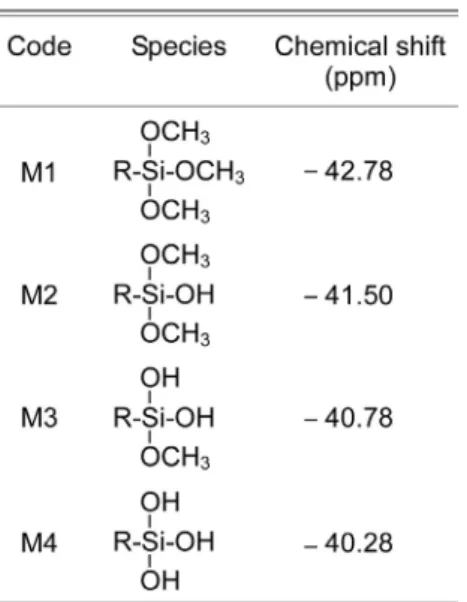
Figure 3 shows the
29Si NMR spectra of γ -MPS in each mixture of γ -MPS and activator solutions: 0.05-mol/L acetic (spectrum B), phosphoric (spectrum C), and hydrochloric acid (spectrum D).
29Si NMR peaks detected in the spectra were assigned based on peak assignments reported in previous studies
12–14). These peak assignments are summarized in Fig. 3.
Addition of acetic acid to γ -MPS solution caused ‘M1’, the NMR peak of unhydrolyzed γ -MPS species [R-Si-(OCH
3)
3], to split into three NMR peaks: ‘M2’, ‘M3’, and ‘M4’.
Dissociated protons produced by acetic acid induced the hydrolysis of methoxy group in γ -MPS.
In contrast, hydrochloric acid showed only NMR peak ‘M4’ of the γ -MPS species whose three methoxy groups had completely hydrolyzed (i.e., R-Si-(OH)
3).
9
Phosphoric acid showed an in-between hydrolysis stage of γ -MPS between acetic and hydrochloric acids. NMR peak ‘M2’ of γ -MPS species, whose one of three methoxy groups had hydrolyzed (i.e., R-Si-(OCH
3)
2(OH)), was still detected in the spectrum.
Hydrolysis rate of the methoxy group in γ -MPS strongly depended on the degree of dissociation of the acid used.
3-2-2. Effect of acid type on the contact angle of a waterdrop to silanized ceramic surfaces
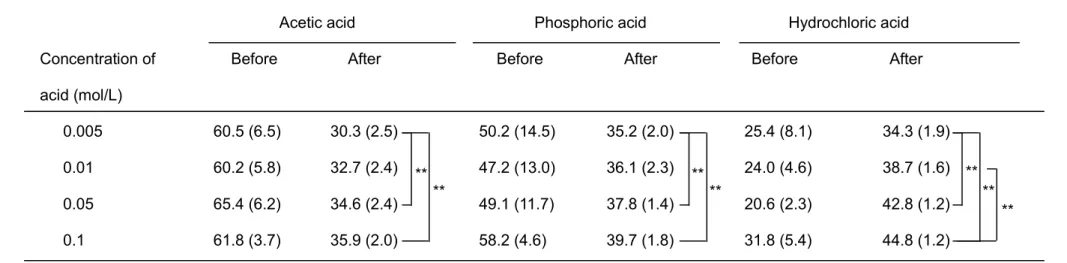
Table 3 shows the contact angles of a waterdrop to the silanized ceramic surfaces, before and after THF rinsing, by varying the concentrations of acetic, phosphoric, and hydrochloric acids.
Figure 4 shows the statistical analysis results of the contact angles obtained.
Before THF rinsing, each acid showed similar contact angles even with increasing acid concentration (Table 3, p>0.05). Acid type significantly affected the contact angles (Fig. 4a), which increased in the order of hydrochloric, phosphoric, and acetic acids (Fig. 4a, p<0.05).
After THF rinsing, contact angles increased with an increase in acid concentration (Table 3).
Acid type significantly affected the contact angles (Figs. 4a and 4b), which increased in the order of acetic, phosphoric, and hydrochloric acids (Fig. 4a, p<0.05).
3-2-3. Effect of acid type on bond strength of resin to silanized ceramic surfaces
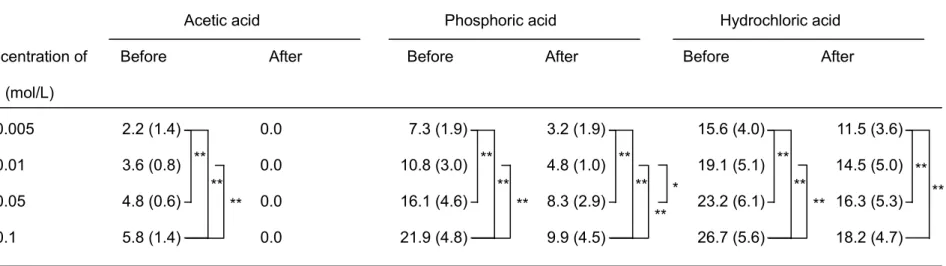
Table 4 shows the bond strengths of resin to the silanized ceramic surfaces, before and after thermocycling, by varying the concentrations of acetic, phosphoric, and hydrochloric acids. Figure 5 shows the statistical analysis results of the shear bond strengths obtained.
With the exception of the bond strength of acetic acid obtained after thermocycling, the bond strengths, obtained before and after thermocycling, increased with an increase in acid concentration (Table 4). Acid type significantly affected the magnitude of bond strength before and after thermocycling (Figs. 5a and 5b, p<0.05). Bond strength increased in the order of acetic, phosphoric, and hydrochloric acids (Figs. 5a and 5b, p<0.05).
As shown in Table 5, an increase in acid concentration before thermocycling, with the exception of acetic acid, tended to increase the incidence of cohesive failure of the ceramic
10
adherend (category 3). In the case of phosphoric acid, thermocycling drastically changed the fracture mode and most specimens exhibited interfacial failure of the resin from the silanized ceramic surface. In the cases of 0.05- and 0.1-mol/L hydrochloric acid solutions, most specimens still exhibited cohesive failure of the ceramic adherend.
Discussion
Initially, the bond durability of four commercial ceramic primers was evaluated by comparing with a simplified experimental ceramic primer (TP) consisting γ-MPS and 0.05-mol/L hydrochloric acid. The results show that for all samples, application of a primer produces a significant increase in the mean bond strength. This is due to adsorption of γ-MPS onto the ceramic surface.
9)However, the mean bond strength and fracture mode differed between the commercial and TP. Specifically, in contrast to the samples treated with the commercial primers, the TP samples exhibited significantly higher mean bond strength of 23.3 MPa and predominantly suffered cohesive failure. This difference may be due to the organic additives in the commercial primers (Table 1).
In addition, the samples treated with the commercial primers exhibited different initial contact angles (before THF rinsing) than those treated with TP. This clearly demonstrates that the organic additives are deposited and/or physisorbed onto the ceramic surface along with γ-MPS.
Furthermore, the contact angles significantly differed among the commercial ceramic primers themselves, since the chemical structure and nature of the organic additives employed differed.
In addition, with the exception of the CP samples, THF rinsing led to an increase in the contact angle for all samples. This is because of the removal of γ-MPS and the other organic additives that had been deposited and/or physisorbed onto the ceramic surface.
Nishiyama et al
15,16)reported that the contact angle obtained after rinsing with a polar solvent increases and then levels off when the γ-MPS concentration in an ethanol aqueous solution is increased, since the amount of γ-MPS that is chemisorbed onto the silica glass increases and then
11
levels off. In the present study, the highest contact angle of 44.3° was observed when TP was applied. This is probably because γ-MPS formed a saturated chemisorption layer on the ceramic surface. Furthermore, the observed lower contact angles with the commercial primers probably indicate a decrease in the amount of chemisorbed γ-MPS. This could be because the organic additives prevent chemisorption of γ-MPS.
Next, with the exception of PL and TP, thermocycling resulted in drastic decreases in the mean bond strength and increases in the frequency of interfacial failure. The observed decreases may be due to the accelerated hydrolytic degradation of the γ-MPS multilayer, since the organic additives in CM, TC, and CP decreased the amount of chemisorbed γ-MPS, as discussed above.
Notably, PL retained a relatively high mean bond strength of 11.8 MPa even after 10,000 cycles. Nevertheless, the number of specimens that exhibited interfacial failure increased to 10 of the 15 samples, as in the case of the other commercial primers. This bond strength was due to the carboxyl group of 4-MET forming more hydrolytically stable hydrogen-bonded interaction with the silanized ceramic surface. However, TP achieved a noticeably higher mean bond strength of 17.2 MPa, and most TP treated specimens exhibited cohesive failure of the ceramic. This is attributed to the lack of interfering organic additives.
Next, to investigate the activation potentials of the carboxyl group in 4-MET and the phosphate group in MDP in inducing the hydrolysis of methoxy group in γ -MPS, acetic, phosphoric, and hydrochloric acids were used, because the degree of dissociation of the acidic group of 4-MET or MDP — which has been employed in commercial ceramic primers as an acid component — ranges among the three types of acids selected.
To understand the effect of the degree of dissociation of the acid used on the hydrolysis rate of methoxy group in γ -MPS,
29Si NMR spectra of γ -MPS activated by acetic, phosphoric, and hydrochloric acids were observed. This is because the chemical shift of
29Si NMR peak is very sensitive to any change of the environment which the silicon atom exists, namely — R-Si-(OCH
3)
3, R-Si-(OCH
3)
2(OH), R-Si-(OCH
3)(OH)
2, and R-Si-(OH)
312-14).
12
29
Si NMR spectra showed that the hydrolysis rate of methoxy group in γ -MPS species strongly depended on the degree of dissociation of the acid used. Phosphoric acid showed an in-between hydrolysis stage of γ -MPS between acetic and hydrochloric acids, since the
29Si NMR peak ‘M2’
assigned to R-Si-(OCH
3)
2(OH) was still detected in the NMR spectrum.
Contact angle measurements confirmed the NMR analyses. Before THF rinsing, each acid showed similar contact angles even with increasing acid concentration. For each acid, the observed three stages of the contact angles were directly related to the degree of hydrolysis of methoxy group in the γ-MPS species, which was adsorbed on the ceramic surface.
THF rinsing of the silanized ceramic surfaces caused the contact angle of each acid type to change. This was because the γ-MPS species physisorbed as a removable phase was removed from the ceramic surfaces by THF rinsing
8). Observed increases in the contact angle to THF-rinsed ceramic surface, with an increase in acid concentration, might be due to an increase in the quantity of γ-MPS species chemisorbed on the ceramic surface. Incidentally, chemisorption was limited by the production of hydrolyzed γ-MPS species
8). Therefore, analysis of the contact angles before and after THF rinsing clearly suggested the following: (1) γ-MPS created a bilayer, comprising both chemisorbed and physisorbed γ-MPS species, on the ceramic surface; and (2) one part of γ-MPS species, which was deposited on the ceramic surface, was chemisorbed on the ceramic surface to create a monolayer during the silanization process of 4.5 min.
To understand which parameter controlled the hydrolytic stability of the γ-MPS bilayer created on the ceramic surface, bond strength measurements were performed before and after thermocycling. Thermocycling decreased the bond strength and changed the fracture mode to interfacial failure type in each experimental group, since the γ-MPS bilayer was hydrolyzed.
However, the magnitudes of bond strength before and after thermocycling strongly depended on the acid type. Hydrochloric acid created a more hydrolytically stable γ-MPS bilayer than acetic and phosphoric acids. This was probably because hydrochloric acid provided a sufficient amount of dissociated protons to induce the hydrolysis of methoxy group in γ -MPS during the silanization
13
process of 4.5 min, as compared with acetic and phosphoric acids. The hydrolytic stability of γ -MPS bilayer strongly depended on the degree of hydrolysis of the methoxy group in γ -MPS.
From the above results, we concluded that the poor hydrolytic stability which commercial 4-MET- or MDP-activating ceramic primers has exhibited may be due to the poor potential of the acid group in 4-MET or MDP to activate the methoxy group in γ -MPS, as in the case of poor activation potentials exhibited by acetic and phosphoric acids.The bond durability of resin cement to the silanized ceramic surface is strongly dependent on the degree of hydrolysis of the methoxy group in the γ -MPS species that has created a bilayer onto the ceramic surface.
Further, the organic additives besides γ-MPS in commercial ceramic primers, such as acidic monomer or unpolymerizable organic acids and methacrylate ester monomers, decrease cohesion in the γ-MPS multilayer on the ceramic surface and, as a result, decrease both the initial ceramic bond strength and durability over time.
Acknowledgements
First and foremost, I would like to show my deepest gratitude to my doctoral supervisor, Prof.
Masahiro Aida (Department of Crown Bridge Prosthodontics, Nihon University School of Dentistry at Matsudo) who has provided me with valuable guidance in every stage of the writing of this article. Without his instruction, kindness and patience, I could not have completed my article. I shall extend my thanks to Prof. Norihiro Nishiyama (Department of Dental Biomaterials) for the reviewal and suggestions.
References
1. Christensen JC. Porcelain-fused-to-metal vs. nonmetal crowns. J Am Dent Assoc 1999;
130:409-411
2. Stewart GP, Jain P, Hodges J. Shear bond strength of resin cements to both ceramic and dentin. J Prosthet Dent 2002;88:277-284.
14
3. Reich S, Wichmann M, Nkenke E, Proeschel P. Clinical fit of all-ceramic three-unit fixed partial dentures, generated with three different CAD/CAM systems. Eur J Oral Sci 2005;113:174-179.
4. Miller JD, Hoh K, Ishida H. Studies of the simulation of silane coupling agent structures on particulate fillers: The pH effect. Polym Eng Sci Polym Comp 1984;5:18-28.
5. Ishida H, Miller JD. Substrate effects on the chemisorbed and physisorbed layers of methacryl silane modified particulate minerals. Macromolecules 1984;17:1659-1666.
6. Ishida H, Miller JD. Cyclization of methacrylate-functional silane on particulate clay. J Polym Sci Ploy Phys ED 1985;23:2227-2242.
7. Ishida H. Structural gradient in the silane coupling agent layers and its influence on the mechanical and physical properties of composites. Polym Sci Technol 1985;27:25-50.
8. Nishiyama N, Shick R, Ishida H. Adsorption behavior of a silane coupling agent on colloidal silica studied by gel permeation chromatography. J Colloid and Interface Sci 1991;143:146-156.
9. Nishiyama N, Horie K, Shick R, Ishida H. Influence of adsorption behavior of a silane coupling agent onto silica on visco-elastic properties. Polymer Communications 1990;31:380-384.
10. Li R. Development of a ceramic primer with higher bond durability for resin cement. J Oral Rehabil 2010;37:560-568.
11. Gale M.S, Darvell B.W. Thermal cycling procedures for laboratory testing of dental restorations. J Dent 1999;27:89-99.
12. Nishiyama N, Horie K, Asakura T. Hydrolysis and condensation mechanisms of a silane coupling agent studied by 13C and 29Si NMR. J Appl Polym Sci 1987; 34: 1619–1630.
13. Nishiyama N, Horie K, Shick R, Ishida H. Adsorption behavior of a silane coupling agent onto a colloidal silica surface studied by 29Si NMR spectroscopy. J Colloid and Interface Sci 1989; 129: 113–119.
14. Goto H. Aging effect of one bottle-type ceramic primer on bonding efficacy of resin cement.
15
J Jpn Prosthodont Soc 2008; 52: 107–116.
15. Ishida S, Nishiyama N. Study on surface treatment of silica filler. Hydrolytic deterioration of the silane coupling layer. J J Dent Mater 1989;8:601-607.
16. Nishiyama N. Studies on behavior of silane coupling agent at the interface of silica/methacrylic resin. J J Dent Mater 1986;5:519-528.
16
Table 1 Components of each commercial ceramic primer as per the manufacturer
Commercial ceramic primer Components Abbreviation
Clearfil Mega Bond Porcelain Bonding kit CM
Clearfil Mega Bond Primer MDP, HEMA, Purified water, Others Clearfil Porcelain Bond Activator Silane coupling agent,
Methacrylate ester monomer, Others
Tokuso ceramic primer TC
Liquid A γ-Methacryloxypropyl trimethoxysilane, Ethanol
Liquid B Phosphoric acid ester monomer, Ethanol
GC ceramic primer CP
Liquid A Vinyl silane, Ethanol,
Liquid B Phosphoric acid ester organic compound,
Methacrylate ester monomer, Ethanol
Porcelain Liner M PL
Liquid A 4-META, MMA, Others
Liquid B Silane coupling agent, MMA, Others
MDP: 10-methacryloyloxydecyl dihydrogen phosphate HEMA: 2-hydroxyethyl methacrylate
4-META: 4-methacryloyloxyethoxycarbonylphthalic anhydride MMA: methyl methacrylate
17
Table 2 Fracture mode [1/2/3] before and after thermocycling Before thermocycling After thermocycling
5000 cycles 10,000 cycles Non-treated
NT [15/0/0] [15/0/0] [15/0/0]
Treated
CM [1/1/13] [15/0/0] [15/0/0]
TC [0/1/14] [15/0/0] [15/0/0]
CP [8/4/3] [15/0/0] [15/0/0]
PL [0/1/14] [9/2/4] [10/1/4]
TP [0/0/15] [0/0/15] [0/2/13]
[1/2/3]: 1, Interfacial failure at the resin-ceramic interface; 2, mixed failure consisting of interfacial failure of the resin and cohesive failure of the ceramic; 3, cohesive failure of the ceramic.
18
Table 3 The contact angles (degree) of a waterdrop to the silanized ceramic surfaces, before and after THF-rinsing, by varying the type of acid used and its concentration.
Acetic acid Phosphoric acid Hydrochloric acid
Concentration of Before After Before After Before After
acid (mol/L)
0.005 60.5 (6.5) 30.3 (2.5) 50.2 (14.5) 35.2 (2.0) 25.4 (8.1) 34.3 (1.9)
0.01 60.2 (5.8) 32.7 (2.4) 47.2 (13.0) 36.1 (2.3) 24.0 (4.6) 38.7 (1.6)
0.05 65.4 (6.2) 34.6 (2.4) 49.1 (11.7) 37.8 (1.4) 20.6 (2.3) 42.8 (1.2)
0.1 61.8 (3.7) 35.9 (2.0) 58.2 (4.6) 39.7 (1.8) 31.8 (5.4) 44.8 (1.2)
Before: Before THF-wiping After: After THF-wiping ( ):SD
*: p<0.05
**: p<0.01 N=10
**
** ** ** **
** **
19
Table 4 Τ he bond strengths (MPa) of resin to the silanized ceramic surfaces, before and after thermocycling, by varying the type of acid used and its concentration.
Acetic acid Phosphoric acid Hydrochloric acid
Concentration of Before After Before After Before After
acid (mol/L)
0.005 2.2 (1.4) 0.0 7.3 (1.9) 3.2 (1.9) 15.6 (4.0) 11.5 (3.6)
0.01 3.6 (0.8) 0.0 10.8 (3.0) 4.8 (1.0) 19.1 (5.1) 14.5 (5.0)
0.05 4.8 (0.6) 0.0 16.1 (4.6) 8.3 (2.9) 23.2 (6.1) 16.3 (5.3)
0.1 5.8 (1.4) 0.0 21.9 (4.8) 9.9 (4.5) 26.7 (5.6) 18.2 (4.7)
Before: Before thermocycling After: After thermocycling ( ): SD
*: p<0.05
**: p<0.01 N=15
*
**
** **
**
** **
**
** **
**
**
** **
**
20
Table 5 Type of fracture mode (Category: [1/2/3]) of the bonded specimens, before and after thermocycling, by varying the type of acid used and its concentration.
Acetic acid Phosphoric acid Hydrochloric acid Concentration of acid Before After Before After Before After
0.005 mol/L [15/0/0] [15/0/0] [14/1/0] [15/0/0] [6/5/4] [7/7/1]
0.01 mol/L [15/0/0] [15/0/0] [8/6/1] [15/0/0] [3/4/8] [6/5/4]
0.05 mol/L [15/0/0] [15/0/0] [6/3/6] [13/2/0] [0/0/15] [0/2/13]
0.1 mol/L [15/0/0] [15/0/0] [0/1/14] [10/4/1] [0/0/15] [0/2/13]
Before: Before thermocycling After: After thermocycling
[1/2/3]: Category 1: an interfacial failure at the resin-ceramic interface; Category 2: Mixed failure consisting of an interfacial failure and a cohesive failure of the ceramic; Category 3: a cohesive failure of the ceramic.
21
Figure 1
Figure 1 Shear bond strength of the resin ceramic to the ceramic surface with and without silane treatment as a function of number of thermal cycles. N=15
Black square: CM; White rhombus: TC; White triangle: CP; White square: PL; White circle: TP:
Double circle: non-treated (NT). Error bar shows SD.
22
Figure 2
Figure 2 Water contact angle on the ceramic surface with and without silane treatment before and after THF rinsing. N=5
Black square: CM; White rhombus: TC; White triangle: CP; White square: PL; White circle: TP:
Double circle: non-treated (NT). Error bar shows SD
23
Figure 3
Figure 3
29Si NMR spectra of γ -MPS in each mixture of γ -MPS and activator solutions, and the assignments of
29
![Table 2 Fracture mode [1/2/3] before and after thermocycling Before thermocycling After thermocycling](https://thumb-ap.123doks.com/thumbv2/123deta/6013231.2072029/19.892.110.605.124.396/table-fracture-mode-thermocycling-thermocycling-thermocycling.webp)
![Table 5 Type of fracture mode (Category: [1/2/3]) of the bonded specimens, before and after thermocycling, by varying the type of acid used and its concentration](https://thumb-ap.123doks.com/thumbv2/123deta/6013231.2072029/22.892.85.845.166.418/table-fracture-category-bonded-specimens-thermocycling-varying-concentration.webp)