Abstract
The aim of this work is to present results of a survey aimed to examine how Japanese junior high school students feel towards learning mathematics. To accomplish this purpose, this study - part of an ongoing project - was carried out on 616 students at a public junior high school in a country city. Five point Likert scale type questionnaire to assess their feelings was conducted. The results showed that the percentage of student feelings of ‘difficulty’ was larger than feelings of ‘good at’. Another finding was that the proportion of feeling of ‘difficulty’ was larger among women than men.
Keywords
mathematical education, feelings of ‘difficulty’, feelings of ‘good at’, gender difference, Japanese junior high school students
1 INTRODUCTION
Japanese junior high school students learn nine subjects such as mathematics, Japanese language, and English language in the course of three-year junior high school 1. Students experience learning through the processes of watching, listening, speaking, and understanding in their daily learning activities. During these phases, students establish their favorite and weak subjects according to their preferences, motivations, feelings, personal characteristics, and fields of interest.
Now, in Japan, English education for all Japanese people from children to adults is becoming more and more popular, in which the goal is to develop human resources to play an important role in the international community 2.
In particular, elementary and secondary school education, foreign language (substantially English language) became compulsory in lower secondary (junior high school) education in April 2002 3. Moreover, ‘foreign language activities’ were introduced in elementary school
A Comparative Study of the Feelings of ‘difficulty’
and ‘good at’ towards Learning Mathematics among Japanese Junior High School Students
Tomoko Nishikawa and Giido Izuta
in April 2011 4. The curriculum is established by the ‘courses of study’, which is designed by the Japanese Ministry of Education, Culture, Sports, Science and Technology (Monbu Kagaku Sho) and updated every ten year or so. In the forthcoming ‘courses of study’ which will be implement in 2020, English language will be compulsory at elementary school 5. On the other hand, the increasing number of Japanese young people avoiding mathematics has been a national problem since a few decades ago. As mathematics is the foundation of the current science and technology, there is a need to take urgent measures to refrain young students from avoiding mathematics.
There are many studies targeted at junior high school students in mathematics education in Japan, these are investigating the ‘like’ and ‘dislike’ of the junior high school students towards mathematics 6, 7, 8, 9, 10. Senuma and Nagasaki made a six-year follow-up of the same student from the fifth grade of elementary school, and reported the transformation of the
‘like’ and ‘dislike’ towards mathematics 11. Nishikawa and Izuta examined the time when Japanese junior high school students begin to feel difficulty towards mathematics, and found differences in gender 12.
Moreover, Izuta and Nishikawa took advantage of conjoint analysis to study Japanese junior high school students, in which the ‘good at’ and ‘not good at’ awareness regarded to the learning area of the junior high school mathematics 13. There they described the characteristics of the differences due to gender from the first grade to the third grade of junior high school. Note that the authors also carried out studies using factor analysis in the survey 14. Furthermore, the authors proposed the usefulness of the conjoint analysis and factor analysis as a tool for metacognitive study by means of this ‘good at’ and ‘not good at’
survey related to mathematics in junior high school 15. It is worth noting that there are also investigations of feelings towards learning school subjects other than mathematics. In fact, in terms of junior high school student's awareness of ‘difficulty’ towards leaning language, Izuta and Nishikawa examined the students’ sense towards English language education, and reported the results 16. In addition, there is a report on the sense of Japanese female college student in relation to the information processing literacy learning 17.
The aim of this work is to examine the actual condition of Japanese junior high school student’s feelings towards learning mathematics, and report on the results obtained from our work.
Finally, the paper is organized as follows: the methods are given in section 2; the results in
section 3; and the discussions in section 4.
2 METHODS
2.1 Participants
Participants were all junior high school students from grades 1 to 3 of a public school located in a country city of Niigata Prefecture in Japan. A total number of 616 students participated in this study: 289 were male and 327 female, in which 182 were in first grade, 212 in second grade, and 222 in third grade. Thus, the ages ranged from 12 to 15 years old.
Three participants (two men and one woman) failed to respond correctly to the questions so their data was not included in the analyses.
2.2 Materials
The questionnaire was designed to measure the degree of difficulty that students feel towards learning mathematics. The questionnaire comprised one single question, which was
“How do you feel towards learning mathematics?”. Participants were asked to respond to this question using a five point Likert scale type defined by ‘difficulty’, ‘a little difficulty’,
‘normal’, ‘reasonably good at’, and ‘good at’.
2.3 Procedure
The survey was carried out at the end of the academic year 2016 in March. Participants responded to the survey during a mathematics class in their usual classroom environment.
There, the students received oral instructions and were given the survey form. Then, they responded to the question voluntarily.
2.4 Data Processing
The data was processed and analyzed manually using Microsoft Excel 2013 on a Microsoft Windows 8.1 computer.
3 RESULTS
3.1 Feelings towards Mathematics Learning
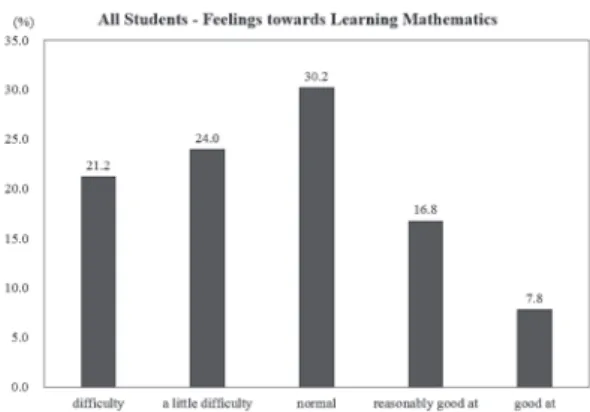
Figure 1 shows the answers of all the students who responded to the survey, which asked them about their feelings towards learning mathematics. It is clear that the largest proportion of feelings was in category ‘normal’ with 30.2%. Interestingly, the category ‘difficulty’ was very similar to ‘a little difficulty’, with just 2.8% difference between the two. The category
‘good at’ had the smallest percentage (7.8%) in overall.
Figure 1. Feelings towards learning mathematics - All students.
The group labeled ‘difficulty group’ which included both ‘difficulty’ and ‘a little difficulty’
category summed up to 45.2%. Thus, the ‘difficulty group’ was close to half of the total. On the other hand, the group labeled ‘good at group’ which contained both categories ‘good at’ and ‘reasonably good at’ summarized 24.6%. Thus, the percentage of students in the
‘difficulty group’ was about 1.8 times greater than the ‘good at group’.
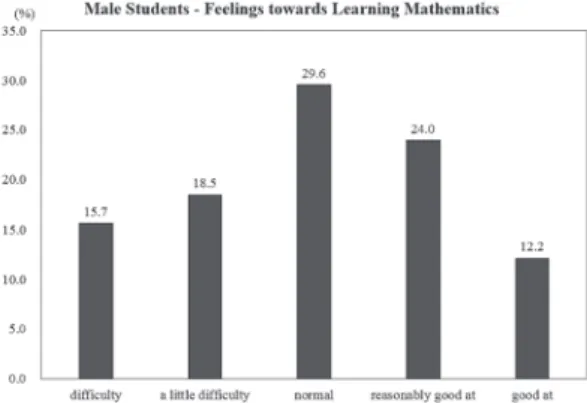
Figure 2 illustrates the result of the survey of male students’ feelings in relation to learning mathematics. It can be seen that the greatest percentage of feelings was on category ‘normal’
with 29.6%. The second largest category was ‘reasonably good at’ at 24.0%.
The group labeled ‘difficulty group’ which contained both categories ‘difficulty’ and ‘a little difficulty’ summed up to 34.2%. The group labeled ‘good at group’ which consisted of both categories ‘good at’ and ‘reasonably good at’ summarized 36.2%. Compared with the group
‘difficulty group’‘good at group’, , and the category ‘normal’, the answers of male students divided the pie chart in three pieces differing in less than 7% when compared pairwise.
Figure 2. Feelings towards learning mathematics - All male students.
Figure 3 shows female students’ responses to the question about how they feel towards learning mathematics. The largest proportion of category ‘normal’ comprised 30.7% of all girls. The second most numerous answers was the category ‘a little difficult’ at 28.8%, then followed by the category ‘difficult’ at 26.1%. It is worth nothing that the category
‘difficulty’ was very similar to ‘a little difficulty’, with just 2.7% difference between the two. Thus, more than half of female students (54.9%) answered they felt either ‘difficulty’ or
‘a little difficulty’ towards learning mathematics, while 10.4% of them considered they were
‘reasonably good at’, and only 4.0% rated themselves as ‘good at’.
The group labeled ‘difficulty group’ which included both ‘difficulty’ and ‘a little difficulty’
categories summed up to 54.9%. Thus, the group ‘difficulty group’ accounted for more than half of the total. On the other hand, the group labeled ‘good at group’, which contained both categories ‘good at’ and ‘reasonably good at’ summarized 14.4%. Thus, the percentage of students in the ‘difficulty group’ was about 3.8 times greater than the ‘good at group’.
Figure 3. Feelings towards learning mathematics - All female students.
3.2 Comparison between the Groups ‘Difficulty’ and ‘Good at’
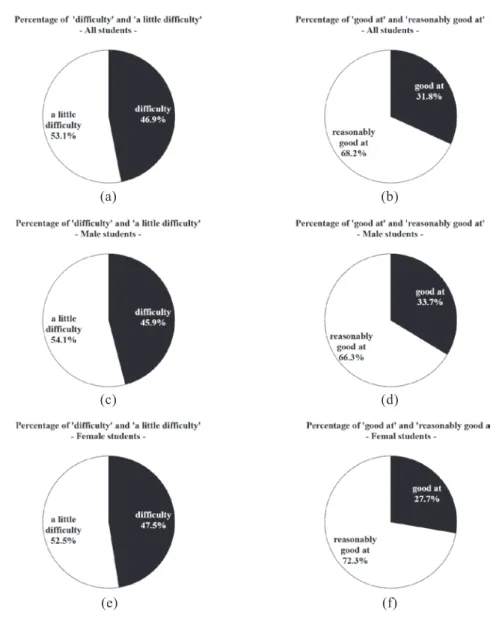
In this section, the percentages of ‘difficulty’ and ‘a little difficulty’, which are drawn in a pie chart, are compared with those of ‘good at’ and ‘reasonably good at’, which are also gathered in a pie chart. Note that these pie charts represents only these two feelings, so that the percentage of ‘difficulty’ is relatively to the total number of answers in the group comprising ‘difficulty’ and ‘a little difficulty’. The same reasoning applies not only to ‘a little difficulty’, but also to the pair composed by ‘good at’, and ‘reasonably good at’.
(a) (b)
(c) (d)
(e) (f)
Figure 4. Percentage of ‘difficulty’ group, ‘good at’ group. (a) All students ‘difficulty’. (b) All students ‘good at’. (c) All male students ‘difficulty’. (d) All male students ‘good at’. (e) All female students ‘difficulty’. (f) All female students ‘good at’.
Figure 4 provides the results for ‘all students’‘all male students’, , and ‘all female students’, from top to bottom respectively. As shown in Figures 4 (a), 4 (c) and 4 (e), it can be seen that all students, all males, and all females had approximately the same percentages for the answers ‘difficulty’ as well as ‘a little difficulty’. In fact, their differences were less than 5%.
In addition, comparing men and women in category ‘difficulty’, females were slightly higher than males, with the difference being 1.6% (Figure 4(c), 4(e)).
Now focusing on Figures 4 (b), 4 (d) and 4 (f), it is also clear that all students, all men, and all women had approximately the same proportion of the answers for ‘good at’, and
‘reasonably good at’ with nearly a third of students responding ‘good at’. In general, the category ‘reasonably good at’ was about twice ‘good at’, and accounted for roughly 70%.
More specifically, the category ‘good at’ of male students comprised 33.7% whereas females 27.7%. Therefore, there was a significant difference between men and women, which was 6.0% (Figure 4(d), 4(f)).
As far as the comparison between category ‘difficulty’ and ‘good at’ is concerned, the percentage of ‘difficulty’ was about 1.5 times higher than ‘good at’ in all students, about 1.4 times for men and about 1.7 times for females.
4 DISCUSSION
The aim of this work was to examine how Japanese junior high school students feel towards learning mathematics. These results represent the perception of students at the time of the survey.
The results suggest that the group ‘difficulty group’ is larger than the ‘good at group’ in overall. Also, comparing men with women, females feel ‘difficulty’ more than males. Indeed, these are in accordance with previous findings 6, 7, 11. From these results, it can be clearly seen that the feeling of junior high school students towards mathematics has not changed during this period time from the previous investigations to our survey, which amounts to about 20 years. Nevertheless ‘Junior High School Teaching Guide for the Japanese Course of Study’
has been revised twice 1, 3 since the earliest report, the results remain almost unchanged.
These indicate that the course of study or methods of instruction of mathematics should be looked into very carefully, and measures should be taken to resolve – or at least improve – the situation.
Focusing on the ‘normal group’ of all students which consists of students who feel ‘normal’,
it had one third of the total of respondents, and similar tendency was seen in women and men. Attention should be paid to the ‘normal group’, in particular first and second year students, because there is a change in their feelings that depend on many factors as unpleasant learning experiences leading them to be part of ‘difficulty’ or ‘a little difficulty’
groups.
5 FINAL COMMENTS
This paper was intended to present only the basic data of our ongoing project. Since these findings are derived from a single case study, further studies are needed to draw a general conclusion.
ACKNOWLEDGMENTS
The authors would like to thank both the students and the teachers of the junior high school in Niigata Prefecture who cooperated with questionnaire investigations. We are also thankful to our school for the financial and resource supports.
REFERENCES
1. MEXT: Ministry of Education, Culture, Sports, Science and Technology. “Junior High School Teaching Guide for the Japanese Courses of Study”. 2008. http://www.mext.go.jp/
a_menu/shotou/new-cs/youryou/chu/index.htm, [accessed Sep 2016].
2. MEXT: Ministry of Education, Culture, Sports, Science and Technology. “Japanese Government Policies in Education, Culture, Sports, Science and Technology 2001”. 2001.
http://www.mext.go.jp/b_menu/hakusho/html/hpab200101/hpab200101_2_317.html, [accessed Sep 2016].
3. MEXT: Ministry of Education, Culture, Sports, Science and Technology. “Junior High School Teaching Guide for the Japanese Courses of Study”. 1998. http://www.mext.go.jp/
a_menu/shotou/cs/1320061.htm, [accessed Sep 2016].
4. MEXT: Ministry of Education, Culture, Sports, Science and Technology. “Elementary School Teaching Guide for the Japanese Courses of Study”. 2008. http://www.mext.go.jp/
a_menu/shotou/new-cs/youryou/syo/index.htm, [accessed Sep 2016].
5. Central Council for Education of MEXT: Ministry of Education, Culture, Sports, Science and Technology. “Jiki Gakusyu Sidou Yoryo tou ni muketa koremadeno singi no matome
ni tsuite (houkoku)”. http://www.mext.go.jp/b_menu/shingi/chukyo/chukyo3/004/
gaiyou/1377051.htm, [accessed Sep 2016].
6. S. Fukaya, S. Sugie, and H. Ohashi. “A Survey of Elementary and Junior High School Students' Attitude and Recognition to Mathematics”. Chukyo University bulletin of the Faculty of Liberal Arts. 1995, vol.36, no.1, p. 243-262.
7. Y. Nirei. “Suugaku ni taisuru chukousei no ishiki: aru chukou ikkan kyouiku no joshikou no chosa kekka kara”. Rigaku senkouka zasshi of Tokyo University of Science, 2000, vol.
42, no.2, p. 39-41.
8. TIMSS & PIRLS International Study Center, Lynch School of Education, Boston College.
“TIMSS 2011 International Results in Mathematics”. 2012. http://timss.bc.edu/timss2011/
international-results-mathematics.html, [accessed Jun 2016].
9. NIER: National Institute for Educational Policy Research. “Summary of Trends in International Mathematics and Science Study 2011”. 2012. http://www.nier.go.jp/
timss/2011/gaiyou.pdf, [accessed Jun 2016].
10. NIER: National Institute for Educational Policy Research. “National Assessment of Academic Ability”. 2015. http://www.nier.go.jp/15chousakekkahoukoku/report/question/, [accessed Jun 2016].
11. H. Senuma and E. Nagasaki. “Sansuu suugaku no toutatsudo to taido no henyo ni kansuru danjo-sa”. Japan Society of Mathematical Education. 1996, Vol.29, p. 145-150.
12. T. Nishikawa and G. Izuta. “Probing When Japanese Junior High School Students Begin to Feel Difficulty in Learning Mathematics”. Proceedings of International Conference on Education, Mathematics and Science 2016 (ICEMS2016). Malaysia. 2016, 6 pages, in press.
13. G. Izuta and T. Nishikawa. “Assessing the Sense of ‘Good at’ and ‘Not Good At’
towards Learning Topics of Mathematics with Conjoint Analysis”. Proceedings of International Conference on Education, Mathematics and Science 2016 (ICEMS2016).
Malaysia. 2016. 6 pages, in press.
14. T. Nishikawa and G. Izuta. “An Assessment of Learning Difficulty Level of Math Class Topics – A Case Study of a Japanese Public Junior High School –”. 2016 Hong Kong International Conference on Education, Psychology and Society (5th HKICEPS). Hong Kong. 2016, 12 pages, in press.
15. G. Izuta and T. Nishikawa. “An investigation of the applicability of conjoint analysis and
factor analysis in a metacognitive study of junior high school students’ feelings of ‘good at’ and ‘not good at’ towards learning mathematics”. Bulletin of Yonezawa Women’s Junior College. 2016, Vol.52, in press.
16. G. Izuta and T. Nishikawa. “Some Insights into the Japanese Junior High School English Education from the Student Learning Awareness Perceptive”. Proceedings of 2016 International Conference on Education, Psychology, and Social Sciences (ICEPS2016).
Malaysia. 2016, p. 206-217.
17. T. Nishikawa and G. Izuta. “Assessment of Anxiety and Hurdle Perceptions towards Introductory Computer Literacy Classes among Japanese Female College Students”. Proceedings of 2016 International Conference on Education, Psychology, and Social Sciences (ICEPS2016). Malaysia. 2016, p. 218-228.