高校入試問題の特徴
青 木 瑠 里
キーワード:高校英語入試問題 中学校英語教科書 英語教育 第二言語習得 カバー率 New General Service List
要 旨
本論文は、東京都立高校英語入試問題に使用される語彙を、中学校英語教科書の必須語彙や英 語学習で有効とされる基本的な語彙リストと照合、比較し、それらの語彙が被験者である中学生 にとって妥当であるかを検討し、まとめたものである。
本研究では、東京都立高校の英語入試問題十年分を用意した。また、比較対象の中学校英語教 科書語彙として、文部科学省で認可されている六冊の英語教科書の全語彙のうち、全ての教科書 に掲載されている語彙を抽出し、分析に利用した。双方の語彙レベルを客観的に計測するため に、英語学習において有効とされる、高頻度の語彙集である New General Service List (NGSL) を基準尺度として用いた。また、カバー率95%をその対象の語彙が妥当であると判断する基準 値として設定した。これは2004年の中條の研究によるものである。
結果として、東京都立高校の英語入試問題の語彙レベル、中学校英語教科書の必須語彙のレベ ル、双方ともに NGSL のカバー率が文章の読みやすさを表す基準値95%以上の数値を記録した。
また、入試問題と教科書語彙の比較においても、95%に到達することはなかったものの、94.7%
と限りなく基準値に近い数値が分析結果として明示された。この結果により、東京都立高校の 英語入試問題の語彙レベルは、中学校で学ばれている必須語彙のレベルと合致していることが 推察され、また両者の語彙レベルが NGSL のカバー率も高いことから、中学校における英語教 育の妥当性が高いということも推察することができる。
東京女子大学言語文化研究( )24(2015)pp.1‑20
Characteristics of High School Entrance Examinations
Author: Ruri Aoki Student ID No.: K11C3001
Keywords: English education, high school entrance examination,
junior high school English textbook, second language acquisition, coverage, New General Service List
Abstract
In this study, I compared the vocabulary of Metropolitan high school entrance examinations and junior high school textbooks. I obtained ten years of entrance examinations for Metropolitan high schools and made a vocabulary list from the words used in all junior high school English textbooks. I also compared the entrance examinations and the textbooks with the New General Service List (Browne, Culligan and Phillips, 2013), which contains high frequency vocabulary that is important for learning English.
The NGSL gave over 95% coverage of the vocabulary in the textbooks and in the examinations. The textbook vocabulary gave under 95% coverage, although with the addition of names and Japanese vocabulary used in the examinations and glosses, coverage (94.54%) was very close to the 95% required to read a text comfortably. I think this result is good news for junior high school students because they study the important, high frequency English vocabulary in their textbooks and, if they study hard, they should be able to cope with the Metropolitan high school entrance examination.
Chapter 1 Introduction
Recently, as a result of globalization, English and/or other foreign languages have been perceived as essential for many people, and the Japanese Ministry of Education, Culture, Sports and Technology (MEXT) has set, as the objectives for English education in junior high school, learning a foreign language and culture deeply and devolping communicative abilities such as listening and speaking.
English education in Japan
In general, most Japanese students start to learn English in junior high school.
However, MEXT made a compulsory subject in the fifth and sixth years of elementary school in 2011. The purpose of this is to make it possible for students to enjoy communicating in a foreign language and understanding another culture. This means that students are exposed to English in elementary school for the first time, but do not begin to study it until after entering junior high school. The curriculum for English education at junior high school includes listening, speaking, reading and writing. Moreover English is also taught in high schools, universities and vocational colleges.
Students who want to enter high school have to take an entrance examination as high school is not part of the compulsory education system in Japan. The entrance examinations for high school can be classified into two types. One is a recommendation system. In this case, high schools decide to accept or reject students on the basis of their school records and an interview. The other type is written examinations. Common subjects for the examinations are the national language (Japanese), mathematics, a foreign language (almost always English), science and social studies.
The Junior High School Education System in Tokyo
There are public and private schools in Tokyo. Public junior high and high schools are usually three years. However, some public schools and almost all private schools have six-year unified school programs. Students who want to enter a school with a
unified secondary education program must take an entrance examination, as do students who graduate from at three-year junior high school and want to go to high school. Overall, according to the Tokyo Metropolitan Board of Educationʼs 2013 report on the public junior high schools, 97.9% of students go on to senior high schools, with 54.5% going on to full-time Metropolitan high schools and 30.6% to private schools. The percentage rose year by year between 2004 and 2013.
Unlike public schools, that have to use approved teaching materials, private schools can choose any teaching materials that they want to use in their classes. There are 54 wards and cities in Tokyo, and each of these chooses the textbooks that will be used in all the public schools in their area. Their choices however are limited to textbooks authorized by MEXT.
Metropolitan High Schools
Metropolitan high schools are public schools run by the Tokyo Metropolitan government. There are 185 metropolitan schools altogether. According to the Tokyo Metropolitan Board of Education, in 2013, common entrance examinations for mathematics and Japanese were used by 153 of these schools, common examinations for English by 152 and common examinations for science and social studies by 146.
New General Service List
The (GSL) is a basic vocabulary list. It was published by Michael West in 1953 and was designed for learners of English as a foreign language. In this study, I used a newer list created in 2013. To celebrate the 60th anniversary of Westʼs GSL in March 2013, Browne, Culligan, and Phillips published a
(NGSL). It consists of nearly 3000 high frequency word families occurring in the Cambridge English Corpus (CEC). Altogether, there are 2818 lemmas (word families) in the NGSL, and they cover 90.34% of all the words occurring in the CEC.
Previous research
In this section I will review four studies on vocabulary in English textbooks and entrance examinations in Japan. Three were written were by Chujo (2004a, 2004b,
2006), who has carried out extensive research into Japanese university entrance examinations, and the other by Tsumura (2010).
Chujo (2004a) looked into the vocabulary levels of English textbooks and tests using a British National Corpus Lemmatised High Frequency Word list (BNCL HFWL).
The words in the BNCL HFWL occurred 100 or more times in the BNC. She created a lemmatised version of the BNC HFWL and compared it with junior and high school English textbooks (JSH textbook), Japanese university entrance examinations, English proficiency tests, and textbooks that were used at university. The university entrance examinations were the National Center Test for University Admissions and examinations for private and national universities. The English proficiency examina- tions were TOEIC, TOEFL and Eiken (a standardised English test in Japan). Chujo assumed that learners would need at least a 95% coverage of the running words in the input in order to gain reasonable comprehension and to have reasonable success at guessing from context (Nation, 2001, cited in Chujo, 2004b, p238). The results indicated that the National Center Test and Eiken 2nd grade test was suitable for students who had reached the vocabulary level of Japanese junior and senior high school textbooks. In contrast, the vocabulary levels of private and national university entrance examinations were higher than this. Moreover she also showed that the amount of vocabulary needed for the TOEIC was greater than that in Japanese school and college textbooks by about 1000 general-purpose words. In other words, university students would need to learn 1000 more words in order to successfully take the TOEIC.
Another study by Chujo (2004b) revealed that many private Japanese university entrance examinations did not take into account the high school syllabus. In the study, she investigated the vocabulary and readability, an objective measure of the difficulty of reading passages, of Japanese college entrance examinations and compared them with those of junior and senior high school textbooks. Altogether, she analysed the entrance examinations of twenty-six universities and ten-yearsʼ worth of the National Center Test for University, which is used by many universities as an entrance examination.
Chujoʼs vocabulary lists were based on the vocabulary occurring in junior and senior high school textbooks. She calculated the coverage the lists gave of the university entrance examinations and the readability of the English in the examinations. The
results of the study showed that only four examinations reached the lowest threshold for students to get a clear understanding of the English in them. The National Center Test was slightly below the threshold. She concluded that when universities make entrance examinations, they should consider studentsʼ level of knowledge.
Chujo (2006) also investigated the appropriateness of the vocabulary in university entrance examinations and National Center Tests between the 1980s and 2000s. She showed that the vocabulary in them was appropriate for students who had graduated from junior and high schools. Five things were looked at in this study: the number of tokens and types in the examinations, the lexical coverage of the vocabulary in the examinations given by junior and high school vocabulary, the vocabulary levels of the examinations, the features of the words in the examinations, and the usefulness of the examination vocabulary. Her results showed that the number of tokens and types in the examinations increased year by year. Junior and high school vocabulary gave about 95%
coverage of the National Center Test and about 90% coverage of the other tests. The vocabulary levels of National Center Tests were lower than the vocabulary levels of textbooks, however the vocabulary levels of the other entrance examinations were higher. A feature of the words in university entrance examinations was their relationship with everyday topics. The vocabulary in the textbooks and examinations was found to be useful for everyday English.
Tsumura (2010) compared English education in Japan and South Korea. In both countries, there is a common entrance examination used by different universities.
Japanese universities have used the National Center Test for University Admissions since 1990. Korean universities have used the College Scholastic Ability Test since 1994.
Tsumura analyzed both the Japanese and Korean examinations between 1994 and 2009.
He focused particularly on vocabulary with special reference to number of tokens and types, readability using the type token ratio (TTR) and the Flesch-Kincaid Grade Level index, and the lexical coverage given by the JACET 8000 vocabulary list. The author had three research questions. The first was: what vocabulary was used in the Korean examinations; the second was which examination was more difficult, the Japanese or Korean; and the third was what changes the introduction of English education at elementary school had brought for universities entrance examination in Korea. The
study showed that the number of words in the entrance examinations of both countries had been rising and that the South Korean entrance examination had had a larger number of words than the Japanese one over the last fifteen years. The vocabulary level of the South Korean examination rose year by year, so there appeared to be no relationship with the introduction of English education at elementary school.
1.7 Purpose of the present study
This study investigates the vocabulary in the Metropolitan high schoolsʼ entrance examinations by means of a comparison with the vocabulary in junior high school textbooks and the New General Service List (NGSL) with the goal of finding if the vocabulary used in the examinations is appropriate for junior high school graduates. In this study, the entrance examinations analysed were those of Metropolitan high schools between 2004 and 2014. They were chosen because there are more than 150 Metropolitan high schools in Tokyo and over 100 of them use as the common examination.
The research questions are:
1) What are the characteristics of the vocabulary used in the Metropolitan high school English entrance examinations?
2) Do the Metropolitan high schoolsʼ entrance examinations have a higher level of vocabulary difficulty than junior high school textbooks?
Chapter 2 Materials and Methods
Materials
The materials used in this study were: the English papers of Metropolitan high school entrance examinations (2005‑2014), a vocabulary list of words used in junior high school English textbooks and the New General Service List (NGSL).
The Metropolitan high school entrance examination consists of four sections: a listening passage, a short reading passage, a conversation reading passage, and a story.
In the listening section, the examinees listen to a short conversation or speech and answer multiple-choice questions about it. In the second section, examinees read the short reading passage accompanied by a picture or chart. The third section, the conversation reading section, has a 350- to 400-word long conversation. The fourth section consists of a 550- to 700-word long story. In the second, third, and fourth sections, the examinees read the reading passages and answer multiple-choice question about them.
The 2005 to 2007 Tokyo Metropolitan Board of Education examinations were obtained from a published collection of past examinations, (Koe no Kyouikusya, 2009).
These were scanned and converted to PDF files. The 2008 to 2014 examinations were downloaded as PDF files from website of the Metropolitan Ministry of Education. All the files were then converted to plain text using Adobe Reader XI (Adobe Systems, 2012).
Explanatory notes and names of the speakers in the lines of the conversation scripts, for example, and were removed.
A list of English junior high school textbook vocabulary was downloaded from the Kairyudo website. The list contains the words used in the six English junior high school textbooks approved from MEXT:
(Sanseido)
(Mitsumura Tosho Shuppan) (Tokyo Shoseki)
(Kyoiku Shuppan) (Kairyudo)
(Gakko Tosho)
Half of the 54 wards and cities in Tokyo use 20% use , 14% use and the other three combined are used by about 10%. In this study, a core vocabulary made up of the words that were used in all six textbooks was created by removing duplicates and multiword expressions from the Kairyudo word list.
The list was then lemmatized by adding inflected forms of the words, e.g. plural forms of nouns and past forms of verbs. In addition, a containing proper nouns, romanised Japanese (for example , ), and personal and place names used in the textbooks was also prepared. Altogether, the lists contained 1651 words.
The NGSL, New Academic Word list (NAWL) and a supplementary word list made up of numbers, days and numbers were downloaded from the newgeneralservicelist.org website. The made with personal and place names, and Japanese words in the textbooks was expanded to include names and Japanese words that were used in the examinations. An additional list of glossed words was made. The glossed words were below passages, dialogs and stories in the examinations. It seems to have been assumed by the test authors that the examinees would not know these words, so they were glossed with Japanese translation equivalents. Multiword expressions such as idioms and collocations were not included. In total, the consisted of 264 words.
The number of words at all levels is shown in Table 1.
Word list Types 1st_NGSL 3196 2nd_NGSL 2971 3rd_NGSL 2312 NAWL 2602 Supplementary 174 Name list 215 Glossed words list 267
Table 1. Number of words at each level of the NGSL, the NAWL, supplementary list and names list
Procedure
Finally, the vocabulary in the junior high school textbooks and Metropolitan high school entrance examinations was profiled using a computer program called AntWordProfiler (Anthony, 2009). This program processes text files and produces information such as the number of tokens, types and groups (word families), the frequency and range of individual words and word families, and the distribution of words and word families across different word lists such as the NGSL frequency levels lists.
Chapter 3 Results
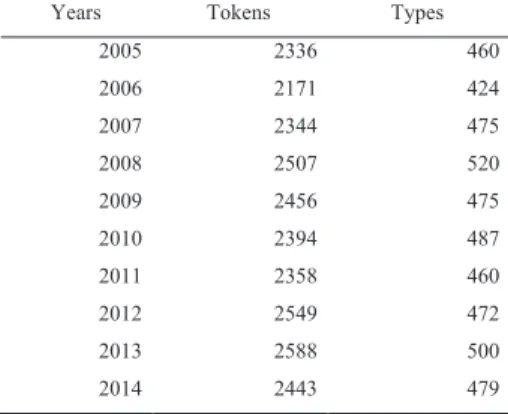
Table 2 shows the numbers of tokens and types in each of the examinations from 2005 to 2014. In this 10 year period, the number of tokens fluctuated between 2170 and 2600, and types between 420 and 500, indicating that there has been no significant change in the length of the high school entrance examinations in the last ten years.
Table 3 and Figure 1 show the distribution of NGSL levels in the junior high school English textbooks. Altogether, the textbooks had a total of 1649 different words.
Coverage was very high, 97.76%, which indicates that the core textbook vocabulary is basic and very high frequency.
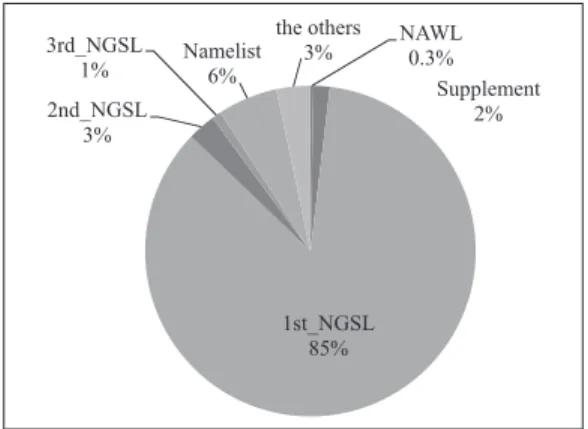
Table 4 and Figure 2 show the distribution of NGSL levels in the Metropolitan high school entrance examinations. Altogether the examinations had 24146 words, and the total coverage given by the NGSL was 23350 words, 96.72 percent. This shows that the words used in the entrance examinations were largely high-frequency, basic vocabulary.
There were, however, 796, 3.28%, low frequency words in the examinations, roughly eight per examination.
Table 5 and Figure 3 show the distribution of the vocabulary in the Metropolitan high school entrance examinations across the textbook vocabulary and names lists. The coverage of the examination vocabulary given by the words common to all six textbooks
Years Tokens Types 2005 2336 460 2006 2171 424 2007 2344 475 2008 2507 520 2009 2456 475 2010 2394 487 2011 2358 460 2012 2549 472 2013 2588 500 2014 2443 479
Table 2. The data of high school entrance examinations
Word list TOKEN Coverage (%)
0 3 . 0 5
L W A N
Supplement 154 9.34
1st_NGSL 1254 76.05
2nd_NGSL 158 9.58
9 4 . 2 1
4 S
G N _ d r 3
0 0 . 0 0
t s i l e m a N
6 7 . 7 9 2
1 6 1 L
A T O T
Table 3. Distribution of NGSL levels in the textbooks
NAWL 0.3%
Supplement 9%
1st_NGSL 76%
2nd_NGSL 10%
3rd_NGS 3%
the others 2%
Figure 1. Distribution of NGSL levels in the textbooks
Word list Tokens Coverage (%)
1st_NGSL 20593 85.29
2nd_NGSL 658 2.73
3 9 . 0 4
2 2 L
S G N _ d r 3
Supplement 387 1.60
9 2 . 0 9
6 L
W A N
8 8 . 5 9
1 4 1 t
s i l e m a N
2 7 . 6 9 0
5 3 3 2 L
A T O T
Table 4. Distribution of NGSL levels in the Metropolitan high school entrance examinations
NAWL 0.3%
Supplement 2%
1st_NGSL 85%
2nd_NGSL 3%
3rd_NGSL
1% Namelist 6%
the others 3%
Figure 2. Distribution of NGSL levels in the Metropolitan high school entrance examinations
Table 5. Distribution of vocabulary in the Metropolitan high school entrance examinations across the textbook vocabulary and names lists
TOKEN Coverage (%)
Textbook 20864 86.41
9 8 . 5 3
2 4 1 t
s i l e m a N
3 . 2 9 7
8 2 2 2 L
A T O T
Textbook 86%
Namelist 6%
the others 8%
Figure 3. Distribution of vocabulary in the Metropolitan high school entrance examinations across the textbook vocabulary and names lists
is 92.3%. This value is a little lower than the 95% coverage that Chujo (2004) claims is necessary to read texts comfortably. Altogether a total of 1649 words, 7.7%, would be unknown to examinees who only knew the textbook vocabulary, approximately 16 words per year.
Altogether 267 words (tokens) were glossed in the entrance examinations. Of these 42, 15%, were in the textbooks, suggesting that some of the glosses may not have been necessary. There were also glosses for 187 of the words, about 35%, not found in the textbooks.
Table 6 and Figure 4 show the coverage of the entrance examinations given by junior high school textbook vocabulary and the glossed words. Total coverage is 94.54%
percent, very near the threshold of 95% needed to read without great difficulty. There are, however, still 1277 words, 5.46%, that would not be known to examinees who know only the textbook vocabulary.
Textbook 86%
Name list 6%
Glossed words 3%
the others 5%
Figure 4. The coverage of the examination given by the textbook vocabulary list and the glossed vocabulary
Word list Tokens Coverage (%)
Textbook 20864 86.41
1 8 . 5 2
0 4 1 t
s i l e m a N
Glossed words 603 2.5 2 7 . 4 9 9
6 8 2 2 L
A T O T
Table 6. The coverage of the examination given by the textbook vocabulary list and the glossed vocabulary
Table 7 shows the most frequently occurring words not found in the textbooks, glossed word list or names list. All these words appeared in five or more entrance examinations.
range frequency
ok 10 33
surprised 9 32
club 7 54
able 7 21
smiled 7 21
parents 7 14
classroom 6 11
worry 6 8
culture 5 23
own 5 18
group 5 17
chance 5 15
library 5 14
dancing 5 10
Table 7. Words not found the textbooks and not glossed in the examinations
Chapter 4 Discussion
After giving very short answers to the two research questions, I will focus on the following points in this section; 1) the vocabulary of textbooks and examinations with NGSL, 2) glossed words in entrance examinations, 3) words not found in the textbook, glossed words and names lists. The first points are relationship with research questions.
This study had two research questions:
1) What are the characteristics of the vocabulary used in the Metropolitan high school English entrance examinations?
2) Do the Metropolitan high schoolsʼ entrance examinations have a higher level of vocabulary difficulty than junior high school textbooks?
The major characteristic of the vocabulary used in the Metropolitan high school English entrance examinations is that the words in it are largely basic, high frequency, general-purpose vocabulary. The core junior high school vocabulary, i. e. vocabulary used in all the textbooks used in junior high schools in Tokyo, textbooks gives good coverage of the examination vocabulary, especially when the glossed words in the examination are taken into account. With the glossed words coverage is very close to the comfortable reading level of 95% (Chujo, 2004b).
The comparisons with the NGSL indicate that the words in the Metropolitan high school entrance examinations and the vocabulary in the junior high school textbooks are mostly high frequency words and therefore extremely important for second and foreign language learners to know, as they represent the core vocabulary of all English language use, both spoken and written. It is therefore good for learners to know these words not only for the examination but also in order to become able to use English for practical purposes. The fact that these words are also in the examination may also encourage junior high school students to learn them well.
In the examinations there were glossed words in each section, which is important for examinees because the examinations had more comprehensions questions about the passages than about grammar. In some cases, the glossed words were also in the textbooks, but it is questionable if it is really necessary to provide glosses for them. In
addition, some of the glossed words were loanwords in Japanese, for example, and . Again, is it really necessary to provide katakana glosses like イメージ ( ) and ライバル ( ) for these kinds of words?
Most of words not found in the textbooks, glossed words or names list surprisingly appeared to be easy words for students because some are loanwords or are often used in class. It should be borne in mind that the textbook vocabulary list is a core list that contains only the words in all the junior high school English textbooks, so it is possible that these words are known, at least by the majority of junior high school students.
Chapter 5 Conclusions
In this study, I compared the vocabulary in textbooks and in the Metropolitan high school entrance examination. The results showed that the NGSL gave about 95%
coverage of the vocabulary in the textbooks and examinations. The textbook vocabulary did not quite reach the 95% threshold for comfortable reading but was close, 94.54%, indicating that the examinations are at an appropriate level for examinees. This result is good news for junior high school students because they study the very important, high frequency vocabulary of on high frequency vocabulary and, if they study hard in class, they should be able to easily do the Metropolitan high school entrance examination.
The focus of this study was the Metropolitan high school entrance examinations. A broader study, investigating, for example, other Metropolitan high school examinations and private high school examinations would probably provide some more interesting findings. It would be interesting to know whether private high schools take into account the English vocabulary taught in public junior high schools, or whether there is a relationship between the vocabulary level of a schoolʼs entrance examination and its ranking.
Studies that included English tests used in schools abroad, for example, South Korea, China, German or Italy, would make it possible to learn about other countriesʼ approaches to measuring language learning achievement. Researchers can also learn about second/foreign language education expectations and systems in those countries.
Another possible direction for research would be to compare the vocabulary in specialist corpora, for example, movie scripts, newspapers or comics, with the vocabulary in textbooks to see how well learners are likely to understand or acquire vocabulary from them. It can also provide a means to check the validity of language learning materials for specific purposes, like English for academic purposes or for business.
References
Antony, L. (2012). AntWordProfiler (Version 1.3.1) [Computer program] Tokyo, Japan:
Waseda University. Retrieved from http://www.antlab.sci.waseda.ac.jp/
Browne, C., Culligan, B. & Phillips, J. (2013). New General Service List. Retrieved from http:
//www.newgeneralservicelist.org
Chujo, K. (2004). Measuring Vocabulary Levels of English Textbooks and Tests Using a BNC Lemmatised High Frequency Word List. In J. Nakamura, N. Inoue, and T. Tabata (eds.).
,Amsterdam: Rodopi, 231‑249. Retrieved from http:
//www5d.biglobe.ne.jp/chujo/
Chujo, K. & Hasegawa, S. (2004). Goi no kabatistu to ridabirithi kara mita daigaku eigo nyuusi mondai no nanido. (Assessing Japanese College Qualification Tests Using JSH Text Coverage and Readability Indices.)
, 45‑55 Retrieved from http: //hanamizuki2010. sakura. ne. jp/public̲html/data/
b37‑45‑55.pdf
Hasegawa, S., Chujo, K. & Nishigaki, C. (2006). Daigaku nyushi eigo mondai goi no nanido to yuyosei no jidaitekihenka. (Validity of vocabulary in university entrance examination and the National Center Test through 1980s to 2000s.) Vol.28, No.2, 115‑134.
Retrieved from http://www5d.biglobe.ne.jp/chujo/
Kairyudo. (2012). .(A list of English junior high school textbook vocabulary.) Kairyudo.
Koe no kyouikusya. (2009). Toukyou toritsu koukou rokunrnkan no nyushi to kenkyu. (The six years of Metropolitan high school entrance examinations and study of them.)
Tsumura, T. (2010). Nihon to kankoku no daigaku nyugaku kyoutsu siken ni okeru siyou goi no hikaku kenkyu ‒gaikokugo eigo 1994‑2009 no bunseki-. (Comparing vocabulary of university entrance examination in South Korea and Japan.)
137‑148. Retrieved from http: //repository. dl. itc. u-tokyo. ac. jp/dspace/bit- stream/2261/52628/1/lis00809.pdf
Tokyo Metropolitan Board of Education. (2013). Kouritsu gakko tokei chousa houkokusyo.
(Statistics report on the public junior high school students.) Retrieved from http://www.
kyoiku.metro.tokyo.jp/toukei/25sotsugo/houkokushosotsugo.pdf
Tokyo Metropolitan Board of Education web site. (nd.) http://www.kyoiku.metro.tokyo.jp Mainichi Sinbun. (28,05,13). Monkasyo Ryugakusei zou he syusyoku ittai 20 nen madeni
kaigai kara 30 mannin sokushinsaku (Promotion plan to increase international students to 300,000 by 2020 with getting a job.) Retrieved from http: //mainichi. jp/feature/new s/
20130528ddm008100058000c.html
Ministry of Education, Culture, Sports and Technology-Japan web site. (nd.) http://www.mext.
go.jp