日本機械学会[No.0117-1]北陸信越支部 48 期総会・講演会 講演論文集 [2011.3.5 長野県上田市]
903
分子動力学法による界面の力学的応答解析
Analysis of mechanical response of interface using Molecular Dynamics
○加藤修(長岡技術科学大学) 正 古口日出男(長岡技術科学大学)
Osamu Kato, Department of Mechanical Engineering, graduate school of Nagaoka University of Technology, 1603-1 Kamioka, Nagaoka 940-2188
Hideo Koguchi, Department of Mechanical Engineering, Nagaoka University of Technology Key Words: Molecular Dynamics, Interface, Elastic constants, Interface stress, interface energy
1.
はじめに現在,電子デバイスの微小化に伴いナノメートルスケー ルの薄膜,回路等の研究が盛んに行われている.ナノメー トルスケールでは体積に対する面積の割合が増加するた め,表面および界面の力学挙動に対する表面または界面に おける力学的特性の影響が大きくなる.そのため界面特性 を知ることは,ナノメートルスケールでは重要であると考 えられる.
このような背景から今回は分子動力学(
MD
)法によっ て,異材が接合している界面におけるエネルギ,応力,弾 性定数についての解析を行い,界面特性を調べる.2. GEMA ポテンシャル
本研究では
GEM
ポテンシャルを用いて解析を行う.GEAM
ポテンシャルは,汎用性,柔軟性を有するポテン シャル関数で,埋め込み関数が多項式やlog
の形式で与え られている.さらに,簡単に多元系を扱うことができる.
GEMA
ポテンシャルEは以下の式で表される(1).!
E
tot= 1
2 V (r
"#)
#($"
%
)"
% + F ( &
")
"
%
(1)
F(
!
)=Fni(
!
!
n"
1)i ,!
<!
n,!
n=0.85!
e i=03
#
Fi(
!
!
e"
1)i ,!
<!
e,!
e =1.15!
e i=03
#
Fe 1"ln
!
!
e$
%&
' ()
*
n+ , ,
- . / /
!
!
e$
%&
' ()
n
,
! 0 ! 1
2 3 3 3 3
4 3 3 3 3
(2)
V(r)=
Aexp
!"
r re!
1#
$%
&
'(
)
* + ,
- .
1+ rre
! /
#
$%
&
'(
20 +
Bexp
!0
r re!
1#
$%
&
'(
)
* + ,
- .
1+ rre
! 1
#
$%
&
'(
20
#
$
% %
%
% %
&
' ( ( ( ( (
(3)
!= f (r)
"
%
(#$)(4)
f(r)=
feexp
!"
r re!1
#
$%
&
'(
)
* + ,
- .
1+ rre
! /
#
$%
&
'(
20
#
$
% %
%
% %
&
' ( ( ( ( (
(5)
原子の種類が異なるときの原子間ポテンシャル
!
V
"#(r)
は,Vab(r)=1 2
fb(r)
fa(r)!aa(r)+ fa(r) fb(r)!bb(r)
"
#$ %
&
'
(6)
ここで
!
f
e, r
e, "
e, # , $ , A,B, % , & ,F
ni, F
i, ' ,F
eはポテンシャル パラメータである.!
r
"#は原子α, β間の距離を表す.3.
界面エネルギ,界面応力,界面弾性係数界面応力および界面弾性係数は界面エネルギの界面ひず みによる変化割合を表す物理量であり,界面応力は界面エネ ルギの一階微分,また界面弾性定数は,界面エネルギを二階 微分で与えられる.
界面エネルギγは != 1
2A(Esurf"Ebalk)
(7)
と表される(2).A
は界面の面積,Esurfは界面のある系のエネ ルギ,Ebulkは界面のない系のエネルギである.ここから界面 応力τijは
!ij= d"
d#ij
= 1 2A
$Esurf
$#ij
%$Ebulk
$#ij
&
'( )
*+
(8)
また界面弾性係数
!
d
ijklは
dijkl= d2! d"ijd"kl
= 1 2A
#2Esurf
#"ij#"kl$#2Ebulk
#"ij#"kl
%
&
'
( )*
(9)
と表される.
また,原子レベルでの不連続構造体における有効な弾性係 数として原子弾性係数 Cαがある.原子弾性係数は以下の式 で表される(3).
Cijkl! = 1
"!
#2E!
#$ij#$kl
(10)
ここでΩαは原子αに対するボロノイ多面体の体積である.4.
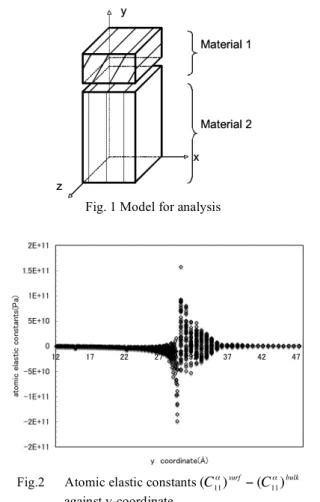
解析モデル本研究の解析モデルでは,図1のように(010)面を有する金 属薄膜にz軸回りに
22.6
,28.1 もしくは36.9
回転した 異材金属を載せて界面を作った.境界条件はx, y軸方向に周 期境界条件を適用している.周期境界条件は異材間で周期が 異なった場合でも適応できるものを用いた.計算中の温度変化は
0K
から計算を始め,5ps
後に1K
まで 上昇させ,その後35ps
後までに0K
に減少させた.モデルの大きさは周期境界条件を適用するため
Material 1
の結晶方向により異なるが,Material 1, Material 2
合わせて原子数
5,000~13,000
個程度である.解析した原子の組み合わせは
Material 1
がNi、Material 2
Fig. 1 Model for analysis
Fig.2 Atomic elastic constants
!
(C
11")
surf# (C
11")
bulk
against y-coordinate
が
Cu
のものとMaterial 1
がAg,Material 2
がAu
のもの2種 類である.5.
界面の影響界面がどのくらいの深さまで弾性係数に影響を及ぼす の か を
!
(C
11")
surf# (C
11")
bulkの 値 を 用 い て 調 べ た . 図2
はMaterial 1
が(010)
面をz軸方向に36.9
傾いたNi
,Material 2
がCu
の解析結果である.この場合,界面から
3
~7Åの範囲に界面の影響が及ん でいることがわかる.6 界面エネルギの解析結果 解析で得られた界面エネルギを表1に示す.
Au-Ag
モデルでは回転角が大きくなると界面エネルギが徐々に大きくなる.一方,
Cu-Ni
ではある角度で最大値とな る.他の研究者により得られた界面エネルギの大まかな値は、
部分整合界面で
0.2~0.8J/m
2,整合界面で0.05~0.2J/m
2,非 整合界面で0.8~2.5J/m
2である(4).今回解析した界面エネル ギは部分整合界面の範囲に入っている.今回のモデルは温度 を与えることにより緩和させているため部分整合界面にな ったと考えられる.Table 1 Interface energy
γ(J/m
2) Rotation
angle[deg]
γRotation
angle[deg]
γ22.6
0.31122.6
0.46528.1
0.32028.1
0.524Au
|
Ag 36.9
0.489Cu
|
Ni 36.9
0.288Table 2 Interface stress
τ11(N/m) Rotation
angle[deg]
τ11Rotation
angle[deg]
τ1122.6 0.532 22.6 0.335
28.1 0.26 28.1 -0.45
Au
|
Ag 36.9 -0.653
Cu
|
Ni 36.9 -0.789
Table 3 Interface elastic constants d
ij(N/m) Rotation
angle[deg]
d11 d4422.6 -2.869 -0.916
28.1 -1.469 -2.303
Au
|
Ag 36.9 -1.689 -1.258
22.6 -2.915 -4.015
28.1 -2.567 -3.686
Cu
|
Ni 36.9 -1.487 -1.492
7. 界面応力の解析結果
解析で得られた界面応力を表2
に示す.すべてのモデルに関して回転角が大きくなるに伴い,その 値が低くなる傾向にある.また
Cu, Ni,
の表面応力τ11は0.62
~
1.77J/m
2程度である(5)ため今回解析した界面応力は表面応力より小さい値を示している.
8.
界面弾性係数の解析結果解析により得られた界面弾性係数を表
3
に示す.原子の距離,結晶方向により界面弾性係数が変化すること が見て取れる.
Ladan
らによると(6),界面弾性係数d11は[1 1 1]面で接合している Ag, Au
は2.16N/m, Cu,Ni
で3.28N/m
で あった.また,[0 0 1]面で接合しているものはAg,Au
が-0.064N/m
でありCu, Ni
で-0.064N/m.今回の結果は大きさで考えれば[0 0 1]面で接合したモデルの値と[1 1 1]面で接触し たモデルの間の値を示している.
9. 結 言
分子動力学法を用いて界面エネルギ,界面応力,界面弾 性係数を求めた.その結果,界面エネルギ,界面応力は接 触面の結晶構造によって規則的に変化することがわかっ た.
参考文献