Designing Collaborative Learning Environments for Architecture,
Engineering and Construction (AEC) Students
Caroline T.W. Chan
1, Willy Sher
21
Lecturer, City University of Hong Kong, Hong Kong, E-mail: [email protected]
2Senior Lecturer, University of Newcastle, Australia, E-mail: [email protected]
Abstract
This paper reports on a survey of AEC students’ perceptions of collaborative learning (CL). A questionnaire was administered to first year sub-degree students in the City University of Hong Kong. The study provides a clear understanding of students’ perceptions and contributes to the sparse literature on the topic. Analysis of the data revealed that most AEC students acknowledged the benefits of CL including academic and generic skill development.
1. Introduction
The construction industry is characterized as having many employers and workers with different specialties who collaborate with each other for the success of a project. Architecture, Engineering and Construction (AEC) professionals are expected to pool their expertise effectively so that facilities are designed and constructed satisfactorily. In the past decade, advances in information and communication technology, and especially in building information modeling (BIM)1, have provided platforms for multi-disciplinary collaboration. Therefore, there is a growing need for integrating structured collaborative training in AEC curricula to improve the generic skills of future building professionals so as to enhance students’ overall design and construction coordination skills.
2. Purpose of this study
Collaborative learning (CL) can be defined as “an instructional method in which students at various performance levels work together in small groups towards a common academic goal” [2].
1 BIM can be defined as “A process that allows data generated by one
party to flow seamlessly to other parties for beneficial reuse.” [1] It begins with the 3D design models acting as the central hub to feed information for all project participants and for use in the various stages of project life cycle.
Literature indicates that CL can be beneficial to some students but problematic for others. Such contrasting findings necessitate a thorough understanding of the students concerned before CL is implemented. Although many studies have investigated students’ perception of CL, very few have been conducted with students who take AEC programmes at university level.
Although AEC programmes are founded on construction principles, they differ considerably in terms of their nature – architecture places emphasis on design; building services engineering is engineering-based; construction engineering and management focuses on project management; and surveying is a social science subject related to economics. This study examines the learning experiences of AEC students. By gathering quantitative data from four different AEC sub-degree programmes which have implemented CL in the form of project-based / case-based learning from a Hong Kong university. It explores these students’ views of CL.
3. Data collection
A questionnaire was designed to collect quantitative data. Adapted from the Survey of CL Experience [3], twenty-four items (Table 1) were developed to collect students’ perceptions about CL. The questions were related to four constructs: academic benefits (ACA); generic skills development (GEN); negative aspects of CL (NEG); and overall feeling to CL (FEEL). Item 19 asked about group size and was not categorized in any construct. All the items were measured using a 5-point likert scale ranging from “strongly agree” to “strongly disagree”. Students were also invited to include their personal comments regarding CL at the end of the questionnaire.
A pilot study was conducted with six undergraduate AEC students to validate the questionnaire. The questionnaire was then sent to all first year sub-degree students at the City University of Hong Kong who were studying Construction Engineering and Management (CEM) / Architectural studies (AS) / Surveying (S) /
70
CollabTech 2012 , August 27-29, 2012, Hokkaido, Japan. Copyright © 2012 by Information Processing Society of Japan.
Building Services Engineering (BSE) programmes in the Division of Building Science and Technology during January and February of 2012.
Item Collaborative learning Construct 1. helps my understanding. ACA 2. encourages me to share my knowledge
and experience. ACA
3. makes problem-solving easier. GEN 4. stimulates critical thinking. GEN 5. gives a more relaxed atmosphere. FEEL 6. provides useful/helpful feedback. ACA 7. allows me to see things differently. ACA 8. focuses on our group succeeding, rather
than me as an individual. GEN 9. requires everyone to meet their
responsibilities. GEN
10. enables group members to help weaker
learners. ACA
11. enhances everyone’s communication
skills. GEN
12. improves my performance. ACA 13. encourages learners to participate in the
teaching/learning process.
ACA 14. is interesting and fun. FEEL 15. helps me to make new friends. GEN 16. inspires team spirit. GEN 17. wastes me a lot of time because I have
to explain things to others. NEG 18. is difficult because some members do
not participate in tasks. NEG 19. should have a maximum group size of
four students.
20. is difficult because students are not all
motivated to the same degree. NEG 21. influences my marks because I have to
rely on my group members. NEG 22. should be encouraged/continued. FEEL 23. doesn't help me understand theoretical
concepts. NEG
24. wastes time because it is difficult to
arrange meetings with my group. NEG
4. Data analysis and results
The coefficient alpha was used to verify the internal consistency of data collected for items within the groups [4]. Having assessed the internal consistency of the instrument and the profile of the respondents, the data were then analyzed using descriptive analysis.
4.1. Response
378 valid responses were received from a population of 426 students. Seven responses were incomplete and
were excluded from the analysis. The response rate of 88.7% is satisfactory for a survey of this nature. 4.2. Test for internal consistency
Internal consistency analysis was applied to the four groups of items: academic benefits, generic skills development, negative aspects and overall feeling about CL. Academic benefits, generic skills development and negative aspects are above or close to 0.7, indicating that the items in the group presented relatively high internal consistency. The last group (overall feeling to CL) exhibited considerably lower internal consistency, with an alpha coefficient of 0.465. Therefore, these three items were interpreted separately.
4.3. Students’ views on CL
To better illustrate the overall agreement and disagreement about each item, the responses were merged into two groups: agree (which include the strongly agree and agree responses) and disagree (which include the strongly disagree and disagree responses). Details are shown in Figure 1.
0.00% 20.00% 40.00% 60.00% 1 2 3 4 5 6 7 8 9 10 11 12 13 14 15 16 17 18 19 20 21 22 23 24 Qu es ti o n n ai re it em Percentage of responses Disagree responses Agree responses
Although more than 25% of respondents chose “neutral” (i.e. score 3), more students generally agreed than disagreed (except for items 17, 23 and 24). More
than 60% of respondents agreed that CL helped their understanding (item 1; 63.5%); allowed them to see things differently (item 7; 66.9%); and helped them to make new friends (item 15; 60.8%). For the desired CL group size (item 19), around one-third agreed that the maximum group size should be four, but also one-fourth disagreed.
Table 2 illustrates the combined responses by each construct. More students agreed that CL could bring academic benefits and help develop generic skills. However, about the same number of students agreed and disagreed about the negative aspects of CL.
Construct Agree responses Disagree responses ACA 1501 56.7% 297 11.2% GEN 1463 55.3% 303 11.5% NEG 761 33.6% 699 30.8% 4.4. Analysis of programme differences
To ascertain the effect of programme on students’ perceptions, analysis of variance (ANOVA) was conducted on each item.
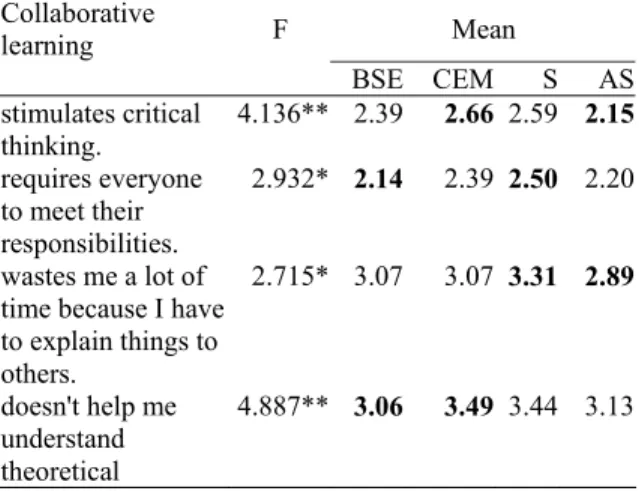
The programme effect did not exhibit any significant difference to most of the CL perception items. As summarized in Table 3, there were only four items that showed a significant difference: “CL stimulates critical thinking”; “requires everyone to meet their responsibilities”; “wastes a lot of time to explain things to others”; and “doesn't help me understand theoretical concepts”. To provide a more detailed analysis, the four programme means for these significant items are shown in Table 3. Collaborative learning F Mean BSE CEM S AS stimulates critical thinking. 4.136** 2.39 2.66 2.59 2.15 requires everyone to meet their responsibilities. 2.932* 2.14 2.39 2.50 2.20 wastes me a lot of
time because I have to explain things to others. 2.715* 3.07 3.07 3.31 2.89 doesn't help me understand theoretical 4.887** 3.06 3.49 3.44 3.13 concepts. Note: * p < 0.05, ** p < 0.01
Regarding whether CL stimulates critical thinking, AS students thought more positively than CEM students. However, in contrast to S students, AS students thought they wasted a lot of their time in explaining things to others. This is probably due to the individual nature of their design work. BSE students showed a stronger sense of requiring everyone to meet their responsibilities. However, the BSE students did not agree that CL helped them to understand theoretical concepts while CEM students thought more positively. The results suggest that CL helps to learn management skills (from the CEM students’ perceptions) but not for theoretical principles like mathematics.
5. Discussions
In general, the results obtained from this study agree with findings in literature. This study has shown that, although students acknowledge the advantages of CL in producing academic benefits and developing generic skills, they are concerned about some negative aspects such as getting all members participate, motivating all members to the same degree and their marks being influenced by group members. These findings align with many previous studies on CL [5], [6]. Many CL researchers observe that one of the most critical concerns of students about CL is the question of fair assessment, as their marks are reliant on their group members’ contributions [5]. Fair assessment should be a priority for those who implement CL, as well as being a good facilitator and motivator. Getting students to participate in CL is critical. To achieve results, teachers should be trained to design equitable assessments (e.g. peer evaluation) and to highlight the benefits of CL to students (as anecdotal evidence suggests that some students question their teacher’s motivation in using CL, seeing it as a means of teachers reducing teaching workload).
Does CL waste time?
CL has been criticized by many students, especially high achievers, as wasting their time [7], [8]. However, the majority of the students in this study were not of this view when it came to explaining things to group members (item 17). Students were concerned about wasting their time due to arranging meetings (item 24). With the use of advanced information technologies and wireless communications, group discussion and meetings can be held in a more efficient manner. Such technologies will be particularly helpful in coordinating meetings for multi-disciplinary group work which applies in AEC curricula.
Do different groups of students learn differently?
Past studies suggest that it is difficult to implement CL in engineering courses [9]. The results from this study confirm this proposition. The ANOVA results indicate a significant difference in perceived effectiveness in “learning the theoretical concepts through CL” between BSE and CEM students. BSE students experienced more difficulty learning theories, whereas the CEM students tended to experience less difficulty. This indicates that fundamental engineering theories which demand a clear, single answer are ill-suited to CL. Conversely ill-defined problems with multiple solutions may be advantageously delivered through CL. Whilst collaboration is an essential skill for engineers, CL and other conventional teaching approaches like lectures, exercises and tests should be carefully designed to ensure engineering students gain a thorough understanding of core principles. More discipline-specific studies need to be conducted to improve our understanding of the impact of study nature to CL effectiveness.
Do Hong Kong Chinese students prefer individual learning to CL?
Many studies have investigated the learning attitudes and perceptions of Chinese students. Some observe that Chinese students prefer competitive rather than cooperative learning [10]. They explain that Chinese students in the Confucian Heritage Culture avoid losing face and disagreeing and will therefore experience problems with CL. However, results from this study indicate that Hong Kong Chinese students appreciate the academic benefits of CL. The majority agreed that CL encouraged them to share their experiences and knowledge (56.3%) and improved their performance (51%). Most of the current studies about Chinese students are conducted in the western countries with international Chinese students. The learning attitudes of Chinese students of different nationalities or ethnicities can be different due to the social, economical and political environment of their domicile. More detailed studies about Chinese students would improve our understanding of their learning attitudes.
6. Conclusion
It is clear that CL enhances AEC students’ learning. Students acknowledged the many benefits of CL including academic and generic skill development. This accords with what is stated in literature.
When implementing CL in AEC programmes, teachers are recommended to:
- design equitable assessment for CL activities;
- be good facilitators and motivators to get students to participate;
- clearly explain the benefits and purpose of CL to students;
- encourage / facilitate students to use information technologies when arranging meetings and discussions;
- supplement CL with appropriate lectures, exercises, tests and the like to teach and assess fundamental engineering principles.
7. Acknowledgements
The authors gratefully acknowledge the Office of Education Development and General Education of The City University of Hong Kong for providing funding to support this research study (6000346).
8. References
[1] S. Taylor and C. Bailey, “Unlocking BIM data.” 12-Feb-2011.
[2] A. A. Gokhale, “Collaborative learning enhances critical thinking,” Journal of Technology Education, vol. 7, no. 1, 1995.
[3] C. Ingleton, L. Doube, T. Rogers, and A. Noble, “Leap into ... collaborative learning.” Centre for Learning and Professional Development, The University of Adelaide, 2000. [4] L. J. Cronbach, Essentials of Psychological Testing, 5th ed. HarperCollins Publishers, Inc., 1990.
[5] M. Ford and J. Morice, “How fair are group assignments? A survey of students and faculty and a modest proposal,”
Journal of Information Technology Education, vol. 2, pp.
367–378, 2003.
[6] G. S. Stump, J. C. Hilpert, J. Husman, W.-T. Chung, and W. Kim, “Collaborative Learning in Engineering Students: Gender and Achievement,” Journal of Engineering Education, vol. 100, no. 3, pp. 475–497, Jul. 2011.
[7] P. J. Giordano and E. Y. Hammer, “In-Class Collaborative Learning: Practical Suggestions From the Teaching Trenches,”
Teaching of Psychology, vol. 26, no. 1, p. 42, Jan. 1999.
[8] C. Reffay and T. Chanier, “How social network analysis can help to measure cohesion in collaborative distance-learning,” 2003.
[9] E. Seymour, Talking About Leaving: Why Undergraduates Leave The Sciences. Westview Press, 2000.
[10] M. Li and J. Campbell, “Asian students’ perceptions of group work and group assignments in a New Zealand tertiary institution,” Intercultural Education, vol. 19, no. 3, pp. 203–216, 2008.