• 検索結果がありません。

Characterization of Massilia sp. BS-1, a Novel Violacein-producing Bacterium Isolated from Soil

N/A
N/A
Protected

Academic year: 2021

シェア "Characterization of Massilia sp. BS-1, a Novel Violacein-producing Bacterium Isolated from Soil"

Copied!
6
0
0

読み込み中.... (全文を見る)

全文

(1)

1. Introduction

  Violacein is a bluish-purple pigment that has  various  important  biological  activities  including  antibacterial(against  gram-positive  bacteria)

[1]

,  antifungal

 [2]

, anti-protozoan

 [3]

, anti-malarial

 [4]

, anti- tumor

 [5]

, anti-viral

 [6]

, anti-oxidant

 [7]

, and anti-diarrheal

 [8]


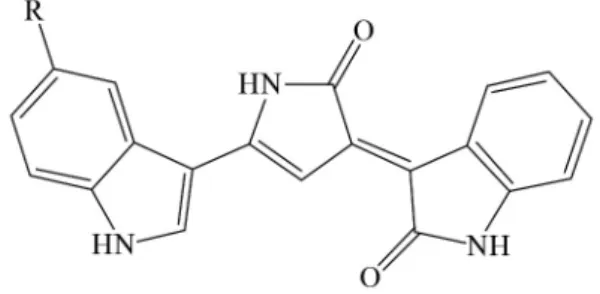
activities. The violacein carbon skeleton is derived  from  2  molecules  of  L-tryptophan(Fig.  1).

Although  further  investigation  to  elucidate  the  pharmaceutical  potential  of  violacein  is  needed,  mass production of violacein is difficult due to its  low productivity. The role of violacein production  in its producers has not been understood, but it is  suggested that it provides a survival advantage  to  species  over  other  microorganisms  in  the  environment.

  It  has  been  reported  that  various  bacteria,  such as  Chromobacterium violaceum

[9]

C. fluviatile

[9]

Janthinobacterium lividum

[10]

, Alteromonas luteoviolacea

[11]

Pseudoalteromonas luteoviolacea

[12]

Duganella sp. 

[13]

,  and  Collimonas sp. 

[14]

, produce violacein. We have  already reported that a novel bacterium,  Massilia  sp.  BS-1,  was  isolated  from  a  soil  sample  and 

produced violacein and deoxyviolacein 

[15]

.

  The production of violacein is known to be  regulated  via  quorum-sensing  molecules,  for  example,  N-hexanoyl-L-homoserine  lactone(C6- HSL)in  C. violaceum

[16]

  and  N-(3-oxooctanoyl)- L-homoserine  lactone  in  Pseudoalteromonas  sp. 

520P1

  [17]

.  Among  the  Gram-negative  bacteria,  N-acylhomoserine lactones(AHLs)are common  quorum  sensing  molecules(autoinducers). 

Quorum sensing allows a species to measure its  population density and control gene expression in  a  population  density-dependent  manner. It  is  now  clear  that  quorum  sensing  is  the  norm 

Characterization of Massilia sp. BS-1, a Novel Violacein-producing Bacterium Isolated from Soil

Hitosi A

GEMATU


(平成28年12月19日受理)  

  Massilia sp. BS-1, a novel bacterium, was characterized from a view point of violacein  production. During cultivation, strain BS-1 began to produce violacein in the early stage of  log phase growth at an incubation time of 16 h, and the amount of violacein rapidly reached  a  maximum  value  of  62 mg/L  for  5 h. This  observation  was  suggested  that  the  violacein  production was regulated by quorum sensing because it was not growth-associated and occurred  over a short period. Strain BS-1 did not produce violacein in a synthetic MM2 medium without  L-histidine. Neither  N-hexanoyl-DL-homoserine lactone nor  N- (3-oxooctanoyl) -DL-homoserine  lactone, known as autoinducers of quorum sensing, induced violacein production of strain BS-1. 

Any acetyl homoserine lactones were not detected in the culture broth by LC-MS analysis. 

However, the supernatant of the culture broth of strain BS-1 induced violacein production.

Key word: Massilia, Violacein, Quorum sensing, Autoinducer

Fig. 1. Chemical structures of violacein(R=OH)and

deoxyviolacein(R=H).

(2)

in  the  bacterial  world  and  that  this  process  is  fundamental to microbiology. Therefore, it is very  important to discover new producers of violacein  to  effectively  produce  it  and  to  elucidate  the  mechanism of quorum sensing.

  In  this  study,  we  characterize  Massilia  sp. 

BS-1  from  a  view  point  of  violacein  production  and examine whether the violacein production is  regulated by quorum sensing.

2. Materials and methods

   Bacterial strain and growth conditions Massilia sp. BS-1 was isolated in our laboratory

 [15]

.  Strain BS-1 was cultivated on a nutrient agar plate  containing 0.1% yeast extract, 0.1% polypeptone,  0.1% KH

2

PO

4

, and 1.5% agar(pH 6.8).  The agar  plate  was  incubated  at  28℃  for  2-3  days. The  strain was also cultivated in nutrient broth consisting  of the same components described above without  agar  at  28℃  for  1-2  days  with  shaking. A  synthetic MM2 medium containing 0.2% glucose,  0.1%(NH

4

2

SO

4

,  0.4%  Na

2

HPO

4

·7H

2

O,  0.2% 

KH

2

PO

4

,  and  0.01%  MgSO

4

·7H

2

O  was  used  for  the characterization of strain BS-1. N-Hexanoyl- DL-homoserine  lacton  and  N-tetradecanoyl-DL- homoserine lactone were purchased and used to  induce violacein production as AHLs. 

  Production of violacein  To produce violacein,  strain  BS-1  was  cultivated  in  30 mL  of  nutrient  broth on a rotary shaker at 28℃ for 18 h. Thirty  milliliters of the seed culture was transferred to a  3-L jar fermentor containing 2.0 L of nutrient broth  followed by cultivation with aeration(0.5 v/v/m) and  agitation(300 rpm)at  25℃. Samples(3.0  mL)withdrawn from the culture broth at regular  intervals were used for measuring pH, bacterial  growth, and violacein production. Violacein was  harvested  from  the  sample  by  centrifugation,  extracted by methanol(3.0 mL), and quantified  using a spectrophotometer at 577 nm. Bacterial  growth was monitored by measuring the turbidity  at  660 nm. After  67 h  of  cultivation,  the  cells  were  centrifuged  at  8,000× g  for  10 min,  and  the supernatant was discarded. The cell pellet  was then mixed with 200 mL of methanol. The  mixture  of  the  cells  and  methanol  was  treated 

by ultrasonication until the cells were completely  bleached.  The  methanol  extract  was  then  separated from the cells by centrifugation at 8,000

× g for 10 min. The extract was concentrated to  remove methanol in a rotary vacuum evaporator  and was extracted twice with an equal volume of  ethylacetate. The extract was evaporated under  vacuum to obtain a crude mixture of violacein and  deoxyviolacein. 

  Quantitative and qualitative analysis    The  amount of violet pigment, consisting of violacein  and  deoxyviolacein,  in  the  culture  broth  was  estimated  using  their  molecular  absorption  coefficient(ε=1.7×10

4

 M

-1

 cm

-1

,  λ=577 nm)

[19]

. Quantitative analysis of the pigment was performed  using  high  performance  liquid  chromatography

(HPLC)with  a  ZORBAX  SB-Aq  column(150

×4.6 mm i.d.)(Agilent Technologies, Inc., USA)

at  577 nm  and  40℃  with  MeOH  /  water(70:30

[V/V] )as  the  mobile  phase  at  a  flow  rate  of  0.5 mL/min. Qualitative analysis of the culture  broth was carried out by liquid chromatography- mass  spectrometry(LC-MS).  The  analysis  was  performed  using  a  time  of  flight  mass  spectrometer(Xevo  QTof  MS,  Waters  Corp.,  USA).  HPLC  separation  was  performed  using  an ACQUITY UPLC BEH C18 1.7µm column(50

×2.1mm  i.d.)at  40℃  with  a  mixture  of  water  and  acetonitrile  contained  0.1%  formic  acid  as  the  mobile  phase  at  a  flow  rate  of  0.2 mL/min. 

To detect trace amounts of AHLs in the culture  broth, we used the selected reaction monitoring  technique. The characteristic fragment ion of m/

z 102, derived from the homoserine lactone moiety  of the AHLs, was monitored selectively to detect  all kinds of AHLs. 

  Antibacterial activities of violacein    The  growth inhibitory and lethal effect of the violet  pigment, a mixture of violacein and deoxyviolacein,  isolated  from  strain  BS-1  were  examined  for  several  bacteria  such  as  Bacillus subtilis, Staphylococcus aureus and Escherihia coli using the  standard methods

 [20]

.

  Assay for autoinducers of violacein    To 

determine  whether  autoinducers  are  produced 

by  strain  BS-1,  we  attempted  the  following 

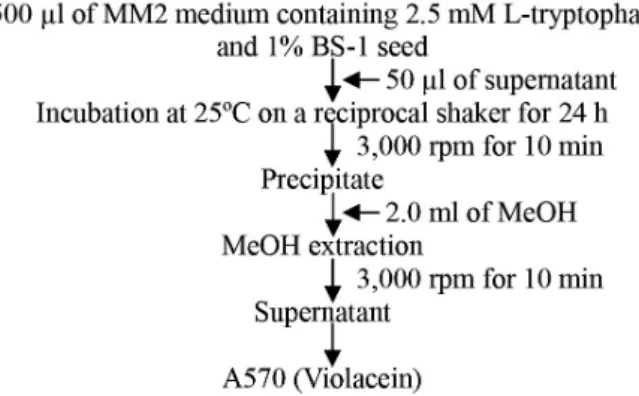
assay(Fig.  2):  Strain  BS-1  was  cultivated  in 

(3)

nutrient broth with shaking as described above. 

Two  ml  of  the  culture  broth  was  sampled  at  various times for the cultivation time from 6 h to  19 h, and was centrifuged to get a supernatant. 

The  supernatant  was  assayed  for  autoinducer  activity. The  autoinducer  activity  showed  the  violacein production induced by autoinducers in  the supetnatant.

3. Results and Discussion

  Cultivation of strain BS-1  Massilia sp. BS-1  is  a  rod-shaped  Gram-negative  bacterium  that  exhibits motility and flocculation. On a nutrient  agar plate, it formed a violet colony whose surface  was wavelike and hard. Although it is an obligate  aerobe, it grew under sessile conditions, forming  extended biofilms on the surface of the culture  broth(Fig. 3).

  However, strain BS-1 did not produce violacein  in a synthetic MM2 medium, even if L-tryptophan  was  added,  with  under  aerobic  conditions,  although  the  strain  grew  well  and  produced  biofilms(Fig. 4).

  Time courses for growth and production   When strain BS-1 was cultivated in the nutrient  broth with shaking, it grew to stationary phase  and ended violacein production by an incubation  time of 24 h. It began to produce a bluish-purple  pigment in the early period of log phase growth at  an incubation time of 16 h, and production rapidly  reached a maximum value of 62 mg/L pigment at  5 h(Fig. 5).  The color of the culture changed  to a deep violet due to the pigment. It appeared 

that pigment production was regulated, because  it was not growth-associated and occurred over a  short period.

  Characterization of the pigment  The pigment  Fig. 2. Assay for autoinducers of violacein production.

Fig. 3. Cultures on an agar plate(A)and formation of biofilm(B).

Fig. 4. Non-production of violacein in a synthetic MM2 medium(B).

Strain BS-1 was cultivated in nutrient medium(A) and MM2 medium(B)supplemented with 1.0 mM L-tryptophan under the same conditions.

Fig. 5. Time course profile of Massilia sp. BS-1 cultivated in nutrient broth.

S y m b o l s : (♦) O D 6 6 0 ; (●) c r u d e v i o l a c e i n

concentration;(▲)pH.

(4)

is water-insoluble and is present in the extracellular  polymers produced by strain BS-1. The pigment was  separated  into  two  components  with  maximum  absorption  wavelengths  of  577 nm  and  555 nm  by  preparative  HPLC. Under  analytical  HPLC  conditions,  the  former(violacein)and  the  latter(deoxyviolacein)components were eluted  at 5.51 min and 7.82 min respectively(Fig. 6).

  The  violacein  concentration  was  about  10- fold  higher  than  that  of  deoxyviolacein. The  molecular masses(m/z)of these two components  were  determined  to  be  344.24(positive)and  328.23(positive)respectively by LC-MS analysis. 

The entirety of the carbon, hydrogen, and nitrogen  skeleton of violacein is derived from 2 molecules  of L-tryptophan, and the 3 oxygen atoms originate  from molecular oxygen

 [2]

.

  Antibacterial activities of violacein    The  antibacterial effect of the violet pigment containing  violacein  and  deoxyviolacein  was  confirmed  for  putrefactive bacteria such as  B. subtilis, S. aureus  and E. coli. The minimum inhibitory concentration

(MIC)of the violet pigment for  B. subtilis and S.

aureus was 2.5 mg/L. MIC is defined as the lowest  concentration  of  antibacterial  material  that  can  inhibit cell growth completely. The concentration  of the violet pigment more than 20 mg/L caused  lethal  effects  on  B. subtilis  and  S. aureus. The  lethal effect means the death of logarithmically  growing bacterium. However, the violet pigment  could not inhibit the growth of E. coli even if more  than 30 mg/L.

  Effect of L-histidine on violacein production   In C. violaceum, the production of violacein is under  the control of signal molecules called autoinducers

 [16]

. The  signal  molecules  are  detected  by  cognate  cytoplasmic  receptors,  and  then  the  activated  receptors bind DNA and induce transcription of 

target  quorum-sensing  genes.

 [20]

  Therefore,  we  considered  that  strain  BS-1  could  not  produce  autoinducers for violacein production and tried to  determine which amino acids were necessary for  violacein production in a synthetic MM2 medium. 

We  found  that  L-histidine  was  necessary  for  violacein  production(Fig.  7A).  When  strain  BS-1 was cultivated in MM2 medium containing  0.04 mM  L-histidine  and  various  amounts  of  L-tryptophan(0-5 mM),  violacein  production  increased with the increase in L-tryptophan till it  reached a value of 0.38 mM violacein(Fig. 7B). 

These results suggest that L-histidine is necessary  for  the  production  of  the  autoinducer  because  L-histidine is not the source of violacein. 

  Putative quorum sensing in Massilia sp. BS-1 In  Gram-negative  bacteria,  autoinducers  are  generally acylhomoserine lactones(AHLs)that  differ in the structure of their N-acyl side chains.

 [21]


Fig. 6. HPLC analysis of the extract of the culture broth. HPLC conditions are described in Materials and Methods.

Fig. 7. Effect of L-histidine(A)and L-tryptophan(B)

on violacein production by strain BS-1 grown in MM2

medium in the presence of 1.0 mM L- tryptophan(A)or

0.04 mM L-histidine(B).

(5)

However,  strain  BS-1  did  not  produce  violacein  in MM2 medium containing 0.1 mM  N-hexanoyl- DL-homoserine lacton or 0.1 mM  N-tetradecanoyl- DL-homoserine lactone. Moreover, to determine  whether AHLs are produced by strain BS-1, we  attempted to extract autoinducers by ethylacetate  from a culture broth sampled just before violacein  production.  Strain  BS-1  was  subsequently  cultivated  in  MM2  medium  containing  both  L-tryptophan and the concentrated extract for 2  days. However  strain  BS-1  did  not  produce  violacein. These results showed that autoinducers  of strain BS-1 were not hydrophobic compounds  like AHLs. We also used LC-MS to detect AHLs  in the culture broth of strain BS-1. To identify  the  selected  ions  as  AHLs,  the  characteristic  fragment  ion  of  m/z  102,  derived  from  the  homoserine  lactone  moiety  of  the  AHLs,  was  monitored  selectively. A  fragment  ion  of  m/

z 102 was not detected in the sample from the  culture  extract.    Gram-positive  quorum-sensing  bacteria,  such  as  Streptococcus  and  Bacillus,  predominantly communicate with short peptides  that often contain chemical modifications

 [20]

. The  autoinducer of strain BS-1 might be a hydrophilic  compound  like  peptide.  So  we  assayed  the  autoinducer activity in the culture broth of strain  BS-1 sampled at various times for the cultivation  time from 6 h to 19 h. We detected the autoinducer  activity in the early stages of violacein production

(Fig. 8).  The peak of the autoinducer activity  was after 10 hours of the cultivation time, and the 

activity  was  decreased  rapidly  as  the  violacein  production progressed.

  The  role  of  L-histidine  and  the  elucidation  of chemical structure of autoinducer in violacein  synthesis in Massilia sp. BS-1 are currently under  investigation.

4. Conclusion

1)Massilia  sp.  BS-1  produced  a  bluish-purple  pigment and biofilms in nutrient medium. The  pigment consists of violacein and deoxyviolacein.

2)Massilia  sp. BS-1  grew  well  in  a  synthetic  MM2  medium,  while  both  L-tryptophan  and  40µM L-histidine were neede to produce violacein. 

L-Tryptophan  is  a  building  block  of  violacein. 

However, the role of L-histidine is unknown.

3)Neither  N-hexanoyl-DL-homoserine lacton nor  N-tetradecanoyl-DL-homoserine  lactone  induced  violacein  production. Any  acetyl  homoserine  lactones were not detected in the culture broth  by LC-MS analysisi. However, the supernatant of  the culture broth of strain BS-1 induced violacein  production.

Acknowledgement

  I thank Hiroaki Tsuya, Kazuya Suzuki, Kévin  Bounoua, Aleksi Saariranta, and Mamoru Washiya  for their help with the experiments.

References

[1]  Tobie WC, J. Bacteriol., 29, 223-227(1935).

[2]  Ballantine JA, Beer RJS, Crujtchley DJ, Dodd  GM, and Palmer DR,  Proc. Chem. Soc.,  1958,  232-233(1958).

[3]  Duran N, Erazo S, and Campos V,  An. Acad.

Bras. Cienc., 55, 231-234(1983).

[4]  Becker  MH,  Brucker  RM,  Schwantes  CR,  Harris RN, and Minbiole KPC, Appl. Environ.

Microbiol., 75, 6635-6638(2009).

[5]  Matz C, Deines P, Boenigk J, Arndt H, Eberl  L, Kjelleberg S, and Jurgens K, Appl. Environ.

Microbiol., 70, 1593-1599(2004).

[6]  Lopes SCP, Blanco YC, Justo GZ, Nogueira  PA, Rodrigues FLS, Goelnitz U, Wunderlich G,  Facchini G, Brocchi M, Duran N, and Costa  FTM,  Antimicrob. Agents Chemother., 53, 2149- Fig. 8. Autoinducer activity in the early stages of

violacein production.

Symbols:(●)Autoinducer activity(A570);(○)

Violacein(A570).

(6)

2152(2009). 

[7]  Carvalho  DD,  Costa  FTM,  Duran  N,  and  Haun M, In Vitro, 20, 1514-1521(2006).

[8]  Andrighetti-Fröhner  CR,  Antonio  RV,  Creczynski-Pasa  TB,  Barardi  CRM,  and  Simões CMO, Mem. Inst. Oswaldo Cruz, 98, 843- 848(2003). 

[9]  Kämpfer P, Busse HJ, and Scholz HC,  Int. J.

Syst. Evol. Microbiol., 59, 2486-2490(2009). 

[10]  Azevedo  MBM,  Alderete  J,  Rodriguez  JA,  Souza AO, Rettori D, Torsoni MA, Faljoni- Alario  A,  Haun  M,  and  Duran  N,  J. Incl.

Phenom. Macrocyclic Chem., 37, 93-101(2000).

[11]  Antonisamy P, Kannan P, and Ignacimuthu S,  Fundam. Clin. Pharmacol., 23, 483-490(2009).

[12]  Matz  C,  Webb  J,  Schupp  PJ,  Phang  SY,  Penesyan A, Egan S, Steinberg P, Kjelleberg  S, PLoS ONE, 3, e2744(2008).

[13]  Pantanella1  F,  Berlutti1  F,  Passariello  C,  Sarli1  S,  Morea  C,  and  Schippa  S,  J. Appl.

Microbiol., 102, 992-999(2007).

[14]  McCarthy  S,  Sakata  T,  Kakimoto  D,  and  Johnson R,  Bull. Jpn. Soc. Sci. Fish.,  51,  479- 484(1985).

[15]  Agematu H, Suzuki K, and Tsuya H,  Biosci.

Biotechnol. Biochem., 75, 2008-2010(2011).

[16]  Yang LH, Xiong H, Lee OO, Qi SH, and Qian  PY, Lett. Appl. Microbiol., 44, 625-630(2007).

[17]  Wang H, Lu Y, Xue Y, Ruan Z, Jiang R, Xing  X, and Lou K,  J. Chem. Ind. Eng.(China),  59,  630-635(2008).

[18]  Antônio RV and Creczynski-Pasa TB,  Genet.

Mol. Res., 3, 85-91(2004).

[19]  Nakamura,  Y.,  Asada,  C.,  and  Sawada,  T.,  Biotechnol. Bioprocess Eng., 8, 37-40(2003).

[20]  Paul Williams,  et al., Phil. Trans. R. Soc.,  362,  1119-1134(2007).

[21]  Durán N and Menck CF,  Crit. Rev. Microbiol., 

27, 201-222(2001).

Fig.  1.  Chemical  structures  of  violacein(R=OH)and  deoxyviolacein(R=H).
Fig.  5.  Time  course  profile  of  Massilia   sp.  BS-1  cultivated in nutrient broth.
Fig.  7.  Effect  of  L-histidine(A)and  L-tryptophan(B) on violacein production by strain BS-1 grown in MM2  medium in the presence of 1.0 mM L- tryptophan(A)or  0.04 mM L-histidine(B).

参照

関連したドキュメント

By con- structing a single cone P in the product space C[0, 1] × C[0, 1] and applying fixed point theorem in cones, we establish the existence of positive solutions for a system

If the interval [0, 1] can be mapped continuously onto the square [0, 1] 2 , then after partitioning [0, 1] into 2 n+m congruent subintervals and [0, 1] 2 into 2 n+m congruent

Dive [D] proved a converse of Newton’s theorem: if Ω contains 0, and is strongly star-shaped with respect to 0, and for all t > 1 and sufficiently close to 1, the uniform

Every 0–1 distribution on a standard Borel space (that is, a nonsingular borelogical space) is concentrated at a single point. Therefore, existence of a 0–1 distri- bution that does

We note that in the case m = 1, the class K 1,n (D) properly contains the classical Kato class K n (D) introduced in [1] as the natural class of singular functions which replaces the

We also give some characterizations of 0-distributive semilattices and a characterization of minimal prime ideals containing an ideal of a 0-distributive

3-dimensional loally symmetri ontat metri manifold is of onstant urvature +1. or

If we assign to each rook diagram d the n × n, 0-1 matrix having a 1 in row i and column j if and only if the ith vertex in the top row of d is connected to the j th vertex in