Using Scrum Principles in the EFL Classroom
Douglas E. Forster
Introduction
Scrum is an Agile framework for completing complex projects that was originally developed to improve the effi ciency and effi cacy of software devel- opment. However, it works well for any kind of complex, innovative work, including teaching English as a foreign language. Indeed, the possibilities are endless and the beauty of Scrum lies in its simplicity. What is Agile? Agile methodologies were created based on the Agile Manifesto, which posits the following set of values: Individuals and interactions over processes and tools.
Scrum is a team-based approach to delivering value to a business, or, for our purposes, EFL students. With Scrum, team members work together to achieve a shared goal, and the Scrum framework promotes eff ective interaction be- tween team members. Once a team is given a goal, it does the following: 1) Figures out how to do the work; 2) Does the work; 3) Identifi es what’s getting in its way; 4) Takes responsibility to resolve all the diffi culties within its scope;
and 5) Works with other parts of an organization to resolve concerns outside its control. Th is focus on team responsibility in Scrum is critical, especially when applying it to EFL instruction.
According to the Scrum Alliance (2016: Online), “Anybody who has a complex project can benefi t from using Scrum” by prioritizing “large to-do lists into manageable tasks with improved teamwork, better communication, and faster results.” For EFL students working in teams, they “become more Agile” and discover “how to react more quickly and respond more accurately to the inevitable change that comes [their] way. And by staying focused, col- laborating and communicating” teams “can accomplish what truly needs to be done—successfully.”
Scrum was created by Jeff Sutherland and Ken Schwaber in 1993 as a new way of working more eff ectively and quickly. It takes its name from a rugby
Studies in English and American Literature, No. 52, March 2017
©2017 by the Engish Literary Society of Japan Women’s University
scrum, refl ecting the way a team works together to move the ball down the fi eld with careful alignment, unity of purpose, and having clarity of a goal.
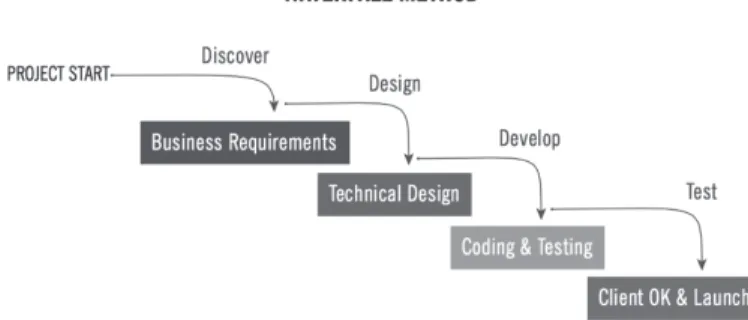
Instead of adopting the traditional “top-down” management system where every step of a project is planned and plotted on a “Waterfall Method” chart (See Figure 1), Scrum asks us to “[b]uild into [our] working method the as- sumption of change, discovery, and new ideas” (Sutherland, 2014: p. 22).
Scrum embraces uncertainty and creativity, places a structure around the learning process, and enables teams to assess what they’ve created and how they’ve created it. Th e Scrum framework harnesses how teams actually work, and gives teams the necessary tools to self-organize and rapidly improve both the speed and quality of their work. Th e idea behind Scrum is actually quite simple: Whenever you start a project, regularly check-in to see if what you are doing is heading in the right direction. Th is is called the “Inspect & Adapt Cycle”: Regularly stop doing what you’re doing, review what you’ve done, ask if it is still what you should be doing, and ask how you might do it better (ibid.
pp. 9–10). According to Sutherland: “Scrum works by setting sequential goals that must be completed in a fi xed length of time” (ibid. p. 14). But how can Scrum be applied in the EFL classroom?
Why use Scrum in EFL Instruction?
Th e use of group work is a long-established practice in EFL instruction. As Long and Porter (1985: p. 207) pointed out over 30 years ago: “Provided care- ful attention is paid to the structure of tasks students work on together, the
Figure 1: Traditional “Waterfall Method” Chart (Sutherland, 2014: p. 5)
negotiation work possible in group activity makes it an attractive alternative to the teacher-led, ‘lockstep’ mode” of instruction. In addition, group work can be used for “motivating learning and increasing the idea of pleasure through learning” (Taqi & Nowreyah, 2014: 52). Furthermore, Wichadee (2007) claims that “cooperative learning in groups results in higher achievement and more positive relationships among students” (ibid.). In fact, students “are more satisfi ed with their learning experiences in group work than individual work (Gross 1993; Springer, Stanne & Donovan 1999)” (Kondo, 2010: On- line). And given that Japanese EFL learners come from a group-oriented soci- ety, they adapt well to working in groups in the classroom. Th erefore, there is suffi cient evidence to suggest that group work is an eff ective way to enhance EFL instruction; however, Scrum takes group work to the next level.
According to Sutherland (2014: p. 34): “Scrum teams that work well are able to achieve what we call ‘hyperproductivity’” and these teams “regularly see somewhere between a 300- to 400-percent improvement in productivity among groups that implement Scrum well.” More importantly, Scrum groups
“end up more than doubling the quality of their work.” Scrum groups can achieve such success by using what is known as the “PDCA cycle (Plan, Do, Check, Act),” which can be applied “to the production of just about anything”
(ibid. p. 35), including second language acquisition. Using PDCA, groups of students plan what they are going to do (P), do it (D), check whether it did what they wanted (C), and (A), act on that and change how they’re doing things. By repeating the PDCA cycle, student groups can “achieve continuous improvement” (ibid. p. 39). Scrum brings team members together to create great things, and it requires everyone in a group to not only see the end goal, but to deliver incrementally to that goal. Scrum can help students strive for continuous improvement with a new mindset: Don’t get better once, get bet- ter constantly; Always be looking for something to improve; Never settle for where you are; Constantly try new ways to achieve improvement.
Scrum Teams
Because the “team dynamic only works well in small teams,” the instructor should keep student groups small (two to fi ve members), and keep language tasks short and simple (no more than four at a time). As Sutherland points
out, “[t]hat very large groups do less seems to be an ironclad rule of human nature” (ibid. p. 59). Once groups are formed, each team selects a leader, a
“Scrum Master,” who facilitates all of the group’s activities, ensures there is transparency among all team members, and helps the team discover what is getting in the way of them completing their English tasks and reaching their goals. Th ese tasks and goals can include setting word goals for extensive read- ing, grammatical, fl uency, listening, or writing goals. It is important to allow the teams to be as autonomous as possible. In other words, give teams the freedom to make decisions on how to take action to improve their English, but hold them accountable for their decisions. Each language task and goal should be given a time limit that must be strictly adhered to, and how the team reaches their goal is up to them. Every member of the team must actively par- ticipate to help each other complete their tasks and reach their goals.
Th is idea of student autonomy has been well-researched in EFL instruction.
As Hardy-Gould (2013: Online) states: “Learner autonomy is when students take control and responsibility for their own learning, both in terms of what they learn and how they learn it. It takes as its starting point the idea that students are capable of self-direction and are able to develop an independent, proactive approach to their studies.” Learner autonomy can also be achieved through Scrum groups where each group member, led by the Scrum Master, must decide together how to best reach their assigned learning goals. In doing so, they must reject passivity and laziness because it hurts the team’s perfor- mance. Team members are encouraged to ask themselves and each other, “Do you really want to improve your English?” and remind each other that being poor at English is a choice; therefore, each member of the Scrum group must actively decide to do better and actively achieve their group’s learning goal. In short, a Scrum team must demand greatness from itself, not the teacher.
Another benefi t of using the Scrum framework is that it encourages stu- dents to not waste time. Team members help each other fi nd the best, more time-effi cient way to study English, complete their assigned tasks, and reach their goals. How? Once again, by adopting the PDCA principle: plan, do, check and act. Scrum teams help students avoid multitasking. Team members should focus on completing one task at a time until it is done.
A Practical Use: Scrum Reading Project
Using Scrum, students are placed in teams of three to four members by the
“Chief Tadoku Offi cer (CTO),” the teacher, whose job it is to give the team a
“vision”: Read a lot, enjoy reading a lot, and succeed at reading a lot. In addi- tion, with the CTO’s help, every Scrum team appoints a “Master” who helps the team plan and manage their reading goals. Th e Scrum teams meet each week in class and create “Book Piles” in which each team member writes two
“Story Notes” of recommended books to read (See Figure 2).
On each story note, students write their name, a book they want to read, a number (1, 2 or 3) for the order they read their three books, and the word count and their reading speed (See Figure 3).
Next, students do “Reading Sprints” each week, which they manage on a
“Scrum Board.” On the board, students write each reader’s name in the
“Reader” column on the left. Students put their three story notes for the week in the “To Read” column, and these are the reading sprint goals for the week.
If a student is already reading a book, they put it in the “Reading” column (See Figure 4).
Use of the Scrum Board helps students see their reading goals and support each other. Th e board allows them to see the books they plan to read (See Figure 5) and books they have read and tracked (See Figure 6).
Figure 3 Figure 2: Story Note
Figure 4: Scrum Board
Figure 5
During every Scrum, students ask three questions about their goals: 1) What did you read last week? 2) What will you read today and this weekend?
And 3) What is slowing you down? How can you read and enjoy more? Every two weeks, the class does a “Sprint Review” in which each team reports its
results to class. Th e CTO (Teacher) asks each group three questions: 1) What went well? 2) What could be improved? And 3) How can we improve? At the end of reading sprint, students answer a simple, ten-point questionnaire that rates their confi dence in doing extensive reading (See Figure 7).
Conclusion
Based on data collected from the student questionnaires, we can determine a slight improvement in students’ reading confi dence after using Scrum (See Figure 8).
In addition, we can see improvement in student opinions about reading Figure 6
Figure 7
after doing the Scrum activity (See Figure 9).
Th e biggest improvement can be seen in increased word counts before and during Scrum (See Figure 10) among both advanced and intermediate level students (See Figures 10 and 11).
Based on these fi ndings, the author believes that Scrum can be used to benefi t all aspects of EFL instruction, not just reading, because Scrum allows students to focus on one common goal and work as a team to reach that goal in the shortest amount of time possible. In addition, it enables students to encourage each other to reach a common language learning goal, whether it be increased reading word counts, mastering grammatical structures, writing
Figure 8
Figure 9
a group research paper, or even improving listening comprehension. In short, because Japanese EFL students tend to be group oriented, Scrum off ers valu- able tools for enhancing EFL instruction.
References
Gross Davis, Barbara. (1993). Tools for teaching. San Francisco: Jossey-Bass, Inc.
Hardy-Gould, Janet. (29 January 2013). “Learner Autonomy.” Oxford University Press ELT. Online: https://oupeltglobalblog.com/2013/01/29/learner-autonomy/
Kondo, Akiko. (2010). Students’ perception of group work in EFL class. Nara Na- tional College of Technology. Online:
http://ci.nii.ac.jp/els/110008114742.pdf?id=ART0009639811&type=pdf&lang=e Figure 10
Figure 11
n&host=cinii&order_no=&ppv_type=0&lang_sw=&no=1464504199&cp=
Long, Michael H. & Porter, Patricia A. (June 1985). “Group Work, Interlanguage Talk, Second Language Acquisition.” TESOL Quarterly, Vol. 19, No. 2: pp. 207–
228. Alexandria, Virginia: Teachers of English to Speakers of Other Languages, Inc.
Scrum Alliance. (2016). Indianapolis, IN. Online: https://www.scrumalliance.org Springer, Leonard., Stanne, Mary Elizabeth, & Donovan, Samuel S. (1999). “Eff ects
of small-group learning on undergraduate in science, mathematics, engineering, and technology: A meta-analysis.” Review of Educational Research, Vol. 69, No. 1:
pp. 21–51. Th ousand Oaks, CA: SAGE Publications.
Sutherland, Jeff . (2014). SCRUM: Th e Art of Doing Twice the Work in Half the Time.
London: Random House Business Books.
Taqi, Hanan A. & Al-Nouh, Nowreyah A. (2014). “Eff ect of Group Work on EFL Students’ Attitudes and Learning in Higher Education.” Journal of Education and Learning, Vol. 3, No. 2. Toronto, ON: Canadian Center of Science and Education.
Wichadee, Saovapa. (2007). Th e eff ect of cooperative learning on English reading skills and attitudes of the fi rst-year students at Bangkok University. Conference of Languages for Specifi c Purposes in Higher Education—Searching for Common Solutions.
Brno University of Technology, Czech Republic. November 29–30, 2007.