buildings based on BIM:A case study of Qing Dynasty tea house in Guifeng Village
著者 Bai Suling, Ying Zhang, Claudia Stancanelli journal or
publication title
International Review for Spatial Planning and Sustainable Development
volume 4
number 1
page range 17‑30
year 2016‑01‑15
URL http://hdl.handle.net/2297/45043
doi: 10.14246/irspsd.4.1_17
17
Copyright@SPSD Press from 2010, SPSD Press, Kanazawa
Protection and regeneration of traditional buildings based on BIM:A case study of Qing Dynasty tea house in Guifeng Village
Bai Suling
1*, Zhang Ying
1and Claudia Stancanelli
21 School of Architecture, Fuzhou University 2 Iuav University of Venice
* Corresponding Author, Email: [email protected] Received 2 April, 2015; Accepted 18 August, 2015
Key words: Traditional Building; Protection and Regeneration; BIM; Qing Dynasty Tea House
Abstract: In the context of China's rapid urbanization, large quantities of traditional buildings are disappearing. How to efficiently and intuitively protect these traditional buildings is an important issue being faced. Taking a Qing Dynasty tea house in Guifeng Village as an example, this paper applies information collection, processing and saving in a Building Information Model (BIM) for traditional buildings. It focuses on the application of BIM in traditional buildings’ surveying and creating 3D virtual models of a tea house with Revit Architecture, in order to provide a new method for the protection and regeneration of traditional buildings.
1. INTRODUCTION
According to “Voice of China News" reporting and the relevant departments of the latest statistics it was shown that there were 3.6 million villages 10 years ago, however now only 2.7 million, with about 80-100 villages still disappearing everyday on average, including a large number of traditional villages. At present there are 2.3 million villages, but less than 5000 traditional villages with high conservation value remain, accounting for only 1.9% of the national total administrative villages (MOHURD, 2013).
Historic preservation, adaptive reuse, and sustainable urban design that considers the full range of social, environmental, and economic factors is an essential component of sustainable urban development (Lewin and Goodman, 2013). In the context of China's rapid urbanization, large quantities of traditional buildings are disappearing and their protection requires a lot of manpower and financial resources.
How to efficiently and intuitively protect these traditional buildings is an
important issue. Protection in the past consisted of recording the two-
dimensional information of traditional buildings with CAD, which was not
easy to census and arrange. The introduction of Building Information
Modeling (BIM) technology can improve the efficiency of the traditional
buildings’ protection and the protection work will be more scientific and
justifiable. BIM is a digital representation of physical and functional
characteristics of a facility. It contains geometry information, performance
and function et cetera of all components in the model. All information
throughout the project life cycle is included in a single model which includes not only the components of the model itself, but also the construction schedule, the construction process and maintenance management information (Goldberg, 2004).
This paper takes a Qing Dynasty tea house in Guifeng Village as an example and creates a model with Revit Architecture to analyse the advantage in traditional buildings’ protection and regeneration with BIM.
2. LITERATURE REVIEW
BIM was introduced to China in 2003, although late, the concepts, technologies and related software have now been recognized by people in the construction industry of China. In the near future, it will replace the current mainstream to become the next generation of mainstream software systems in the construction industry (Yang, et al., 2013). During this period, many scholars have done a lot of research on the application of BIM for traditional buildings. Combining with "Xi'an residential protection project,"
(Wang and Xue, 2007) discussed and summarized the protection of traditional buildings in new technologies and new methods, particularly the application of three-dimensional laser scanning technology and BIM. Some advantages of applying BIM to traditional building surveying are put forward regarding the aspects of data recording, sharing data models and the data counting (Sun, et al., 2014). (Wang, et al. 2014) designed an index performance function to extract quantified ancient building information models incorporating critical information with the information reuse technology based on BIM, creating an economic evaluation index. (Zhu and Wu, 2012) selected a number of different structural forms of the early extant examples of wooden architecture as a case study to make a preliminary inquiry of information model building ideas and methods based on BIM technology, analysing BIM family planning of building elements. There are also some scholars who have analysed parameter models from Revit Architecture, the core software of BIM.(Sun and Xu, 2012) from model elements, annotation symbol entity, and viewing database elements in four areas, made an overall appearance of an ancient building information model to show, focusing on the subject of the information model, model elements.
(Luo and Ji, 2009 )described the elementary methods in parametric modeling of Chinese traditional architecture based on family components, including the setting of parameters , the modeling of main structures and rooves, using the case study of Cuanjian Pavilion. In addition to the application of BIM for single buildings, Li and Xia (2012) expanded the scope of a study proposed for the study of historic district City Information Modeling (CIM), to solve the shortage of existing BIM software when applied to an urban scale.
3. PROJECT BASIC INFORMATION
3.1 Regional location
Guifeng Village is located in the northeast of Yangzhong Town, Youxi
County, Sanming City, Fujian Province, China. The village government is
only 500m away from Beijing-Fuzhou expressway in Euclidean distance
(Figure 1). The weather is mainly rainy and humid, and the village is at a high altitude, this factor affects the moisture conditions of the area. There is a large presence of springs and streams with the mountains around the north, south and east creating a barrier to the wind. The enhancement of the area make this place unique, such as its history of the buildings, agricultural land resources, rice, tea, mining, industry and the beauty of the natural landscape of the mountains surrounding the village of Guifeng.
The village streets are pedestrian only and follow the trends of soil morphology intertwining and creating tunnels between the picturesque stone houses, earth and wood. The access to the village is a road under construction and currently in clay from which you reach the square/parking area, and the tea house of this study is located in the middle of the village, close to the main stream (Figure 2). This house has two access points, one on the north facade as the main entrance, and the other on the west side as a point of secondary and service access.
Figure 1. The position of Guifeng Village
Source: The protection planning design of Guifeng Village, 2014
Figure 2. The position of the tea house in Guifeng Village, drawn by the author
3.2 Historical evolution
Guifeng Village has a long history lasting more than 760 years. Because of the main surname Cai, Guifeng was once called "Cai Ling." Later, there was an official road from Youxi to Fuzhou through here, and it was the only transit station and accommodation for Youxi dignitaries, merchants and hawkers to and from Fuzhou. Then, Guifeng quickly flourished and became also known as "Little Fuzhou"(Jin, 2012).
The tea house of this project belonged to the Cai family, and there was a time in the Qing Dynasty when the front house was used as a teahouse mainly for people passing by. They would buy a cup of tea to drink, or mainly bring the homemade local tea back home. They were rich people when the house was built, but not so rich after the 1960s to nowadays. There used to be five families living there at most. This house has never collapsed or been burnt. It has been repaired twice, once was in the late Qing Dynasty and the other was in the 1970s or 1980s. After that, it began to be ruined. In 2000, the village government organized repairing this building for tourism, but it was interrupted because of lacking funds.
The tea house shows the features of buildings in the past. The shape of
the roof, the position of the stairs, the structural composition and so on was
due only to the ability of craftsmen and builders. It consisted of two
rectangular buildings, which are not in the same horizontal position (Figure
3). The rooms beside the road were shops and rooms on the floor above were
used for storage and service. The halls on two floors of the back house were
for public use, and the shrine in the hall on the first floor was for worshiping
ancestors, other rooms were bedrooms.
Figure 3. Photos of tea house
4. APPLICATION OF BIM IN TRADITIONAL BUILDING INVESTIGATION OF PRESENT SITUATION
The approach of traditional buildings’ protection should follow the principle “first rescue those important traditional buildings which have endangered structural and hidden safety trouble”, then diagnose its structure and develop programs about restoration and renovation (Zhang, et al., 2008).
The present situation investigation of traditional buildings is a very important part of the process and initial survey is often done to better understand the building.
4.1 Drawing the surveyed data of tea house
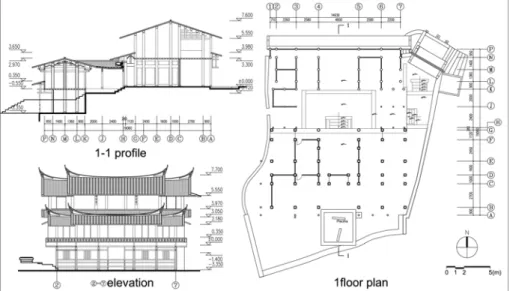
We generally choose a hand-held laser rangefinder for surveying or 3D laser scanner if the buildings are valuable heritage. Drawing the surveyed data of the tea house with CAD means drawing a projection of each side of the building. In this way, we first draw two-dimensional projections of each side of the tea house, then mark the measurement data on a draft. Since the recording of the data is intensive, different projections are generally drawn by different people, finally forming a set of drawings (Figure 4). Because different people process the surveying data in different ways, it is prone to problems such that different drawings’ data cannot be connected. Elevation and profile contains a large number of components, such as brackets, pillars, beams and others, so it is very tedious and prone to error when drawing the elevation and profile.
Figure 4. The CAD drawings of tea house
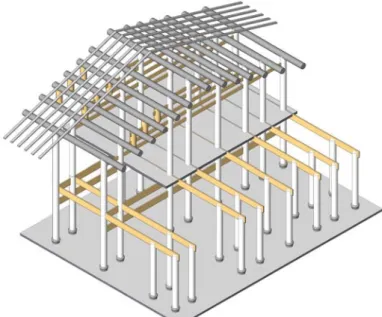
BIM is based on three-dimensional graphics, and it eliminates the process of drawing two-dimensional projections, avoiding the drawing of erroneous projections and bringing inconvenience for the paradigm shift of mapping personnel between two- and three-dimensions. It is not like CAD’s division of labour in accordance with plane, elevation and profile, but according to the division of the building components. For example, when the beams and pillars structure of the tea house are drawn, first of all we draw a beam and a pillar, then we define each of the major data for the corresponding length, width and height attributes, finally, these data will appear in the list of family type. Other beams and pillars can directly be quoted from their respective component family in the repository, and record information by directly entering the property value. With some simple operations in the plane and elevation, BIM builds a 3D model directly from the data information (Figure 5). Because all of the projections are different ways to express the same information model, BIM does not show inconsistencies between plane and elevation, and modeling itself is equivalent to the data collation. If we want to receive a two-dimensional view, we only need a few simple operations such as marking elevation, sectioning and so on, then it will automatically generate the desired view (Sun, et al., 2014).
Figure 5. The 3D models of the tea house’s beam and pillar structure
4.2 The visualization of information
For traditional buildings, they carry a lot of information. In addition to the size of the data, a great deal of non-data information is important, such as the background of the relevant building, damaged levels of components, and the cultural information of the building. Before building the model of the tea house, we can organise the current situation issues table of the tea house’s pillars and beams through field research (Table 1). Through this table of photos and text, we can know the main damage of the tea house’s structure.
This qualitative data information reflects all the problems about the tea
house in its experience of the changing times, which included both natural
and man-made disasters.
Table 1. Current situation issues table of pillars and beams Issues Picture Description
Shrinkage cracks in the wood
The shrinkage cracks cause structural problems naturally occurring in the wood when it is dehydrated after its implementation; the change in temperature as in this case may enhance this phenomenon.
Deep shrinkage cracks or breaks
In the case of continuous and rapid changes in temperature and/or when the column is subjected to excessive weight loads, deep fissures are created in the wood till the break of the carrier occurs. Rupture is a normal stress for an axial load.
Deformation in buckling
The deformation of the load-bearing column is due to natural factors; the wood presents axial deformations in Y-axis. Or is deformed due to the load. Other deformations and/or swelling can be caused by moisture.
Rattan laces The connection with rattan is used to reinforce the pillar in the intersection with one or more beams. Most of these laces are destroyed by insects and they had no more function.
Shrinkage for beam insertion
Fractures and vertical slits are to be attributed to the adaptation of the wood for the insertion of the vertical element. With moisture, permanent load and other factors such as xylophagous insects, the problem can be accentuated requiring new supports within the column to support the beam.
Missing parts The lack of parts or elements in the entire column can be attributed to two factors, anthropological, where parts have been removed to be replaced, or due to erosion by fungi and insects. In both cases, the replenishing of these elements should be implemented.
New wood/new addition
The replacement of whole carriers was accomplished without paying attention to the study of the existing case- pillar prospectus South Regarding the restoration of contact between column and base in the case of failures, the operation was carried out in an approximate way without solving the underlying problems.
Decay fungus white/brown
(Synonym: rot) Degraded wood caused by fungi that causes progressive loss of mass, mechanical strength, hardness and generally also variations in colour and appearance. These fungi can be active only if the wood has higher moisture of (18-20%). The type of decay is found by its white fibrous appearance and bleached wood and brown rot.
Holes, flicker of wood eating insect
Animal or vegetable organism that procures their nourishment from the wood. The holes created by these insects are particularly common and can give rise to structural problems and missing parts.
Gallery of insects on the surface
Gallery built by insects (usually by termites) with different material (dirt, excrement, etc.). Attached to the outside of the building to move from one area to another.
Mould This term is used generically to indicate superficial mycelial growth of fungi, typically in environmental conditions of high humidity.
Moss They occur when there is plenty of water and may become black when there is poor lighting, and otherwise turn green.
They have behaviour similar to other plant species, as they procure physical degradation when the root system penetrates deep into the cracks and produces a chemical degradation by substances secreted from the roots.
Smoke and carbonization
The presence of smoke and carbonization is due to rituals that were using smoke for the ancestral hall, and is also found in areas used for food preparation. The phenomenon is manifested by the blackening of smoke particles. The focus of this was too close to the structures and has resulted in a superficial carbonization of wood.
Metal element
Presence of metal elements such as nails inconsistent and unnecessary from the structural point of view for the functional building. Their position is probably due to the necessity of hanging candle lamps or furniture.
Surface erosion
Disrupted surface due to removal of small fragments from the wood surface, by various factors, such as rubbing of solid bodies, or impact of particles carried by the wind or liquid streams. Sometimes it is differentiated between those areas of spring wood and late wood, according to their relative hardness.
Humidity Amount of water contained in the wood, expressed as a percentage by mass dry weight of the wood itself. Being highly hygroscopic, the wood can exchange moisture with the surrounding air, and can also absorb water, which may be in contact.
Exposure to UV rays
Factor of degradation of the wood surface, which if exposed for long periods has surface discoloration (graying) and micro-cracks by ultraviolet radiation (through photo- oxidation processes and depolymerisation), and infrared radiation (by heating).
Efflorescence Training superficial appearance of crystalline or powdery or stringy, usually whitish in colour.
BIM's system of information input is completely dependent on the model, and process modeling is the process of information input (Sun and Xu, 2012). When building the models of the tea house’s beams and pillars, except for the data information, we input the above table about structural degradation, alteration and degradation of the material and so on at the same time. The family model comes with a system containing perfect parameter mechanisms for designers inputting, but the family model that we build ourselves can allow adding of the needed information to the properties dialog box of components. According to the classification of the current situation issues table, we input the specific attribute of each beam and pillar, and then the system will automatically generate the current situation attribute table of beams and pillars (Figure 6).
Figure 6. The interface of Revit model
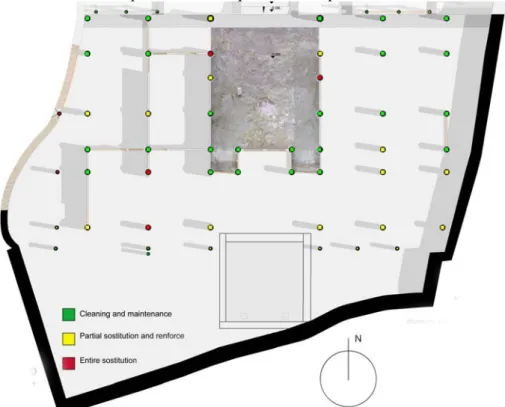
After knowing the current situation attribute of every beam and pillar, we can get the appropriate disposal measures for the pillars on the first floor, such as cleaning and maintenance, partial substitution and reinforcement or entire substitution (Figure 7). Traditional architecture is made up of a large number of complex wood components mainly. In the building regeneration process, different treatment means treating different situations of members, and the problem most of the members faced are complex. Developing targeted measures needs scientific statistical analysis. For example after inputting information to each component according to the current situation issues table (Table 1), BIM can build up an information table to help find the key issues. Then we can summarize the corresponding proposals which are suitable for traditional buildings in the countryside (Table 2), and combine them with each component in the implementation process.
Figure 7. The appropriate disposal measures of the pillars on the tea house's first floor Table 2. The intervention proposals
Metallic elements incoherent
Mechanical removal of the elements that are damaged by oxidation of the woody parts, using cleaning solvents with surfactants.
Solution for the glue on wooden elements
Removal with hot steam and scraping off the glue and paper with a plastic spatula, if necessary with sandpaper.
Removing paint from plaster and graffiti
Hydroxide sodium or hydroxide potassium. Pack with absorbing substances such as talcum powder.
Solution for black smoke on wood elements
Clean the stained surface with a cloth dampened with a mild solution of soapy water, rinse well with clean water and dry immediately passing the oil.
Moss Remove with a rubber spatula and water, if it were not enough, use chemical biocides.
Intervention for white or brown fungus
Eliminate or reduce the problem of moisture through the drying or forced ventilation, remove the contaminated area and two coats of fungicide spray at a distance of at least two meters for destroying any spores in the air.
Intervention for xylophagous insects
Treatment micro-node, natural, is based on heating at 55°C of the entire trunk, allowing the killing by dehydration and hyperthermia of woodworms. The most severely damaged parts should be removed
and replaced with wood previously treated against insect attack.
Treatment with permethrin-based solvent. Preventive treatments will be carried out with boron salts.
Mould Do not cause structural damage but create aesthetic problems, can be removed with simple cleaning bleach and water or any antiseptic treatment such as chlorine. For the most affected areas it is okay to use sanding or sandblasting.
Salinity and efflorescence
Ascent or descent by capillarity is formed by salts. Remove steam with muriatic acid distilled in water, 1:12. You can also use wraps with the solution to dissolve the salts, use packs of paper. Give hand protection with natural oils or acrylics. Done every two years, every four with natural acrylics.
Weathering and UV protection
Sandpaper and remove dust. Dealing previously with wood with a coat of water-repellent treatment to protect it better. Use of oils such as linseed oil or oils in the acrylic latex.
5. APPLICATION OF 3D VIRTUAL MODEL IN TRADITIONAL BUILDINGS
5.1 The 3D design scheme
The purpose of the regeneration of the tea house is due to the importance and strategic location of this within the village for tourism purposes and the promotion of local products of the village. Being a predominantly agricultural village and having experienced first-hand the dishes of the place there is a good idea that the tea house should have the function of restaurant but most of all it should regain its original function as a tea house and a meeting place of passage.
The following is the design scheme. The second floor will function as the tea rooms with divisions intact. On the ground floor, the underside of the tea rooms will be used as exhibition space, the topics will vary from the history of Chinese tea to the beautiful landscape paintings of the historical personalities of the village; the space in front is clear of furniture and seating is provided to observe the village overlooking the Shen Gui creek. The floor below ground will be used as shops selling local crafts and tea (Figure 8). It is from this desire to want to reopen house shops to the public, a better location could not be found if not in direct contact with the road along the creek. So in a way it flows back to the original interior of the house with shops open and in addition it is necessary to remove the thin expansion of the existing port entrance and add a new port.
Conducting the protection and restoration of traditional buildings just by providing text descriptions will make the owner confused, and most of them do not want to protect the traditional buildings because they can’t see what the traditional buildings will become in the future. Now, they can easily know the design ideas of the project by 3D virtual model, the partition function, the restoration of structure, the roof and so on (Figure 8). Except for the overall isometric drawings of the buildings, BIM also can provide any corner of the virtual reality scene of the traditional buildings (Figure 9).
BIM can create an immersive visual, and it automatically generates an image
from the height of human sight (Figure 10).
Figure 8. The 3D virtual model of tea house
Figure 9. The virtual scene of tearoom
Figure 10. The interior scene model of tea house
5.2 The specific practices of components
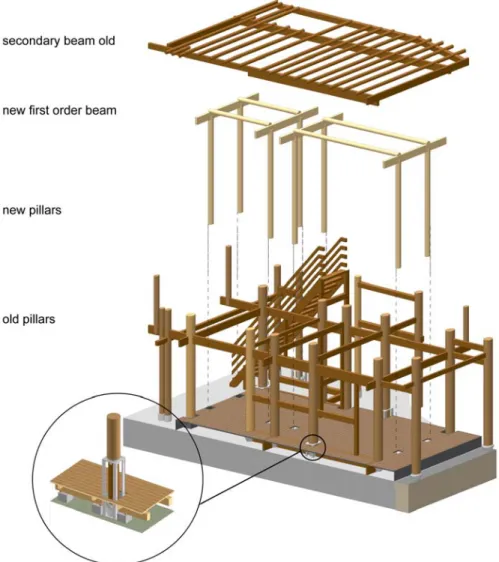
We can understand the construction steps of traditional buildings from the station base to the roof, and it is easy to know the changes of the pillars and beams in the tea house with the information model. In this case, considering the integration of partial pillars, problems are more concentrated in the base of the pillar so proposed integration with removal of the damaged part, using a new steel structure is practical. Some cases of strong deformation and cracking will be eased with the creation of new unions and increasing the cohesion of the element itself, which can hoop with root or for more severe cases of carbon fibre. Second, we replace entire bearing elements. Due to the severe cracking they should be fully replaced, the replacement of the central elements is also required because there are no masonry unions preventing its removal. Finally, construct the new structure for beams. Some rooms on the second floor present fragile resistance, with the support of two new beams and pillars that depart from the floor below, we will be able to keep the beams excessively not consumed by degradation to lay new flooring (Figure 11).
Figure 11. The specific practices of components in tea house
BIM makes the progress of drawing the plane, elevation and profile simple and visual. It expresses the approach of components more intuitively.
For the new steel section of pillar for example, we cut the decaying wood of
the pillar and temporarily hold it stable with media that anchor the pillar at
the upper end below the slab inter-story, then we weld the base plate with the
L profiles, place it below the stone plinth, bolt the plate above the L profiles previously welded to the supports and spike the pillar’s ancient elements arranged below the upper plate. At last we glue the supports for the glass to the L and the glass glue on supports. L-shaped elements and glass will be previously dimensioned to fit the corrupted part of the pillar (Figure 12).
Figure 12. The new steel of pillar in tea house
5.3 Other applications of the information model in traditional buildings
There are other functions of information modeling in the current situation of traditional buildings, such as the economic evaluation of protection projects, information sharing of traditional buildings, data docking with the three-dimensional laser scanner and so on. In addition to enhancing the visualization of traditional buildings, there are some features very important for the protection of traditional buildings that can be demonstrated with the 3D model of BIM, such as the simulation of disaster response, virtual construction and docking with ecological software, et cetera (Zhao, et al., 2012).
6. CONCLUSION
Traditional buildings often use comparatively low energy and durable materials, and traditional neighbourhoods are often characterized by density, short distances and mixed use, which make them a relatively efficient model of sustainable development. Therefore, the protection and regeneration of traditional buildings can play a pivotal role in the sustainable development of the city (Zhang, et al., 2015). Faced with a wide range of traditional buildings, we cannot always use the previous method of protection, so the introduction of BIM is very meaningful. It can completely replace the traditional survey drawings as design and construction data can be archived for inspection at the time of the traditional building’s repair in the future.
Relying on the recording of components’ size and process data of traditional building information modeling, we can repair or replace the residual components. Based on the record of components’ size and material data of the information model, we can also make the missing components based on the original.
In the practical application, BIM still has existing issues that need further
exploration and solutions: First, its popularity is low, and most people
cannot use Revit modeling. Second, the information model of BIM contains
a large amount of information, so different departments of the project need to cooperate with each other, which is a test for the project management.
In this paper, the applications of BIM in traditional buildings are explored, referring to the Qing Dynasty tea house in Guifeng Village. There are still many shortcomings in the building information modeling because of the time and technology limitations. Focusing on the application of BIM in traditional building surveys and 3D virtual modeling, there will be a more in- depth study following up.
ACKNOWLEDGEMENTS
This work is supported by 2012 National Science and Technology Support Program of China (No.2012BAJ14B05) and the National Natural Science Foundation of China (No.51278123).
REFERENCES
Goldberg, H.E. (2004). “The building information model”, CADalyst.Eugene, (21), 56-58.
Jin, F.H. (2012). “Analysis on the inspiration that comes from colour composition elements for the urban colour design, taking Guifeng Village in Sanming Youxi County of Fujian Province as the example”, Art and Design, (09), 89-91.
Lewin, S.S. and Goodman, C. (2013). “Transformative renewal and urban sustainability”, Journal of Green Building, 8(4), 17-38.
Li, W.P. and Xia, Q. (2012). “Research of historic district integrated safety based on BIM”, Tianjin University.
Luo, X. and Ji, G. H. (2009). “On parametric modeling of traditional Chinese architecture based on family component of Revit Architecture”, Chinese and overseas architecture, (8), 42-44.
MOHURD. (2013). “Accelerate the demise of traditional villages, 1561 Protected”, http://www.mohurd.gov.cn/zxydt/201310/t20131021_215934.html
Sun, W.C, Wang, W.B., et al. (2014). “Advantages of applying BIM to ancient building surveying”, Theory of Urban Construction (The electronic version), (8).
Sun, W.C. and Xu, Z. (2012). “An approach to the system of ancient building information modeling based on Revit Architecture”, Tianjin University.
Wang, C. and Xue, Y. (2007). “The application of new technologies to protect traditional buildings”, ShanXi Architecture, 33(22), 28-29.
Wang, R., Zhang, X. et al.(2014). “The Research of economic evaluation of traditional buildings’ protection project based on BIM”, Construction Economy, (6), 110-114.
Yang, F., Zou, H., et al. (2013). “The comparative analysis of Building information modeling (BIM) and traditional CAD”, Shenyang Academy of Sciences Annual Meeting.
Zhang, Y., Shen, S.J., et al. (2008). “Protection and improving human habitation environment of Puyuan Village, with concept of concrescence”, Architectural Journal, (12), 46-49.
Zhang, Y.Y., Zhang, Y., et al. (2015). “3D laser scanning technology-based historic building mapping for historic preservation --a case study of Shang Shu Di in Fujian Province, China”, International Review for Spatial Planning and Sustainable Development, 3(2), 53- 67.
Zhao, J.X. , Jiang, L., et al.(2012). “The possibility of application of BIM technology in the protection of heritage buildings”, Journal of Information Technology in Civil Engineering and Architecture, 4(1), 43-46.
Zhu, L., Wu, C. (2012). “Practice analysis on early ancient Chinese wooden structure Building Information Modeling (BIM)”, Tianjin University.