福島県立医科大学 学術機関リポジトリ
This document is downloaded at: 2021-11-08T01:53:46Z
Title 単相性4連発磁気刺激法の効果に対する、被験筋の随意
収縮の影響についての検討( 本文 )
Author(s) 門脇, 傑
Citation
Issue Date 2015-09-28
URL http://ir.fmu.ac.jp/dspace/handle/123456789/479
Rights
This is the preprint of the following article: "Clin Neurophysiol. 2016 Feb;127(2):1568-1573. doi:
10.1016/j.clinph.2015.10.063. © 2015 International Federation of Clinical Neurophysiology".
DOI
Text Version ETD
Influence of Phasic Muscle Contraction upon the Quadripulse Stimulation (QPS) Aftereffects
(単相性 4 連発磁気刺激法の効果に対する,被験筋の随意収縮の 影響についての検討)
Suguru Kadowaki
Fukushima Medical University, Department of Neurology
Summary (論文概要)
ヒトの大脳皮質の生理的機能を検討するために,大脳皮質の電気刺激が行われる.
そのためには従来,外科的に開頭して直接脳を電気刺激したり,経頭蓋的に高電圧で 電気刺激したりする手法が用いられていたが,前者は手術中の患者にしか行えず,後 者は強い疼痛があり侵襲が大きいことなどが問題であった.その後 Barker らにより開 発された経頭蓋的磁気刺激法(transcranial magnetic stimulation: TMS)は,頭皮上 に置いたコイルに電流を流すことで電磁誘導の原理により頭蓋内に電流を誘導できる 手法であり,これを用いて非侵襲的にヒトの大脳皮質を電気刺激することが可能とな った.更に,TMS を反復して大脳皮質に与える(反復経頭蓋磁気刺激,repetitive TMS:
rTMS)ことで,ヒトの大脳皮質の興奮性を長時間にわたり変化させることが可能であ る.これは大脳皮質のシナプスにいわゆる長期促通(long-term potentiation: LTP)
や長期抑圧(long-term depression: LTD)類似の効果を誘導していると考えられてい る.これを用いて,ヒトの大脳皮質の生理的機能についての検討や,各種の神経疾患 の治療,特にリハビリへの応用が盛んに研究されている.rTMS では従来一定のリズ ムで磁気刺激を行う方法が用いられていたが,より強い可塑性誘導効果を求めて末梢 神経の電気刺激と単発磁気刺激の組み合わせを反復する方法(paired associative stimulation: PAS),高頻度刺激の burst をθ帯域のリズムで反復する方法(theta burst stimulation: TBS)などが開発され,また磁気刺激以外にも,LTP,LTD 類似の効果 を誘導する別の電気生理学的な手法として経頭蓋的直流電気刺激法(transcranial direct current stimulation: tDCS)などが用いられているが,これらの手法による刺 激後効果は様々な要因により大きな影響を受ける.例えば rTMS や tDCS の効果は,
ヒトのシナプス可塑性に関る脳由来神経栄養因子(brain derived neurotrophic factor: BDNF)の多型により大幅に異なると報告されている.また,rTMS の刺激後 効果については,特に脳の一次運動野を刺激した場合,その領域の刺激によって四肢 に誘発される筋の筋電図の振幅を以て論じられることが多いが,この被験筋を rTMS の刺激前,刺激中,あるいは刺激後に随意的に収縮させると,rTMS の効果が増強し たり,消失したり,あるいは反転したりするなど,時には極めて大きな影響があると 報告されている.このためこれらの刺激効果の解釈は時に難しく,更に rTMS を患者 の治療に用いようとする場合,刺激前後に患者が筋を収縮させることで刺激効果が大 幅に変動してしまう可能性を示唆しており,重要な問題点であった.一方,我々が開 発した単相性 4 連発磁気刺激法(quadripulse stimulation: QPS)という手法は,従
来の刺激法に比してシナプス可塑性を長時間誘導でき,BDNF の多型にも影響されな いことが示されており,その可塑性誘導効果が強固である.そこで本研究では,QPS の刺激後効果は他の刺激法と同様に,被験筋の随意収縮により影響を受けるのか否か についての検討を試みた.
研究は 13 名の健常人(26 歳〜61 歳:平均 36.3 歳)を対象として行われた.単相 性磁気刺激装置(Magstim 200: イギリス Magstim 社製)に 8 の字型の刺激コイル を接続し,まず初めに右手の第一背側骨間筋(first dorsal interosseous muscle: FDI)
に最も高振幅な筋電図(motor evoked potential: MEP)を誘発できる左大脳運動野 上の領域(motor hot spot)を頭皮上から同定し,以後の実験における磁気刺激部位 とした.引き続き,被験筋に弱い随意収縮を行いながら motor hot spot を刺激し,半 分 の 確 率 で MEP を 誘 発 で き る 刺 激 強 度 を 定 め , 運 動 収 縮 閾 値 ( action motor threshold: AMT)とした.QPS は単相性の 4 連発磁気刺激のトレインを 5 秒間隔で 30 分間にわたり反復する手法である.このために 4 台の単相性磁気刺激装置を連結し,
接続されたコンピュータのソフトウェアによって,4 台から出力される 4 連発刺激パ ルスの 1 発毎の間隔(inter stimulus interval: ISI)を設定する.QPS の効果は ISI に 依存し,ISI が比較的短い場合は LTP 様効果,ISI が比較的長い場合は LTD 様効果が 誘導される.ISI が 5 ms の時(QPS-5)に QPS の LTP 様効果が最大となり,ISI が 50 ms の時(QPS-50)に LTD 様効果が最大となることが過去の検討により判明して いる.そこで,今回は QPS-5,QPS-50 の 2 刺激条件を用いた.この 4 連発の刺激を,
5 秒間隔で 30 分(合計 1440 発)行う.QPS の刺激強度は従来用いられているものと 同様,先に定めた AMT の 90%に設定した.QPS による皮質興奮性の変化は,右 FDI に対する左運動野の motor hot spot の磁気刺激によって誘発される右 FDI の MEP の 振幅によって評価した.
今回の研究で QPS の刺激後効果に対する影響をみた運動タスクは,1 分間の右手の 随意的な開閉運動である.被検者はメトロノームの音のガイド下に 1 秒間に 1 回のリ ズムで右手の開閉運動を行った.まず初めに,Exreriment 1 ではこの運動タスク自体 が MEP に与える影響を検討するため,6 名の被検者において右手の開閉運動だけを行 い,その後 60 分にわたって右 FDI の MEP を反復して測定した.MEP の振幅を 1 要 因の分散分析により検討したところ,60 分間にわたり上記の運動タスクによる MEP 振幅の変化はなかった.
続いて,Experiment 2 と 3 では QPS-5 と QPS-50 の刺激終了直後に右手の開閉運 動を行い,60 分間にわたって MEP を反復して測定し,刺激後効果に対する随意運動
の影響をみた(被検者はそれぞれ 7 名,9 名).刺激のパターン(QPS 単独 vs 随意 収縮あり)および QPS 後の経過時間について,2 要因の分散分析を行い,MEP 振幅 に対する筋の随意収縮の影響を検討した.QPS の直後に右手の開閉運動を行うと,
QPS-5 の LTP 様効果と QPS-50 の LTD 様効果はいずれも消失した.最後に,
Experiment 4 および 5 では QPS-5 と QPS-50 の刺激終了 20 分後に右手の開閉運動 を行い同様の検討を行ったところ,QPS-5,QPS-50 のいずれにおいてもその効果が減 弱する傾向が見られたものの,その影響は一過性に留まり,最終的な QPS の効果は保 たれていた.
Experiment 1 の結果から,今回我々が用いた運動タスクはそれ自体では MEP を変 化させないことを確認しているため,Experiment 2 から 5 における FDI の随意収縮 の影響は,単に QPS の効果の上に被験筋の随意収縮による MEP 変化が重畳したもの ではないと言える.あるシナプスに LTP や LTD が誘導された後に,引き続き何らか の刺激が行われた場合,既に誘導された LTP や LTD が消失するという現象が知られ ている.この現象は,脱促通(depotentiation)や脱抑圧(de-depression)と呼ばれ る.例えば海馬における LTP は記憶のメカニズム,depotentiation はその消去のメカ ニズムと考えられている.また,depotentiation や de-depression のための刺激は,
先行する LTP や LTD が誘導された後なるべく早く行う方が,depotentiation や de-depression の効果が高く,LTP や LTD の誘導後に長い時間が経過すると LTP や LTD は強化され,その後からそれを消去するような刺激をしても depotentiation や de-depression は 起 こ り に く い と 報 告 さ れ て い る . 即 ち LTP/LTD の depotentiation/de-depression が有効に起こる time window があると言われている.
我々の結果は,この知見と非常に良く合致しており,QPS の効果は被験筋の随意収縮 により depotentiation や de-depression を受けたのだと考えられた.
rTMS はヒトの大脳皮質の生理機能の検討や,神経疾患の非薬物治療のために頻用 されており,QPS も同様である.QPS をこれらの目的で応用する上で,その刺激効果 を正しく解釈するため,あるいは疾患の治療として用いた場合にその効果を計画的に 発現させるため,QPS の刺激直後には筋の安静を保つことが重要であることを示唆す る結果である.
Contents
Title p. 1
Summary p. 2
Contents p. 5
Abstract p. 6
Introduction p. 7
Methods p. 9
Results p. 13
Discussion p. 16
Conclusion p. 19
References p. 20
Figure and Figure legends p. 23
Acknowledgement p. 27
Abstract
[Objective]
Muscle contractions of the target muscle influence the aftereffects of repetitive transcranial magnetic stimulation (rTMS). The aim of this study is to investigate whether or not the aftereffects of quadripulse stimulation (QPS) are influenced by voluntary muscle contractions similarly to other rTMS protocols.
[Methods]
Thirteen healthy volunteers participated in this study. After QPS-5 or QPS-50 intervention over the motor hot spot for the right first dorsal interosseous muscle (FDI), the subjects performed motor task (opening-closing right hand movements at 1 Hz for 1 min). We compared the time courses of MEP size between the conditions with and without voluntary contraction.
[Results]
When the subjects contracted the FDI muscle immediately after the QPS, both QPS-5 and QPS-50 aftereffects were abolished continuously. If they contracted the FDI muscle at 20 min after the QPS, however, the long-term aftereffects were preserved.
[Conclusions]
The QPS aftereffects are influenced by the voluntary muscle contraction of the target muscle applied after QPS, but the magnitude of the influence depends on the time interval between the contraction and QPS.
[Significance]
In the interpretation of QPS experiments, we should always mind the fact that the voluntary contraction of the target muscle seriously influences the induced long-term effects.
1. Introduction
Repetitive transcranial magnetic stimulation (rTMS) is able to induce long lasting excitability changes in the human motor cortex, which are analogous to the synaptic plastic changes: long-term potentiation (LTP) or long-term
depression (LTD). Patterned rTMSs, such as paired associative stimulation (PAS) and theta burst stimulation (TBS), or transcranial direct current stimulation (tDCS) can also induce these effects (Stefan et al., 2000; Nitsche and Paulus, 2001;
Huang et al., 2005). These aftereffects, however, can be readily modulated by various confounding factors (Ridding and Ziemann, 2010), one of which is the contraction of the target muscle. Ziemann and his colleagues (2004) reported that ballistic thumb movements prior to PAS converted its LTP like aftereffect to LTD and enhanced the LTD like aftereffect. Gentner et al (2008) demonstrated that preceding continuous isometric contraction of the target muscle reversed continuous TBS (cTBS) LTD like aftereffect to LTP like effect. Iezzi et al. (2008) reported that phasic voluntary finger movements administered before TBS reversed their aftereffects bidirectionally. The modulations shown above are usually explained by the metaplasticity. Moreover, some previous studies demonstrated that muscle contractions during or after plasticity-inducing protocols influenced their aftereffects. Huang et al. (2008) reported that static muscle contractions during TBS abolished both facilitative intermittent TBS (iTBS) aftereffects and depressive cTBS aftereffects. When the muscle contractions were applied immediately after TBS, it enhanced the iTBS LTP and reversed the cTBS LTD to LTP. They also reported that muscle contractions applied 10 minutes after cTBS transiently weakened its depressive aftereffects for a few minutes.
Thirugnanasambandam et al. (2011) reported that isometric voluntary muscle contraction immediately after tDCS abolished both the anodal tDCS induced potentiation and cathodal tDCS induced depression. They considered that these are produced by depotentiation and de-depression mechanisms. The fact that rTMS or tDCS aftereffects are readily modulated by the target muscle contraction after these interventions is a serious problem for the interpretation of rTMS or tDCS experiment results, especially in its therapeutic application. Therefore, it is important to elucidate how the voluntary movements influence the plasticity
induction effects in humans.
Hamada et al. (2007) reported a novel patterned rTMS method:
quadripulse stimulation (QPS). This method can induce bi-directional cortical excitability changes (Hamada et al., 2008). Its effects continued longer than other rTMS protocols, and they were unaffected by brain derived nerve growth factor (BDNF) polymorphism (Nakamura et al., 2011) in contrast to the drastic influence of BDNF polymorphism on rTMS or tDCS aftereffects (Cheeran et al., 2008; Antal et al., 2010). Two factors may explain this robustness of QPS to several
confounding factors. One is that QPS uses monophasic pulses for stimulation. The activated population by monophasic pulses may be more specific than those by usually used bi-phasic pulses. Another big difference is the duration of the intervention. QPS takes 30 minutes and the others at most a few minutes,
especially cTBS for one minute. Some cascade for the plasticity induction should have been on going at 30 minutes after the beginning of the intervention. We suppose some process have started and some of them have been finished at 30 minutes from the beginning. The longer duration of the intervention on its own may partly explain the robustness of QPS to several confounding factors as compared with other rTMS protocols. In the present paper, we studied influences of the target muscle voluntary contraction on the QPS aftereffects.
2. Methods 2.1. Subjects
Thirteen healthy volunteers (26 to 61 years old; mean age 36.3)
participated in the present study. Seven of 13 subjects participated in more than one experiment. They had no contraindications to TMS and provided written informed consent to take part in the present study. The experiments were performed according to the Declaration of Helsinki; the procedures were approved by the Ethics Committee of Fukushima Medical University (receipt number: 1427). In each subject who took part in several experiments, two
successive experiments were separated by at least one week. No side effects were noted in any individuals.
2.2. MEP recording
Subjects were seated in a comfortable armchair during the experiments.
Electromyograms (EMGs) were recorded from the right first dorsal interosseous muscle (FDI) (filtered between 16 - 3000 Hz and sampled with 20 kHz) using Ag-AgCl electrodes placed in a conventional belly-tendon arrangement. EMGs were input to a personal computer running TMS Bistim Tester software (Medical Try System, Japan) through a multichannel amplifier (MA-1000; TEAC, Japan) for offline analyses. In order to record motor evoked potentials (MEPs), single TMS pulses were applied to the left motor cortex with a 70 mm diameter figure-of-eight coil (The Magstim Co. Ltd, Whitland, Dyfed, UK) combined with a monophasic magnetic stimulator (Magstim 200; The Magstim Co. Ltd). The coil was placed tangentially on the scalp in a direction in which electric current was induced from lateral-posterior to medial-anterior in the motor cortex. The right FDI motor hot spot was defined as the optimal site for eliciting the largest MEP. The stimulation intensity was adjusted to elicit MEPs as large as 0.5 - 1 mV in the relaxed
condition. Before each intervention, voluntary muscle contraction or QPS (its details are described below), to obtain the baseline MEPs, we recorded 20 MEPs using single TMS pulses every 4.5 - 5.5 seconds (MEPpre). At each time point after any intervention, 20 MEPs were also recorded in the same way (MEPpost). The cortical excitability was estimated by the "MEP size ratio": the ratio of the
peak-to-peak amplitude of MEPpost to that of MEPpre.
2.3. Quadripulse stimulation (QPS)
QPS consists of 360 bursts of four monophasic TMS pulses separated by different inter-stimulus intervals (ISIs). The burst was regularly repeated in every 5 seconds for 30 minutes. Four monophasic magnetic stimulators were combined with a specially customized module (The Magstim Co. Ltd) to deliver four
consecutive monophasic TMS pulses through one figure-of-eight coil. Hamada et al. (2008) reported that the direction of QPS induced motor cortical excitability changes depended on the inter-stimulus interval (ISI) of TMS pulses. When the ISI is relatively short (≤ 10 ms), QPS induces potentiating aftereffects, and when relatively long (≥ 30 ms), it induces depressive aftereffects. We employed QPS-5 (ISI = 5 ms) for LTP like effect induction and QPS-50 (ISI = 50 ms) for LTD like effect induction because they were most effective (Hamada et al, 2008). The intensity of TMS pulses for QPS was set at 90% of active motor threshold (AMT).
The AMT was the lowest intensity to elicit MEPs in the right FDI at least 100 µV to five of ten consecutive TMS pulses while the subjects maintained weak voluntary contractions of the target muscle (right FDI). The time points for MEP recordings after the intervention were every 5 min until 30 min, and every 10 min until 60 min (see Fig. 1). As control experiments, we performed usual QPS-5 and QPS-50 experiments (called as QPS-5 alone and QPS-50 alone sessions).
2.4. Voluntary contraction (VC) of the target muscle
In the present study, we used a repetitive opening-closing cyclic movement of the right hand (named “VC”s) applied after the QPS intervention.
Subjects were seated in a comfortable armchair and placed their right arm onto the chair arm. During the VC intervention, subjects were instructed to perform opening-closing movement of their right hand at 1 Hz guided by a metronome sound for 60 seconds. We chose this task instead of simple right index finger abduction because of its easiness and lack of fatigue after internvention. Another merit to use this task was no considerable effects on MEP by the voluntary contraction alone (shown below).
2.5. Experimental paradigm (Fig. 1)
2.5.1. Experiment 1: Effects of the voluntary muscle contractions given alone (VC alone)
Six subjects participated in this study. First, 20 MEPs (MEPpre) were recorded for the baseline. Then, subjects performed the voluntary muscle
contractions (VC: 60 cycles of opening-closing) for one minute, and 20 MEPs were recorded immediately after the voluntary movements. MEPs were repeatedly recorded at 2 min, 5 min and every 5 min until 30 min, then every 10 min until 60 min (MEPpost).
2.5.2. Experiment 2: Effects of the voluntary muscle contractions immediately after QPS-5 (QPS-5 VC0)
Seven subjects participated in this study. First, 20 MEPs were recorded as the baseline. Then AMT was measured and QPS-5 was performed for 30 min.
Twenty MEPs were recorded at several time points (QPS-5 alone session, for the control experiment). On another day, the same seven subjects participated in the following experiment. They were received QPS-5 and performed the voluntary muscle contractions immediately after it (VC0). MEP measurements were all the same as QPS5 alone session. The orders of QPS-5 alone and QPS-5 VC0 were randomized between the subjects.
2.5.3. Experiments 3: Effects of the voluntary muscle contractions immediately after QPS-50 (QPS-50 VC0)
Nine subjects participated in this study. This experiment was the same as Experiment 2, except that QPS-5 was replaced by QPS-50.
2.5.4. Experiment 4: Effects of the voluntary muscle contractions 20 minutes after QPS-5 (QPS-5 VC20)
Eight subjects participated in this study. This experiment was the same as Experiment 2, except for the time point at which the voluntary muscle
contractions were performed. Subjects performed the VC just after MEP
recordings at 20 min (VC20). The MEP recording time points were all the same as those above.
2.5.5. Experiment 5: Effects of the voluntary muscle contractions 20 minutes after QPS-50 (QPS-50 VC20)
Seven subjects participated in this study. This experiment was the same as Experiment 4, except that QPS-5 was replaced by QPS-50.
2.6. Data analysis
All the data were analyzed using IBM SPSS Statistics version 22 for Macintosh. In Experiment 1, the effects of the voluntary muscle contractions on MEPs were analyzed using one-way repeated measures analysis of variance (ANOVA) (factor of “TIME”: before to 60 min after the VC) on the absolute MEP amplitude. In Experiment 2 to 5, firstly MEP size ratios were compared by two-way repeated measures ANOVA (factor of “PATTERN”: QPS-alone sessions vs QPS-VC sessions, and factor of “TIME” after QPS: 5 to 60 min). If the PATTERN effect or the PATTERN x TIME interaction was statistically significant, we used post-hoc one-way repeated measures ANOVA on the absolute MEP amplitudes (factor of “TIME”: before to 60 min after QPS) for each session to reveal how the VCs affected the QPS aftereffects. Additionally, in Experiment 4 and 5, the same analyses were separately done on the time points after VC administration (25 to 60 min). For only clear presentation, we depicted the MEP size ratio against the time after QPS in all figures.
3. Results
3.1. Experiment 1: VC alone session
Fig. 2 shows the time course of MEP size ratios after the voluntary muscle contractions. A one-way repeated measures ANOVA showed that the voluntary muscle contraction of the target muscle did not significantly affect the MEP amplitude (F11, 55 = 0.888, P = 0.557) throughout 60 min. At a glance, MEP was enlarged immediately after the VC as compared to the baseline, but it was statistically insignificant (P = 0.104 in a paired t-test on the MEP amplitude). The subjects felt no fatigue during this one-minute light task and MEPs did not change during the procedure.
3.2. Experiment 2: QPS-5 alone session vs QPS-5 VC0 session
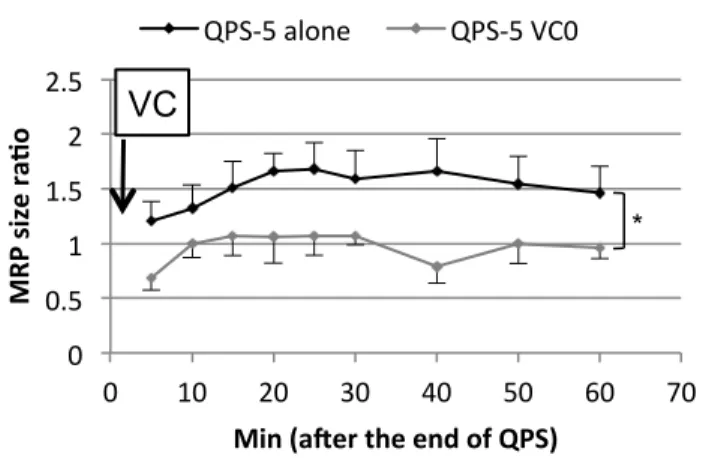
Fig. 3 compares the time courses between the QPS-5 alone and QPS-5 VC0 sessions through 60 min after the end of QPS-5. A two-way repeated
measures ANOVA on the MEP size ratio showed that the PATTERN and the TIME significantly affect the MEP size ratio (F1, 6 = 8.210, P = 0.029 for the PATTERN
and F8, 48 = 2.264, P = 0.038 for the TIME) and that the PATTERN x TIME
interaction was insignificant (F8, 48 = 1.240, P = 0.297). One-way repeated measures ANOVAs on the absolute MEP amplitude showed that the TIME
significantly affected the MEP amplitude in the QPS-5 alone session (F9, 54 = 4.055, P = 0.001), but did not in the QPS-5 VC0 session (F9, 54 = 1.146, P = 0.348). This result indicates that the VC0 abolished QPS-5 induced LTP-like aftereffects.
3.3. Experiment 3: QPS-50 alone session vs QPS-50 VC0 session
Fig. 4 compares the time courses between the QPS-50 alone and QPS-50 VC0 sessions through 60 min after the end of QPS-50. A two-way repeated measures ANOVA revealed that the PATTERN significantly affected the MEP size ratio (F1, 8 = 12.424, P = 0.008). However, neither the effect of the TIME nor the PATTERN x TIME interaction was significant (F8, 64 = 0.291, P = 0.967 for the TIME
and F8, 64 = 1.679, P = 0.121 for the PATTERN x TIME interaction). Secondary,
one-way repeated measures ANOVAs on the absolute MEP amplitude showed that the TIME significantly affected MEP in the QPS-50 alone session (F9, 72 = 2.117, P
= 0.039), but did not affect it in the QPS-50 VC0 session (F9, 72 = 0.644, P = 0.756).
This result indicates that the VC0 abolished QPS-50 induced LTD-like aftereffects.
3.4. Experiment 4: QPS-5 alone session vs QPS-5 VC20 session
Fig. 5 compares the MEP size ratios between the QPS-5 alone and QPS-5 VC20 sessions. A two-way repeated measures ANOVA on the MEP size ratio showed that the TIME significantly affected the MEP size ratio (F8, 56 = 3.203, P
=0.005), but both the PATTERN effect and the PATTERN x TIME interaction were insignificant (F1, 7 = 0.106, P = 0.754 for the PATTERN and F8, 56 = 1.740, P = 0.109 for the PATTERN x TIME interaction). Secondary, a two-way repeated measures ANOVA on the MEP size ratio on the time points after VC administration showed that both the PATTERN effect and the TIME effect were insignificant (F1, 7 = 0.086, P = 0.778 for the PATTERN and F4, 28 = 1.001, P = 0.424 for the TIME). The PATTERN x TIME interaction had significant trends but that did not reach
statistical significance (F4, 28 = 2.506, P = 0.065). This indicates that the VC20 did not affect long-term QPS-5 aftereffects significantly even though the potentiation was transiently lessened after the VC20 administration.
3.5. Experiment 5: QPS-50 alone session vs QPS-50 VC20 session
Fig. 6 compares the MEP size ratios between the QPS-50 alone and QPS-50 VC20 sessions. A two-way repeated measures ANOVA on the MEP size ratio showed that neither the PATTERN nor the TIME significantly affected the MEP size ratio (F1, 6 = 0.464, P = 0.246 for the PATTERN and F8, 48 = 1.743, P = 0.113 for the TIME) and that the PATTERN x TIME interaction was also
insignificant (F8, 48 = 0.470, P = 0.871). Secondary, a two-way repeated measures ANOVA on the MEP size ratio on the time points after VC administration showed none of the PATTERN, the TIME and the PATTERN x TIME interaction was statistically significant (F1, 6 = 2.648, P = 0.155 for the PATTERN, F4, 24 = 2.140, P = 0.107 for the TIME and F4, 24 = 0.467, P = 0.759 for the PATTERN x TIME
interaction). This indicates that the VC20 did not affect long-term QPS-50 aftereffects significantly even though the depression was transiently lessened after the VC20 administration.
4. Discussion
4.1. Why the QPS induced aftereffects were abolished by the voluntary movements of the target muscle?
There have been several precedent studies of the influences of muscle contractions on rTMS aftereffects. In most of these studies, the target muscle contractions were prior to rTMSs. Ziemann et al. (2004) reported that the ballistic finger movements prior to PAS shifted the LTP like aftereffects induced by
succeeding PASN20 to LTD like effects and enhanced the LTD like effects by PASN20-5. Because the motor task used in their experiment induced LTP like aftereffects when given alone, they concluded that the effect was explained by the
Bienenstock-Cooper-Munro (BCM) theory of bi-directional synaptic plasticity.
Gentner et al. (2008) reported that the static muscle contractions for five minutes given prior to cTBS300 reversed its facilitatory aftereffects to depression and they called it as "polarity-reversing metaplasticity." Iezzi et al. (2008) reported that ballistic finger movements applied prior to TBS reversed its potentiation aftereffects to depression and its depressive aftereffects to facilitation. These effects of voluntary muscle contractions before rTMSs were generally considered to be a kind of metaplasticity (Abraham, 2008). In contrast, in our study, the motor tasks were applied after QPS. The timing of motor task is different between our study and other previous papers.
In Experiment 1, we confirmed that the motor task did not affect MEP in its own, which suggests that the present results are not explained solely by the superimposed MEP change induced by the VC. We propose two hypotheses to explain our results.
The first is the depotentiation and de-depression. Depotentiation and de-depression indicate that once induced synaptic plasticity is abolished by a subsequent protocol (O'Dell and Kandel, 1994; Staübuli and Chun, 1996; Bruette et al., 1997), and it may play crucial roles in erasing previous learning (Neves et al., 2008). Depotentiation tends to be induced by protocols that are too mild to induce LTD by itself but potentially tend to depress the cortical excitability, and the de-depression tends to be induced by protocols that are too mild to induce LTP by itself but potentially tend to potentiate the cortical excitability (Zhou and
Poo, 2004). Huang et al (2010) confirmed this principle in the human brain. They reported that cTBS150 (half in the duration and the number of TMS pulses as compared with conventional cTBS300), that is too short to induce LTD when given alone, abolished the potentiation induced by preceding conventional iTBS (600 pulses), and iTBS150, which is too short to induce LTP, also abolished cTBS300 depressive aftereffects when they were applied immediately after iTBS600 or cTBS300. On the contrary, iTBS150 did not affect preceding iTBS aftereffects, and cTBS150 also did not affect preceding cTBS aftereffects. Based on these, they concluded that depotentiation and de-depression were
accomplished by specific second protocol in TBS. On the other hand, some studies showed depotentiation/de-depression inconsistent with the homeostatic regulations. Thirugnanasambandam et al. (2011) reported that isometric
voluntary muscle contraction of FDI muscle applied just after tDCS abolished both the LTP induced by anodal tDCS and LTD by cathodal tDCS. These suggest that one motor task, under a certain condition, may abolish any plasticity induction through depotentiation/de-depression mechanisms, whichever the target
plasticity is. Their results are consistent with our present results and support the idea that the abolishment of LTP and LTD shown here can be explained by depotentiation/de-depression mechanisms. Our finding that VC immediately after QPS abolished the QPS aftereffect but did not abolish it when applied 20 minutes after QPS also supports the possibility of depotentiaton/de-depression
mechanisms. The depotentiation inducing protocol should be given soon after LTP induction for a stable depotentiation because when the same protocol was given belatedly, usually tens of minutes, it failed to depotentiate the LTP (Staübli and Scafidi, 1999; Chen et al., 2001). We propose that at 20 minutes after the end of QPS, the consolidation of LTP or LTD had already started and the VC failed to depotentiate /de-depress them. This time window hypothesis is compatible with the above influence of VC timing in our results.
Another possible mechanism is metaplasiticity. Although we confirmed that the VC did not changed cortical excitability in its own in Experiment 1, the VC0 may induce metaplastic effects on the already induced plasticity. This mechanism is usually one direction. Some intervention should reduce LTP and
increase LTD, or increase LTP and reduce LTD. In the present experiments, however, the VC0 abolished both LTP and LTD. This fact may support the depotentiation/de-depression mechanisms for our present results.
Based on these arguments, we conclude that the VC right after the intervention abolishes both LTP and LTD like effects by QPS through
depotentiation/de-depression mechanisms.
Finally, the VC 20 minutes after QPS seemed transiently reduce the plastic changes even though the effect was not statistically significant. The plasticity induction process is considered to consist of several phases, such as post-tetanic potentiation (PTP), short-term potentiation (STP), and LTP. The VC20 practice might disturb some phase of LTP induction, for example STP, and transiently changed cortical excitabilities. Another candidate for explanation for the transient effect of VC20 is metaplasticity. Although VC does not change MEPs when given alone, it may transiently depress facilitative QPS-5 aftereffect when given 20 min after QPS-5 because the cortical excitabilities were previously enhanced by QPS-5 and the metaplastic effect made VC20 depress cortical excitabilities in turn.
4.2. The limitations
One limitation of this study is a small number of the studied subjects.
The VC 20 minutes after QPS may transiently reduce the plastic changes.
However, this effect was not statistically significant probably because of small number of subjects.
We studied only one specific task influence on the plasticity induction by QPS.
From the present results, we are not able to make a general conclusion about the effects of motor tasks on the plasticity induction in human brain because such effects of motor tasks on the plasticity deeply depend on the type of motor task and also the plasticity induction method (Ziemann et al., 2004; Agostino et al., 2008; Gentner et al., 2008; Huang et al, 2008; Iezzi et al., 2010;
Thirugnanasambandam et al, 2011). The comparison between different tasks is an interesting issue. However, it is out of scope of this study and should be one of the
future projects.
5. Conclusion
We have studied influence of the target muscle voluntary contraction on LTP/LTD like effects induced by QPS. When the voluntary muscle contraction is applied to the target muscle immediately after QPS, both LTP like and LTD like aftereffects were weakened thereafter. On the other hand, when the muscle contractions were given 20 min after QPS, the long-term aftereffects were preserved. We stress to keep the target muscle relaxed immediately after the long-term effect induction procedures. The target muscle contraction, however, may not disturb the final long lasting effects when given some time after the intervention in QPS.
6. References
Abraham WC. Metaplasticity: tuning synapses and networks for plasticity. Nat Rev Neurosci 2008;9:387–99.
Agostino R, Iezzi E, Dinapoli L, Suppa A, Conte A, Berardelli A. Effects of intermittent theta-burst stimulation on practice-related changes in fast finger movements in healthy subjects. Eur J Neurosci 2008;28:822–8.
Antal A, Chaieb L, Moliadze V, Monte-Silva K, Poreisz C, Thirugnanasambandam N et al. Brain-derived neurotrophic factor (BDNF) gene polymorphisms shape cortical plasticity in humans. Brain Stimul 2010;3:230–7
Burette F, Jay TM, Laroche S. Reversal of LTP in the hippocampal afferent fiber system to the prefrontal cortex in vivo with low-frequency patterns of stimulation that do not produce LTD. J Neurophysiol 1997;78:1155–60.
Cheeran B, Talelli P, Mori F, Koch G, Suppa A, Edwards M et al. A common polymorphism in the brain-derived neurotrophic factor gene (BDNF) modulates human cortical plasticity and the response to rTMS. J Physiol 2008;586:5717–25.
Chen YL, Huang CC, Hsu KS. Time-dependent reversal of long-term potentiation by low-frequency stimulation at the hippocampal mossy fiber-CA3 synapses. J Neurosci 2001;21:3705–14.
Gentner R, Wankerl K, Reinsberger C, Zeller D, Classen J. Depression of Human Corticospinal Excitability Induced by Magnetic Theta-burst Stimulation: Evidence of Rapid Polarity-Reversing Metaplasticity. Cereb Cortex 2008;18:2046–53.
Hamada M, Hanajima R, Terao Y, Arai N, Furubayashi T, Inomata-Terada S et al.
Quadro-pulse stimulation is more effective than paired-pulse stimulation for plasticity induction of the human motor cortex. Clin Neurophysiol
2007;118:2672–82.
Hamada M, Terao Y, Hanajima R, Shirota Y, Nakatani-Enomoto S, Furubayashi T et al. Bidirectional long-term motor cortical plasticity and metaplasticity induced by quadripulse transcranial magnetic stimulation. J Physiol 2008;586:3927–47.
Huang YZ, Edwards MJ, Rounis E, Bhatia KP, Rothwell JC. Theta Burst Stimulation of the Human Motor Cortex. Neuron 2005;45:201–6.
Huang YZ, Rothwell JC, Edwards MJ, Chen RS. Effect of Physiological Activity on an NMDA-Dependent Form of Cortical Plasticity in Human. Cereb Cortex
2008;18:563–70.
Huang YZ, Rothwell JC, Lu CS, Chuang WL, Lin WY, Chen RS. Reversal of plasticity-like effects in the human motor cortex. J Physiol 2010;588:3683–93.
Iezzi E, Conte A, Suppa A, Agostino R, Dinapoli L, Scontrini A et al. Phasic Voluntary Movements Reverse the Aftereffects of Subsequent Theta-Burst Stimulation in Humans. J Neurophysiol 2008;100:2070–6.
Iezzi E, Suppa A, Conte A, Agostino R, Nardella A, Berardelli A. Theta-burst stimulation over primary motor cortex degrades early motor learning. Eur J Neurosci 2010;31:585–92.
Nakamura K, Enomoto H, Hanajima R, Hamada M, Shiizu E, Kawamura Y et al.
Quadri-pulse stimulation (QPS) induced LTP/LTD was not affected by Val66Met polymorphism in the brain-derived neurotrophic factor (BDNF) gene. Neurosci Lett 2011;487:264–7
Neves G, Cooke SF, Bliss TVP. Synaptic plasticity, memory and the hippocampus:
a neural network approach to causality. Nat Rev Neurosci 2008;9:65–75.
Nitsche MA, Paulus W. Sustained excitability elevations induced by transcranial
DC motor cortex stimulation in humans. Neurology 2001;57:1899–901.
O'Dell TJ, Kandel ER. Low-frequency stimulation erases LTP through an NMDA receptor-mediated activation of protein phosphatases. Learn Mem 1994;1:129–
39.
Ridding MC, Ziemann U. Determinants of the induction of cortical plasticity by non-invasive brain stimulation in healthy subjects. J Physiol 2010;588:2291–304.
Stäubli U, Chun D. Factors regulating the reversibility of long-term potentiation. J Neurosci 1996;16:853–60.
Stäubli U, Scafidi J. Time-dependent reversal of long-term potentiation in area CA1 of the freely moving rat induced by theta pulse stimulation. J Neurosci 1999;19:8712–9.
Stefan K, Kunesch E, Cohen LG, Benecke R, Classen J. Induction of plasticity in the human motor cortex by paired associative stimulation. Brain 2000;123:572– 84.
Thirugnanasambandam N, Sparing R, Dafotakis M, Meister IG, Paulus W, Nitsche MA et al. Isometric contraction interferes with transcranial direct current
stimulation (tDCS) induced plasticity: evidence of state-dependent
neuromodulation in human motor cortex. Restor Neurol Neurosci. 2011;29:311– 20.
Zhou Q, Poo MM. Reversal and consolidation of activity-induced synaptic modifications. Trends Neurosci 2004;27:378–83.
Ziemann U, IIić TV, Pauli C, Meintzschel F, Ruge D. Learning Modifies Subsequent Induction of Long-Term Potentiation-Like and Long-Term Depression-Like
Plasticity in Human Motor Cortex. J Neurosci 2004;24:1666–72.
Figure and Figure legends
Fig. 1
Fig. 1 The experimental paradigms.
This figure shows the experimental paradigms. “MEP” boxes indicate measuring of 20 MEPs, “AMT” boxes indicate measuring of active motor threshold (AMT) for the right first dorsal interosseous muscle, and diagonal lined boxes indicate voluntary muscle contraction (VC) intervention, respectively.
-30 0 2 5 10 15 20 25 30 40 50 60 (min) Experiment 1
MEP : recording of 20 MEPs AMT : measuring of AMT : voluntary muscle contraction (VC) M
E P
M E P
M E P
M E P
M E P
M E P
M E P
M E P
M E P
M E P M
E P M E P aloneVC
Experiment 2 QPS-5
alone
M E P A M T
M E P
M E P
M E P
M E P
M E P
M E P
M E P
M E P
M E
QPS-5 P
Experiment 3
Experiment 4
Experiment 5 QPS-5
VC0
M E P A M T
M E P
M E P
M E P
M E P
M E P
M E P
M E P
M E P
M E
QPS-5 P ME
P MA
T
ME P
ME P
ME P
ME P
ME P
ME P
ME P
ME P
ME P QPS-50
alone QPS-50
M E P A M T
M E P
M E P
M E P
M E P
M E P
M E P
M E P
M E P
M E P QPS-5
alone QPS-5
M E P A M T
M E P
M E P
M E P
M E P
M E P
M E P
M E P
M E P
M E P QPS-50
alone QPS-50
QPS-50
VC0 ME QPS-50
P A M T
M E P
M E P
M E P
M E P
M E P
M E P
M E P
M E P
M E P
QPS-5
VC20 ME QPS-5
P A M T
M E P
M E P
M E P
M E P
M E P
M E P
M E P
M E P
M E P
QPS-50
VC20 ME QPS-50
P A M T
M E P
M E P
M E P
M E P
M E P
M E P
M E P
M E P
M E P -30 0 2 5 10 15 20 25 30 40 50 60 (min)
Fig. 2
Fig. 2 The time course of the MEP size ratio of the right FDI after the repetitive opening-closing right hand movements (VC).
The error bars show SEM. The arrow indicate the application of one minute of VC.
MEPs were stable through 60 min after the VC, though it was comparatively greater immediately after the VC than the baseline (statistically not significant).
Fig 3.
Fig. 3 The time courses of Experiment 2.
The black line indicates MEP size ratios of QPS-alone session and grey line those of QPS5-VC0 session. The error bars show SEM. The QPS-5 aftereffects were abolished by the VC applied immediately after QPS-5.
*; P < 0.05 in a two-way repeated measures ANOVA for the factor of PATTERN.
0 0.25 0.5 0.75 1 1.25 1.5
-10 0 10 20 30 40 50 60 70
MEP size ratio
Min (after VC)
VC
0"
0.5"
1"
1.5"
2"
2.5"
0" 10" 20" 30" 40" 50" 60" 70"
MRP$size$ra+o
Min$(a/er$the$end$of$QPS)
QPS.5"alone" QPS.5"VC0"
VC
*
Fig. 4
Fig. 4 The time courses of Experiment 3.
The black line indicates MEP size ratios of QPS-alone session and grey line those of QPS50-VC0 session. The error bars show SEM. The QPS-50 aftereffects were abolished by the VC applied immediately after QPS-50.
*; P < 0.05 in a two-way repeated measures ANOVA for the factor of PATTERN.
Fig. 5
Fig. 5 The time courses of Experiment 4.
The black line indicates MEP size ratios of QPS-alone session and grey line those of QPS5-VC20 session. The error bars show SEM. The QPS-5 aftereffects was transiently reduced by the VC but the long-term effects were preserved.
0"
0.5"
1"
1.5"
0" 10" 20" 30" 40" 50" 60" 70"
MRP$size$ra+o
Min$(a/er$the$end$of$QPS)
QPS.50"alone" QPS.50"VC0"
VC
*
0"
0.5"
1"
1.5"
2"
2.5"
0" 10" 20" 30" 40" 50" 60" 70"
MRP$size$ra+o
Min$(a/er$the$end$of$QPS)
QPS.5"alone" QPS.5"VC20"
VC
Fig. 6
Fig. 6 The time courses of Experiment 5.
The black line indicates MEP size ratios of QPS-alone session and grey line those of QPS50-VC20 session. The error bars show SEM. The QPS-50 aftereffects was transiently reduced by the VC but the long-term effects were preserved.
0"
0.5"
1"
1.5"
0" 10" 20" 30" 40" 50" 60" 70"
MRP$size$ra+o
Min$(a/er$the$end$of$QPS)
QPS.50"alone" QPS.50"VC20"
VC
Acknowledgement 謝辞
This work was supported in part by grants from the Research Project Grant-in-aid for Scientific Research from the Ministry of Education, Culture, Sports, Science and Technology No. 22390181, No. 25293206, and No.
15H05881, the Research Committee on Degenerative Ataxia from the Ministry of Health and Welfare of Japan, the Magnetic Health Science Foundation, the Uehara Memorial Foundation, and The Novartis Foundation (Japan) for the Promotion of Science.
本研究を行うにあたり,福島県立医科大学神経内科学講座,宇川義一 教授から研究全般および本論文作成にわたり多大なご指導頂いた.また,同講 座榎本博之先生には本研究の手法の基礎の学習から,研究計画の立案,その後 の過程にわたり懇切丁寧なご指導を頂いた.同講座小林俊輔先生には特に統計 学的解析に関するご助言を頂いた.並びに,同講座村上丈伸先生,榎本雪先生 には磁気刺激法の全般にわたり多大なご助言と技術的指導を頂いた.以上の先 生方,並びに本研究にご協力頂いた被験者の皆様に,心よりの感謝を申し上げ る.