Contribution of the surface diffusion on mass transfer of Ba
2+in granite matrix
Tetsuji Yamaguchi* Shinichi Nakayama* Chiharu Kawada**
The effective diffusivity (De) and the distribution ratio (Kd) of Ba2+ in Inada granite have been determined by the through-diffusion method. Stable BaCl2 solutions of the equal concentration were placed in two reservoirs across a granite sample and the self-diffusion of Ba was observed using radioactive 133Ba. Experiments were performed in triplicate for 10-1, 1 and 10 mol m-3 BaCl2 solutions at 25°C. The De value obtained at a BaCl2 concentration of 10 mol m-3, agreed to the estimated value based on the pore diffusion model. The lower BaCl2 concentrations yielded higher De values and higher Kd values. The variation in De was neither due to the speciation of barium in the solutions nor due to variation in physical properties of the pore structure in the rock because diffusivity of I was the same between 10-1, 1 and 10 mol m-3 BaCl2 solutions. Contribution of diffusion in sorbed state should be responsible for the variation in De.
Keywords: effective diffusivity, distribution ratio, surface diffusion, granite, barium
稲田花崗岩についてBa2+イオンの透過拡散実験を行い、有効拡散係数(De)と分配係数(Kd)を取得した。岩石試料をはさ んで2つの溶液槽に同じ濃度の安定BaCl2溶液を満たし、放射性の133Baを用いてBaの自己拡散を観察した。溶液とし て10-1, 1, 10 mol m-3 BaCl2溶液を用い、25℃においてそれぞれ3ランを行った。10 mol m-3 BaCl2溶液を用いた実験で得ら れた有効拡散係数は細孔拡散モデルから予想される値と一致していた。これに対して塩化バリウムの濃度が低い場合ほ ど、分配係数が高く、有効拡散係数も高くなった。バリウムの溶存形態は同じであり、同時に拡散させた I-の挙動から 花崗岩試料による間隙構造にも差がないことが明らかになった。それにもかかわらず、有効拡散係数が分配係数に対し て正の相関を持っていることは、表面拡散(吸着状態での拡散)の寄与を強く示すものである。
Keywords:有効拡散係数、分配係数、表面拡散、花崗岩、バリウム
1 Introduction
After emplacement of high-level radioactive waste in a deep underground repository, long-lived radionuclides may be leached from the wastes and may subsequently be transported through surrounding rock masses. Major water bearing fractures in rocks surrounding the repository are considered to form main transport paths. Radionuclides diffuse into the pores or micro fissures in the rock matrix and adsorbed on mineral surfaces.
These processes lead to retardation of the transport of radionuclides through the fractures. Diffusion of radionuclides through the rock mass is a main transport mechanism under extremely low flow rate of groundwater. To predict the migration of radionuclides in deep geological formations, it is important to understand the diffusion mechanism of radionuclides into the rock matrix and to quantify the diffusivity.
Granite was used in this study because it occurs widely in Japan and is considered as a potential host rock for the deep underground disposal of high-level radioactive waste.
Diffusion of aqueous species in macro-porous media has been explained by pore-diffusion model, which was proposed by Brakel & Heertjes [1]. Neretnieks [2] proposed the application of the pore-diffusion model to the diffusion of ions in rock matrix. In the pore-diffusion model, Eq. (1) holds between apparent diffusivity Da (m2 s-1), diffusivity in water Dv (m2 s-1), the constrictivity of the pores δ, the tortuosity of the
pores τ, the bulk density of the rock ρ (kg m-3), the distribution ratio Kd (m3 kg-1), the porosity of the rock ε, the pore diffusivity Dp (m2 s-1) and the effective (or intrinsic) diffusivity De (m2 s-1);
Da = Dvδτ-2/(1+ρKd/ε) =Dp/(1+ρKd/ε) =De/(ε +ρKd). (1) The apparent diffusivity, Da, is defined as
J=-Da∂C/∂x, (2)
where J is the diffusive flux (Bq m-2 s-1), C the amount of a diffusing species in unit volume of porous material (Bq m-3) and x the length coordinate in diffusion direction (m). The De is defined as
J=-De∂c/∂x, (3)
where c is the concentration of diffusing species in pore water (Bq m-3). In the pore-diffusion model, the De is given by
De = Dvεδτ-2. (4)
Although Eq. (1) and (4) seem to be applicable to describe diffusion of radionuclides in rock matrix, these equations have not been verified. Skagius & Neretnieks [3] determined the De
of I, tritiated water, Cs and Sr in pieces of granite and found that the results for Cs and Sr were by more than ten times higher than expected from Eq. (4) though the results for non-sorbed species were in fair agreement with Eq. (4). They interpreted the results for Cs and Sr as an effect of surface diffusion. Their determination of the De, however, was not very accurate due to incomplete attainment of the sorption equilibrium. Bradbury &
Stephen [4] performed the through-diffusion experiments for
85Sr, 137Cs and 95mTc in sandstone and found that the De of Sr was higher than that of I by 4-5 times. They suggested that a different diffusion mechanism or process may be occurring.
Bradbury et al. [5] performed the through-diffusion experiments for 85Sr, 137Cs and 95mTc in sandstone anhydrite and upper magnesian limestone and found that the diffusive transport of Sr was higher by orders of magnitude than predicted from the pore-diffusion model. They mentioned that the results may be explained by a second diffusion mechanism, namely surface diffusion. Skagius & Neretnieks [6] performed both the
花崗岩マトリクス内におけるBa2+の拡散に対する表面拡散の寄与 山口徹治 ([email protected]), 中山真一, 川田千はる
*Disposal Safety Laboratory, Department of Fuel Cycle Safety Research, JAERI, Tokai, Ibataki 319-1195, Japan. 日本原子力研究所燃料サイクル安 全工学部処分安全研究室 〒319-1195茨城県那珂郡東海村白方白根2-4
**Applied Science Course, Graduate School of Engineering, Tokai University, 1117 Kitakaname, Hiratsuka, Kanagawa 259-1292, Japan.
Present affiliation: Toshiba Corporation, Power Systems & Services Company, 8, Shinsugita, Isogo, Yokohama, Kanagawa 235-8523, Japan.
東海大学大学院工学研究科応用理学専攻 〒259-1292 神奈川県平塚市北
金目1117 現所属:株式会社東芝電力システム社 〒235-8523神奈川県
横浜市磯子区新杉田町8
in-diffusion experiment and the through-diffusion experiment for Cs and Sr in biotite gneiss and found the diffusive transport was higher than expected from the pore diffusion model. They concluded that both the pore diffusion and the surface diffusion had to be included to interpret the experimental data. Smith [7]
performed the through-diffusion experiments for 85Sr, 137Cs and
125I in sandstone and found that the De of 85Sr is higher than those of 137Cs and 125I by a factor of more than 6. Tsukamoto &
Ohe [8] performed intraparticle diffusion experiments into crushed granite for Cs and Sr and determined the apparent diffusivity. They interpreted the results taking both the surface and the pore diffusion processes. Their determination of the apparent diffusivity, however, was not accurate due to spherical approximation of crushed granite particles in data analysis.
Berry & Bond [9] determined the De of tritiated water, I, Cs, Sr and Am in sandstone by the through-diffusion method and calculated the contribution of the surface diffusion to the De as 73 % for Sr and 62 % for Am. They concluded that evidence has been obtained for the apparent existence of the process of surface diffusion in the migration of Sr and Am, but not Cs, through the sandstone. Brace et al. [10] and Ohlsson &
Neretnieks [11] suggested the existence of surface diffusion from electrical conductivity measurements, although the evidence is quite indirect.
Several researchers [4-7] observed higher diffusivity for Sr and Cs in rocks than expected from pore diffusion model.
However, there was no evidence to show that the higher diffusivity for Sr and Cs is due to the contribution of the surface diffusion.
Our previous study [12] found that the De of Sr2+ in various rocks roughly agrees with
De = Dvεδτ-2 + DsρKd (5) The second term of Eq. (5), DsρKd, represents the contribution of the surface diffusion. Equation (5) states that the De of an ion has the factor that increases linearly with its Kd on rock materials. It is essential to confirm this increase in the De
with the Kd in order to prove the contribution of the surface diffusion. Systematic through diffusion experiments were performed for Ba2+ in a granite as a function of Ba concentration in this study. Experiments were carefully designed to minimize variation in De caused by any reason expect for the contribution of the surface diffusion.
2 Experimental
The rock used in this study was a biotitic granite obtained from the Inada mine in the Ibaraki prefecture, eastern Japan.
The chemical and mineral compositions were presented elsewhere [8, 12-14]. The porosity and the bulk density of the granite were determined to be 0.49±0.07 % and 2.64x10³ kg m-3, respectively [15]. The distribution of the pore diameters was approximately log normal, with a modal diameter of 160 nm [15]. A granite core having a diameter of 40 mm was cut to disks of 5.0 mm thickness with a diamond saw in the same manner as in our previous papers [12, 15]. Granite disks without
visible cracks were used in the experiments. The acrylic diffusion cells used in this study were shown in a previous paper [12]. A granite disk was fitted tightly into the central part of the cell and any gap between the rock disk and the acrylic filled with a silicone gasket. The central support member containing the granite disk was sandwiched between two reservoirs, each with a capacity of 1.16x10⁻⁴ m3. After assembling a diffusion cell, the diffusion cell was soaked in deionized water under vacuum for 3 days to evacuate all air from the interconnected pores.
After the evacuation was completed, the diffusion cell was filled with a 10 mol m-3 BaCl2 solution to pre-equilibrate the granite disks with the solution for 30 days. The starting solution was prepared by combining 1.20x10⁻⁴ m3 of 10 mol m-3 BaCl2
solution, 3.0x10⁻⁷ m3 of 133Ba (10.5 y half-life) stock solution (103 mol m-3 HCl) and 3.0x10⁻⁷ m3 of 125I (59.9 d half-life) stock solution in a polypropylene bottle. The stock solution of
125I was a NaI/Na2S2O3 mixture solution in which the concentrations of I- and S2O32-
were 3.3x10⁻¹ and 3.2x10⁻¹ mol m-3, respectively. The concentrations of 133Ba and 125I in the starting solution were planned to be 1040 MBq m-3 and 2070 MBq m-3, respectively. To measure the concentrations of 133Ba and 125I in the solutions, a 1.0x10⁻⁶ m3 aliquot was withdrawn and its activity determined by γ-spectrometry. The statistical error of the determination of the tracer concentration was 1 - 10 % by radioactivity measurement. The solutions were prepared from reagent grade chemicals (Wako Pure Chemical Industries, Ltd., Tokyo) and deionized water (Milli-Q Labo System, Millipore). The diffusion experiment was started by placing the starting solution in the source reservoir and a blank 10 mol m-3 BaCl2 solution in the other, or measurement reservoir. The diffusion experiment was performed at (25.0±0.5)°C in a water bath. The diffusion experiment for the 10 mol m-3 BaCl2 solution was performed in triplicate using 3 granite samples, L14, N9 and O3. The name of the granite sample, L14, denotes the 14th disk cut from the granite core named L.
The diffusion experiment was performed in triplicate also for 1 mol m-3 BaCl2 solution using 3 granite samples, N6, O6 and O8, and for 10-1 mol m-3 BaCl2 solution, granite samples, L12, O16 and O22.
At 14-day intervals, a 1.0x10⁻⁶ m3 aliquot was taken from the measurement reservoirs to determine the concentrations of
133Ba and 125I. The 1.0x10⁻⁶ m3 aliquot removed from the measurement reservoir was replaced with an equal volume of the BaCl2 solution to maintain the balance of the water level between the two reservoirs. Balancing is necessary to avoid development of a pressure gradient that could lead to advective transport from the source to the measurement reservoir across the granite disk. The concentrations of 133Ba and 125I in the source reservoir were determined occasionally by taking a 1.0x10⁻⁸ m3 aliquot. At the termination of each run, the inner wall of the measurement reservoir was rinsed with 103 mol m-3 HCl to determine the amount of 133Ba adsorbed on the cell walls.
The amount of 133Ba was found to be less than 1 % of the final
62
133Ba inventory in the measurement reservoir and can be ignored.
Zeta potential of the granite in BaCl2 solutions were measured by a microscope electrophoresis zeta potential analyzer, RANK Brothers MARK II. Crushed granite material (2 mm) was milled by a mixer mill. The milled material was suspended in the BaCl2 solutions overnight and the supernatant was used for the zeta potential analysis.
3 Results and discussion
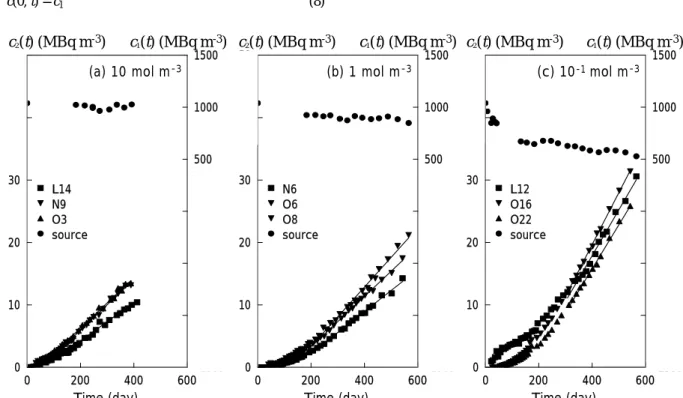
Figure 1(a) shows the time dependence of the concentrations of 133Ba in the measurement reservoirs from the diffusion experiment using the 10 mol m-3 BaCl2 solution. The concentrations of 133Ba were corrected for the decay. The concentrations increase linearly after 100 days from the initiation of the diffusion. The rate of change in concentration of
133Ba due to diffusion in pore water at distance x from the surface facing to the source reservoir at time t can be described as
(ε+ρKd)∂c/∂t = De∂2c/∂x2 (6)
This equation is based on an assumption that the Kd is independent on t and on x. Skagius & Neretnieks [6] presented the data analysis for the case that Kd depends on t and on x assuming non-linear sorption isotherms. In this study, a BaCl2
solution of the same concentration was placed in both reservoirs and was pre-equilibrated with the rock disk before starting diffusion of 133Ba. This assures that the concentration of barium is independent on t and on x, and that the Kd can be assumed to be independent on t and on x. The initial and boundary conditions are
c(x, 0) = 0 at 0<x≦L (7)
c(0, t) = c1 (8)
c(L, t) = c2 << c1, (9)
where L is the thickness of the rock sample (5x10⁻³ m), c1 the concentration of 133Ba in the source reservoir (Bq m-3), c2 the concentration of 133Ba in the measurement reservoir (Bq m-3). In the case that c1 can be regarded to be constant, the solution of Eqs. (6) - (9) was given by Crank [16] and the concentration of
133Ba in the measurement reservoir after a long period is approximated as
c2(t) = AV2-1
c1(DeL-1t – (ε+ρKd)L/6) (10) where A is the cross section of the sample (1.256x10⁻³ m2), V2
the volume of the measurement reservoir (1.16x10⁻⁴ m3). The least-squares fitting of the plots of c2(t) vs. t to Eq. (10) as shown in Fig. 1(a) yields the De from the slope, and the rock capacity factor, (ε+ρKd), from the intercept on the concentration axis of the extrapolated linear portion. The De of (1.95±0.21)x10-13 m2s-1 and the Kd of (8.0±0.9)x10-5 m3 kg-1 were obtained on an average of three runs and tabulated in Table 1. An average 133Ba concentration in the source reservoir in the period of 100 – 400 days was used as c1 in this calculation.
Figure 1(b) shows the results from the diffusion experiment using the 1mol m-3 BaCl2 solution. The linear portion of the curve appeared after 200 days from the initiation of the diffusion. The De of (2.38±0.38)x10-13 m2 s-1 and the Kd
of (2.26±0.35)x10-4 m3 kg-1 were obtained. An average 133Ba concentration in the source reservoir in the period of 200 – 580 day was used as c1 in this calculation.
Figure 1(c) shows the results from the diffusion experiment using the 10-1 mol m-3 BaCl2 solution. The linear portion of the curve appeared after 300 days from the initiation of the diffusion. The De of (6.6±0.7)x10-13 m2 s-1 and the Kd of (8.4±0.9)x10-4 m3 kg-1 were obtained. An average 133Ba
0 200 400 600
Time (day)
0 10 20 30 40 50
-1500 -1000 -500 0 500 1000 1500
L14 N9 O3 source
0 200 400 600
Time (day)
0 10 20 30 40 50
-1500 -1000 -500 0 500 1000 1500
N6 O6 O8 source
0 200 400 600
Time (day)
0 10 20 30 40 50
-1500 -1000 -500 0 500 1000 1500
L12 O16 O22 source
(b) 1 mol m-3
(c) 10-1mol m-3
(a) 10 mol m-3
c2(t) (MBq m-3) c1(t) (MBq m-3) c2(t) (MBq m-3) c1(t) (MBq m-3) c2(t) (MBq m-3) c1(t) (MBq m-3)
Fig. 1 Changes in concentration of 133Ba in measurement reservoir due to diffusion through 5-mm thick Inada granite samples obtained in 10 mol m-3 BaCl solution (a), 1 mol m-3 BaCl solution (b), 10-1 mol m-3 BaCl solution (c).
Table 1 The De and the Kd of Ba in granite.
[BaCl2]
(mol m-3) Sample No. De
(10-13 m2 s-1) Kd
(10-4 m3 kg-1)
10-1 L12
O16 O22 Avg.
6.57±0.21 7.43±0.09 5.71±0.11 6.6±0.7
8.1±0.7 9.56±0.30 7.59±0.34 8.4±0.9
1 N6
O6 O8 Avg.
1.99±0.04 2.25±0.03 2.90±0.07 2.38±0.38
1.94±0.10 2.12±0.09 2.72±0.20 2.26±0.35
10 L14
N9 O3 Avg.
1.66±0.03 2.12±0.03 2.08±0.03 1.95±0.21
0.74±0.06 0.90±0.05 0.76±0.07 0.80±0.09 concentration in the source reservoir in the period of 300 – 580 days was used as c1 in this calculation.
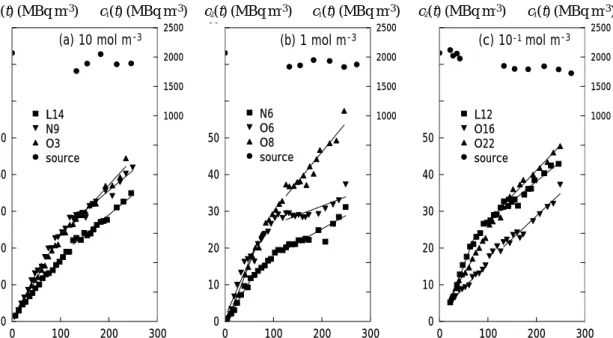
Figure 2(a) shows the time dependence of the concentration of 125I in the measurement reservoirs from the diffusion experiment using the 10 mol m-3 BaCl2 solution. The concentrations of 125I were corrected for the decay. The concentrations increase linearly for the first 70 days period. The increase in the concentration of 125I become less steep in the period of 70 – 120 days and another linear increase was observed in the period of 120 – 250 days. From the first linear portion of the curve, a De of (6.1±0.9)x10-13 m2 s-1 and a Kd of
<1.6x10⁻⁵ m3 kg-1 were obtained on an average of three runs and tabulated in Table 2. The second linear portion was analyzed using Eq. (3) to obtain another De as
De = -J/(∂c/∂x) = (∆c2/∆t)VA-1/{(¯c1 - ¯c2)L-1} (11) where ∆c2/∆t is the rate of increase in the concentration of 125I
in the period between 120 and 250 days (Bq m-3 s-1), ¯c1 the average concentration of 125I in the source reservoir in the
period of 120 - 250 days, ¯c2 the average concentration of 125I in the measurement reservoir in the period of 120 - 250 days. A De
of (3.39±0.43)x10-13 m2 s-1 was obtained by the least square fitting and tabulated in Table 2. Figure 2(b) shows the results from the diffusion experiment using the 1 mol m-3 BaCl2 solution.
From the first linear portion of the curve, a De of (8.4±1.7)x10-13 m2 s-1 and a Kd of <2.6 x10⁻⁵ m3 kg-1 were obtained. From the second linear portion of the curve, another De of (2.8±1.5)x10-13 m2 s-1 was obtained. Figure 2(c) shows the results from the diffusion experiment using the 10-1 mol m-3 BaCl2 solution. From the first linear portion of the curve, a De of (6.7±2.6)x10-13 m2 s-1 and a Kd of <3.9x10⁻⁵ m3 kg-1 were obtained. From the second linear portion of the curve, another De of (3.50±0.42)x10-13 m2 s-1 was obtained.
Table 2 The De and the Kd of I in granite.
0 – 70 day 120 - 250 day [BaCl2]
(mol m-3)
Sample No.
De
(10-13 m2 s-1) Kd
(10-4 m3 kg-1) De
(10-13 m2 s-1) 10-1 L12
O16 O22 Avg.
10.05±0.48 3.90±0.47 6.29±0.39 6.7±2.6
0.55±0.19 -0.53±0.18 -0.38±0.14
<0.39
3.06±0.24 3.54±0.29 3.89±0.23 3.50±0.42
1 N6
O6 O8 Avg.
6.62±0.36 8.55±0.94 10.08±0.31
8.4±1.7
0.09±0.10 -0.27±0.32
0.32±0.09
<0.26
2.20±0.31 1.41±0.31 4.74±0.47 2.8±1.5
10 L14
N9 O3 Avg.
5.15±0.10 7.22±0.31 6.07±0.13 6.1±0.9
-0.12±0.03 -0.03±0.10 -0.13±0.04
<0.16
3.18±0.17 3.07±0.21 3.91±0.21 3.39±0.43
The De of I was reduced by half about 100 days after the start of the diffusion as shown in Table 2. This reduction may be due to oxidation of I- to IO3-
. In aerated conditions, I- can be oxidized by dissolved oxygen;
0 100 200 300
Time (day) 0
10 20 30 40 50 60 70 80
-2500 -2000 -1500 -1000 -500 0 500 1000 1500 2000 2500
L14 N9 O3 source
0 100 200 300
Time (day) 0
10 20 30 40 50 60 70 80
-2500 -2000 -1500 -1000 -500 0 500 1000 1500 2000 2500
N6 O6 O8 source
0 100 200 300
Time (day) 0
10 20 30 40 50 60 70 80
-2500 -2000 -1500 -1000 -500 0 500 1000 1500 2000 2500
L12 O16 O22 source
(b) 1 mol m-3 (c) 10-1mol m-3 (a) 10 mol m-3
c2(t) (MBq m-3) c1(t) (MBq m-3) c2(t) (MBq m-3) c1(t) (MBq m-3) c2(t) (MBq m-3) c1(t) (MBq m-3)
Fig. 2 Changes in concentration of 125I in measurement reservoir due to diffusion through 5-mm thick Inada granite samples obtained in 10 mol m-3 BaCl2 solution (a), 1 mol m-3 BaCl2 solution (b), 10-1 mol m-3 BaCl2 solution (c).
64
0 0.2 0.4 0.6 0.8 1 0
0.2 0.4 0.6 0.8
D
e(10
-12m
2s
-1)
K
d(10
-3m
3kg
-1)
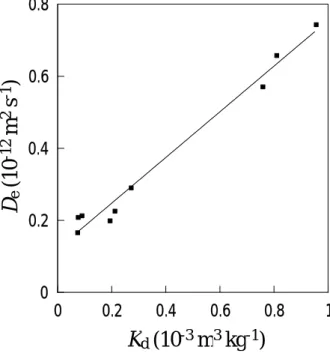
Fig. 3 Correlation between the De and the Kd of 133Ba in the granite.
I- + 1.5O2(g) = IO3-
log K = 13.38 [17] (12) Diffusivity of IO3- in water at infinite dilution is 1.06x10⁻⁹ m2 s-1, which is about half as high as that of I- (2.00x10⁻⁹ m2 s-1) at 25ºC [18].
The pore-diffusion model gives the De as Eq. (4) where εδτ-2 is (2.6±0.4)x10-4 [12] for the granite. Since the diffusion of
133Ba in the present experiment was self - diffusion, diffusivity of Ba2+ at infinite dilution, 8.48x10⁻¹⁰ m2 s-1 [18], can be used as Dv. Equation (4) gave the De of Ba2+ of (2.2±0.3)x10-13 m2 s-1 under the present experimental conditions. The De values obtained at the BaCl2 concentration of 10 mol m-3 agreed with the estimated value.
The De value obtained for the 1 mol m-3 BaCl2 solution was slightly higher than the value and the value obtained for the 10-1 mol m-3 BaCl2 solution was higher by 3 times. It is noticeable that if the decrease in the concentration of 133Ba in the source reservoir shown in Fig. 1(c) was taken into account by using the method developed by Spacek & Kubin [19], the De of 1.3x10⁻¹² m2 s-1 was obtained, which is higher by 6 times than the value estimated by the pore-diffusion model. But the De value obtained by their method was not further considered in this paper because comparison with the other De values obtained by Eq. (10) is not convincing.
The Kd of barium on granite was lowest in case that the concentration of BaCl2 was 10 mol m-3 and was highest in case of 10-1 mol m-3. This type of dependence of the Kd on concentration is often observed for Sr that analogizes to barium [20-22], and can be attributed to the gradual saturation of adsorption sites on granite by Ba2+. The zeta potential of the milled granite suspension was –30.7 mV in 10-1 mol m-3 BaCl2 solution, -13.6 mV in 1 mol m-3 BaCl2 solution and -7.4 mV in 10 mol m-3 BaCl2 solution. The fact that the zeta potential of the granite gradually approached zero as the BaCl2 concentration increased suggested that the sorption sites were gradually dominated by Ba2+ ions at the higher concentration of BaCl2.
In case of low Kd value due to high BaCl2 concentration, the De value was low, while in case of higher Kd value due to low BaCl2 concentration, the De value was high. The positive correlation is clearly seen between the De and the Kd as the second term of Eq. (5) stated.
The variation in the De value in the three BaCl2
concentrations was not due to the speciation of barium in the solution because complexation of Ba2+ by Cl- is negligible and carbonate precipitation is not favorable under the working pH range (5.8 - 6.7) [23].
The De of I-, non-sorbed species, was not affected by BaCl2 concentrations; (6.1±0.9)x10-13, (8.4±1.7)x10-13 and (6.7±2.6)x10-13 m2 s-1 for 10, 1 and 10-1 mol m-3 BaCl2 solution, respectively. These values are close to an estimated value, 6.4x10⁻¹³ m2 s-1, obtained from an equation for the De of I- in rocks [24]
De = 6.4x10⁻¹⁰ε1.3, (13)
where ε was 0.0049. The similar De values of I- for the three BaCl2 concentrations indicate that the physical property of the pore structure was almost the same between the experiments, and accordingly the variation in the De of Ba2+ was not
physically caused. Both Dv and εδτ-2 values were independent on the concentration of BaCl2; nevertheless, the De of Ba2+
depended on concentration of BaCl2. The second term of Eq. (5) or the contribution of the surface diffusion should be responsible for the variation in the De.
The De of Ba2+ was plotted versus Kd in Fig. 3. Using the least squares method, the Ds value was determined to be (2.4±0.1)x10-13 m2 s-1. The present Ds value is smaller than previously obtained value, 3.5x10⁻¹² m2 s-1, for Sr2+ [12].
4 Conclusion
Through diffusion experiments for barium ion in granite were performed; a positive correlation was found between the De and the Kd. The result is strongly indicative of the diffusion in sorbed state. When we apply pore diffusion model to sorbing ions, the diffusive transport can be underestimated.
Acknowledgement
The authors acknowledge Nuclear Safety Research Association for hosting experts’ meetings on surface diffusion over a year. Waste Safety Testing Facility (WASTEF) of JAERI is acknowledged for technical advise on radioactivity measurement.
References
[1] Brakel, J. V., Heertjes, P. M.: Analysis of diffusion in macroporous media in terms of a porosity, a tortuosity and a constrictivity factor. Int. J. Heat Mass Transfer 17, 1093-1103 (1974).
[2] Neretnieks, I.: Diffusion in the rock matrix: an important factor in radionuclide retardation? J. Geophys. Res. 85,
4379-4397 (1980).
[3] Skagius, K., Neretnieks, I.: Diffusion in crystalline rocks of some sorbing and nonsorbing species, KBS-TR-82-12, Swedish Nuclear Fuel and Waste Management Co., Stockholm (1982).
[4] Bradbury, M. H., Stephen, I. G.: Diffusion and permeability based sorption measurements in intact rock samples. Sci. Basis for Nucl. Waste Manag. IX (Mater. Res.
Soc. Symp. Proc. Vol. 50) (Werme, L. O. ed.) Stockholm, Sep. 9-12, 1985, pp. 81-90. (1986).
[5] Bradbury, M. H., Green, A., Lever, D., Stephen, I. G.:
Diffusion and permeability based sorption measurements in sandstone, anhydrite and upper magnesian limestone samples, AERE-R 11995, Harwell Laboratory (1986).
[6] Skagius, K., Neretnieks, I.: Measurement of cesium and strontium diffusion in biotite gneiss. Water Resour. Res.
24, 75-84 (1988).
[7] Smith, P. A.: Modeling of a diffusion-sorption experiment on sandstone, PSI-Bericht Nr. 53, Paul Scherrer Institut (1989).
[8] Tsukamoto, M., Ohe, T.: Intraparticle diffusion of cesium and strontium cations into rock materials. Chem. Geol. 90, 31-44 (1991).
[9] Berry, J. A., Bond, K. A.: Studies of the extent of surface diffusion in the migration of radionuclides through geological materials. Radiochim. Acta 58/59, 329-335 (1992).
[10] Brace, W. F., Grange, A. S., Madden, T. R.: The effect of pressure on the electrical resistivity of water-saturated crystalline rocks. J. Geophys. Res. 70, 5669-5678 (1965).
[11] Ohlsson, Y., Neretnieks, I.: Some evidence for surface ion mobility in rock. J. Contam. Hydrol. 35, 91-100 (1998).
[12] Yamaguchi, T., Sakamoto, Y., Senoo, M.: Consideration on effective diffusivity of strontium in granite. J. Nucl. Sci.
Technol. 30, 796-803 (1993).
[13] Uematsu, K.: Japanese approaches to the assessment of radionuclide migration in the geosphere. Radioactive Waste Management and the Nuclear Fuel Cycles 10, 145-158 (1988).
[14] Tsukamoto, M., and Ohe, T.: Effect of biotite distribution on cesium diffusion in granite. Chem. Geol. 107, 29-46 (1993).
[15] Yamaguchi, T., Isobe, H., Nakayama, S.: Analysis of microporous structure in granite. Radioact. Waste Res. (in Japanese) 3, 99-107 (1997).
[16] Crank, J.: The mathematics of diffusion, 2nd edn, Oxford Univ. Press, London, pp. 50-53. (1975).
[17] Yamaguchi, T.: Consideration on thermodynamic data for predicting solubility and chemical species of elements in groundwater, Part 2: Np, Pu, JAERI-Data/Code 2000-031 (in Japanese), JAERI, Tokai, Japan (2000).
[18] Li, Y. H., Gregory, S.: Diffusion of ions in sea water and in deep-sea sediments. Geochim. Cosmochim. Acta 38, 703-714 (1974).
[19] Spacek, P. and Kubin, M.: Diffusion in gels. J. Polym. Sci:
Part C 16, 705-714 (1967).
[20] Andersson, K., Torstenfelt, B., Allard, B.: Sorption of radionuclides in geologic systems, SKBF/KBS TR-83-63, Swedish Nuclear Fuel and Waste Management Co., Stockholm (1983).
[21] Konishi, M, Yamamoto, K., Yanagi, T.: Sorption behavior of cesium and strontium ions on natural minerals.
Technology Reports of the Osaka University, Vol. 36, No.
1864, pp. 397-403 (1986).
[22] Akiba, K., Hashimoto, H.: Distribution coefficient of strontium on variety of minerals and rocks, J. Nucl. Sci.
Technol. 27, 275-279 (1990).
[23] Dean, A.: Lange's Handbook of Chemistry. McGraw-Hill, New York. (1978).
[24] Nishiyama, K., Nakashima, S., Tada, R., Uchida, T.:
Diffusion of an ion in rock pore water and its relation to pore characteristics. Mining Geol. (in Japanese) 40, 323-326 (1990).
66