Interaction of Np(V) with heterogeneous sites on surfaces of montmorillonite and illite
Shinya Nagasaki* Satoru Tanaka**
Sorption equilibrium and kinetics of NpO2+ on dispersed particles of Na-montmorillonite and Na-illite were experimentally investigated by using batch technique and a spectrophotometric method at pH 6, respectively. Considering the heterogeneity of sorption sites, we showed the affinity spectra for the sorption of NpO2+. It was found that the spectrum of NpO2+ for Na-montmorillonite was monomodal but asymmetrical and that the half-width at half-maximum of the spectrum was relatively broad, indicating that the sorption sites of surface of Na-montmorillonite are strongly heterogeneous. On the other hand, the spectrum of NpO2+ for Na-illite was relatively symmetrical and that the half-width at half-maximum of the spectrum was narrower.
From the kinetic spectra of NpO2+ for Na-montmorillonite, two sorption processes, which are fast and slow sorption, could be distinguished. It was considered that the fast process is attributable to the sorption of NpO2+ on the easily accessible outer surface of Na-montmorillonite particles and the slower process is assigned to the sorption on the interlayer surface. Mean apparent activation energies for the fast and the slow processes were evaluated as 19 ± 2 kJ/mol and 23 ± 3 kJ/mol, respectively. On the other hand, the kinetic spectra of for NpO2+ for Na-illite indicated that the sorption of NpO2+ occurs only at the outer surface.
From the temperature dependence of mean rate constants, a mean apparent activation energy was evaluated as 37 ± 3 kJ/mol.
For Na-montmorillonite, we measured the kinetic spectra of sorption process for Np(V) carbonate complexes at pH 10. We found that the negatively charged Np(V) carbonate complexes sorbs only at the outer surface of Na-montmorillonite and that the mean apparent activation energy was evaluated as 35 ± 3 kJ/mol.
Keywords: Np(V),heterogeneous sites, montmorillonite, illite
1 Introduction
Because of the long half-life (T1/2 = 2.14 x 10⁶ y) and the mobility under aerobic conditions due to the high chemical stability of the pentavalent state, NpO2+, 237Np is considered a possible long-term hazard in the ecosystems.
An understanding of Np sorption is required to quantitatively describe its transport in surface and groundwater systems.
Recently, there has been a consensus of the wide heterogeneity of binding energetics in the surface of minerals and rocks, and the importance of heterogeneity for sorption of metal ions has been pointed out [1]. This heterogeneity is due to the change of conformation of the binding sites, due to the different chemical nature and steric environment of the binding sites and due to the variation of the electrostatic potential by the complexation in the neighborhood of the binding sites.
The clay minerals such as montmorillonite and illite are the important components of groundwater colloids. These carry constant negative charges due to isomorphic substitution inside the crystal lattice, and thereby ion exchange sites are formed on their surface. As mentioned above, the binding properties of the ion exchange sites are not uniform. Their affinity and accessibility for metal ions may vary depending on (i) the different charge density inside the layer, (ii) the location of binding sites on the outer surface and in the interlayer space, and (iii) the irregular shape of the clay
platelets. These properties give rise to a heterogeneity of the surface influencing their binding properties with respect to metal ions.
Pohlmeier has proposed a new method to discuss the sorption of metal ions on the heterogeneous surface [2-4].
His basic idea is that binding sites on homologous complexant (like humic acid or suspended colloidal particles) are heterogeneous. The system should not be described with a definite, discrete affinity (expressed by an equilibrium constant), but rather with a spectrum of affinities. That means at the surface of the homologous complexant there exists as very large number of exchange sites and each of them has its own affinity to a certain metal ion. The contribution of each site to the total occupancy can be plotted versus its affinity, expressed as the logarithm of its specific equilibrium constant. This plot is called the affinity spectrum. For the kinetics in such a system this means each site should be described by its own rate constant, ki (kinetic spectrum). This rate constant implies, for example, its special energy of activation or its accessibility in porous media. The change of this spectrum can be investigated as a function of temperature, pH or concentration to give further information and knowledge about a certain system.
Montmorillonite is expected to be used as the buffer materials in the high-level radioactive waste disposal system because of the low hydraulic conductivity and high sorption capacity. Due to elevated temperature and presence of potassium ion in groundwater, montmorillonite, the major clay mineral in the buffer of radioactive waste disposal system, changes into illite. As the illite content in the buffer increases, hydraulic conductivity of the buffer will increase and sorption capacity of the buffer will decrease.
Furthermore, as mentioned above, montmorillonite and illite are the important components of groundwater colloids.
This article was presented in Japan-China Workshop on Nuclear Waste Management and Reprocessing .
Interaction of Np(V) with heterogeneous sites on surfaces of montmorillonite and illite, By Shinya Nagasaki ([email protected]), Satoru Tanaka
*Department of Environmental Studies, The University of Tokyo 7-3-1 Hongo, Bunkyo-ku, Tokyo 113-8656
**Department of Quantum Engineering and Systems Science, The University of Tokyo 7-3-1 Hongo, Bunkyo-ku, Tokyo 113-8656
In the present work, the equilibrium and kinetics of sorption of NpO2+ on the Na-montmorillonite and the Na-illite are investigated at pH 6 by the experimental methods proposed by Pohlmeier[2-4], and the influence of heterogeneity of the Na-montmorillonite surface on the sorption of NpO2+ is discussed. For comparison, we also investigated the sorption kinetics of Np(V) carbonate complexes on Na-montmorillonite at pH 10.
2 Experimental
2.1 Chemicals
All chemicals except the 237Np solution were reagent grade and used without further purification (Wako Pure Chemical Industries Co. Ltd., Japan). Water was prepared from doubly distilled water by further purification with a Milli-Q system (Millipore); it was ultrafiltered through a 2 nm pore size ultrafilter (UFP1, Millipore) immediately before use.
Neptunium-237 in 1 M HNO3 was purchased from LMRI, France. By repeatedly extracting the Np solution with CMPO (n-octyl(phenyl)-N, N-diisobutylcarbamoylmethyl- phosphine oxide), a Np(V) stock solution was prepared.
CMPO can extract Np(IV), Np(VI) and daughter nuclides from 1 M HNO3 solution with high distribution ratios, but can not extract Np(V) sufficiently, which remains in the HNO3
solution [5-7]. Hence, by this procedure, we prepared the pure Np(V) solution [5-7]. Detailed description of the extraction procedure is shown in Ref.5. Then, the pH of Np stock solution was adjusted with NaOH at pH 6. The pH was measured with a combination glass electrode (type ROSS, Orion Co. Ltd.) calibrated against pH buffer solutions.
Sodium nitrate with a concentration of 1 x 10⁻² M was added to the Np(V) stock solution as the supporting electrolyte.
The concentration of Np(V) stock solutions was 1 x 10⁻³ M.
The oxidation state of Np was spectrophotometrically confirmed to be pentavalent.
Highly pure Na-montmorillonite (Tsukinuno, Yamagata, Japan) and highly pure illite (Rochester, New York, USA) were purchased from Nichika, Japan. Their Na+-type of sorption sites were prepared by threefold ion exchange with 1 M NaNO3 and subsequent dialysis for 2 months to remove the excessive and/or released Na+, K+, NO3- and other ions [8].
For montmorillonite, the sorption sites at outer surface and interlayer were adjusted to Na+-type with this procedure.
The cation exchange capacity (CEC) of the Na-montmorillonite used was 107.5 mEq/100 g. For illite, the sorption sites at outer surface were adjusted to Na+-type, but interlayer cations were K+ which are hardly exchangeable.
The CEC and the specific surface area (BET) were determined as 27 mEq/100 g and 41 m2/g, respectively.
2.2 Sorption equilibrium
One gram of the montmorillonite or the illite was suspended in distilled water (1 liter) that was adjusted at pH 6
with HNO3 and the pH was kept constant throughout the experiments. Sodium nitrate with a concentration of 1 x 10⁻² M was added to the montmorillonite-suspended and illite-suspended solutions as the supporting electrolyte.
After sedimentation for 1 day, the sedimentated montmorillonite and illite were separated from the dispersed montmorillonite and illite by filtration with 0.45m pore size filters. We measured the weight of the sedimentated montmorillonite and illite after drying the Na-montmorillonite trapped on the filter. It was found that the montmorillonite of 8 x 10⁻² g and the illite of 1 x 10⁻¹ g were dispersed in the filtrate. The Np(V) stock solution was added to polypropylene tubes (50 ml) containing the montmorillonite- dispersed or the illite-dispersed solution. The NpO2+
concentrations in these tubes were ranged from 1 x 10⁻⁸ to 1 x 10⁻⁴ M. The additionally added amount of HNO3 to keep pH constant throughout the experiments was not so large (maximum 1.1 ml). Immediately before the addition of Np, the Np stock solution was filtered through UFP1 ultrafilter to remove Np colloids (if Np colloids generated). By comparing the Np concentration in ultrafiltrate with that in the feed, we confirmed that Np was not trapped on the ultrafilter.
One hour was sufficient to reach the sorption equilibrium [9,10]. After the sorption equilibrium was reached, a sample was taken from the supernatant of each experimental tube and ultrafiltered through UFP1. The activities of 237Np in the ultrafiltrates were measured by a well-type Ge detector. We investigated the sorption of Np onto the tube wall, and found that the sorption onto the wall was negligible. The filters used were pre-washed with a solution of the same pH and ionic strength as those of the supernatant. The Np concentration in the pre-washing solution was adjusted to the same concentration as that initially added. For the pre-washing, we followed the experimental procedure described by Nitsche [11]. The influence of the surfactant used by the manufacturer of the filters can be considered as negligibly small and the influence of sorption onto the filter is avoidable by the pre-washing method. All experiments were conducted at 25 ± 0.5 oC.
2.3 Sorption kinetics
We found an absorption peak at 981 nm in the absorption spectrum of the NpO2+ solution. We know that NpO2+ has an absorption maximum at 981 nm [12]. When Np is sorbed on the Na-montmorillonite or Na-illite, the absorbance at 981 nm decreases. After the addition of the Np(V) stock solution to the solution of the dispersed montmorillonite or illite, the variation of absorbance at 981 nm with time was measured spectrophotometrically. The initial Np concentrations were 1 x 10⁻⁵ M. We investigated the dependence of the sorption kinetics as a function of temperature (12 - 28 oC). In order to study the sorption for negatively charged Np species, we studied the sorption
10-7 10-6 10-5 10-4
10-8 10-7 10-6 10-5 10-4
Concentration of Np sorbed (mol/g)
Concentration of Np in liquid phase (mol/l) NpO2
+ for Na-montmorillonite
Langmuir fitting Langmuir-Freundlich fitting
Figure 1 Sorption isotherm of NpO2+
for Na-montmorillonite. Bold and slight solid lines represent the fitting result by Langmuir- Freundlich equation and Langmuir equation, respectively.
10-8 10-7 10-6 10-5 10-4 10-3
10-8 10-7 10-6 10-5 10-4
Concentration of Np sorbed (mol/g)
Concentration of Np in liquid phase (mol/l) NpO2
+ for Na-illite
Figure 2 Sorption isotherm of NpO2+ for Na-illite.
kinetics of Np(V) carbonate complexes on the Na-montmorillonite at pH 10. At pH 10, Np(V) is present mainly as NpO2CO3- and NpO2(CO3)23-. In this study, 1 x 10⁻² M Na2CO3 was added to the Np(V) solution of pH 6 and the pH was re-adjusted at pH 10 by NaOH solution.
Na-montmorillonite was dispersed in the 1 x 10⁻² M Na2CO3
solution of pH 10 containing 1 x 10⁻² M NaNO3, and the dispersed Na-montmorillonite solution was used after separating from the sedimentated montmorillonite. Other experimental procedure was the same as that at pH 6.
3 Results and discussion
3.1 Sorption equilibrium
The sorption isotherms of Np for the Na-montmorillonite and the Na-illite are shown in Figs.1 and 2, respectively. Experimental errors were within 5 - 10 % for all data. The values of sorption distribution coefficient for Na-montmorillonite obtained here were one to three orders of magnitude larger then those reported in literatures [13,14].
The reason is not clear at the present. In Fig.1, the fitting result by Langumuir equation is illustrated. It was found that the Langmuir equation could not describe the experimental results sufficiently both in the montmorillonite and in the illite cases. The Langmuir equation can not be used for heterogeneous surfaces. Many different kinds of sorption sites, Zi, are present on the heterogeneous surface of montmorillonite and illite. Because cations such as Na+, Co2+ and Am3+ sorb on Na-montmorillonite and Na-illite by ion exchange reaction [3,15,16], we assumed that NpO2+
predominantly sorbs on Na-montmorillonite and Na-illite by ion exchange reaction in the present paper. The sorption reactions of NpO2+ on Na-montmorillonite and Na-illite can be written as
From the reaction scheme, Eq.(1), the conditional equilibrium constant Ki0 is defined conventionally [3]
where χZi are the mole fractions of binding sites of type i
occupied with a metal ion, m are the molarilties of the metal ions in the bulk aqueous phase, and f are their activity coefficients in the solution. If the molarity of Na+ is much greater than all other concentrations in Eq.(2), it is nearly constant over the whole isotherm and may be included together with the activity coefficients in the equilibrium constant, which becomes the affinity coefficients, Km,i:
) 2 (
NpO2 Na NpO2 Na
2 Na NpO
+ + +
= +
f f m
m K
Zi Zi o
i χ
χ
An affinity spectrum is a plot of the distribution function, P(K), of the conditional equilibrium coefficient for
an ion exchange reaction as a function of log K. We fitted the Langmuir-Freundlich type equation [3] to the experimental results by considering the heterogeneous surface of the montmorillonite and the illite
) 3 ( .
Na 2 NpO2 2
NpO Na
NpO
N 0 ,
+ +
+ +
=
= f m
f m K K
Zi Zi
a i i
m χ
χ
The heterogeneity is described by the parameter β and Km
which is the mean affinity coefficient. A small value of β
yields a broad affinity spectrum, namely the surface is rather heterogeneous. If β approaches unity, the width of spectrum is rather narrow and the reacting surface binding sites can be treated as quasi-homogeneous sites. χZiNpO2 is the mole fraction of sorption sites occupied by NpO2+ which was calculated from CEC and sorbed amount of NpO2+. The
) 4 ( ) .
( 1
) (
NpO2 NpO2
NpO2 β
β
χ
+ +
= +
m K
m K
m m Zi
) 1 ( .
Na NpO NpO
Na+ 2+ ⇔ i 2+ +
i Z
Z
Langmuir-Freundlich type equation was fitted to the experimental results and the fitting result is illustrated in Figs.1 and 2 as a solid line. The calculated results by the Langmuir-Freundlich type equation agreed well with the experimental results for both cases. The mean affinity coefficients and the heterogeneity coefficients were evaluated as log Km = 4.5 ± 0.1 and β = 0.83 ± 0.03 for the montmorillonite case and log Km = 4.6 ± 0.1 and β = 0.89
± 0.05 for the illite case. The corresponding affinity spectrum is given as [3,4]
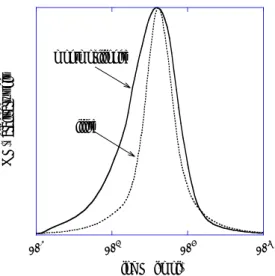
By using the Km and β obtained, the affinity spectra for the sorption of NpO2+ on the montmorillonite and the illite were calculated as shown in Fig. 3. A solid and a dashed lines represent the montmorillonite and the illite cases, respectively. The half-width at half-maximum (HWHM) is 0.60 log-unit for the montmorillonite case and 0.19 log-unit for the illite case. For the sorption of NpO2+ on Na-montmorillonite, the distribution function was broader and more asymmetrical, compared with the narrow and symmetrical affinity spectrum for the sorption of NpO2+ on Na-illite. Na-montmorillonite is weakly aggregated and the interlayer space is accessible, indicating that NpO2+ can be sorbed not only on the outer surface sites but also on the interlayer sites. Since there are many different available sites for the sorption on Na-montmorillonite and the surface is strongly heterogeneous, the affinity spectrum is considered to be broader. On the other hand, illite is already in an aggregated state, but does not swell. Therefore, NpO2+ can be sorbed only on the outer surface sites, leading to the relatively narrow affinity spectrum.
From the affinity spectrum, we can say that
Na-montmorillonite must be treated as strongly heterogeneous and a description analogous to the classical treatment with one or two discrete exchange coefficients is only approximately valid. Of course, the sorption of NpO2+ can be satisfactorily described by a single Freundlich isotherm or by considering the sorption on at least two sites, but the affinity spectrum approach has an advantage for understanding the degree of heterogeneity of the surface.
3.2 Sorption kinetics
Assuming that the sorption of Eq.(1) is a pseudo-first-order reaction, the kinetics at each site Zi is described as
) 5 ( .
] ) / ( ) / ( ) cos(
2 [
) ) sin(
( π πβ β β
β π
m K m K K K K
P = + +
ni (t ) = ni0[1 - exp(-ki t )] (6) where ni (t ) is the concentration of site Zi sorbed by NpO2+ at time t, ni0 the total concentration of site Zi sorbed by NpO2+ at equilibrium, and ki the apparent rate constant at Zi. Eq.(6) is rearranged to Eq.(7) with ⊿ni (t ) = ni0 – ni (t )
⊿ni (t ) = ni0 exp(-ki t ) (7) We can not experimentally observe the sorption reaction at each site Zi, but can observe the time dependence of change in total NpO2+ concentration⊿n (t )
∑ ∑
= n
i
i n
i i i
i n t n kt
n t
n() 0⊿ ()− 0exp(− ) (8)
⊿
If the number n is large enough, the sum may be replaced by an integral, Eq.(9)
∫
∞ −= 0 ( )exp( ) (9)
)
(
⊿nt F Ak kitdk
where F is the proportionality factor and A(k ) represents the distribution of sites, sorbed by Np, as a function of rate constant k, specific for each site. The A(k) plotted vs. log k gives the kinetic spectrum. The A(k) is obtained by an inverse Laplace transform on n(t) which can be experimentally obtained from the change in the absorbances at 981 nm with time. In the present work, the inverse Laplace transform was numerically derived, according to the Talbot method[17].
103 104 105 106
P(K), arbitrary unit
log K (l/mol) montmorillonite
illite
Figure 4 shows the kinetic spectra for the sorption of NpO2+ on the surface of montmorillonite as a function of temperature. Two processes were observed: the mean rate constants of a fast process, estimated from the peak positions of spectra, are from 3 s-1 to 20 s-1, and those of a slow process are from 0.1 s-1 to 3 s-1. The mean rate constants of the fast process are nearly in the same order of magnitude as the sorption of NpO2+ on the outer surface sites of illite as discussed below. We can consider that the fast process in the montmorillonite case is the sorption of NpO2+ on easily accessible outer surface sites of dispersed Na-montmorillonite particles. The slower process may be assigned to the sorption on the interlayer sites. Sorption on the interlayer sites is much slower than that on the outer surface sites, Figure 3 Affinity spectra of NpO2+
for Na-montmorillonite and Na-illite. Solid and dashed lines represent the affinity spectra for montmorillonite and illite, respectively.
-1 -0.5 0 0.5 1 1.5
3.3 3.4 3.5 3.6 3.7
log k (s-1)
103T-1 (K-1) kfast
kslow
Figure 6 Temperature dependences of rate constants of fast process (kfast) and slow process (kslow) in NpO2+ and Na-montmorillonite system.
-1 -0.5 0 0.5 1 1.5 2
Distribution function, arbitrary unit
log k (s-1) 12.2 oC
16.1 oC 20.3 oC
24.5 oC 27.5 oC
Figure 4 Kinetic spectra of NpO2+
for Na- montmorillonite as a function of temperature.
because the diffusion paths are longer and the diffusion rate in the interlayer is suppressed. Kinetic spectra for slower process at low temperature have two peaks and the peaks are unified at high temperature. At the present time, the reasons for these phenomena are not clear. Figure 5 shows the kinetic spectra for the sorption of NpO2+ on the outer surface of illite as a function of temperature. One process, which was a fast reaction and markedly dependent on temperature, was observed in the kinetic spectra. The mean rate constants, estimated from the peaks of spectra, are ranged from 2.5 s-1 to 17 s-1. Because potassium ions in the interlayer of illite are hardly exchangeable and it is difficult for Np to access to the interlayer of the illite, Np is considered to be sorbed on the outer surface of the illite. The one process shown in kinetic spectra therefore indicates the sorption of Np on the outer surface of the illite.
The temperature dependence of the kinetic spectra yields further information about the sorption process. In the montmorillonite case, since the shape of kinetic spectra for fast process was relatively symmetrical, we plotted the rate
constant at peak position (kfast) versus the inverse of temperature (T-1) for the fast process. On the other hand, the shape of kinetic spectra for the slow process was complicated.
We calculated the weighted mean rate constants (kslow) for the slow process, and plotted them versus the inverse of temperature. Figure 6 shows these plots. A linear relationships were obtained for both plots. From the slopes the lines, the mean apparent activation energies for fast and slow processes were evaluated as 19 ± 2 kJ/mol and 23 ± 3 kJ/mol, respectively. The mean activation energy of the ion exchange of Cd2+ and that of alkali ions at montmorillonite are ranged from 7 - 25 kJ/mol [3]. The activation energy for ligand exchange reactions of transition metal ions in aqueous solution is about 70 kJ/mol [2]. This suggests that the fast and slow processes observed in the present work were ion exchange reactions at the sites of outer surface and those in interlayer. Also, in the illite case, the linear relationship of kmean on T-1 was obtained (Fig. 7), yielding a mean apparent activation energy as 37 ± 3 kJ/mol. Although we can not explain why the mean apparent activation energy of the fast process is different between the montmorillonite and illite
-0.5 0 0.5 1 1.5 2
Distribution function, arbitrary unit
log k (s-1) 12.2 oC
16.1 oC 20.3 oC
24.5 oC 27.5 oC
Figure 5 Kinetic spectra of NpO2+
for Na-illite as a function of temperature.
0.2 0.4 0.6 0.8 1 1.2 1.4
3.3 3.4 3.5 3.6
ln k obs (s-1 )
1/T (K-1)
Figure 7 Temperature dependence of rate constant in NpO2+ and Na-illite system.
-0.5 0 0.5 1 1.5 2
Distribution function, arbitrary unit
log k (s-1) 12.2 oC
16.1 oC 20.3 oC
24.5 oC 27.5 oC
Figure 8 Kinetic spectra of Np(V) carbonate complexes for Na-montmorillonite as a function of temperature.
0.2 0.4 0.6 0.8 1 1.2 1.4
3.3 3.4 3.5 3.6
ln k obs (s-1 )
1/T (K-1)
Figure9 Temperature dependence of rate constant in Np(V) carbonate complexes and Na-montmorillonite system.
cases, we consider that the sorption of NpO2+ on the illite takes place on the outer surface.
Figure 8 shows the kinetic spectra for the sorption of Np(V) carbonate complexes on the Na-montmorillonite. We can observe the only one fast process, suggesting that negatively charged Np(V) carbonate complexes is sorbed on the outer surface of the Na-montmorillonite, but not in the interlayer. Figure 9 shows the linear relationship between the mean rate constant and the temperature. From the slope of this line, a mean apparent activation energy was evaluated as 35 ± 3 kJ/mol. There is a possibility that negatively charged Np(V) carbonate complexes is sorbed on the edge sites by surface complexation. However, from these spectrophotometric measurements and energy evaluation, we can not say whether Np is sorbed on edge sites or associated with other sites such as silanol-functional group at the present time. In order to elucidate the sorption mechanism of negatively charged Np(V) carbonate complexes on the Na-montmorillonite, we will have to study the desorption behavior of Np, to estimate the free energy of sorption/desorption processes, to measure the sorption structure by FTIR/Raman spectrometry and to calculate the optimized sorption structure by theoretical calculation such as molecular orbital calculation.
4 Conclusions
The following conclusions can be drawn from the present work.
(1) By using the affinity spectrum approach, it was found that the sorption sites of surface of Na-montmorillonite were strongly heterogeneous and the sorption of NpO2+ was influenced by the surface heterogeneity. On the other hand, the surface of the Na-illite was weakly heterogeneous and the sorption of NpO2+ was also influenced by this surface
heterogeneity.
(2) By using the kinetic spectrum approach, the sorption process of NpO2+ on Na-montmorillonite was found to comprise the fast and slow processes. The fast process was attributable to the sorption of NpO2+ on the outer surface of Na-montmorillonite and the slower process was assigned to the sorption on the interlayer surface. Mean apparent activation energies for the fast and the slow processes were evaluated as 19 ± 2 kJ/mol and 23 ± 3 kJ/mol, respectively.
On the other hand, NpO2+ sorbed only on the outer surface of the Na-illite and the mean apparent activation energy was evaluated as 37 ± 3 kJ/mol. Furthermore, negatively charged Np(V) carbonate complexes also sorbed on the outer surface of the Na-montmorillonite, yielding the mean apparent activation energy was evaluated as 35 ± 3 kJ/mol.
(3) Affinity and kinetic spectrum approach is useful for analyzing the sorption behavior of Np(V) on clay minerals.
References
[1] van Riemsdijk, W. H., Koopal, L. K.: Ion binding by natural heterogeneous colloid. In: Environmental Particles, 1st edn. (Buffle J. and van Leeuwen H. P. ed.) Lewis Publishers, Michigan, pp.455-495 (1992).
[2] Pohlmeier, A.: The kinetic spectrum method applied to the ion exchange of Cd(II) at Mg-montmorillonite. Progr.
Colloid & Polym. Sci. 95, 113-118 (1994).
[3] Pohlmeier, A., Rützel, H.: Kinetics and equilibrium of cadmium complexation with heterogeneous complexants:
a stopped-flow study at Na-illite. J. Colloid Interface Sci.
181, 297-305 (1996).
[4] Pohlmeier, S. H., Pohlmeier, A.: Kinetics and equilibrium of the ion exchange of Cd2+ at Na-montmorillonite:
analysis of heterogeneity by means of the regularization technique COTIN. J. Colloid Interface Sci. 188, 377-386 (1997).
[5] Wisnubroto, D.S., Nagasaki, S., Enokida, Y., Suzuki, A.:
Effect of TBP on solvent extraction of Np(V) with n-octyl(phenyl)-N,N-diisobutylcarbamoylmethylphosphin e oxide. J. Nucl. Sci. Technol. 29, 263-268 (1992).
[6] Mincher, B.J.: The separation of neptunium and plutonium from nitric acid using n-octyl(phenyl)-N, N-diisobutyl- carbamoylmethylphosphine oxide extraction and selective stripping. Solvent Ext. Ion Exch. 7, 645-654 (1989).
[7] Kolarik, Z.J., Horwitz, E.P.: Extraction of neptunium and plutonium nitrates with n-octyl(phenyl)-N, N-diisobutyl- carbamoylmethylphosphine oxide. Solvent Ext. Ion Exch.
6, 247-263 (1988).
[8] Japanese Society of Clay Minerals: Handbook on Clay Minerals, 2nd edn. Gihodo, Tokyo, p.355 (1987) (in Japanese).
[9] Nagasaki, S., Tanaka, S., Todoriki, M., Suzuki, A.: Two sorption processes of NpO2+ within amorphous hydrous ferric oxide. J.Alloys Comp. 271-273, 252-256 (1998).
[10] Nakata, K., Fukuda, T., Nagasaki, S., Tanaka, S., Suzuki, A.: Sorption of neptunium on iron-containing minerals.
Czechoslovak J. Phys. 49, 159-166 (1999).
[11] Nitsche, H.: Solubility studies of transuranium elements for nuclear waste disposal: principles and overview.
Radiochim. Acta 52/53, 3-9 (1991).
[12] Neck, V., Runde, W., Kim, J. I., Kanellakopulos, B.:
Solid-liquid equilibrium reactions of neptunium(V) in carbonate solution at different ionic strength. Radiochim Acta 65, 29-37 (1994).
[13] Kozai, N., Ohnuki, T., Muraoka, S.: Effect of calcium ion on sorption of neptunium by smectite. J. Atomic Ener. Soc.
Japan 36, 955-957 (1994) (in Japanese).
[14] Kozai, N., Ohnuki, T., Muraoka, S.: Sorption characteristics of neptunium by sodium-smectite. J. Nucl.
Sci. Technol. 30, 1153-1159 (1993).
[15] Nagasaki, S., Tanaka, S., Suzuki, A: Affinity of finely dispersed montmorillonite colloidal particles for americium and lanthanides. J. Nucl. Mater. 244, 29-35 (1997).
[16] Swartzen-Allen, S.L., Matijević, E.: Surface and colloid chemistry of clays, Chem. Rev. 74, 385-400 (1974).
[17] Fujita, K.: Effect of TRU elements on safety assessment of HLW disposal. Master Thesis, The University of Tokyo (1993) (in Japanese).