Modeling of water -glass and water –granite interaction in Beishan Area, Northwestern China
Zhou Wenbin* Zhang Zhanshi* Li Mangen*
Water-glass and water-granite interactions in Beishan Area, a potential area for China HLW repository, have been studied using EQ3/6, a geochemical software package developed by the Lawrence Livermore Laboratory for use in modeling the complex geochemical processes that occur when aqueous solutions react with soil, rock, or solid waste materials, and the results of calculation are reported in this paper. The modeling shows that a lot of secondary minerals which contain the components of the glass could be formed due to the interaction between glass and groundwater of Beishan Wuyi well. The formation of the secondary minerals could not only decrease the concentrations of the radionuclides in the groundwater, but also fill and block the pores in the rock, and reduce the groundwater flow rate. These processes are very important to prevent the nuclides from migrating into the human’s environment.
The most significant feature for the interaction between groundwater and granite from Beishan area is the precipitation of large amount of clay minerals, such as montmorillonite, smectite, nontronite, beidellite and so on, in the later stage of the reaction. All of them have very strong adsorptivity for the nuclides. So it is thought that the granite of Beishan Area is favorable to the construction of HLW repository.
Keywords: Geochemical modeling, Water-rock interaction, High level waste disposal, EQ3/6
1 Introduction
China’s R&D Program “Deep Geological Disposal of HLW ” was launched by the China National Nuclear Corporation in 1985. According to the program, site selection for China’s HLW repository is in progress, and granite is considered as the potential host rock for the repository[1]. The site selection is implemented in the sequence of nationwide screening, regional screening, district screening and site screening. At present, the third step has been reached, and the screening efforts are focused on the Beishan Area, Gansu Province in northwestern China.
According to the policy of nuclear fuel cycle in China, reprocessing of spent fuel will be necessary, and the high-level radioactive liquid wastes from the reprocessing will be solidified by virtrification. At present, granite in Beishan Area of Gansu province has been preliminarily selected as the host rock for the geological repository. Consequently, it is very important to study the interaction between the groundwater and the waste glass and the granite.
In this study, EQ3/6 was employed to simulate the geochemical processes during the groundwater interacting with the waste glass and granite in Beishan area, and results of the modeling are reported and discussed below.
2 Methodology
2.1 EQ3/6
EQ3/6, a geochemical software package developed by the Lawrence Livermore Laboratory, is a set of computer codes and associated databases for use in modeling the complex geochemical processes that occur when aqueous solutions react with soil, rock, or solid waste materials[2]. The software was originally developed to model rock/water interactions in
hydrothermal and geothermal systems over the temperature range of 0 to 300 degrees Celsius. It later underwent extensive further development for use in modeling geochemical processes pertinent to the geologic disposal of high-level nuclear waste.
EQ3 and EQ6 are among the most important codes in the EQ3/6 software package. EQ3 deals with geochemical aqueous speciation-solubility calculations[3]. EQ6 is a reaction path code for water-rock and water-rock-waste system[4]. It models the chemical evolution of such systems using thermodynamic and kinetic constraints. The kinds of reaction path calculations include simple titration, fluid mixing, irreversible reaction in closed systems, irreversible reaction in fluid-centered flow-through systems, and heating or cooling processes, as well as solve “single-point” thermodynamic equilibrium calculations.
Some of the practical processes of interest that can be modeled using EQ3/6 include mineral dissolution and precipitation, wasteform leaching, and incorporation of heavy metals and other inorganic toxic components into secondary minerals.
2.2 The reactants
2.2.1 Groundwater in Beishan Area
Beishan is in a typical arid climate region. As a part of the HLW Deep Geological Disposal project of China, a preliminary characterization of hydrogeology and chemistry of the groundwater for the studying area has been carried. The pH value of the shallow groundwater in this area is usually in the
Table 1 Chemical composition of water from Wuyi well in Beishan Area[5] ( mg/L)
Dissolved
species Concentration Dissolved
species Concentration Dissolved
species Concentration Na+ 47.83 NH4+ 0.12 HCO3-
103.7
Ca2+ 73.88 Al3+ 0.06 Cl- 61.35
K+ 8.88 Mn2+ 0.022 F- 0.26
Mg2+ 8.98 Li+ 0.0112 Br- 0.0001
Cu 0.0001 Sr2+ 0.715 SO42-
161.8 Eh(V) 0.345 SiO2
(aq) 12.91 NO3-
10.42 pH 7.24
This article was presented in “Japan-China Workshop on Nuclear Waste Management and Reprocessing”.
Modeling of water -glass and water –granite interaction in Beishan Area, Northwestern China, by Zhou Wenbin([email protected]), Zhang Zhanshi, Li Mangen
*East China geological Institute, Fuzhou, Jiangxi,344000, China
86 range of 7.1 to 8.8, temperature from 8 to 14℃, and the total dissolved solid (TDS) from 0.3 to 12g/L. The majority of shallow groundwater are of Cl·SO4-Na and SO4·Cl-Na types, followed by Cl·SO4-Na·Ca type[5]. The water from Wuyi well, a 50-meter-deep well in Beishan area, is considered as the representative of the groundwater in depth for the study area.
The chemical composition for the water, shown in table 1, has been used in the model calculations.
2.2.2 The waste glass
The Waste glass was made from the vitrification of high-level liquid waste from spent fuel reprocessing with the glass of basic composition under 1150℃ for three hours, the loading of liquid waste and glass are 16% and 84% separately.
Table 2 shows the compositions of high-level liquid waste, indicating the most common elements are Na, Al, S, Fe and U
which take up above 90% of the total oxide of the liquid waste.
The composition of glass shown in Table 3 is similar to that of borosilicate glass. The components of the waste glass are listed in Table 4.
2.2.3 The granite of Beishan Area
The major mineral composition of Beishan granite are quartz, plagioclase, K-feldspar, pyrite and fluorite, and their chemical composition is shown in Table 5.
2.3 Procedures
The modeling study is designed to simulate the geochemical reactions when the groundwater encounters the waste glass or granite in a closed system at 100 °C. Reaction path calculations of EQ6 have been employed for the simulation.
The groundwater from Wuyi well has been defined as the Table 2 Chemical composition of the high-level liquid waste (Weight %)[6]
Element SO4 P2O5 Al2O3 Fe2O3 K2O Na2O U3O8 Cr2O3 NiO TiO2 CeO3
Content 4.242 0.456 9.259 20.687 0.602 44.78 19.028 1.900 3.779 0.317 0.344 Element La2O3 Nd2O3 Pr2O3 BaO SrO MoO2 ZrO2 RuO2 Cs2O Y2O3 MnO2
Content 0.211 0.811 0.199 0.134 0.237 1.020 0.986 0.203 0.763 0.102 0.089
Table 3 Formulation of the basic glass [6]
Element SiO2 B2O3 Na2O Li2O Al2O3 CaO TiO2 MgO
W/% 61.50 17.80 5.30 2.90 2.50 6.40 1.40 2.20
Table 4 Components of the waste glass(Mol/100g)
Element Concentration Element Concentration Element Concentration Element Concentration
S 9.643E-04 Cr 3.637E-04 Ba 1.272E-05 Mn 1.488E-05
P 9.345E-05 Ni 7.361E-04 Sr 3.329E-05 Si 8.610E-01
Al 4.960E-03 Ti 1.528E-03 Mo 1.159E-04 B 4.290E-02
Fe 3.762E-03 Ce 3.200E-05 Zr 1.166E-04 Li 8.120E-03
K 1.864E-04 La 1.884E-05 Ru 2.221E-05 Ca 9.600E-03
Na 2.102E-04 Nd 6.013E-05 Cs 7.877E-05 Mg 4.620E-03
U 9.167E-04 Pr 1.754E-05 Y 1.313E-05
Table 5 The compositions of Beishan granite[5]
Component SiO2 TiO2 Al2O3 Fe2O3 FeO MnO MgO CaO Na2O K2O wt% 69.98 0.36 15.20 0.11 2.08 0.03 0.92 2.78 3.87 3.26
87 aqueous solution for the interaction, whereas the waste glass and Beishan granite have been treated as the solid phase for the reactions. At the beginning of the simulation, the reaction progress variable Zi=0,100g granite or waste glass was added into 1 liter water of Wuyi well. Zi value will approach to 1 when equilibrium between groundwater and glass or granite is attained. Results of the modeling have been processed into diagrams using Microsoft Excel.
3 Results and discussions
3.1 Graoundwater-glass interaction
As shown in Fig. 1, the geochemical evolution curves during groundwater-glass interaction indicate that the concentrations of Si, C, B, Li and Ce are increased as the reaction proceeds ( Pr, Nd and Y have the same evolution curves, so as Mo, Ce, Cs and La), while the other elements (Ni, Cu, Cr, S, Mg, F ) would decrease in the later stage of the reaction due to the formation of secondary minerals such as chromite and chalcopyrite (cf. Fig. 2), the contents of Cl, Na, K, F, Sr, N and Br are almost the constant during the whole reaction.
Figure 2 shows the generation process of the secondary minerals during groundwater-glass interaction. CaZrO3 precipitates throughout the reaction; antigorite, hematite, calcite and pyrolusite form at the early stage of the reaction but dissolve at the later; then quartz, chromite and chalocopyrite are deposited, but saponite, RuO2and NiSiO4 are formed while
1. 00E- 09 1. 00E- 08 1. 00E- 07 1. 00E- 06 1. 00E- 05 1. 00E- 04 1. 00E- 03 1. 00E- 02 1. 00E- 01 1. 00E+00 1. 00E+01 1. 00E+02 1. 00E+03
- 9 - 8 - 7 - 6 - 5 - 4 - 3 - 2 - 1 0
LogZi
mg/kg
B C Si
K N
0. 1 1 10 100 1000
- 9 - 8 - 7 - 6 - 5 - 4 - 3 - 2 - 1 0
LogZi
mg/kg
Ca Cl
Na S
1. 00E- 08 1. 00E- 07 1. 00E- 06 1. 00E- 05 1. 00E- 04 1. 00E- 03 1. 00E- 02 1. 00E- 01 1. 00E+00 1. 00E+01 1. 00E+02
-9 -8 -7 -6 - 5 - 4 - 3 - 2 - 1 0
LogZi
mg/kg
Br Al Ce
Cs Ba F
Sr La Li
1. 00E- 14 1. 00E- 13 1. 00E- 12 1. 00E- 11 1. 00E- 10 1. 00E- 09 1. 00E- 08 1. 00E- 07 1. 00E- 06 1. 00E- 05 1. 00E- 04 1. 00E- 03 1. 00E- 02 1. 00E- 01 1. 00E+00 1. 00E+01
- 9 - 8 - 7 - 6 - 5 - 4 - 3 - 2 - 1 0 LogZi
mg/kg
Mg Mn Ni
Cr Cu Fe
Fig.1 Water-glass interaction: evolution of the element
0 2 4 6 8 10 12 14
-9 -8 -7 -6 -5 -4 -3 -2 -1 0
LogZ
Chalcopyrite Saponite
NiSiO4
Chromite CaUO4
RuO2
Quartz Pyrolusite
Antigorite Calcite
Hematite
CaZrO3
Fig. 2 Water-glass interaction: formation of secondary minerals as a function of Zi
88 logZi=-5 ~ -3 and then dissolve. Formation of the secondary minerals would decrease the concentration of radionuclides in water, and fill the pore in the rock, resulting to the decrease in flow rate of groundwater, and play an important role in the retardation of radionuclides.
3.2 Groundwater-granite interaction
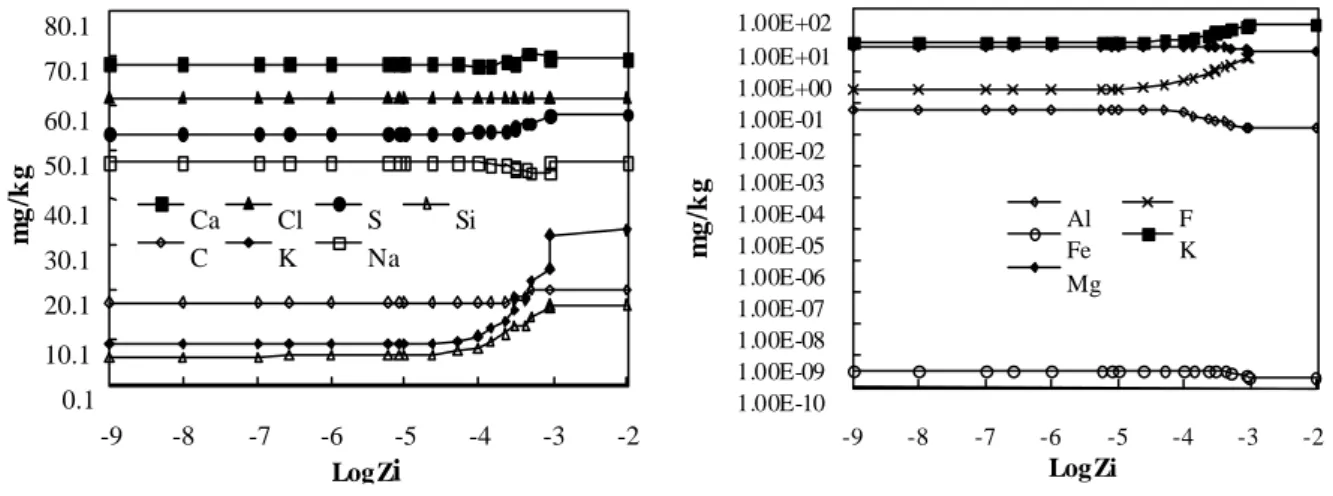
In this case, the fluid phase is still the water of Wuyi well mentioned above. Results of the modeling have been shown in Figs. 3 and 4.
Figure 3 shows that contents of Na, Cl, Mg, Ca, K and S in the aqueous solution are almost fixed, while Al and Fe decrease slightly, and F and Si increase in the later stage of the reaction. The increasing Si concentration in the liquid phase implies that quartz and feldspar in the granite dissolve during the water-rock interaction at elevated temperatures, and the dissolved silica could precipitate in the fractures of granite at a lower temperature and reduce the permeability of granite when the fluid flows in a negative temperature gradient. Experimental study of permeability of granite done by Morrow, Moore and
Byerlee [7,8,9], Lowell et al [10], Chigira and Watanabe [11], have confirmed the permeability of granite could decease between 1 and 2 orders of magnitude due to the precipitation of silica.
The formation processes of the secondary minerals by the water-granite interaction are shown in Fig. 4. Only dolomite precipitates throughout the reactions, and hematite forms at the early stage and dissolves later. The most significant feature is the deposition of a large amount of clay minerals such as montmorillonite, smectite, nontronite and beidellite at the later stage of the reaction besides the muscovite. Clay mineral precipitation was observed by Morrow and his colleagues in their experiments[7]. The clay minerals could not only decease the permeability of the granite, but also have strong adsorptivity for radionuclides, which is favorable to prevent the radionuclides from migrating into human environment.
Consequently, the granite of Beishan Area is favorable to hosting the HLW repository.
4. Conclusions
Based on the modeling of groundwater-glass and groundwater-granite interaction in Beishan area, conclusions can be derived as follows:
1) During groundwater-glass interaction, a large amount of secondary minerals containing the components of high-level liquid waste such as CaZrO3, RuO2, NiSiO4, chromite and pyrolusite could precipitate associated with ordinary secondary minerals such as dolomite, quartz, calcite, hematite and nontronite. This process would decrease the concentration of radionuclides in the groundwater, the porosity of the host rocks and flow rate of the groundwater.
2) A lot of clay minerals such as montmorillonite, smectite, nontronite and beidellite could precipitate at the later stage of the reaction between groundwater and granite in Beishan area. These clay minerals are strong in adsorption of radionuclides.
0.1 10.1 20.1 30.1 40.1 50.1 60.1 70.1 80.1
-9 -8 -7 -6 -5 -4 -3 -2
LogZi
mg/kg
Ca Cl S Si
C K Na
1.00E-10 1.00E-09 1.00E-08 1.00E-07 1.00E-06 1.00E-05 1.00E-04 1.00E-03 1.00E-02 1.00E-01 1.00E+00 1.00E+01 1.00E+02
-9 -8 -7 -6 -5 -4 -3 -2
LogZi
mg/kg
Al F
Fe K
Mg
Fig.3. Water-granite interaction: evolution of the element
1
-9 -8 -7 -6 -5 -4 -3 -2
LogZi Dolomite Hematite
Muscovite Smectite Mesolite
Beidellite
Montomorillori Nontronit
Fig.4. Water-granite interaction: formation of secondary minerals
89 Therefore, from geochemical point of view, the granite of Beishan Area is thought to be one of favorable site for the construction of HLW repository in China.
References
[1] Xu, G. Q, et al. Deep geological disposal of high level radioactive waste in China. In: Witherspoon, P.A (ed) Geological Problem in Radioactive Waste Isolation:
Second Worldwide Review 51-61(1996).
[2] Wolery, T. J., EQ3/6, A software package for geochemical modeling of aqueous systems: package overview and installation guide (version 7.0), UCRL-MA-110662 PT I (1992).
[3] Wolery, T. J., EQ3NR, A computer program for geochemical aqueous speciation-solubility calculations:
theoretical manual, user’s guide, and related documentation (version 7.0), UCRL-MA-110662 PT III (1992).
[4] Wolery, T. J., EQ6, A computer program for reaction path modeling of aqueous geochemical systems: theoretical manual, user’s guide, and re;ated documentation (Version 7.0), UCRL-MA-110662 PTIV (1992).
[5] Yang, T. X., Guo, Y.H., The ground water chemical characteristics of Beishan Area—The China’s potential high-level radioactive waste repository. Acta Geoscientia Sinica 20, 679-685(1999).
[6] Jiang, Y. Z., et al. The development of basic glass formulations for solidifying HLW from nuclear fuel reprocessing plant. Atomic Energy Science and Technology 29(3), 253-261(1995).
[7] Morrow, C., et al, Permeability of granite in a temperature gradient. Journal of Geophysical Research 86, 3002-3008, (1981).
[8] Moore, D.E., et al, Chemical reaction accompanying fluid flow through granite held in a temperature gradient.
Geochimica et Cosmochimica Acta 47, 445-453 (1983).
[9] Moore, D.E., et al, High-temperature permeability and groundwater chemistry of some Nevada Test Site tuffs.
Journal of Geophysical Research 91, 2163-2171 (1986).
[10] Lowell R.P, et al, Silica precipitation in fractures and the evolution of permeabilty in hydrothermal upflow zones.
Science 260, 192-194 (1993).
[11] Chigira, M. and Watanabe, M., Silica precipitation behavior in a flow field with negative temperature gradients, Journal of Geophysical Research 99, 15539-15548 (1994).
90
![Table 1 Chemical composition of water from Wuyi well in Beishan Area[5] ( mg/L)](https://thumb-ap.123doks.com/thumbv2/123deta/7509388.2501097/1.892.458.821.968.1128/table-chemical-composition-water-wuyi-beishan-area-mg.webp)