Online Identities of Taiwanese and Japanese
EFL Learners
その他(別言語等)
のタイトル
臺灣和日本英語學習者的線上身?特?
著者
Tim Newfields
journal or
publication title
The economic review of Toyo University
volume
43
number
1
page range
1-28
year
2017-12
Online Identities of Taiwanese and Japanese EFL Learners
オンラインを活用する台湾と日本の英語学習者の
アイデンティティーの比較
臺灣和日本英語學習者的線上身份特徵
Tim Newfields
AbstractThis study compares the virtual identities of one hundred Taiwanese and one hundred Japanese learners of English on a popular language exchange forum. Issues of image projection, online behaviors, target language proficiency, and investment are addressed. In light of recent research on identity theory, it outlines varied ways that language learners attempt to negotiate multiple identities and position themselves online. Adopting Sealey and Carter s (2004) social realism framework, this study also compares the posting behaviors of three different types of network users: prolific posters, typical posters, and lurkers who avoid posting. It suggests some of the ways these three sub-groups vary. Prolific posters were generally more proficient in their target languages than lurkers, and had more extensive friendship networks. Taiwanese users also tended to study Asian languages more often than Japanese users. This paper concludes by considering the pedagogical applications of social media language learning sites such as Lang-8.
Keywords: linguistic identities, cyber-identities, online language learning resources, online social network behaviors, social
media language learning
概要 本研究は、近年、言語学習に活用されるオンライン上での台湾と日本(各100名づつ)の英語学習者の言語ア イデンティティーを比較したものである。比較指標として、オンライン上での自己イメージの投影方法、オン ライン・コミュニティー内での行動、学習言語の達成度とその 能力活用に着目した。最近のアイデンティティー 理論の研究によると、言語学習者は、オンライン上で自分自身を複数のアイデンティティーで位置付けている 事を示唆している。本研究はまた、SealeyとCarter (2004年)の社会的リアリズムの枠組みを採用し、3つの異な るタイプのネットワークユーザーの投稿行動(投稿数、典型的な 投稿、投稿を避けるユーザー)も比較した。 そしてこの3つのサブグループの変化についても示唆する。投稿数のユーザーは、投稿を避けるユーザーより それらの目的言語に熟練し、より広い親交ネットワークを持っていました。台湾のユーザーは、また、日本の ユーザーよりしばしばアジアの言語を勉強する傾向があった。本稿は、 Lang-8のようなソーシャルメディア言語
学習サイトの教育的効果を結論付けている。 キーワード:言語アイデンティティー、サイバーアイデンティティー、オンライン言、語学習リソース、 オンラインソー シャルネットワークでの行動、言語学習のソーシャルメディア 摘要 本研究比較各一百名台灣和日本的英語學習者在一個受歡迎的語言交流論壇上的虛擬身份。本文探討了圖像投 影、在線行為、目標語言能力和投資問題。根據最近認同理論的研究,本論文表明一些語言學習者試圖對他們的 線上多重身份還有社會定位做溝通。本研究使用Carter和Sealey(2004年)社會現實主義的框架,還比較了三種不 同類型的網路使用者:多產的發表,典型的發表,網路旁觀者。這顯示了這三個子組(次群組)的一些方式有所不同。 普通海報通常比潛水員更精通其目標語言,並擁有更廣泛的友誼網絡。台灣用戶比日本用戶更傾向於學習亞洲語 言。研究所得到的結論是, Lang-8等社會化媒體網站具有潛在教育價值。 關鍵字:語言學的特性、 網路身份、 虛擬社群、 線上語言學習資源、線上社交網路的行為
This paper explores the interface of two concepts. One is online identity, also known as cyber identity, virtual identity, or Internet persona. Informed by concepts by Norton (2013), Ricoeur (1992), Turkle (1984), and Weinreich (2004), I define online identity as:
Any of the ways that networked users construe themselves via online social media. In particular, it refers to how a user s current narratives and symbolic referents suggest continuity with their past construals and with their imagined future construals. Such construals share many features with Ricoeur s (1992) notion of
ipse identity, except that online identities exist solely in cyberspace. Moreover, as Weisgerber (2011) notes,
online identities are likely to be fragmentary and highly context-dependent. Online identities can also refer to the ways that online community members construe other members of their communities.
It should be emphasized that people tend to portray themselves differently across various social media networks. In academically oriented networks such as ResearchGate.net or Academia.edu, there is a tendency to present work-oriented, professional self-construals. These contrast with the more personally oriented construals in networks such as Facebook or QZone (a popular Chinese SNS).
An ongoing debate is about how online identities differ from so-called real life identities. In other words, to what extent - if any - do people project themselves differently on and off their computer screens? A key variable seems to be a network s policy towards pseudonymity, or the ability of users to mask their legal identities. Although perfect anonymity does not exist in any social media, some sites such as Lang-8 and Duolingo allow users to adopt pseudonyms, while others such as Google+ and Facebook request that legal names be used. At sites permitting pseudonyms, online disinhibition effects (Suler, 2004) are apt to occur. The ease of masking ones legal identity can induce some to become less inhibited. As Abelson and Lessig (1998)
point out, there is a complex relation between social accountability and perceived anonymity. Persons who consider themselves invisible online may express things that they would hesitate to do offline.
In short, online identities often differ from offline identities in at least three ways. First, as hinted above, the ease of concealing ones legal identity in cyberspace means that often it is difficult to know who online interactants actually are. For example, in the language exchange forum discussed in this paper, some users conceal or misrepresent their gender, age, nationality, occupation, or native languages. Second, to borrow a metaphor from Bauman (2000), online identities tend to be more liquid than offline identities. Users can reinvent themselves in each Internet forum they visit. Moreover, through the practice of socking (the use of multiple user names by a single person in the same community) it is possible for one user to display multiple facades. What might seem like a multiple personality disorder in real life is, in the Carolesque world of the Internet, often simply another day on screen. A third way those online identities differ from offline identities is in terms of transience. Generally speaking, it is much easier to disappear from cyber-forums than it is to go through the work of physically moving in real life. In fact, over 70% of the users of the online language forum discussed in this paper have been inactive for at least a year: the majority seem to become inactive within two years. As Aiken (2016) asserts, terminating online relationships is generally easier than terminating real world relations, although both can result in emotional heartaches that subjectively feel equally real. Since 91% of all Japanese are online (Sterling, 2012) and the average Japanese spends about 49 hours a week on the Internet (Heikin Oji, 2012), and about 22% of the time online is spent on social networking (Gaille, 2013), the notion of online identity seems worth exploring.
Linguistic Identity
Another concept explored in this paper is linguistic identity. I adopt a post-modernist perspective informed by Block (2007), Joseph (2004), Norton (2013), and Wenger (1998) to elucidate this. From that perspective, linguistic identity might be described as how we conceive of who we are over time through words, and how we represent those construals to others through speech or writing. Moreover, linguistic identities can also refer to how we interpret others on the basis of what they have written or spoken.
This concept differs from online identity in two ways. First, not all symbolic referents used to construct online identities involve linguistic codes: photographs, gestures, and sometimes music can be used to build online personas. By contrast, linguistic identities are limited entirely to words. Second, linguistic identities can include both online and offline representations. Hence, whereas linguistic identity is a centuries old notion, online identity is more recent. The fictional works of Daley, Lisberger, and MacBird (1982), Gibson (1984), and Shirō (1989) represent some of the prominent early portrayals of online identity.
In my view, Van Lier s (2010) ecological metaphor for identity is a useful way to understand it. Although it is heuristically convenient to divide identity into sub-domains such as social, national, ethnic, linguistic, or psychological, it is also important to remember that these are interconnected. Changing even a single variable may have an unforeseen (and at times far-reaching) impact upon other variables. It is for this reason that Thornborrow (2004, p.71) suggests, The relationship between language and identity will always involve a complex mix of individual, social, and political factors which work to construct people as belonging to a certain group, or to exclude them from another group.
In recent decades, it might seem tempting to frame linguistic identity as a form of social identity. However, in my view it is unwise to overlook the psychological dimensions of this construct. For this reason, I have come to believe that linguistic identity should be regarded as both individual and social. Indeed, Weisgerber (1939, 1962, cited in Coseriu and Geckeler, 1981, p. 24) comments, If we accept the proposal that identity is shaped in part through an internal dialog, then it seems reasonable to conclude the language in which that dialog is constructed does – to some degree at least – influence that dialog itself.
Literature Review
Online identity is an active research field. Over 13,100 articles and books have been published on this topic between 2006 and 2016 according to GoogleScholar. The majority of these deal with how legal identity is represented online, and issues regarding identity theft are frequently discussed. However, there is also extensive research about how the Internet is impacting adolescent identity. Long and Chen (2007) and Zheng, Burrow-Sanchez, and Drew (2010) are but two salient examples. The online identities of ethnic minorities have also been explored at length by researchers such as Kennedy (2006) as well as Macfadyen, Roche, and Doff (2004). Perhaps of greater interest to foreign language teachers is how the Internet may influence on the identities of foreign language learners. For example, Al-Saleem (2011) describes how Facebook use by 44 Jordanian undergraduates appears to result in increased English-Arabic code switching among 38% of the respondents. However, he asserts that English use does not signify an embrace of Western culture or an abandonment of Jordanian identity (p. 201).
Pasfield-Neofitou (2011) explored the Internet use patterns by L2 Australian university students of Japanese, showing how language use is highly domain dependent. Whereas the respondents used English extensively in their Facebook and email accounts, they tended to use Japanese on Mixi and Ameba, both Japan-based SNSs. In fact, their experiences on those latter two networks could be likened to a virtual Japanese study abroad. Pasfield-Neofitou s study suggests how identity displays vary with context. She also narrates how ingroup/outgroup frictions arise when group norms are violated.
More locally, Zeng, Yoshida, and Takatsuka (2008) explored the impact of Moodle (a learning management system) on 28 Japanese university EFL students over a semester. They note how respondents relied on emoticons to overcome linguistic handicaps and suggest that students were engaged in identity construction and negotiation by constantly reflecting on who they were vis-a-vis the community of practicing members (p. 96). Linguistic identity is also recognized as a major research area, with 889 articles and books written on this topic between 2006 and 2016 according to GoogleScholar. Attempts at comprehensive reviews of this topic have been offered by Block (2006), Horiba (2013), Marui (2012), and Rezaei (2012).
Japan-based studies
Japan-based studies of linguistic identity include Kondo s (2009) description of how social status, gender, and cultural expectations weave complex linguistic landscapes that influence identity enactments. Kondo also shows how identity performances are crafted at a confectionary shop in Tokyo.
Shigematsu (2012) studied the linguistic identities of 22 long-term Brazilian residents of Japan, providing evidence of L1 attrition, creolization, and code-switching. Many of the informants described their identities as blended with diverse Japanese and Brazilian-Portuguese components. Through most used Japanese and Portuguese in daily conversations, the majority expressed difficulty using either of these languages in academic contexts.
Ryan (2009), Ueki and Takeuchi (2012), as well as Kojima-Takahashi (2013) have each examined the linguistic identities of Japanese university students from Dörnyei s (2005) motivational self-system framework. Taken together, these studies suggest that Japanese EFL learners often have multifaceted linguistic identities. Moreover, Kojima-Takahashi observed that English wasn t necessarily related to who all of respondents were aspiring to become: for some it was merely an extrinsic goal; others saw themselves as future English users and hence felt more motivated to study that language.
Taiwan-based studies
In Taiwan it is no surprise that many linguistic identity studies have been conducted since Formosa has a very complex linguistic history and different languages tend to be used in different regions and by individuals in different occupations.
Liao (2010) examined the linguistic behaviors of 40 young persons from central Taiwan, half of whom were living in the Taipei area. His study shows how identity and ideology often constrain language use. Those who identify as ethnic Chinese and support the KMT political party are more apt to use Mandarin [Guóyǔ,
contrast, those identifying as ethnic Taiwanese and who support the DPP political party are more apt to use Taiwanese [Tâigú] or other dialects in informal contexts. Those dialects tend to have a lower social status. Liao also laments that Taiwanese use is gradually waning among young highly educated persons, in part because the strong economic incentives to be proficient in Mandarin. Tan (2009) and Tsai (2001) echo these findings. They observe how social stratification correlates with language use in Taiwan and suggest Tâigú and other languages are deeply rooted in rural areas, but their prevalence in major urban centers seems to be diminishing.
In an online survey of 352 Taiwanese (69% female, 63% between age 20 and 30) Fracchia (2014) observed variegated patterns of language use and linguistic affiliation. About half of his respondents indicated that Mandarin was the language they used for utilitarian purposes: they preferred to express themselves in other local languages/dialects. Perhaps a legacy of the former Japanese colonization (or of an enduring affinity for Japan), 37% of the respondents reported being able to speak at least basic Japanese. Moreover, only 1% of the respondents (n=4) indicated that they spoke no English - suggesting that English may be more widely understood in Taiwan than it is in Japan. Although Fracchia s study is not generalizable to the entire Taiwanese population due to sampling limitations, his study does suggest that multilingualism is likely more prevalent in Taiwan than it is in Japan.
Zhāng (2012) surveyed six female English majors at a national university in Taiwan, discovering how most of the informants felt uncertain about their current positioning as English speakers or as members of a broader English-speaking community. Despite the attempts of many universities in Taiwan to internationalize, Zhāng suggests that students generally feel vague about what being international (guójì huà) actually means. The undergraduates interviewed felt more comfortable identifying as Taiwanese than as members of some wider transnational English-speaking population.
Surveying the published literature so far, no studies comparing the online linguistic identity performances of Japanese and Taiwanese appear to have been published. Considering the significant amount of time that many Japanese and Taiwanese spend on the Internet, this merits further investigation.
Research Questions
This research explores the following three research questions:
1. How do the the Japanese and Taiwanese in this sample tend to differ in terms of (i) posting frequency, (ii) target languages being studied, (iii) target language procifiency, (iv) friendship patterns, (v) thematic content, and (vi) identity statements?
2. How to especially prolific posters, lurkers, and typical posters from this sample tend to differ in terms of of (i) membership length in this network, (ii) posting frequency, (iii)
target language choices, (iv) target language proficiency, (v) friendship patterns, (vi) thematic content, and (vii) identity statements?
3. In what ways do the identity statements by the male and female users of this network tend to differ?
Method
Research Context
Lang-8 is an online language exchange social network established in 2006 (Cho, 2015). At the time of this writing, it offers language exchanges in 90 different languages. It has a global Alexa rank of 16,058 (Alexa Internet, 2017). To put that in perspective, out of the thirty million Internet domains currently existing, Lang-8 is in the top 1%. 42.5% of its visitors are from Japan, 9.4% from the USA, 6.6% from China, 3.3% from South Korea, and 2.8% from Germany (Alexa Internet, 2017). Over a million different persons from 190 countries have registered as Lang-8 users in the last decade. However, the precise number of active users is difficult to ascertain since (1) some users have created multiple accounts, and (2) many users appear to be inactive. This website receives 52,320 page views a day (WebsiteOutlook, 2017) from 16,400 unique visitors (Nexhon, 2017). If that information is correct, an average visitor reads approximately three pages from this website per visit. I estimate that perhaps 5% of the users on this network generate about 80% of its traffic volume. Lang-8 works on the basis of reciprocity. By correcting the compositions by others, users earn points and increase the likelihood that their compositions will be corrected. However, a system of supply-and-demand is also at work. For example, it is generally easier to receive Japanese or Chinese corrections than it is to receive French or German corrections since the ratio of proficient speakers in the former two languages is higher. Not surprisingly, young females tend receive more corrections than older males, and for this reason some users may misrepresent their ages and/or gender. Lang-8 is a freemium service: non-paying members can study up to two languages simultaneously. Premium members, comprising less than 10% of the user database, can study an unlimited number of languages, receive preferential posting placements, indicate which linguistic register they would like for their corrections, upload photos, and also easily save texts in .pdf format. I have used this system since March 15, 2012, but changed accounts after losing my password in November 2016. Currently I am studying Chinese and Spanish on this network. So far I have made 5,279 corrections and received 3,282 corrections for 595 journal entries. On December 31, 2016, that amounted to an average of one post every three days and my entries typically receive 5.5 corrections. The Lang-8 website claims a native speaker will correct your entries. However, quite often non-native speakers do so and as Fotheringham (2016) suggests, not all corrections are necessarily correct. At the moment I have 1,221 friends on this network
and log in about five times a week. Participants
In December 2016 I selected a random sample of 100 active Lang-8 users who identified as native speakers of Japanese and 100 persons who identified as native speakers of Traditional Chinese (fántǐ zhōngwén). Since Traditional Chinese is also used in Hong Kong and Macau, users indicating they were from these places were excluded from this sample.
The users of both groups claimed to be studying English as at least one target language. 12% of the Japanese were studying other Asian languages such as Chinese, Cantonese, Thai, Tagalog, or Vietnamese. 11% were learning other European languages such as French, Spanish, Italian, Polish, or Russian. However, 77% of the users in Japan indicated that English was their only current foreign language of study. By contrast, only 30% of the Taiwanese did so. Although 63% of the Taiwanese were studying other Asian languages (Japanese, n=56; Korean, n=7; Turkish, n=1), only 6% stated they were studying other European languages such as French, Spanish, Swedish, or Russian. What this suggests is that the Japanese informants tended to focus more on European languages, but the Taiwanese exhibited a stronger interest in the languages of their Asian neighbors. Curiously, one Japanese Lang-8 user professed to be studying 17 foreign languages at the same time. That claim will be examined later in this paper.
Since 74% of the Japanese in this sample and 72% of the Taiwanese did not specify their ages, inter-group age comparisons are difficult. The majority who did report their ages were in their twenties. The average Taiwanese is now 40.2 and Japanese 46.9 (CIA World Fact Book, 2016). In this sample, only 3% of the Taiwanese indicated they were age fifty or older, but 6% of the Japanese did so.
62% of the Japanese informants and 58% of the Taiwanese chose not to state their occupations. However, some trends were revealing. Whereas only 10% of the Japanese mentioned that they were students, 26% of the Taiwanese did so, providing further evidence that the Taiwanese sample was likely younger than the Japanese sample. Furthermore, 8% of the Japanese in this sample declared that they were full-time housewives, but none of the Taiwanese did so. This echoes the demographic that Taiwan has a higher portion of working women than Japan does (Taiwan Directorate-General of Budget, Accounting and Statistics, 2017; World Bank, 2014). Did gender differences exist between these two samples? Alexa Internet tracking of this website suggests an even ratio of male to female users. However, only 34% of the Taiwanese in this sample indicated they were male, compared to 45% of the Japanese. Since 18% of the Japanese and 19% of the Taiwanese decided not to reveal their genders, and because gender itself is an amorphous construct in cyberspace, the possibility that Taiwanese females were statistically over-represented is uncertain. Other salient characteristics of this sample
are summarized in Table 1.
The data suggest the Japanese and Taiwanese have been involved on Lang-8 for similar lengths of time. However, more heavy users exist in the Japanese sample, resulting in wider data distributions. Since a goal of this research is to highlight how both samples differed, I did not exclude such users as statistical outliers. To the contrary, exploring why a few persons were so prolific in terms of writing fascinated me – particularly in light of the fact that many others users were merely passive lurkers or minimally active users.
Procedure
Let me specify how a random sample was obtained, then how the data was analyzed. On the Lang-8 interface, a Member Search button exists at the top of the menu. After pressing that button, a User Search sub-menu appears. To set the parameters of that sub-menu, native language: Japanese / language of study: English or native language: Traditional Chinese / language of study: English was selected. After this, the basic demographic information from the first hundred users from each group was entered onto an Excel spreadsheet. As previously mentioned, if any Traditional Chinese speakers indicated they were from Hong Kong or Macau, they were excluded from this database. One limitation of this sampling method is that I did not obtain any native speakers of Hakka, Hokkien (Tâigú), or the dozen or so aboriginal languages (nándǎo
yǔyán) existing in Taiwan. Those languages/dialects are not marked in this network. However, an interesting
fact is that many Taiwanese regard themselves as native speakers of more than one language/dialect. For example, one Lang-8 friend has a Mandarin-speaking father, a Hokkien-speaking mother, and a grandmother most comfortable in Hakka. She grew up speaking each of those languages, which, depending on your viewpoint, might also be labeled dialects (McWhorter, 2016, par 6).
Data entry was done over a 10-day period between December 21 and December 31, 2016. To protect user confidentiality, each Lang-8 user s publicly accessible user number was changed to an anonymous code. Hence, the first Japanese appearing on this list was labeled as user J-1, and the first Traditional Mandarin user
Table 1. Contrastive Features of the Japanese / Taiwanese Lang-8 Users in This Sample mebership
length # of postsmade # of corrections made # of corrections received # of friends
median 0.94yrs/0.66yrs 19 / 7 59 / 9 26 / 9 23 / 6
mean 1.69yrs / 1.26yrs 159 / 59 850 / 109 269 / 305 243 / 22
min. 1day / 3days 0 / 0 0 / 0 0 / 0 0 / 0
max. 8.11yrs / 8.01yrs 3151 / 910 43614 / 3523 6386 / 2221 8964 / 271
S.D. NA* 456 / 145 4505 / 164 269 / 116 1121/ 36
was labeled as user T-1. (In this paper, Taiwanese and Traditional Mandarin are used interchangeably. However, as suggested earlier, they do differ in some ways.)
After entering all of the data into an Excel spreadsheet, the Japanese and Taiwanese groups were divided into three further subgroups for detailed analyses. One sub-group consisted of prolific writers who were especially active in terms of posting. Another consisted of typical writers: those posting the statistical median number of posts for each sample. A third comprised lurkers – individuals who appeared to be on the network, but avoided posting.
For practical reasons, seven Japanese and seven Taiwanese from each sub-group category were selected. Although larger sized subgroups would have enhanced the statistical reliability and provided further insights, it would have also greatly increased the data volume. Hence, the prolific writers sub-group consisted of the seven most prolific Japanese writers (those with 762+ entries) as well as the seven most prolific Taiwanese writers (those with 246+ entries). The typical writer sub-group comprised those with a statistical average number of posts in each group: seven Japanese with 19 ( ±3) entries and seven Taiwanese with 7 ( ±1) entries. 93% (n=13) of those in the lurker sub-group had absolutely no entries at the time of data collection; one person posted merely one entry.
As this study sought to examine target language writing proficiency, at first I initially tried using the readability indices such as those described by Fry (2002) to gauge target language proficiency levels. However, since some writers frequently code-switched and others wrote in multiple languages, this approach proved unfeasible. Because the Common European Framework of Reference for Languages (CEFR) - or
Yōroppa gengo kyōtsū sanshō-waku as it is known in Japanese or Ōuzhōu gòngtóng yǔyán cānkǎo biāozhǔn
in Chinese - is now widely used as a yardstick for language proficiency, I adopted this. Having previously worked with Obunsha in aligning the STEP-Eiken Exams to CEFR benchmarks, I was already experienced with this scale. I applied the Council of Europe s rubrics for writing proficiency to the following ordinal scale to calculate statistical means:
A1- A1 A1+ A2- A2 A2+ B1- B1 B1+ B2- B2 B2+ C1- C1 C1+ C2- C2 C2+
1 2 3 4 5 6 7 8 9 10 11 12 13 14 15 16 17 18
Since some persons in this sample have written over 100,000 words and others less than ten words, it was necessary to collect data from the three subgroups in different ways. For the lurkers, everything that was publicly visible was collected: their self-introductions and any comments they made about other posts in a target language they were learning. For those from the other two subgroups, I used this formula: obtain six random posts if the word count exceeded 500 words, or more until a saturation point of at least 500 words was obtained. In all but three cases, six random writing samples sufficed.
After obtaining a sample corpora output from each subgroup member, a word/character count, thematic analysis, and a rough CEFR rating was done. Let me briefly outline how each of those measures was obtained. Average word/character counts were calculated by pasting each user s sample corpora into a MS Word file, selecting the word count menu from the toolbar, and then dividing that by the number of posts that the corpora represented. If both Asian characters and English words were present, the composite count included both. Thematic analysis was done based on a framework developed by Richards (2005), who first recommended focusing on descriptive coding and then engaging in topic coding and finally analytical coding. Instead of offering a detailed thematic analysis of all postings by all two hundred persons in this study, two Japanese and two Taiwanese from each subgroup were selected to accentuate their similarities and differences. My goal was to find contrastive narratives hinting at the diversity present within each sub-sample.
For those writing in English or Japanese, I examined their corpora against the CEFR rubrics issued by the Council of Europe, then assigned a CEFR rating. Having two independent raters would have enhanced the rating reliability, but this seemed impractical. For Japanese writings, however, I asked a highly educated native Japanese to confirm my ratings: although I have been studying Japanese for over thirty years, I still need to corroborate my guesses with proficient native speakers. In two cases (T-60, T-76), a Taiwanese writer s English and Japanese proficiency levels differed. In such cases, their composite scores were averaged. Unfortunately, the few Korean, Polish, French, or Italian posts from this sample were not given any CEFR ratings: I simply lacked access to the linguistic capital to do that.
Statistically, subgroup means, median scores, and standard deviations were calculated through Excel. For inter-group comparisons, I used a two-tailed Mann-Whitney U-Test (also known as the Wilcoxon Rank-Sum Test) with a .05 significance level for ordinal data since some distributions were nonparametric. To measure effect size, I used Cohen s d if the two samples sizes were identical and Hedge s g if they differed. Although these tests can be calculated through most standard statistical packages such as MATLAB, DAP, or SPSS, I chose the Social Science Statistics website for convenience. When comparing cardinal data such as the word counts, two-tailed Mann-Whitney U-Test results were corroborated with Pearson correlation coefficients, which were calculated through Patrick Wessa s online implementation of R (Ver.1.1.23-r7).
Results
Online posting behaviors
Let us examine the posting patterns of the three focus groups, and speculate about possible identity constructs behind them.
Prolific Writers
Some characteristics the most prolific writers from this sample are summarized in Table 2.
The most prolific Japanese writer [J-42] is a professional translator who posts industrial translation questions on nearly a daily basis. In his self-introduction, he mentions his love of English literature. However, his online identity is more prosaic and work-related. When considering identity, self-selected user names and avatar images may provide interesting insights (Turkle, 1995). This user chose a character from a classic Meiji Era Japanese novel as his virtual pen name, highlighting not only his love of literature, but also his national identity.
The least prolific Japanese member of this subgroup [J-27] is actually one of the most proficient English writers. Since December 2014 this person has been translating a well-known newspaper column into English. As an avatar icon, this person selected an image of Miffy, a popular female rabbit created by the Dutch cartoonist Dick Bruna. That rabbit appears in front of a keyboard typing. Based on that icon, it is tempting to infer that this user is female. However, I find it interesting that all of the posts by this user are transpersonal: s/he translates political, social, and cultural news events from a popular column on a daily basis. This user avoids mentioning all personal information, preferring instead to focus on producing nearly flawless English translations of elegant Japanese texts.
The most prolific Taiwanese writer [T-60] posts entirely in Japanese about his travels around Japan, though he offers an English self-introduction. His avatar image is revealing: it depicts a Cheer for Taiwan image of a sweet potato and banana that was downloaded from the LINE Store. Taiwan is often depicted as a sweet potato. In fact, in Taiwanese slang, short and chubby Taiwanese are metaphorically referred to as yams [地 瓜 dìguā]. Since southern Formosa in renown for its bananas, by using this symbol, this writer identifies as a southern Taiwanese.
The least prolific Taiwanese writer in this subgroup [T-39] joined this network just half a year ago. She posts at least one entry a day in Japanese or English, and at times code-switches within the same entry. Much of her writing is highly gendered: she narrates her love life and stories about persons who have inspired her,
Table 2. Features of the Most Prolific Japanese and Taiwanese Lang-8 Writers in This Sample
Group Av. # of Posts Av. Membership Length Av. Posting
Frequency Av. EntryLength (Characters or Words)
Language(s)
Used CEFR Av. Level
Av. # Friends Japanese
(n=7) 1610.4 4.45 yrs 0.97 /day 210.3 81% Eng., 19% Jap. B2 1461 Taiwanese
(n=7) 478.7 2.49 yrs 1.02 /day 502.3 40% Eng., 40% Jap., 20% Kor.
and also periodically posts love poems. This unedited entry about a teacher that she admires is revealing: 私が英語を習っていた時は、ずっととてもいい英語の先生に巡り合いました。私はその中で 一人の特別な先生がいました。このユニークな先生は、クラスで文法や単語などを教えたこと が滅多にありませんでした。その代わりに、彼はいつも哲学や文学や宗教などを我々若者と話 し合いました。ですから、先生のおかげで、私は多くの英語の文章に触れることができていま した。今やっと、先生の意図がわかりました。知識は、人生の知恵とは違うということです。 知識よりも、むしろ生活の知恵の方が、私たちに欠かせないということです。この先生は、問 題への対応方法を私たちに決して語りませんでした。 彼は私たち自分で考えて判断する能力を 訓練させたかったからでした。当時、私は17歳でした。先生にお会いできたことは、本当に幸 運だったと感じています。しかし、私は先生が数年前に亡くなったと聞きました。先生は、母 校の女子高生に奨学金を残しています。私は非常にこの先生に、本当に敬服し感謝しています。
In this post, T-39 demonstrates a Confucian respect for her teachers, but also a rejection of grammar-driven language instruction as well as a thirst for engaging curricular content.
Posting regular journal entries seems to be part of the daily rituals of many of the prolific writers in this sample. However, whereas the Japanese tended to post in English, two of the Taiwanese [T-60, T-75] wrote entirely in Japanese. Not surprisingly, both of them were working for Japanese companies. One other Taiwanese [T-92] wrote entirely in Korean about her daily life and work. What this suggests is that although all users selected English as a language of study , not all of them appear to be actively studying it. In fact, only three of the fourteen prolific users seemed to be studying two different foreign languages at the same time: most prefer to focus on one language at a time.
Average Writers
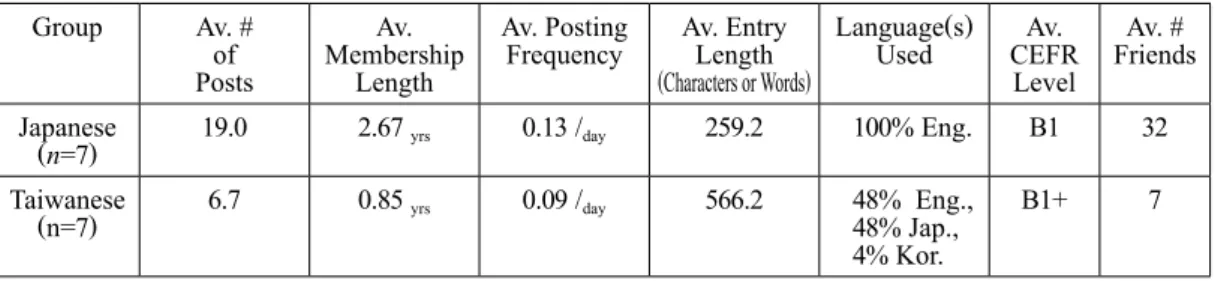
Now let us take a look at the posting behaviors of those approximating the norms of their sample groups. As mentioned earlier, the typical Japanese member had nineteen posts and Taiwanese had seven. Table 3 highlights some of their similarities and differences.
The Taiwanese from this sub-group tended to post longer essays in a greater variety of languages than their Japanese counterparts, but they posted slightly less frequently and had significantly fewer online friends. A typical Japanese user [J-34] is a university student in Tokyo who generally posts about about English grammar points as well as questions likely to arise in future employment interviews. Like many Lang-8 members, she expresses an interest in studying abroad and communicating with those from overseas.
However, she fears that her English is inadequate. This woman selected a snapshot of a young doe on Itsukushima island as her avatar: a choice that marks her both as female and Japanese. Moreover, since Itsukushima (more commonly known as Miyajima) is close to Hiroshima, her choice also links her to Japan s Chūgoku region.
Another typical Japanese [J-61] is a university student who studied for three months in Australia. Since April 2015 she has been writing about movies she has recently seen and items she that has purchased. This person projects a Disneyified identity, displaying a picture of herself in a Minnie Mouse headband at Tokyo Disneyland. Posting just once every 32.6 days, she seems only peripherally involved in Lang-8 and does not interact extensively with other users.
It is interesting to contrast the previous case this with a Taiwanese of similar age [T-94] and number of posts. This young woman describes herself as a Taiwanese backpacker in Australia and she generally writes 171-word posts about her experiences in Australia, life in Taiwan, and recently some Chinese-English translations. Since returning to Taiwan, she has started working for a shipping company and is required to use her bilingual skills at work. As her writing is representative of many younger Taiwanese Lang-8 members, one unedited post is included:
I always want to learn Japanese but I don t have money to pay tuition so I start to pretend the student in Japanese class of K college. It s interesting.If you attend every class since new semester start then nobody knows there is a spy sneak out to this class,even the teacher. Teacher has a lot of experience and nonsense. She always late 15 minutes to class (or more.) Talk some boring nonsense like politics or how hard she studied when she was a student. So one Japanese class need 2 hours but teacher actually teach 1 hour. I feel angery for the education in Taiwan. When I was young,audlt taught us that students was not smart enough to understand politics. But now I realize some teacher still imply something to the ignorant students. This passage highlights how T-94 is a very pro-active learner. It also underscores her cultural beliefs about punctuality, autonomy, and what should be discussed in class. The passage further illuminates the asymmetrical power relations in many classrooms, frustrating this writer.
Table 3. Features of Average Japanese and Taiwanese Lang-8 Writers from This Sample
Group Av. # of Posts Av. Membership Length Av. Posting
Frequency Av. EntryLength (Characters or Words)
Language(s)
Used CEFR Av. Level
Av. # Friends Japanese
(n=7) 19.0 2.67 yrs 0.13 /day 259.2 100% Eng. B1 32
Taiwanese
(n=7) 6.7 0.85 yrs 0.09 /day 566.2 48% Eng., 48% Jap., 4% Kor.
Another Taiwanese Lang-8 member who might be described as typical is user T-37, a young woman with a B.A. degree in accounting who will shortly quit her job in Taipei to spend a year in South Korea. Bored with her current deskwork, she is attempting to create a new identity that involves Korean and English. She plans to enroll in a three-month intensive Korean class in Seoul, then look for a job as a waitress or drugstore staff. Since Taiwan and South Korea have reciprocal working holiday agreements, it easy for young people in both countries to cross borders. This user, who has adopted a Korean pen name, idolizes Korea. In one diary entry she adds, I like everything in Korea. I was impressed by the fact that Koreans are kind to foreigners and are friendly. Also, I love Korean food too. She is not so interested in Japan or studying Japanese, stating, Many people in Taiwan can speak Japanese. Moreover, she regards English as useful tool for communicating with foreigners. Although she is not as passionate about English as she is about Korean, she does recognize its utilitarian value.
Lurkers
Let us now examine the behaviors of those who have not posted on this network and see if it is possible to discern any possible identity patterns. In a sense, writing about lurkers is like ghost hunting: most of their activity is invisible. However, their self-introductions (if public), correction patterns, and friendship patterns do reveal some clues, as summarized in Table 4.
Quite likely, people lurk on this network for a variety of reasons. As Georgen, Duncan, and Cook (2015) observe, new users often prefer to observe online behavior norms before posting. Most persons in this sub-group are significantly newer to to the network than those from other sub-sub-groups. Also, target language proficiency among this subgroup tends to be lower than other sub-groups. Some of the lurkers might seem less confident about their ability to post in a target language, preferring instead merely to read. Finally, it is also quite possible that personality factors play a role in lurking behavior – many appear to be hesitant about disclosing personal information and shyer than the norm. Let me outline the profiles of four lurkers.
Table 4. Some Features of Non-Posting Japanese and Taiwanese Lang-8 Members
Group Av. #
of Posts Av. Membership Length CorrectionsAv.# Given
Av. Self-Intro Length (Characters/Words)
Av. Self-Intro
CEFR Level FriendsAv. # Japanese
(n=7) 0 0.18 yrs 2.0 34.6 A2-* 6.0
Taiwanese
(n=7) 0.14 0.14 yrs 1.1 31.4 A2-* 3.5
User J-6 has been on the site 140 days, and uses the icon of a popular Japanese female anime character. This user has made 16 different Lang-8 friends – all of them female and most of whom also have anime characters as their avatars. This user avoids revealing much personal information, unless it is on a one-on-one basis with others who appear to share mutual interests.
User J-96 is a male office worker who has been on this network for 54 days. He has corrected entries by three American students learning Japanese, but has so far avoided posting. In his self-introduction, he mentions his fondness of English study and his desire to correct others studying Japanese. However, he seems reticent about sharing personal information and avoids mentioning his age or disclosing any personal information through his avatar icon.
User T-50 is a 21-yr. old university student who has been on this network a short time. This person offers no self-introduction, but did translate a five-minute segment from the 2015 Taiwanese romantic comedy television series Marry Me, or Not? [Bì Qǔ Nǚrén, lit.: Women Must Marry]. Her 1,123-character Japanese transcription got just one correction, and she did not reciprocate by correcting the individual who corrected her. Perhaps without knowing it, this user broke two network norms. First, her passage was far longer than most Lang-8 passages. Second, her failure to reciprocate a peer correction makes it less likely that she will receive future corrections.
One more Taiwanese lurker is user T-56, who has been on the site just 18 days. She has corrected three posts by Japanese attempting to learn Traditional Chinese. This user is cautious about disclosing any personal information: no photo or personal details exist. Her 8-word self-introduction is hauntingly cryptic, but it echoes the trepidation many foreign language learners feel in unfamiliar public forums involving languages they are not yet fluent in:
I m nobody. Maybe you know me, or not. :)
Will this person become somebody in the days to come? Or will fear or lethargy perhaps get the better of her, resulting in her withdrawal from this community entirely? Since some Lang-8 users lurk for extended periods before posting, only time will tell.
Discussion
Let us first discuss how the Japanese and Taiwanese writings tend to differ, and then reflect on possible differences between frequent, occasional, and non-posters. After that, we will address the issue of gender.
Japanese – Taiwanese Differences (i) posting frequency
There is no statistically significant difference regarding how often Japanese and Taiwanese subgroups tend to post (U=88, Z=0.44, p=0.66). The composite average posting rating for Japanese and Taiwanese from all three subgroups was about 2.5 times a week. If we consider the entire Lang-8 database, however, the posting frequency is likely to be less frequent. For example, user J-7 took a seven-year hiatus from posting and at least 70% of those who signed up five years ago are no longer active. Attrition is a reality and long-term regular involvement in this network for more than several years is infrequent. Quite likely, some users move onto other language learning sites. Others appear to have given up their studies altogether.
(ii) target languages
Multilingualism appeared to be more prevalent among the Taiwanese in this sample. Whereas only 39% of the Japanese indicated they were studying more than one foreign language, 68% of the Taiwanese did so. Moreover, Japanese tended to study European languages and Taiwanese were more likely to study Japanese or Korean. However, a word of caution is in order: what people claim to do and actually do sometimes differs due to social desirability bias. For example, user J-48 claims to be studying 17 languages at the same time. However, an analysis of his 33 most recent posts reveals that that 51% are in English, 21% in Japanese, 15% in in his native Chinese, and only 13% are in four other European languages. Moreover, the majority of these posts have the hallmarks of computer translations: the author is likely relying on translation engines such as Google, Bing, Baidu, or Yandex to produce text. In light of this, we need to reflect on what it means to study a foreign language in a digitalized age. With translation engines, is now possible for even novice language learners to produce comprehensible foreign language texts about complex topics. Social constructivists such as Ede (1989) and Sullivan Palincsar (2004) would encourage us to consider study more as a process – not merely a product. (iii) target language proficiency
There is no statistically significant difference in how proficient Japanese and Taiwanese appeared to be in their target languages (U=143.5, Z=0.30, p=0.76). The effect size between the two samples was minor (g= 0.24), suggesting a very large overlap. However, since the sub-group sizes were small, and languages other than Japanese and English were not rated, this finding should be regarded as exploratory.
Indeed, as Kearns (2012) suggests it probably wise to be cautious about gauging foreign language writing proficiency solely on the basis of online posts since some people use computer translation software and grammar/spelling checkers, and others may receive feedback from peers or teachers before posting. To accurately assess writing ability, we must know many details about how a composition is produced. In this forum, we can only observe the product – not the actual writing process.
(iv) friendship patterns
The hundred Japanese in this sample tended to have significantly more friends than the Taiwanese (U=3220,
Z=4.26, p=0.001). Examining the Pearson correlation coefficients, the number of user friendships correlates
moderately with the number of posts made (r=.50, n=200, p<.001) by both populations. Friendship numbers also correlate moderately with the number of corrections given (r=.56, n=200, p<.001) as well as the number corrections received (r =.54, n=200, p<.001).
There is likely a variety of reasons why Japanese tend to have more friends than Taiwanese. Japanese outnumber Taiwanese members in this network. However, most Japanese seem to avoid friendships with compatriots: less than 4% of the friends in composite Japanese sub-samples consisted of friends with other Japanese. The general trend among both Japanese and Taiwanese users is to develop friendships with native speakers of the target language(s) they are learning. A salient exception to this pattern is user J-4, who has over four thousand Japanese friends. This elderly matron often offers advice and encouragement to fellow Japanese users. It is fascinating to observe how she deftly employs pragmatic politeness strategies with gentle exhortations about online behavioral norms, which are superbly balanced by a light-hearted touch of humor. It must be acknowledged that there are many aspects of online friendship that cannot readily be explained. As a case in point, why would a medical student in Taipei writing mainly in Japanese become friends with a Korean writing mainly in English? Such questions defy simplistic answers. Quite likely, the perception of risk – and reward – involved in friendship varies widely from user to user. Moreover, friendship patterns encourage us to reflect on the hetergeneous nature of identity. Examined closely, few Lang-8 users seem like monolithic agents with only one agenda. They tend to be diverse individuals with multiple agendas.
(v) thematic content
After coding all of the posts among the corpora of the 42 sub-group members, two distinct patterns emerged: whereas a majority described their private lives in detail, a minority preferred to avoid sharing any personal details and instead focused on what might be called transpersonal content such as descriptions of historical sites or translations of texts by other authors. Thematic content of posts seemed to vary more by gender, age, and occupation than it did by nationality. Of course, superficial differences can be discerned: Japanese are more apt write about cherry blossoms, Golden Week travel plans, and J-pop, whereas Taiwanese are more likely to write about dragonboat festivities, Chinese dishes, or local scandals.
What I did notice is that the thematic content of Taiwanese studying Japanese often tends to be Japanified : they frequently discuss Japanese television dramas, anime, or travels in Japan. By contrast, those writing mainly English tend to have more of what Bennett (2004) describes as Anglospheric content: information about English-language movies, books, or TV programs as well as travels to English-speaking countries. This
the world. This excerpt from user T-13 underscores point:
... I live in Taiwan, and I am an English beginnir. [sic] My favorite things are watching U.S dramas, like Gossip Girl, Six Ways, House of Cards. I also like Japanese dramas, like Your Name. Doing exercise and weight training will enhance my body s immunity. I will choose to go jogging, or running.
(vi) identity statements
This paper examined two types of identity statements: (i) current self-perceptions, and (ii) statements about how the writers hoped to become. In both Japanese and Taiwanese groups, current identity statements usually include current place of residence and occupation. Hobbies and places traveled can also be interpreted as identity statements. Future identity statements tended to focus on future language proficiency goals and/ or career aims. For example, user T-94 stated, I want to improve my English also make some friends :D . Whereas the Taiwanese in this sample tended to identify with Asian things, it can be said that Japanese often expressed a preference for either Western things. Interestingly, the sole negative statement of negative linguistic identity among the subgroup members was made by a Japanese. User J-96 wrote, Although my English skill is still poor right now. [sic] I ll do my best to study it well. Pragmatically, this statement seems like a classic ganbaru speech ritual (Sreetaharn, 2004).
Subgroup Differences (i) membership length
Prolific posters differed significantly in membership length from lurkers (U=0, Z=4.48, p<.001, r=0.19) and from typical posters (U=40, Z=2.64, p<.05). Lurkers tended to be newer members, with a mean membership length of just 57 days (SD=0.16yrs). By contrast, most prolific posters had several years experience in this network. Comparing these two sub-groups, a Cohen s d value of 1.91 predicts less than 34% overlap between the two groups.
One reason that long-term lurkers (defined as who log in and read, but do not post) rarely manifest among long-term users in this sample is that they are not among the list of displayed active users. As Walker, Redmond, and Lengye (2010) suggest, most long-term lurkers who fail to engage through posting eventually become shirkers: those who stop using a SNS entirely.
(ii) posting frequency
That prolific posters post more regularly than lurkers goes without saying. However, they also tend to post more frequently than typical users (U=4, Z=4.11, p<.01). Only about 40% of these two sub-samples overlap (d=1.64). Stated in another way, we can say that 95% of the prolific posters write more often than typical posters (Cohen s U3=94.95%). Whereas typical posters tend to post once every nine days (SD=0.13 days), many
inconsequentially – appears to be part of their identities. Frequently posters tend to invest substantial time not only in writing, but also in correcting others. In other words, they represent what Wegner (1998) would describe as an ongoing community of practice and are often leaders in the online forums they participate in. In Lang-8, the membership in each of the 90+ language forums plus hundred of special interest forums tends to differ. In most cases, prolific posters are among the leaders of their groups.
(iii) target languages
Although the sub-sample sizes are too small to make decisive conclusions, preliminary analyses suggest a weak correlation does exist between the number of foreign languages being studied and the number of posts being made among for two of the three sub-groups: prolific posters (r=-0.47, n=14) and typical users (r=-0.35,
n=14). Among lurkers, there is almost no correlation (r=-0.02, n=14).
Seven lurkers are reputedly studying two foreign languages and an equal number just one foreign language. By contrast, nine prolific writers indicate they are studying two or more foreign languages and five appear to be studying just one. However, this information should be regarded cautiously not only due to the small sample sizes, but also the fact that Lang-8 users can study only two foreign languages for free – a structural artifact that likely skews the data. Social desirability bias may also lead to target language inflation.
(iv) target language proficiency
It was not possible to ascertain the CEFR levels of 43% of the lurkers because not enough material was publicly visible. Most of the lurkers that I could ascertain were at an A+ CEFR level. By contrast, the prolific posters tended to be at a B1+ CEFR level, although the variance was wide. There appears to be no statistically significant difference between typical posters and prolific posters in terms of target language writing proficiency (U=83.5, Z=0.03, p=.97). However, it seems noteworthy that all CEFR C1 or higher level users were prolific posters. This message by user J-27 may illuminate this point:
Many Japanese people wrote, I d like to learn/study English, so I joined Lang-8. They posted only one entry and then never posted again....later, they came back to Lang-8 and wrote It s been a long time since I posted my last entry. Whenever I read such entries, I chuckle. Actually, I don t know whether they ve been studying English on other sites or school[s], ... but it seems that most of them haven t improved their English. It s really none of my business, but if you d like to improve your English, you should practice it every day. I ve been learning English on Lang-8 for about seven years, and I can say my English has dramatically improved.... I just want to encourage people to keep practicing English every day if they are serious about improving....
(v) friendship patterns
Prolific posters tend to have significantly more friends than lurkers (U=7, Z=4.16, p<.01) as well as typical users (U=14, Z=3.84, p<.01). Comparing the entire database, friendship correlates moderately with posting volume (r=.51). It seems likely that many aspects of cyberfriendship can be explained in light of game theory (Harsany, 1986; Gintis, 2009): there are clear advantages to having active friends because your target language entries are more likely to be corrected. Indeed, Lang-8 can be described as a cooperative, largely symmetric, non-zero sum, sequential, and infinitely long game. It does not fit Akerlof s (1970) market for lemons scenario because when choosing to interact with others, Lang-8 members can examine each other s posting histories – and especially correction rates - to decide whether a friendship investment seems worth it. Since undesirable friends can be blocked and real-life identities masked in this network, very little risk is involved in online friendships on Lang-8. However, it seems that many aspects of cyberfriendship cannot easily explained by a single theory. Quite likely, a variety of different – and at times conflicting – motives exist when forming cyberfriendships.
(vi) thematic content
Not surprisingly, since prolific posters tend to be more proficient than lurkers or typical posters, their posting themes also differ. Prolific posters are more apt to write about a wider range of subjects than those in other sub-groups. Writing coherently about topics such as arranged marriage or Abenomics is beyond the ability of most CEFR A2 level users, and even many B1 users would find such tasks daunting. However, not all prolific users produce high-level content. For example, user J-9 consistently posts mundane personal letters to her North American friends to obtain native checks. Lacking confidence in her own English, she feels the need to have others validate her writings. Actually, she is not addressing the Lang-8 community, but former overseas friends. To her, Lang-8 is essentially a proofreading service rather than a social network. In spite of such examples, we can say there is a loose correlation between posting volume and overall level of abstraction and sophistication in written content. At the same time, it should be acknowledged that some Lang-8 writers fossilize (Selinker, 1972, cited in Wei, 2008) in terms of language learning: their writing quality has remained essentially the same for years.
(vii) identity statements
Lurkers, who tend to be both elementary-level target language users and new to the Lang-8 community, are more apt to make shorter and less revealing identity statements than prolific writers. The average lurker introduction is just 33 words/characters (SD= 47.8) and 43% wrote nothing. By contrast, the average self-introduction among prolific posters was 381 words/characters (SD= 484.5) and only one person wrote nothing.
In general, prolific posters seem willing to reveal more about who they are than lurkers, though exceptions certainly exist. Lurkers also seem more apt to make negative statements about their language ability than prolific users. This fairly typical (and unedited) self-introduction by this Taiwanese lurker makes this explicit:
I am [NAME]. I live in Taiwan. My favorite food is ice cream. I want to learn English. Because often need to use English. So I am very troubled by poor English.
It might be worth contrasting this with a self-introduction by a prolific user voicing more confidence in her ability to communicate in foreign languages. This Japanese teacher of English positions herself as someone who enjoys learning about foreign languages and cultures:
みなさん、こんにちは!言葉を学ぶことで、さまざまな文化圏の心にふれ、また、自国の文化 を振り返ることができるということに気がついて以来、言語に魅了されています。そして何よ り、いろいろな人との出会いがあります!このサイトで言葉の学習だけでなく友だちもできた らと思っています。国籍を問いません。もちろん日本の方も歓迎です!仕事は、自宅で児童英
語教師をしています。家庭では2人の大学生の母親です。どうぞよろしくお願いします!
Similar views are expressed in this person s English and German self-introductions. Curiously, most of her recent posts have been in French. Instead of framing foreign language learning as an arduous task involving
ganbaru [great effort], she underscores how it can be a joy.
Gender Differences
The Japanese and Taiwanese diary entries made me more keenly aware of how writing can often be described as a gendered practice, an insight echoed by Phillips, Pullen, and Rhodes (2013) and many others. Much of the time, the thematic content of those identifying as male and female Lang-8 members differs. Those who identify as female seem more apt to write about intimate relations, food, flowers, or love. By contrast, those reputing to be male are more apt to write about economics, politics, or historical events. The boundaries, however, are fluid and some users are gender opaque both in terms of their writing style and content. For example, when reading discussions about language learning, I often cannot discern a writer s gender.
Is there a tendency of Japanese and Taiwanese writers to enact gender in different ways? Going through a substantial volume of posts, I could detect no clear disparities. The only mild suggestion of a difference was the avatar icons chosen by Japanese and Taiwanese users. 39% of the Taiwanese users revealed a photo that was likely their actual face in their public profiles, whereas only 11% of Japanese did so. Moreover, although twenty-two Taiwanese women revealed their faces in their avatar icons, only two Japanese women
did so. This suggests that concepts of what is public and what is private might vary in Japan and Taiwan. Japanese women seemed more cautious than Taiwanese about revealing their actual identities, preferring instead to use avatar icons such as flowers (n=7), animals (n=6), or cartoon characters (n=5).
Conclusion
After summarizing this study s main findings, a few pedagogical applications will be mentioned, then some research limitations and avenues for further study highlighted.
Main Findings
The Japanese and Taiwanese in this sample shared many similarities, but also differed in at least three ways. First, multilingualism appears to be more prevalent in Taiwan than Japan. Second, Taiwanese exhibit more interest in learning the languages of neighboring Asian countries than Japanese do. Finally, for reasons that are elusive, the Taiwanese in this sample tended to have fewer online friends than the Japanese.
This study also examined differences between prolific posters, typical users, and lurkers. It showed how prolific posters tend to be more proficient in their target languages than lurkers. They also generally have more online friends and are more active in correcting others.
Finally, it was noted that Japanese females in this sample tend to be more cautious about revealing their facial photos than Taiwanese. Although men are somewhat more willing to display such photos, here too Japanese were less willing to share such digital information than Taiwanese.
Classsroom Applications
As Thorne, Black and Syke (2009) note, networks such as Lang-8 appear to have great potential in fostering online learning along with other Web 2.0 tools. However, Lang-8 membership is by no means a guarantee that foreign language learning will occur. To garner maximum benefit of this network, strategic use of it is necessary. For example, the notebook function in this platform allows users to reflect on the target language forms they encounter, record their language learning experiences, and hypothesize about proper use. That tool can be either public or private, potentially allowing other users to comment on a user s linguistic conjectures. If recommending Lang-8 for students, it is probably worth pointing out how to use this function.
Lang-8 is probably not appropriate for novice language learners. However, in my view it has great potential for so-called pre-intermediate or higher level language learners who can more or less make sense of basic foreign language texts.
option who those seeking authentic communication with target language peers. When recommending it, however, three things should be pointed out. First, mention the importance of privacy protection. Encourage students not to reveal their real names or give away too much personal information. Second, briefly outline a code of conduct. Mention the necessity of maintaining a polite tone and avoiding undue flaming. Lang-8 is a social community that it works best when members encourage each other. A final suggestion is to remind potential users of the importance of regular posting and reciprocity. Members of this network who post without correcting peers are unlikely to receive corrections in the long term. With these simple caveats, I feel Lang-8 can be a helpful resource for many language learners.
Limitations & Further Research
This study has limited itself to examining the writing behaviors of some Japanese and Taiwanese. As Zhang (2013) notes, the personas that people adopt when writing do not necessarily match how they project themselves in face-to-face interactions. Future research should explore the differences - and similarities - between asynchronous identity enactments and synchronous verbal behaviors.
Second, this study has examined patterns in merely one online computer-supported collaborative learning network. Participants in other networks such as HelloTalk, iTalki, or Tandem Exchange might exhibit quite different identity projections. Future research should seek to look at language learners more holistically, both online and offline.
Finally, this study has attempted to provide a snapshot of one social media language exchange site at just one point in time. It has not offered any in depth analysis of how the identities of language learners might change over time. Future studies should adopt a longitudintal focus to explore why some language learners appear to fossilize while others exhibit marked growth. Such studies should probably also include verbal interviews in addition to written document analysis.
Kramsch (1993) has described the process of learning a foreign language as creating a third space in which individuals try out new identities. For many users of this language learning social network, Lang-8 represents a useful third space in which they can try out alternative versions of themselves. With the use of pseudonyms, Lang-8 is a relatively safe place to experiment, make mistakes, and learn comfortable at a pace that is self-directed.
Acknowledgement
References
Abelson, H. & Lessig, L. (1998). Digital identity in cyberspace: White paper submitted for 6.805/Law of Cyberspace: Social Protocols. Retrieved from goo.gl/nhzEaY
Aiken, M. (2016). The Cyber Effect: A Pioneering Cyber Psychologist Explains How Human Behavior Changes Online. New York: Spiegel & Grau.
Akerlof, G. (1970). The Market for Lemons : Quality Uncertainty and the Market Mechanism. Quarterly Journal of
Economics. 84 (3): 488–500. doi:10.2307/1879431
Alexa Internet. (2017). Lang-8. Retrieved from http://www.alexa.com/siteinfo/lang-8.com
Al-Saleem, B.I.T. (2011). Language and identity in social networking sites. International Journal of Humanities and Social
Science, 1 (19) 107-202. Retrieved from
www.ijhssnet.com/journals/Vol_1_No_19_December_2011/19.pdf Bauman, Z. (2000). Liquid Modernity. Cambridge, MA: Polity.
Bennett, J. C. (2004). The Anglosphere Challenge: Why the English-Speaking Nations Will Lead the Way in the Twenty-First
Century. Lanham, MD: Rowman & Littlefield.
Block, D. (2007). Second Language Identities. London: Continuum.
Boroditsky, L. (2010, July 23). Lost in Translation. Wall Street Journal. Retrieved from https://www.wsj.com/articles/SB10001424052748703467304575383131592767868
Central Intelligence Agency. (2016). The World Factbook. Retrieved from www.cia.gov/library/publications/the-world-factbook/geos/tw.html
Cho, Y. (2015). Exploration of a social networking site from L2 learners perspectives: The case of Lang-8.
Multimedia-Assisted Language Learning, 18 (3), 11-40. doi: 10.15702/mall.2015.18.3.11
Coșeriu, E. & H. Geckeler. (1981). Trends in structural semantics. Tübinger Beiträge zur Linguistik, 15. Tübingen, Germany: Gunter Narr.
Daley, B. Lisberger, S. & MacBird, B. (1982). Tron. New York: Del Rey.
Dörnyei, Z. (2005). The Psychology of the Language Learner: Individual Differences in Second Language Acquisition. Mahwah, NJ: Lawrence Erlbaum.
Ede, L. (1989). Writing as a social process: A theoretical foundation for writing centers? Writing Center Journal, 9 (2) 3-13. Retrieved from casebuilder.rhet.ualr.edu/wcrp/publications/wcj/wcj9.2/WCJ9.2_Ede.pdf
Fotheringham, J. (2016). Why You Should Learn Languages with Lang-8. Retrieved from l2mastery.com/blog/guest-posts/ lang-8/
Fracchia, R. (2014). Taiwan s Linguistic Identity. (Doctoral dissertation, University of Milan- Bicocca). Retrieved from www.academia.edu/9353377/taiwans_linguistic_Identity
Fry, E. (2002). Readibility versus levelling. The Reading Teacher, 56(3) 286-291
Gaille, B. (2013, May 6). Time spent online statistics by region and type of activity. Retrieved from brandongaille.com/ time-spent-online-statistics-by-region-and-type-activity/
Georgen, C., Duncan, S., & Cook, L. (2015). From Lurking to Participatory Spectatorship: Understanding Affordances of the Dota 2 Noob Stream. CSCL 2015 Conference Proceedings. Retrieved from www.isls.org/cscl2015
/papers/MC-0393-ShortPaper-Georgen.pdf