* Received November 1,2018
** 長崎ウエスレヤン大学 現代社会学部 外国語学科、
Nagasaki Wesleyan University, Faculty of Contemporary Social Studies, Department of Foreign Languages
Keywords: politics; communism; democracy; society, freedom
1. Introduction:
Western politics in Asia has changed many traditional Asian social structures. Sometimes such changes are met with success and other times such systems are challenged by abuse of power and different belief ideologies based upon cultural variations. Countries such as China have avoided democracy and therefore have evolved quite differently when compared with Asian nations that are under democratic influence. South Korea and Japan had democracy introduced by the United States through direct intervention. As in the case of Japan, democracy can often be very successful in transforming into a free society guaranteeing citizens’ rights and privileges.
The author would like to share thoughts and research on the political systems in Asia and how both Democracy and Communism have played an important role in shaping and preserving human freedom in the nations of Asia. As academic institutes consider student exchange and other international programs, safety and freedom are an immediate concern to all stakeholders. With this in mind, the Human Freedom Index (HFI) report provides a quantitative reference for measuring safety and freedom. Considering the audience of this report, the author will maintain a focus on Asian countries.
2. Human Freedom Index (HFI) Rankings: The Human Freedom Index (HFI) 2016 is an
assessment authored by Ian Vásquez and Tanja Porčnik though the Cato Institute (United States), Fraser Institute (Canada) and the Friedrich Naumann Foundation for Freedom (Germany). According to executive summary of the research, the index presents a broad measure of human freedom, understood as the absence of coercive constraint. The research uses 79 distinct indicators of personal, civil and economic freedom to assess and rank 159 countries around the globe (Vásquez & Porčnik, 2016). The broad measure of indicators for ranking freedom includes: Rule of Law, Security and Safety, Movement, Religion, Association, Assembly, and Civil Society, Expression, Relationships, Size of Government, Legal System and Property Rights, Access to Sound Money, Freedom to Trade Internationally, Regulation of Credit, Labor, and Business. Vásquez & Porčnik define each of these indicators in their report as well as a detailed description of political terms such as negative and positive liberty. According to the 2016 report, the top ten in order were Hong Kong (1), Switzerland (2), New Zealand (3), Ireland (4), Denmark (5), Australia (6), Canada (6), the United Kingdom (6), Finland (9), and the Netherlands (10). The United States is ranked in 23rd place. Other countries rank as follows:
Germany (13), Chile (29), France (31), Japan (32), Singapore (40), South Africa (74), Brazil (82), India (87), Russia (115), Nigeria (140), China (141), Saudi Arabia (144), Zimbabwe (148), Venezuela (154), and Iran (157). The bottom three countries are Iran, Yemen, and Libya in descending order.
アジアにおける政治システムと人権に関する思想
*フレイク・リー**
Thoughts on Political Systems and Human Rights in Asia
The index contains data on 140 nations and Hong Kong going back to 2008, with the most recent available data from 2014. In recent years the world has lost some personal freedom while gaining some economic freedom, while the overall score has remained unchanged. Human freedom is a composite measure combining personal and economic freedom (Vásquez & Porčnik, 2016). In 2008, 69 nations had human freedom scores above 7.00. In 2014, that had fallen to 64 nations and this trend has continued to 2016. Three of the most significant changes in HFI concern China, Russia and Turkey. These countries represent a broader importance for the broader world.
Xi Jinping became the supreme leader in
China in 2012 and moved to consolidate his power internally over the first few years which has intensified into much-increased efforts to suppress freedom among the population as a whole. The effects were already evident in 2014. China’s personal freedom level, low to begin with, fell by 0.27 points between 2008 and 2014, while its overall human freedom index fell by just 0.03 due to an increase in economic freedom. The data from 2014 to today are likely to show a further lessening of freedom. Xi’s government has suppressed the little freedom the media had and has arrested thousands of dissidents, lawyers, and journalists (Vásquez & Porčnik, 2016).
Table 1. Human Freedom Index (HFI) averages by year.
PERSONAL FREEDOM ECONOMIC FREEDOM HUMAN FREEDOM
2008 7.23 6.78 7.01
2012 7.08 6.85 6.96
2014 7.17 6.86 7.01
2016 7.01 6.85 6.93
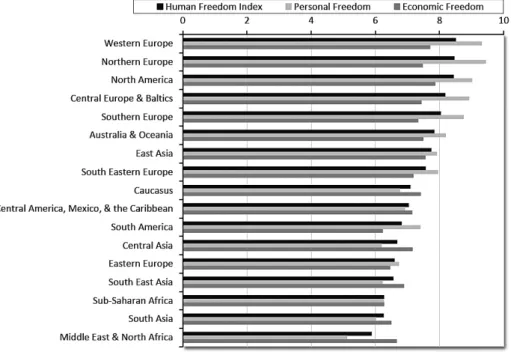
Out of 17 regions, the highest levels of freedom are in Western Europe, Northern Europe, and North America (Canada and the
United States). The lowest levels are in the Middle East and North Africa, South Asia, and sub-Saharan Africa (Vásquez & Porčnik, 2016).
Figure 1. Average Freedom Index Score Ranked by Region, 2014. HFI, 2016 Cato Institute, Fraser Institute, Friedrich Naumann Foundation for Freedom, Women’s freedoms, as measured by seven
relevant indicators in the index, are strongest or least repressed in Europe and North America and least protected in the Middle East and
North Africa, South Asia, and sub-Saharan Africa (Vásquez & Porčnik, 2016). The 2014 data on the average women’s personal freedom index score by region is as follows:
Figure 2. Average Women’s Personal Freedom Index Score by Region, 2014. HFI, 2016 Cato Institute, Fraser Institute, Friedrich Naumann Foundation for Freedom The author believes the greatest discrepancies
between the political systems of Communism and Democracy in the HFI report are over issues of freedom of association, assembly, movement, and freedom of media and information as well as civil freedom. Governments that restrict people’s movement greatly limit the scope of overall liberty. Moreover, as stated by Vásquez & Porčnik (2016) without the rule of law and security, specific freedoms cannot in a practical sense be lived out. Civil security is essential to provide reasonable assurance that life is protected. Without security or the rule of law, liberty is degraded or even meaningless. Locke famously stated this by conceptualizing the rule of law and security as a single whole:
“The end of law is not to abolish or restrain, but to preserve and enlarge freedom: for in all the states of created beings capable of
laws, “where there is no law, there is no freedom;” for liberty is to be free from restraint and violence from others; which cannot be where there is not law: but freedom is not, as we are told, “a liberty for every man to do what he lists:” (for who could be free, when every other man’s humour might domineer over him?) but a liberty to dispose, and order as he lists, his person, actions, possessions, and his whole property, within the allowance of those laws under which he is, and therein not to be subject to the arbitrary will of another, but freely follow his
own.” (Locke, 1691/1960, ch. VI, 241-2,
para 57).
Countries in the top quartile of freedom enjoy a significantly higher per capita income ($37,147) than those in other quartiles; the per capita income in the least-free quartile is
$8,700. Economic freedom is not just inherently valuable—it empowers individuals to exercise other freedoms. As Vásquez & Porčnik (2016)
suggest, being a citizen of the freest countries in the world greatly improves the average person’s income.
Figure 3. Average GDP per Capita by HFI Quarterlies, 2014 The Human Freedom Index 2016 Cato Institute, Fraser Institute, Friedrich Naumann Foundation for Freedom According to the latest HFI data, the
correlation between the personal and economic freedom ratings was 0.55 for 2014. Therefore, some countries that ranked high on the economic freedom index saw their positions fall significantly compared to their previous positions on the Human Freedom Index. For example, Singapore ranked in second place in economic freedom in 2014 but ranked 40th on
the HFI; the United Arab Emirates ranked 5th
in economic freedom but 118th in human freedom;
and Qatar ranked 12th in economic freedom but
117th in human freedom. By contrast, some
countries ranked consistently high in the human freedom sub-indices, including Switzerland, which ranked in the top 10 in both personal and economic freedom (Vásquez & Porčnik, 2016).
Figure 4. Personal Freedom vs. Economic Freedom, 2014, The Human Freedom Index 2016 Cato Institute, Fraser Institute, Friedrich Naumann Foundation for Freedom
The author finds a strong correlation between human freedom and democracy. Only Hong Kong is an exception in this regard. The findings in the HFI suggest that freedom plays an important role in human well-being. HFI quantitative data offers opportunities for further research into the complex ways in which freedom influences, and can be influenced by, political regimes, economic development, and the whole range of indicators of human well-being (Vásquez & Porčnik, 2016).
There is a strong correlation (0.82 in 2012 and 0.77 in 2014) between freedom and democracy as can be seen in Figure 5. The findings are not surprising to this author, but the data offers rich opportunities to empirically examine a complex relationship in which the direction of causation or support between the two variables, if any, may strengthen or weaken over time and may be influenced by numerous other factors, including the level of development (Vásquez & Porčnik, 2016).
Given the link between freedom and democracy, Hong Kong’s top ranking in the HFI is quite unexpected. The territory, first administered by the United Kingdom as a colony and since 1997 ruled by mainland China under its “one country, two systems” model, has never experienced de-mocracy. Hong Kong’s maintenance of a high degree of freedom for a long period of time
indeed makes it an exception in the HFI survey. The pro-democracy protests that erupted in Hong Kong in 2014 may in part be a late manifestation of a pattern we have seen in other non-democracies that liberalized their economies and subsequently liberalized their political systems as wealth and demands for political freedoms increased. Nevertheless, Hong Kong is unique in that it has enjoyed high levels not only of economic freedom but also of personal liberty and income without transitioning to democracy. The territory’s close adherence to the policies and institutions it inherited from the British, including the rule of law, no doubt explain the stability its system has displayed. Clearly, the pro-democracy protests represent a political agenda not acceptable to Beijing, and are a reaction to interference and perceived interference by mainland China in Hong Kong’s policies and institutions including infringements on freedom of the press and the independence of the legal system (Vásquez & Porčnik, 2016). The HFI data on Hong Kong is somewhat limited, so it does not capture all of the recent developments, but it registers some slight deterioration in certain areas. This author believes that as the political future of Hong Kong plays out, and as China asserts itself in the region, there will be a decline in its freedom ratings.
Figure 5. Human Freedom vs. Democracy, 2014. The Human Freedom Index 2016 Cato Institute, Fraser Institute, Friedrich Naumann Foundation for Freedom The 2016 Overall Human Freedom Index
(HFI) ratings and rankings provide an overview of human rights development and security in the world. To maintain relevancy for the audiences of Nagasaki Wesleyan University, the author will maintain a focus on the AU+ participant countries—South Korea, Japan, Taiwan, China and the U.S. However, other
Asian countries including Cambodia, Laos, Malaysia, Mongolia, Myanmar (Burma), Nepal, Philippines, Singapore, Thailand, and Vietnam are added for reference in data table 2. The following table presents the ratings of the countries on the personal and economic freedom indices for 2014 as currently published in 2016.
Table 2. 2016 Overall Human Freedom Index (HFI) ratings and rankings.
Rank Δ HFI Rank(2013-14) Country PersonalFreedom EconomicFreedom FreedomIndex Δ HFI Score(2013-14)
1 = Hong Kong 9.08 9.03 9.06 ▲ 23 ▼ 4 U.S.A. 8.79 7.75 8.27 ▲ 26 ▼ 9 Taiwan 8.71 7.65 8.18 ▼ 32 ▼ 2 Japan 8.67 7.42 8.04 ▼ 35 ▼ 2 South Korea 8.57 7.40 7.98 ▲ 40 ▼ 3 Singapore 7.01 8.71 7.86 ▲ 47 ▲ 7 Mongolia 7.66 7.39 7.52 ▲ 64 ▼ 1 Cambodia 6.97 7.20 7.08 ▲ 84 ▼ 3 Nepal 7.04 6.54 6.79 ▼ 101 = Philippines 6.05 7.01 6.53 ▼ 107 ▼ 10 Thailand 6.41 6.56 6.49 ▼ 109 Laos 6.00 6.85 6.43 115 ▼ 9 Malaysia 5.53 7.25 6.39 ▼ 128 ▼ 2 Vietnam 5.82 6.43 6.12 ▲ 141 ▼ 4 China 4.81 6.45 5.63 ▼ 153 ▼ 1 Myanmar 4.48 5.39 4.94 ▲
The average rating of the HFI decreased slightly from 2008 to 2014 (it was 7.01 in 2008 and 6.93 in 2014), though those ratings are not strictly comparable since the index surveys 18 more countries in 2014 than in 2008. A comparison of the 141 jurisdictions for which data are available over that period shows the average human freedom rating staying the same at 7.01, with personal freedom falling somewhat and economic freedom increasing. Some 66 countries increased their overall freedom ratings from 2008 to 2014, while 71
countries decreased their freedom. The correlation between the personal and economic freedom ratings was 0.55 for 2014 (Vásquez & Porčnik, 2016). Therefore, some countries that ranked high on the economic freedom index saw their positions fall significantly on human freedom. For example, Singapore ranked in second place in economic freedom in 2014 but ranked 40th on the HFI. As another example (although not included in Table 2), the United Arab Emirates ranked 5 in economic freedom but 118 in human freedom.
3. A Look at Japanese Politics:
After World War II, under the pressure of the American occupation forces, a new constitution was drawn for Japan as democracy was introduced. One of the principal characteristics of democracy is the importance of competitive elections between two or more independent political parties as well as certain guaranteed freedoms and rights for citizens. Japan has witnessed remarkable success with its new political institutions. Such success reflects the Japanese skill in identifying desirable features in other countries and then perfecting them in their own setting. Just as the Japanese are masters at developing and applying technologies invented elsewhere, they have proved that importing Western democracy and adapting it to their own historical and cultural traditions. The kanji expression 和 魂 洋 才 Wakonyosai roughly meaning Western
mind, Japanese spirit, captures this mindset.
Japanese are innovative and industrious and have worked collectively to advance their nation. By adapting Western democracy to their own traditions and culture, they have changed some Western/European principles, and although there have been some very noteworthy bumps in the political road, Japan as a whole has endeavored to prove the viability of Western liberal democracy in the non-Western setting.
However, some turbulent times in the Prime Ministry of Japan began in the 1990s. Between the years 1990 to 2012 there was an overwhelming turnover in the ranks of Prime Ministers. In the time that the United States and the United Kingdom went through four presidential terms, Japan had changed Prime Ministers a total of eleven times. The United States was under the presidency of George H. W. Bush, William J. Clinton, George W. Bush, and Barack H. Obama while the United Kingdom was under the leadership of John Major, Tony Blair, Gordon Brown, and David Cameron. Compare this time period to what went on over the ranks of Prime Ministers in Japan it seems almost comical. The drama of the reigns of Prime Ministers in Japan began with Sosuke Uno who soon
resigned after allegations of an extramarital relationship. Uno was followed by Toshiki Kaifu, Kiichi Miyazawa, Morihiro Hosokawa who resigned over allegations of misused personal funds. Hosokawa was followed by Tsutomu Hata who resigned after his implication in a banking scandal. Hata was followed by Tomiichi Murayama, Ryutaro Hashimoto, Keizo Obuchi who fell into a coma after suffering from a stroke. Obuchi’s Chief Cabinet Secretary Aoki Mikio served as Deputy Prime Minister until replace by Yoshiro Mori, Junichiro Koizumi, Sinzo Abe—all having resigned over low approval ratings, term limits or for poor health reasons. Yasuo Fukuda, Taro Aso, Yukio Hatoyama, Naoto Kan, Yoshihiko Noda all followed their election or appointment into office by resigning over approval rating or asserting the need to improve the flow of the political process. The current Prime Minister is Shinzo Abe having won the 2012 elections. In the year 2015, the Japanese Diet enacted a law lowering the voting age from 20 years old to 18. This as well as other campaign changes seemed to this author as an effort to renew faith in the political system. The lowered voting age came at a time of controversy over the boost of Japan’s Self-Defense Force which has also caused many to be concerned about what political changes might be occurring in Japan. Nevertheless, Japan has enjoyed a certain level of stability throughout the changes in the political landscape.
However, Democracy has not always seen success in Asia. Such is the case with Thailand and South Korea. Granted, politics and corruption seem to go hand-in-hand in any country, these countries have especially witnessed the systematic abuse of democracy. Also, democracy may not be culturally adapted without the informal acceptance of society and having the political system, even within democracy, properly defined. Political turmoil as in the years before Prime Minister Abe was reinstated as Prime Minister has done nothing to improve the public opinion toward politicians. The right wing is very influential in Japan and has its hands in even academics and the media—including NHK
and national newspapers. If permanent residents or 在日永住者 zainichi-eijusha were given the power to vote, this would weaken the right wing. This fear as well as other “social concerns” has created a xenophobic policy toward foreigners. This author feels that this is very unfortunate that the foreign community is being criminalized when considering that foreigners have the potential to help Japan recover from economic hardships by countering the lowering population. Immigration policy should be carefully reconsidered. Moreover, if dual-citizenship were to be accepted by the government, the demographics would be dramatically improved. Many foreigners, even with plans to remain as permanent residents in Japan do not naturalize simply due to the cumbersome paperwork involved. Some expatriated foreigners may come from lands that are abhorrently difficult to renounce citizenship. The United States is a country that makes relinquishing citizenship an intensive and expensive process as citizens are viewed as tax vessels and U.S. citizens are the people of only two countries on the planet that are taxed according to their citizenship.
4. Further Thoughts on Asia
Cambodia, Vietnam, and Laos are further developing albeit at their own pace as Malaysia and Singapore serve as examples of how a government can be inclusive for a population of religious, linguistic, and ethnic diversity. The author is of the opinion that a greater amount of social freedom exists in Malaysia and Singapore than what one would experience under the Chinese government. Although some rules are strict when compared to Western countries, it appears that Malaysia and Singapore have found equilibrium when compared with China. China’s iron fist policy is about maintaining control, yet Malaysia and Singapore have maintained control of an even more diverse population while protecting most basic freedoms. Malaysia has had a measure of tyranny under the government that remained in power for 61 years. In April of 2018, Malaysia
witnessed the transition of power as Pakatan Harapan (Coalition of Hope) won the election after unseating Barisan Nasional (National Front). This author was in Kuala Lumpur attending the Asian University (AU+) conference hosted by Berjaya University College when the new government was announced. There was an observable excitement to the political changes. Thailand is in a situation of competition of political ideologies within democratic rule. Thailand also has a history of political corruption based upon self-interest of the politicians and the desire to generate revenue through various means. Thailand has adopted too many different political systems that are in competition with each other resulting in confusion of basic political doctrines. Thailand politically evolved trying to create its own democracy in an effort to avoid colonization by Europeans.
The Philippines is an ethnically and linguistically diverse country as well. Safety and rights much depends on where one lives. Chaos ensues on many of the islands in the Philippines, but as a whole, the author believes the country is advancing itself. Nevertheless, Philippine President Rodrigo Duterte has recently aligned himself with China and essentially gave up its claim on islands that China had previously debated the Philippines over control of. This action alone leaves this author perplexed and concerned for the future of the Philippines. China has advanced itself throughout Asia and has claims on islands in the Philippines, Vietnam, and Japan that historically have not been included as Chinese territory.
The author, majoring in anthropology, has traveled extensively and studied the diverse ethnic groups in Taiwan. Although some tribes were traditionally marginalized, there is a newfound interest in preserving the language and customs of these indigenous groups. This author also avidly believes that China’s claim on Taiwan has no merit. Although an unorthodox measure, Taiwan, as a nation welcomes international visitors. The author
has been able to enter and leave Taiwan freely without a visa. On the other hand, the author has never been able to visit China—even after attempting to secure a visa in order to attend a marathon race in mainland China. The author was ultimately not able to travel due to not having an individual sponsor from within the country to complete the petition to travel. Simply speaking, as a Westerner, one must be invited to travel to China instead of simply purchasing a ticket and petitioning for a travel visa at the Chinese embassy. Japanese nationals are currently able to visit China without this restriction. Through this author’s experience China’s policy of not allowing, nor welcoming internationals has politically separated itself as a nation—especially when compared to Taiwan’s open-door policy. China and Taiwan maintain a polarized standard on immigration policy. Taiwan, as an independent nation, with its own leadership, is in the process of asserting itself in the political world. Taiwan is the highest ranking country in Asia next to Hong Kong for Human Freedom Index (HFI). Taiwan ranked 26th in the 2014 HFI data—ahead of Japan,
South Korea and China.
In South Korea, under the title of democracy, past presidents have turned to dictators. Syngman Rhee’s leadership is often used as an example of how the leadership position has been abused under the Korean presidential system. Self-interest and longevity is competitively sought after and response to public opinion is viewed as being trivial according to political leadership. This has been challenged on several occasions—the most notable in recent history is the public ousting of President Park Geun-Hye for political corruption and favoritism.
Korea was historically in a situation of great political instability. Lack of control, poor government capabilities, fear of ideological defeat, and severe economic problems created disorder in the 2nd Republic which convinced
the military leaders that they needed to take control of the state. Two decades later, in May 18th 1980, the Kwang-ju uprising revives the
same argument with the result of a military
take-over in the 5th Republic. This is a common
phenomenon in developing nations—as Democracy a l l o w s f o r a d v a n c e m e n t o f a m b i t i o u s individuals and programs, things become too diverse, the military then tries to intervene and restore stability.
In recent history, President Park Geun-Hye’s influence-peddling scandal sparked mass protests calling for her resignation. Disenchantment with President Park is merely a repeat of the political issues South Korea has had since democracy was introduced to the peninsula. The youth of South Korea are the group that inevitably implements changes through protests. By the end of 2016, the country’s youth had abandoned President Park with polls showing zero support from Koreans in their 20s.
Taegu (Daegu) is South Korea’s third largest city but boasts being an economic power with the many factories the city has. The economic importance of the city translates into political power as six of South Korea’s eleven presidents have all come from Taegu. According to Bloomberg reports (2016), in the last presidential election in 2012, some 80 percent of Taegu voters backed President Park. President Park’s scandal includes giving favors to and allowing her friend Choi Soon-Sil to access presidential documents. Choi used her relationship with Park to pressure some of the country’s biggest corporations into donating large amounts of revenue to her foundations. Corruption and scandals tend to plague politics on the peninsula. This author believes that another great weakness in the Korean political system is that the Government Party is always too strong. Over 160 political parties participated in elections between 1945 and 1972, the only parties to survive are the Democratic Nationalist Party, Liberal Party (Syngman Rhee), New Democratic Party (Kim Young Sam), Democratic Republican Party (Park Chung Hee), and the Democratic Justice Party (Chun Doo Hwan). The Presidential system of South Korea gives the president too much power. In essence, it was initiated as a dictatorship under the mask
of democracy. Political parties in South Korea are personalized and focused on the individual. While this provides a way for establishing identity for the party leader, there is no structure to the party as it quickly dissolves once the party leader initiates his or her own agenda. In the case of Syngman Rhee, his first agenda was to continually increase the term of his office.
Unfortunately, American democracy is not a model example of a democracy either. Perpetuation of the two-party system between Democrats and Republicans has not provided for the adequate representation of other political parties. However, the parties are established and the representative is required to conform to the ideologies of the party rather than blindly following the leadership of the party leader, as the case is in South Korea.
5. HFI report on Human Rights in Communist States: North Korea and China
North Korea and China are known for its communist rule. Civil rights as well as the government’s response to the needs of its people are in serious question in both these countries. However, in the case of China, it is a nation that is linguistically and culturally divided. It is one theory in support of communism that perhaps the only device that can keep such a country united is the iron fist of communism. Korea is united by the same people sharing culture and language. Both nations have manifested historical problems dealing with basic human rights causing most Westerners to have critical opinions concerning communism. Civil rights has been a plight for humanity all through time. Western society only gave up slavery when fossil fuels and machines invented during the industrial revolution finally liberated the need for slaves. However, the mindset of bigotry is far removed from any society. “Othering” and displacement of social woes onto minority groups and discriminating against native or aboriginal cultures can be seen throughout the world. By far, North Korea is among the worst countries when it comes to
human rights. Because there is no data provided by this hermit state, Ian Vásquez and Tanja Porčnik of The Human Freedom Index (HFI) do not include North Korea in their HFI report. Although Iran (157), Yemen (158), and Libya (159) rank last on the HFI report, no doubt North Korea would rate below these countries on human freedom.
North Korea's nuclear ambitions have exacerbated its rigidly maintained isolation from the rest of the world. The country emerged in 1948 amid the chaos following the end of World War II. Its history is dominated by its Great Leader, Kim Il-sung, who shaped political affairs for almost half a century. After the Korean War, Kim Il-sung introduced the personal philosophy of self-reliance, which became a guiding light for North Korea's development. Kim Il-sung died in 1994, but the post of president has been assigned eternally to him. Although the armistice of 1953 ended armed conflict on the Korean peninsula, but the two Koreas are technically still at war; tensions have been exacerbated in recent decades by North Korea's nuclear ambitions. Decades of this rigid state-controlled system have led to stagnation and a leadership dependent on the cult of personality.
Aid agencies have estimated that up to two million people have died since the mid-1990s because of acute food shortages caused by natural disasters and economic mismanagement. The country relies heavily on foreign food aid. The totalitarian state also stands accused of systematic human rights abuses. Amnesty International estimates that hundreds of thousands of people are held in detention facilities, in which it says that torture is rampant and execution commonplace.
Pyongyang has accused successive South Korean governments of being U.S. “puppets”. Seoul's sunshine policy towards the North aimed to encourage change through dialogue and aid, but was dealt a blow in 2002 by Pyongyang's decision to reactivate a nuclear reactor and to expel international inspectors. In October 2006 North Korea said it had successfully tested a nuclear weapon, spreading alarm throughout
the region.
Intensive diplomatic efforts were mounted to rein in North Korea's nuclear ambitions, finally yielding in 2007 under which Pyongyang agreed to shut down its main nuclear reactor in return for aid and diplomatic concessions. But negotiations stalled as North Korea accused its negotiating partners (the U.S., South Korea, Japan, China and Russia) of failing to meet agreed obligations.
Kim Jong-Il’s successor in December 2011, his third son Kim Jong-Un, continued the dynastic policy of mixed signals. He agreed to suspend long-range missile tests in order to receive U.S. food aid in February 2012, but soon after carried out a “rocket-launched satellite” launch, although this failed. A more successful December 2012 satellite launch, not long after a new South Korean-U.S. missile deal, suggested Pyongyang was developing rockets capable of hitting the U.S. mainland. In February 2013, it performed a long-promised third nuclear test in February 2013, prompting further U.N. Security Council sanctions. Following further missile tests in 2014, North Korea announced that it would restart all facilities at its main Yongbyon nuclear complex, including a reactor mothballed in 2007, while also offering to restart talks if U.N. sanctions are dropped. North Korea tested a missile test in February 2017 in what seems to be show of power to newly elected U.S. president Donald Trump (BBC, 2017). North Korea has continued ICBM tests throughout 2017 causing tension, instability and threatening peace and human freedom on this planet. Donald Trump met with Kim Jung-Un in June of 2018 and North Korea has temporarily received less media attention since.
South Korea continues to maintain a tough line towards the Pyongyang regime. North Korea has traditionally enjoyed the support of its powerful neighbor China, but in recent years Chinese leaders seem increasingly embarrassed by Pyongyang's intransigence over its nuclear program (Kim, 2016). At the time of this writing, China is in opposition of
South Korea’s Terminal High Altitude Area Defense missile (THADD) in response to North Korea’s nuclear missile tests. China’s opposition has created a negative public opinion against China in South Korea.
Modern China is still ranked among the nations with the least amount of civil liberty issued to individual society members which is even more notable when considering the economic prosperity of the country. In 2012, the Human Freedom Index ranking for China was 115th which, currently based on the 2014 data,
ranks at 141st on the HFI (Vásquez & Porčnik,
2016). The author believes this is a result of communist rule and the influences of the Cultural Revolution in China.
China has advanced itself economically but has done so at the expense of moral consideration for the environment and international law. China continues to be the biggest trader with North Korea and Iran frustrating international sanctions. This has been a topic well documented in the U.S. Security Review Commission. Hearing transcripts are available online on the U.S. government’s webpage. In 2017, the United States fined Chinese Tech Giant ZTE $1.2 billion for its illegal sell of electronics to North Korea and Iran after the company made $32,000,000 illegally selling U.S.-made electronic devices with 283 documented shipments to North Korea in spite of international sanctions (Chappell, 2017). China’s sell of weapons was further documented by Vice News reporter Shane Smith in the 2012 Vice News documentary on SOFEX (Special Operations Forces Exhibition Conference) exposing the Chinese government of capitalizing on weapon sales to terrorists and sanctioned states (Smith, 2012). In an effort for the author to maintain objectivity in this criticism, it should be known that China is not the first nation to capitalize on the sale of weapons as the United States has weaponized and funded both the Shiites and Sunnis and even gave Saddam Hussein $5 billion to help his campaign against Iran (Mohammadi, 2015).
for ten years from May 1966 to October 1976, brought great calamity to the country and the people. Drawing on the support of the masses of the Chinese people, the Communist Party of China smashed the Jiang Qing counter-revolutionary clique to bring end of the disastrous Cultural Revolution and marked the beginning of a new era in Chinese history. China has instituted a policy of reform and opening to the outside world. The errors of the Cultural Revolution have been a topic of issue and the focus was shifted to modernization centered on the economy.
A new socialist modernization approach has been in effect since the end of 1978. Unfortunately, even the modern China of 2018 is ranked by the “Freedom in the World” committee as being among the countries with the least amount of liberty and is under scrutiny by the committee for their treatment of Tibetans and Uyghur. The Chinese Government continues to commit widespread and well-documented human rights abuses. Such abuses are in direct violation of internationally accepted norms due to the fact the government has very limited tolerance of public dissent and have a fear of unrest and lack of control. Also, the Government authorities display no interest in implementing l a w s p r o t e c t i n g b a s i c f r e e d o m s . T h e Constitution and laws provide for fundamental human rights, but they are often ignored in practice. The Government continues tight restrictions on freedom of speech, the press, assembly, association, religion, privacy, and worker rights. Discrimination against women, minorities, and the disabled, violence against women, trafficking of women and children, and the abuse of children remain problems. The Government continues to restrict worker rights. Serious human rights abuses persist in minority areas, including Tibet and Xinjiang, where tight controls on religion and other fundamental freedoms continue.
The People’s Republic of China is an authoritarian state in which the Chinese Communist Party controls all power. At the national and regional levels, communist regime members hold all of
the top government, police, and military positions. Ultimate authority rests with members of the regime. Leaders stress the need to maintain stability and social order to perpetuate the rule of the regime. Laws and moral codes as defined by the government are based upon what is considered to be a threat to the regime or not. What is viewed as “right” or “wrong” is not based upon moral principles or rights of the citizens. If some act or item (whether tangible or abstract) is viewed as a threat to the regime, it is made by law to be illegal. Citizens of China lack the freedom to express peacefully opposition to the party-led political system and the right to change their national leaders or form a new government. The party’s authority is based on the Government’s ability to maintain social stability and patriotism through the use of providing a sense of freedom to the citizens and by using tactics of fear induction. China’s 1.39 billion citizens are under control of the iron fist of communism. Justice is a concept that is contradictory to China’s criminal justice system. China’s constitution provides for an independent judiciary—however, the judicial system is subject to the “policy guidance” of the Chinese Communist Party. Security police and the penal system of China are responsible for numerous human rights abuses. Authorities in the criminal justice system continue to use repressive measures such as intimidation, administrative detention, and imposition of prison terms. Abuses also include torture and mistreatment of prisoners, forced confessions, and arbitrary arrest and lengthy detention. According to China Uncensored reporter Chris Chappell, the nature of the crimes committed by the prisoners is also highly subjective as prisons in China are filled with peaceful protestors, artists, activists, reporters, wrongfully criminalized Falun Gong members, and Christian converts. Prison conditions at many facilities remain harsh. This problem is perpetuated by the government using prisoners to harvest organs for economic gain. Human rights groups and private organizations have
opposed this over the years. With the June 22, 2016 journal publication titled “Bloody Harvest/ The Slaughter” authored by David Kilgour, Ethan Gutmann, and David Matas, the issue of organ harvesting in China has become more visible.
Socialism continues to provide the theoretical control of Chinese politics, but Marxist ideology has given way to economic reform in recent years. China has a mixed economy that continues to expand rapidly. China faces growing problems, including unemployment, underemployment, and regional economic disparities. Urban areas are also coping with millions of state-workers working for only partial wages or unemployed as a result of industrial reforms. Such workers are harshly punished by the police when they organize public protests to press their demands for employment or compensation.
In 1997, the Government took several positive, although superficial actions to address international concerns in the area of human rights. The Government signed the United Nations Covenant on Economic, Social and Cultural Rights and allowed the United Nations Working Group on Arbitrary Detention to visit China. Average citizens go about their daily lives with more personal freedom than in the previous generation. They also continue to enjoy a higher disposable income, looser economic controls, greater freedom of movement, increased access to outside sources of information, greater room for individual choice, and more diversity in cultural life. However, Chinese still live in an atmosphere of oppression concerning several important aspects of civil liberties including freedom of speech and press,
freedom of religion, as well as freedom of peaceful
assembly and association.
Although the Constitution states that freedom
of speech and freedom of the press are fundamental
rights enjoyed by all citizens, the Government interprets the Communist Party’s “leading role,” as taking priority to these rights. It does not permit citizens to publish or broadcast criticism of senior leaders or opinions that
contradict basic Communist Party doctrine. The Government continues to tightly control print and broadcast media and use them to propagate the regime. All media employees are under explicit public orders to follow the Chinese Communist Party directives, to “guide public opinion” as directed by political authorities. Journalists must also protect the regime’s image. Public orders from the State Security Law provide strict guidelines that restricts the freedom of broadcast journalists and newspapers to report the news and leads to a high degree of censorship.
Freedom of religion is provided in the Constitution, but there is no comprehensive legislation governing religious affairs, the Criminal Law states that government employees who illegally deprive citizens of this right may be punished. However, the Government seeks to restrict religious practice to government-controlled religious organizations and registered places of worship. The Government continues to monitor religious activity.
The constitution also provides for freedom of
peaceful assembly, but the Government severely
restricts this right in practice. The Constitution provides that such activities may not challenge “party leadership” or infringe upon the “interests of the State.” Protests against political systems or its leaders are prohibited. The Government is ruthless against any demonstration. The violent suppression of the 1989 student demonstrations in Tiananmen Square is one of the most publicized events relating a perfect example of the Chinese Government’s injustices concerning human rights. The Chinese Government continues to censor all information concerning the demonstration and refuse to issue an apology concerning this event as well as the slaughter of protestors in Mianyang, and Sichuan. Falun Gong, Tibetans, Christian converts and other minority groups are currently being criminalized by the Chinese government. 7. Conclusion
No matter the mask that politics takes on, human rights and the welfare of the nation are
ideally the priorities and purpose of government. Democracy and communism are two different ideologies used to govern. One might feel that history itself dictates which system is proper and offers the most to its citizens. People remain the capricious element that prevents any single system, governmental or otherwise, from being absolute. There is no “perfect” country on this planet. To make such a claim is merely the ranting of an uninformed idealist. Nevertheless, there is a strong correlation between personal, civil and economic freedom and Democracy. The Human Freedom Index authors and Freedom House “Freedom in the World” authors also emphasize this point. As one studies the HFI rankings, many sociological and political changes can be noticed. Western politics in Asia has changed many traditional Asian social structures in numerous ways. Changes are met with both success and difficulties. The degree of freedom when compared to previous HFI rankings for most countries included in the HFI rankings report share an overall decrease in freedom. This author finds this trend very concerning. Freedom is challenged by abuse of power and different government ideologies. The author is in hope that as HFI rankings are more universally known and acknowledged, freedom will become a priority around the world.
References
BBC (2017). North Korea conducts ballistic missile
test. BBC News Asia. February 12, 2017.
Available online at: http://www.bbc.com/ news/world-asia-38947451
Chappell, Chris (2017). China Uncensored. US
Fines Chinese Tech Giant ZTE $1.2 billion.
Available on YouTube channel at URL: https:// www.youtube.com/channel/UCgFP46yVT-GG4o1TgXn-04Q
Kanzaki (1998), Political Parties and Youth
Organizations in Asia: (14 July 1998). n. pag.
Online. Available: http://kanzaki.com/jinfo/ PoliticalParties.html
Kim, Sam (2016). Park’s Problems Are Shifting South Korea’s Political Map. Bloomberg News.
November 17, 2016. Available online at: https:// www.bloomberg.com/news/articles/2016-11-16/ park-s-hometown-rebellion-signals-shift-in-korea-political-map
Matsuzaki, T. (1998), Institute for Contemporary Politics. Political Parties in Japan: (12 March 1998). n. pag. Online. Available: http://www. geocities.com/CapitolHill/Lobby/8008/ political_parties.html
Mohammadi, Fatehem (2015). 20 things the U.S.
did to help Saddam against Iran. Khamenei
News available online at: http://english. khamenei.ir/news/2168/20-things-the-U-S-did-to-help-Saddam-against-Iran
Smith, Shane (2012). Vice News. The Business of
War: SOFEX. Available on YouTube channel at
URL: https://www.youtube.com/watch?v=QL_ 3Qg-SADY
Stanford Guide to Japan Information Resources (1998). Politics/Administration Political Parties: n. pag. Online. Available: http://www.ouc. bc.ca/ mola/jp/links-politics.htm
Theen, R.H.W. & Wilson, F.L. (1996), Comparative
Politics: An Introduction to Seven Countries.
(Third Edition). New Jersey: Prentice Hall Publishing